

A Spiritual Scientific View
of Nature and Man
GA 352
19 January 1924, Dornach
Translated by Steiner Online Library
2. Toxins and Their Effects on the Human Body
[ 1 ] Gentlemen, I would now like to add a few supplementary remarks to the lectures we have had so far. Next time, I will again ask you to pose one or two scholarly questions.
[ 2 ] Well, I have told you that one must view a human being as consisting not only of his physical body, which one sees with the eyes, but also of higher levels of organization—of invisible bodies. And I have explained to you that the first invisible body is the etheric body. This is therefore a subtle body that cannot be perceived with the ordinary senses, but which is actually the reason why human beings live—and also the reason why all plants and animals live. Then there is another higher body, the so-called astral body. This astral body enables us to sense and feel. We share this with animals, for animals also have an astral body. But there is something in human beings that is not present in animals: self-consciousness. For this, we have an “I.” Thus, a human being consists of the physical body that can be seen and the three higher bodies: the etheric body, the astral body, and the “I.”
[ 3 ] One can best see that it is well-founded when, based on a certain supersensible perception, it is asserted that human beings possess these supersensible constitutional elements—one can see this from other sources as well, but one can truly grasp it when one considers the toxic effects on the human body.
[ 4 ] As we saw when discussing insects, the toxic effect on humans can, under certain circumstances, be extremely beneficial. We have seen how insect venom can cure certain diseases. And that is why most medicines are composed of substances that are considered poisons in everyday life. One simply has to take them in the proper dosage—that is, one must take them in such a way that they can act correctly on the human organism.
[ 5 ] When it comes to the effects of poison, the human organism behaves in a rather peculiar way. Just consider the following example regarding the effects of poison. You see, arsenic—which is sometimes used as rat poison—is a very potent poison. When a person ingests arsenic—or even when arsenic is administered to an animal—death either occurs immediately, or, if one succeeds in preventing death by administering the appropriate antidotes—that is, by expelling the arsenic from the body, so to speak—then a kind of slow-onset arsenic poisoning may begin, and the condition then progresses gradually. Or it may also happen that a person, let’s say, is exposed to something at work that necessarily contains arsenic; in that case, arsenic poisoning from small amounts of arsenic can develop into an occupational disease. If this occurs—that is, if a person does not ingest enough arsenic to be killed immediately, but instead ingests a small amount, yet enough to cause significant harm—then they become pale, take on a chalky appearance, grow thin, and gradually waste away as their body wastes away. They lose their fresh, healthy complexion and also lose the necessary body fat. Thus, even though the effects of arsenic are slow, the body gradually wastes away.
[ 6 ] But there’s another side to this. For example, there are Alpine valleys in Austria where arsenic is found in the rock. There, people begin by taking very small, minuscule amounts of arsenic. They can tolerate that. They start with small amounts; then they go further and further, taking more and more, and ultimately—and this is the strange part—they can tolerate an enormous amount of arsenic.
[ 7 ] Why do they do that? Well, you see, gentlemen, most people who do this do it out of vanity. They believe it gives them a beautiful complexion, and if they were thin before, they even become a bit plump. So they take it out of vanity, get used to eating arsenic out of vanity, and become good-looking as a result.
[ 8 ] There you have this strange contradiction. Such contradictions are not only present in human thought—where, after all, everything usually contradicts one another—but such contradictions are certainly also present in nature. Here you have this contradiction: Sometimes arsenic causes a person to lose weight and become pale and gray—not gray in the hair, but the skin turns gray. Sometimes a person wastes away, and other times a person takes arsenic precisely to look good! There you have a complete contradiction.
[ 9 ] What is the basis for this? Whenever this topic is discussed in scientific circles today, the only thing you’ll ever hear is: “We can’t explain it; that’s just the way it is.” —You can’t explain it if you simply know nothing about the human being’s supersensible bodies! You see, the fact is that, just as I’ve told you, the human being must always have formic acid within them, and must also constantly have arsenic within them. For they produce it themselves. In many respects, what comes into play here is highly remarkable for human beings, because—as I’ve told you before—when it’s claimed that a person can live entirely without alcohol, that’s simply not true. One person can live without drinking alcohol; that is true. But he cannot live without alcohol. For if he does not drink alcohol, then his own body produces the necessary amounts of alcohol within him. All the substances a human being has are, in fact, produced within himself. What a human being takes in from the outside is merely there to support and stimulate this process. In truth, human beings produce the substances they need from the universe itself. In outer space, all substances are distributed in a very fine dispersion. Everything exists in outer space; for example, iron is found there. They not only breathe it in, but it also enters their bodies through their eyes and ears. And the iron that people eat is there merely for support. For the most part, they excrete it again. For if human beings were not dependent on living on Earth between birth and death—and thereby performing earthly tasks—they would not need to eat at all, since they could draw everything from outer space. But when we work with our hands, or when we have to walk, we need the support provided by food, since the body does not produce enough on its own.
[ 10 ] So, human beings constantly produce arsenic; animals do as well, but plants do not. Why? Because plants have only an etheric body! It is the astral body that produces arsenic. That is why human beings and animals produce arsenic. And what is the purpose of arsenic? Well, you see, gentlemen, if humans could not produce arsenic within themselves, they would be unable to feel. Then they would gradually begin to lead a plant-like existence. They would start by dreaming and then go about like a sleepy person. Arsenic gives humans the ability to be awake and to feel. When I press my hand against something, it’s not just the skin on the front that gets pressed in—I also have a sensation. And that sensation comes from the fact that my astral body is constantly producing arsenic.
[ 11 ] Now, anyone who eats or ingests arsenic thereby intensifies the activity of their astral body. And what is the consequence of this? The consequence is that the astral body takes hold throughout the entire body. It becomes too powerful. It attacks all the organs, wearing them down. And that is the result of rapid arsenic poisoning. If someone ingests a large amount of arsenic quickly, their astral body begins to become terribly active, swirling, swirling, swirling, and finally destroying the functioning of the entire organism. It drives the life out of the organs, because a constant struggle must take place within the human being between the astral body and the etheric body. The etheric body brings life; the astral body brings sensation. But sensation cannot exist unless life is suppressed. So it is with human beings—if I were to sketch it out for you schematically: there is the astral body, there is the etheric body; they are constantly fighting each other. If the etheric body prevails, we become a little drowsy; if the astral body prevails, we become wide awake. But this alternates constantly throughout the day, and it happens so briefly, so quickly, that we do not notice it—we believe we are constantly awake. But in reality, wakefulness and sleep constantly alternate: wakefulness, sleep, wakefulness, sleep, and so on. And what the astral body needs in order to exert its influence properly is precisely the amount of arsenic that the person produces themselves.
[ 12 ] If one now introduces extra arsenic into the astral body, the astral body quickly becomes strong—far too strong—and kills all life in the etheric body. Now the person can no longer live; the person dies. But if I give a person so much arsenic that the astral body becomes far too strong, then the limbs and internal organs gradually lose their substance, and the person becomes emaciated and takes on a gray appearance because the internal organs are not functioning properly. But if I start by giving the person a little arsenic at first—just a tiny amount—or if they take it on their own—it won’t be given to them, but they’ll take it themselves—then the astral body begins to become a little more lively, just a little; it stimulates the organs just enough, and the effect is the opposite. If I give them too much from the start, it quickly kills the organs. If I give them just a little, it stimulates the organs. It stimulates them, just as when one uses a spice. If one then increases the dose more gradually, the organs can tolerate it. The person begins to look a little better, to gain a little weight, because his astral body is more active than before, when he was not taking arsenic.
[ 13 ] But now just imagine: a person like that, who has “consumed” arsenic, must stop doing so. Yes, then their astral body also ceases to function, because it no longer has the whip of arsenic driving it, and then the person deteriorates very quickly. So a person who starts eating arsenic and has reached a certain dose is forced to keep eating it until their death. And that is the worst part: People cannot break the habit. That is the worst part—that a person must eat it throughout their entire life. Otherwise, one would have to—though this is also very difficult—begin to slowly reduce the amount, giving less and less. But usually it turns out the way it did for the farmer who wanted to wean an ox off its food using such a theory. He gave the ox less and less. The ox did indeed become very thin, but it was still alive. Finally, he gave it just one blade of grass; that’s when the ox died. But the farmer thought to himself: “Yes, if only it had weaned itself off that last blade of grass as well, it would still be alive today.”—Yes, that’s exactly how it is with those who are supposed to wean themselves off arsenic! They don’t manage to wean themselves off that last bit; they perish before they can.
[ 14 ] You see, gentlemen, the human astral body needs arsenic, and it is very strange how science today is floundering terribly. It really is floundering terribly! After all, you hear every few moments these days that, for example, a cure for syphilis has been discovered somewhere. Just a few days ago, you could read in the newspaper again that a cure for syphilis had been discovered in Paris. Well, actually, none of the people who are experimenting like this know what syphilis is really based on. It is based on the fact that the physical body becomes too active and the astral body cannot intervene. But people don’t know that, and that’s why they’re experimenting. And the funny thing is, all these remedies contain arsenic! You can always notice it—just take a look. But one can only truly penetrate to the heart of these matters through Spiritual Science. There is always some arsenic in all these things; but people don’t know what it is—they’re groping completely in the dark. That is the peculiarity of modern science. Of course, people notice that something happens within a person when they use a preparation that contains arsenic. But they do not know that the astral body becomes more active and that, because the physical body has been subjected to a process of dissolution, it will itself dissolve. This is precisely what a new form of medicine must achieve: that we look deeply into the human being once again; only then can we truly bring about healing effects.
[ 15 ] Well, if we’re going to talk more about poisons: there are mineral poisons. Arsenic, for example, is a mineral poison; other mineral poisons include copper, lead, phosphorus, and emetic tartar; such substances are mineral poisons—they are stones that we’re dealing with here, or powders made from pulverized rock. So there are mineral poisons. Then there are plant poisons, for example, the poison found in belladonna, or the poison found in black henbane, *Hyoscyamus niger*, or in red foxglove, *Digitalis purpurea*. These are plant poisons. And a third type consists of animal poisons—we discussed some of these quite recently, so I need only add a few details today—namely, insect venoms and snake venoms. And among the animal poisons, there is one particularly dreadful, terrible poison: the rabies toxin of dogs, the toxin from a rabid dog.
[ 16 ] A distinction is thus made between mineral poisons, plant poisons, and animal poisons; each of these poisons affects humans in very different ways. Take mineral poisons, for example—lead, copper—all of which are toxic—or sulfuric acid, nitric acid, phosphorus, and so on. Such poisons can really only be studied if they are not administered to humans in quantities large enough to kill them immediately. For it is remarkable: when taken in high doses, the poison kills a person; the mineral poison kills a person. When taken in weaker doses, it makes a person sick. And that is the main point: that one can properly study under what conditions of poison exposure a person becomes ill. It is precisely with weak exposures that one can best study the effects of the poison. And with the appropriate dose, when a disease is present, a person can recover.
[ 17 ] Here’s the thing about these poisons: When a person ingests mineral poisons—that is, arsenic, copper, or lead—the first symptoms appear: nausea, the urge to vomit, followed by abdominal discomfort, intestinal distress, and colic-like symptoms. This occurs when a person ingests mineral poisons. Now, the body naturally strives to absorb only what it can actually process. Therefore, as soon as mineral poisons are ingested, the urge to vomit sets in. The person begins to vomit. This is the body’s self-defense mechanism, but as a rule, it is not enough. So if a certain amount of toxin is present, this is not sufficient; in that case, one must counteract it with an antidote. One must ensure that an antidote is introduced into the stomach and intestines, with which the toxin can bind. When the toxin enters the stomach and intestines, it attacks the body. But if I administer an antidote, the toxin and the antidote bind together and become one substance. As a result, the toxin no longer attacks the body, since it has, so to speak, “married” the antidote. And then I simply have to administer a strong emetic or laxative to expel it.
[ 18 ] In cases of mild poisoning—since only the medical profession can really speak of severe poisoning—but in cases of mild poisoning with mineral poisons, what are the antidotes? You see, there is a good antidote: if you quickly take lukewarm water and crack an egg into it—so that you have liquid egg white—and allow it to enter the stomach and intestines. The toxin then binds to this liquid egg white and can be vomited up or expelled through diarrhea; or, especially in cases of mild poisoning, this can be achieved with lukewarm milk, as well as with all kinds of oils extracted from plants. These act as antidotes against mineral poisons, but not against phosphorus. If someone has phosphorus poisoning, one must not administer vegetable oils, as these actually intensify the toxic effect of the phosphorus. However, all other mineral substances can also be bound and expelled using oily substances.
[ 19 ] So what happens when I have that poison in my stomach? Well, the poison is there, isn’t it? Let’s take what I just said—an egg beaten into lukewarm water—and imagine that this substance surrounds the poison in the stomach. All these poisons that I’ve listed for you are produced by the human organism itself. The human organism produces some lead, it produces some copper, it produces phosphorus. Human beings are, in fact, producers of all sorts of things. But these substances must be produced only in the quantities the body needs. If I now introduce lead into the human body, there is too much lead inside. So one must ask oneself: What does the lead do in the human body? Yes, you see, gentlemen, if we never produced lead in the human body, we would all be walking around with rickets! Our limbs would become soft. And a child with rickets is precisely one who produces too little lead. The human body must have neither too much nor too little lead. Generally speaking, humans are designed in such a way that they produce these substances in sufficient quantities. If it doesn’t, it simply becomes ill. So if I introduce lead into the human organism, what happens? What happens to the lead that the human body constantly produces? Just think about it: you begin producing lead in your body as a child. But lead is actually never found in detectable quantities in the body because it is immediately excreted through sweat. But if it weren’t excreted through sweat, by the time you were a few years old as a child, you would already have so much lead in your body that it could be detected. And now that you are elderly men, you would all be walking around with very hard bones instead of soft ones. You would only need to bump into something, and the bone would immediately fall apart because it is brittle. So the lead that a person has inside them—this small amount—is constantly being produced and sweated out again. But if I were to introduce too much of it at once, it couldn’t be sweated out right away; it would destroy the person. Now I introduce protein-rich water. This prevents the lead from having a harmful effect. Where does that come from? Well, gentlemen, the fact that I constantly sweat out my own lead is due to the fact that I also constantly have protein in my system. And when a child drinks its mother’s milk—lukewarm mother’s milk—one of the effects this milk has is that, through drinking the milk, the child becomes accustomed to constantly sweating out the lead. So I can also use lukewarm milk; this causes the lead to be expelled from the body, either through vomiting or sweating. The last traces must always be expelled through sweating.
[ 20 ] So you see, we are simply imitating what nature does continuously. The protein, which is always present in the human body, continuously dissolves the lead. If I now introduce too much lead into the stomach and then reintroduce protein-rich liquid, I am essentially doing the same thing artificially that the body does constantly. So the fact is that the effects of these mineral toxins must be neutralized by introducing something from life. It must always be something from life—either protein-rich water (the egg comes from the chicken and is from life), or lukewarm milk that comes from an animal and is from life, or oils that come from plants and are from life. So I must introduce something that is from life, something that still retains some of the etheric life. And so, when mineral poisoning is present, I treat the physical body through the etheric body. The physical body sends its substances too forcefully into the etheric body when mineral poisoning is present. So we can say: Mineral toxins cause the physical body to penetrate the etheric body, drawing itself into the etheric body somewhere within the organs. So you see, if I have too much lead and it is not eliminated from the stomach by the antidote, when it passes into the body, the physical body is immediately driven into the etheric body throughout the entire human body. The physical body is dead; the etheric body is alive. But the etheric body is killed by the physical body, which intrudes too forcefully.
[ 21 ] If I ingest copper poison and do not immediately neutralize it in the stomach with an antidote, it passes into the body, and in the lower abdomen, the physical body then penetrates the etheric body too strongly. This, in turn, causes damage to the body. And so one can say that all mineral poisons cause the physical body to penetrate the etheric body. If I now administer my antidote—something that comes from the etheric body, such as protein water, lukewarm milk, and so on—the physical body is once again expelled from the etheric body. You see, here one can look right into the inner workings of the human body.
[ 22 ] Well, what about plant poisons? If you have the poison from belladonna, or henbane, or digitalis (foxglove), or Datura stramonium (jimsonweed)—in other words, if you have any such plant poison—then the following happens. With mineral poisons, you feel nauseous; your stomach starts churning, and your intestines start churning. But when you ingest plant poisons—taken in large quantities, alcohol also acts as a plant poison, as does opium—it doesn’t stop at nausea, the urge to vomit, and so on; rather, the entire body is affected. And at first, with plant poisons, hardly anything happens in the stomach. In contrast, something does occur in the lower intestines: diarrhea sets in. While mineral poisons tend to cause more nausea, plant poisons tend to cause more diarrhea. But it goes further. The body becomes bloated, takes on a bluish hue, and experiences cramps. The black part of the eye—the pupil—expands, becomes large, or even shrinks; with opium it becomes very small, while with other plant poisons it becomes very large. Yes, you see, such plant poisons affect the body much more profoundly. Mineral poisons affect only the human physical body. Plant poisons, because they originate in the etheric—in life itself—affect the etheric body directly. So one can say: Plant poisons cause the etheric body to draw itself into the astral body. There it penetrates deeper into the body. While mineral poisons drive the physical body somewhere into the etheric body—into life itself—plant poisons drive life into sensation, into the astral body. And the result of this is that the person becomes numb, that sensation fades away altogether, that they become numb, that precisely those organs through which one experiences the finer sensations—the eyes—are affected—the pupils become large or small—and that the skin, through which one feels, is affected. So with plant poisons, the effect penetrates deeper into the body. And the fact is that one must now bear in mind that, just as one expelled the mineral poison from the etheric body with something that comes from life, one must now expel the plant poison from the astral body. And this involves seeking out plants that are more than ordinary plants—plants in which the astral body has already been influenced by the cosmos, by the world.
[ 23 ] You see, gentlemen, the ordinary plants that grow in the spring last through the summer, and in the fall they wither away. These are the ordinary plants. But there are also trees; they do not wither away, but endure for a long time. This is because the astral force approaches from the outside and intervenes. This is particularly strong in certain trees; although they do not become animals—the plant nature has the upper hand—the astral force intervenes, particularly in the bark. Trees, after all, have the distinctive characteristic of surrounding themselves with bark, and the bark of oak and willow trees is the most effective—because that is where the astral realm intervenes most strongly. But all those trees that contain what is called tannic acid are trees in which the astral realm has intervened strongly. And the result of this is that the sap which can be squeezed or boiled out of the bark of willow or oak trees serves as an antidote, because it can be used to expel from the astral body what has entered it through the plant toxin. But in a certain sense, coffee and tea also contain such an acid that expels harmful substances from the astral body. And strong coffee and good tea also have this effect against plant toxins. And now we see why, when we eat meals, it may not be a bad idea at all to drink black coffee. When we drink black coffee, the reason is this—since there is always a little poison in plants—that we use the black coffee to expel from the astral body whatever is consuming the physical body as the etheric body penetrates the astral body. And drinking black coffee actually means that every time we consume a meal that introduces something into the physical body that makes it somewhat unhealthy, we expel whatever might be in the food that could penetrate too deeply into the astral body.
[ 24 ] When drinking tea, one should be careful to drink it during a meal, because it has an even stronger effect and affects the astral body. If tea is drunk during a meal, it mixes with the digestive process and aids digestion by freeing up the astral body, which is otherwise occupied with digestion. However, if one drinks tea afterward, it acts directly on the astral body and causes it to become too active and turbulent.
[ 25 ] But you see, gentlemen, humanity has actually had quite a good instinct. It is true that people have not gotten into the habit of drinking a little coffee for no reason, because it frees their astral body from whatever is trying to harm it. The body always has a slight tendency to produce toxins. That is why people need these mild antidotes found in coffee. And as you know, there are people who want to aid digestion not only with black coffee, but by adding a small glass of cognac to it. Yes, with cognac, there is a substance in the cognac itself that acts as a plant toxin, and this completely shuts down the astral body. And then the etheric body acts particularly strongly when a person drinks cognac. With all types of spirits, the etheric body acts particularly strongly. A person feels at ease because they shut off their consciousness and become entirely plant-like. They sink completely into the plant-like state when they drink spirits, and in doing so they feel at ease, just as a person otherwise feels at ease while sleeping. In sleep, however, they are not conscious of this sense of well-being. For when a person feels at ease while sleeping, it is because they can perceive the activity of the physical body. But ordinarily, when people sleep, they are unaware of their sense of well-being. But when they drink cognac, they are aware of their sense of well-being, and they are still somewhat awake; yet, on the other hand, their lower body is asleep, and with this lower body asleep while their head is awake, they feel infinitely at ease. Thus, drinking schnapps is in fact a promotion of the animal-plant-like sense of well-being in humans.
[ 26 ] Now, the third type of poison consists of animal venoms. These include, for example, snake venom, various insect venoms, and toxins such as the one associated with rabies in dogs. These poisons act in the blood. This is best illustrated by snake venom. When a snake bites you, the venom enters the bloodstream, where it has an extremely harmful effect. But if you were to prepare a meal by extracting the snake’s venom and mixing it with pepper or salt—though it wouldn’t make any sense because it doesn’t taste good, but I suppose if you were to do it for fun—then your stomach could tolerate the snake venom just fine! In the stomach, it isn’t poisonous at all. And other animal venoms, such as insect venoms, work in a similar way. The only exception is constrictor venom, which primarily enters the saliva and then passes from the saliva into the bloodstream; therefore, under certain circumstances, it could cause at least some harmful effects if ingested, though not nearly as harmful as being bitten by a dog. Rabies toxin also enters the bloodstream via saliva. So, in general, one can say: Animal venoms actually take effect only once in the bloodstream; they have no effect whatsoever in the digestive tract.
[ 27 ] Yes, you see, when a person begins digestion, the things they take into their body first enter the stomach. There, they are still just as they are on the outside—physical things, that is, still physical. When it comes to plant poisons—which are not merely physical but originate from the etheric body—the process goes deeper. But all food eventually enters the bloodstream. Snake venom, for example, can be properly digested; once it enters the bloodstream via the digestive system, it causes no harm. Why? Well, when the substances are in the stomach, the physical body is still at work. When these substances move further into the intestines until they pass into the blood, the etheric body is active; upon entering the blood, the astral body takes over. But once inside the blood, the “I” is active. So if you introduce snake venom into the blood, it causes the astral body to withdraw into the “I.” Mineral poisons cause the physical body to withdraw into the etheric body. Plant poisons cause the etheric body to withdraw into the astral body. Animal poisons cause the astral body to withdraw into the “I.” And therefore, with animal poison, the only remedy is to remove it from the blood, because the “I” is the highest principle. In such cases, you can no longer administer anything that will cause it to be expelled; you must remove it directly. And that is why it can only be removed through what is already present in the blood itself. So if you have gotten dog rabies into your blood, or if you have gotten snake venom into your blood, then you must take some animal and inoculate that animal with the poison in question. If the animal dies, well, then it has simply perished from the poison; but if it does not die, then its blood can combat that poison. If one then takes the blood serum from that animal and injects it into a person suffering from rabies, that person receives blood that can combat the poison, and in this way, one may be able to cure them. So that the only way to eliminate the poison is directly through one’s own antidote, which is produced in the blood.
[ 28 ] But this is actually quite instructive when it comes to animal venoms. For you see, gentlemen, humans themselves constantly produce animal venoms as well. In fact, humans produce everything that exists. And the fact that animals produce such venoms is, above all, what gives them their strength; they would be foolish if they did not produce toxins. And humans produce toxins that are very similar to animal toxins, particularly in those organs located closer to the head—though in a weaker form, so that their bodies can utilize them. If they produce them in excess, they may end up with too many of these animal toxins in their own organism.
[ 29 ] This is the case, for example, with diphtheria. Diphtheria arises precisely because the human body itself produces animal toxins. Therefore, diphtheria can be cured in a similar way by inoculating an animal that can tolerate the disease with the diphtheria toxin and then re-inoculating the human with the animal’s blood serum. The person then receives something into their blood that combats the diphtheria toxin.
[ 30 ] You can see from this that nature does not consist solely of what is, in a certain sense, useful; rather, even that which is harmful has its own purpose. Mineral poisons are simply, to a greater degree, the same substance that the etheric body within the human being constantly deals with. Plant poisons are the same substance that the astral body in humans is constantly dealing with. Animal poisons are the same substance that the ego is constantly dealing with. So one can say: A certain degree of poisoning is constantly present in the waking human—and in the sleeping one as well—but this poison, in turn, contains its own antidotes. And the fact of the matter is precisely this: one must be clear that poison and non-poison must exist in nature so that the entire balance of nature can proceed in the proper way.
[ 31 ] And now you will also understand why I said: Formic acid must be present. Formic acid is, after all, constantly evaporating from anthills out into the natural world. As a result, formic acid is actually always present everywhere. Humans produce their own formic acid. But nature needs the ants that release formic acid into the environment. And if formic acid were not produced, then our Earth would never again be able to be renewed in the universe; instead, it would die.
[ 32 ] You see, when you have a human corpse, what is known as “corpse poison”—which is, in turn, a poison—is produced within that corpse. But a person carries this corpse around with them constantly. The poison is constantly being produced. If you have a corpse, the corpse provides you with cadaveric poison. If you have a living human being, the physical body also produces cadaveric poison, but the etheric body, the astral body, and the “I” are still present. They are constantly engaged with this developing poison, consuming it, and deriving their life from the fact that the poisons are there. If we were not toxic as corpses, we simply could not be human beings as living people. But this shows you that something must have departed from the human being when the person dies. That is precisely the supersensible aspect. Now that the supersensible has departed, the poison is no longer neutralized; it remains present within the human being. So if people could really think through why corpse poison arises in the physical body, they would say: Well, the physical body has been producing corpse poison all along; there is no reason at all why it shouldn’t produce it—after all, as a physical body, it remains the same whether the human being is dead or alive. But the human being—the supersensible human being—who needs the corpse poison for his life, is gone; therefore, the corpse poison remains. So this does indeed testify to how the supersensible human being is embedded within the sensory, the physical. Only modern science cannot arrive at this conclusion, because modern science does not think.
[ 33 ] So this, I would say, is the general principle that emerges from the effects of poisons. But at the same time, you can see from this: If one wants to speak medically about human beings, if one wants to know about a remedy, then one must be able to ask oneself: Yes, how does this remedy actually work? Under certain circumstances, if one notices that the astral body cannot function properly—that it has no control over the physical body and the etheric body—one must administer a small amount of arsenic to the person, because when administered to the astral body, it strengthens that astral body. And the same is true when one notices that the ego is not functioning properly. One can tell this by the fact that a person develops gout or rheumatism, because the ego becomes too weak and cannot break down the food. Then the food enters the bloodstream and becomes a foreign body there. If one notices through gout or rheumatism that the bodily tissues are becoming foreign bodies, then one must strengthen the ego. This can be done precisely through insect venom. And when a bee stings a person, this is achieved in a natural way, and the person can then be healed for their own good. Knowledge of remedies means: How does nature act upon the ego? How does nature act upon the astral body? How does nature act upon the etheric body? One must know the supersensible nature in particular if one wishes to have knowledge of remedies.
[ 34 ] As you can see, true science in any field only emerges when one is able to consider the supersensible human being. Now, all sorts of questions will arise for you—or may already have arisen. We will continue with this next Wednesday at nine o’clock.
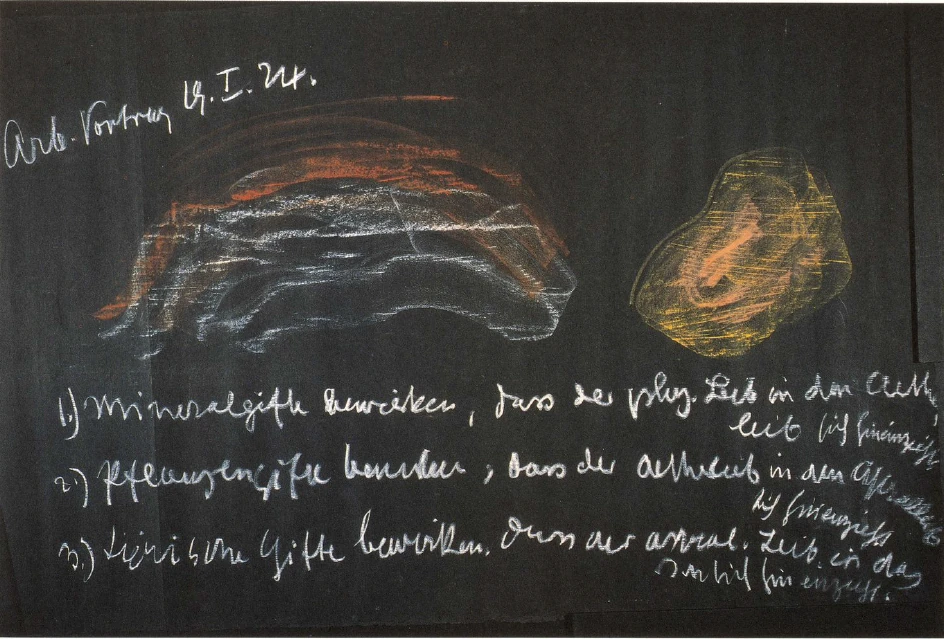
[ 35 ] 1. Mineral toxins cause the physical body to be drawn into the etheric body.
[ 36 ] 2. Plant toxins cause the etheric body to be drawn into the astral body.
[ 37 ] 3. Animal poisons cause the astral body to withdraw into the “I.”