A Spiritual Scientific View
of Nature and Man
GA 352
7 January 1924, Dornach
Translated by Steiner Online Library
1. About Pachyderms — The Nature of Shell and Skeleton Formation
[ 1 ] Good morning, gentlemen! It’s been quite a while since we last met; perhaps someone has thought of something special in the meantime that we should discuss today?
[ 2 ] Questioner: The large ants that roam the forests have a kind of honey or resin at the very bottom of their nests; this is used for ritual purposes, and Catholic priests like to use it as incense. I would like to ask where this comes from and what it is made of.
[ 3 ] Dr. Steiner: The resins that form there contain the same substance found in frankincense, so they really have no other value than that they provide a cheap source of incense. The anthill is formed because the ants secrete formic acid along with all sorts of substances they bring back from the resinous parts of the trees where they collect sap. It is therefore not a kind of honey, but rather a resin mixed with formic acid.
[ 4 ] Mr. Müller: I’d like to come back to the bees—the carpenter bees that nest in trees. When I was young, I witnessed a situation in a wooded area—a district where all the wood had rotted and wasn’t being put to use. Then a master carpenter came along and bought up large quantities of this wood, which had previously been used only for making crates. He used this wood for carpentry work on new buildings. After a year, bees were found everywhere inside the apartments. These bees were so dangerous to the structure that after two years, the master carpenter had to take it back himself; all the beams, right up to the roof, had to be taken down. He had to take it back completely and buy it.
[ 5 ] Dr. Steiner: Of course, that can happen once in a while—that goes without saying. Did the wood get infested by carpenter bees at the storage site, or while it was still in the forest?
[ 6 ] Mr. Müller: It was auctioned off in the fall, then used up in the spring, and the bees emerged in the summer.
[ 7 ] Dr. Steiner: Anything that can be very useful on the one hand can also be terribly harmful on the other. But that doesn’t contradict what I said—that these bees are absolutely necessary for the wood. As I said, anything that can be extraordinarily useful on the one hand can also be extraordinarily harmful on the other. Let me give you an example: Imagine a young boy who is nearsighted and is given glasses—that is necessary and, under certain circumstances, very useful. But if the other boys were to view this as something particularly prestigious and wanted to wear glasses as well, that would not be useful, but rather harmful. And so it is: what is extraordinarily useful in one case can, on the other hand, become extraordinarily harmful. That is simply the way it is.
[ 8 ] Mr. Müller would like to return once more to the topic of bees and what relates to our lives and activities as beekeepers: My colleagues have pointed out to me on several occasions lately that it would have been better if I hadn’t read from a script but had spoken off the cuff. However, I must respond to my colleagues:; I only attended elementary school and do not possess any particular talent for public speaking. So I am not able to speak off the cuff. Therefore, I will read from my notes today as well, rather than speaking off the cuff: about the bees, the queen. (He moves from the beehive to complaints about workers and employers; he goes back as far as 1914 and expresses some dissatisfaction. He draws a comparison: “We, too, are a beehive,” and so on.)
[ 9 ] Dr. Steiner: Well, gentlemen, it is difficult to discuss such matters off the cuff, and we’ve probably all had the experience that when issues like these are added to the agenda and discussed immediately afterward, the discussion takes on a different tone than when the matter has been thoroughly considered. Therefore, if we are to discuss this matter further at all, let us give it thorough consideration. We do, after all, have another hour available on Wednesday, and I will ask those of you who have something to say on this matter to set aside that hour on Wednesday for this purpose.
[ 10 ] It has, after all, been rightly pointed out that temperaments play a role. Temperaments act differently once you’ve had a good night’s sleep in the meantime! Of course, I certainly don’t want to take this matter off the agenda, because I’m not saying that I won’t have something to say about it myself on Wednesday. But I think we’ll proceed in such a way that we don’t discuss the matter right now—when it might still be a hot-button issue for some—but rather that we’ll take our time until Wednesday. I will then ask that the gentlemen, if they wish, take the floor on Wednesday to speak on the matter.
[ 11 ] So let’s stick once again today to what has otherwise been occupying us: questions of knowledge. And as I said, we should certainly take Mr. Müller’s suggestion into account that we then express our views on the matter on Wednesday. And whatever I have to say myself, I will say then as well.
[ 12 ] You see, when it comes to scientific matters, it’s relatively easy—quite possible, in fact—for someone who’s deeply immersed in the subject to say a few things even without preparation; but I’d like to think through the whole issue that’s been raised here once more. That’s all right with you, isn’t it? (Agreement.) Does anyone have any more questions?
[ 13 ] Mr. Dollinger: The question has been raised a lot lately—it’s been discussed in all the newspapers—that no one ever knows where the dead elephants end up, because their remains are never found. I’d like to ask Dr. [Name] if it might be interesting to talk about this?
[ 14 ] Dr. Steiner: This is an interesting thing about elephants! The fact is that one sometimes finds the remains of prehistoric elephants—from ancient times—in excellent condition. And the way in which these prehistoric elephants are found testifies that precisely these animals—which are called pachyderms in natural history—must have perished wherever they are found as prehistoric animals—that is, they must have been preserved—in such a way that they were suddenly enveloped by the surrounding soil. So what I mean is this: these pachyderms could only have remained so well-preserved because they were not gradually eroded—say, by water, soil, and mud—but rather because they must have been lying in a cave and were suddenly buried by the earth as a result of a landslide. As a result, when the foreign soil around the skeletal framework dissolved the flesh, the naturally solid outer layer preserved the skeletal framework exceptionally well. In museums everywhere, you will find the best-preserved specimens of precisely these mighty prehistoric animals.
[ 15 ] But that proves to you that these animals have a tendency to retreat into caves when they are about to die. Isn’t that right? The matter shouldn’t be taken quite as strictly as you said earlier; rather, one can only say: in very many cases—though, of course, one does find dead elephants as well—there is no trace whatsoever of an elephant that had been clearly visible just moments before. These animals, you see, have the peculiar habit of retreating into caves when they sense death approaching and ultimately meeting their end there. You see, gentlemen, this is connected to the fact that these animals—and what you said essentially applies only to pachyderms—have this extraordinarily thick skin. And what does this thick skin signify? You see, the hard parts of an animal are precisely what are most closely related to the earth. Even your own fingernails are most closely related to the earth. And elephant skin is such that it is, in fact, extraordinarily closely related to the earth. Because of this, the elephant actually feels surrounded by the earth its entire life—namely, by the earth within its skin—and feels at ease only when it is surrounded by its skin. Now, within its skin, the elephant is, in a sense, constantly dying. When death approaches—and this is what is peculiar about these pachyderms—these animals feel it exceptionally strongly, precisely because of their thick skin. Then they want more of the earth inside their skin; it is their instinct that leads them to seek out earthen burrows. People don’t look for them in these earthen burrows. If one were to look for them in earthen burrows, one would find more dead elephants in places where elephants are found. One does not find them in open fields.
[ 16 ] But this fact proves precisely how animals, far more than humans, have a sense of their own death—and this is especially true of those animals that are covered in thick skin; but it is also most evident in those animals that are lower forms of life, small in size—for example, insects, which are, after all, also covered in horn-like exoskeletons. And you see, with these small animals, one really must say: It is the case that they not only sense their death, but that when death approaches, they also take all sorts of precautions to ensure that death occurs where it can occur most effectively. Certain insects retreat into the ground to experience their death there.
[ 17 ] Isn't it true that, in the case of human beings, they pay for their freedom by having as little intuitive sense as possible? Animals have no freedom; everything about them is unfree. But in return, they have a strong intuitive sense, and as you know, when dangers—such as earthquake-like threats—loom, animals migrate, while humans are truly taken by surprise by such events.
[ 18 ] We can say: It is extremely difficult for humans to put themselves in the minds of animals. But anyone who is truly able to observe animals—who has a knack for observing them—will certainly find that animals act in an extraordinarily prophetic way in all aspects of their lives. And the peculiarity we have been discussing is precisely connected to this prophetic life within these animals. However, one must not, for that reason, go so far as to compare animals entirely to human beings when they do such things!
[ 19 ] Let’s discuss something else that relates to elephants, and this will help us understand what you asked even more clearly. You see, it has been observed repeatedly that, say, a small herd of elephants is led to a watering hole—as we would say here—to drink. Now, some good-for-nothing boy might be standing there as the elephants approach, and he throws something at an elephant. At first, the elephant seems to be a patient animal and does nothing of the sort; it reacts quite indifferently. The good-for-nothing boy waits, intending to throw something at the elephant again when it comes back. But lo and behold, as the elephant walks back, it has held back a good load of water in its trunk. And when it returns and sees the boy again, before the boy can pelt it, it sprays the boy from head to toe with that load of water. These things have been observed repeatedly. One might say: Good grief, the elephant is much smarter than a human, for the elephant must possess tremendous wisdom if it can remember something like the insult the boy inflicted on it, hold back this load of water in its trunk, and then take revenge!
[ 20 ] Yes, gentlemen, the idea people have about the elephant in this context isn’t quite right. You shouldn’t compare it to human intelligence; rather, you should compare it to something else in humans. If a fly lands on your eye, you do this: you brush the fly away without giving it much thought. In science—where they have many terms for things that are sometimes much less understood—this is called a reflex movement. So, out of a kind of instinct, out of a kind of defensive movement, you simply brush away whatever might potentially be harmful to you. Things like this happen all the time with humans. In an action like this, where a person simply swats a fly away, their brain isn’t active at all; only the nerves that lead to the spinal cord are active. Isn’t that right? When a person thinks something through, it works like this: Up here is the brain; then, for example, when they see this or that, the optic nerve sends a signal to the brain, and from the brain, the will to perform an action travels through the rest of the body. But if a person simply swats away a fly that’s sitting there, the nerve doesn’t go to the brain at all—even if the fly is on the head—but goes directly to the spinal cord, and without the brain even thinking about it, the fly is swatted away. So it is the spinal cord that actually causes this phenomenon within us—that we, as human beings, instinctively defend ourselves when something approaches us in this way.
[ 21 ] We humans, at least physically speaking, do not have thick skin, but rather very thin skin. Our skin is so thin that it’s even transparent, because human skin consists of three layers: the innermost is the dermis, followed by the stratum malpighii, and then the outermost layer, which is completely transparent. We have skin just like an elephant’s, only it’s incredibly thin. The outer layer of skin is completely transparent. Because we have skin that is transparent, we are in contact with our surroundings through all our sensory faculties, and because we are in contact with our surroundings, we are inwardly reflective human beings who ponder things. The elephant is indeed a pachyderm in the physical sense; humans are often so in the moral sense. But what does this mean? Based on what I’ve told you, you can now easily create a mental image of the elephant as being extraordinarily insensitive to its surroundings. An elephant like that actually feels nothing at all, and everything it perceives from its surroundings, it must see; it is like a world unto itself. Studying the mind of an elephant in depth is, after all, something extraordinarily interesting for some people. Sometimes, in order to gain further insight, a person would have to wish with all their heart to be an elephant. For you see, if a person also had the ability to reason—in addition to having the mind of an elephant—then they would indeed become so intelligent that it would be impossible to put into words just how intelligent they would be! But the elephant doesn’t have the brain to become that intelligent. Because it is completely self-contained, its reflex movements—its defensive movements—are prolonged. It takes a long time. If you had a fly sitting on you and didn’t have the instinct to swat it away immediately, the fly would fly away on its own first. With the elephant, it’s like this: he’d let a fly sit there, because the thought of swatting it away might not even occur to him for an hour—that’s how slow his reflexive movements, his defensive movements, are. And what the elephant does with his trunk is nothing other than such a reflexive movement, one that simply takes longer. And it’s not as if he’s thinking: “That boy has insulted me; I have to splash a load of water over his head”—the elephant doesn’t think that way. But while the boy is standing there, the elephant actually wants to smack him with his trunk; yet that takes a long time for an elephant. If a boy throws dirt at you, you’ll slap him right away without thinking much about it. The elephant, however, is a slow animal, precisely because he’s a pachyderm, and that’s why it takes a long time—all that pacing back and forth—until he’s stretched out his trunk and is ready to slap the boy. But as he drinks in the meantime, he realizes: When the water is in his trunk, his trunk is stronger—it strengthens his trunk; he wants to make his trunk stronger by holding the water inside. And he feels his trunk getting longer. It is simply this elongated trunk that he intends to use to strike the boy when he squirts out the water. That is what one must consider. One must not simply attribute human wisdom to the elephant, but must consider the elephant’s entire nature, and then one discovers such things. And so it is with the elephant that he is, inwardly, a self-contained being who perceives everything—and perceives most keenly precisely what is going on within himself. Through this, he also senses the approach of death and is able to withdraw.
[ 22 ] The fact is that there is actually very little research on the psychology of animals today. Isn’t that so? We do observe animals and discover, as I’ve already told you, all sorts of interesting facts. But truly looking into the animal soul—that is something that is extremely rare today. Yet if one wishes to gain insight into these matters, one must sharpen one’s senses in order to observe life at all.
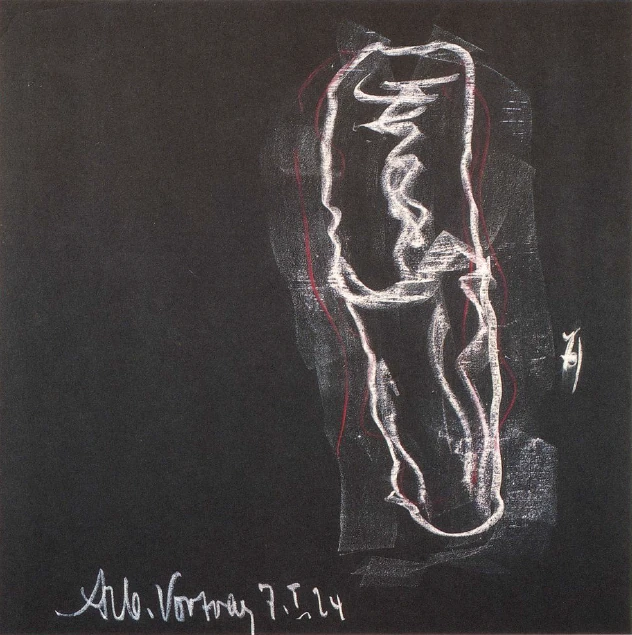
[ 23 ] Consider very small animals—yes, they do exist. There are very small animals that consist entirely of a soft, slimy mass (see illustration). This soft, slimy mass can, if there is a grain nearby, extend something like a tentacle from the mass. First, a “arm” is formed from the mass. This can then be retracted. But look: such animals secrete calcium carbonate or silica shells, so that they are surrounded by these shells. Now, with such a tiny animal that secretes a calcium carbonate or silica shell, there isn’t much to notice yet. But there are more complex animals, and with them, you can already notice more. There are animals that also consist of such a slimy mass, but inside there is something that, if you look closely, looks like little rays; and then they have a shell all around them, and there are spines on the shell. Everything that later develops into corals looks just like that.
[ 24 ] Take, for example, an animal that has a shell with spines and, inside its soft mass, such radiant structures. What is this? If one really investigates, one finds that these rays inside are not caused by the Earth, but by the Earth’s surroundings—by the stars. This soft mass is brought in from the heavens, and the hard mass—or the mass with the spines—is formed from within the Earth. How does something like this come about? Well, gentlemen, if you want to know how something like this comes about, imagine this: Here is a small piece—I’ll draw it quite enlarged—of such a slimy little creature. Now, due to a stellar influence coming from far away, a small portion of such a ray forms internally here. As this forms, the stellar influence presses quite strongly on the remaining mass here. But that, in turn, exerts an even stronger pressure against the wall here. As a result, because the pressure is stronger, a more pronounced bulge—a spike protruding from the surrounding limestone or quartz mass—forms on the inner shell. So that from the outside, this spike is caused by the Earth, while from the inside, this ray is caused by the influence of the star. Does that make sense?
[ 25 ] What is forming inside there is the beginning of a mass of nerves; what is forming out there is the beginning of a mass of bone. Thus, in these lower animals, we see that nerves form under the influence of the external environment, of the external world. Everything that is bony or shell-like—since lower animals have only an outer bone—forms under the influence of the Earth.
[ 26 ] The more one observes more highly developed animals, the more evident it becomes that the formation of shells ceases and the formation of a skeleton begins, which is then most fully developed in humans. But just look at the human skeleton. When you look at the human skeleton, you’ll find that you can actually compare the head to that of a lower animal, for it has a sort of shell. Inside, it is soft. This is a major difference from the rest of the human skeletal structure. Your leg bones are inside your body, and the flesh covers them. There, the soft tissue is on the outside. Here, the human has incorporated the bony skeleton into its interior. Now, the fact that the external skeletal structure is not enclosed within the body as in the head, but rather, as in the rest of the human body, is related to the way blood develops in these higher animals and also in humans. If you observe such lower animals, everything is a white mass. Even what flows through them as blood is white. These lower animals therefore actually have white blood that is not warm at all. The higher the animals become, and the closer we approach the human being in terms of animal organization, the more the human being—who, after all, remains light in color—is permeated by the blood mass. And the more the nervous system becomes permeated by the blood mass, the more the skeleton—which was previously merely an outer shell—also retreats into the interior of the organism.
[ 27 ] So one might ask: Why do humans have internally formed bones, such as in their arms and legs? Because their nervous tissue is interwoven with their blood. Thus, one might say: Internally, higher animals and humans need blood so that they can take the outer shell into themselves. Can you understand this?
[ 28 ] But one could also say: Such a lower animal knows nothing about itself. Humans, however, and higher animals—they know about themselves. How does one know about oneself? It is because one has a skeletal structure within oneself; that is how one knows about oneself. So if one asks: “Well, how does a human actually have self-awareness? How does he know of himself?”—then one must not point to the muscles, nor to the soft tissues, but rather one must point precisely to his solid skeletal structure. It is through the solid skeletal structure that a human knows of himself. And the point is this: it is extraordinarily interesting to examine the human skeletal structure in particular.
[ 29 ] Suppose you have a human being here, and I sketch out his skeletal system very roughly (see drawing). Now this is extremely interesting: When you look at a skeleton, you have to imagine that this skeleton was inside the human being; but this human skeleton is completely covered by skin. If I were to draw this skin here, I would have to draw it like this. For when a person is alive, their entire skeletal system is enclosed in a skin—the so-called periosteum—that fits them perfectly, as if in a sack. So imagine a joint here; here, a bone has a femoral head, and that fits, let’s say, into a socket. Here’s how the periosteum works: there is the periosteum; the entire outer surface of the bone is surrounded by the periosteum, and the periosteum continues on like this, coming back around and covering the entire skeleton. So if you simply create a mental image of the skeleton inside a human being, the skeleton is completely separated from the rest of the body. Between all the other parts of the human body and the skeleton is a sack-like membrane. It really is as if you were to take the skeleton of a living person and imagine spreading a sack over the entire skeleton, holding it in place all around so that the outside of the sack would cover the skeleton everywhere. But you don’t need to do that at all, because nature has already done it; the whole thing is enclosed in a sack—the periosteum. And here’s the interesting part: The blood vessels extend only as far as the periosteum—the periosteum is permeated by them—and this blood nourishes the bone as far as it needs to be nourished, but inside the sac, the bone is entirely earth: calcium carbonate, calcium phosphate, ash, salts, and so on. So you have this remarkable fact: You are, in other words, muscles, liver, and so on, and you have your blood vessels within you, and the blood now forms a sac. The sac encloses you on the inside. Inside this sac is a cavity, but within this cavity lies the skeletal framework. So it really is as if your bones were inside you, and you had enclosed your bones within a sac—the periosteum. And these bones are entirely earthy; they are earth on the inside. You cannot feel them internally. You do not feel your bones through what the bones are, any more than when you pick up a piece of chalk. When you pick up a piece of chalk, you do not feel it either—it is outside of you. So the bone is outside of you, and you are separated from it by a sac. You all have something within your skeleton that is not part of you at all—earth formed into bone, phosphoric calcium, salts, and carbonate of calcium; you carry this within you, except that you have enclosed it in a sac, the periosteum.
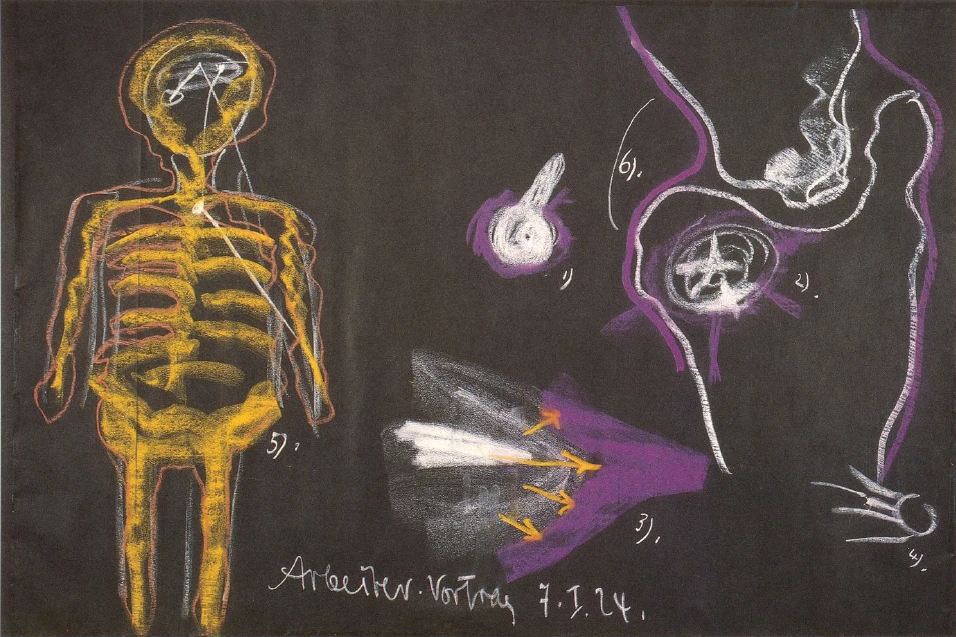
[ 30 ] You see, gentlemen, there is no room there for anything unspiritual; for if you bring even a speck of earth into yourselves, it must fester its way out. The bone does not fester. Why? Because in the place where you are dead within yourself—where the bone appears dead beneath the periosteum—the spirit resides through and through. You see, this is the wonderful instinct that led simple people—who often knew more than the scholars—to create a mental image of death as a skeleton, because they knew that the spirit resides within the skeleton. And that is why they imagined that when a spirit wanders about, it must also appear in skeletal form. This is a correct mental image. For as long as a person lives, they make room for the spirit through their bones.
[ 31 ] This is something we’d like to discuss further in the very near future. But you can also see from this that human beings devote a great deal of effort to bringing the spirit into their very bones. The elephant, on the other hand, leaves room for the spirit within its thick skin. And because the elephant leaves room for the spirit within its thick skin, the spirit—which the elephant then senses—can perceive when the outside world destroys it. Human beings know nothing of their own death because their skin is too thin. Even if they were physically pachyderms, they would still retreat into a cave and die there. And one would certainly say: Where do people go? They go to heaven when they die! — Yes, gentlemen, the same thing has been said about certain people who have been greatly revered in certain cultural circles as it has been said about the elephant. Take Moses, for example, of whom it was said that his body was never found. He disappeared because people had a mental image of what had actually happened to him. He had become so wise, people had a mental image of him, as I told you earlier. If a human were physically a pachyderm and had his brain, then he would be so clever that one cannot even express just how clever he is! And people understood such connections. Just think—it’s truly astonishing what people knew! People say that Moses was already as intelligent as he would have been had he had thick skin; that is why he withdrew, and his body was never found. It is a very interesting connection. Don’t you think so? Ancient legends are often connected to the pure, beautiful veneration of animals.
[ 32 ] Well, let's talk more about that next time, if the hearing we've been assigned today leaves us time for it.
[ 33 ] So, next Wednesday, gentlemen.