A Spiritual Scientific View
of Nature and Man
GA 352
23 January 1924, Dornach
Translated by Steiner Online Library
3. About Nutrition
[ 1 ] I would still like to add a few things to what I told you last Saturday, and I can answer the two questions that were given to me for today next time. We have spoken about poisons and their effects on human beings, and we have seen precisely in the case of poisons that, if one is to understand true science, one must ascend to the supersensible, to the spiritual constituents of the human being.
[ 2 ] Today, as part of our discussion of what causes such strong toxic effects—so that you have a complete picture—I would like to add what a more or less healthy body produces during the digestive process. Although I have spoken about nutrition on several occasions, let us once again discuss a few points related to nutrition, taking into account what we covered last time.
[ 3 ] In terms of nutrition, humans primarily consume three to four types of food. The first is protein, which you can best understand by looking at a chicken egg. Protein is produced by plants as well as by animal and human bodies. Human and animal bodies do not rely solely on their own internal resources to produce protein—since every living body produces protein—but they also require the protein that plants produce entirely on their own. The human body also absorbs animal protein. With regard to this protein, science has, in fact, suffered a major embarrassment in very recent times; for as recently as twenty years ago, it was universally taught that a person must consume at least 120 grams of protein per day to remain healthy. Consequently, the entire diet was structured around prescribing specific foods that people were supposed to eat in order to obtain the necessary amount of protein. It was therefore believed that 120 grams were necessary.
[ 4 ] Today, science has completely abandoned this view. It now knows that when a person eats so much protein, it not only fails to promote good health but actually contributes directly to illness, because most of the protein ferments in the human intestinal tract. Thus, by consuming 120 grams of protein a day, the human body constantly has something like rotting eggs in the intestines, which terribly contaminate the intestinal contents and release toxins that then enter the body—not only easily causing what later in life leads to so-called arteriosclerosis —since most arteriosclerosis stems from consuming too much protein—but also makes people extraordinarily susceptible to all kinds of infectious diseases. The less excess protein a person consumes—while, of course, still obtaining the necessary amount—the less they are exposed to the risk of infection. Those who consume a lot of protein are more susceptible to infectious diseases such as diphtheria, smallpox, and chickenpox than those who do not consume as much protein,
[ 5 ] It is indeed very peculiar that scientists today teach that we do not need 120 grams of protein, but only 20 to 50 grams. That, they say, is the amount a person actually needs each day. That is how quickly scientific views have changed in just two decades. So you see how much weight should actually be given to something when it is, so to speak, scientifically established. For if it so happens that you need to inform yourself about this subject and you pick up a general encyclopedia that is twenty years old, you will read in the relevant chapter that you need 120 grams of protein; but if you pick up a later edition, you’ll read: 20 to 50 grams, and if you had more, it would actually make you sick. So you see what the situation really is with so-called scientific truths. You’re told what to regard as true or false depending on which edition of the encyclopedia you happen to pick up. All of this simply points to the fact that one cannot possibly gain clarity about such matters—which pertain to the spiritual realm—in this way at all. And this, of course, is a reason—if one really thinks the matter through—that one must delve into the spiritual realm if one wants to understand what happens when a person consumes protein. But it is the very food that absolutely must still be processed in the intestines, in the lower abdomen, and the lower abdomen itself must have the strength to process this protein. As you know, protein—especially fresh protein—is semi-liquid. All protein is semi-liquid. The human etheric body has access to everything that is semi-liquid. The human etheric body cannot process anything that is solid, but only that which is liquid. Thus, a person must consume all the food they take in while it is in a liquid state.
[ 6 ] Now you might say: When a person takes salt, sugar, or something like that, it’s solid. — But it dissolves right away! That’s exactly what our saliva is for. The solid matter that constitutes the actual physical body must not enter the human body from the outside world at all. Therefore, you can conclude from this: You have solid matter within you; you know that—the bones are solid. But the fact is this: The solid bones are formed within the human body itself, out of liquid matter. Nothing solid from the outside can ever enter the human body. The human body must produce all solid matter itself from the liquid. Therefore, you can say: We have the solid within us, and that forms the physical body. But the physical body is formed entirely from the liquid, and the etheric body is there for the liquid—the subtle body that cannot be seen, but which permeates the entire human being. And protein, too, must be processed entirely by the etheric body—specifically in the lower abdomen. Of course, as I have already told you, the other spiritual members of the human being are also at work there; but the protein must be processed in the etheric body. So the liquid is there for the human etheric body. Now, simply from the fact that you know protein must be processed in the human lower abdomen, you can see that protein cannot actually perform the most demanding work in the human being, for it does not need to be transported up into the chest region, and above all, it does not need to be transported up into the human head. From this you can see that protein cannot serve as a nutrient that is of primary importance. One could say: It is actually impossible for a person to eat too little protein, because whatever is eaten goes straight into the lower abdomen; it does not require much processing there. Protein is processed in the abdomen. Even if a person consumes only food that is very low in protein, all the protein is processed immediately.
[ 7 ] So we can see from this that humans are perfectly capable of getting by on very little protein. Today, science already acknowledges this, but years ago, children in particular were overfed protein. Today, don’t we see those children who were overfed protein in the 1970s or 1980s? They’re now suffering from arteriosclerosis or have already died from it. So the harmful effects of something don’t become apparent right away, but only much later.
[ 8 ] The second type of food is fats. Naturally, when you eat fats, they also enter the lower abdomen. But fats pass through the intestines and have a very strong effect on the midsection—specifically, the chest area. Therefore, for the proper nourishment of the heart, chest, and so on, a person must absolutely consume fatty substances.
[ 9 ] It follows that the human body primarily needs fatty substances in the chest area, because that is where respiration takes place. What does that mean? It means that the carbon the human body contains combines with oxygen. When carbon combines with oxygen, heat is required. What fats do—by combining with oxygen—is generate heat. Thus, fats contribute an extraordinary amount precisely to what the human body needs in the chest region.
[ 10 ] Now one might say: Proteins, if they are not processed by the body—specifically, if they are not processed in the lower abdomen—tend to rot. When we have proteins in our system that cannot be properly processed, we really do have something like rotten eggs in our intestines. Isn’t that right, gentlemen? You’re surely familiar with the stench of rotten eggs, and the fact is that when a person consumes too much protein, this rotten-egg stench seeps out of his body. He becomes completely permeated with this rotten-egg stench. Yes, if you let eggs sit, they simply turn into rotten eggs, and then they stink just like rotten eggs. And the part that the body hasn’t processed will, of course, also stink inside the body; but the other part, which is processed, won’t stink—instead, it is cleanly assimilated into the body. But that is the work of the etheric body. The etheric body exists to overcome and eliminate whatever arises as a putrid stench. In the human body, the etheric body is the fighter and the victor over decay. Decay is overcome in human beings by the etheric body. When a person no longer has their etheric body after death, they begin to decay. So you can see here, I would say, quite tangibly: A person does not decay as long as they are alive; as soon as they are no longer alive, they decay. Why is that? Because the etheric body is gone when a person is dead! The etheric body is therefore the part of the human being that prevents decay. We are thus constantly engaged in a struggle against decay within ourselves, and the one who fights against decay is our etheric body.
[ 11 ] Well, gentlemen, I think that anyone who thinks all this through must conclude with the utmost clarity—simply by observing the external facts—that an etheric body must exist, that indeed an etheric body must be present everywhere. Just imagine: proteins are produced everywhere on Earth, and they decay. The Earth would stink all the way up to the heavens if it weren’t for the ether, which constantly dispels this decay. So, both inside and outside the human organism, it is the ether that continually fights against the decay of proteins. This must definitely be taken into account.
[ 12 ] When we turn to fats, we have to say: Fats don’t rot, but they do go rancid—as you all know if you’ve ever left fats sitting out somewhere—even butter goes rancid. So fats have the peculiarity of going rancid. Now, if you’ve left butter out, you won’t be able to tell whether it’s rancid butter or good, fresh butter—unless you’ve been trained to tell by looking at it. But if you put the butter on your tongue and taste it, you’ll know immediately that the butter is rancid. So this has something to do with consciousness, with sensation. Rottenness, on the other hand, has to do with smell, with the external—you can smell it. Of course, it’s different with rotten eggs than with the scent of roses, but in any case, you can smell it. But that’s not the case with rancidity. Rancidity is something for which we use a term that refers to something more internal—taste.
[ 13 ] This already indicates that it has much more to do with inner sensation than with the rotten part of the eggs. Physically, the human middle body—the chest body—is involved in everything that is a sensation in consciousness, but spiritually, it is the astral body. And as you know, the chest is precisely where that which has an air-like quality is located. We inhale air. We process the air. In the chest, the air is in its proper place. In the other parts of the human body, gases and air-like substances should be produced only sparingly. If too many gases are produced in the intestines, pathological bloating occurs, and that is unhealthy. The human middle body is responsible for the actual production of gases. And that higher, supersensible-spiritual member that intervenes there—that is, it intervenes in the gaseous substance—is the human astral body. This human astral body now combats the rancidity of fats within itself; just as the etheric body combats the putrefaction of proteins, so does the astral body combat the rancidity of fats. A person would constantly experience a rancid aftertaste from their own fats and would taste rancid to themselves internally if their astral body did not constantly combat this rancidity. Thus, we have this astral body within us to combat the rancidity of fats.
[ 14 ] You see, gentlemen, this is truly wonderful, for you can see from this that what exists out there in the ordinary physical, material world takes a completely different course than what is happening here within us. Out there in the physical world, fats inevitably go rancid. For the sake of one’s health, a person does not always go rancid; it happens only when one becomes ill internally. So the fact is that, when a person is healthy, their astral body is such that they cannot become rancid. They only become rancid if they eat too much fat, so that the astral body cannot process it, or if too much fat is produced by some other means; cannibals know this better than we do. But internally, a person already perceives their own process of becoming rancid. And one can say: When a person experiences severe rancidity—that is, a significantly diminished activity of the astral body—they constantly have an unpleasant taste in their mouth. This unpleasant taste then has a reciprocal effect on the stomach. And through this indirect route, a person first develops stomach and intestinal diseases from the rancid fat within themselves.
[ 15 ] If you notice that a person is becoming rancid on the inside, arsenic is a good remedy for the fats within them that they are not metabolizing. Arsenic combats fat accumulation and strengthens the astral body. As a result, the person can then fight this process of becoming rancid. These are matters of extraordinary importance. If a person shows an inner tendency to be unable to overcome their putrid protein through the etheric body, then a compound containing copper usually acts as an extraordinarily potent remedy. Copper is effective, then, when abdominal or intestinal diseases are directly caused by protein. But if you notice that something is manifesting itself through the mouth or through taste, it won’t help to give the person copper; instead, it must be arsenic, because you must first strengthen their astral body. So simply stating that this or that disease is present in this or that part of the human body is not enough; rather, one must know where they come from—whether they stem from putrid protein in the intestines or from rancid fats that, via the sense of taste, indirectly affect the intestines and stomach once again.
[ 16 ] So you see, gentlemen, we have within us the opposite of what these substances demonstrate on the outside. We have an astral body that combats the rancidity of fats, whereas in the ordinary physical-material world, fats simply become rancid.
[ 17 ] A third type of food that humans consume consists of substances known as carbohydrates. Carbohydrates are found, for example, in potatoes, lentils, and beans, and of course in all types of grains. That’s where the carbohydrates are. Many of these foods either contain sugar directly—which we always consume as part of our diet—or the sugar is produced directly from these carbohydrates through the process of converting what we ingest, such as from potatoes. Potatoes consist largely of starch. This starch is first converted in our bodies into dextrin and then into sugar. So when you eat potatoes, you’re actually getting your nutrition from sugar, because the potato starch is converted into sugar in the human body. Isn’t that right? Grapes, for example, contain a particularly large amount of this sugar—and consequently, so does alcohol. The entire effect that alcohol has on humans is actually based not only on the alcohol itself but also on its sugar content. Sugar is, in fact, produced again from alcohol within the human organism.
[ 18 ] The first type of food was therefore protein, the second type was fats, and the third type was starch and sugar. We have seen that protein is processed—in such a way that it does not putrefy—by the etheric body in certain quantities. Fats are processed—in such a way that they do not become rancid—by the astral body. Now, starch and sugar! When one looks at the etheric body, one must say: It is primarily active in the lower abdomen. The astral body is primarily active in the chest region. Now let’s turn to something else. You are all familiar—I won’t say from personal experience, but from having observed people who are not like you—with the effects of alcohol, and you know that alcohol brings about a particular peculiarity in humans, initially in the state of intoxication, but we won’t discuss that for now. But you know, the next day—we’ve already spoken of this—comes the so-called “brummschädel,” which is also called a hangover. What, then, does the “brummschädel” or the hangover mean?
[ 19 ] Yes, gentlemen, you can probably tell from the name that a “Brummschädel” has something to do with the human head. And if, the next day, you’ve heard people—those who are just a bit different from you—describe how they’d had a little drink the day before, you’ll have heard them complain mainly about their heads. Their heads hurt, and even when they don’t hurt, it feels as if they’re about to fall off their shoulders and so on. What’s actually happening there?
[ 20 ] The role of the head, in fact, is primarily to combat what starch and sugar seek. What do starch and sugar seek? You need only look at wine. Isn’t it true that when autumn comes, the grapes are harvested? They are pressed, and then the mixture ferments. What has then finished fermenting is enjoyed as wine. Precisely because the wine has become wine through fermentation, it has overcome the fermentation process. But when you put the wine into your stomach, it turns into something that, in turn, becomes part of your food. The alcohol is, in effect, converted back. And now, the substances that are most prone to fermentation are precisely starch and sugar. Starch and sugar in the human organism have a strong tendency to ferment. When you drink alcohol, the alcohol in your head drives out the forces that prevent the fermentation of sugar and starch in the human body. Let’s take a very clear example. Let’s say you ate potatoes and beans on January 22 and drank alcohol with them. All right. If you hadn’t drunk any alcohol, your mind would have remained sober. Potatoes and beans contain starch and sugar derived from the starch; your mind would have had the power to properly prevent the fermentation of starch and sugar. But when you introduce alcohol, your brain loses the ability to prevent the fermentation of the starch and sugar you consumed with the potatoes, and the potatoes and beans—as well as other foods, such as grains—begin to ferment inside you.
[ 21 ] So instead of fermentation being prevented in a person, it now occurs. And it occurs due to an impairment of the mind caused by alcohol, so that the person is now filled with fermentative forces. There is a curious folk expression in Central Germany, in Thuringia. When someone talks nonsense, people in Thuringia say: “He’s fermenting.” In these parts here, it’s not customary to say “he’s fermenting” when someone talks nonsense; but those who have been to Germany will surely have heard this in Central Germany. And if someone is always talking nonsense, then in Central Germany—in Thuringia—they call him an “old fermenting fool.” So the point is this: in Central Germany, “fermenting” is associated with being confused in the head, with talking nonsense. That’s a very good folk instinct. People know that too much is fermenting inside a person when they talk too much nonsense. Now, when someone has drunk alcohol and gotten a hangover, they don’t talk nonsense—they become quiet—but the nonsense is still inside them, rumbling within. So what is happening there is something that prevents starch and sugar from fermenting—something that counteracts the immediate effect of the alcohol. So one can say: There is something in the human mind that works constantly to prevent all the starch and sugar within it from fermenting.
[ 22 ] Now, no one denies that the human mind—just as the etheric body resides in the lower abdomen and the astral body in the middle abdomen—is where the “I,” the true “I,” is most strongly situated. The fact is that this true “I” is concerned with the warm, just as the physical body is concerned with the solid, the etheric body with the liquid, and the astral body with the gaseous. The fact is that, in everything that depends on the true “I,” the human being sets warmth in motion. This can be traced in every detail within the human body. The true “I” is also connected to the blood; hence, the blood generates warmth. But the true “I”—that which the human being experiences in consciousness—is also connected, for example, to glandular secretion. Therefore, glandular secretion is now linked to heat. It is also the true “I” that, from the supersensible realm through the forces of the head, prevents fermentation. So one can say: The etheric body combats the putrefaction of proteins, the astral body combats the rancidity of fats, and the “I” combats the fermentation of sugar and starch.
[ 23 ] That is also the reason why I had to tell you once that excessive potato consumption is harmful to the mind. Excessive potato consumption has the following effect on people. You see, the potato contains little protein. Because it contains little protein, it is actually a good food for humans. And when a person eats potatoes in moderation along with other foods, they are indeed a good food precisely because of their low protein content. But the potato contains an extraordinary amount of starch, which must be converted into sugar in the human body—first into dextrin, then into sugar. I told you back then: When a person eats too many potatoes, their brain has to work terribly hard—naturally, because the brain must prevent fermentation. Therefore, people who eat excessive amounts of potatoes—and who consequently have to strain their brains terribly to process the potato fermentation—become mentally weak. In particular, the middle regions of the brain become weak; only the frontal regions of the brain remain, which exert little effort in preventing potato fermentation. And so, precisely because the potato diet has become so widespread in recent times, materialism has emerged, since it is generated in the frontal lobe.
[ 24 ] It’s so peculiar: people believe that materialism is a logical thing. In a certain sense, materialism in modern times is nothing more than the result of eating potatoes! Well, isn’t it true that, in and of itself, people don’t like the idea of having to live on nothing but potatoes; yet they do like materialism. So they’re actually caught in a contradiction. If one really wanted to be a materialist, one would actually have to advise spreading the potato diet everywhere, because that would be the very best way to convince people of materialism, wouldn’t it? That’s something most people just can’t seem to pull off. But if the materialist monists—the Monist League—wanted to fight truly effectively, they would actually have to ensure that other foods are replaced by a potato-based diet as much as possible. Then the Monist League would achieve tremendous success. Even if not very quickly, but over the course of a few decades, the Monist League could be most effective if it focused on promoting a potato-based diet. However, the very people it was trying to influence through this diet would likely play a trick or two on it; so it might not achieve the best results after all!
[ 25 ] But you can draw one conclusion from this: The Spiritual Science practiced here recognizes precisely the true nature of materialism. Materialism, after all, knows nothing at all about the material world; Spiritual Science, on the other hand, recognizes that the potato, in particular, is the true source of materialism. The potato is terribly insidious, cunning, and clever to a fault. For consider this: humans can eat only the tubers of the potato, not even the eyes on the potato—which are already harmful—and they certainly cannot eat the flowers, for the potato is a nightshade plant and the flowers are poisonous. But what is this poison? I already told you last time: in large quantities, the poison kills; in small quantities, finely dispersed, it is a remedy. The potato itself contains a great deal of starch paste; it consists almost entirely of starch paste. It couldn’t possibly survive, because the starch paste would have a terribly harmful effect; so at the same time, it draws the poison out of the world and neutralizes the harmful effect within itself. That’s why I call it clever and cunning. It has its own poison, through which it removes the harmfulness for itself. But the potato’s poison is particularly harmful to humans; it does not pass this on to humans; it gives them only what it combats within itself through its own poison. This is truly something that can be called exactly that: The potato is a clever, cunning creature! And humans must be aware that if they eat too many potatoes, their midbrain atrophies, and that even—precisely because of excessive potato consumption—their senses can suffer.
[ 26 ] If a person eats too many potatoes as a child or as a very young person, their midbrain becomes extremely weak. But the midbrain is where the sources of the most important sensory organs are located. The midbrain contains the colliculus, the optic colliculi, and so on, and even vision is impaired by excessive potato consumption because it has its origins precisely in the midbrain. And some eye diseases in old age stem from the fact that a person was raised on too many potatoes as a child. The person then develops poor eyesight and weak eyes. It is indeed true that people in Europe used to suffer from poor eyesight in old age much less frequently than they do now. And this, in turn, stems from the fact that—apart from other factors affecting the eyes—which do not even have such a strong effect because they do not act internally, such as electric light and so on—excessive potato consumption has a very harmful effect on the eyes, on vision, and even on the sense of taste—even on the sense of taste! You see, this is what happens. Suppose a person eats too many potatoes even in childhood. In such a person, you will very often observe in later life that they never know when they’ve had enough, because their sense of taste has been corrupted by potato consumption, whereas a person who has not eaten too many potatoes knows instinctively when they’ve had enough. So the instinct, which is more closely linked to the midbrain, is simply corrupted by excessive potato consumption. This is something that has become particularly prominent in recent times.
[ 27 ] But from everything I have told you, you can now see that a person must take special care to ensure that they are strong enough, first, to prevent proteins from becoming sluggish; second, to prevent fats from becoming rancid; and third, to prevent starch and sugar from fermenting.
[ 28 ] Well, as I already told you last time, a person cannot be completely abstinent from alcohol, because if he does not drink any alcohol at all, alcohol is produced within him. But this alcohol remains in the lower abdomen; it does not rise up to the head, because the head must be free of alcohol—otherwise, as the bearer of the “I,” it immediately becomes incapable of properly counteracting the fermentation taking place in the body. You see, now you can form an idea of the relationship between human beings and their natural environment. If, for example, you look at the protein that is rotting everywhere—animals rot it, plants rot it—then you must say: There is also ether everywhere, which gradually counteracts this process. If you look at the fats, which are also found in plants and are everywhere, then you must say: These fats would gradually render all living things—both animal and human—incapable of life if there were not a force in the astral body that combats rancidity. So, in a sense, human beings are actually combating what exists out there in nature. And when a human being dies, the etheric body, the astral body, and the “I” depart from them. They depart from the physical body. The human being then passes into the spiritual world. What happens then? Well, gentlemen, you know what happens there. The corpse immediately begins to decompose, to become rancid, and to ferment—though decomposition is naturally more visible, or rather more noticeable by smell, since people very rarely go around with their noses plugged. So the process of decay is easily detected by smell. But one does not usually bend over a grave to taste whether the fat of the corpse in question has become rancid, and that is why one generally knows nothing about it. And the fermentation that does take place is certainly not studied. So it is indeed the case that when the ego departs, the human body begins to ferment; when the astral body departs, the human body begins to turn rancid; and when the etheric body departs, the human body begins to decay. Human beings carry this within themselves constantly, but while they live on Earth, they constantly fight against it. Anyone who denies that the etheric body, the astral body, and the “I” exist within the human being as real spiritual entities must be asked: What do you actually imagine? Why doesn’t the human being rot? Why doesn’t it ferment? Why don’t they turn rancid? For that is precisely what would happen if they were like the mere physical body!”
[ 29 ] But what does our science do? Our science waits to begin its study until a person has died. For what it knows about a living person is, in fact, very little compared to what it actually knows about anatomy once a person is a corpse, once they have died. Everything you can actually learn relates only to the corpse. Our science always waits for the corpse. So this science cannot know anything at all about the real human being who is actually living, because it does not take that person into account at all. And that is precisely the harm of our science—it has actually only been this way since the 17th century—that it derives all its knowledge, fundamentally speaking, only from the corpse. But the corpse is no longer the human being, for one must ask: What is it that causes the corpse—which the human being carries within them even while alive—not to behave like a corpse while the person is alive, that is, to rot, ferment, and become rancid? It is precisely when one truly observes the living human being that one comes to recognize these spiritual, these supersensible members of the human being. And then one also realizes that the “I” acts primarily in the head, that the astral body acts primarily in the chest, and that the etheric body acts primarily in the lower abdomen. And science does not even know anything about the lower abdomen, because it believes that the same processes occur there as those found out in nature. That is simply not the case.
[ 30 ] Well, gentlemen, it is interesting to study these things—I would say—not in the confines of a study, but out in the midst of everyday life. As you know, there are spas where it smells like rotten eggs, such as Marienbad. There are also German spas that contain hydrogen sulfide, where it smells just like rotten eggs. Yes, really: people who are otherwise gourmets and have a keen sense of smell have to visit such spa towns. And why do they do that? Why do they sometimes spend several months in the summer in places where it smells as if everything were laced with rotten eggs? You see, here’s the thing: these people have actually eaten too much protein, and now they come to the resort; because they’re covered in skin and the problem is internal, they don’t smell that way themselves, but if you could smell it, they’d smell terribly of rotten eggs on the inside! So now all these people, who smell like rotten eggs on the inside, come to the seaside resorts, where it smells like rotten eggs, and what happens there? Well, you see, sometimes the rotten-egg smell is on the inside, and other times it’s on the outside. When it’s on the inside, the nose doesn’t detect it; when it’s on the outside, the nose does. The head and the gut are opposites. Whatever rotten-egg smell the gut produces—when it reaches the head through the sense of smell—is counteracted. And so, in the spa towns that smell like rotten eggs, the internal rotten-egg smell is counteracted.
[ 31 ] This is particularly noticeable to those who are very sensitive and have a knack for making such observations. As a boy, I happened to have to go to such a spa town. I had to go to Bad Marienquelle every other day. It stinks of rotten eggs there. While it’s so unpleasant on the surface—since it smells so terrible—you suddenly start to feel very comfortable in your stomach. So if you’re not sick—if your stomach doesn’t smell like rotten eggs—you experience a heightened zest for life. Anyone who isn’t put off by the rotten-egg smell can experience this. Of course, those who hold their noses don’t experience the contrast; they don’t feel that spring-like sensation in their stomach that one feels when they truly surrender to the rotten-egg smell. And the rotten-egg smell, for example—even when it is artificially produced—is an extraordinarily effective remedy. It gives the body, for instance, the strength to firm up and strengthen muscles that are wasting away. Well, people don’t usually like such treatments, but in a certain sense they are extraordinarily useful. For you see, when the smell of rotten eggs reaches a person externally, it brings springtime to their inner belly. And in spring, everything sprouts and grows, and a person can become strong again by experiencing springtime within their belly.
[ 32 ] This is what happens to people who ruin their stomachs by overeating during the winter. You see, if someone doesn’t upset their stomach through gluttony in the winter, then they participate in the spring that is happening outside. The lower abdomen, in particular, participates in spring in an extraordinarily powerful way. But if you want to truly experience spring out in nature, then you must eat as little as possible of things like goose liver pâté and the like. If you’ve eaten a lot of goose liver pâté, then spring doesn’t come to a person’s stomach; instead, it actually remains inside the person’s stomach just as it is beneath the earth in winter—not as it is on the earth’s surface, but as it is beneath the earth. It’s warm down there—that’s where you put the potatoes in the pits. But everything inside a person becomes rotten because the heat is stored in the stomach; spring doesn’t come to the person there. And then one has to seek out an artificial spring in the smell of rotten eggs.
[ 33 ] Such is the contrast between the “I” and the etheric body. The “I” and the etheric body must balance each other out within the human being. You can see from this that if one truly studies nature—that is, if one goes to a spa town with open senses where there is a smell of rotten eggs, hydrogen sulfide—the sensation of spring in the abdomen teaches one how, internally, the opposite is actually at work in the putrefaction of protein.
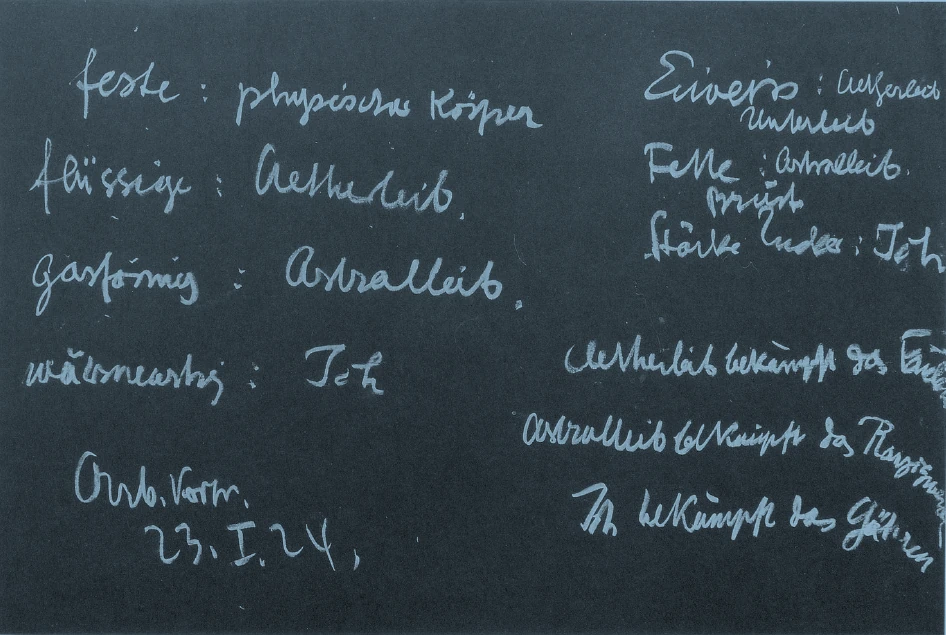
| solid: | physical body | ||
| liquid: | etheric body | Protein: | Etheric body, lower abdomen |
| Gaseous: | Astral body | Fats: | Astral body, chest |
| heat-like: | I | starch, sugar: | I |
| The etheric body combats putrefaction | |||
| The astral body combats rancidity | |||
| The “I” combats fermentation | |||
[ 34 ] I wanted to add to what I said last time. As you know, I told you: If someone has ingested certain toxins, they must take liquid protein as an antidote. It is precisely those things that are healthy that become toxins if they are not properly processed by the body or if too much of them enters the body. So even protein can expel a toxin from the human body, but protein itself becomes toxic if it spoils in the body or if too much enters the body. That’s how closely linked nutrition and poisoning are. And you’ve surely heard for yourselves how excess in one’s diet can lead to poisoning. A large proportion of diseases are, in fact, dietary diseases—that is, no consideration is given in one’s diet to the fact that the substances in question should only be ingested in specific amounts if they are to be properly processed.
[ 35 ] I'll have someone announce the next class because I won't be there on Saturday. I'll be in Bern, after all.