

A Spiritual Scientific View
of Nature and Man
GA 352
2 February 1924, Dornach
Translated by Steiner Online Library
4. The Human Eye — Albinism
[ 1 ] Gentlemen, the question that has been asked is:
[ 2 ] Is the iris in the eye a mirror of the soul in both healthy and diseased states?
[ 3 ] I think the second question can be addressed right away; they are probably related:
[ 4 ] What causes albinism or leukopathy in Black people?
[ 5 ] If we are to answer this question, we must first and foremost discuss the nature of the human eye a little more. The question relates to the fact that certain people draw conclusions about the healthy or diseased condition of the entire body based on the appearance of the iris—that is, the colored, ring-shaped structure in the eye that surrounds the black part known as the pupil. This iris, as you know, exhibits the greatest possible variation among different people. As you know, the iris is not only colored blue, black, brown, gray, or even greenish-brown in a person, but it also has lines of one kind or another that are formed by fine blood vessels. So just as the general facial expression differs from one person to another, the finer structure of this iris—or rainbow membrane—differs greatly from person to person, and in fact differs far more from one another than human physiognomy actually does.
[ 6 ] Now, if we are to discuss such a matter, we must go into the structure of the eye a little. This is, after all, connected to the other question you asked. Namely, that—particularly among Black people, but also among non-Black people—an abnormal, somewhat unusual skin pigmentation occurs, which is associated with the distinctive coloration of the iris. These two phenomena are connected in a certain way. Now, this skin coloration is particularly striking in naturally black people because they are otherwise black, and then they have all sorts of white spots; they are speckled like a tiger. They are very rarely completely pale and completely white; this occurs very rarely among Black people—extremely rarely. But such so-called albinos also occur among other races that are not entirely black. But this albinism also occurs among white people, among the so-called “cockroaches”—that’s what they’re called—; they have a very pale skin color, almost milky white. Their irises are usually a light reddish color, and the pupil, which is otherwise black in humans, is dark red. One such “white” woman, whom I once saw, even exhibited herself in all sorts of sideshows. She had completely milky-white skin, red irises, dark-red pupils instead of black pupils, and then said in an incredibly faint voice: “I am completely white, have red eyes, and see very poorly.” That was true; she could see very poorly.
[ 7 ] If one wants to delve into this subject, one must first and foremost study the structure of the eye itself. Now, I have told you many things about the eye over the years. You will therefore perhaps understand what I have to say today. You see, the eye is situated inside the very solid bony structure of the head. The bony structure of the head curves inward there, and the eye is situated within this bony cavity, which is open toward the back here, toward the brain (see drawing). The eye is first bounded on the outside by a tough membrane that is opaque here. The so-called eyeball is bounded by the cornea. This membrane becomes transparent toward the front, here, where it bulges slightly. Otherwise, the interior of the eye could not be exposed to light if this outer cornea were not transparent. It is called the cornea because it is horny in texture. Inside, moving toward the interior, there is a membrane consisting of fine blood vessels. The body’s blood network extends into the eye and also sends very small, fine blood vessels into the eye. So here we have the hard cornea, which becomes transparent toward the front, and then the adjacent choroid. The third layer inside is made up of nerves; this is the retina. So I still need to draw a third layer, the retina. And the retina extends backward into the brain, as does the choroid, of course. And because this is nerve tissue that is involved in vision, it is called the optic nerve. As you know, people say: “We perceive through our nerves.” — So it is with the optic nerve that we see.
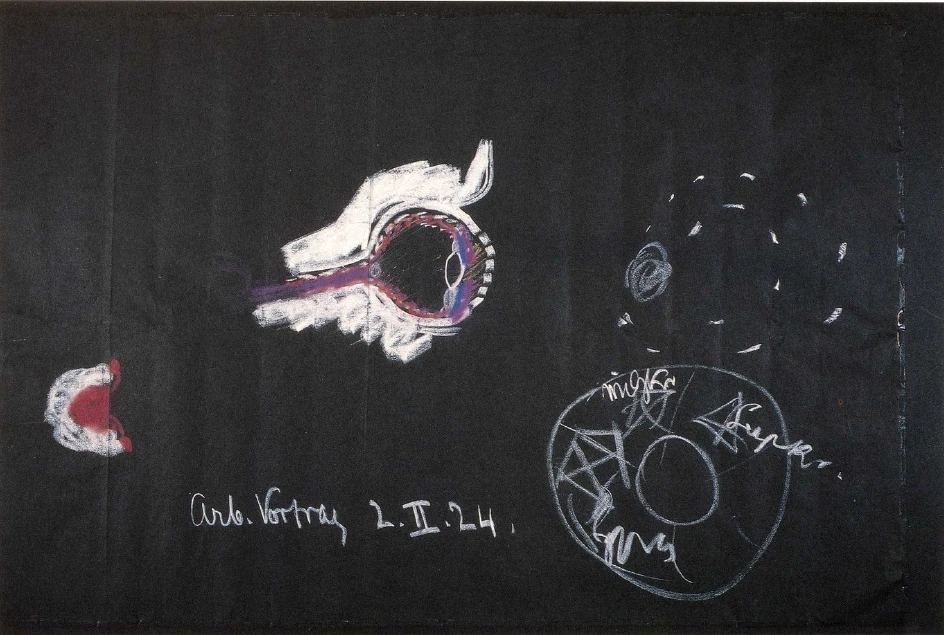
[ 8 ] Well, the strange thing is simply that everyone has to admit that, as people say, you can see everywhere with the optic nerve—except right where it enters; there you’re blind—you can’t see anything there! So if someone happens to look in such a way that they’re somehow looking out of there, or if the nerves all around are diseased and only the spot where the optic nerve enters is healthy, then you still see nothing right where the optic nerve enters. Now people say: You see with the optic nerve; that’s what it’s there for—so you can see. - Have you heard the following yet? Just imagine: There’s a group of workers—let’s say thirty workers. Twenty-five of them have to work quite hard; they’re standing all over the place. And there’s a group of five—we wouldn’t actually do this, but let’s assume for a moment that we do—these five are allowed to loaf around while the others work diligently. So we can say: there are the twenty-five hardworking laborers, and there are five who loaf around the whole time, sitting in upholstered armchairs and doing nothing. Now, if someone were to tell you that the work is done just as well by the five slackers—or perhaps they can’t say that because they don’t see it, but the work gets done precisely because they’re slacking off—you wouldn’t believe it, would you? That’s nonsense. But science teaches us: the optic nerve sees. — But right at the spot where it’s most concentrated, it sees nothing! That’s just like saying: The work is done by what those five loafers are doing. — You see, we know such things—and that’s precisely the curious part—we know such things, but we still keep asserting the most ordinary nonsense. Isn’t it true that the fact that this is the so-called blind spot—that’s what it’s called, after all—and that one sees nothing at all at the point where the optic nerve is most active, clearly shows that the optic nerve cannot be what we use to see.
[ 9 ] Here’s the thing: There’s something in the human body that’s very similar to this aspect of the optic nerve; namely, your two arms and hands. Imagine you’re lifting a chair. You strain your arms all the way down to your hands. But what connects them stays up there, doesn’t it? It’s exactly the same with the optic nerve. You’re reaching for something that captures the light, and in the middle, it’s just like it is between the two shoulder joints here. But it is not the optic nerve that perceives it—for if it were the optic nerve, it would have to see it most clearly there—but rather, what perceives it is something of the completely invisible realm that I have described to you. That is precisely the “I,” the “I”-organization. It is not the physical body, not the etheric body—it is not even the astral body; it is the “I.” And so I must sketch something else for you here, in addition to what is already there: there is the invisible “I” spreading out there. Except that it is not as if there were two such arms, but rather as if the arms were closing together to form a sphere. We already begin to form a sphere with our hands when we touch something. So there, within, is the supersensible “I”; that is what takes hold. And what is the nerve there for? Yes, gentlemen, the nerve is there—because this is a task performed by the invisible human being—to secrete. Substance is secreted everywhere, and it remains there everywhere. With the supersensible “I,” one sees. But the nerve is there so that something may be secreted.
[ 10 ] Just think what nonsense science is spouting here—it’s exactly as if you were to examine the large intestine and its contents, and then immediately conclude, based on what is being excreted from the large intestine, that this is what nourishes the human being! Just as what is inside the large intestine is eventually excreted, so too is the nervous substance excreted here. And this (the blind spot) is the place where it is excreted the most. What the eye doesn’t need is excreted into the brain, then continues on and is excreted altogether. You see, this is something you can understand quite easily, yet today you’re told the wildest stories about it. It’s just that people don’t realize what it means when someone claims that one sees, feels, or perceives something through the nervous substance. That would be just like nourishing oneself with the contents of the rectum. So you see that this story about the blind spot has no significance whatsoever for vision, because the optic nerve doesn’t fail to see around it—it’s just that here, where the blind spot is, the most is simply excreted. And just as nourishment ceases in the rectum—since it exists solely for excretion—so, too, does vision cease here, because that is where the most waste is excreted, and because it makes no sense at all to see in the center.
[ 11 ] Imagine you have a stick lying there and want to pick it up with your head! You can’t do that. You have to pick it up with your arm, with your hand—with what extends from the side. Nor can you see with a nerve. You have to see with what actually makes contact.
[ 12 ] Well, gentlemen, everything you see here (pointing to the drawing) ends here in a kind of muscle. This muscle supports the lens. It is a completely transparent structure. Why is it transparent? So that light can pass through it. And behind this structure here is a thick fluid. In front is an even thicker fluid, and floating in that thick fluid up front is the iris, which is attached here near the blood vessels. It really floats there in the fluid and leaves an opening for the light. This opening appears black when you look into it, because you’re looking all the way through the eye to the back, which happens to be black.
[ 13 ] This iris is fairly transparent at the front and black at the back. This black layer at the back is quite thin in some people. Because when it is thin, you can see the black through the transparent part, which is why certain people have blue eyes. And for those whose membrane is thicker here—where you look up at the thick back membrane through the iris—they have black or dark eyes. We’ll talk about brown eyes in a moment.
[ 14 ] Well, gentlemen, we must now examine the reason why, in some people, this skin here—which actually determines whether the skin is blue, brown, or black—is thicker or thinner. As I have already told you: what is called the “I,” this noblest, supersensory part of the human being, enters through the eye. That is where the “I” enters. The “I” varies in strength from person to person. Now suppose the “I” is very strong in a person—that a person has a very strong “I.” You see, such a person is capable of completely dissolving the iron that is in their blood and that also enters the eye through this choroid. So anyone with a very strong “I” completely dissolves the iron, and the result is that very little iron enters this membrane—which, after all, lies at the very outermost edge of the body—because it is completely dissolved. Thus, little iron enters, and the result is that this membrane becomes thin. As it becomes thin, one develops blue eyes. Now imagine a person with a weak ego; this person does not dissolve the iron as thoroughly, and the result is that a great deal of undissolved iron enters the skin. This undissolved iron causes the skin to thicken, and the person develops dark, black eyes. Whether a person has black or blue eyes therefore depends on the ego.
[ 15 ] Well, gentlemen, there is also another substance in the blood: sulfur. And even though the “I” can process iron, it is sometimes still unable to process sulfur. If the “I” allows unprocessed sulfur to enter the skin, a yellowish-brown color develops in the iris, resulting in brownish eyes. And if a particularly large amount of sulfur enters the eyes, a reddish iris develops. Because of the sulfur shimmering behind it, even the pupil does not turn black. You do not see the black; rather, the sulfur that radiates and is expelled turns even the pupil dark red. This is the case with cockroaches, and it is the case with people who, for other reasons, are also unable to properly supply their skin with its natural color. So one can say: There are simply people who can inject sulfur into their eyes, as it were. The “I” can inject it, and this results in this particular coloring of the iris.
[ 16 ] But whatever sulfur or iron enters the eye actually enters the entire body, because it comes from the blood. These are just small blood vessels here in the eye. So if someone injects sulfur into the eye here, he is spraying sulfur all over his skin. And the consequence of spraying sulfur all over his skin is that in the places where the sulfur has been sprayed, his skin does not have its natural color; for the natural skin color comes from the processing of iron. So if a person processes very little iron but expels sulfur instead, they develop such mottled patches on their skin, and at the same time, this can be seen in the color of their eyes.
[ 17 ] So you see: it is precisely when we consider this invisible human being that lies within every person that we can also understand the human being right down into matter, right down into the substance itself. Anthroposophy is certainly not so nonsensical that it fails to understand matter. Materialism, on the other hand, does not understand matter. Look up albinism somewhere—what do you find? The one of you who asked me probably read somewhere: “The cause of albinism is unknown!” — Materialism always arrives at this curious conclusion: “The cause is unknown!” — because it pays no attention whatsoever to those cases where the causes can actually be found. Of course, it is easy to say: “There is a red pupil.”—Yes, but one must know what is actually at work inside it and what history has injected into it, for the red and pale coloring of the body comes from sulfur.
[ 18 ] But now you can understand what real science is. Imagine you come to a place somewhere on Earth where work has been done; someone looks at it and says: “The work is already there; the cause is unknown.” — He doesn’t care about what happened before; which is why he states: “The cause is unknown.” — So the fact that, for example, thirty people worked there for many days—he doesn’t care about that. This is how science operates when it says: “The cause of the red coloration of the pupil and the pale coloration of the skin is unknown.” — But the cause lies precisely in the “I” that is at work there in matter, in the substance.
[ 19 ] But this also shows you once again: The iris truly contains a faithful reflection of how the entire body works with iron and sulfur. But take, for example, an albino—or a cockroach; that is actually a kind of disease. Too much sulfur is being processed in the body, but the body gets used to it, and it’s organized that way. Now, however, it can happen that this affects the eyes to a much weaker degree. You see, aside from this cockroach I told you about, aside from that lady who put herself on display in the freak show, I’ve seen many a cockroach. One can always demonstrate that there is something quite special about such cockroaches. One might say: Here is a cockroach, an albino of this kind, and it has this peculiar reddish coloring of the iris—pale red—a dark red pupil, and a pale body. If one examines it further, the nature of its body suggests that the connection between its heart and kidneys is particularly weak. It is not only weak in the eyes; it is weak in the connection between heart and kidneys. In such a person, the kidneys are supplied with blood with great difficulty and therefore work very hard. If he were to deposit the sulfur—which he carries within him due to his entire physical constitution—in his kidneys, he would die even as a child. That is why he expels the sulfur to the body’s surface—the skin turns white, the eyes turn red—so that the kidneys can function delicately. Such albinos, for example, have the most delicately functioning kidneys. This can also occur in other people. But if, in people who are not cockroaches—most of them are not cockroaches, after all—some kind of kidney dysfunction occurs, well, shouldn’t that also manifest itself in the iris? After all, the interaction between sulfur and iron is also expressed here. So one can already infer from the condition of the human iris whether something is damaged here or there in the human body. Therefore, by observing this delicate appearance of the iris—if there is a spot here or there that isn’t actually normal—one can see: There is damage in the body. But, gentlemen, you must bear this in mind: The entire human body is a unified whole, and what one sees in the iris—if one were only wise enough—one would also see if one were to cut out and remove a small piece of skin—something abnormal would also appear in the skin—or even if one were to cut off the toenail of the big toe. There is also a very fine structure there that would reveal if the liver, kidneys, or lungs were not functioning properly—albeit in a slightly different way. So if someone were particularly astute and, instead of an iris examination, were to examine the cut fingernails, for example—though it would be much more difficult, since the signs aren’t as pronounced—they would also be able to discern the healthy or diseased condition there. With the eye, it’s only noticeable because the eye is a particularly delicate structure, and that delicacy is easy to perceive. It stands out most clearly with the eye. But you can also see in other contexts that things are most evident on the surface of the body. For example, I’ve rarely seen someone who, when wanting to feel a particularly fine fabric or something like that, would place it on their shoulders. If that were the case—if that were more advantageous—we would have evolved a way so that, when we needed to feel something delicate, we could free up our shoulders and feel it there. But that doesn’t help us. We feel it with our fingertips. And at the fingertips, we are particularly sensitive to the sensation of objects. There you have the same principle again. If the nervous system were what actually constitutes sensation, one would have to feel the most near the brain. But we do not feel the most near the brain at all; rather, we feel the most where it is farthest from the brain—precisely at the very tips of our fingers—because the “I” is located most on the surface of the body. What a person is at their core—their “I”—can best be recognized on the outermost surface. Therefore, because the eyes are closest to the surface, we can also perceive the most there, since the eyes are delicate and located far from the brain.
[ 20 ] You might say: The eyes are, after all, inside the skull and close to the brain. — But to keep them quite far away, there are quite a few bones, and where the eye is connected to the brain—where there is no bone—nothing can be seen. So, in the case of the fingertips, it is due to the vastness of the space that they are particularly sensitive; in the case of the eyes, it is because they are most protected from the brain.
[ 21 ] There is something else that is strange. If you have any lower animal that develops its brain, it develops the brain in such a way that the brain leaves a cavity free for the eye, and the eye does not grow out of the brain in that way, but rather attaches itself there from the side and grows inward (this is illustrated). The eye grows from the outside, not from within the brain; it grows into the brain. It is thus formed from the outside in.
[ 22 ] From all this you can see that what is formed on the surface—whether in the skin or in the eye—is connected to the very means by which a person is most closely linked to the outside world. In the case of a person who is always bedridden, who cannot exercise their will over their body, one cannot really say that they are developing a strong sense of self. In the case of a person who is very active, one would certainly say that they are expressing their sense of self strongly. And what else brings us into contact with the outside world is precisely through smelling, seeing, and so on—that is, the senses. And the eye is precisely the most delicate sense that brings us into contact with the outside world. So one can indeed say: Because the “I” acts particularly strongly in this delicate network of blood vessels—it is, after all, an incredibly delicate network in the iris—one can see a great deal from it about how the entire “I” works inwardly, and thus whether a person is healthy or ill.
[ 23 ] This is the fundamental truth and understanding one can have regarding this matter. But this fact, which I have just described to you, is also one of the most difficult, because one must be very thoroughly educated about what such a small irregularity in the iris signifies if one wants to use it to determine whether a person is healthy or sick. Let me give you an example. You see, it may be, for example, that small spots—dark spots—appear here and there in the iris. These dark spots naturally indicate that the person has something that is not normally present when these dark spots are absent from the iris. But suppose the person with these dark spots is a terribly foolish fellow. Then he will have some illness to which these dark spots point. But it may also be the case that the person with these dark spots overexerted himself in his youth with some kind of study, having had to study beyond his physical limits. In that case, by overusing certain organs in their youth, they may have caused a certain degree of weakened function in the eyes, and these small iron deposits—these very fine iron deposits—may then arise as a result of overexertion during childhood. So they can arise from an illness in later life, but they can also arise from overexertion during childhood. Most people think: if I see little black dots in the iris, then there must be this or that going on in the body. — But it is essential not only to know the person’s current life, but especially when one wants to identify the causes of illness in this way, one must go through the person’s entire life with them; one must help them recall what they did here and there during their childhood. So what one sees in the iris can indicate many different things. And drawing conclusions from such observations is among the most complex forms of knowledge.
[ 24 ] That is why it is so outrageous that all sorts of little booklets are being written today; the things written in them are usually very brief and are titled: “On Eye Diagnosis.” You get a fifty-page guide on how to examine the iris. You see: there’s the iris classification, there’s the pupil—drawn very schematically—and then the disease is listed: spleen disease, lung disease, syphilis, and so on. Now, the iridologist in question, who is familiar with what is recorded there, simply needs to consult his little booklet when he looks at the iris through a moderate-magnification magnifying glass; and when he notices what is marked right where “lung disease” is listed, he declares: “Lung disease!” And that is how numerous iridologists do it today after just one hour of study. They then leave the rest to the little handbook they have; they simply make the diagnosis. Yes, gentlemen, but that is outrageous. For what is most difficult is being taught in the easiest possible way. This does not result in anything of value; on the contrary, it causes damage to the entire field of medicine. And one must distinguish whether someone is serious about the field of medicine, or whether they merely want to make money.
[ 25 ] Of course, people today are upset with science; and rightly so, because—as illustrated by the example of the optic nerve I told you about—science doesn’t really pay attention to what a human being truly is, but instead values most the filth within a human being, the filth in the eye, for example, which is the optic nerve. People don’t know this, of course, but they sense it and are outraged by science. This outrage is understandable. But what the eye diagnostician usually does is no better than science—in fact, it’s usually much worse. Science, unaware—because materialism leaves it no other choice today—considers filth to be the noblest components of the human being. Of course, this filth is also very necessary, for if it were to remain in the body, it would kill the body very quickly; thus, it is necessary. But science considers this filth to be the most valuable part of the human being! Yet it is still on the path of goodness and does not merely seek to make money. It is simply struck by blindness. It has a very large blind spot in its understanding; but despite all this, one must acknowledge its good will. However, when it comes to such little eye-diagnosis booklets, one can no longer speak of good will, but only of the obsession with making money. That is why, with all these things, you must always tell yourselves: There may be a good truth underlying any endeavor, but it is precisely the best truths, gentlemen, that are most abused by the world. You see, it is truly marvelous that the healthy and sick human being is actually fully reflected in this small iris. But on the other hand, precisely because it fully reflects both the healthy and the sick person, the iris is also the most difficult to interpret in its entirety, and one must say: Anyone who practices eye diagnosis without recognizing the whole person—without truly knowing anything about the whole person—is engaging in nonsense.
[ 26 ] And to recognize the whole human being—what does that mean? You see, we have learned that the human being consists of the physical body, the etheric body, the astral body, and the I. So one must not only know something about the physical human being, but—especially when performing eye diagnosis—one must also know something about the spiritual human being. Isn’t it true that ordinary anatomy, which deals only with the corpse, can under certain circumstances be sufficient with what it offers—and can actually provide relatively good results? Even if it doesn’t know that the optic nerve is the “dirt” of the eye, it at least locates the optic nerve. But the eye diagnostician usually has no idea how the nerve runs; instead, he has his little fifty-page booklet with the classification of the iris and diagnoses based on that, without actually examining the person. Now, of course, he needs yet another little booklet, again fifty pages long. It lists the category “lung disease” and the corresponding remedy. But lung disease is something that can stem from many different causes. Simply knowing that the lungs are affected doesn’t get you very far. The lungs can be affected by issues originating in the digestive system. One must know where it comes from. Many people suffer from lung disease. For many, lung disease has a wide variety of causes. This is precisely where one must be extremely cautious, because where the most beautiful things exist, the most nonsense also exists. How much have I told you in these lectures about how human beings depend not only on the Earth but on the entire starry sky? But that is precisely what requires the most complex understanding. One must not engage in nonsense with this. Deception and nonsense are, after all, widely practiced today by the various astrologers in the world. Eye diagnosis is similar to astrology in this respect. Astrology, too, is based on something very noble and magnificent; but among those who practice astrology today, there is nothing particularly noble at its core. For them, it is mostly speculation aimed at the wallets of their fellow human beings.
[ 27 ] And so you can understand the connection, gentlemen: On the one hand, there are the manifestations that already alter the entire surface of the human being externally. The person develops pale patches, whereas the rest of their skin is darker; their eyes take on a different color—they are an albino. A certain activity is driven to the surface, diverted from the internal organs. But if a person is not a cockroach, not an albino, then the same features—the external appearance of the eye—are present in the iris; yet the finer structure, the finer organization, points to the inner being. The albino is not a completely sick person simply because he is an albino; rather, he is merely predisposed to illness because he has had this condition since childhood and his physical constitution has subsequently adapted to it.
[ 28 ] You see, it is not at all appropriate to also call an albino a “leukopath.” This implies—since leukocytes, for example, are certain cells in the blood—that the blood of such people is of a different nature. The cause is unknown. However, when the blood becomes paler on the surface, it is not a case of general pallor, but rather the skin becomes paler on the surface. That is the difference between the condition of pallor, where the blood simply becomes paler internally, and leukopathy or albinism, in which the blood is pushed more toward the surface. So it is that in people with pallor, an internal function is not working properly. The ego is more active on the surface, while the astral body is more active internally. Therefore, all the organs with which one sees and hears are pushed more toward the surface. These are needed for the ego. You need the liver internally. And if you were to feel everything as intensely as your liver does, then you would constantly be observing only your inner self and say: “Ah, I’ve just had a little cabbage soup go into my stomach, and the stomach walls are beginning to absorb it.” It’s like a radiating process—very interesting. Now it passes through the pylorus into the small intestine; now it enters the villi on the intestinal walls. You’d observe all of that, and it would all be very interesting; but you wouldn’t have any time at all to observe the outside world! It is very interesting and there is plenty to observe—and in some respects much more beautiful than the outside world—but people are simply quite distracted by it. So, in general, what goes on in there does not enter consciousness; what lies on the surface is what enters consciousness. So if someone does not properly process iron internally—where the astral human is particularly active—he becomes anemic. If he does not properly process the iron externally but dissolves it, as I have described to you, then he becomes an albino—which is very rare—and develops leukopathy.
[ 29 ] So you see, what I was asked about in this context is related to this: Albinism stems from an irregular processing of sulfur or iron by the ego. Pallor stems from an irregular processing of iron by your astral body and manifests more within the blood itself. Thus, if one only understands the human being correctly in terms of what is going on within him, one can also look at which supersensible part of the human being is actually involved in the process. Whoever properly understands the physical human being also understands the supraphysical, the supersensible human being. But with materialism, precisely the opposite is true: it does not understand the supersensible human being at all, and therefore it does not understand the physical human being either.
[ 30 ] I’ll let you know whether I’ll be back by next Wednesday. Perhaps by the next class, someone will have another question, so that this question can lead to a similar discussion again.