

A Spiritual Scientific View
of Nature and Man
GA 352
9 February 1924, Dornach
Translated by Steiner Online Library
5. The Earth's Water Cycle in Relation to the Universe
[ 1 ] Gentlemen, today I would like to say a few more things that may help clarify various points we have already covered, and then please prepare questions for next time regarding anything that has been on your minds. Today I would like to say a few things that may remind you once again how the Earth—which, as you know, is a spherical body in the universe—is connected to the entire world. Let’s consider this today in relation to the rivers and the seas.
[ 2 ] As you know, only part of the Earth’s surface is solid land; for the most part, it is a sphere of water moving through space—a sphere of water, an ocean. And regarding rivers, one can generally say that they have their source somewhere on Earth—they “spring,” as they say—and that they then flow toward the sea. Take the Danube, for example. You know that the Danube springs from the Black Forest. Or take the Rhine. You know that it springs from the southern Alps. The Danube then flows through various valleys into the Black Sea. The Rhine flows through various valleys into the North Sea. Now, when people look at rivers and seas, they usually consider only this course and the mouth where the river empties into the sea. They take pleasure in the rivers. They do not consider the great significance that the rivers, together with the sea, actually have for all life on Earth.
[ 3 ] When it comes to human beings, we usually have more to say about what is fluid within them. As I have told you, human beings are, for the most part, also a mass of fluid. And as you know, a certain kind of fluid—namely, blood—flows through the veins. We also know that this fact—that blood flows—is of the utmost importance for life. Blood constitutes life; it sustains life. As physical human beings, we are entirely dependent on this blood flowing through the body in the proper way—that is, following very specific pathways. If it were to stray from these pathways, we would not be able to live. People usually do not realize that water, as it is arranged in rivers and the sea, is of equal importance to the Earth. People usually do not realize that water actually constitutes the Earth’s blood circulation. Why is this usually overlooked?
[ 4 ] Yes, you see, with blood, it’s obvious; it’s red, it contains all kinds of substances, and that’s why we say to ourselves: Blood is simply something special. With water, you simply think: Well, it’s just water! It’s less noticeable; and the substances it contains—aside from hydrogen and oxygen, which are, of course, present in water—aren’t present in such large quantities as, for example, the iron in blood. That’s why people don’t pay much attention to it. And yet it is true that the entire water cycle is of immense importance for all life on Earth. And just as the human organism could not survive without blood circulation, so too could the Earth not survive without the water cycle.
[ 5 ] This water cycle is characterized by the fact that, where it begins, it originates from something entirely different from what it becomes when it flows into the sea. You see, if you follow the rivers, you’ll find that these rivers are not salty; they contain fresh water. Freshwater is found in the rivers. The ocean is salty. And everything that the ocean produces is based on this salinity of the ocean. This is of extraordinary importance: Water begins to circulate on Earth, flowing in a fresh, salt-free state, and ends up in the ocean in a salty state.
[ 6 ] Usually, people approach the matter by saying: Well, a river like the Rhine, which originates somewhere, then flows on like this (see drawing), and finally flows into the sea. — That is precisely what one sees on the surface. But what is often overlooked is that the river—the Rhine, for example—does indeed flow that way on the surface; yet while this river flows outwardly in its waters from the Southern Alps toward the North Sea, there is also a kind of force-current flowing back underground from the mouth to the source. It flows back. And what happens there (above ground) is that the river is fresh, free of salt. What flows back there (underground) carries salt into the earth, always in the direction of the river, so that the earth absorbs salts that actually come from the sea. So, in a sense, we have a salt current underground, flowing back from the mouth of a river to its source. And the earth would have no salt if the salt current did not flow back underground from the mouths of the rivers to their sources. Therefore, so-called geology—which, after all, studies the earth’s interior—must always be mindful of how, wherever there are riverbeds, there are salt deposits somewhat deeper within the earth.
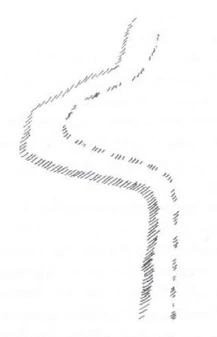
[ 7 ] But, gentlemen, if there were no salt deposits in the soil, plant roots could not grow in the soil, for plant roots grow in the soil precisely because they, so to speak, obtain the soil’s salt as nourishment. The plant contains the most salt at the root, with the salt content decreasing toward the top, and the flower contains very little salt. So one might ask: How is it that our soil is able to produce plants? This is because the earth has a water cycle: just as in humans, the arteries carry blood out from the heart and the veins carry the blue blood back to the heart, so too on earth the waterways flow in one direction, and the salt veins flow back underground. Thus, there is also a proper circulation, a proper cycle.
[ 8 ] Why is it, in fact, that the Earth consists, so to speak, of a watery, salty mass on one side, solid land on the other, and then of fresh waters—the rivers that flow through the land—and that salt from the sea is constantly being carried into these waters in this way? Well, you see, when one examines the actual saltwater—the highly saline seawater—one comes to realize that this saline seawater has little connection to outer space. Just as, for example, our stomach has little connection to the outside world—except through what it takes in—so too does the interior of the sea have little connection to outer space. In contrast, for the Earth, everything that constitutes land—where bodies of water flow through, where plants are produced by salt deposits, but especially where the waters flow through—is in a very close relationship with outer space.
[ 9 ] When we look at it this way, gentlemen, we approach the mountain springs in a completely different way! We take pleasure in the fact that the springs trickle and flow beautifully, that their water is so wonderfully pure, and so on. But that’s not all! The springs are, in fact, the eyes of the Earth. The Earth cannot see out into outer space through the sea, because the sea is salty, and that makes its interior just like the inside of our stomach. The springs, which have fresh water, are open to outer space and are like our eyes, which also open out into the open. So we can say: In the lands where there are springs, the Earth gazes far out into outer space; there lie the Earth’s sensory organs, while the Earth’s body—more like its inner workings—resides in the salty sea. Of course, it’s different from the human body; these aren’t the kind of enclosed organs, nor are they organs that can be fully mapped out. One could map them out, but they are not so visible. Yet the Earth has its inner organs in the sea and its sensory organs on land. And everything through which the Earth is connected to outer space comes from fresh water. Everything through which the Earth possesses its inner organs comes from salt water.
[ 10 ] Now I will provide you with proof that this is so. You see, I once told you: Human and animal reproduction is also connected to the celestial realm. I told you: This does not depend solely on the fact that the egg—the embryo in the mother’s womb—develops only within that womb; rather, forces from the universe act upon it, and it is precisely because these forces from the universe act upon it that the egg takes on its rounded form. Just as we see the movement of the universe as round from the outside, so this little egg is a reflection of the universe, because forces act upon it from all sides. So where procreation takes place, the heavenly realm is actually at work on Earth. You can see the same thing in the eye: it is a sphere. I described that recently. It, too, is formed from the universe. The sense organs and the eye are formed from the universe. If you look at the spleen, it is not spherical, but is formed more by the Earth, by earthly forces, by the Earth’s visceral forces. That is precisely the difference.
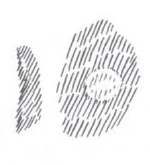
[ 11 ] If you just pay close attention to these things, you’ll find—I’d say—evidence. I said I’d provide you with evidence later on regarding what the sea and the land are. Now I’d like to interject something. I’ve already told you: Some time ago, we conducted experiments in our biological laboratory on the importance of the spleen. The spleen serves the purpose—when we cannot eat regularly—and we all eat more or less irregularly—of balancing all of that out; it is the regulator. We provided proof of this in our biological laboratory. There is, in fact, a little booklet by Mrs. Kolisko that describes all of this. During these experiments, we were also compelled—because that is what modern science demands—to provide tangible proof, visible evidence. This will no longer be necessary once science comes to believe in supernatural evidence, but today it is still necessary. So we took a rabbit—which, of course, we had not otherwise harmed; it can be done with the utmost care—removed its spleen, and let it continue to live. It went quite well. The rabbit would not have died from the spleen operation, but it caught a cold due to a mishandling and perished as a result. Then we dissected it and were, of course, very curious to see what had become of the spleen that had been removed. What must be said from the perspective of Spiritual Science? What remains, then, when the physical spleen is removed? Well, don’t you see: when the spleen is present (see drawing), and you cut it out and remove it, what remains in its place is the etheric body of the spleen, the astral body, and so on. The spleen is formed from the earth, and that is why it has its shape. If one now removes the physical spleen, and only the etheric spleen remains inside—as was the case with the rabbit—what must happen then? Well, gentlemen, this is what must happen: While the physical spleen is dependent on the Earth and tends toward it, the etheric spleen—which has become completely free and is no longer weighed down by the physical spleen—must now come under the influence of the heavens once more. And one must assume that something like a reflection of the heavens arises there. And lo and behold, when we dissected the rabbit, there was a small, round body inside, formed of fine white tissue! So the matter was entirely consistent. What had to happen according to the principles of Spiritual Science has occurred. A small, nut-sized body of tissue has formed there in a relatively short time. So you see, one need only approach the matter correctly, and then one finds evidence everywhere for what Spiritual Science must say. From this you can conclude that what can be spiritually explored—and uncovered by tracing the process in the right way—actually occurs in the physical realm.
[ 12 ] Just as the white body has been formed here by the surrounding influences, so too does the human, animal, and other potentials first take on a spherical form within the single germ through the influence of the heavens.
[ 13 ] Now that we know this, we must say that fish are in a special situation, for they never actually come ashore. At most, they can gasp for air a little on land, but they cannot live on land; they must live in the sea. Consequently, fish are also very specially adapted; they do not reach the point where the Earth opens up to the cosmos. Therefore, it is very difficult for fish to develop their senses and, in particular, their reproductive organs. For this depends on the cosmic space in which they can exist. Fish must therefore make careful use of the little light and heat that falls into the sea from the universe so that they can reproduce and develop sensory organs. But nature provides for many things; you can see this in the so-called goldfish. They use their entire skin to absorb the influence of light; that is why they become so golden. Fish take every opportunity to absorb what enters the water from the cosmos. And they must lay their eggs wherever light can still penetrate, so that these eggs can be incubated from the outside. So fish are, so to speak, adapted to living underwater; they do not come out of the water. But what I am saying does not apply so much to freshwater fish—since freshwater is, in turn, permeable to the universe—but rather to saltwater fish. Saltwater fish, however, demonstrate everywhere that they are adapted to utilize everything that enters the saltwater from the universe in order to reproduce.
[ 14 ] Salmon, however, are a very strange exception. Salmon, you see, have a peculiar physiology. Salmon must live in the ocean in order to develop strong muscles. In order to nourish themselves properly for their muscles, they need the earth’s forces. These are found primarily in sea salt. It must live in sea salt in order to develop its strong muscles. But if the salmon lives in the sea, it cannot reproduce, because it is structured in such a way that seawater completely isolates it from the rest of the universe; and salmon would have died out long ago if they were to reproduce in the sea. Salmon are exceptions. While they build up their strength in the ocean—that is where they develop their muscles—they are, first of all, quite blind, and secondly, they cannot reproduce. Their reproductive organs and their sensory organs become weak; they are dulled. Salmon in the ocean, however, grow fat. Now, to prevent the salmon from dying out—we can see this in the salmon here in the North Sea and toward the Atlantic Ocean—the salmon migrates into the Rhine every year. That is why it is also called the Rhine salmon. But the Rhine makes the salmon thin; it loses its muscles again. What it gained in fat in the salty sea, it loses in the Rhine. The salmon becomes very slender; and its sensory organs—and especially its reproductive organs, in both males and females—develop enormously, enabling the salmon to reproduce in the Rhine. Thus, the salmon must migrate every year from the salty sea to the fresh-water Rhine so that it can reproduce. It must even become lean there, because the fresh water cannot support its muscle development. Then, when the adults are still alive and the young are present, the entire school migrates back to the sea to regain its fat after becoming lean.
[ 15 ] You see, gentlemen, this is entirely true. One can say that where the earth is salty, it exerts its influence through the forces of the earth. It acts upon those organs that are formed by the earth. Our own muscles are formed by the earth when we move under the influence of gravity. Gravity is the force of the earth. The earth acts upon everything muscular; the earth acts upon everything bony. The earth imparts its salt to us, and we develop strong bones and strong muscles. However, with this release of salt from the earth, we could do nothing at all for the sensory and reproductive organs; they would wither away as a result. They must always come under the influence of extraterrestrial forces—the forces of the heavens. And the salmon demonstrates this by the distinction it makes between saltwater and freshwater. It goes into saltwater to grow plump, absorbing the forces of the Earth, and to become capable of reproduction, it goes into freshwater, absorbing the forces of the heavens.
[ 16 ] So one could say: The Earth also has a kind of cycle when it comes to animals, as is the case, for example, with salmon. This cycle alternately drives the salmon out to sea and back into the river. So it goes there and comes back, back and forth. The entire salmon population goes back and forth. The salmon really illustrate how everything in life on Earth is in motion.
[ 17 ] When you come to understand the salmon in this way, you also gain a picture of something else that is always before our eyes and that is such a wonderful spectacle: migratory birds. They simply fly back and forth through the air; the salmon swims back and forth through the water. Salmon runs in the water are just like bird migrations in the air, except that salmon move back and forth between saltwater and freshwater, and birds move back and forth in the air between colder and warmer regions that they need. Anyone who understands salmon runs also has a picture of bird migrations. And one can say: All of this is connected to the fact that birds, too, must migrate south to access the right thermal earth forces; there they develop their musculature further. To access celestial forces, they must enter the purer air of the north; there they develop their reproductive organs. These animals need the entire Earth. Only the higher animals—the mammals—and human beings have become more independent of the Earth; they have emancipated themselves more from the Earth and have become more independent in their entire organization.
[ 18 ] But that’s just how it seems to us. You see, we humans are actually always two people. We are, in fact, even more than that; as I’ve told you: the physical human, the etheric human, and so on. But even within the physical human, we are in fact two people: a right-side human and a left-side human. The right half of the body is, after all, vastly different from the left. I believe very few of you sitting here will be able to write with your left hand; we write with our right hand. But the part of the nervous system associated with speech, for example, is located in the left hemisphere of the brain. There are strong convolutions there; in the same area on the right, there aren’t any. Only in left-handed people is it the other way around. Those who are left-handed have their language centers on the right—but not the external structure, only the internal mechanisms that stimulate language. You see, gentlemen, one can say: Human beings are colossally different on the left and right. But this is also true in other respects. The heart is shifted more to the left; the stomach is on the left, the liver on the right. But even those organs that are otherwise symmetrical are not entirely so in reality. Our lungs have two lobes on the left and three on the right. So the right-sided person is very different from the left-sided person. Where does this come from? Well, let’s start with something very simple. We don’t usually learn to write with our left hand; we learn to write with our right. This is an activity that depends more on the etheric body. The physical body is heavier and more developed on the left, while the etheric body is more developed on the right. The left-handed person develops two lobes; the right-handed person, being more active and bringing more life into the lungs, develops three lobes in the lungs. It is the case with human beings that on the left they are more physical, and on the right more etheric. And so it is with language as well. In right-handed people, nourishment to the brain is more necessary on the left than on the right. And in this way, everything in the human being is arranged so that on the left the human being contains more of the earthly forces, and on the right more of the etheric, heavenly forces.
[ 19 ] You see, gentlemen, our current science, which focuses solely on matter and consequently knows very little about the material world, actually promotes the absurdity in children’s education that children should learn everything in the same way on both the left and the right. Yes, human beings are not at all designed for that! If this is taken to extremes, people are effectively raised to be half-mad, because the human body is designed such that the left side is more physical and the right side more ethereal. But what does today’s science care about the physical and the ethereal! For it, everything is the same—whether a person is left-sided or right-sided. One must be able to penetrate these matters through Spiritual Science if one wants to understand them at all. So on the left, the human being is more earthly; on the right—if the word is not misunderstood—one might say more heavenly, more cosmic.
[ 20 ] Well, human beings have already emancipated themselves to a great extent from the Earth. As I have told you, they shape this left-hand earthly aspect and this right-hand heavenly aspect in such a way that they can carry them about as physical human beings, and one no longer really notices that they are inclined toward the Earth on the left and toward Heaven on the right. But there are people who are more inclined toward the Earth; they usually sleep on their left side, lying on their left side. People lie on their right side either when they are tired of the left side or when they are more engaged with forces that are more inclined toward the heavenly. Such things are, of course, difficult to observe, because all sorts of other factors come into play. After all, it may simply be that when a person lies on their right side, that side of the room is in the dark; so they have a reason for it. It is difficult to observe through thoughts or other factors, but in general it is likely that people have a natural inclination to lie on their left side when sleeping, because that is the earthly side. But there’s no need to pay attention to this at all, because people are emancipating themselves from the earth and becoming independent of it in their actions. However, one can observe this in animals. Everywhere, one sees the mysteries of the world revealing themselves in a very remarkable way.
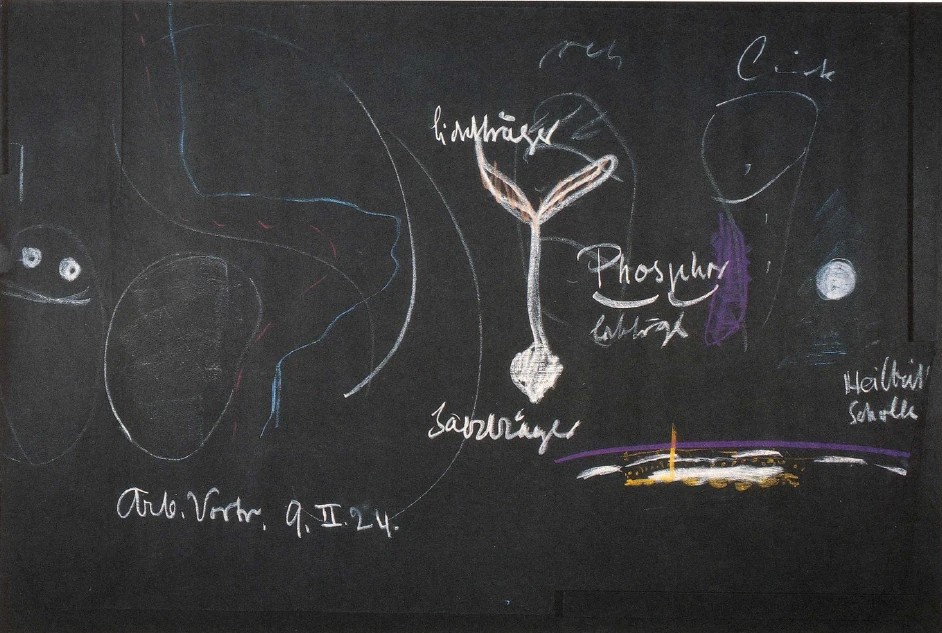
[ 21 ] Imagine that this is the surface of the ocean (see Figure $92), with salty seawater below, containing all sorts of other substances. Now there are certain fish that are organized in a very peculiar way. These fish are organized in such a way that they are strongly drawn toward the earthly forces, while the other fish actually snap voraciously at everything that enters the water from the light and air. Since they have no lungs, they cannot breathe in the air; they die in the air, perish, but with their gills they snap at everything that enters the water from the air and light. But there is one fish—in its larger species it is called halibut, in its smaller species plaice—this fish is a very nutritious fish, containing a great deal of nutrients, almost the most of any fish. This already shows that it is drawn to the earth, because the nutrients come from the earth. The halibut, so to speak, is in tune with the earth. What, then, can we expect from these fish?
[ 22 ] We can expect them to express this outwardly in their lives as well—that they are attuned to the earth. And they do express this. They lie on one side; that side turns pale, white. And they lean so strongly to one side that their head turns and their eyes end up facing the other side. So that such a clod looks like this from below (see drawing on the left).
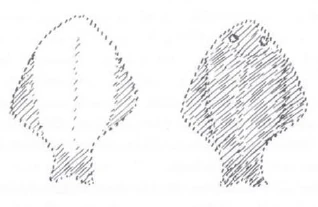
[ 23 ] There it is completely flat and white; and from the other side, from above, the two eyes are on one side; the head is turned because it always lies on its left side, so to speak. The left side becomes entirely the nourishing side, pale and white. The other side takes on the color of the sky and so on, becoming bluish, brownish, and the eyes even turn away from the feeding side; the head turns around. Such a flounder is entirely one-sided, with its eyes and all its organs on one side; the other side is flat and pale. Halibut really do develop a lot of nutrients within themselves because they lean toward the earth. Some of them weigh over three hundred kilograms. So they are large fish. They are fished extensively for food. Now, these halibut clearly demonstrate this: their bodies are oriented toward the earth; they always lie on one side. And they lie so heavily on that one side that if a person could lie on their left side every night, their head would turn and they would always be looking toward that one side as well. But with humans, it doesn’t go that far. Humans are, after all, emancipated from the earth; humans remain independent of the earth.
[ 24 ] But certain things can already occur in humans; for example, one might encounter a person with a peculiar condition—namely, that he sees slightly better with his right eye, or with one eye in general, than with the other. If this is not congenital, one usually finds out by asking that the person lies on the other side when sleeping. The earthly forces act on the side on which one lies very frequently; the eye becomes somewhat weaker, more nearsighted. The effect is not as strong as with the halibut, but it is noticeable to some extent. The eye that tilts outward toward the sky—the one turned away from the earth—becomes slightly stronger. You see, the connections are that remarkable. I’ve said: Nature shows us, in one way or another, the forces with which it works. When you look at this flounder—you can see this small flounder everywhere in fish markets; the large plaice are in the sea, in saltwater—one says to oneself: Only what is filled with nutrients can form there; that must be dissolved. If these animals want to receive something from the sky, then they must always turn the other side toward the sky; then their eyes tilt that way, and the animals thereby also become capable of reproduction. So they do it differently than the salmon. The salmon migrates; it travels from the North Sea into the Rhine, and from the Rhine into its tributaries, in order to reproduce. The plaice lie on one side so that the sky can act upon them from the other side, enabling them to have senses and to be capable of reproduction.
[ 25 ] And the Earth itself—what does it do? Yes, gentlemen, if there were only salty seawater, the Earth would have perished long ago, for it cannot exist on its own. It has not only the salty seawater, but also the fresh water, and the fresh water absorbs the life-giving forces for the Earth from the heavens. The salty sea cannot bring in from the vastness of the universe that which continually refreshes the Earth. When you go to a spring and the wonderfully pure water trickles out of it: you’ll notice that near the spring, there’s a gurgling sound, it smells so wonderful, and everything is so fresh. Yes, that which is fresh near the spring also refreshes the entire living Earth. There, the Earth opens up to the cosmos as if through its own eyes and senses. And you can still see this in animals like the salmon and the flounder: they go where that is; they have a kind of instinct to stay true to what the Earth is. The salmon seeks out the fresh water directly. The flounder turns toward the light by orienting its body in that direction. It cannot reach the springs. But the springs are like the flounders; they are the places on Earth where the Earth turns toward the light. The flounder, the fish, must turn directly toward the light with its own body.
[ 26 ] These things are immensely instructive because they reveal what still exists within human beings, but can no longer be observed so clearly in them, since—as I have told you—they have emancipated themselves from the earth. But if one is not at all attentive to such things, then one does not really understand the whole of earthly life at all. It is truly the case that one can say: Let us look out at the sea and see these sandbars there; we can see everywhere that the sea opens up to the sky through the sandbars! These sandbars are proof that the sea thirsts for the sky, because its salinity turns it away from the sky! One could say that the sandbars express the sea’s thirst for light and air. And when we look at our own circulatory system, we find that in the places where we become saltier—where the muscles are located—we also have delicate sensory organs: the tactile organs. There, the human being opens up to the outside world—not as with the eyes, where one opens directly to the light. These are, so to speak, the places where the sandbars are located in the sea. These sandbars open themselves to the sky. And the sky, in fact, also gives them extraordinary intelligence. Just as we become skillful when we can make good use of our external tactile organs, so too do the flounders become skillful because they open themselves to the sky. What lies down below in the sea—just observe it for a moment—is clumsy and awkward. The flounders, oh, they become incredibly skillful; they become clever creatures precisely because they turn away from the sea on one side. Even as they turn toward the earthly forces, they say: the earthly forces remain to themselves, accumulating nutrients—up to three hundred kilograms, as I said—but they have these delicate organs through which they open themselves to the heavens. The flounders eat the other fish—namely, the smaller ones. But you see, when a flounder like this approaches—especially since it’s like a ghost to the other fish—the other fish would swim away in both directions, because they consider it necessary to have eyes on both sides and for those eyes to be equally developed on both sides. To the other fish, the flounders are just like a person approaching them; the fish would quickly swim away, and the flounders would have nothing to eat if they weren’t smarter than the others. But the other fish, which have eyes on both sides, aren’t quite as smart, because they don’t turn toward the heavens as strongly. Flounders seek out places to settle in the shallower parts of the sea, where the ocean has a narrow shoreline. With its flat body, the flounder burrows into the seabed, using its mouth to cover itself with a little sand, then stirs up sand—but so finely that a fish can swim through it. Then the fish and crabs come along, unaware of the flounder, and in a flash, as the fish swim by, the flounder snaps and snaps at them! The flounder does this with extraordinary cleverness! But of course, only an animal that connects, so to speak, in a subtle way with the celestial forces—the forces of the universe—can do this.
[ 27 ] On the one hand, such an animal has developed its physical body; on the other hand, it develops its invisible etheric body with particular intensity. It is precisely from such things that we can see how everything within us—including our spiritual powers—does not originate from the forces of the earth. The forces of the earth make us muscular and provide us with minerals, while the forces of the heavens actually give us those powers that are both reproductive and spiritual, as well as the powers of intelligence.
[ 28 ] You see, the thing about human beings is that they are, in essence, a tiny globe. After all—as I’ve told you time and again—the human body is ninety percent water. In fact, a human being is also a fish, because what constitutes the solid part of a human—the part that’s swimming in that water—is really only ten percent. Essentially, we are all fish swimming in our own water. Even conventional science acknowledges that, for the most part, we are essentially a small sea. And just as the sea sends out rivers, so does our sea—our fluid body—send out salt-free fluids. We also have our own freshwater currents. These lie outside the muscles and bones. In contrast, within the muscles and bones we have the same salt deposits that the sea has. That is actually where our nourishment lies—in the muscles and bones. So in this respect, we are already a small globe; we have our own salty sea within us.
[ 29 ] If a person’s bodily fluids—his “freshwater currents”—become too strong—which can easily happen in children if their milk is not salty enough—then he becomes rachitic and contracts what is known as rickets. If a person consumes too much salt, they become too “seawater-like”; their bones become brittle, and their muscles become clumsy and uncoordinated. In humans, there must always be a balance between salt intake and the salt content found in other foods.
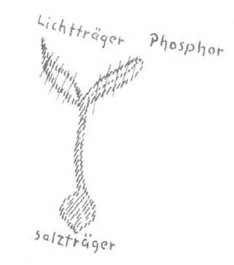
[ 30 ] Well, what is found in other foods? Gentlemen, take a look at a plant. You now know that plants grow because the rivers that flow into the sea carry these salty currents back inland, where they then spread out and cause the plants to grow. So, in the earth, the plants have their salt inside—in the roots. But as the plant grows out of the earth, it moves more and more toward the flower. The flower becomes beautifully colored because it absorbs light. Out there in the flower, the plant absorbs light; in the root, it absorbs salt. Out there, the plant becomes a bearer of light; down below, it becomes a bearer of salt. Down below, it becomes like the oceanic part of the Earth; up above, it becomes like the sky. The root is rich in salt; the flower is rich in light. In earlier times, people understood this much better. That is why they called what is in the flower “phosphorus.” Today, when everything is materialistic, phosphorus is seen as nothing more than a solid substance. Phosphorus: “phos” means light, “phor” means bearer; phosphorus means “bearer of light”; phosphorus was actually what carries the light within the flower. People simply called the mineral phosphorus “phosphorus” as well, because all you have to do is light it to see light emanate from it. But the true bearer of light is the plant flower. The plant flower is phosphorus. So we can say: For those organs in our human body that, in a sense, contain the freshwater currents, we need light; we need what the plants give us when they reach toward the light. For the muscles, for the bones, and for that which is to become salty within us, we need salt and the solid nutrients in our food. And there must be the right balance between them. One or the other must enter our bodies in the right measure.
[ 31 ] But that’s how it is with the Earth, gentlemen. Yet no matter how far you’ve traveled, you haven’t seen it—and neither the globetrotters nor the true world travelers have ever seen anywhere that the Earth has cooked anything for itself, cooked a midday meal! And yet, it sustains itself; substances are constantly being exchanged, for what constitutes the Earth is continually rising through the mist and fog. And as you know: the rainwater that falls is distilled—that is, it is pure water, containing nothing. But the Earth sustains itself in a subtle way from outer space; it does not need to eat meals. Only we humans—precisely because we have emancipated ourselves from the Earth—must first obtain our food from the Earth. The Earth itself nourishes itself from the subtle substances that are present everywhere in the universe. It is constantly “eating,” but we do not notice it because it does so in a subtle way. But you see, if one observes a human being rather crudely, one does not notice that he is constantly taking in oxygen. In the same way, one does not notice that the Earth is constantly drawing its nourishment from outer space.
[ 32 ] Well, gentlemen, we humans eat our meals. We consume food through our stomachs into our lower abdomen. That is quite clear—terribly clear. But when it comes to breathing, things become less clear again. And it is precisely this clarity that gives rise to social issues: one person is better off, another worse off. Everyone wants to be well off; social issues arise in relation to what is clear. But social issues become less clear when it comes to the air we all breathe. It doesn’t work so well for one person to take it away from another; it works to some extent, but not so well. With our lower abdomen, we are quite different from the earth. Through our breathing, we become more like the earth; this happens more imperceptibly. For we are constantly—not only through hearing—absorbing iron through our ears; we finely, finely inhale iron. Through our eyes, we take in light, but also constantly absorb substances. This can be seen in those who lack these substances. We take in an enormous amount of substances through the nose, in particular, without even noticing it. With our lower body, we have emancipated ourselves from the Earth, set ourselves free. There, we can only absorb those foods that the Earth produces and then binds together, making them denser. We can, however, take in the air as it exists in outer space. And with our head, with our senses, we remain fully connected to the Earth. There, we also take in nourishment from the cosmos in the same way that the Earth itself takes it in. It is no coincidence that the head is spherical, modeled after the Earth. For it functions exactly as the Earth does in relation to outer space. Only downward—that is where gravity comes in. There, the human body is shaped after the Earth: physical hands, where gravity pulls downward. Gravity has little influence on the head; it remains round. Therefore, one must also transition from the visible to the invisible in this regard. One must tell oneself: The crustaceans would perish, even though they eat fish and crabs—for the fish and crabs are of use to them only for their pale, flat abdomen—if they did not, by making themselves one-sided, absorb in a certain way that which comes from outer space. These are the beautiful, subtle connections, gentlemen, through which one looks, I might say, into the laws and mysteries of the universe.
[ 33 ] This is precisely what the Spiritual Science must repeatedly emphasize: that the true laws are recognized not through crude observation, but through subtle observation.
[ 34 ] So we'll continue on Wednesday at 9:00 a.m. If you have any questions, please ask them.