

A Spiritual Scientific View
of Nature and Man
GA 352
13 February 1924, Dornach
Translated by Steiner Online Library
6. On Human Clothing
[ 1 ] Good morning, gentlemen! Have you thought of anything you'd like today?
[ 2 ] Mr. Burle: If I might ask the doctor about human clothing—the garments that people wear. In some countries, people have nothing but a ragged scrap of cloth that they drape around themselves; others are fully buttoned up. Some wear dazzling colors, while others wear plain ones. Then there is the question of national costumes—what the various peoples, or the people in question, actually wear. And also, what the waving flags represent—and, perhaps related to that—what kind of ecstasy they evoke?
[ 3 ] Dr. Steiner: As far as human clothing is concerned, a great deal of thought has been given to this topic, because, as you can imagine, there are very few external records and historical documents available on this very subject.
[ 4 ] You see the clothing worn by simpler peoples and tribes; after all, you also see the clothing worn by the people in the city to which you yourself belong. And finally, you see what you yourself wear—though you actually care the least about what you wear. In this matter, one simply goes along with what has become the custom. Yes, after all, to a certain extent one must do it simply because otherwise one would be regarded as at least half a fool, if not a complete one.
[ 5 ] Well, isn’t it true that the first question here—the one that is perhaps the most difficult for an external science to answer, precisely because, as I said, external written records are so scarce—concerns the reasons why people originally began to wear clothing. If one really takes into account everything that can be surveyed in this regard, one must conclude: Certainly, much of what we see in clothing has already emerged from the human need for protection—from the need to protect oneself as a human being against the influences of the environment. You must consider that animals have their own protection. Animals have, to the greatest extent possible, protection against external influences—which cannot penetrate through fur, skin, and so on—into the more delicate, softer parts of their bodies.
[ 6 ] Now you might ask yourself: Why doesn’t man possess this protection by nature? — I don’t want to place too much emphasis on this question, which always asks “why,” because in nature it is not really entirely justified to ask “why.” Nature simply presents beings as they are, and one must simply examine them as they are presented. The “why” is never entirely justified. But I’m sure you’ll understand me when I nevertheless ask: How is it, actually, that human beings must go through the world in this way, stripped bare by nature?
[ 7 ] We must then ask ourselves another question: Is this covering that nature has given the animal not quite clearly connected to the animal’s lower level of mental organization? And it is. You see, gentlemen, it is indeed the case that sometimes the parts of a living being—that is, of an animal and also of a human being—that are most important are not the ones that appear to be the most important in outward life. We can point to certain very small organs in the human organism. If they are not as they should be, the entire human organism breaks down. For example, here in the thyroid glands on both sides there are very small organs—I have mentioned them to you before in another context—that are barely as large as a pinhead. One might think that they are not very important. But if a person ever needs surgery for a thyroid condition or goiter, and the surgeon is clumsy and accidentally removes these tiny, pinhead-sized organs as well, then the entire organism becomes ill. The person becomes mentally dull and gradually wastes away. So these small, tiny, pinhead-sized organs are of the utmost importance for the entire human life! They are so important because these organs secrete a very fine substance that must flow into the blood. And the blood is useless if these organs are not present and their secretions do not flow into the blood. So you can see that even organs that are not usually given much attention in this context are of the utmost importance to the being in which these organs are located.
[ 8 ] Take, for example, the animals in the animal kingdom that have hairy skin. Well, you might think that hairy skin is good for keeping the animals from freezing in the winter and so on. Certainly, it serves that purpose as well. But for this hair to develop on the skin, the animal must be exposed to particularly strong sunlight. The hair develops only because the animal is exposed to strong sunlight.
[ 9 ] You might say: Yes, but hair doesn’t grow everywhere—only where the sun’s rays could reach! —And yet that is the case. It even goes so far that the human embryo, in its earliest stages while being carried in the womb, is indeed covered in hair. You might say: “It isn’t exposed to the sun.” It loses this hair later. And every human being who is born was actually completely covered in hair during the first weeks of the mother’s pregnancy. It loses this hair. Where does this come from? It comes from the fact that the mother absorbs the sun’s energy, which then works internally. The hair is intimately connected to the sun’s influence.
[ 10 ] Take the lion, for example. The lion, whose males have this mighty mane, is an animal that is exceptionally exposed to the sun’s rays. As a result, the lion has highly developed thoracic organs—which become particularly strong under the sun’s influence—as well as a short intestine and powerfully developed lungs. This distinguishes it from our ruminants, which have more highly developed organs in the lower abdomen—the intestines, stomach, and so on. The way an animal is covered in fur, feathers, and so on is therefore primarily related to the effects of the sun.
[ 11 ] But then again, when the sun’s influence on a being is very strong, it follows that this being allows the sun to be thought within itself, to be willed within itself: it does not become independent. Human beings derive their independence precisely from the fact that they do not have this external protection, but are more or less exposed to the influences of the earthly environment. It is even interesting to note how animals are less dependent on the earth than human beings. The animal is largely shaped from outside the earth. I have, after all, provided you with evidence for these things throughout. But human beings emancipate themselves entirely from these external natural influences. And this is because they have, so to speak, unprotected skin on all sides and must therefore seek their own protection.
[ 12 ] You can already see from our everyday clothing that it is actually made up of two parts. One part is evident in the fact that in winter we put on a winter coat to protect ourselves from the cold. That is the part of clothing through which we seek protection. But that is not the only one. You can see, for example—especially with women—that they do not merely seek protection through clothing, but rather arrange it so that it is beautiful; sometimes it is indeed hideous, but it is meant to be beautiful. Of course, it depends on taste or lack thereof, but in any case, it is meant to be beautiful; it is meant to adorn. These are the two functions of clothing: to offer protection against the outside world and to adorn.
[ 13 ] One aspect of this function of clothing developed more in the north, where protection is needed. That is why clothing there is more about protection. When it comes to protection, people don’t exactly take it to extreme lengths. In warmer regions, however—in regions where entire populations actually go about nearly naked—adornment constitutes the little that you see, or, even when they wear more, it makes up the main part of their clothing.
[ 14 ] But you will now realize that it is precisely from the warmer regions that higher civilization has emerged, and that intellectual life has originated more from the warmer regions. Therefore, when we examine clothing, we can always see that, in a certain sense, the type of clothing intended to protect people from the external influences of their environment has remained imperfect. In contrast, clothing intended to adorn has undergone all manner of refinement. Of course, what comes into play here is people’s individual tastes, doesn’t it? The entire spiritual orientation of people comes into play here. Let us take, for example, more primitive peoples—simpler, more unspoiled ones. Such peoples have a strong sense of color. We in our parts of the world, who are—or at least believe ourselves to be—so intellectually advanced, do not possess the same sense of color that more primitive peoples have.
[ 15 ] But these more primitive peoples have an entirely different understanding. Namely, they believe that there are spiritual and supersensory aspects to human beings. In so-called civilized regions today, people no longer believe that there are individuals who are not as intelligent as civilized people wish to be, but who nevertheless have a sense that human beings possess a supersensory aspect. And they perceive this supersensible aspect as colored. This is the case with simple peoples: they perceive the supersensible part they carry within themselves—what I have called the astral body—as colored, and they wish to make visible within themselves that which is invisible. So they adorn themselves in red or blue—or similar colors—depending on whether they see themselves as red or blue in the astral realm. This stems from the perception these people have of the spiritual world.
[ 16 ] The Greeks, for example, saw how the human etheric head is much larger than the physical head, how it protrudes, and so they endowed Pallas Athena, this goddess, with a kind of helmet. But you can see for yourself: if you take this Pallas Athena and examine the helmet she wears, the helmet has something like eyes at the top. You can see this everywhere; just look at Pallas Athena—even in a poorly made statue, there are eyes at the top of the helmet. This proves that people believed it was truly part of the body. That’s something you can see, too; they put it on Athena.
[ 17 ] And the style of clothing worn by people in those regions where they had a sense of the supersensible nature of human beings was also adapted to their mental image of the human astral body.
[ 18 ] Well, in our regions—as you well know, gentlemen—only the ritual garments in the true sense are still made in color. If you look at what liturgical vestments are, you’ll see that they are modelled entirely on the mental image of the astral body. So the color scheme, as well as the shape and form of the vestments, are essentially derived from the supersensible realm. And only when one understands this does one grasp the extent to which the vestments are designed as adornments. That is also very important. If you look at paintings created by the old masters, you will see: Mary, for example, always wears a very specific dress and a very specific cloak, because this is meant to suggest what she is like in her astral body, her heart, and her spirit. This is meant to be conveyed through her clothing. If you compare paintings in which Mary and Mary Magdalene appear together, you will always find that the old painters viewed Mary and Mary Magdalene differently—just as differently as they are depicted—because this is meant to be rooted in their astral bodies, and the clothing is designed to reflect the coloration of those astral bodies.
[ 19 ] We civilized people have simply become immersed in materialism, so we no longer have any sense of this supernatural side of humanity. We think with our earthly intellect and believe that the earthly intellect is master of everything. Yes, gentlemen, that is why we no longer have any sense of dressing in a way that makes what we wear look even remotely human! We men stick our legs into tubes. Of all the garments that have ever appeared in the world, the pair of pants is surely the most unadorned! But we do much more than that; when we want to be especially elegant, we also pull a so-called “fear tube” over our heads. Just imagine the mental image of an ancient Greek’s face if he could rise from the dead and encounter a person with both legs stuffed into tubes and, on top of that, a tall “fear tube” up there—and black at that! The Greek wouldn’t think that was a human being, but rather that he was facing an unbelievable specter! You just have to take that in. And things even go so far that, in a completely abstract way, you cut off such flaps from a coat that’s already ugly enough; then you call it a tailcoat. Yes, that’s something that shows, far more than anything else, just how thoughtless humanity has actually become. Just because people are used to it—and because, as I said, you’re regarded as a half-fool or a complete fool if you don’t go along with it—they just go along with it. But one must be aware that, in fact, the entire way men dress today is already somewhat reminiscent of a madhouse, especially when it’s supposed to be quite normal. This simply testifies to the fact that, little by little, we have become completely detached from any sense of reality,
[ 20 ] Women—whom many men believed to be less civilized than men—have, in their dress, remained somewhat more faithful to the traditional style. Today, however, there is also a trend toward making women’s clothing more similar to men’s, though it has not yet been entirely successful.
[ 21 ] To adorn—what does that actually mean? To present oneself outwardly in such a way as to give expression to what a person is, even spiritually! In this regard, in order to understand how, among more primitive peoples, everything related to clothing comes into being, one must be clear about the fact that among such peoples, people do not consider themselves to be as independent as people today do. Today, every person considers himself—with a certain degree of justification, even—to be an independent personality. Well, they tell themselves: I have my own intellect, through which I conceive of everything I am capable of accomplishing. — If they are particularly conceited, they immediately regard themselves as reformers, and so today we have almost as many reformers as there are people in the world. Thus, people today regard themselves as something absolutely independent. Well, this was not the case at all among earlier peoples and tribal groups. These tribes regarded themselves as a unity within their group and viewed a spiritual being as their group soul; they saw themselves as belonging together like the limbs of a body and regarded the group soul as that which holds them together. In this sense of belonging to a group, they imagined themselves in a very specific form. They then expressed this in their clothing. So, for example, when they imagined the group soul in Greece as having a sort of helmet-like extension on the head, they put on a helmet. And the helmet did not arise at all out of a need for protection, but because they believed that by wearing one, they would become more like the group soul.
[ 22 ] Similarly, some group souls have been conceived as eagles, vultures, other animals, owls, and so on. Clothing was then designed so that it was adorned in some way with feathers and the like, in order to resemble the group soul. And so, for the most part, clothing arose out of spiritual needs.
[ 23 ] In primitive peoples and tribes, their clothing reveals something of the mental image they had of their group soul. And if one encounters a primitive people and asks: How did they dress—specifically, how did they adorn themselves? Did they adorn themselves with feathers or with fur?” Then one can say: If one finds a tribe that adorns itself primarily with feathers, one knows that the collective group soul—which was, in a sense, their guardian spirit—was created with a bird-like mental image. If one finds that a people primarily adorned themselves with furs, then they created a mental image of their group soul—which was, in a sense, their guardian spirit—as either lion-like or tiger-like, or conceived of it in that form. So one can also see in this something that informs the design of their original clothing by simply asking: How did these people conceive of their group soul? - And what Mr. Burle said is quite correct: one person prefers flowing clothing, another prefers form-fitting clothing. — Flowing clothing developed because they wanted to make some sort of bird-like garments, garments with wings; they liked it when the garment was wing-like. And it even had a great influence on people’s dexterity when they acquired such flowing garments. And when they turned around, they simultaneously performed graceful movements with their arms. This is how they became dexterous and so on. One can certainly say: Adornment is the will to express the spiritual through garments of the times. And the mere act of protecting oneself—against which, of course, nothing should be said—is an expression of philistinism in people. The more one seeks to design clothing solely for the purpose of protection, the more one is a philistine. The more one seeks to adorn oneself, the less one is a philistine and the more one actually seeks to express through clothing the spiritual essence that lies in human dignity.
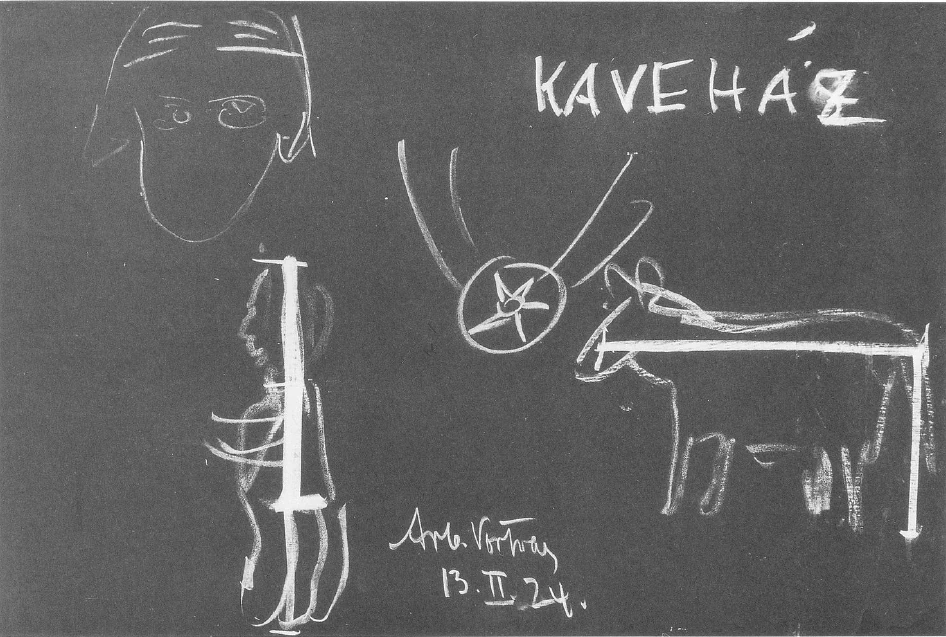
[ 24 ] It is, of course, natural that these things have shifted entirely in later civilization. One must, for example, be clear about the following. Imagine that such ancient peoples came to realize that the sun has a special influence on the human heart—and on the human chest in general—and they said to themselves: “I am a warm-hearted person only because the sun exerts the right influence. Not externally on the skin—otherwise I would become completely hairy—but the sun’s rays act on the heart from within.”—The heart is rightly associated with the sun’s influence. What, then, do people do who still have a vivid awareness of this connection to the sun? Well, you see, they tie a kind of medallion around their necks—a medal depicting the sun. And so they have something hanging down in front of their necks that represents the sun (see drawing). These people walk around wearing it, as it were, saying: “I acknowledge that the sun has an influence on my heart.”
[ 25 ] Later, of course, this was forgotten. Civilized people forgot that it was originally a symbol of the sun’s influence on the heart. But what once made sense has become a habit—a true habit. And out of habit, people then adopt such things without having the slightest idea why they were originally established. These habits develop first; later, states or governments take possession of such habits—they occupy them. This is, after all, what the so-called “progress” of states and governments mostly consists of: taking possession of what has become a habit. Someone discovers—it can only ever be a single person—let’s say a remedy. It comes from their mind. The government then sets out to lay claim to this remedy for itself and says: “Only if I permit it may it be sold here and there.”—So in the end, it all stems from the government.
[ 26 ] That’s exactly what happened with the sun medallion. People originally made it based on their own knowledge; later, they continued to make and wear it out of old habit; and then the governments said: No, you are not allowed to do this voluntarily; rather, we must first grant you permission to make and wear it. - And that is how orders of merit came into being! And that is how governments adorned their officials with these orders. Of course, the order no longer has even the slightest meaning. But anyone who criticizes these orders should also realize that they originally had a good purpose, and that they arose from something that was meaningful.
[ 27 ] You see, this is what happened to many original garments. The ancient Romans and Greeks still knew that when a person walks around showing his naked body, that is not the whole person—but that there is a supersensory body. They imitated this supersensible body in their toga, and that is how the toga came to be. The Romans thus sought to replicate the supersensible body. The toga is nothing other than the astral body. And in the folds artfully arranged in the toga, the forces of the astral body were revealed. And in more recent times, because people no longer knew anything about the true spiritual human being, they could think of nothing better to do than to take the old garments and—in order to make something new out of them—cut off bits and pieces from all sides: first shortening the part that reached nearly to the ground, then shaping it as much as possible so that one could slip into it, and gradually transforming it into what has become the modern men’s skirt. The modern men’s skirt is nothing other than the altered old toga; it’s just that one no longer recognizes it.
[ 28 ] Take the belt, for example. Yes, the belt came into being because human beings know: I am divided in the middle in a way that no animal is. — No animal, for example, has a diaphragm like the one human beings have. For no animal does this division in the middle here have such significance as it does for humans. Just compare the two. People today forget this in the most incredible way. For example, the height of a human is often compared to the height of an animal in order to determine, for instance, how much food the animal needs versus how much the human needs. But just think about it for a moment: there is an animal, and there is a human. Now someone measures the length of the animal, and he measures the length of the human. Well, gentlemen, can you really compare the two? That’s utter nonsense. What you’re measuring in the animal is merely the equivalent in humans; so you can only compare it to the animal kingdom if you measure the human’s length from the crown of the head down to the waist. Or if you want to compare that in humans with the animal, you can compare it with what the animal’s two hind limbs represent here. It’s really true that thoughtlessness sometimes goes terribly far.
[ 29 ] Well, as primitive peoples became aware of the significance of the fact that human beings have a division right in the middle, they symbolized this with a belt. Thus, a human characteristic was also symbolized by the belt.
[ 30 ] And you see, when human nature is properly understood, one realizes, for example, that there is a special power even in the act of squatting. And that is why the squat—which we can no longer particularly adorn today, since we have our skinny jeans over it—was once adorned. This then gave rise to something like the English Order of the Garter, in the way I have described. All these things arose from a genuine insight; they did not arise from the sort of terribly abstract, theoretical thinking that we have today.
[ 31 ] And, you see, modern clothing has also lost all its colors. Yes, why has it lost its colors? Because a sense of the supernatural is best expressed through color. And the more a person takes joy in color, the more inclined they actually are to grasp the supernatural in some way. But our age loves shades of gray—colors that are as undyed as possible. This is for the reason suggested by the proverb: “All cats are gray in the dark”—because modern people no longer look into the light at all; I mean, into the spiritual light. Everything has become gray for them. They express this best through their clothing. They no longer know which color to adorn themselves with, so they simply adorn themselves with no color at all. One does indeed come to realize that everything related to clothing is connected to what people still knew in ancient times—what they knew about the spiritual human being. Now, civilization as a whole has simply turned gray. But for certain purposes in life, the original colorfulness has remained, without anyone knowing where it actually came from,
[ 32 ] Uniforms such as those worn by our military in the modern state naturally originated in a time when people were increasingly dependent on defending themselves. And every single piece of military clothing can be examined to see if it is in any way connected to means of defense or means of attack; and basically, one can say that all military clothing is actually obsolete today—it can no longer be understood. You see, the modern civilian coat is understandable because it evolved from the Roman toga. The military tunic, however, can only be understood not by tracing it back to the Roman toga—to that drapery that has been distorted into a caricature—but by tracing it back to medieval chivalry, where the entire ensemble was a kind of armor. That is where the armor was redesigned.
[ 33 ] The flag was also mentioned (in the question). You see, the story behind the flag is as follows: Originally, the flag actually featured what is known as the heraldic animal—it didn’t necessarily have to be an animal—but what was the heraldic animal? It was precisely the group soul—that soul which held the people together. And when they were gathered in groups, they wanted to have that soul depicted before them. So they made the flag out of it. The flag is precisely the proof that the shared thoughts they have are embodied in this flag.
[ 34 ] It is especially important to realize this: Old painters were actually much more authentic in their entire approach to painting than today’s painters. Today, people mostly paint what are called “easel paintings”—that is, they paint pictures that are then placed in frames and hung up somewhere, simply because that is what we have become accustomed to. Basically, that makes no sense at all. After all, why should one hang a painting on a wall? That’s the question one must ask. In the old days, it was like this: there were altars; people painted images on the altars that they were meant to remember when standing before the altar. There were churches where people would walk around. They painted on the walls the things that were meant to come to mind one after another as one walked through them. Back then, it made sense; it had a connection to what was going on inside people.
[ 35 ] And, let’s say, in old knightly castles—well, what was knighthood based on? Knighthood was based on the fact that the people who belonged to it always looked up to their so-called ancestors. After all, one’s ancestors were much more important than oneself. The more ancestors one had, the more one was worth. That’s why the portraits of the ancestors were hung there. So there was a reason for that, too.
[ 36 ] But once that sense was lost, that’s when landscape painting really took off. And landscape painting—having a landscape hanging on the wall, right? Well, one can certainly have a soft spot for it. I certainly don’t mean to be harsh in this regard and disparage all landscape painting, but after all, a painted landscape can never be the same as actually going out into the landscape! And so, strictly speaking, landscape painting really only emerged at a time when people no longer had a true appreciation for nature.
[ 37 ] If you look at the paintings from a few centuries ago—yes, take a look at those by Raphael or Leonardo yourself—you’ll see: What is depicted are the people, and the landscape—only slightly suggested—is actually rendered in a childlike manner, because people agreed that the landscape should be viewed out in nature. But in a person, one can express many different things; a person is not merely nature—one can express many different things through them! And so Raphael was able to express many things in the figure of Mary. You may be familiar with the painting that hangs in Dresden: Mary with the infant Jesus on her left arm, clouds above; then, at the bottom, two figures: Saint Sixtus and Saint Barbara—this painting, which is called the “Sistine Madonna.” Yes, gentlemen, Raphael did not paint this picture to be hung up somewhere; rather, he painted only the Virgin Mary with the infant Jesus so that a banner could be made to be carried at the head of processions. Now there are these processions where people walk out into the field to the altar. There has always been a banner carried at the front. They would stop at the altar, where the people would then kneel. Later, someone added the figures of those who were kneeling—Saint Sixtus and Saint Barbara. They do not belong in the painting at all, and their depiction is terribly poor compared to what Raphael himself painted back then. But people don’t notice that. Some people admire the rather repulsive figure of Barbara in this painting just as much as they admire Mary and the Baby Jesus themselves!
[ 38 ] All of these are things that simply show you: We have strayed from what still made sense in painting. Why, then, did Raphael paint this picture for a church banner? For the reason that people were supposed to share this common thought when they were in their procession—which corresponded to the very purpose for which banners were made in the first place.
[ 39 ] Well, that’s when the desire arises to ascribe a certain meaning to what has been preserved from the old days, when things had real meaning. Today, you can visit places—Finland, for example—where people once again greet you in traditional clothing. Those who want to be particularly patriotic appear in traditional clothing—clothing that had been forgotten but is now being revived.
[ 40 ] But these people no longer live in the era when those ancient instincts existed, when clothing was imbued with meaning. Today, we would have to derive clothing precisely from what exists in spiritual life today, just as those ancient peoples derived their clothing from their sense of what they considered to be right in the world and for humanity. But people today lack the capacity to do this, precisely because they know nothing of the real—that is, the spiritual—human being. And so it has come to pass that we now have garments that are actually quite meaningless and are based solely on taking this meaninglessness to extremes.
[ 41 ] Humans originally wore belts. The belt expressed the idea that there is something special about human beings. The purpose of this belt was to convey that very idea. Later, however, people looked at the belt and saw that it divided the human body; they then used the belt to create that division themselves. Instead of the belt expressing something, in women’s clothing it often led to designing women’s clothing in such a way that it expresses nothing, but merely compresses the liver, the stomach, and all sorts of other things enormously. One could even say that a large part of what has emerged in the materialistic age has actually arisen out of meaninglessness—out of sheer meaninglessness. Even things that we must regard as nonsense today have had a certain significance among primitive peoples. Suppose, for example, that primitive peoples have the peculiarity of not clothing themselves by putting on garments, but of clothing themselves in a different way. Isn’t it true that clothing is actually what adorns, what adds something to what a person is? The significance of clothing is, in fact, a hint, a revelation. Thus, the invisible is to be revealed through clothing. Therefore, according to these primitive peoples—and they still believe this today, as do others—one does not necessarily need fabric to clothe oneself; rather, one can also clothe oneself by applying all sorts of designs directly to the body. In this way, one adorns oneself through what is known as tattooing. People thus apply all sorts of markings to their bodies.
[ 42 ] Yes, gentlemen, these marks that people make on their bodies originally had great significance. Suppose, for example, that a person carves a heart into his body. Well, when he walks around during the day, it doesn’t have much meaning while he’s awake. But when he sleeps, what he has carved into his skin makes a very profound impression on his sleeping soul, and it becomes a thought in his sleeping soul—one that he naturally forgets again in the morning when he regains consciousness. But this practice of tattooing originally arose from the intention of influencing a person even into their sleep. Later, however, even among primitive peoples, it lost its significance—at least to the extent that people now do it only out of habit, continuing the practice out of habit, but it has indeed lost its meaning.
[ 43 ] Well, don’t you see, you have to take all these things into consideration. Then you’ll see that clothing arose in part out of a need for protection, but for the most part—the greater part—out of a need to adorn oneself. And this adornment is connected to the act of revealing the supernatural to the outside world. And when it comes to clothing, people have come to know nothing more than that humans wear it. And that is how national costumes came into being. Of course, a tribe that is more compelled to protect itself will have close-fitting clothes, thick clothes, covering more or less the entire body with clothing—or at least those parts that are more exposed to the cold. A person in a milder climate, on the other hand, will place much greater emphasis on adornment, wearing thinner garments, flowing garments, and so on. It will therefore depend to some extent on the entire environment—on the climate—how a person partly protects themselves and partly adorns themselves. Then people forget this. When the great migrations occur, it can happen that a people from a region where the clothing was suited to the local conditions moves into another region where it is no longer at all clear why that clothing should be suitable for these people; yet they have retained it simply out of habit. And in this way, it is often very difficult today to understand, based on the immediate surroundings alone, why these people wear precisely this particular clothing. You can see, can’t you, that people simply stop thinking. They are like the polar bear, which has its white coat because it blends in with the Arctic snow and thus provides protection against all kinds of predators and so on—yes, if it were to wear it in a warm climate, it simply wouldn’t be protection, would it!
[ 44 ] That is how it is: People tend to stick with what they are accustomed to, even without being fully aware of the reason behind it. That is why it is not so easy today to determine, based on the way people dress, why one tribe or another dresses in a particular way. As I said, one must go back to earlier times to find the answer.
[ 45 ] For example, you will find that the traditional Magyar attire of the Hungarians is quite unique. The Hungarians wear somewhat high boots with tight shafts, tight-fitting trousers tucked into the shafts, and a close-fitting jacket. It has all been modernized and has lost its original meaning, but it points to what the Hungarian language also points to; namely, that it mostly uses hunting terms in its original forms! It is indeed very curious: When you come to Pest and walk down a street, for example, you might find a sign that says: “Kave Häz.” That is nothing other than a coffeehouse! Of course, this isn’t Hungarian or Magyar, but a slightly altered form of the German word. People say “Kave Häz”; that way, you don’t realize it’s actually a German word. But if you set aside the numerous words in Magyar that come from Latin or German, you’ll realize that they’re mostly hunting terms, and you’ll come to understand that the Magyars were originally a people of hunters. And if you look at the clothing, it is the kind that was originally the most comfortable for hunters. But it has since been modernized and altered. That much is still understandable. But when you look at today’s clothing, there’s not much left to understand.
[ 46 ] Well, Mr. Burle, has anything become clear from what I said
[ 47 ] Did I? Mr. Burle: Pretty much!
[ 48 ] Well, then let's continue the presentations next Saturday. Maybe one or two of you will think of something else you'd like to ask.