

A Spiritual Scientific View
of Nature and Man
GA 352
16 February 1924, Dornach
Translated by Steiner Online Library
7. The Effects of Arsenic and Alcohol on the Body
[ 1 ] Good morning, gentlemen! Do you have anything special in mind today?
[ 2 ] Mr. Müller: Yes, a quick question. The other day, the doctor spoke about arsenic and about the overweight children. Many years ago, I used to see such overweight children at the fair. It occurred to me later that the children who were shown at the fair were no older than eight, twelve, or sixteen years old. The children who were artificially fattened up for this purpose sometimes came from Hungary. And since the doctor said that arsenic is so easily found in the rock there, I would like to ask: How old can such children live to be—children who were artificially fattened up with arsenic to make them fat? Wouldn’t it be possible to take action against the
[ 3 ] Should we take legal action against people like this who raise children on arsenic, and work to ensure that the law prohibits this practice? Or is this simply being used in secret as a source of income?
[ 4 ] The doctor mentioned that people who were able to stop taking arsenic at a certain stage were able to lose weight again. That was not the case with these children; they were children who weighed nearly two centner, even though they were only about sixteen years old. Could it be that they are heading toward a difficult period after all?
[ 5 ] Then the doctor spoke about alcohol, explaining that our bodies actually produce alcohol on their own, and about the various effects of alcohol. One person gets terribly agitated, makes a racket, and so on, while another remains completely calm. For yet another, it affects their eyes, as is the case with me. After one, two, or three glasses, the next morning I have hard lumps in my eyes that are almost impossible to crush with my fingers—that’s the effect of alcohol.
[ 6 ] Then the doctor said that, in a sense, one could diagnose all diseases simply by looking at the eyes. Nowadays, there are also various people who, just by looking at urine, claim they can identify all diseases. There’s someone like that in Basel, too; is there any truth to that? I can’t believe it.
[ 7 ] I'd also like to ask: Is there any truth to the idea that when people receive a medicine somewhere and have a strong belief in it, does that contribute to their healing?
[ 8 ] Next, I’d like to address the doctor’s penultimate point regarding freshwater. There is a pond near Darmstadt into which hot water from the chemical industry constantly flows—it’s even steaming—and in this pond there are thousands upon thousands of goldfish, all of them completely dark red. How is that possible? They are completely dark red.
[ 9 ] Dr. Steiner: So the first point concerns children who are overweight. The fact is, as you correctly surmised, that these children—who are simply paraded around in all sorts of sideshows as peculiar curiosities—are artificially fattened using arsenic or similar substances—after all, many substances are similar to arsenic—. As one could easily verify, they are not particularly strong; rather, they are actually just fat and plump.
[ 10 ] Now, you see, this is actually much more complicated than what I told you recently regarding arsenic ingestion in adults. What I said back then referred specifically to adults. Under the influence of arsenic, they develop the conditions I described at that time. In the case of these children—against whom a kind of crime is indeed being committed, as cannot be denied—the effects of arsenic or similar substances, however, are based on something else entirely. These children are subjected to this criminal treatment roughly during the age range that I have always described to you as an important stage of life: the period between the change of teeth—that is, the ages of seven and eight—and puberty, which is around the ages of fourteen and fifteen. And, isn’t it true that at this age, a child is not merely someone you send to school—to the ordinary elementary school—because that is where they can learn best through human development, but at this age something entirely different also takes place.
[ 11 ] Remember, gentlemen, I have told you that a human being does not consist merely of this physical body that one sees with the eyes and can touch with the hands, but that a human being also consists of supersensible, soul-spiritual members. Now there is a subtle body of the human being, which I have referred to as the etheric body. In human development, one must pay just as much attention to this etheric body as to the physical body. If I were to sketch this out for you very schematically, we have the human being (see drawing) as regards his physical body; but surrounding this physical body—and also within it—is this subtle body, the etheric body. Furthermore, in addition to this physical body and etheric body—the etheric body, of course, cannot be seen with ordinary eyes—the human being possesses the astral body, which is capable of sensation. The plant also has an etheric body; it can grow—that comes from the etheric body. Human beings and animals have an astral body; they can perceive and feel. The plant cannot do that. I have told you that some people believe the plant can feel; but it simply cannot!
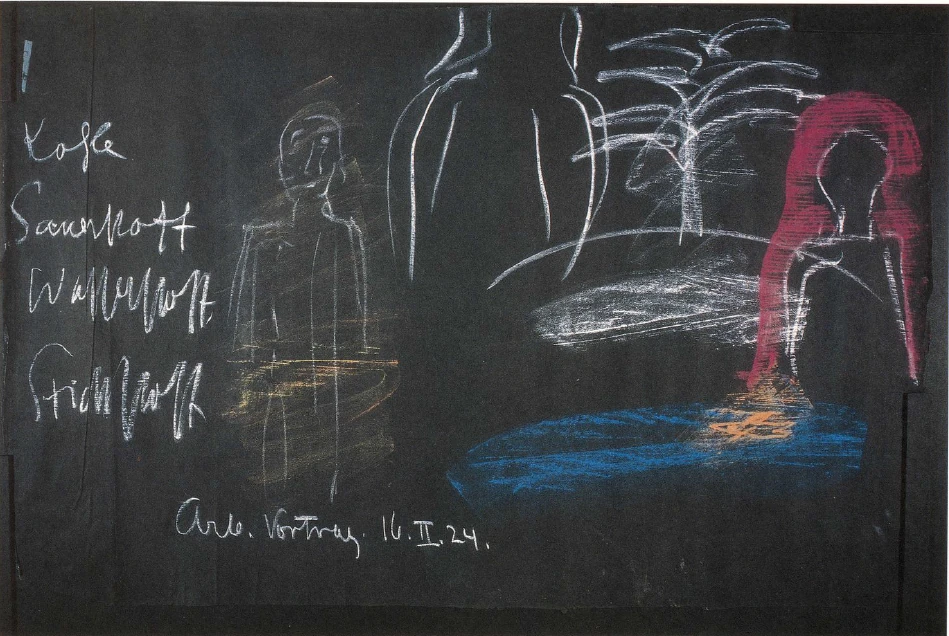
[ 12 ] You see, gentlemen, with every substance that affects a person, one must ask: On which of these bodies does the substance in question act? Arsenic, now, acts particularly on the astral body and has a particularly strong effect on respiration. Breathing is, after all, dependent on the astral body. So when one gives a person arsenic, all the effects caused by the arsenic arise indirectly through the astral body.
[ 13 ] As a person goes through the first years of life—from birth, let’s say, until the teeth begin to fall out around the ages of seven or eight—it is primarily the physical body that develops. You can see how this physical body develops. Look at a very young child who was just born; at that point, you can’t really tell yet whether the child resembles the father or the mother. That’s when, isn’t it, the aunts and uncles come around when a child like that is born. One says, “Oh, the child is the spitting image of the mother—especially the feet!” Another comes along and says, “But the child looks just like the father—you could hardly tell them apart!” - The fact is: The small child’s physical body is still in a very indeterminate stage of development, and only later can one see whom it resembles. Just consider an organ as expressive in a child as the nose, for example. A young child’s nose can look quite different from what it will look like later on. For some, of course, this change comes later, but as a rule, by the time the teeth begin to fall out, the nose—which develops relatively late in reaching its proper shape and form—has already taken on its proper form.
[ 14 ] Later, after the seventh and eighth years, the physical body actually only grows larger and becomes stronger in its muscles, but it already has its true form, its true shape, by the seventh year. So it is the case that between the first and seventh years of life, the physical body in particular comes to the fore. And between the change of teeth and sexual maturity—between the seventh, eighth, and the fourteenth, fifteenth years—the etheric body, in which the forces of nutrition and growth are contained, develops primarily. And the astral body does not begin to develop until between the ages of fourteen or fifteen and twenty or twenty-one. Only then does the astral body truly take shape. Not that it isn’t there before—a person has it from birth—but the actual development of the astral body does not occur until after the age of fourteen or fifteen.
[ 15 ] When an adult who is over fourteen or fifteen years of age ingests arsenic, his astral body has already developed. Although the arsenic now also affects them, their organism is still able to defend itself against it to some extent. But if a child between the ages of seven and fifteen is given arsenic, the astral body is not yet fully developed, so the arsenic affects the child with full force. There is no counteraction whatsoever in the human organism. And the consequence of this is that the effect of arsenic—which primarily causes fat deposits to accumulate in the human body, so that everything turns to fat—results in the body becoming more rounded and broader between the ages of seven and fourteen or fifteen.
[ 16 ] You must keep in mind that the things I’m telling you here are of immense importance for life! Isn’t that right? Each of you might say: “Well, you’re telling us that arsenic, if administered to a child between the ages of seven and fourteen or fifteen, is very important—it makes the child fat and round; but I know people who, even without being given arsenic, became terribly fat right from childhood!” - Yes, gentlemen, you just have to consider that the substances found in nature are present everywhere, at least in small quantities. And one could say: A person cannot nourish themselves at all—nor can a child—without consuming something that contains arsenic. Arsenic is simply present in food as well.
[ 17 ] Now, as you know, children have different tastes; one child likes to eat this, another that. And there are indeed children who particularly love foods that contain arsenic. Later in life, it also happens that you gain weight precisely from the foods you enjoy. If you eat things you don’t like, you’ll become skinny as a rail. If you eat things you enjoy and also have the time to indulge in them, you’ll get fat and plump. But this is especially true for children; and it is particularly true for children in this growth phase between the ages of seven and fourteen or fifteen. So if children have such a taste for foods that contain arsenic, they become plump and fat. But in the case of those children who are exhibited in show booths, at fairs, and the like—as the questioner mentioned—the arsenic is artificially introduced, just as it is in the Alpine countries, and the same is true in Hungary, where arsenic is contained in the rocks of the mountains. So these children are taught to consume arsenic, and the main point is that the child develops a taste for arsenic precisely at this age. It is abhorrent, but it is true: the child gradually begins to crave this arsenic as if it were sugar, consumes it, and as a result, even before the astral body is properly developed, the child becomes plump and fat. Such children can then be paraded around precisely because they are abnormal and become terribly heavy. And then people find this to be something strange. People always want to see something out of the ordinary, and what wouldn’t one do in this world to give people pleasure! There are, after all, things of a completely different nature that are aimed at giving people pleasure. For example, there is the fact that with boys of the same age, people do something completely different!
[ 18 ] As you know, at the age of puberty—around fourteen or fifteen—the human voice also changes. From this you can see that puberty is connected to the human voice. In boys, the voice changes; in girls, the changes are more related to breast development and so on. But in boys, the voice does change. Now there is this absurd practice—and it was carried out with great skill in Rome—where, in order to preserve a boyish voice, that is, to maintain a very high-pitched voice, boys are castrated; in other words, their sexual organs are surgically removed. This results in the famous choirboys with their incredibly high voices. Well, you see, that’s an even greater absurdity. But it’s done under the guise of holiness. I don’t know if you’re familiar with it or not? Isn’t it true that these things do exist, and one simply has to be very clear about the fact that such things have already existed in the world, and that people really will do all sorts of things to exploit even human nature for spectacle.
[ 19 ] If we now consider the consequences of such a thing, the fact is that once a person has been imbued with this arsenic at a young age and is then supposed to develop his astral body after becoming fat and obese, that astral body is far too small for the obese physical body! It is far too small and weak. And the result of this is that when, upon reaching sexual maturity, the astral body is supposed to begin to develop, this astral body is in fact far too small and weak for the fat, obese body. And such children, who have been fed arsenic in this way and paraded around in sideshows, end up with an astral body that is too small. And the result of this, in turn, is that certain organs cannot develop at all. The organs then become flaccid, completely flaccid. And in particular, the lungs become flaccid in such children. This is sometimes a terrible tragedy, for these children reach a state where, by the age of twenty—or even earlier—they can no longer breathe. This is not merely because the lungs are suffocating inside the fat, but rather because the lungs become flaccid; they no longer have any strength. And then comes the stage where something very special happens to the lungs. You see, gentlemen, the lungs are not merely a respiratory organ; they are also an important organ of nutrition, and the lungs must be properly nourished if a person is to live a healthy life. Most lung diseases are not caused by unhealthy breathing at all, but rather by the fact that the lungs are not being properly nourished.
[ 20 ] Now, starting around the ages of seventeen or eighteen, these children are no longer properly nourished at all, because the fatty deposits in all their organs prevent the nutrients from even reaching the lungs. In fact, the lungs are the last to receive them, so to speak, even though they must be nourished. As I have already explained to you, nutrients undergo all kinds of transformations in the human body. They undergo six to seven transformations. And the lungs need these nutrients that have been transformed seven times—the finest substances. But in these children, the nutrients never even reach the stage of this final transformation. That is why such children die by the early twenties at the latest. And it can be said with certainty that such children, who are exhibited in this way in show booths, are bound to die in their early twenties. They either die of exhaustion or develop lung disease. They usually die of lung disease. This ties in with what you said—that such people are no longer seen later in life because they simply die earlier.
[ 21 ] Of course, it is difficult to take immediate legal action against such things. People should make sure that this stops; in general, people themselves should contribute more to a healthy social life rather than constantly calling for the law to be enforced everywhere. It is not the right thing to do to constantly call for the law to be enforced. But I am also convinced that very few people know what I have just told you, for example. Very few people know how much more harmful arsenic is at the very age at which it is taught to these children than, for example, even at a later age. And I still believe that if you educate people about these matters, then things will improve even without the law, without coercion, without having the stick hanging over everyone’s head. But how can things get better if you can’t educate people!
[ 22 ] Don't you say: Well, we haven’t learned much, we can’t know that; the university professors will surely know. — Yes, but they certainly don’t know it either. They simply don’t know it. And that is why such things are not widely known. And it is important that this be truly understood by the broadest possible audience. Such things are absolutely essential to know.
[ 23 ] Well, something similar—yet quite different—is the case with alcohol. We’ve already talked about alcohol before. But isn’t it true that, in the case of arsenic poisoning—which, after all, manifests as obesity—it is, of course, someone else who first teaches the children to do it, and when an adult ingests arsenic, they actually do so with full awareness. And one really has to say: Education would have an immensely powerful effect here. For example, one could say that someone who ingests arsenic simply out of vanity—as I’ve told you—could be educated; he would probably refrain from doing so if he knew the consequences exactly. With alcohol, on the other hand, the problem is that education isn’t particularly effective unless it leads the person to abstain from drinking alcohol entirely. For once they start drinking one or two glasses, they enter a state where education loses its effectiveness, and then they continue drinking. That is why it is so extraordinarily difficult to achieve much through education when it comes to alcohol. Isn’t it true that education would have to be effective as well, and the fact that we resort to legislation so often in this very area is actually a sad reflection on the strength of humanity? There are already countries today—just think of North America—where outright bans on alcohol imports are being enacted so that people can remain reasonable. Yes, if humanity has come to the point where it can only remain sane—indeed, remain functional at all—if every single detail is prescribed by law, then humanity on Earth is actually no longer worth much.
[ 24 ] Here’s the thing about alcohol: I’ve told you that the human body produces alcohol on its own. That’s because humans need alcohol for their own preservation. And you can be sure of this, gentlemen: you will never get drunk from the alcohol your own bodies produce! It’s exactly the amount you need to preserve the food within you, to sustain everything that a person needs on a long-term basis. You can well imagine, can’t you, what the alcohol you produce yourselves is needed for. You’ve probably seen here and there that if you want to preserve a dead animal or a human limb, you can’t just leave it out in the open—instead, you place it in alcohol. So alcohol preserves the form of that which has ceased to be alive. This is, in fact, a very important law of nature. If you leave that which has ceased to be alive to the forces of ordinary nature, what happens to it? The human body perishes the moment it is left to the earth; it disintegrates. And so it is with all living things. The moment the etheric body leaves the living being, the living being is destroyed—unless a substance such as alcohol is used. Alcohol thus possesses the power to hold together, in turn, the other forces that bind a living organism together.
[ 25 ] From this you can already see that alcohol is not something of this world. Yes, but you can also see from something else that alcohol is actually not an ordinary earthly substance. The human body, the animal body, and the plant body are destroyed by earthly forces; but alcohol, as they say, preserves them, sustains them, and protects them from destruction.
[ 26 ] But how is alcohol actually produced? Well, you just need to look at the grapevine. Alcohol is produced right where the sun can shine on the vine most effectively. And as you know, wine doesn’t thrive in northern Germany because it gets too cold there—the sun simply doesn’t have enough strength. If you draw a line at Grünberg in Silesia, parallel to the equator—very few people get drunk on Grünberg wine because it’s as sour as it can possibly be! Only where the sun exerts its power on the plants can wine be produced. Thus, wine is not produced by the earthly, but precisely by the extraterrestrial, the solar, by that which is outside the Earth. Human beings must be very careful indeed when they take into themselves that which is outside the Earth.
[ 27 ] So how does this happen if humans produce alcohol within themselves? It happens in the following way, and I’m going to tell you something that will probably interest you quite a bit—but you’ll have to pay close attention to understand it. You see, where is the power of the sun, gentlemen? Yes, the power of the sun is everywhere the sun shines. But the power of the sun isn’t just where the sun shines—it can also be present in another way. Let’s observe this—let’s make it very clear: On a really hot summer day, I’ll put this chair out in the blazing sun, leave it out there for a few hours, and then I’ll invite you to sit down on the chair. You sit down on it. “Good heavens,” you think, “it’s gotten really warm!” Well, isn’t it true that it’s not the case that the sun is shining directly on that particular part of your body and warming you up? If you had stood there in that position for that long, the corresponding part of your body would have become just as warm as the chair did; you would have experienced it firsthand. But that’s not the case; the chair is the one that got warm. So you see, this is just an ordinary inanimate object that absorbed the sun’s heat and then transfers it to you.
[ 28 ] With coal, it’s much more complicated. Thousands upon thousands of years ago, coal was once a palm tree or some other kind of tree. How did that happen? Well, there was the Earth (see drawing), and there was the palm tree—or some kind of palm-like tree—which was bathed in sunlight. Later, it died and sank into the ground. But just as the sun’s heat remains in the chair, so too does the sun’s heat remain inside the palm tree, going down into the ground with it.
[ 29 ] The palm tree turns to charcoal; the sun’s heat remains inside. And after millennia, you dig the coal out of the ground, put it in your stove, and the sun’s heat comes back to you. After all, you’re heating your home today with the very same solar heat that shone down on the Earth millennia ago. People often don’t stop to think about that. With the chair that warms your bottom when you sit on it, you can still sense that the sun has left some of its power behind. With coal, you no longer notice it. So you have to say: Wherever there is coal in the earth—everywhere coal is found—there is very ancient solar power. Very ancient solar power lies everywhere in the coal deposits.
[ 30 ] Yes, gentlemen, but you do eat plants. You take those plants into your bodies. Your own organism works faster than the earth; the carbon endowed with life from the plants is transformed very quickly, and you then end up with carbon dioxide—which is very rich in carbon—inside your own bodies. This carbon dioxide that you have inside you doesn’t turn into coal like the coal in the ground, but remains carbon dioxide. Now, in that carbon dioxide, you have carbon—which you carry within you—and oxygen, which comes from the air and also from your food. It’s called carbon and oxygen. But in the human body, you also have hydrogen; you drink water, for example. This hydrogen combines with the carbon and the oxygen. And you need only think of what’s also in the human body and what, under certain conditions, begins to stink. You need only think of what comes from the animal body, such as eggs—we spoke of this recently—which start to stink. That’s the nitrogen. It just doesn’t stink in the air there because it’s combined with other substances in a certain way.
[ 31 ] Well, you see, gentlemen, you go about your business, needing oxygen, carbon, and nitrogen to live, and inside your bodies you produce alcohol. Alcohol is produced in the human body so that we do not constantly decay from within. The body would indeed disintegrate, just as a corpse does, if alcohol and alcohol-like substances were not produced. That is, of course, the case. But now we must ask: On which of these bodies does alcohol actually have an effect? You see, alcohol actually has an extraordinarily beneficial effect on the physical body at first, when consumed in moderation, because then a person who doesn’t produce enough alcohol on their own can supplement their needs with alcohol as a good preservative, and alcohol doesn’t actually harm the physical body at all. Basically, alcohol does not have a harmful effect on the physical body at all. If alcohol—and people don’t think about this enough—were to harm the physical body, then the grapevine would be in a bad way, for the grapevine, after all, also has a physical body. The grapevine is now completely drunk—it certainly is, since it’s full of alcohol—but its physical body does not suffer from it at all. Well, yes, but the etheric body doesn’t suffer from alcohol either. It is only the astral body that suffers from alcohol in adults. In children, it is so harmful—as I will mention in a moment—because something else is happening there as well. But in adults, alcohol in turn affects the astral body, just like arsenic, and specifically the “I” itself. And the “I” lives in the blood circulation. So alcohol has an immensely strong effect on the blood circulation.
[ 32 ] It is particularly harmful for children because alcohol itself contains an astral body. The plant has only an etheric body, but the alcohol in the grapevine already has an astral body. It acts just like what is bubbling in the blood. Can’t you understand that? Surely you can understand this: It already acts like what is bubbling in the blood. And that is why, when a child drinks alcohol at an early age, it effectively acquires an astral body that is not supposed to be fully developed until the age of fourteen or fifteen; and the child has no control over it. That is why alcohol is particularly harmful to children, because under the influence of alcohol, a child immediately acquires an astral body.
[ 33 ] From this, however, you can see that alcohol actually exerts its effect within the soul and spirit of the human being. That is where it acts. There it disrupts respiration and blood circulation, which, after all, originate in the spiritual and soul aspects. That is where alcohol exerts its effect.
[ 34 ] Now, you shouldn’t have a mental image of the head as an organ in and of itself, or of the chest as an organ in and of itself; rather, even though the human being is divided into three parts, everything is interconnected. It is not only the lower abdomen that must be nourished, but the head in particular must be nourished. And now, if a person drinks alcohol and has a lower body that processes alcohol particularly well—let’s say, for example, a person who can tolerate two or three small glasses of alcohol quite well. I don’t know if Mr. Müller meant to say that about himself? But you probably tolerate a small amount of alcohol quite well?
[ 35 ] Mr. Müller denies this, saying that even after just one glass of beer, he would have grit in his eyes the next morning.
[ 36 ] So in your case, it's actually the opposite; you can't handle alcohol at all?
[ 37 ] Confirmed by Mr. Müller.
[ 38 ] Well then, you’re an example of someone who doesn’t handle alcohol particularly well. Well, isn’t it true that when someone doesn’t tolerate alcohol well—that is, doesn’t actually digest it very well—the undigested alcohol reaches the head, affects the eyes, and causes mucus to rise up toward the head? Just as the blood begins to surge in a heavy drinker, so too do the mucus masses surge in someone who can’t handle much alcohol, and they condense on the outside, becoming grainy. These are mucus masses that have become dense. This is what can happen to someone who actually has a low tolerance for alcohol, even after just the first glass. But let’s suppose someone tolerates it well. Then the substance also goes to the head, but it enters the bloodstream; and instead of these granules forming, the entire blood circulation of the head is stimulated, and the entire blood circulation of the head secretes substances that are harmful. Then comes the general drowsiness, the general hangover, and the person simply enters a state where they keep drinking more and more. This, then, is what allows us to distinguish the effect of alcohol on one person versus another.
[ 39 ] Isn't it true that one might say: Actually, there shouldn't be any need to make such a strong distinction, because under any circumstances, whenever alcohol has a particularly abnormal effect, one should really cut back on drinking. It’s not good to keep drinking when you’re already feeling any effects from alcohol.
[ 40 ] But as I said, alcohol today affects the astral body and the ego. The ego feels stimulated. People enjoy the taste of alcohol, and that is why they feel, as it were, that it gives them something that lifts them above the earthly realm. This feeling is actually very interesting; for as I had to tell you: Alcohol does not come from the earthly realm, but from the non-earthly realm. That is why people also feel lifted above the earthly realm. Alcohol becomes a way to forget one’s worries, doesn’t it? So, through alcohol, a person actually steps outside of themselves a little, and it does them a world of good to transcend themselves a bit. And that is precisely what leads to alcohol abuse on a massive scale.
[ 41 ] Now there is one more question we need to address. It is this: Mr. Müller mentioned that, if I understood you correctly, there is a pond near Darmstadt, and that warm industrial wastewater flows through it? From what I have already said, you can deduce what this is all about. I already tried to explain to you the time before last that when I say fish in the ocean are not exposed to direct sunlight, one must not assume that these fish are completely unaffected by the sun’s influence; rather, just as coal—after millennia upon millennia—still retains the sun’s influence deep within the earth, so too does water still retain the sun’s influence within it. And so, it must be said, fish simply have to be built differently than animals that live on land. Well, you can see for yourself that fish are built differently. If fish had lungs like other animals and humans, they naturally could not live in water. You know, after all, that higher animals and humans drown if they live in water continuously. So they cannot live in there. Fish can live in water because they have gills instead of lungs; through them, they draw in the air that is present in the water—air that still contains the energy of the sun.
[ 42 ] Now you know how to raise goldfish. You can’t raise goldfish in ordinary water—you simply won’t get any goldfish that way. In the shade, you can at most breed goldfish, but not raise them. The offspring of the older goldfish will take on their vibrant color if you try to raise them without sunlight; but you’ll notice that if you keep the goldfish in water without sunlight, they’ll become completely pale after three to four months. The goldfish really get their vibrant color when direct sunlight reaches the water. That’s the difference. Isn’t it true that if I have a pond here—or even just a small basin—and the sun shines into it (see drawing), then for the fish, that spot is different from another spot: here, it must use old solar energy that has been in the water for a longer time; there, it receives new solar energy that has been in the water for a shorter time.
[ 43 ] Well, at the Darmstadt factory, which lets its warm water flow into the pond, there’s something quite special going on. You must admit that something that has lived for a long time under a certain constraint—in terms of its life—will struggle and develop with particular vigor once it regains its freedom. Just think for a moment what it would be like if you had kept a person tied up for a long time. He cannot move a limb when he is locked up. When he is set free again, he rejoices in his life; he enjoys his life in a very special way. And now think of the water flowing from the Darmstadt factory into the pond. This water has been imbued with the sun’s energy in a very special way. After all, this Darmstadt factory is initially powered by coal—everything traces back to the coal. The heat contained within it comes from the coal. The coal has stored solar forces dating back thousands upon thousands of years. These solar forces now flow into the pond as warm water. And it’s true that these solar forces—which are extracted from the coal after having been imprisoned within it for millennia—are particularly potent. So there’s nothing better you can do than let these potent solar forces flow into the pond along with the warm water. Yes, one could even create this artificially. One could set it up artificially by pouring heated water into the tanks where the goldfish are kept. And especially when the water is allowed to flow—that is, when the solar energy is set in motion—it has a particularly stimulating effect on the goldfish, causing them to take on the most vibrant colors.
[ 44 ] You can try the following experiment. Imagine you take a large basin; first, let warm water flow in slowly at the bottom, standing still, and then pour ordinary water over it; then put goldfish into it. Then take a second basin, fill it with warm water, but let a steady stream of water flow into it continuously, and then see which fish have taken on a more vibrant golden-yellow color: not the ones in the still water, but the ones with the continuously flowing warm water, because that keeps their vitality alive.
[ 45 ] All of this works independently at the industrial plant, because new warm water is constantly flowing in. So it’s not at all surprising that the goldfish thrive there particularly well. That’s just how these natural processes work. Only when you truly understand these things can you grasp these natural processes.
[ 46 ] You are probably asking yourselves now: Well, what exactly is it that is at work in the sun’s rays? — Yes, gentlemen, it is precisely the ether that is also at work in our own etheric body! What is at work in the sun’s rays is the ether. And just as the ether first stimulates the astral in us, so it is out there in nature as well.
[ 47 ] The grapevine itself contains the etheric body; but through its contact with the sun’s warmth, something astral—something truly extraterrestrial—is formed within the vine, and this acts as alcohol. And so one can truly come to an understanding of these things only by taking the human being into account—both within the human being and out in nature.
[ 48 ] And now I’m going to move on to a completely different topic—a brief addition I’d like to share with you at the very last moment regarding Mr. Burle’s question about clothing. You see, I’ve told you all sorts of things about clothing, but it’s actually interesting that clothing really did arise from human instinct in such a way that it corresponds to the whole being of the human being, to the whole nature of the human being. Even as a physical being, the human being has three parts. There is the head, the chest region—where respiration and blood circulation, that is, inner movement, are primarily located—and the limbs, which represent outer movement. Thus, even in terms of their physical body, human beings consist of three parts: the head, the chest system—which I always call the rhythmic system because everything moves in rhythm—and the outer movement of the limbs, the outer motor system.
[ 49 ] Well, you see, the etheric body is particularly active in the head; the astral body is active in the chest, in blood circulation, and in breathing; and the “I” is active in voluntary movements. If you look at all clothing—with the exception of the somewhat overly simple clothing of wild people—isn’t that right, the truly wild ones—you can always see that no matter what frills are added, essentially all clothing consists of three pieces, somehow three pieces. Of course, it has changed somewhat everywhere; you just have to bear in mind that, in the course of humanity’s historical development, it has changed tremendously—frills have been added, frivolous embellishments have been added—but essentially, every garment consists of three parts. One of these is what originally developed from the loincloth—and the men among the ancient Egyptians essentially wore nothing but loincloths. What is the purpose of clothing for human beings? To cover the limbs. Human beings have expressed their ability to walk by covering their feet. The power of the feet—the power of movement—was meant to be expressed through the loincloth.
[ 50 ] It is interesting that such traditions are passed down, and that Freemasons wear the apron as a special insignia at their meetings. This is an ancient Egyptian legacy. Just as people today generally do not know why they pin medals on themselves, they are equally unaware of why they put on the apron. The apron is worn as a sign that one is to exert a particularly strong influence with one’s limbs. And from the apron has arisen everything that in any way concerns the limbs—for example, our pants—though so greatly altered that they hinder our gait rather than aid it. This, then, relates to the limbs. The Egyptians developed the apron-like garment in a particularly artificial way, making it fit closely to the limbs; they then slipped their arms into it, and this is how the apron-like garment came into being—one that extends upward, featuring a chest flap and sleeves, so that the upper limbs are also secured within it.
[ 51 ] The second point, gentlemen, is that human beings express the chest system through their clothing. And this chest system is best expressed in everything that is shirt-like and pulled over the head. This was particularly developed among the ancient Assyrians. There, the shirt-like garment was developed—one that you slip on from the top and which then falls smoothly down. This is the expression of the chest system, of the inner movement. That is why the folds are made that way. The Greeks then adopted this from Asia and added this artificial draping, which was even intended, in a sense, to mimic the blood vessels in their most important course. It was designed in such a way that the most important blood circulation and the flow within were imitated.
[ 52 ] The third is the cloak, the cloak that is thrown over one’s shoulders. Well, the cloak that is thrown over one’s shoulders was originally not merely thrown over the shoulders, but also over the head. You can see this in certain regions; there, it is still done in the same way. The cloak is thrown over the head in such a way that it also covers the head. In the way the cloak is thrown, the idea of everything that comes from the head is expressed; in the fur apron, it is more the will that lives in the limbs; in the shirt-like garment we have—isn’t it true that only a little of it remains in our vest, but in the priest’s robe, in the vestments of Catholic priests, you can still find it very well developed—which is still present in women’s clothing as the bodice. And the head covering is the cloak. Of course, this has undergone changes. Imagine the cloak that is thrown over the shoulders and also over the head, draped this way (see drawing); it originally covered the head. If it is a red cloak, it is very beautiful. The color red is such that one does not even seek to distort it. Then came the time I spoke of last time, when people were no longer attentive to colors. So they made themselves a black cloak or a blue one, and what did they do? They cut the cloak off here and made the head covering separately! That’s how the hat came to be. Of course, you can’t tell that anymore today. But I must still say this: Whenever I see someone walking by in a tailcoat and top hat, I always say to myself, “Good heavens, how you’ve changed!”—because originally, the tailcoat and top hat were a single coat. Then the coat was cut down, took on the tailcoat’s dreadful shape, and the top hat remained at the top, covering the head. You can still see its original form there. Take a look at a top hat together with a tailcoat, and then try cutting the top hat open at the front so you can throw the whole thing over your head—then you’ll have what the tailcoat and top hat evolved from. So you have to go back to the old clothing—then you’ll figure out where modern clothing comes from; though I don’t think Mr. Burle wears tailcoats and top hats so often that that’s why he asked how things stand. (Laughter.) But it really does look as if people’s heads have been cut off when they walk around in tailcoats and top hats. The continuation will follow next Wednesday at nine o’clock in the morning.