A Spiritual Scientific View
of Nature and Man
GA 352
20 February 1924, Dornach
Translated by Steiner Online Library
8. On the Connection Between the Higher Levels of Being and the Physical Body — On the Effects of Opium and Alcohol
[ 1 ] Good morning, gentlemen! Well, perhaps you have another question?
[ 2 ] Mr. Müller asks what might cause a change in the pupils.
[ 3 ] Dr. Steiner: That’s quite a personal question! You should come down to the Clinical-Therapeutic Institute sometime; when I go down there again, I’ll let you know so you can come along. It’s a medical matter.
[ 4 ] Another question: What do the longitudinal stripes on the sides of the fish mean?
[ 5 ] Another question: A man drank an enormous amount of alcohol and died eight weeks ago. In the last few days before he died, he ate chocolate and sugar, something he had never done in his entire life. Why do you think that happened?
[ 6 ] Dr. Steiner: Well, as far as the question about the longitudinal stripe on fish is concerned, you must be very clear about the following. When you observe any being—whether from the plant or animal kingdom—you must ask yourself how these beings relate to the external world. You see, plants initially have their green color in their leaves. This green color in the leaves stems from the fact that the plant has a very specific relationship to light and heat. On the one hand, the plant absorbs what comes from the light and reflects other things back; it does not absorb them. And that is where the plant’s green color comes from.
[ 7 ] You might also ask yourself: What causes one trait or another in fish? Well, I’ll just point out that you’ll see that fish that live mostly in murky water have a much darker color than those that live in clear water. The fish that tend to seek out darkness are bluish, even black. The fish that tend to seek out light are lighter in color. You can therefore already see how external influences such as light and heat affect the fish.
[ 8 ] And just consider other animals that live in areas with a lot of snow, such as polar bears. They, too, take on a white color. Everything that lives is, in some way, subject to its environment.
[ 9 ] Well, in the case of fish, there is a very clear relationship between their own nature and their environment. And these stripes along the edges serve to make the fish subtly sensitive to the light and heat present in their environment. This makes the fish particularly sensitive. As I’ve mentioned before, this isn’t so much of use to them in terms of how they move, but rather in terms of how they process light and heat internally, so it is, in a sense, a kind of sensory organ.
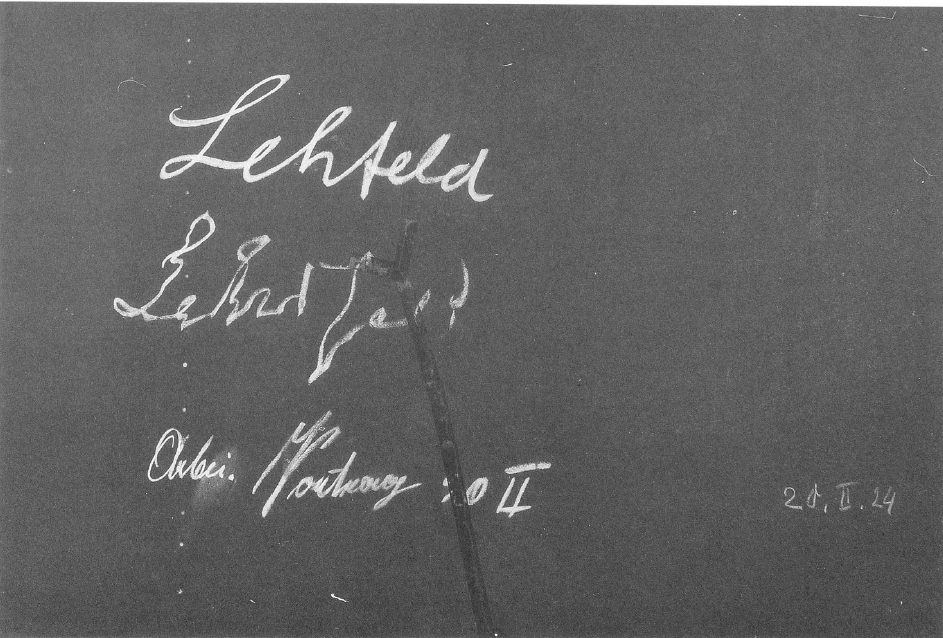
[ 10 ] As for your other question about the man who drank alcohol his whole life and then, toward the end, began to become quite pious and ate “pious” chocolate and sugar—you say: the last days before his death—well, this phenomenon is easy to understand when compared to numerous others that occur in life. I have known many people who grew old. As they grew old, for example, they saw their handwriting become more and more shaky. Their handwriting became shaky; they could no longer write properly, and one could tell precisely from their handwriting that they had grown old. They may have once had a handwriting style—let’s say “Lehfeld” (sharp, clear)—and then they wrote “Lehfeld” (shaky). But then, in the last days before their death, it turned out that they returned to a certain sharp handwriting; they were suddenly able to write well again. I have met many people who regained their former sharp handwriting before their death. Likewise, it has been observed in numerous cases—I’m not exactly sharing my own observation in this area with you, but rather well-documented observations that have been made—that people who learned a certain language as children—perhaps they had been in a foreign country as children, learned a language, and then forgot it; which does happen; let’s assume that as a man in his forties or fifties, they had absolutely no way of communicating with anyone else in that language—suddenly, a few days before their death, they begin to speak quite intelligibly in that language again. It came back! Yes, you see, these are indeed very significant phenomena. What is actually happening there? What is happening is that when a person dies, they leave their physical body—that is, one aspect of their being—behind on Earth; it dissolves into the Earth, it is destroyed in the Earth. As for the next aspect of a person’s being—the etheric body—I have told you that it gradually dissolves into the general world ether a few days after death. And then what remains of the person, to journey through the spiritual world, are the astral body and the actual “I.” These then journey through the spiritual world.
[ 11 ] There, a complete separation of the individual members of the human being takes place. And anyone with a keen eye can already observe in a person whose death is near how the various members—the physical body, the etheric body, and the astral body—separate from one another. Now, what does it mean when someone changes their handwriting a few days before their death? Yes, gentlemen, we do not write with the physical body! With what, then, do we actually write? We write with the “I”! We use the physical body only as a tool of the “I” when we write. And our “I”—it does not grow old! With your “I,” you are still as young today as you were when you were born. The “I” does not grow old. Nor does the astral body age to the same extent as the physical body. But it is the physical body that one must use as a tool when one wants to write; thus, the physical body must grasp the pen with its hand. Now, as a person grows old, they become weaker and weaker, and they can no longer properly control their physical body. But not only that—all sorts of deposits accumulate within the physical body itself. And the result is that a person can no longer use their fingers properly. They become clumsy, tremble, and instead of making firm strokes, their writing becomes shaky. When a person is near death, the etheric body begins to detach from the physical body. A loosening occurs. This can sometimes happen a few days before death; sometimes it happens at the very last moment. One must not say that one should no longer attempt to heal a person whom one has seen for days before their death as being on the verge of death; what has become loosened can, in turn, be brought back together. As long as a person is alive, one must always try to heal them under all circumstances. But the fact remains that for many people, the etheric body begins to detach itself days before death.
[ 12 ] Well, when the etheric body loosens up, the human being becomes stronger. You can also see from something else that a person becomes stronger when their etheric body loosens up. There is a certain type of madman who develops tremendous strength—truly extraordinary strength. You might often be amazed at the feats of strength such a person with mental illness is capable of. Not only are the blows they deliver far more powerful than those of others, but they sometimes lift pieces of furniture with ease—furniture that no one would ever think a human being could lift. So you see, something strange occurs that distinguishes such a person from a normal person. What happens in the case of the madman? Well, in the madman, the etheric body is always somewhat loose, or the astral body is loosened. Now, the human being is not exactly strong through the physical body, but rather weak. He must control the physical body through the etheric or astral body. As the saying goes quite correctly: “He’s got a screw loose”—something is loosened. The common people sometimes speak very accurately, because they possess an instinct for the supersensible, and such old folk sayings should not be viewed with contempt, but rather as something that is entirely true. Now, if the insane person has loosened his etheric or astral body and thereby becomes stronger, he is, as an insane person, in the same situation as someone whose etheric body has already loosened because he is about to die in a few days. And when he grows stronger in his etheric body, he can write better again. When he grows stronger in his astral body—for everything one has forgotten is contained within it—he then draws from the astral body what he has forgotten and can once again speak the language he used to speak.
[ 13 ] But now let’s take your case. You see, I didn’t know the man, so I don’t know how he lived. Perhaps you knew him? If so, you can answer certain questions. Did you know him well?—Well, you see, with a person like that, it’s very important to consider whether he might have had a wife or someone else in his circle—perhaps it could have been you yourself who constantly warned him how harmful it is to drink so much alcohol? (This is confirmed.) Well, there we have something right away that will put us on the right track. He had people around him who were always warning him not to drink so much, because it’s not right and it’s harmful to him. With this man, as they say, it went in one ear and out the other. Yet another popular saying that isn’t entirely without foundation. It’s true that people are sometimes so disposed toward certain things that they go in one ear and out the other. Why? Well, because the astral body overlooks these things. The ear is, after all, merely the instrument of hearing. The astral body overlooks it.
[ 14 ] However, it does happen that the astral body hears what is said, but the physical body does not participate because the person in question is too weak. Now think about this: the man heard from Mr. Erbsmehl himself, on my behalf: “You’re a completely crazy guy—I’m putting it quite bluntly now, aren’t I—because you’re getting drunk all the time! That won’t do; it’s degrading!”—and so on, and the man swallowed it all. That’s how it happened; it does happen once in a while in life that people swallow it all and then carry on as before. But his astral body retained something of it. Perhaps you said it so forcefully and so often that the astral body and the etheric body couldn’t get away without retaining it. As long as they were inside the physical body without any hindrance, they heard nothing. The moment the physical body reached a state where the etheric body and the astral body were loosened—yes, suddenly the thought entered the person through the etheric and astral bodies: Mr. Erbsmehl might have been right after all! Perhaps it’s completely crazy that I’ve drunk so much my whole life. Now I want to—well, you can imagine, once things have loosened up—do penance!—Then the astral body and the etheric body say: “Aha, now he’s not drinking alcohol; now he’s drinking chocolate and sugar water!” — Perhaps he would have drunk lemonade, too, if there had been any. The fact that something like this can happen provides proof—especially for those who view things sensibly—that all sorts of things can be lodged within a person that don’t come out. I’ve also told you about the opposite case once. The opposite case was one where the story did not remain within the astral and etheric bodies, but penetrated too deeply into the physical body—where, so to speak, one paid far too much attention to the matter. The opposite case is this: It happened one day to a former acquaintance of mine—he was a very learned gentleman—that his consciousness and memory deserted him. He no longer knew who he once was or what he had done; he knew nothing more of all his learning. He had forgotten everything. He didn’t even know that he was himself, that he was who he was. Yet despite this, his intellect remained clear. His intellect functioned perfectly clearly. He went to the train station, bought a train ticket, and traveled far. He had also taken money with him—whatever he still had. He was able to travel far. When he arrived at the station where the ticket was valid, he bought a new one. And he did this several times, knowing absolutely nothing of what he was doing. But the mind is so separate from the person himself that everything happened quite rationally, just as animals act rationally—as I have often shown you with many good examples—without having a sense of self. Well, then he found himself there once again; his memory returned. He knew who he was; his erudition also came back to him; but he found himself in Berlin at a homeless shelter! That is where he ultimately ended up. He had departed from Stuttgart. It was later established that he had left from there. While unconscious, he had been in Budapest and other places. He was able to make his way from Berlin to Stuttgart again. Then someone from his family, who were terribly anxious, picked him up. He was able to do that again. However, he ultimately ended his life by suicide. One time it happened as a result of unconsciousness; the other time, by suicide.
[ 15 ] But what exactly happens in a case like that? Well, you see, I can picture this man I’ve just told you about so clearly in my mind that I could actually paint him at any moment. The man had eyes that made you think they were constantly trying to sink deeper into his head. He had something here in the front, as if his nose had burrowed—all of this, of course, very subtly suggested—into his physical body. He spoke to you in a very strange way. He spoke to you in such a way that he was convinced of his words in a completely different way than any other person. You got the feeling that he was always savoring his own words on his tongue and swallowing them—that’s how much he loved them. He enjoyed it so much when he spoke; he swallowed it all up inside himself. And if you contradicted him in any way, he would get quite angry. But he didn’t show much of this anger outwardly; instead, his face would contort. If a car rattled by somewhere on the street, he would startle terribly; if you told him any news, he would startle just as much, whether it was joyful or sad.
[ 16 ] You see, this person had listened too much, and everything immediately manifested itself in his physical body. And because of this, he had developed the habit of his astral body always burrowing very deeply into his physical body; he kept nothing to himself, like your alcoholic, but everything burrowed into the physical body until the physical body reached the point where it even displaced his own self for a time.
[ 17 ] Here you have the opposite case. In this alcoholic, the admonitions remained embedded in the astral body and emerged when he let his guard down. In the case of that other person I told you about, the astral body sank so deeply into the physical body that the physical body then went on by itself.
[ 18 ] So you see, there are signs everywhere within the human being that these higher bodies—these supersensory bodies—are intimately connected with the physical body and the etheric body. All of this shows you, however, that one can truly come to know life only by looking at such connections within life that directly reveal to us: There is a physical body in the human being, there is an etheric body in the human being, there is an astral body, and there is an “I.”
[ 19 ] You can also see, in cases where the person in question suddenly develops entirely different cravings under the moral pressure of what they have left behind in their astral body, how other phenomena can arise. Here is an example. I’d like to tell you an interesting story now. There was once a woman who sold vegetables and similar items. This was back in a time that is now far behind us. The woman went from house to house with her basket of vegetables. Well, she was always the kind of person whom people simply regarded as a woman who viewed life exactly as a vegetable vendor does. She laughed when someone said something funny; otherwise, she was indifferent to life. She carried her vegetables into people’s homes, collected her money, and spent her life that way. Then one day she came to an apartment and wanted to sell some vegetables. There was no one else there but the man of the house, who opened the door for her. And this man of the house had a very peculiar way of looking at people. He would gaze at people very sternly and had often noticed that when he looked at people with that particular gaze, they would become talkative about things they would otherwise keep to themselves. Now, the following turned out to be true; this is a very well-documented account. This vegetable vendor approached the man; he looked at her. She was startled. He didn’t say a word, just looked at her. He saw that she was startled, didn’t say a word, but continued to look at her. Now she wasn’t just startled—she said, “Don’t look at me like that! Please don’t look at me like that—I’ll tell you everything!” He said nothing, but kept looking at her. Then the woman said, “Yes, but I only did it out of fear.” He still said nothing; he just kept looking at her. “Don’t look at me like that—I really wouldn’t have done it if I hadn’t done it out of fear!” He still said nothing; he just kept looking at her. “Yes, I’ll tell you everything, but don’t look at me like that!” He looked at her. “I’ll tell you everything! Yes, you see, I would never have killed him if I hadn’t—if I hadn’t done it out of fear!” He continued to look at her. “Yes, I was so afraid of what people would say—that the child would say something really terrible about me—and so I did it out of fear. I wasn’t even fully in my right mind!” And look, this woman told him the whole story—from A to Z—of the infanticide she had committed! What on earth happened there?
[ 20 ] Here’s the thing: This man had a certain sharp gaze. When a person uses their ordinary eyes—well, they talk with others, but they don’t particularly strike a chord with them. But when someone has a gaze that they can easily fix—a gaze that then becomes penetrating, even magnetizing, one might say—that gaze affects the person’s etheric body. And the conscience resides in the etheric body. When the etheric body is properly integrated with the physical body—well, don’t you think so?—then when something like that stirs, a person will immediately push it down. But when the etheric body is magnetized by such a gaze, then that etheric body loosens. And if a person has something on their conscience, it loosens along with it, rises up, and disturbs the astral body and the “I.” The result is that, due to this loosening of the conscience brought about by the etheric body, the person makes confessions they would not otherwise make.
[ 21 ] These are the things that once again show how the etheric body, when it is artificially drawn out of the physical body, acts independently, and how the physical body actually conceals much of what a person carries within themselves. And when the etheric body is detached, this may—not always, but under certain circumstances—occur before death.
[ 22 ] There has also been a great deal of abuse in these matters. If you were even a little bit of an observer of life before the war, you would have noticed on your travels—in every hotel or wherever letters were piled up for people to pick up—that you’d find the same thing over and over again: something bearing the logo of an American company. It was the same everywhere. What had happened back then? Well, an American company had been founded that had branches. There was such a branch in Berlin, in Frankfurt—in most major cities there were such branches. So business must have been booming! It was announced that anyone who wanted to gain power over humanity would receive booklets from this American company. All they had to do was send in a certain amount of money, and then they’d receive booklets—and inside those booklets were instructions on how to gain power over humanity. Well, all the salespeople, all the agents, thought to themselves: That’s a wonderful thing, gaining power over people. Wow, we’ll sell a lot of these—no one will be able to resist us! — These booklets began right off with instructions on how the reader should position his eyes so that he doesn’t look the other person in the eyes, but instead stares fixedly at the point between their eyes; then the other person is magnetized, falls under his influence, and does whatever he wants. Well, you know, the wine salesmen and the other traveling salesmen fell for all of it. And you could see that, especially in hotels where such agents stayed, these letters and materials were constantly being sent out in droves. Most of them didn’t actually do any better business because of it; rather, American society was the one that profited from it. It didn’t benefit most of them at all, but it might have benefited a few; and they did something that no human being should ever do under any circumstances, for it is a violation of human freedom. No one should ever seek to gain power over another person in such a way! And if nature endows a person with such a gift—as it did the man I told you about—it can, under certain circumstances, become quite serious; but in that case, it is nature that grants something like a special insight, and it is far less likely to be abused than by someone who seeks to learn the art. Well, during the war, these follies subsided, and they are now virtually nonexistent. But one can certainly say that, precisely from these things, one can learn, on the one hand, how people themselves exploit the spiritual, and how even the worst materialists—for they were mostly materialists who allowed these things to happen—turn to the spirit when it comes to making a profit from it. They do not believe in it, but they turn to the spirit when it comes to making a profit from it! I therefore wanted to draw your attention to how these things can be subject to such immense abuse.
[ 23 ] But there are many other factors to consider here. What people consciously strive for—and what this little book consciously strives for—is something that many people who have achieved something through it have practiced for themselves, albeit not to such a high degree. Perhaps you have, after all, occasionally attended gatherings where speakers have addressed the audience. Well, you will agree with me that the conviction emanating from the speaker does not always play the sole role, but that a tremendous amount depends on the influence the speaker exerts. And it is indeed true that the most popular public speakers are sometimes people who exert an improper influence on the masses or other large groups of people. One does, after all, have very special experiences in this day and age.
[ 24 ] For example, this is currently the case: I am writing essays about my own life in *The Goetheanum*. These essays—which perhaps one or two of you have read—aim, with a certain intention, to tell the story as simply as possible, without embellishment, in the simplest way, without ever being particularly heavy-handed. Now, a critic has already come forward who particularly criticizes this, saying that, unlike Goethe, I do not present “poetry and truth,” but rather truth with complete sobriety. Yes, that is precisely what I am striving for! And I am not at all striving to achieve what such a critic demands. Such a critic today embodies precisely what constitutes a “drunken” style in contrast to a sober one. And, isn’t it true, this drunken style is, in fact, present almost everywhere today. People no longer care at all about making an impact through what they say; rather, they need words that overwhelm others. That is where the harmful influence begins. For when one writes as I strive to write, one influences the “I,” which possesses free will. But when one writes in a drunken style, one influences the astral body, which is not so free—but rather unfree. One can influence the astral body, in particular, when one speaks to people in a way that one knows they will enjoy hearing.
[ 25 ] People who seek not to convince but to persuade in this way usually use phrases and words that please others, whereas those who wish to speak the truth cannot always say what pleases others. For in our time, it is even the case that people generally do not like the truth. So even from the way a person writes their sentences, one can see: If a person writes their sentences in such a way that they are logical—so that one sentence follows from the next—then they will have an effect on the other person’s free “I.” If a person writes their sentences in a way that is not logical, but is primarily concerned with writing what pleases others—what stirs their desires, drives, instincts, and passions—then they influence the other person’s astral body, which is not free. And this is a hallmark of our time: that there is so much talk of freedom, and that the greatest sin against freedom actually stems today from public discourse, both spoken and written. In fact, spoken and written language is being misused everywhere in public discourse.
[ 26 ] You will also gain a better understanding of ordinary life circumstances if you can distinguish between the “I” and the astral body in such a way that you can influence one or the other; likewise, you will be better able to understand a phenomenon such as when, before death, a person begins once again to recognize their own handwriting, or begins to speak a language they had forgotten, or, under a moral influence they had ignored their entire life, eats something they would otherwise never have eaten. There you can see how the “I” is embedded within the physical body and begins to loosen its grip.
[ 27 ] Another question: Last time, the doctor spoke about arsenic. Today, the issue of opium has become a topical one in Switzerland. Some time ago, the *Goetheanum* published an article by Dr. Usteri about the poppy plant in connection with opium. Could we hear something about opium?
[ 28 ] Another question: About two years ago, Einstein's theory became widely known. Today, you hardly hear anything about it anymore. Has this theory actually stood the test of time, or has it also fallen by the wayside?
[ 29 ] Dr. Steiner: Well, you know, I would have to talk at length about Einstein’s theory, because it is difficult to explain it briefly. If one wants to understand it properly, one needs mathematical knowledge. But the strange thing about Einstein’s theory was that everyone talked about it without understanding a thing—they spoke about it solely on the basis of authority, because, as I said, you need some mathematical knowledge. But to the extent that one can understand something without mathematical knowledge—and there isn’t time for that today—I’d still like to explain a few things so that you can see to what extent it is, on the one hand, based on truth, and on the other hand, a great error. People still talk about it today. The general public tends to latch onto anything reported in the newspapers, but they don’t retain any of it. The public has forgotten it by now, but the relevant university professors today are Einsteinian. So among actual scholars, Einstein’s theory is much more widespread today than it was years ago. Next time, as far as I can explain it in very accessible terms, I’ll go into some of this in more detail. I just need to have more time for that than we have today. — Does anyone else have a question?
[ 30 ] Question: I would especially like to know the difference between alcohol and opium. According to Dr. Usteri’s article, it can be assumed that poppy juice acts upward, while alcohol acts downward.
[ 31 ] Dr. Steiner: You see, gentlemen, we must ask ourselves: When a person drinks alcohol, which part of their being is affected? The “I.” And physically, the “I” uses the blood circulation as its instrument. The influence of alcohol on the “I” manifests physically in the blood circulation. Thus, in what actually constitutes a person’s life—the blood circulation—the person is particularly strongly influenced by alcohol.
[ 32 ] With opium, the effect is such that it acts particularly strongly on the astral body—in such a way that the person actually draws it out of the physical body. You see, what happens is that the person then experiences this separation of the astral body from the physical body as a profound sense of well-being. They are free of their physical body for a time, and they experience this as a sense of well-being.
[ 33 ] People are quick to say—as you’ve probably heard—that sleep is sweet. But the thing about sleep is that a person can’t really perceive this sweetness at all, precisely because they’re asleep! They can’t perceive this sweetness; they can only experience it as an aftertaste. And because they experience it in the aftertaste, that is precisely why people say that sleep is sweet. But when a person ingests poppy juice—opium—then they feel this sweetness; for in reality, their body is in a state as if they were sleeping, yet they are awake at the same time. This allows them to enjoy the sweetness, and through it they feel this sweetness and feel immensely at ease within it. It is as if their entire body were permeated with sugar—a very special kind of sugar—filled through and through with sweetness. But at the same time, their astral body is free from the physical body, and through this they perceive all manner of things, even if not clearly. They do not have ordinary dreams, but rather perceive the spiritual world. They undertake great journeys through the spiritual world. This pleases them. Through this, they are lifted up, as you say, into the spiritual world. When drinking alcohol, on the other hand, his physical body is completely occupied, right down to the blood. In this case, his astral body does not become free. Everything is occupied even more by the physical body. Therefore, when a person drinks alcohol, he is completely occupied by the physical body—much more so than he normally is. That is precisely the difference. With opium, the spiritual-soul aspect is set free; first, it enjoys the physical body in its sweetness, but second, it goes on journeys, entering the spiritual world—albeit somewhat haphazardly, but entering it nonetheless. And much of what the Orientals describe—not entirely accurately, but still describing the spiritual world—comes from the use of opium, hashish, and the like.
[ 34 ] These are the things that, in turn, show you that there is no other way to understand such matters than by taking into account the higher aspects of human nature.
[ 35 ] Now let's continue this next Saturday at nine o'clock.