

A Spiritual Scientific View
of Nature and Man
GA 352
23 February 1924, Dornach
Translated by Steiner Online Library
9. Synthesis and Breakdown in the Human Body — The Importance of Secretions
[ 1 ] Good morning, gentlemen! Perhaps one or two of you have thought of something else you’d like to ask? Or do you have any further comments on what we discussed the other day?
[ 2 ] Mr. Müller asks if the doctor would like to say something about a question he asked the other day: There are quacks who can diagnose people’s illnesses by examining their urine.
[ 3 ] Dr. Steiner: Yes, you asked that the other day. I either overlooked the question or didn't have time to answer it.
[ 4 ] Mr. Müller, who posed the question, goes on to say: In the Basel area, there is a man who has been involved with
[ 5 ] achieved good results through his practice, urine analysis, and the remedies he prescribed. What are we to make of this?
[ 6 ] Dr. Steiner: Well, regarding this question about urine analysis, I have the following to say. Urine analysis is by no means limited to quacks and the like; rather, it plays a major role today in what is recognized as scientific medicine. However, there is a major difference between the way today’s medical professionals and the people you’re actually referring to—and you were essentially talking about non-medical practitioners—approach things, and this difference stems from the following. Urinalysis has always played an extraordinarily important role in the diagnosis of all diseases, ever since ancient times. But you must bear the following in mind. If you look back at ancient medicine, as it existed up until the 18th century—for medicine was not actually reformed into materialism until the 18th century in Italy—you will find that both the diagnosis of diseases and their treatment were based on entirely different principles. Today, this ancient medicine is completely disregarded by science. To a certain extent, this is entirely justified, but it is not entirely justified. And one must clearly understand the difference between ancient medicine and modern medicine in order to grasp what science actually means today. For ancient medicine knew very well that the human being is not merely this physical body that one sees with the eyes and touches with the hands, but is also a supersensory being that permeates the body, as we have, after all, always emphasized.
[ 7 ] You will certainly find the differences between this ancient medicine and modern medicine if you go back very far in human life—namely, if you go back to the time before birth. I am not referring here to the spiritual aspect before birth, but to the physical aspect—the human body in the womb. Today, medicine and the natural sciences in general see the essence of the human being in how it develops in the womb; they see the essence in how the egg gradually forms. At first, we are dealing only with the egg cell that has been fertilized. This is a tiny cell, visible only under a microscope. This cell then multiplies and takes on a sort of cup-like shape. And around the third week, this cup-like shape folds over slightly on one side. Then, in the sixth or seventh week, the human being begins to resemble a small fish. On one side, the head then develops (see drawing); here, the first nerve cords form; and so it continues. And in this way, by observing one stage of development after another, modern science seeks to gain a deeper understanding of the origin of humans and animals alike.
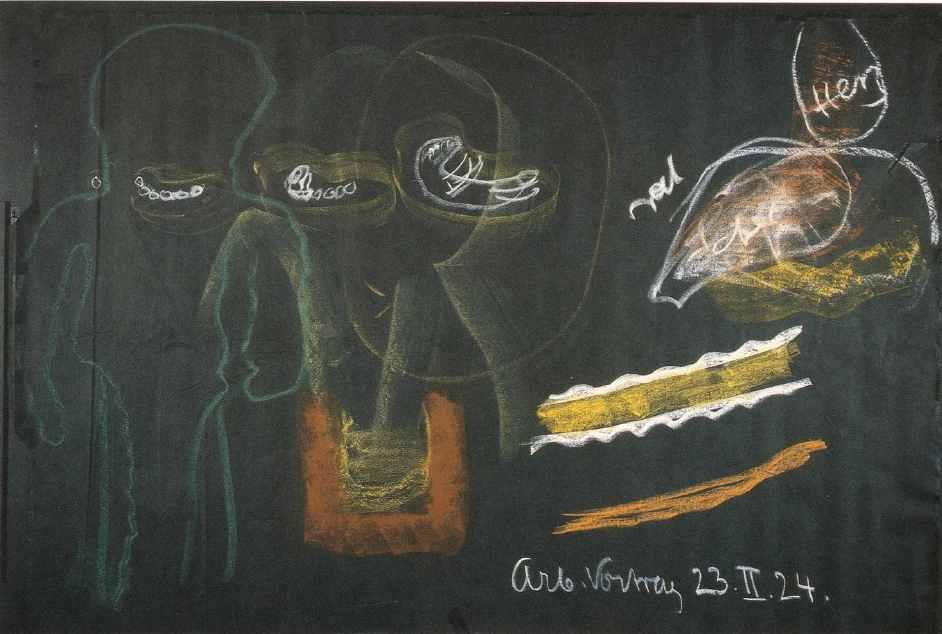
[ 8 ] But in addition to what is present in this way, there is, of course, a thick fluid constantly surrounding the human being in the womb. This thick fluid is present in this way (as illustrated), and only then is the uterus all around it. This thick fluid, containing all sorts of thick inclusions, then flows out during birth as what is called the afterbirth. It is regarded as waste, as something of no significance, because today everything that occurs in a living being—that is, everything that comes out—is regarded as waste.
[ 9 ] But that is not the case; rather, the situation is as follows: Here, in the way the cell multiplies and the physical human body forms, the external force of nature is at work within, whereas in the surrounding fluid—which is then expelled as the afterbirth—the spiritual-soul aspect is at work. This spiritual-soul aspect is initially present in the vicinity of the tiny human body; only later does it enter the human body. And one must actually seek the spirit in what is later expelled as the afterbirth. This is, of course, very surprising, but it is extraordinarily important.
[ 10 ] Today, there is such strong resistance to studying the spiritual realm that a friend of mine, guided by my instructions, has set out to investigate the afterbirth as it gradually transfers its spiritual essence to the actual embryo—the physical entity itself. This could very well be studied scientifically; but the effort fails simply because, in those rare cases where human embryos are obtained—which is not very common—due to the mother’s death or the need for surgery, today’s natural scientists immediately remove everything surrounding the embryo, and one is left with no human embryo to examine in order to determine this. So even the way things are handled today is an obstacle to true science. The shift toward materialism, I would say, begins right with the study of human origins.
[ 11 ] But you know that humans also excrete while they are alive. What is excreted is, after all, something that is not particularly popular in the outside world because it does not smell good. Almost all excretions smell bad. Today—and quite rightly so, of course—all secretions are regarded as something that simply has to be excreted, washed away, and so on.
[ 12 ] Human secretions are, therefore, first and foremost what you mentioned: urine, sweat, aren’t they? Also the coarse secretions—feces and a few other things as well. After all, what you cut off from your fingernails is also a human secretion. It is, after all, a solid secretion. But some things that are also secretions are not recognized as such; yet they are, in reality, secretions.
[ 13 ] You see, the eye is often regarded as the noblest organ in the human body. Well, just think about how easily an eye can be removed. It lies almost entirely isolated inside the eye socket. And the fluid inside the eye—as I’ve explained to you—is also a secretion. And the fact that the various organs of hearing in the ear also involve secretions, that secretion plays a role there, can be seen from the formation of earwax, which is precisely the outermost secretion. So, in human beings, we are dealing with secretions everywhere; on the one hand, the human being is built up, but on the other hand, he breaks down and secretes.
[ 14 ] Well, what follows from this? I told you something the other day that might be instructive to you in this regard. I told you: People regard the nerves, the entire brain, as an organ just like any other—like the liver or the spleen. But that is not true, gentlemen. The brain is a secretion. The entire brain, as I told you, is a secretion! And if one wants to compare the brain to something, one must not compare it to the intestine, but to what is inside the intestine. So if you have a piece of intestine, there is the intestinal wall, and there is the intestinal contents (see drawing on p. 159, below). The fact is that the intestinal wall is corrugated. In the case of the brain and the nerves, the wall is missing; it is there, but it is transparent, it is not visible, and only the contents are present (see drawing, above). You can quite rightly ask: What, then, is our brain actually filled with? It is filled with a very special kind of intestinal contents! And if you call this intestinal contents “dirt,” then you can say that the brain is dirt. That is absolutely scientifically correct. For the activity of thinking does not consist in an activity of the brain, but rather the activity of thinking consists in the brain being set apart from thinking, being separated. The further you go from the bottom to the top in a human being, the more the human being is separation.
[ 15 ] I have now spoken to you about the physical and the spiritual human being—about the human being we can see, and about the human being who is also within us, whom we cannot see. What we see in a human being is that which is continually being built up, which arises from what develops into the physical human body. This is where the arm stumps come from (see drawing on p. 156), and the leg stumps as well. But what is supersensible—the astral body and the “I”—is meant to separate; they are constantly separating. Only the physical body and the etheric body build up. The astral body and the “I” break down again.
[ 16 ] When you build a house, you strive to build it as quickly as possible and to live in it for as long as possible. Little by little, nature also breaks things down; otherwise, you would still be seeing today the houses that once stood in ancient India. But of the houses that stood here three hundred years ago, you will find very few remaining. With human beings, the processes of building up and breaking down occur simultaneously. First comes the building up: we eat, take things in; they reach the liver, where they are transformed. Then the breakdown begins again—the excretion. And this cycle of building up and breaking down actually constitutes the entire activity of the human being. If we were to do nothing but build up, we would be dull and stupid. We’d be nothing but a bunch of idiots. We wouldn’t even be idiots—we’d be mindless, walking plants if we did nothing but build up. The fact that we break things down—that, for example, we are constantly excreting in the brain—and that we therefore have excretory organs, glands—is the very reason we are not stupid people, but rather intelligent human beings, with differences, of course. But the spiritual is based on breaking things down, not on building them up. And that is why these excretions are of very special importance.
[ 17 ] You see, the thing is this: The very same process that takes place when the afterbirth is expelled occurs during every process of decay. Whenever more and more is broken down around the structure of the human being, the spirit is at work. And when the spirit can then act within the human body itself—when the human being is born—the afterbirth is no longer needed; it is simply expelled. But this process of expulsion continues throughout one’s entire life. It is expelled in the more or less solid or soft intestinal secretions; it is expelled in urine; it is expelled in sweat, for example. You can observe the significance of sweat as a secretion if you ever have a truly frightening nightmare. Just observe it once when you have a truly frightening nightmare. For example, if you dream that someone is chasing you, someone who wants to kill you or at least beat you up badly. You run away from him; you run in the dream—run, run, run—and suddenly you wake up, only to find yourself completely drenched in sweat. There, this heightened activity—which is so intense that it produces images that frighten you—manifests itself in outbreaks of sweating. And these bouts of sweating are the physical manifestation of what a nightmare is. Or consider someone with severe lung disease who is not in the final stage but whose lungs are not functioning properly. The lungs cannot breathe well, causing them to constrict; the person suffers greatly from nightmares. But he is also always drenched in sweat when he sleeps. So there you have the connection between sweating and these mental activities—the images that arise in the dream. Well then, gentlemen, the etheric body is active, because the nightmare actually arises only at the moment of waking. One merely believes that the dream lasted almost the entire night. The entire dream takes place at the moment of waking.
[ 18 ] This can be demonstrated by observing how dreams play out at the moment of waking. I once told you—back when many of you weren’t here yet—about a characteristic dream that shows how, upon waking, the entire dream first flashes through your mind. A student is standing at the door of the lecture hall. Another approaches him and bumps into him. Well, being bumped into is a terrible insult among students! It can only end in a duel; there’s no other way. So, immediately after being bumped, one of them looks for a second; the other must also find a second—it’s a long story that the student dreams—and everything is arranged: the negotiations with the seconds, everything; it seems to take an awfully long time. He dreams of them going out into the forest, of them lining up there, the distance being determined, the ground being paced to measure how far apart they are. The pistols are loaded—he dreams all of this—; then, as they take aim and the first shot is fired, he wakes up! He immediately realizes that, because he had become restless in his sleep, he had knocked over the chair; but it falls even as he is waking up. So the chair falling is what created the entire dream; in that moment, the whole dream flashed through his mind. The dream only expands inwardly to that length. In reality, one actually dreams at the very moment of waking up. And that is why such patients have these nightmares as they wake up; they sleep, wake up, and in the process begin to sweat. It is the etheric body that is active there. When we wake up early of our own accord, we return—with our “I” and astral body, which have been outside the physical body during the night—back into it, and as a result we break out in a sweat. So when we sweat, it is the etheric body that is primarily responsible for making us spiritual beings, for stones and plants do not dream and are therefore not spiritual beings.
[ 19 ] But then there is the secretion of urine. You see, you don’t notice this as much as you do with sweat, because sweat can do nothing but come out, and it then covers the skin. But if the skin had small sacs where the sweat is secreted inside, and if a fine layer of skin covered them, one would not notice it at all. It could be that there are small sacs inside the skin. The sweat would go into them, and at certain times—one might have fine muscles—one would squeeze the skin, and the sweat could flow out. Just as sweat is secreted through the etheric body, so is urine secreted through the astral body. But one does not notice that, for example, when one has more intense feelings, more urine is secreted than when one has weaker feelings, because the urine does not flow out immediately. You see, the matter is this: If someone is in a state of enthusiasm and remains in that state—regardless of whether it manifests outwardly in actions or whether one is simply contemplating something—and if that person did not have a bladder, they would have to constantly urinate right in the midst of that enthusiasm. It would be a very unfortunate arrangement. A person could not go to a museum, because if they saw the paintings there and became enthusiastic, there would have to be nothing but restrooms nearby! The fact is that human nature has provided for this excretion. It accumulates in the bladder and can be expelled at certain times. But urine is primarily secreted by the astral body, which fills the human being everywhere; the urine comes from everywhere, accumulates in the kidneys, and then flows into the bladder.
[ 20 ] And the excretion of the intestines is governed in a very special way by the “I”—in animals also by the astral body, but in humans by the “I.” And it is not just the intestines that are active in excretion, but the whole human being. Excretion takes place continuously throughout the entire human being. The bowel is merely the excretory organ. Thus one can say that it is precisely in the process of excretion that we see the etheric body at work in the case of sweat, the astral body at work in the case of urine, and the ego at work in the case of fecal excretion.
[ 21 ] If you consider this, you will not come to regard bodily secretions as something so unimportant. For let us assume that a person has normal urine. Yes, then the astral body within the person is also functioning normally. But whether a person is healthy or sick depends on how the astral body functions. Everything related to health and illness ultimately depends on how the astral body functions.
[ 22 ] For example, when we eat eggs and they need to be digested, the egg must first go into the mouth, then into the stomach; then it goes into the intestines, and there, as I once said, it is completely broken down as an egg. The egg white is broken down. But as the broken-down egg white travels to the liver, it is rebuilt, and human protein is formed from the animal and plant proteins as they pass from the intestines to the liver. Only then does the human protein enter the bloodstream.
[ 23 ] If you look at the human body, here is the diaphragm (see diagram), here is the liver, and here is the heart; they are separated only by the diaphragm. What passes from the intestines into the liver is converted from animal and plant protein—I’ll color this yellow here—into human protein (darker yellow). This is held together in the liver, and then it passes on to the heart.
[ 24 ] The fact is this: When we eat protein, our astral body must work to properly convert animal and plant protein into human protein. If the astral body is sluggish and cannot function properly, the animal protein is not converted into human protein in the liver; instead, it goes directly to the kidneys and is excreted in the urine. If one examines the urine—as modern scientific medicine also does—one finds protein in it.
[ 25 ] Or do you think, gentlemen, that you are eating potatoes? The potato is usually already broken down in the mouth, because starch is, after all, an important food—it’s not just there for stiffening shirts. After all, the potato consists almost entirely of starch. On its way from the mouth to the stomach and into the intestines, the potato is gradually converted into sugar. Potato starch first turns into dextrin and then into sugar. Potatoes are only unpleasant in the mouth; in the intestines, they are incredibly sweet because they are converted into sugar there. But once the potato starch has been converted into sugar in the intestines, and once the liver has converted potato sugar or any other sugar into human sugar, it then supplies this internal sugar to the entire body, which thereby becomes warmer and gains its inner warmth. For this to happen, however, the astral body must be functioning properly again. If it is not functioning properly, then the sugar is not properly converted into human sugar; instead, the animal and, in particular, the plant-based sugar goes directly to the kidneys. The sugar is excreted, and the person becomes diabetic. You can, in turn, determine from the sugar content of the urine that the person is ill.
[ 26 ] All of this is something that modern medicine also does and considers to be extremely important. In fact, it is the very first thing doctors do today: they test the urine for protein and sugar. This immediately provides an indication of whether a person might have this or that disease.
[ 27 ] Or consider the following: You see, if we want to have a healthy mind—which, after all, is not entirely unimportant for physical human beings here on Earth—people do want to have a healthy mind because they believe that the mind is the most important organ in the human being; so they want to keep their minds healthy—if we want to keep our minds healthy, then we must bring a substance that is constantly produced within us—namely, clover acid—up into the head through the chest. A healthy mind must have a certain amount of clover acid. We produce oxalic acid ourselves, just as we produce the alcohol we need. But for this to happen, the head must function properly so that oxalic acid can be produced. If it does not function properly and the acid remains below, we end up with a head that is anemic, and the oxalic acid is excreted in the urine.
[ 28 ] As you can see, gentlemen, even today the most common chemical analysis of urine can reveal the most important diseases. But the chemistry we have today did not exist in the past. And yet medicine did exist!
[ 29 ] Now, here’s the thing: Suppose a person has a fever; I’ll take a drastic case as an example. What does it mean when a person has a fever? It does not mean that their astral body has become weak, listless, or sluggish, but rather that it is in a state of excessive activity, so that it affects the ego itself. Then the ego is, as it were, whipped when the astral body is in excessive activity. But the ego regulates blood circulation. And an excessively active astral body—which wants to enter all the organs but cannot, and therefore seethes within like a storm-tossed sea—generates fever within itself. Now the person has a fever caused by their whipped astral body. What will be the next consequence? The blood is rushed through the body too quickly. The blood does not circulate properly. The blood does not have time to nourish the organs; it flows back as blood from the heart to the kidneys and from there into the urine, and we end up with urine that is very dark in color. Anyone who knows how to interpret the dark color of urine understands that, regardless of whether it is slightly darker or very dark, fever is surging through the human organism.
[ 30 ] Suppose the astral body becomes completely sluggish; it no longer functions properly. The blood flows very slowly through the body, and the pulse is barely noticeable. You can then feel from the pulse how the blood is flowing slowly throughout the body. Everything in the body becomes congested. The body experiences pain in all sorts of places; the urine turns light yellow or even white. Now, between dark and white urine, there are all sorts of shades—nuances of color. If one trains oneself to recognize these color nuances, takes a sample of the urine, and examines it against the light, one can discern a wide variety of things simply from the colors of the urine.
[ 31 ] The blood constantly seeks to replace what is lost by the organs. As a result, the blood has a constant tendency to thicken. If the blood flows through the organs too quickly, it cannot release anything to them. But it wants to become thick. When it then exits the kidneys as urine, the urine becomes flocculent with such blood. If you look at it again, you will see flocculent urine. If the astral body is sluggish and the pulse becomes weak, then the urine is not flocculent, but rather almost water-clear and pure.
[ 32 ] So you can learn a lot not only from the color, but also from the cloudiness or clarity of the urine. If, when you look through it, the urine looks like a stormy summer day with dark clouds, and if all sorts of things are visible inside it—if everything is bubbling in the urine—in other words, if it resembles a stormy summer day, then the person has something that causes a high fever. And if you can assess what is going on, you can deduce the illness from it. If, when you look through it, the urine appears delightfully clear, like a bright summer day when the sun illuminates everything, then you can conclude that the person is ill in the opposite way—that they are very prone to all sorts of organ failure; one organ becomes inactive, another organ becomes inactive, and so on.
[ 33 ] So, you see, the point is that anyone who has trained themselves to interpret what is excreted in the urine can tell a great deal from the urine. But that is precisely the difference between modern medicine and the old: Old medicine looked at urine the way one looks at a summer day—as either a bright one or a storm-lashed one—so it made a more general assessment, but because it had trained itself to do so, it was able to draw more conclusions from the composition. Today’s, more materialistic medicine examines urine chemically, finding protein, oxalic acid, sugar, and so on in it. So the difference is that one approach was based on observation—more on the way things presented themselves—while the other relies more on chemistry.
[ 34 ] Now, of course, the situation is this: In earlier times, when this view was still taken very seriously, people learned it properly and were not yet charlatans. Today, those who do this are mostly charlatans; though I don’t mean to say that all of them are charlatans. Someone can train themselves so well that they can actually diagnose all sorts of illnesses; that is a matter of personal training, but one must have had a great deal of experience, and they must have applied that experience.
[ 35 ] Now here’s the difference: People today don’t really care much about the spirit. Intellect is, after all, on the verge of being abolished. Anyone can learn what chemistry has to offer—how to chemically analyze a substance; you simply learn that during the three, four, five, or six years you spend at the university. Basically, any fool can manage to chemically analyze a substance. And that’s what people strive for, after all. Intellect is supposed to be abolished. Everyone is supposed to be able to do the same thing. That wasn’t the case in the past. In the past, the mind was held in high regard. But you have to have a mind to be able to examine urine. That’s the difference: In the past, people were made intellectual by being taught; today, they’re turned into laborers. The story is this: If you want to work, you need your hands, and your hands should be guided by the mind. There is much talk today of manual labor and intellectual work, but these things should not be distinguished at all. Those who perform manual labor should be given the opportunity to develop themselves intellectually so that they can approach the spirit just as much as the so-called intellectual workers. These distinctions can only be made among people if genuine intellectual work is once again valued. But today, people want to abolish the spirit.
[ 36 ] Well, gentlemen, as you can see, early medicine placed greater emphasis on observing things directly. But this had another consequence as well. I don’t know if you’re aware that today’s so-called scientific medicine puts on quite a high-and-mighty air—well, you can’t really put on an air as high as that of today’s physicians, who look down on the old “dirty apothecary” because remedies used to be made from all sorts of secretions. And people used to say: Human beings secrete these substances. If you return them to the body in the right way, they immediately want to come out again. But what do they do there? Through this, for example, they bring a sluggish astral body into regular activity or a sluggish etheric body into regular activity.
[ 37 ] Now you might say: So if you find that a person’s astral body has become sluggish, you could give them sweat as a remedy—you might say that. And you might say: Well, that’s just the old “dirt pharmacy”; it really does have something similar to it! — Yes, the difference isn’t very great. For if you were to examine the products used as remedies today, you would find that they are the same substances found in sweat; the only difference is that they are synthesized externally from mineral sources. The ancients used sweat directly. And in many respects it was more effective than what is synthesized today, because—as I have shown you in many cases—nature is much wiser than humans. Humans can synthesize in their remedies what nature synthesizes. It was very remarkable with the ancients; they valued something that is no longer valued at all today. The ancients said: When a person really breaks a sweat, they are actually surrounded by a whole layer of sweat (see drawing). — Well, that’s the first point. But a person secretes sweat all over their surface. If one could capture this sweat that the person secretes and remove it from the person—imagine it like this: here is someone sweating profusely; his entire body is covered with sweat—imagine if I could remove that person and the sweat remained here: That would be the person’s entire imprint; the whole person would be standing there in the sweat! Very interesting, isn’t it? So it is that sweat constantly seeks to imitate the human form.
[ 38 ] The ancients did something else as well. They didn’t just observe sweat in this way; they also observed urine in this way. For example, here they had a small glass of urine (see illustration on p. 170). The ancients had an even clearer vision in their minds; and lo and behold: something like a human specter emerged from this urine! What sweat forms on its own when it rises to the surface—that is what seemed to rise up from the urine. In fact, people used to see this in ancient times when they had a vial of urine. Yes, it rose—I don’t know if you’re familiar with the legend that the goddess Venus rose from the sea foam?—well, a human astral apparition rose from the urine. And in a person prone to a certain illness—let’s say, a person prone to emaciation—this astral specter was thin and gaunt. In a person who, let’s say, was prone to morbid obesity, this specter was swollen on all sides. Call it a figment of my imagination, if you will; it may well be a figment of the imagination that when someone sees light-colored urine, they see a different specter emerge than when they see dark-colored urine. But they do see it. And as an experienced physician, he used this to diagnose illnesses.
[ 39 ] And that’s exactly how it was back when people examined not only urine but also feces—the products of intestinal secretion. In the old days, these were particularly important for diagnosing diseases. Just imagine: someone had collected intestinal secretions. Inside, you might find that one sample contains a lot of sulfur, while another contains iron. Depending on what’s inside, you might have intestinal contents with a higher sulfur content. Dogs, for example, have a lot of sulfur in their intestinal contents, which is then excreted. The more sulfur there is, the whiter and firmer the intestinal contents are. Conversely, the more carbon or carbon-containing substances are present, the softer and darker the intestinal contents are; cats exhibit this. Thus, one can infer the nature of the illness from the intestinal contents excreted—the feces—even more reliably than from urine.
[ 40 ] The ancients also had, shall we say, a vision regarding the contents of the intestines; they had precisely such visions. This is something very remarkable! Regarding sweat, they said: When a person secretes sweat, he envelops himself in his own spirit. When a person excretes urine, his ghost is contained within it and rises up. And as for intestinal contents, they are said to be completely distinct in all directions and to have specific colors. And based on these—call them visions or dreams, as you will—but based on these dreams, many illnesses were diagnosed in ancient times.
[ 41 ] And in a vague, sometimes quite foolish way—by reading about it in old books that are hardly understandable today—people like those you mentioned try to do the same. There are also those who diagnose illnesses based on feces; usually, not much comes of it. But one can gain a great deal of experience; then something might come of it. Only modern science pays no attention to it, because it prefers to examine everything chemically. But, as I said, in modern medical science, urine analysis is just as important as it is in unscientific medicine, which is simply a remnant of old times.
[ 42 ] When you leaf through and read old medical books, you will come across a term that you usually won’t understand. All sorts of mystics and people who always claim to have devoured all wisdom—not just science, but wisdom by the spoonful—will constantly regale you with what they’ve read in old books. That isn’t worth much, because they don’t understand the old books. But if you read them yourself, you’ll come across a term. The term “mummy” appears there again and again. You’re told: If the mummy is light in color, then the person is afflicted with all sorts of illnesses that lead to emaciation and so on; if the mummy is very dark, almost black, then the person is afflicted with fever and febrile illnesses. Everywhere, people describe what the mummy looks like and judge the illnesses accordingly.
[ 43 ] What exactly is a mummy? When people today read this, they just assume it’s referring to Egyptian mummies. Well, what do they make of it when they read that the mummy is light or dark? It doesn’t even occur to them what is meant. But what did the ancients who wrote the old medical books mean? The form present in sweat, and the form that appeared to them in the urine jar and in the feces—that is what they called the mummy. The mummy was precisely the spiritual human being. And the spiritual human being becomes visible through these secretions. And the ancients said: When the child is born, the afterbirth is expelled, and with it the last remnant of the spiritual human being departs. - And if people could investigate this today, they would find: When a small child is born, sometimes very little of the afterbirth—and thus of the supersensible—is expelled. But there are also some cases where quite a lot is expelled. In the latter cases, where quite a lot is expelled—where the spirit departs already at birth—those children then become materialists.
[ 44 ] And that is how it is, gentlemen: The astral and ego activities are extraordinarily closely connected to the process of excretion in human beings. And when people speak of the old “filth pharmacy,” this simply indicates that what was once valued is no longer valued today. Waste products—they are no longer valued today. In many respects, it is actually good not to value them too highly, for all sorts of things can happen otherwise. I knew a person who wanted to do away with washing because—after hearing that the spirit lives in excretions—he said that one should preserve whatever is excreted, including dirt. And the result was that he valued dirt to an extraordinary degree! Yes, gentlemen, all of this sometimes seems like folly. But it is not always folly. Take horses, for example. Horses, you see, have hooves on their feet, and from the hooves it transitions into the soft part of the hoof. Dirt accumulates there. And it may be that if you constantly scrape the dirt off a horse, it will get sick. You must have an instinct for how long you must leave the dirt there so that the horse can once again produce this dirt. So there, in the horse, you can see quite clearly, I would say, how significant the dirt—the secretion—is. This matter is significant for the spiritual aspect of the human being; it is also significant for health and illness. Health and illness can indeed be found in these secretions. And the ancients called the spiritual aspect within these secretions the “mummy.” When you come across the word “mummy” in ancient writings, you will understand it from now on, because I have told you how the mummy actually comes into being: that it arises precisely from these secretions.
[ 45 ] You see, the question posed by Mr. Müller involves a very vast field of science—but one that can only be mastered by delving into the spiritual realm. Otherwise, everything that is excreted is simply an excretory product; no one pays it any mind. But in the act of excretion, a person reveals the nature of their spirit. And the fact that this is true of feces is already evident from a cursory glance. Compare horse feces with cattle feces. Cattle feces are larger and spread out. Horse feces are almost like little heads, rounded. If you have a sense of beauty—after all, beauty doesn’t lie in merely finding odorless things beautiful—if you have a sense of beauty at all, you can’t help but say, when you see a cowpat: “The whole cow!” It is reflected in there with its broad presence, its nonchalant activity, its tendency to want to lie down; the cow is entirely present within the droppings. And the horse, that little jumper among the animals, which always wants to break free from the earth, which wants to hop and leap out into the world—a horse dropping reveals the whole horse! And so it is with the feces of all animals; one can recognize the whole animal in them. And from this you can see what the ancients understood by a “mummy” and what is simply astral. The supersensible animal, the supersensible human—they live in the excretions.
[ 46 ] The Spiritual Science can help us come to terms with these things. But of course, we mustn’t end up in a situation where our opponents can say, “The Spiritual Science deals with sweat, urine, and so on, and is therefore actually a ‘dirty’ science.” That’s exactly what our opponents would love to see!
[ 47 ] Well, gentlemen, since you have raised the question, I had to point out to you what is true. But you can also point out at every opportunity that this is not about some specific considerations of what is filthy, but rather about what the spiritual is. For a person becomes powerless when the building-up within them is too strong. Then tumors form within them if they only build up. They must break down accordingly. They must break down. A person becomes powerless—constantly powerless and mentally absent—when a tumor forms in the brain, because then there is only building up. The tumor forms when the brain does not break down properly. And the cranial nerves arise as breakdown products—as spiritual breakdown products. Only when this process gets too intense does too much blood flow in, causing inflammation. And there you have the difference between tumors and inflammation. If your urine is dark, you are prone to inflammation somewhere in the body. If your urine is light, you are prone to tumors. That is one thing. But in this way, you can deduce all diseases from the urine, if you only examine the urine properly.
[ 48 ] So, we'll continue on Wednesday.