

A Spiritual Scientific View
of Nature and Man
GA 352
23 February 1924, Dornach
Translate the original German text into any language:
Versions Available:
A Spiritual Scientific View of Nature and Man, tr. SOL
9. Aufbau und Abbau im menschlichen Organismus — Die Bedeutung der Absonderungen
9. Synthesis and Breakdown in the Human Body — The Importance of Secretions
[ 1 ] Guten Morgen, meine Herren! Vielleicht ist dem einen oder andern wieder etwas eingefallen, das er fragen will? Oder noch etwas zu dem, was wir neulich besprochen haben?
[ 1 ] Good morning, gentlemen! Perhaps one or two of you have thought of something else you’d like to ask? Or do you have any further comments on what we discussed the other day?
[ 2 ] Herr Müller fragt, ob Herr Doktor vielleicht etwas sagen möchte über eine Frage, die er neulich gestellt hat: Es gibt so Quacksalber, die sehen aus dem Urin die Krankheiten der Menschen.
[ 2 ] Mr. Müller asks if the doctor would like to say something about a question he asked the other day: There are quacks who can diagnose people’s illnesses by examining their urine.
[ 3 ] Dr. Steiner: Ja, das haben Sie neulich gefragt. Ich habe die Frage nur übersehen, oder ich habe keine Zeit mehr dazu gehabt, sie zu beantworten.
[ 3 ] Dr. Steiner: Yes, you asked that the other day. I either overlooked the question or didn't have time to answer it.
[ 4 ] Herr Müller sagt weiter als Fragesteller: Im Baselbiet gibt es einen Mann, der hat mit
[ 4 ] Mr. Müller, who posed the question, goes on to say: In the Basel area, there is a man who has been involved with
[ 5 ] seiner Praxis, Urinuntersuchung, und dem, was er als Heilmittel gegeben hat, gute Erfolge erzielt. Was ist davon zu halten?
[ 5 ] achieved good results through his practice, urine analysis, and the remedies he prescribed. What are we to make of this?
[ 6 ] Dr. Steiner: Nun, zu dieser Frage bezüglich der Urinuntersuchung habe ich folgendes zu sagen. Die Urinuntersuchung ist nicht etwa bloß beschränkt auf Quacksalber und dergleichen, sondern sie spielt heute ja auch eine große Rolle in der als wissenschaftlich anerkannten Medizin. Nur ist eben doch ein großer Unterschied zwischen der Art und Weise, wie die heutigen Mediziner und die Leute, von denen Sie eigentlich sprechen — und Sie sprachen im Grunde genommen von Nichtmedizinern —, die Dinge behandeln, und das beruht auf folgendem. Die Urinuntersuchung spielte überhaupt bei allen Krankheitsuntersuchungen von jeher, seit uralten Zeiten eine außerordentlich große Rolle. Nur müssen Sie dabei das Folgende bedenken. Wenn Sie zurückgehen auf die alte Medizin, wie sie bestanden hat noch bis ins 18. Jahrhundert — denn die Medizin ist eigentlich erst im 18. Jahrhundert in Italien in den Materialismus hinein reformiert worden —, so werden Sie finden, daß sowohl das Erkennen der Krankheiten wie auch das Heilen auf ganz anderen Prinzipien beruhte. Heute wird diese alte Medizin von der Wissenschaft ganz verachtet. Das ist bis zu einem gewissen Grade auch durchaus berechtigt, aber es ist eben nicht ganz berechtigt. Und man muß sich schon den Unterschied klarmachen zwischen der alten Medizin und der neueren Medizin, um das zu verstehen, was sie eigentlich heute meint. Die alte Medizin wußte nämlich ganz genau, daß der Mensch nicht bloß dieser physische Körper ist, den man mit den Augen sieht, mit den Händen greift, sondern auch ein übersinnliches Wesen ist, das den Körper durchdringt, wie wir es jetzt ja auch schon immer betont haben.
[ 6 ] Dr. Steiner: Well, regarding this question about urine analysis, I have the following to say. Urine analysis is by no means limited to quacks and the like; rather, it plays a major role today in what is recognized as scientific medicine. However, there is a major difference between the way today’s medical professionals and the people you’re actually referring to—and you were essentially talking about non-medical practitioners—approach things, and this difference stems from the following. Urinalysis has always played an extraordinarily important role in the diagnosis of all diseases, ever since ancient times. But you must bear the following in mind. If you look back at ancient medicine, as it existed up until the 18th century—for medicine was not actually reformed into materialism until the 18th century in Italy—you will find that both the diagnosis of diseases and their treatment were based on entirely different principles. Today, this ancient medicine is completely disregarded by science. To a certain extent, this is entirely justified, but it is not entirely justified. And one must clearly understand the difference between ancient medicine and modern medicine in order to grasp what science actually means today. For ancient medicine knew very well that the human being is not merely this physical body that one sees with the eyes and touches with the hands, but is also a supersensory being that permeates the body, as we have, after all, always emphasized.
[ 7 ] Sie werden die Unterschiede zwischen dieser alten Medizin und der neueren Medizin schon finden, wenn Sie ganz weit im menschlichen Leben zurückgehen, nämlich wenn Sie zurückgehen bis zu der Zeit vor der Geburt. Ich meine jetzt nicht das Geistige vor der Geburt, sondern das Physische, den Leib des Menschen im Murterleibe. Heute sieht die Medizin und die Naturwissenschaft überhaupt das Wesentliche beim Menschen, wie er im Mutterleib entsteht, das Wesentliche sieht sie in dem, wie sich das Ei allmählich aufbaut. Zuerst hat man es nur mit dem Eikeim zu tun, der befruchter worden ist. Das ist also eine kleine, nur mit dem Mikroskop bemerkbare Zelle. Diese Zelle vermehrt sich dann und bekommt eine Art von Becherform. Und diese Becherform stülpt sich etwa in der dritten Woche an der einen Seite etwas auf. Dann wird der Mensch in der sechsten, siebenten Woche ähnlich einem kleinen Fischchen. Auf der einen Seite bildet sich dann der Kopf aus (siehe Zeichnung), hier bilden sich dann die ersten Nervenstränge; und so geht es weiter. Und auf diese Art, Gestaltung nach Gestaltung beobachtend, sucht heute eben die Naturwissenschaft der Enstehung des Menschen und auch des Tieres näherzukommen.
[ 7 ] You will certainly find the differences between this ancient medicine and modern medicine if you go back very far in human life—namely, if you go back to the time before birth. I am not referring here to the spiritual aspect before birth, but to the physical aspect—the human body in the womb. Today, medicine and the natural sciences in general see the essence of the human being in how it develops in the womb; they see the essence in how the egg gradually forms. At first, we are dealing only with the egg cell that has been fertilized. This is a tiny cell, visible only under a microscope. This cell then multiplies and takes on a sort of cup-like shape. And around the third week, this cup-like shape folds over slightly on one side. Then, in the sixth or seventh week, the human being begins to resemble a small fish. On one side, the head then develops (see drawing); here, the first nerve cords form; and so it continues. And in this way, by observing one stage of development after another, modern science seeks to gain a deeper understanding of the origin of humans and animals alike.
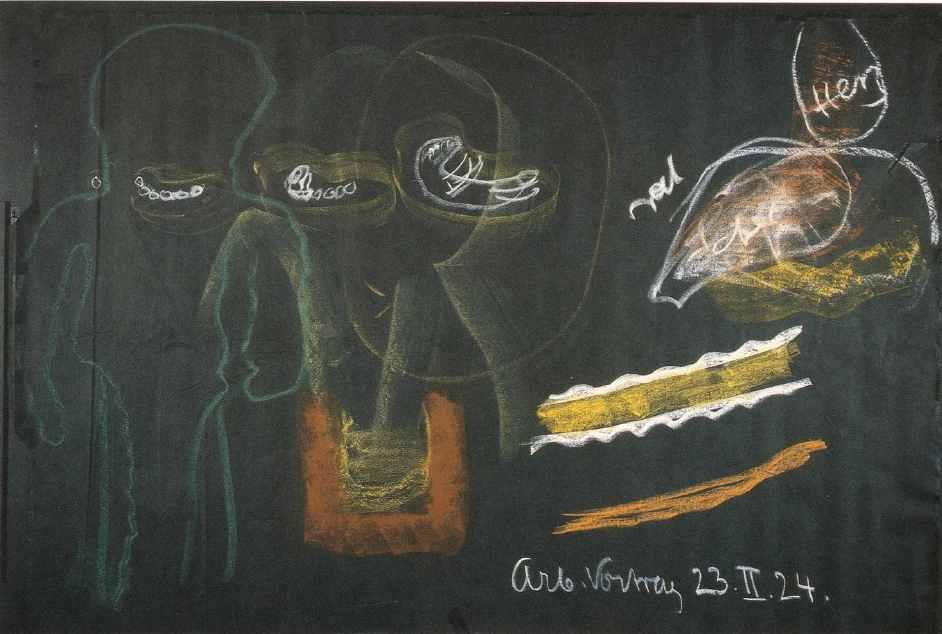
[ 8 ] Aber außer dem, was auf diese Weise vorhanden ist, ist ja um den Menschen herum im Mutterleibe fortwährend vorhanden eine dickliche Flüssigkeit. Diese dickliche Flüssigkeit ist so vorhanden (es wird gezeichnet), dann erst ist ringsherum die Gebärmutter. Diese dickliche Flüssigkeit, mit allerlei dicklichen Einschlüssen, fließt dann bei der Geburt als die sogenannte Nachgeburt ab. Die betrachtet man als einen Abfall, als etwas, was keine Bedeutung hat, weil man überhaupt alles, was am lebenden Wesen heute vorkommt, das heißt so vorkommt, daß es herauskommt, als einen Abfall betrachtet.
[ 8 ] But in addition to what is present in this way, there is, of course, a thick fluid constantly surrounding the human being in the womb. This thick fluid is present in this way (as illustrated), and only then is the uterus all around it. This thick fluid, containing all sorts of thick inclusions, then flows out during birth as what is called the afterbirth. It is regarded as waste, as something of no significance, because today everything that occurs in a living being—that is, everything that comes out—is regarded as waste.
[ 9 ] Aber das ist nicht der Fall, sondern die Sache ist so: Hier, in dem, wie die Zelle sich vermehrt und der physische Menschenleib sich bildet, da wirkt drinnen die äußere Naturkraft, währenddem in der umgebenden Flüssigkeit, die dann abgestoßen wird als Nachgeburt, das GeistigSeelische wirkt. Dieses Geistig-Seelische ist zunächst in der Umgebung des kleinen Menschenleibes; nachher zieht es erst in den Menschenleib hinein. Und man muß den Geist eigentlich in dem suchen, was dann später als Nachgeburt abgestoßen wird. Das ist natürlich sehr überraschend, aber es ist außerordentlich wichtig.
[ 9 ] But that is not the case; rather, the situation is as follows: Here, in the way the cell multiplies and the physical human body forms, the external force of nature is at work within, whereas in the surrounding fluid—which is then expelled as the afterbirth—the spiritual-soul aspect is at work. This spiritual-soul aspect is initially present in the vicinity of the tiny human body; only later does it enter the human body. And one must actually seek the spirit in what is later expelled as the afterbirth. This is, of course, very surprising, but it is extraordinarily important.
[ 10 ] Es wird heute so sehr verneint, das Geistige zu untersuchen, daß ein Freund von mir sich unter meinen Angaben die Aufgabe gestellt hat, diese Nachgeburt zu untersuchen, wie sie allmählich den Geist abgibt an den eigentlichen Embryo, das eigentlich Physische. Man könnte das ganz gut wissenschaftlich untersuchen; aber das scheitert nur an dem, daß da, wo man Menschenkeime bekommt - es ist ja nicht in sehr vielen Fällen der Fall -, dadurch, daß die Mutter stirbt oder operiert werden muß, die heutigen Naturforscher sogleich alles, was ringsherum ist, wegnehmen, und man kriegt keinen Menschenkeim zu untersuchen, um das herauszubekommen. Also selbst die Art und Weise, wie die Dinge behandelt werden, ist heute störend für die wirkliche Wissenschaft. Das Materialistischwerden, möchte ich sagen, fängt schon an bei der Untersuchung der Entstehung des Menschen.
[ 10 ] Today, there is such strong resistance to studying the spiritual realm that a friend of mine, guided by my instructions, has set out to investigate the afterbirth as it gradually transfers its spiritual essence to the actual embryo—the physical entity itself. This could very well be studied scientifically; but the effort fails simply because, in those rare cases where human embryos are obtained—which is not very common—due to the mother’s death or the need for surgery, today’s natural scientists immediately remove everything surrounding the embryo, and one is left with no human embryo to examine in order to determine this. So even the way things are handled today is an obstacle to true science. The shift toward materialism, I would say, begins right with the study of human origins.
[ 11 ] Nun wissen Sie aber, daß der Mensch auch, während er lebt, absondert. Dasjenige, was abgesondert wird, ist ja etwas, was nicht besonders beliebt ist in der äußeren Welt aus dem Grunde, weil es nicht gut riecht. Fast alle Absonderungen riechen nicht gut. Man betrachtet heute — aber das natürlich mit einem vollständigen Recht - alle Absonderungen als etwas, was halt eben abgesondert, weggewaschen werden muß und so weiter.
[ 11 ] But you know that humans also excrete while they are alive. What is excreted is, after all, something that is not particularly popular in the outside world because it does not smell good. Almost all excretions smell bad. Today—and quite rightly so, of course—all secretions are regarded as something that simply has to be excreted, washed away, and so on.
[ 12 ] Die Absonderungen am Menschen sind also zunächst dasjenige, was Sie angeführt haben: der Urin, die Schweißabsonderungen, nicht wahr, auch die derben Absonderungen, die Fäkalien und einiges andere noch. Schließlich ist ja auch das, was Sie von den Nägeln herunterschneiden, eine Absonderung des Menschen. Es ist eben eine feste Absonderung. Aber manche Dinge, die auch Absonderungen sind, erkennt man wiederum nicht als Absonderungen an, aber sie sind in Wirklichkeit doch Absonderungen.
[ 12 ] Human secretions are, therefore, first and foremost what you mentioned: urine, sweat, aren’t they? Also the coarse secretions—feces and a few other things as well. After all, what you cut off from your fingernails is also a human secretion. It is, after all, a solid secretion. But some things that are also secretions are not recognized as such; yet they are, in reality, secretions.
[ 13 ] Sehen Sie, als das edelste Organ im Menschen sieht man oftmals das Auge an. Nun, Sie brauchen sich nur zu überlegen, wie leicht ein Auge herausgenommen werden kann. Es liegt fast ganz abgesondert in der Augenhöhle drinnen. Und dasjenige, was als Flüssigkeit im Auge ist ich habe es Ihnen erklärt -, das ist auch eine Absonderung. Und daß in dem, was die verschiedenen Organe im Gehör, im Ohr sind, auch Absonderungen sind, daß da die Absonderung mitspielt, können Sie schon aus der Bildung des Ohrenschmalzes entnehmen, das eben die äußerste Absonderung ist. Also wir haben es beim Menschen überhaupt überall mit Absonderungen zu tun; auf der einen Seite wird der Mensch aufgebaut, auf der anderen Seite löst er sich aber auf, sondert er ab.
[ 13 ] You see, the eye is often regarded as the noblest organ in the human body. Well, just think about how easily an eye can be removed. It lies almost entirely isolated inside the eye socket. And the fluid inside the eye—as I’ve explained to you—is also a secretion. And the fact that the various organs of hearing in the ear also involve secretions, that secretion plays a role there, can be seen from the formation of earwax, which is precisely the outermost secretion. So, in human beings, we are dealing with secretions everywhere; on the one hand, the human being is built up, but on the other hand, he breaks down and secretes.
[ 14 ] Nun, was folgt daraus? Ich habe Ihnen neulich einmal etwas gesagt, was Ihnen lehrreich sein könnte in dieser Beziehung. Ich habe Ihnen gesagt: Die Menschen sehen die Nerven, das ganze Gehirn als etwas an, was gerade solch ein Organ ist wie die anderen Organe, wie die Leber oder Milz. Das ist aber nicht wahr, meine Herren. Das Gehirn ist eine Absonderung. Das ganze Gehirn, habe ich Ihnen gesagt, ist eine Absonderung! Und wenn man das Gehirn mit etwas vergleichen will, so muß man es nicht vergleichen mit dem Darm, sondern mit dem, was im Darm drinnen ist. Also wenn Sie ein Stück Darm haben, so ist da die Darmwand, und da ist der Darminhalt (siehe Zeichnung S. 159, unten). Die Sache ist so, daß die Darmwand so gewellt ist. Beim Gehirn, beim Nerv, da fehlt die Wand; sie ist auch da, aber sie ist durchsichtig, sie ist nicht sichtbar, und nur der Inhalt ist da (siehe Zeichnung, oben). Sie können ganz richtig sagen: Womit ist denn eigentlich unser Gehirn angefüllt? Mit einem ganz besonders gearteten Darminhalt ist es angefüllt! Und wenn Sie den Darminhalt Dreck nennen, so können Sie sagen, ist das Gehirn Dreck. Das ist durchaus absolut wissenschaftlich richtig. Denn die Denktätigkeit besteht nicht in einer Tätigkeit des Gehirns, sondern die Denktätigkeit besteht darinnen, daß das Gehirn vom Denken ausgesondert wird, abgesondert wird. Je mehr Sie von unten nach oben im Menschen gehen, desto mehr ist der Mensch Absonderung.
[ 14 ] Well, what follows from this? I told you something the other day that might be instructive to you in this regard. I told you: People regard the nerves, the entire brain, as an organ just like any other—like the liver or the spleen. But that is not true, gentlemen. The brain is a secretion. The entire brain, as I told you, is a secretion! And if one wants to compare the brain to something, one must not compare it to the intestine, but to what is inside the intestine. So if you have a piece of intestine, there is the intestinal wall, and there is the intestinal contents (see drawing on p. 159, below). The fact is that the intestinal wall is corrugated. In the case of the brain and the nerves, the wall is missing; it is there, but it is transparent, it is not visible, and only the contents are present (see drawing, above). You can quite rightly ask: What, then, is our brain actually filled with? It is filled with a very special kind of intestinal contents! And if you call this intestinal contents “dirt,” then you can say that the brain is dirt. That is absolutely scientifically correct. For the activity of thinking does not consist in an activity of the brain, but rather the activity of thinking consists in the brain being set apart from thinking, being separated. The further you go from the bottom to the top in a human being, the more the human being is separation.
[ 15 ] Nun habe ich Ihnen vom sinnlichen und vom übersinnlichen Menschen gesprochen, von dem Menschen, den man sieht, und von dem Menschen, der auch in uns ist, den man nicht sieht. Dasjenige, was man am Menschen sieht, ist das, was fortwährend aufgebaut wird, was von dem kommt, was sich zum physischen Menschenleib ausbildet. Dahier kriegt er die Armstumpfe (siche Zeichnung S. 156), da die Beinstumpfe. Aber was das Übersinnliche ist, der astralische Leib und das Ich, die sind zum Absondern da, die sondern fortwährend ab. Nur der physische Leib und der Ätherleib bauen auf. Der astralische Leib und das Ich bauen wieder ab.
[ 15 ] I have now spoken to you about the physical and the spiritual human being—about the human being we can see, and about the human being who is also within us, whom we cannot see. What we see in a human being is that which is continually being built up, which arises from what develops into the physical human body. This is where the arm stumps come from (see drawing on p. 156), and the leg stumps as well. But what is supersensible—the astral body and the “I”—is meant to separate; they are constantly separating. Only the physical body and the etheric body build up. The astral body and the “I” break down again.
[ 16 ] Wenn man ein Haus aufbaut, bemüht man sich darum, es möglichst schnell aufzubauen und möglichst lange darinnen zu wohnen. Nach und nach baut die Natur auch ab, sonst müßten Sie die Häuser heute noch sehen, die im alten Indien gestanden haben. Aber von unseren Häusern, die vor dreihundert Jahren hier gestanden haben, werden Sie wenige noch finden. Beim Menschen ist es so, daß das Aufbauen und das Abbauen gleichzeitig vor sich geht. Erst wird aufgebaut: Wir essen, nehmen die Dinge auf; die kommen bis zur Leber, da werden sie umgewandelt. Dann beginnt schon das Abbauen wieder, das Aussondern. Und in diesem Auf- und Abbau besteht eigentlich die ganze Tätigkeit des menschlichen Wesens. Wenn wir bloß aufbauen würden, dann wären wir stumpf und dumm. Lauter blöde Kerle wären wir. Nicht einmal blöde Kerle wären wir, sondern wir wären ganz geistlos herumgehende Pflanzen, wenn wir bloß aufbauen würden. Daß wir abbauen, daß wir zum Beispiel im Gehirn fortwährend aussondern, daß wir also Absonderungsorgane haben, Drüsen, darauf beruht überhaupt das, daß wir nicht blöde Kerle sind, sondern daß wir gescheite Menschen sind, mit Unterschieden natürlich. Aber das Geistige beruht auf dem Abbauen, nicht auf dem Aufbauen. Und daher sind die Absonderungen von ganz besonderer Wichtigkeit.
[ 16 ] When you build a house, you strive to build it as quickly as possible and to live in it for as long as possible. Little by little, nature also breaks things down; otherwise, you would still be seeing today the houses that once stood in ancient India. But of the houses that stood here three hundred years ago, you will find very few remaining. With human beings, the processes of building up and breaking down occur simultaneously. First comes the building up: we eat, take things in; they reach the liver, where they are transformed. Then the breakdown begins again—the excretion. And this cycle of building up and breaking down actually constitutes the entire activity of the human being. If we were to do nothing but build up, we would be dull and stupid. We’d be nothing but a bunch of idiots. We wouldn’t even be idiots—we’d be mindless, walking plants if we did nothing but build up. The fact that we break things down—that, for example, we are constantly excreting in the brain—and that we therefore have excretory organs, glands—is the very reason we are not stupid people, but rather intelligent human beings, with differences, of course. But the spiritual is based on breaking things down, not on building them up. And that is why these excretions are of very special importance.
[ 17 ] Sehen Sie, die Sache ist so: Ganz dieselbe Tätigkeit, die vor sich geht, wenn da die Nachgeburt ausgesondert wird, geht vor sich bei jeglichem Abbau. Wenn immer mehr zerstört wird, um den Aufbau des menschlichen Wesens herum, dann wirkt der Geist. Und wenn der Geist dann im menschlichen Körper selber wirken kann, wenn der Mensch geboren wird, dann braucht man die Nachgeburt nicht mehr; dann wird sie eben abgestoßen. Aber es wird das ganze Leben hindurch abgestoßen. Es wird abgestoßen in den mehr oder weniger fest-weichlichen Darmabsonderungen, es wird abgestoßen im Urin, es wird abgestoßen im Schweiß zum Beispiel. Welche Bedeutung der Schweiß als Absonderung hat, das können Sie beobachten, wenn Sie einmal einen richtigen Angsttraum haben. Beobachten Sie es nur einmal, wenn Sie einen richtigen Angsttraum haben. Wenn Sie zum Beispiel träumen, daß jemand Ihnen nachläuft, der Sie umbringen oder wenigstens tüchtig durchprügeln will. Sie laufen ihm davon, Sie laufen im Traum, laufen, laufen, laufen; flugs wachen Sie auf, aber nicht anders, als daß Sie völlig in Schweiß gebadet sind. Da geht diese Tätigkeit, die so gesteigert ist, daß Sie solche Bilder haben, die Ihnen Angst machen, in Schweißausbrüchen vor sich. Und diese Schweißausbrüche sind die körperliche Begleiterscheinung von dem, was der Angsttraum ist. Oder denken Sie an einen schwer Lungenkranken, der nicht im letzten Stadium ist, aber dessen Lunge nicht in Ordnung ist. Die Lunge kann nicht gut atmen, dadurch preßt sich diese Lunge zusammen: Er leidet sehr unter Angstträumen. Aber er ist auch immer, wenn er schläft, in Schweiß gebadet. So haben Sie den Zusammenhang zwischen den Schweißabsonderungen und diesen geistigen Tätigkeiten, Bildern, die im Traum kommen. Ja dann, meine Herren, ist der Ätherleib tätig, weil der Angsttraum eigentlich erst im Moment des Aufwachens entsteht. Man glaubt nämlich nur, das Träumen habe fast die ganze Nacht gedauert. Der ganze Traum spielt sich ab im Moment des Aufwachens.
[ 17 ] You see, the thing is this: The very same process that takes place when the afterbirth is expelled occurs during every process of decay. Whenever more and more is broken down around the structure of the human being, the spirit is at work. And when the spirit can then act within the human body itself—when the human being is born—the afterbirth is no longer needed; it is simply expelled. But this process of expulsion continues throughout one’s entire life. It is expelled in the more or less solid or soft intestinal secretions; it is expelled in urine; it is expelled in sweat, for example. You can observe the significance of sweat as a secretion if you ever have a truly frightening nightmare. Just observe it once when you have a truly frightening nightmare. For example, if you dream that someone is chasing you, someone who wants to kill you or at least beat you up badly. You run away from him; you run in the dream—run, run, run—and suddenly you wake up, only to find yourself completely drenched in sweat. There, this heightened activity—which is so intense that it produces images that frighten you—manifests itself in outbreaks of sweating. And these bouts of sweating are the physical manifestation of what a nightmare is. Or consider someone with severe lung disease who is not in the final stage but whose lungs are not functioning properly. The lungs cannot breathe well, causing them to constrict; the person suffers greatly from nightmares. But he is also always drenched in sweat when he sleeps. So there you have the connection between sweating and these mental activities—the images that arise in the dream. Well then, gentlemen, the etheric body is active, because the nightmare actually arises only at the moment of waking. One merely believes that the dream lasted almost the entire night. The entire dream takes place at the moment of waking.
[ 18 ] Das kann man beweisen, wie sich Träume im Moment des Aufwachens abspielen. Ich habe Ihnen früher einmal, wo viele von Ihnen noch nicht da waren, einen charakteristischen Traum erzählt, aus dem Sie sehen, wie man im Aufwachen erst den ganzen Traum durch den Kopf schießen hat. Da steht ein Student an der Türe des Hörsaals. Ein anderer kommt auf ihn zu, rempelt ihn an. Nun, das ist eine furchtbare Beleidigung unter Studenten, wenn man angerempelt wird! Das kann nur mit einem Duell ausgehen; anders geht das nicht. Nun also, sofort, wie der ihn anrempelt, sucht sich der eine einen Sekundanten; der andere muß sich auch einen Sekundanten suchen — das ist eine lange Geschichte, die der Student träumt —, das ganze wird verabredet, die Sekundantenverhandlungen, alles; scheinbar dauert das furchtbar lange. Er träumt, wie sie in den Wald hinausgehen, wie sie sich da aufstellen, Distanz bestimmt wird, abgeschritten wird, wie groß die Entfernung ist. Die Pistolen werden geladen - alles das träumt er -; wie dann angesetzt wird, der erste Schuß fällt, da wacht er auf! Flugs merkt er, daß er, weil er unruhig geworden ist im Schlaf, den Stuhl umgeworfen hat; aber der fällt noch während er aufwacht. Also das Stuhlumfallen hat den ganzen Traum gemacht; in dem Moment schoß der ganze Traum durch den Kopf. Der Traum dehnt sich nur innerlich aus zu der Länge. In Wirklichkeit träumt man eigentlich im Moment des Aufwachens. Und deshalb ist es auch so, daß solche Kranke im Aufwachen nun die Angstträume haben; sie schlafen, wachen auf, und dabei kommen sie in diese Schweißabsonderung. Das ist der Ätherleib, der da tätig ist. Wenn wir von selber früh aufwachen, so gehen wir mit unserem Ich und astralischen Leib, die aus dem physischen Leib heraußen sind in der Nacht, wieder hinein, und dadurch brechen wir in Schweiß aus. Also beim Schwitzen ist es der Ätherleib, der hauptsächlich zuwege bringt, daß wir geistige Wesen sind, denn die Steine und die Pflanzen träumen ja nicht, sind deshalb auch keine geistigen Wesen.
[ 18 ] This can be demonstrated by observing how dreams play out at the moment of waking. I once told you—back when many of you weren’t here yet—about a characteristic dream that shows how, upon waking, the entire dream first flashes through your mind. A student is standing at the door of the lecture hall. Another approaches him and bumps into him. Well, being bumped into is a terrible insult among students! It can only end in a duel; there’s no other way. So, immediately after being bumped, one of them looks for a second; the other must also find a second—it’s a long story that the student dreams—and everything is arranged: the negotiations with the seconds, everything; it seems to take an awfully long time. He dreams of them going out into the forest, of them lining up there, the distance being determined, the ground being paced to measure how far apart they are. The pistols are loaded—he dreams all of this—; then, as they take aim and the first shot is fired, he wakes up! He immediately realizes that, because he had become restless in his sleep, he had knocked over the chair; but it falls even as he is waking up. So the chair falling is what created the entire dream; in that moment, the whole dream flashed through his mind. The dream only expands inwardly to that length. In reality, one actually dreams at the very moment of waking up. And that is why such patients have these nightmares as they wake up; they sleep, wake up, and in the process begin to sweat. It is the etheric body that is active there. When we wake up early of our own accord, we return—with our “I” and astral body, which have been outside the physical body during the night—back into it, and as a result we break out in a sweat. So when we sweat, it is the etheric body that is primarily responsible for making us spiritual beings, for stones and plants do not dream and are therefore not spiritual beings.
[ 19 ] Dann aber die Urinabsonderung. Sehen Sie, das merkt man aus dem Grunde nicht so stark wie beim Schweiß, weil der Schweiß nichts anderes tun kann als herausgehen, und er bedeckt dann die Haut. Würde aber die Haut kleine Säcke haben, wo der Schweiß im Innern sich absondert, und würde darüber noch eine feine Haut das zudecken, so würde man das gar nicht bemerken. Es könnte so sein, daß man im Innern der Haut kleine Säcke hätte. Da ginge der Schweiß hinein, und zu gewissen Zeiten —- man könnte feine Muskeln haben — preßt man die Haut, da könnte der Schweiß abrinnen. Gleichsam wie der Schweiß durch den Ätherleib, so wird der Urin durch den astralischen Leib abgesondert. Aber man merkt nicht, daß wenn man zum Beispiel lebhaftere Gefühle hat, mehr Urin abgesondert wird, als wenn man schwache Gefühle hat, weil sich der Urin nicht gleich nach außen ergießt. Sehen Sie, die Sache ist so: Wenn einer in Begeisterung ist und er in dieser Begeisterung bleibt - gleichgültig ob sie sich äußerlich in Taten auswirkt, oder ob man etwas betrachtet —, und der Mensch hätte nicht die Urinblase, so müßte der Mensch gerade in der Begeisterung fortwährend Urin lassen. Es wäre eine sehr schlimme Einrichtung. Der Mensch könnte in kein Museum gehen, denn wenn er dort die Bilder sieht, in Begeisterung kommt, so müßten lauter Toiletten in der Nähe sein! Da ist es eben so, daß in der menschlichen Natur für diese Absonderung, die bewirkt wird, gesorgt ist. Sie sammelt sich in der Urinblase an und kann zu gewissen Zeiten abgelassen werden. Aber der Urin ist vorzugsweise vom astralischen Leib abgesondert, und der füllt den Menschen überall aus, der Urin kommt von überall her, sammelt sich in den Nieren und geht dann in die Urinblase.
[ 19 ] But then there is the secretion of urine. You see, you don’t notice this as much as you do with sweat, because sweat can do nothing but come out, and it then covers the skin. But if the skin had small sacs where the sweat is secreted inside, and if a fine layer of skin covered them, one would not notice it at all. It could be that there are small sacs inside the skin. The sweat would go into them, and at certain times—one might have fine muscles—one would squeeze the skin, and the sweat could flow out. Just as sweat is secreted through the etheric body, so is urine secreted through the astral body. But one does not notice that, for example, when one has more intense feelings, more urine is secreted than when one has weaker feelings, because the urine does not flow out immediately. You see, the matter is this: If someone is in a state of enthusiasm and remains in that state—regardless of whether it manifests outwardly in actions or whether one is simply contemplating something—and if that person did not have a bladder, they would have to constantly urinate right in the midst of that enthusiasm. It would be a very unfortunate arrangement. A person could not go to a museum, because if they saw the paintings there and became enthusiastic, there would have to be nothing but restrooms nearby! The fact is that human nature has provided for this excretion. It accumulates in the bladder and can be expelled at certain times. But urine is primarily secreted by the astral body, which fills the human being everywhere; the urine comes from everywhere, accumulates in the kidneys, and then flows into the bladder.
[ 20 ] Und die Absonderung des Darmes, die steht ganz besonders unter dem Ich — beim Tiere auch unter dem Astralleib, aber beim Menschen unter dem Ich. Und nicht bloß der Darm ist am Absondern betätigt, sondern der ganze Mensch ist betätigt. Im ganzen Menschen wird fortwährend abgesondert. Der Darm ist nur der Ableitungsapparat. So daß man sagen kann, gerade an der Absonderung sieht man, daß beim Schweiß der Ätherleib tätig ist, beim Urin der Astralleib tätig ist, und beim Fäkalienabsondern das Ich tätig ist.
[ 20 ] And the excretion of the intestines is governed in a very special way by the “I”—in animals also by the astral body, but in humans by the “I.” And it is not just the intestines that are active in excretion, but the whole human being. Excretion takes place continuously throughout the entire human being. The bowel is merely the excretory organ. Thus one can say that it is precisely in the process of excretion that we see the etheric body at work in the case of sweat, the astral body at work in the case of urine, and the ego at work in the case of fecal excretion.
[ 21 ] Wenn Sie das bedenken, so werden Sie nicht darauf kommen, die Absonderungen als etwas so Unwichtiges anzusehen. Denn nehmen wir an, der Mensch hat einen normalen Urin. Ja, dann ist der Astralleib im Menschen auch auf normale Weise tätig. Aber von dem, wie der Astralleib tätig ist, hängt es ab, ob der Mensch gesund oder krank ist. Alles in Gesundheit und Krankheit hängt im Grunde genommen davon ab, wie der Astralleib tätig ist.
[ 21 ] If you consider this, you will not come to regard bodily secretions as something so unimportant. For let us assume that a person has normal urine. Yes, then the astral body within the person is also functioning normally. But whether a person is healthy or sick depends on how the astral body functions. Everything related to health and illness ultimately depends on how the astral body functions.
[ 22 ] Wenn wir zum Beispiel Eier essen und die Eier verdaut werden sollen, da muß das Ei zunächst in den Mund, dann in den Magen gehen; dann geht es in die Gedärme, und da wird es, wie ich einmal gesagt habe, als Ei ganz zerstört. Das Eiweiß wird zerstört. Aber dann bei dem Weg, den das zerstörte Eiweiß macht in die Leber hinein, wird es wieder neu aufgebaut, und es entsteht aus dem tierischen und pflanzlichen Eiweiß auf dem Wege vom Darm in die Leber Menscheneiweiß. Das Menscheneiweiß geht dann erst ins Blut hinein.
[ 22 ] For example, when we eat eggs and they need to be digested, the egg must first go into the mouth, then into the stomach; then it goes into the intestines, and there, as I once said, it is completely broken down as an egg. The egg white is broken down. But as the broken-down egg white travels to the liver, it is rebuilt, and human protein is formed from the animal and plant proteins as they pass from the intestines to the liver. Only then does the human protein enter the bloodstream.
[ 23 ] Wenn Sie den menschlichen Organismus ansehen, so ist hier das Zwerchfell (siehe Zeichnung), hier sitzt die Leber, und hier sitzt das Herz; sie sind nur durch das Zwerchfell getrennt. Was vom Darm in die Leber kommt, wird umgewandelt aus tierischem und pflanzlichem Eiweiß - ich will das hier gelb machen - in menschliches Eiweiß (dunkler gelb). Das wird in der Leber zusammengehalten, und dann geht das ins Herz hinüber.
[ 23 ] If you look at the human body, here is the diaphragm (see diagram), here is the liver, and here is the heart; they are separated only by the diaphragm. What passes from the intestines into the liver is converted from animal and plant protein—I’ll color this yellow here—into human protein (darker yellow). This is held together in the liver, and then it passes on to the heart.
[ 24 ] Die Sache ist nun so: Wenn wir Eiweiß essen, dann muß unser astralischer Leib arbeiten, damit das tierische und pflanzliche Eiweiß richtig in menschliches Eiweiß verwandelt wird. Ist der astralische Leib faul, kann er nicht ordentlich arbeiten, so wird in der Leber das tierische Eiweiß nicht in menschliches Eiweiß umgewandelt, sondern das tierische Eiweiß geht direkt in die Niere und wird mit dem Urin abgesondert. Untersucht man nun den Urin — das macht die moderne wissenschaftliche Medizin auch -, so findet man im Urin Eiweiß.
[ 24 ] The fact is this: When we eat protein, our astral body must work to properly convert animal and plant protein into human protein. If the astral body is sluggish and cannot function properly, the animal protein is not converted into human protein in the liver; instead, it goes directly to the kidneys and is excreted in the urine. If one examines the urine—as modern scientific medicine also does—one finds protein in it.
[ 25 ] Oder denken Sie, meine Herren, Sie essen Kartoffeln. Die Kartoffel wird zumeist im Munde schon umgewandelt, denn die Stärke ist überhaupt ein wichtiges Nahrungsmittel, ist nicht bloß da zum Hemdenstärken. Die Kartoffel besteht ja fast ausschließlich aus Stärke. Auf dem Wege vom Mund in den Magen und in die Gedärme hinein wird nun die Kartoffel allmählich in Zucker umgewandelt. Aus der Kartoffelstärke wird zuerst Dextrin und nachher Zucker. Die Kartoffeln sind nur im Mund schlecht; im Gedärm sind sie ungemein süß, weil sie da in Zucker umgewandelt werden. Aber wenn nun in den Gedärmen die Kartoffelstärke in Zucker umgewandelt worden ist, und wenn die Leber nun Kartoffelzucker oder irgendeinen anderen Zucker in Menschenzucker umgewandelt hat, dann übergibt sie dem Gesamtkörper, der dadurch wärmer wird, der dadurch seine innere Wärme hat, diesen inneren Zucker. Damit das aber geschehen kann, dazu muß der astralische Leib wieder ordentlich arbeiten. Arbeitet er nicht ordentlich, dann wird das nicht bewirkt, daß das ordentlich in Menschenzucker verwandelt wird, sondern der tierische und namentlich der pflanzliche Zucker geht direkt in die Niere. Der Zucker wird abgesondert, und der Mensch wird Diabetiker, zuckerkrank. Sie können wiederum aus dem Zuckergehalt des Urins finden, daß der Mensch krank ist.
[ 25 ] Or do you think, gentlemen, that you are eating potatoes? The potato is usually already broken down in the mouth, because starch is, after all, an important food—it’s not just there for stiffening shirts. After all, the potato consists almost entirely of starch. On its way from the mouth to the stomach and into the intestines, the potato is gradually converted into sugar. Potato starch first turns into dextrin and then into sugar. Potatoes are only unpleasant in the mouth; in the intestines, they are incredibly sweet because they are converted into sugar there. But once the potato starch has been converted into sugar in the intestines, and once the liver has converted potato sugar or any other sugar into human sugar, it then supplies this internal sugar to the entire body, which thereby becomes warmer and gains its inner warmth. For this to happen, however, the astral body must be functioning properly again. If it is not functioning properly, then the sugar is not properly converted into human sugar; instead, the animal and, in particular, the plant-based sugar goes directly to the kidneys. The sugar is excreted, and the person becomes diabetic. You can, in turn, determine from the sugar content of the urine that the person is ill.
[ 26 ] Das alles ist etwas, was die heutige Medizin auch macht und was sie als etwas außerordentlich Wichtiges ansieht. Das ist das erste sogar, was man heute tut: Man untersucht den Urin auf Eiweiß und Zucker. Dann hat man gleich einen Anhaltspunkt dafür, ob der Mensch diese oder jene Krankheit haben kann.
[ 26 ] All of this is something that modern medicine also does and considers to be extremely important. In fact, it is the very first thing doctors do today: they test the urine for protein and sugar. This immediately provides an indication of whether a person might have this or that disease.
[ 27 ] Oder nehmen Sie folgendes: Sehen Sie, wenn wir den Kopf gesund haben wollen, was ja schließlich für den physischen Menschen hier auf der Erde auch nicht etwas ganz Unwichtiges ist — die Menschen wollen schon einmal den Kopf gesund haben, weil sie glauben, daß der Kopf das wichtigste Organ ist beim Menschen; also wollen sie den Kopf gesund haben -, wenn wir den Kopf gesund haben wollen, dann müssen wir eine Substanz, die fortwährend sich in uns erzeugt, nämlich die Kleesäure, durch die Brust in den Kopf heraufbringen. Ein gesunder Kopf muß eine bestimmte Menge Kleesäure haben. Wir erzeugen die Kleesäure selber in uns, wie wir auch den Alkohol erzeugen, den wir brauchen. Aber dazu muß wieder der Kopf in richtiger Weise arbeiten, damit die Kleesäure, Oxalsäure erzeugt wird. Arbeitet er nicht richtig und bleibt sie unten, bekommen wir einen Kopf, der blutarm ist, und die Kleesäure wird in den Urin geleitet, geht ab.
[ 27 ] Or consider the following: You see, if we want to have a healthy mind—which, after all, is not entirely unimportant for physical human beings here on Earth—people do want to have a healthy mind because they believe that the mind is the most important organ in the human being; so they want to keep their minds healthy—if we want to keep our minds healthy, then we must bring a substance that is constantly produced within us—namely, clover acid—up into the head through the chest. A healthy mind must have a certain amount of clover acid. We produce oxalic acid ourselves, just as we produce the alcohol we need. But for this to happen, the head must function properly so that oxalic acid can be produced. If it does not function properly and the acid remains below, we end up with a head that is anemic, and the oxalic acid is excreted in the urine.
[ 28 ] Daraus sehen Sie, meine Herren, daß man auch heute durch die gewöhnlichste chemische Untersuchung des Urins auf die wichtigsten Krankheiten kommt. Aber diese Chemie, die man heute hat, die hat es ja früher nicht gegeben. Und eine Medizin hat es doch auch gegeben!
[ 28 ] As you can see, gentlemen, even today the most common chemical analysis of urine can reveal the most important diseases. But the chemistry we have today did not exist in the past. And yet medicine did exist!
[ 29 ] Nun ist die Sache so: Nehmen Sie einmal an, ein Mensch habe Fieber; ich will einen drastischen Fall nehmen. Was heißt das, ein Mensch hat Fieber? Das heißt nicht, sein Astralleib ist schwach und flau geworden, träge, sondern er ist gerade in einer übermässigen Tätigkeit, so daß er bis ins Ich herauf wirkt. Dann wird das Ich wie gepeitscht, wenn der Astralleib in übermäßiger Tätigkeit ist. Aber das Ich bewirkt die Blutzirkulation. Und ein übermäßig tätiger Astralleib, der überall in die Organe hereinwill und nicht kann und daher in sich brodelt wie das sturmgepeitschte Meer, der erzeugt in sich Fieber. Jetzt hat der Mensch Fieber von seinem gepeitschten Astralleib. Was wird die weitere Folge sein? Das Blut wird zu schnell durch den Körper gejagt. Es wandelt sich das Blur nicht ordentlich um. Das Blut hat nicht Zeit, die Organe zu bilden, geht wiederum als Blut vom Herzen in die Niere und von da in den Urin, und wir bekommen einen Urin, der sehr dunkel gefärbt ist. Wer nun die dunkle Farbe des Urins zu beurteilen weiß, der weiß, daß unter allen Umständen, ob er ein bißchen dunkler oder stark dunkel ist, das Fieber im menschlichen Organismus flutet.
[ 29 ] Now, here’s the thing: Suppose a person has a fever; I’ll take a drastic case as an example. What does it mean when a person has a fever? It does not mean that their astral body has become weak, listless, or sluggish, but rather that it is in a state of excessive activity, so that it affects the ego itself. Then the ego is, as it were, whipped when the astral body is in excessive activity. But the ego regulates blood circulation. And an excessively active astral body—which wants to enter all the organs but cannot, and therefore seethes within like a storm-tossed sea—generates fever within itself. Now the person has a fever caused by their whipped astral body. What will be the next consequence? The blood is rushed through the body too quickly. The blood does not circulate properly. The blood does not have time to nourish the organs; it flows back as blood from the heart to the kidneys and from there into the urine, and we end up with urine that is very dark in color. Anyone who knows how to interpret the dark color of urine understands that, regardless of whether it is slightly darker or very dark, fever is surging through the human organism.
[ 30 ] Nehmen Sie an, der astralische Leib wird ganz träge, er wird nicht mehr ordentlich arbeiten. Da geht das Blut ganz langsam durch den Körper, der Puls wird kaum bemerkbar. Man kann es dann am Puls abtasten, wie das Blut überall langsam durchgeht. Im Körper schoppt sich alles zusammen. Der Körper bekommt Schmerzen an allen möglichen Stellen; der Urin wird hellgelb oder sogar weiß. Nun, zwischen dem, daß der Urin dunkel ist und weiß ist, gibt es alle möglichen Nuancen, Farbennuancen. Wenn sich einer auf diese Farbennuancen einschult und nimmt den Urin und schaut ihn durchs Licht an, kann er schon aus den Farben des Urins das allerverschiedenste ablesen.
[ 30 ] Suppose the astral body becomes completely sluggish; it no longer functions properly. The blood flows very slowly through the body, and the pulse is barely noticeable. You can then feel from the pulse how the blood is flowing slowly throughout the body. Everything in the body becomes congested. The body experiences pain in all sorts of places; the urine turns light yellow or even white. Now, between dark and white urine, there are all sorts of shades—nuances of color. If one trains oneself to recognize these color nuances, takes a sample of the urine, and examines it against the light, one can discern a wide variety of things simply from the colors of the urine.
[ 31 ] Das Blut will ja fortwährend dasjenige, was von den Organen weggeht, wieder ersetzen. Dadurch hat das Blut fortwährend die Tendenz, fest zu werden. Wenn das Blut nun zu schnell durch die Organe schießt, kann es an die Organe nichts abgeben. Aber es will fest werden. Wenn es dann als Urin aus den Nieren herauskommt, wird der Urin bei einem solchen Blut flockig. Schaut man jetzt wieder durch, hat man einen flockigen Urin. Geht der Astralleib träge und der Puls wird schwach, dann hat man keinen flockigen Urin, sondern einen fast wasserhellen, reinen Urin.
[ 31 ] The blood constantly seeks to replace what is lost by the organs. As a result, the blood has a constant tendency to thicken. If the blood flows through the organs too quickly, it cannot release anything to them. But it wants to become thick. When it then exits the kidneys as urine, the urine becomes flocculent with such blood. If you look at it again, you will see flocculent urine. If the astral body is sluggish and the pulse becomes weak, then the urine is not flocculent, but rather almost water-clear and pure.
[ 32 ] Also nicht nur aus der Farbe, sondern auch aus dieser Wolkigkeit oder Reinheit des Urins kann man viel schließen. Wenn der Urin, wenn man durchschaut, ausschaut wie ein gewittriger Sommertag, wo dunkle Wolken stehen, und wo alles mögliche da drinnen sich zeigt, wo alles brodelt im Urin, also wenn es so ist wie ein sturmbewegter Sommertag, dann hat der Mensch irgend etwas, was starkes Fieber bringt. Und kann man da beurteilen, was los ist, so kann man daraus auf die Krankheit schließen. Schaut der Urin, wenn man durchsieht, entzückend klar aus wie ein heller Sommertag, an dem die Sonne alles beleuchtet, so kann man daraus schließen, daß der Mensch nach der anderen Seite krank ist, daß er sehr leicht neigt zu allerlei zugrundegehenden Organen; das eine Organ wird untätig, das andere Organ wird untätig und so weiter.
[ 32 ] So you can learn a lot not only from the color, but also from the cloudiness or clarity of the urine. If, when you look through it, the urine looks like a stormy summer day with dark clouds, and if all sorts of things are visible inside it—if everything is bubbling in the urine—in other words, if it resembles a stormy summer day, then the person has something that causes a high fever. And if you can assess what is going on, you can deduce the illness from it. If, when you look through it, the urine appears delightfully clear, like a bright summer day when the sun illuminates everything, then you can conclude that the person is ill in the opposite way—that they are very prone to all sorts of organ failure; one organ becomes inactive, another organ becomes inactive, and so on.
[ 33 ] Also Sie sehen, die Sache ist diese, daß wer sich eingeschult hat auf dasjenige, was da im Urin abgesondert wird, aus dem Urin sehr viel sagen kann. Aber das ist eben gerade der Unterschied zwischen der heutigen neueren Medizin und der alten: Die alte Medizin hat den Urin angeschaut, so wie man einen Sommertag als einen hellen oder als einen sturmgepeitschten Sommertag anschaut, hat also mehr im groben beurteilt, aber hat dadurch, daß sie sich eingeschult hatte, mehr aus dem Bestande geurteilt. Die heutige, mehr materialistische Medizin untersucht den Urin chemisch, findet Eiweiß, Kleesäure, Zucker und so weiter drinnen. Also der Unterschied ist der, daß der eine das nach der Anschauung gemacht hat, mehr nach der Art, wie es sich ihm gibt, und der andere macht es mehr nach der Chemie.
[ 33 ] So, you see, the point is that anyone who has trained themselves to interpret what is excreted in the urine can tell a great deal from the urine. But that is precisely the difference between modern medicine and the old: Old medicine looked at urine the way one looks at a summer day—as either a bright one or a storm-lashed one—so it made a more general assessment, but because it had trained itself to do so, it was able to draw more conclusions from the composition. Today’s, more materialistic medicine examines urine chemically, finding protein, oxalic acid, sugar, and so on in it. So the difference is that one approach was based on observation—more on the way things presented themselves—while the other relies more on chemistry.
[ 34 ] Nun ist es natürlich so: In der früheren Zeit, wo man auf diese Anschauung noch große Rücksicht genommen hat, da haben die Menschen das ordentlich gelernt, waren noch keine Scharlatane. Heute sind diejenigen, die das machen, zumeist Scharlatane; wobei ich nicht sagen will, daß alle Scharlatane sind. Es kann sich einer so gut einschulen, daß er tatsächlich viel absehen kann, alle möglichen Krankheiten; das ist persönliche Schulung, da muß einer aber viel Erfahrung gehabt haben, und diese Erfahrung muß er angewandt haben.
[ 34 ] Now, of course, the situation is this: In earlier times, when this view was still taken very seriously, people learned it properly and were not yet charlatans. Today, those who do this are mostly charlatans; though I don’t mean to say that all of them are charlatans. Someone can train themselves so well that they can actually diagnose all sorts of illnesses; that is a matter of personal training, but one must have had a great deal of experience, and they must have applied that experience.
[ 35 ] Nun ist der Unterschied: Die Menschen geben ja heute nicht viel auf den Geist. Der Geist ist ja nahe daran, abgeschafft zu werden. Dasjenige, was die Chemie bietet, das kann jeder lernen, Einen Stoff chemisch zu untersuchen, das lernt man einfach in den drei, vier, fünf, sechs Jahren, in denen man an der Universität ist. Das kann im Grunde genommen jeder Dummkopf leisten, den Stoff chemisch zu untersuchen. Und darnach strebt man ja auch. Der Geist soll abgeschafft werden. Jeder soll das gleiche können. Das war früher nicht der Fall. Früher hat man den Geist sehr geachtet. Aber man muß eben Geist haben, um den Urin ansehen zu können. Das ist der Unterschied: Früher hat man die Menschen geistig gemacht, indem man sie belehrt hat; heute macht man sie zu Handlangern. Die Geschichte ist diese: Man braucht, wenn man arbeiten will, die Hand, und die Hand sollte vom Geiste geführt werden. Es ist heute viel die Rede von Handarbeit und Kopfarbeit, aber die Dinge sollten gar nicht unterschieden werden. Derjenige, der Handarbeit verrichtet, der sollte Gelegenheit bekommen, wiederum sich so geistig auszubilden, daß er ebenso an den Geist herankommt wie der sogenannte Kopfarbeiter. Diese Unterschiede können nur dadurch unter den Menschen gemacht werden, daß wirkliche geistige Arbeit wiederum geschätzt wird. Aber man will heute den Geist abschaffen.
[ 35 ] Now here’s the difference: People today don’t really care much about the spirit. Intellect is, after all, on the verge of being abolished. Anyone can learn what chemistry has to offer—how to chemically analyze a substance; you simply learn that during the three, four, five, or six years you spend at the university. Basically, any fool can manage to chemically analyze a substance. And that’s what people strive for, after all. Intellect is supposed to be abolished. Everyone is supposed to be able to do the same thing. That wasn’t the case in the past. In the past, the mind was held in high regard. But you have to have a mind to be able to examine urine. That’s the difference: In the past, people were made intellectual by being taught; today, they’re turned into laborers. The story is this: If you want to work, you need your hands, and your hands should be guided by the mind. There is much talk today of manual labor and intellectual work, but these things should not be distinguished at all. Those who perform manual labor should be given the opportunity to develop themselves intellectually so that they can approach the spirit just as much as the so-called intellectual workers. These distinctions can only be made among people if genuine intellectual work is once again valued. But today, people want to abolish the spirit.
[ 36 ] Nun, meine Herren, daraus sehen Sie, daß die frühere Medizin eben mehr darauf gegeben hat, daß die Dinge unmittelbar angeschaut werden. Aber das hat noch eine andere Folge gehabt. Ich weiß nicht, ob Sie wissen, daß die heutige sogenannte wissenschaftliche Medizin ziemlich hohe Nasen macht, na, man kann sie gar nicht so hoch machen, die Nase, wie der heutige Mediziner sie macht, mit der er auf die alte «Dreckapotheke» heruntersieht, weil man früher aus allerlei Absonderungen die Heilmittel herstellte. Und man hat sich gesagt: Der Mensch sondert die Absonderungen ab. Bringt man sie in der richtigen Weise in den Körper zurück, dann wollen sie gleich wiederum heraus. Was tun sie aber da? Dadurch bringen sie zum Beispiel einen trägen Astralleib in eine regelmäßige Tätigkeit oder einen trägen Ätherleib in eine regelmäßige Tätigkeit.
[ 36 ] Well, gentlemen, as you can see, early medicine placed greater emphasis on observing things directly. But this had another consequence as well. I don’t know if you’re aware that today’s so-called scientific medicine puts on quite a high-and-mighty air—well, you can’t really put on an air as high as that of today’s physicians, who look down on the old “dirty apothecary” because remedies used to be made from all sorts of secretions. And people used to say: Human beings secrete these substances. If you return them to the body in the right way, they immediately want to come out again. But what do they do there? Through this, for example, they bring a sluggish astral body into regular activity or a sluggish etheric body into regular activity.
[ 37 ] Jetzt können Sie sagen: Findet man also bei einem Menschen, daß der astralische Leib träge geworden ist, so könnte man ihm ja Schweiß geben als Heilmittel -, das könnten Sie sagen. Und Sie könnten sagen: Nun ja, das ist halt die alte Dreckapotheke, die hat ja wirklich so etwas Verwandtes! — Ja, der Unterschied ist da kein sehr großer. Wenn Sie nämlich die heutigen Produkte, die man zu Heilmitteln verwendet, aufsuchen würden, so würden Sie finden, daß das dieselben Produkte sind, die im Schweiß drinnen sind, nur setzt man sie von außen, vom Mineralischen zusammen. Die Alten haben direkt den Schweiß verwendet. Und er war in vieler Beziehung wirksamer als dasjenige, was man erst zusammensetzt, weil — wie ich Ihnen in vielen Fällen gezeigt habe — die Natur viel gescheiter ist als der Mensch. Der Mensch kann sich in seinen Heilmitteln das zusammensetzen, was die Natur zusammensetzt. Da war es bei den Alten sehr merkwürdig, die haben also etwas geschätzt, was heute gar nicht mehr geschätzt wird. Die Alten haben gesagt: Wenn ein Mensch richtig in Schweiß kommt, dann hat er eigentlich um sich herum nun eine ganze Schweißdecke (siehe Zeichnung). — Nun, das ist das erste. Aber der Mensch sondert überall an seiner Oberfläche Schweiß ab. Wenn man diesen Schweiß, den der Mensch da absondert, festhalten könnte und könnte den Menschen wegnehmen — denken Sie sich, das wäre so: hier schwitzt einer furchtbar; da ist sein Körper an der ganzen Oberfläche mit Schweiß bedeckt —, denken Sie, wenn ich diesen Menschen herausnehmen könnte, und der Schweiß bliebe hier bestehen: Das wäre ja der ganze Abdruck vom Menschen, da würde im Schweiß der ganze Mensch dastehen! Sehr interessant, nicht wahr? Es ist also so, daß der Schweiß immerfort die Absicht hat, die menschliche Gestalt nachzuahmen.
[ 37 ] Now you might say: So if you find that a person’s astral body has become sluggish, you could give them sweat as a remedy—you might say that. And you might say: Well, that’s just the old “dirt pharmacy”; it really does have something similar to it! — Yes, the difference isn’t very great. For if you were to examine the products used as remedies today, you would find that they are the same substances found in sweat; the only difference is that they are synthesized externally from mineral sources. The ancients used sweat directly. And in many respects it was more effective than what is synthesized today, because—as I have shown you in many cases—nature is much wiser than humans. Humans can synthesize in their remedies what nature synthesizes. It was very remarkable with the ancients; they valued something that is no longer valued at all today. The ancients said: When a person really breaks a sweat, they are actually surrounded by a whole layer of sweat (see drawing). — Well, that’s the first point. But a person secretes sweat all over their surface. If one could capture this sweat that the person secretes and remove it from the person—imagine it like this: here is someone sweating profusely; his entire body is covered with sweat—imagine if I could remove that person and the sweat remained here: That would be the person’s entire imprint; the whole person would be standing there in the sweat! Very interesting, isn’t it? So it is that sweat constantly seeks to imitate the human form.
[ 38 ] Die Alten haben dabei noch etwas anderes gemacht. Die haben jetzt nicht nur den Schweiß so angesehen, sondern sie haben schon den Urin so angesehen. Nun haben sie zum Beispiel hier ein Gläschen Urin gehabt (siehe Zeichnung S. 170). Die Alten haben nun noch eine bessere Anschauung gehabt im Geiste; und siehe da: Aus diesem Urin ist ihnen herausgekommen so etwas wie ein Gespenst vom Menschen! Was der Schweiß von selber bildet, indem er an der Oberfläche sein kann, das ist wie aus dem Urin herausgestiegen. Tatsächlich sah man das in alten Zeiten, wenn man ein Fläschchen Urin hatte. Ja, da stieg - ich weiß nicht, ob Sie diese Sage kennen, daß die Göttin, die Venus, aus dem Meerschaum emporgestiegen ist? —, so stieg ein menschliches Astralgespenst aus dem Urin auf. Und bei einem Menschen, der nach einer gewissen Krankheit hinneigte, sagen wir bei einem Menschen, der nach Auszehrung hinneigte, war dieses Astralgespenst dünn und dürr. Bei einem Menschen, der, sagen wir nach krankhafter Dicke hinneigte, da war dieses Gespenst nach allen Seiten schwellend. Nennen Sie das meinetwillen eine Einbildung; es kann ja eine Einbildung sein, wenn Sie wollen, daß einer, wenn er einen hellen Urin sieht, ein anderes Gespenst herauskommen sieht, als wenn er dunklen Urin sieht. Aber er sieht es halt. Und er hat danach als alter Arzt die Krankheiten beurteilt.
[ 38 ] The ancients did something else as well. They didn’t just observe sweat in this way; they also observed urine in this way. For example, here they had a small glass of urine (see illustration on p. 170). The ancients had an even clearer vision in their minds; and lo and behold: something like a human specter emerged from this urine! What sweat forms on its own when it rises to the surface—that is what seemed to rise up from the urine. In fact, people used to see this in ancient times when they had a vial of urine. Yes, it rose—I don’t know if you’re familiar with the legend that the goddess Venus rose from the sea foam?—well, a human astral apparition rose from the urine. And in a person prone to a certain illness—let’s say, a person prone to emaciation—this astral specter was thin and gaunt. In a person who, let’s say, was prone to morbid obesity, this specter was swollen on all sides. Call it a figment of my imagination, if you will; it may well be a figment of the imagination that when someone sees light-colored urine, they see a different specter emerge than when they see dark-colored urine. But they do see it. And as an experienced physician, he used this to diagnose illnesses.
[ 39 ] Und genauso ging es in der Zeit, als man noch untersucht hat nicht nur den Urin, sondern die Fäkalien, die Darmabsonderungsprodukte. Die waren in alten Zeiten ganz besonders wichtig für die Bestimmung der Krankheiten. Denken Sie sich einmal, jemand hatte die Darmabsonderungen genommen. Da drinnen kann man finden, bei dem einen ist viel Schwefel drinnen, Eisen drinnen. Je nachdem dieses drinnen ist, können Sie einen schwefligeren Darminhalt haben. Die Hunde haben zum Beispiel viel Schwefel in ihrem Darminhalt, der dann nach außen geht. Je mehr Schwefel drinnen ist, desto weißlicher und fester ist der Darminhalt. Je nachdem mehr Kohle, Kohlehaltiges drinnen ist, desto weichlicher und dunkler ist der Darminhalt; die Katzen haben dies. Nun, so kann man nach dem Darminhalt, der nach außen kommt, aus den Fäkalien, noch viel besser als aus dem Urin, auf die Krankheit zurückschließen.
[ 39 ] And that’s exactly how it was back when people examined not only urine but also feces—the products of intestinal secretion. In the old days, these were particularly important for diagnosing diseases. Just imagine: someone had collected intestinal secretions. Inside, you might find that one sample contains a lot of sulfur, while another contains iron. Depending on what’s inside, you might have intestinal contents with a higher sulfur content. Dogs, for example, have a lot of sulfur in their intestinal contents, which is then excreted. The more sulfur there is, the whiter and firmer the intestinal contents are. Conversely, the more carbon or carbon-containing substances are present, the softer and darker the intestinal contents are; cats exhibit this. Thus, one can infer the nature of the illness from the intestinal contents excreted—the feces—even more reliably than from urine.
[ 40 ] Auch beim Darminhalt haben die Alten, sagen wir, eine Vision gehabt; sie haben eben solche Visionen gehabt. Das ist etwas sehr Merkwürdiges! Beim Schweiß haben sie gesagt: Wenn der Mensch Schweiß absondert, so hüllt er sich in sein eigenes Gespenst ein. Wenn der Mensch Urin absondert, so ist darinnen sein Gespenst, das aufsteigt. Und beim Darminhalt ist es so, daß es sogar vollständig nach allen Seiten sich abgrenzt und bestimmte Farben hat. Und nach diesen - nennen Sie es Visionen oder Träume, wie Sie wollen -, aber nach diesen Träumen wurden in alten Zeiten viel die Krankheiten bestimmt.
[ 40 ] The ancients also had, shall we say, a vision regarding the contents of the intestines; they had precisely such visions. This is something very remarkable! Regarding sweat, they said: When a person secretes sweat, he envelops himself in his own spirit. When a person excretes urine, his ghost is contained within it and rises up. And as for intestinal contents, they are said to be completely distinct in all directions and to have specific colors. And based on these—call them visions or dreams, as you will—but based on these dreams, many illnesses were diagnosed in ancient times.
[ 41 ] Und in unbestimmter, manchmal ganz dummer Art und Weise machen — indem sie es lesen in alten Büchern, die man heute kaum mehr verstehen kann - solche Leute, wie die von Ihnen erwähnten, das nach. Es gibt auch solche, die nach dem Kot die Krankheiten bestimmen; es kommt dabei meistens nicht viel heraus. Aber es kann einer sich eine große Erfahrung sammeln; dann kann etwas dabei herauskommen. Nur die heutige Wissenschaft gibt nichts darauf, weil sie lieber alles chemisch untersucht. Aber, wie gesagt, es ist bei der heutigen medizinischen Wissenschaft die Urinuntersuchung geradeso wichtig wie bei der unwissenschaftlichen Medizin, die eben ein Überbleibsel ist aus alten Zeiten.
[ 41 ] And in a vague, sometimes quite foolish way—by reading about it in old books that are hardly understandable today—people like those you mentioned try to do the same. There are also those who diagnose illnesses based on feces; usually, not much comes of it. But one can gain a great deal of experience; then something might come of it. Only modern science pays no attention to it, because it prefers to examine everything chemically. But, as I said, in modern medical science, urine analysis is just as important as it is in unscientific medicine, which is simply a remnant of old times.
[ 42 ] Sie werden nun, wenn Sie in alten medizinischen Büchern blättern und lesen, auf einen Ausdruck stoßen, den Sie gewöhnlich nicht verstehen werden. Allerlei Mystiker und solche Leute, die immer sagen, sie haben alle Weisheit, nicht nur Wissenschaft, sondern Weisheit mit Löffeln gegessen, die werden Ihnen immer vorreden, was sie in alten Büchern gelesen haben. Das hat nicht viel Wert, weil sie die alten Bücher nicht verstehen. Aber wenn Sie darin lesen, werden Sie auf einen Ausdruck stoßen. Es steht da immer wieder und wieder der Ausdruck Mumie. Es wird einem erzählt: Ist die Mumie hell, dann ist der Mensch von allerlei Krankheiten befallen, die ihn zur Auszehrung und so weiter treiben; ist die Mumie ganz dunkel, schwärzlich, dann ist der Mensch von Fieber, von hitzigen Krankheiten befallen. Es wird überall erzählt, wie die Mumie ist, und danach die Krankheiten beurteilt.
[ 42 ] When you leaf through and read old medical books, you will come across a term that you usually won’t understand. All sorts of mystics and people who always claim to have devoured all wisdom—not just science, but wisdom by the spoonful—will constantly regale you with what they’ve read in old books. That isn’t worth much, because they don’t understand the old books. But if you read them yourself, you’ll come across a term. The term “mummy” appears there again and again. You’re told: If the mummy is light in color, then the person is afflicted with all sorts of illnesses that lead to emaciation and so on; if the mummy is very dark, almost black, then the person is afflicted with fever and febrile illnesses. Everywhere, people describe what the mummy looks like and judge the illnesses accordingly.
[ 43 ] Was ist denn die Mumie? Wenn der heutige Mensch das liest, so weiß er ja nur, das sind die ägyptischen Mumien. Nun ja, was macht er daraus, wenn er da liest, daß die Mumie hell oder dunkel ist? Er kommt gar nicht darauf, was gemeint ist. Aber was haben die alten Leute, die die alten medizinischen Bücher geschrieben haben, gemeint? Die Gestalt, die im Schweiß ist, und die Gestalt, die ihnen aus dem Uringlas heraus auftauchte und aus den Fäkalien, die haben sie die Mumie genannt. Die Mumie war gerade der geistige Mensch. Und der geistige Mensch wird aus den Absonderungen sichtbar. Und die Alten haben gesagt: Wenn das Kind geboren wird, da geht die Nachgeburt ab, und da geht der letzte Rest des geistigen Menschen weg. - Und wenn die Menschen das heute untersuchen könnten, so würden sie finden: Wenn ein kleines Kind geboren wird, dann gibt es manchmal ganz wenig, was nachgeht an Nachgeburt und damit an Übersinnlichem. Es gibt aber auch manche, wo recht viel weggeht. Die letzteren, wo recht viel weggeht — da geht schon bei der Geburt der Geist fort -, die werden dann Materialisten.
[ 43 ] What exactly is a mummy? When people today read this, they just assume it’s referring to Egyptian mummies. Well, what do they make of it when they read that the mummy is light or dark? It doesn’t even occur to them what is meant. But what did the ancients who wrote the old medical books mean? The form present in sweat, and the form that appeared to them in the urine jar and in the feces—that is what they called the mummy. The mummy was precisely the spiritual human being. And the spiritual human being becomes visible through these secretions. And the ancients said: When the child is born, the afterbirth is expelled, and with it the last remnant of the spiritual human being departs. - And if people could investigate this today, they would find: When a small child is born, sometimes very little of the afterbirth—and thus of the supersensible—is expelled. But there are also some cases where quite a lot is expelled. In the latter cases, where quite a lot is expelled—where the spirit departs already at birth—those children then become materialists.
[ 44 ] Und so ist es, meine Herren: Mit der Absonderung hat die geistige Tätigkeit im Menschen, die astralische und Ich-Tätigkeit außerordentlich viel zu tun. Und wenn man gesprochen hat von der alten Dreckapotheke, so deutet das eben darauf hin, daß man heute das nicht mehr schätzt, was einmal geschätzt worden ist. Abfallserscheinungen, die schätzt man heute nicht mehr. Es ist ja auch in mancher Beziehung gut, wenn man sie nicht zu stark schätzt, denn es kommt dann allerlei vor. Ich kannte einen Menschen, der hat das Waschen abschaffen wollen, weil er gesagt hat - nachdem er gehört hatte, daß der Geist in der Absonderung lebt —, daß man dasjenige, was abgesondert wird, bewahren soll, also auch den Schmutz. Und die Folge davon war, daß er den Schmutz außerordentlich geschätzt hat! Ja, meine Herren, all das erscheint manchmal als Narrheit. Aber es ist nicht immer Narrheit. Nehmen Sie zum Beispiel die Pferde. Die Pferde, nicht wahr, haben unten ihre Hufe, und von den Hufen geht es dann ins Weiche der Pferdezehe über. Da sammelt sich Schmutz an. Und es kann sein, wenn Sie beim Pferd den Schmutz fortwährend abschaben, daß es krank wird. Sie müssen einen Instinkt dafür haben, wie lange Sie den Schmutz lassen müssen, damit das Pferd wiederum nachkommen kann, diesen Schmutz zu erzeugen. Also da zeigt sich Ihnen am Pferde ganz handgreiflich, möchte ich sagen, wie bedeutsam der Schmutz, die Absonderung ist. Die Sache ist bedeutsam für das Geistige im Menschen, sie ist auch bedeutsam für Gesundheit und Krankheit. Aus der Absonderung ist eben Gesundheit und Krankheit zu finden. Und die Alten haben das Geistige in der Absonderung eben die Mumie genannt. Wenn Sie das Wort Mumie in alten Schriften finden, werden Sie es von jetzt ab verstehen, weil ich Ihnen gesagt habe, wie die Mumie eigentlich entsteht: daß sie gerade aus den Absonderungsprodukten entsteht.
[ 44 ] And that is how it is, gentlemen: The astral and ego activities are extraordinarily closely connected to the process of excretion in human beings. And when people speak of the old “filth pharmacy,” this simply indicates that what was once valued is no longer valued today. Waste products—they are no longer valued today. In many respects, it is actually good not to value them too highly, for all sorts of things can happen otherwise. I knew a person who wanted to do away with washing because—after hearing that the spirit lives in excretions—he said that one should preserve whatever is excreted, including dirt. And the result was that he valued dirt to an extraordinary degree! Yes, gentlemen, all of this sometimes seems like folly. But it is not always folly. Take horses, for example. Horses, you see, have hooves on their feet, and from the hooves it transitions into the soft part of the hoof. Dirt accumulates there. And it may be that if you constantly scrape the dirt off a horse, it will get sick. You must have an instinct for how long you must leave the dirt there so that the horse can once again produce this dirt. So there, in the horse, you can see quite clearly, I would say, how significant the dirt—the secretion—is. This matter is significant for the spiritual aspect of the human being; it is also significant for health and illness. Health and illness can indeed be found in these secretions. And the ancients called the spiritual aspect within these secretions the “mummy.” When you come across the word “mummy” in ancient writings, you will understand it from now on, because I have told you how the mummy actually comes into being: that it arises precisely from these secretions.
[ 45 ] Sie sehen, es liegt in der Frage, die Herr Müller gestellt hat, eine ganz große Wissenschaft, aber eine Wissenschaft, die man nur bewältigen kann, wenn man auf das Geistige eingeht. Sonst ist eben einfach alles dasjenige, was abgesondert wird, Absonderungsprodukt; man kümmert sich nicht darum. Aber in der Absonderung zeigt der Mensch, welchen Geistes er ist. Und daß das so bei den Fäkalien ist, das zeigt Ihnen ja schon der oberflächliche Anblick. Vergleichen Sie Pferdefäkalien mit den Rinderfäkalien. Die Rinderfäkalien sind größer, breiten sich aus. Die Pferdefäkalien sind fast kleine Häupter, runden sich. Sie können nicht anders, wenn Sie einen Sinn haben für Schönheit — nicht wahr, die Schönheit liegt ja nicht darinnen, daß man bloß geruchlose Dinge schön findet -, wenn Sie einen Sinn haben für Schönheit überhaupt, können Sie nicht anders sagen als, wenn Sie einen Kuhfladen sehen: Die ganze Kuh! Darinnen bildet sie sich ab mit ihrem breiten Auftreten, mit ihrer lässigen Tätigkeit, mit ihrem Hang, sich niederlegen zu wollen; sie ist ganz drinnen in den Fäkalien. Und das Pferd, dieses Springingerl unter den Tieren, das immer loswill von der Erde, das hinaus in die Welt hüpfen und springen will —, ein Pferdeapfel zeigt das ganze Pferd! Und so ist es bei den Fäkalien von allen Tieren, man kann in ihnen das ganze Tier erkennen. Und daraus können Sie ersehen, was die Alten unter Mumie verstanden haben und was eben einfach astralisch ist. Das übersinnliche Tier, der übersinnliche Mensch, das lebt in den Absonderungen.
[ 45 ] You see, the question posed by Mr. Müller involves a very vast field of science—but one that can only be mastered by delving into the spiritual realm. Otherwise, everything that is excreted is simply an excretory product; no one pays it any mind. But in the act of excretion, a person reveals the nature of their spirit. And the fact that this is true of feces is already evident from a cursory glance. Compare horse feces with cattle feces. Cattle feces are larger and spread out. Horse feces are almost like little heads, rounded. If you have a sense of beauty—after all, beauty doesn’t lie in merely finding odorless things beautiful—if you have a sense of beauty at all, you can’t help but say, when you see a cowpat: “The whole cow!” It is reflected in there with its broad presence, its nonchalant activity, its tendency to want to lie down; the cow is entirely present within the droppings. And the horse, that little jumper among the animals, which always wants to break free from the earth, which wants to hop and leap out into the world—a horse dropping reveals the whole horse! And so it is with the feces of all animals; one can recognize the whole animal in them. And from this you can see what the ancients understood by a “mummy” and what is simply astral. The supersensible animal, the supersensible human—they live in the excretions.
[ 46 ] Mit der Geisteswissenschaft kann man diese Dinge bewältigen. Nur darf natürlich nicht das herauskommen, daß nun wiederum die Feinde sagen, die Geisteswissenschaft beschäftigt sich mit Schweiß, Urin und so weiter, und die ist daher eigentlich eine Dreckwissenschaft. Das möchten ja die Feinde am allerliebsten!
[ 46 ] The Spiritual Science can help us come to terms with these things. But of course, we mustn’t end up in a situation where our opponents can say, “The Spiritual Science deals with sweat, urine, and so on, and is therefore actually a ‘dirty’ science.” That’s exactly what our opponents would love to see!
[ 47 ] Also, meine Herren, indem Sie die Frage aufgeworfen haben, mußte ich Sie hinweisen auf das, was wahr ist. Aber Sie können auch bei jeder Gelegenheit darauf hinweisen, daß es sich nicht um irgendwelche besonderen Betrachtungen desjenigen handle, was dreckig ist, sondern was das Geistige ist. Denn der Mensch wird ohnmächtig, wenn der Aufbau in ihm zu stark ist. Dann entstehen die Geschwulstbildungen in ihm, wenn er nur aufbaut. Er muß entsprechend abbauen. Er muß abbauen. Der Mensch wird ohnmächtig, dauernd ohnmächtig und geistesabwesend, wenn sich eine Geschwulst im Gehirn bildet, weil dann nur aufgebaut wird. Die Geschwulst wird aufgebaut, wenn im Gehirn nicht richtig abgebaut wird. Und die Gehirnnerven entstehen als Abbauprodukte, als geistige Abbauprodukte. Nur wenn es zu stark losgeht, dann kommt das Blut zu stark hinein; es entsteht die Entzündung. Und da haben Sie den Unterschied zwischen Geschwülsten und Entzündungen. Haben Sie einen dunklen Urin, neigen Sie irgenwo zu Entzündungen im Körper. Haben Sie einen hellen Urin, neigen Sie zu Geschwülsten. Das ist eines. Aber so können Sie vom Urin aus auf alle Krankheiten schließen, wenn Sie den Urin nur richtig untersuchen.
[ 47 ] Well, gentlemen, since you have raised the question, I had to point out to you what is true. But you can also point out at every opportunity that this is not about some specific considerations of what is filthy, but rather about what the spiritual is. For a person becomes powerless when the building-up within them is too strong. Then tumors form within them if they only build up. They must break down accordingly. They must break down. A person becomes powerless—constantly powerless and mentally absent—when a tumor forms in the brain, because then there is only building up. The tumor forms when the brain does not break down properly. And the cranial nerves arise as breakdown products—as spiritual breakdown products. Only when this process gets too intense does too much blood flow in, causing inflammation. And there you have the difference between tumors and inflammation. If your urine is dark, you are prone to inflammation somewhere in the body. If your urine is light, you are prone to tumors. That is one thing. But in this way, you can deduce all diseases from the urine, if you only examine the urine properly.
[ 48 ] Am Mittwoch also weiter.
[ 48 ] So, we'll continue on Wednesday.