

Introductions to Goethe's Scientific Writings
GA 1
Translate the original German text into any language:
Versions Available:
Introductions to Goethe's Scientific Writings, tr. SOL
4. Über das Wesen und die Bedeutung von Goethes Schriften über organische Bildung
4. On the Nature and Significance of Goethe’s Writings on Organic Formation
[ 1 ] Die hohe Bedeutung von Goethes morphologischen Arbeiten ist darin zu suchen, daß in denselben die theoretische Grundlage und die Methode des Studiums organischer Naturen festgestellt ist, welches eine wissenschaftliche Tat ersten Ranges ist.
[ 1 ] The great significance of Goethe’s morphological works lies in the fact that they establish the theoretical foundation and methodology for the study of organic nature, which is a scientific achievement of the highest order.
[ 2 ] Will man dieses in der richtigen Weise würdigen, so muß man sich vor allem den großen Unterschied gegenwärtig halten, welcher zwischen Erscheinungen der anorganischen und solchen der organischen Natur besteht. Eine Erscheinung der ersteren Art ist z. B. der Stoß zweier elastischer Kugeln aufeinander. Ist die eine Kugel ruhend und stößt die andere in einer gewissen Richtung und mit einer gewissen Geschwindigkeit auf dieselbe, so erhält jene ebenfalls eine gewisse Bewegungsrichtung und eine gewisse Geschwindigkeit. Handelt es sich nun darum, eine solche Erscheinung zu begreifen, so kann dies nur dadurch erreicht werden, daß wir das, was unmittelbar für die Sinne da ist, in Begriffe verwandeln. Es muß uns dieses in dem Maße gelingen, daß nichts Sinnenfällig-Wirkliches bleibt, welches wir nicht begrifflich durchdrungen hätten. Wir sehen die eine Kugel ankommen, an die andere stoßen, letztere sich weiter bewegen. Wir haben diese Erscheinung begriffen, wenn wir aus Masse, Richtung und Geschwindigkeit der ersten und aus der Masse der anderen die Geschwindigkeit und Richtung von letzterer angeben können; wenn wir einsehen, daß unter den gegebenen Verhältnissen jene Erscheinung mit Notwendigkeit eintreten müsse. Das letztere heißt aber nichts anderes, als: Es muß dasjenige, was sich unseren Sinnen darbietet, als eine notwendige Folge dessen erscheinen, was wir ideell vorauszusetzen haben. Ist das letztere der Fall, so können wir sagen, daß sich Begriff und Erscheinung decken. Es ist nichts im Begriffe, was nicht auch in der Erscheinung wäre und nichts in der Erscheinung, was nicht auch im Begriffe wäre. Nun haben wir auf jene Verhältnisse, als deren notwendige Folge eine Erscheinung der unorganischen Natur auftritt, näher einzugehen. Hier tritt der wichtige Umstand ein, daß die sinnlich wahrnehmbaren Vorgänge der unorganischen Natur durch Verhältnisse bedingt werden, welche ebenfalls der Sinnenwelt angehören. In unserem Falle kommen Masse, Geschwindigkeit und Richtung, also durchaus Verhältnisse der Sinnenwelt in Betracht. Es tritt nichts weiteres als Bedingung der Erscheinung auf. Nur die unmittelbar sinnlich-wahrnehmbaren Umstände bedingen sich untereinander. Eine begriffliche Erfassung solcher Vorgänge ist also nichts anderes als eine Ableitung von Sinnenfällig-Wirklichem aus Sinnenfällig-Wirklichem. Räumlichzeitliche Verhältnisse, Masse, Gewicht oder sinnlich wahrnehmbare Kräfte wie Licht oder Wärme sind es, welche Erscheinungen hervorrufen, die wieder in dieselbe Reihe gehören. Ein Körper wird erwärmt und vergrößert dadurch sein Volumen; das erste wie das zweite gehört der Sinnenwelt an, sowohl die Ursache wie die Wirkung. Wir brauchen also, um solche Vorgänge zu begreifen, gar nicht aus der Sinnenwelt herauszugehen. Wir leiten nur innerhalb derselben eine Erscheinung aus der andern ab. Wenn wir also eine solche Erscheinung erklären, d. h. begrifflich durchdringen wollen, so haben wir in den Begriff keine anderen Elemente aufzunehmen als solche, welche auch anschaulich mit unseren Sinnen wahrzunehmen sind. Wir können alles anschauen, was wir begreifen wollen. Und darin besteht das Decken von Wahrnehmung (Erscheinung) und Begriff. Es bleibt uns nichts dunkel in den Vorgängen, weil wir die Verhältnisse kennen, aus denen sie folgen. Hiermit haben wir das Wesen der unorganischen Natur entwickelt und zugleich gezeigt, inwiefern wir dieselbe, ohne über sie hinauszugehen, aus sich selbst erklären können. An dieser Erklärbarkeit hat man nun niemals gezweifelt, seit man überhaupt angefangen hat, über die Natur dieser Dinge zu denken. Man hat zwar nicht immer den obigen Gedankengang durchgemacht, aus welchem die Möglichkeit einer Deckung von Begriff und Wahrnehmung folgt; doch hat man nie Anstand genommen, die Erscheinungen auf die angedeutete Weise aus der Natur ihres eigenen Wesens zu erklären. 64Einige Philosophen behaupten, daß wir die Erscheinungen der Sinnenwelt wohl auf ihre ursprünglichen Elemente (Kräfte) zurückführen können, daß wir aber diese ebensowenig wie das Wesen des Lebens erklären können. Demgegenüber ist zu bemerken, daß jene Elemente einfach sind, d. i. sich nicht weiter aus einfacheren Elementen zusammensetzen lassen. In ihrer Einfachheit sie abzuleiten, zu erklären, ist aber eine Unmöglichkeit, nicht weil unser Erkenntnisvermögen begrenzt ist, sondern weil sie auf sich selbst beruhen; sie sind uns in ihrer Unmittelbarkeit gegenwärtig, sie sind in sich abgeschlossen, aus nichts weiterem ableitbar.
[ 2 ] If one is to appreciate this properly, one must, above all, bear in mind the great difference that exists between phenomena of inorganic and those of organic nature. An example of a phenomenon of the former kind is the collision of two elastic balls. If one ball is at rest and the other strikes it in a certain direction and at a certain velocity, the first ball likewise acquires a certain direction of motion and a certain velocity. If the aim is to grasp such a phenomenon, this can only be achieved by transforming what is immediately present to the senses into concepts. We must succeed in this to such an extent that nothing sensually real remains that we have not conceptually penetrated. We see one sphere approaching, colliding with the other, and the latter continuing its motion. We have comprehended this phenomenon if, based on the mass, direction, and velocity of the first and the mass of the other, we can specify the velocity and direction of the latter; if we recognize that, under the given conditions, that phenomenon must necessarily occur. The latter, however, means nothing other than this: What presents itself to our senses must appear as a necessary consequence of what we must presuppose conceptually. If the latter is the case, then we can say that concept and phenomenon coincide. There is nothing in the concept that is not also in the phenomenon, and nothing in the phenomenon that is not also in the concept. Now we must examine more closely those conditions under which a phenomenon of inorganic nature occurs as their necessary consequence. Here an important circumstance comes into play: the sensually perceptible processes of inorganic nature are conditioned by relations that likewise belong to the sensory world. In our case, mass, velocity, and direction—that is, relations of the sensory world —come into consideration. Nothing else appears as a condition of the phenomenon. Only the circumstances that are immediately perceptible to the senses condition one another . A conceptual grasp of such processes is therefore nothing other than a derivation of the sensually perceptible and real from the sensually perceptible and real. Spatio-temporal relationships, mass, weight, or sensually perceptible forces such as light or heat are what give rise to phenomena that, in turn, belong to the same category. A body is heated and thereby increases in volume; both the former and the latter belong to the sensory world—both the cause and the effect. We therefore do not need to step outside the sensory world at all to understand such processes. We merely within the same realm derive one phenomenon from another. Thus, when we wish to explain such a phenomenon—that is, to grasp it conceptually—we need include in the concept no elements other than those that are also intuitively perceivable by our senses. We can observe everything we wish to understand. And therein lies the correspondence between perception (phenomenon) and concept. Nothing in these processes remains obscure to us, because we know the relationships from which they follow. With this, we have elucidated the essence of inorganic nature and, at the same time, shown to what extent we can explain it from within itself without going beyond it. No one has ever doubted this explicability since people first began to think about the nature of these things. Although people have not always followed the line of reasoning outlined above, from which the possibility of a correspondence between concept and perception follows, they have never hesitated to explain phenomena in the manner indicated, based on the nature of their own essence. 64Some philosophers claim that while we can indeed trace the phenomena of the sensory world back to their original elements (forces), we cannot explain these any more than we can explain the essence of life. In contrast, it should be noted that those elements are simple , i.e., they cannot be further composed of simpler elements. However, it is impossible to derive or explain them in their simplicity—not because our cognitive faculties are limited, but because they are self-subsistent; they are present to us in their immediacy; they are self-contained and cannot be derived from anything else.
[ 3 ] Anders aber verhielt es sich bis zu Goethe mit den Erscheinungen der organischen Welt. Beim Organismus erscheinen die für die Sinne wahrnehmbaren Verhältnisse, z. B. Form, Größe, Farbe, Wärmeverhältnisse eines Organes, nicht bedingt durch Verhältnisse der gleichen Art. Man kann z. B. von der Pflanze nicht sagen, daß Größe, Form, Lage usw. der Wurzel die sinnlichwahrnehmbaren Verhältnisse am Blatte oder an der Blüte bedingen. Ein Körper, bei dem dies der Fall wäre, wäre nicht ein Organismus, sondern eine Maschine. Man muß vielmehr zugestehen, daß alle sinnlichen Verhältnisse an einem lebenden Wesen nicht als Folge von andern sinnlichwahrnehmbaren Verhältnissen erscheinen, 65Dies ist eben der Gegensatz des Organismus zur Maschine. Bei der letzteren ist alles Wechselwirkung der Teile. Es existiert nichts Wirkliches in der Maschine selbst außer dieser Wechselwirkung. Das einheitliche Prinzip, welches das Zusammenwirken jener Teile beherrscht, fehlt im Objekte selbst und liegt außerhalb desselben in dem Kopfe des Konstrukteurs als Plan. Nur die äußerste Kurzsichtigkeit kann leugnen, daß gerade darinnen die Differenz zwischen Organismus und Mechanismus besteht, daß dasjenige Prinzip, welches das Wechselverhältnis der Teile bewirkt, beim letzteren nur außerhalb (abstrakt) vorhanden ist, während es bei ersterem in dem Dinge selbst wirkliches Dasein gewinnt. So erscheinen dann auch die sinnlich wahrnehmbaren Verhältnisse des Organismus nicht als bloße Folge auseinander, sondern als beherrscht von jenem inneren Prinzipe, als Folge eines solchen, das nicht mehr sinnlich wahrnehmbar ist. In dieser Hinsicht ist es ebensowenig sinnlich wahrnehmbar, wie jener Plan im Kopfe des Konstrukteurs, der ja auch nur für den Geist da ist; ja es ist im wesentlichen jener Plan, nur daß er jetzt eingezogen ist in das Innere des Wesens und nicht mehr durch Vermittlung eines Dritten - jenes Konstrukteurs - seine Wirkungen vollzieht, sondern dieses direkt selbst tut. wie dies bei der unorganischen Natur der Fall ist. Alle sinnlichen Qualitäten erscheinen hier vielmehr als Folge eines solchen, welches nicht mehr sinnlich wahrnehmbar ist. Sie erscheinen als Folge einer über den sinnlichen Vorgängen schwebenden höheren Einheit. Nicht die Gestalt der Wurzel bedingt jene des Stammes und wiederum die Gestalt von diesem jene des Blattes usw., sondern alle diese Formen sind bedingt durch ein über ihnen Stehendes, welches selbst nicht wieder sinnlich-anschau-licher Form ist; sie sind wohl füreinander da, nicht aber durcheinander. Sie bedingen sich nicht untereinander, sondern sind alle bedingt von einem anderen. Wir können hier das, was wir sinnlich wahrnehmen, nicht wieder aus sinnlich wahrnehmbaren Verhältnissen ableiten, wir müssen in den Begriff der Vorgänge Elemente aufnehmen, welche nicht der Welt der Sinne angehören, wir müssen über die Sinnenwelt hinausgehen. Es genügt die Anschauung nicht mehr, wir müssen die Einheit begrifflich erfassen, wenn wir die Erscheinungen erklären wollen. Dadurch aber tritt eine Entfernung von Anschauung und Begriff ein; sie scheinen sich nicht mehr zu decken; der Begriff schwebt über der Anschauung. Es wird schwer, den Zusammenhang beider einzusehen. Während in der unorganischen Natur Begriff und Wirklichkeit eins waren, scheinen sie hier auseinanderzugehen und eigentlich zwei verschiedenen Welten anzugehören. Die Anschauung, welche sich den Sinnen unmittelbar darbietet, scheint ihre Begründung, ihre Wesenheit nicht in sich selbst zu tragen. Das Objekt scheint aus sich selbst nicht erklärbar, weil sein Begriff nicht von ihm selbst, sondern von etwas anderem entnommen ist. Weil das Objekt nicht von Gesetzen der Sinnenwelt beherrscht erscheint, doch aber für die Sinne da ist, ihnen erscheint, so ist es, als wenn man hier vor einem unlösbaren Widerspruche in der Natur stünde, als wenn eine Kluft bestünde zwischen anorganischen Erscheinungen, welche aus sich selbst zu begreifen sind, und organischen Wesen, bei denen ein Eingriff in die Gesetze der Natur geschieht, bei denen allgemeingültige Gesetze auf einmal durchbrochen würden. Diese Kluft nahm man in der Tat bis auf Goethe allgemein in der Wissenschaft an; erst ihm gelang es, das lösende Wort des Rätsels zu sprechen. Erklärbar aus sich selbst sollte, so dachte man vor ihm, nur die unorganische Natur sein; bei der organischen höre das menschliche Erkenntnisvermögen auf. Man wird die Größe der Tat, welche Goethe vollbracht hat, am besten ermessen, wenn man bedenkt, daß der große Reformator der neueren Philosophie Kant jenen alten Irrtum nicht nur vollkommen teilte, sondern sogar eine wissenschaftliche Begründung dafür zu finden suchte, daß es dem menschlichen Geiste nie gelingen werde, die organischen Bildungen zu erklären. Wohl sah er die Möglichkeit eines Verstandes ein - eines intellectus archetypus, eines intuitiven Verstandes -, dem es gegeben wäre, den Zusammenhang von Begriff und Wirklichkeit bei den organischen Wesen geradeso wie bei den Anorganismen zu durchschauen; allein dem Menschen selbst sprach er die Möglichkeit eines solchen Verstandes ab. Der menschliche Verstand soll nämlich nach Kant die Eigenschaft haben, daß er sich die Einheit, den Begriff einer Sache nur als hervorgehend aus der Zusammenwirkung der Teile - als durch Abstraktion gewonnenes analytisches Allgemeine - denken kann, nicht aber so, daß jeder einzelne Teil als der Ausfluß einer bestimmten konkreten (synthetischen) Einheit, eines Begriffes in intuitiver Form erschiene. Daher sei es diesem Verstande auch unmöglich, die organische Natur zu erklären, denn diese müßte ja aus dem Ganzen in die Teile wirkend gedacht werden. Kant sagt darüber: «Unser Verstand hat also das Eigene für die Urteilskraft, daß ihm Erkenntnis durch denselben, durch das Allgemeine, das Besondere nicht bestimmt wird, und dieses also von jenem nicht abgeleitet werden kann». 66Kant, Kritik der Urteilskraft; Ausgabe von Kehrbach, S. 294. Wir müßten danach also bei den organischen Bildungen darauf verzichten, den notwendigen Zusammenhang der Idee des Ganzen, welche nur gedacht werden kann mit dem, was unseren Sinnen im Raume und in Zeit erscheint, zu erkennen. Wir müßten uns nach Kant darauf beschränken, einzusehen, daß ein solcher Zusammenhang existiert; die logische Forderung aber zu erkennen, wie der allgemeine Gedanke, die Idee aus sich heraustritt und als sinnenfällige Wirklichkeit sich offenbart, diese könne bei den Organismen nicht erfüllt werden. Wir müßten vielmehr annehmen, daß sich Begriff und Wirklichkeit hier unvermittelt gegenüberstünden und durch einen außerhalb der beiden liegenden Einfluß etwa auf dieselbe Weise zustande gebracht worden seien, wie der Mensch nach einer von ihm aufgeworfenen Idee irgendein zusammengesetztes Ding, z. B. eine Maschine aufbaut. Damit war die Möglichkeit einer Erklärung der Organismenwelt geleugnet, ihre Unmöglichkeit sogar scheinbar bewiesen.
[ 3 ] However, the situation was different up until Goethe with regard to the phenomena of the organic world. In an organism, the characteristics perceptible to the senses—such as the shape, size, color, and temperature of an organ—are not determined by characteristics of the same kind. For example, one cannot say of a plant that the size, shape, and position of the root determine the characteristics perceptible to the senses in the leaf or flower. A body in which this were the case would not be an organism, but a machine. Rather, one must acknowledge that all sensory characteristics of a living being do not appear as a consequence of other sensory characteristics, 65This is precisely the contrast between the organism and the machine. In the latter, everything is a matter of interaction between the parts. Nothing real exists within the machine itself apart from this interaction. The unified principle that governs the interaction of those parts is absent from the object itself and lies outside it, in the mind of the designer as a plan. Only the most extreme short-sightedness can deny that this is precisely where the difference between an organism and a mechanism lies: that the principle which brings about the interrelation of the parts exists in the latter only externally (abstractly), whereas in the former it acquires real existence within the thing itself. Thus, the sensually perceptible relationships of the organism do not appear as a mere sequence of separate elements, but as governed by that inner principle, as a consequence of a principle that is no longer sensually perceptible. In this respect, it is just as little sensually perceptible as that plan in the mind of the designer, which, after all, exists only for the mind; indeed, it is essentially that plan, only that it has now been drawn into the inner core of the being and no longer exerts its effects through the mediation of a third party—that designer—but does so directly itself. as is the case with inorganic nature. Rather, all sensory qualities appear here as a consequence of such a principle, which is no longer perceptible to the senses. They appear as a consequence of a higher unity hovering above the sensory processes. It is not the form of the root that determines that of the trunk, and in turn the form of the trunk that determines that of the leaf, and so on; rather, all these forms are determined by something standing above them, which itself is not in turn a form perceptible to the senses; they do indeed exist for one another, but not through one another. They do not condition one another, but are all conditioned by something else. Here, we cannot derive what we perceive sensually from sensually perceptible relationships; we must incorporate into the concept of these processes elements that do not belong to the world of the senses, we must go beyond the sensory world. Intuition is no longer sufficient ; we must grasp the unity conceptually if we are to explain the phenomena. As a result, however, a distance arises between intuition and concept; they no longer seem to coincide; the concept hovers above intuition. It becomes difficult to grasp the connection between the two. Whereas in inorganic nature concept and reality were one, here they seem to diverge and actually belong to two different worlds. Intuition, which presents itself directly to the senses, does not seem to carry its own justification or essence within itself. The object does not seem explainable in and of itself, because its concept is derived not from the object itself but from something else. Because the object does not appear to be governed by the laws of the sensory world, yet is present to the senses and appears to them, it is as if one were faced here with an insoluble contradiction in nature, as if there were a gulf between inorganic phenomena—which can be understood from within themselves—and organic beings, in which there is an intervention in the laws of nature, in which universally valid laws are suddenly violated. This gulf was, in fact, generally assumed in science up until Goethe ; it was only he who succeeded in uttering the words that solved the riddle. It was thought before him that only inorganic nature could be explained from within itself; in the case of organic nature, human cognitive faculties came to an end. The magnitude of Goethe’s achievement can best be appreciated when one considers that the great reformer of modern philosophy Kant not only fully shared that old error but even sought to find a scientific justification for it —namely, that the human mind would never succeed in explaining organic formations. He did indeed recognize the possibility of a mind—an *intellectus archetypus*, an intuitive mind—that would be capable of discerning the connection between concept and reality in organic beings just as in inorganic ones; yet he denied that human beings themselves possessed such a mind. For, according to Kant, the human mind has the characteristic that it can conceive of the unity, the concept of a thing, only as arising from the interaction of the parts—as an analytical universal derived through abstraction—but not in such a way that each individual part appears as the emanation of a specific concrete (synthetic) unity, a concept in intuitive form. Therefore, it is also impossible for this understanding to explain organic nature, for this would have to be conceived as acting from the whole into the parts. Kant says on this subject: “Our understanding, then, has this characteristic with regard to the faculty of judgment that knowledge is not determined by the latter—by the general—through the particular, and thus the particular cannot be derived from the general.” 66Kant, Critique of Judgment; Kehrbach edition, p. 294. According to this, we would therefore have to forgo, in the case of organic formations, recognizing the necessary connection between the idea of the whole—which can only be conceived—and what appears to our senses in space and time. According to Kant, we would have to limit ourselves to recognizing that such a connection exists; but the logical requirement to recognize how the general thought, the idea, emerges from itself and reveals itself as sensually perceptible reality cannot be fulfilled in the case of organisms. Rather, we would have to assume that concept and reality stand in direct opposition to one another here and have been brought about by an influence lying outside of both, in much the same way that a human being constructs some composite object—such as a machine—based on an idea he has conceived. This denied the possibility of an explanation of the world of organisms; indeed, its impossibility seemed to have been proven.
[ 4 ] So standen die Dinge, als Goethe sich daran machte, die organischen Wissenschaften zu pflegen. Aber er ging an das Studium derselben, nachdem er durch die wiederholte Lektüre des Philosophen Spinoza in der angemessensten Weise darauf vorbereitet war.
[ 4 ] This was the state of affairs when Goethe set out to study the organic sciences. But he undertook this study only after he had been thoroughly prepared for it through repeated readings of the philosopher Spinoza.
[ 5 ] Zum ersten Male machte sich Goethe an Spinoza im Frühjahre 1774. Goethe sagt von dieser seiner ersten Bekanntschaft mit dem Philosophen in «Dichtung und Wahrheit»: 67III. Teil, 14. Buch. «Nachdem ich mich nämlich in aller Welt um ein Bildungsmittel meines wunderlichen Wesens vergebens umgesehen hatte, geriet ich endlich an die ˂Ethik˃ dieses Mannes». Im Sommer desselben Jahres traf Goethe mit Friedrich Jacobi zusammen. Letzterer, der sich ausführlicher mit Spinoza auseinandersetzte - wovon seine Briefe über die Lehre des Spinoza, 1785, zeugen -, war ganz dazu geeignet, Goethe tiefer in das Wesen des Philosophen einzuführen. Spinoza wurde damals auch viel besprochen, denn bei Goethe «war noch alles in der ersten Wirkung und Gegenwirkung, gärend und siedend». 68Dichtung und Wahrheit, III. Teil, 14. Buch. Einige Zeit später fand er in der Bibliothek seines Vaters ein Buch, dessen Autor gegen Spinoza heftig kämpfte, ja ihn bis zur vollkommenen Fratze entstellte. Dies wurde der Anlaß, daß sich Goethe mit dem tiefen Denker noch einmal ernstlich beschäftigte. Er fand in seinen Schriften Aufschlüsse über die tiefsten wissenschaftlichen Fragen, die er damals aufzuwerfen fähig war. Im Jahre 1784 liest der Dichter Spinoza mit Frau von Stein. Er schreibt am 19. November 1784 an die Freundin: «Ich bringe den Spinoza lateinisch mit, wo alles viel deutlicher ... ist.» [WA 6, 392] Die Wirkung dieses Philosophen auf Goethe war nun eine ungeheure. Goethe selbst war sich darüber stets klar. Im Jahre 1816 schreibt er an Zelter: «Außer Shakespeare und Spinoza wüßt' ich nicht, daß irgend ein Abgeschiedener eine solche Wirkung auf mich getan (wie Linn詮» [WA 27, 219] Er betrachtet also Shakespeare und Spinoza als die beiden Geister, welche auf ihn den größten Einfluß ausgeübt haben. Wie nun sich dieser Einfluß in bezug auf die Studien organischer Bildung äußerte, das wird uns am deutlichsten, wenn wir uns ein Wort über Lavater aus der «Italienischen Reise» vorhalten: Lavater vertrat eben auch jene damals allgemein gangbare Ansicht, daß ein Lebendiges nur durch einen nicht in der Natur der Wesen selbst gelegenen Einfluß, durch eine Störung der allgemeinen Naturgesetze entstehen könne. Darüber schrieb denn Goethe die Worte: «Neulich fand ich in einer leidig apostolisch-kapuzinermäßigen Deklamation des Züricher Propheten die unsinnigen Worte: Alles, was Leben hat, lebt durch etwas außer sich. Oder so ungefähr klang's. Das kann nun so ein Heidenbekehrer hinschreiben, und bei der Revision zupft ihn der Genius nicht beim Ärmel». 69Italienische Reise, 5. Okt. 1787. Dies ist nun ganz im Geiste Spinozas gesprochen. Spinoza unterscheidet drei Arten von Erkenntnis. Die erste Art ist jene, bei der wir uns bei gewissen gehörten oder gelesenen Worten der Dinge erinnern und uns von diesen Dingen gewisse Vorstellungen bilden, ähnlich denen, durch welche wir die Dinge bildlich vorstellen. Die zweite Art der Erkenntnis ist jene, bei welcher wir uns aus zureichenden Vorstellungen von den Eigenschaften der Dinge Gemeinbegriffe bilden. Die dritte Art der Erkenntnis ist nun aber diejenige, bei welcher wir von der zureichenden Vorstellung des wirklichen Wesens einiger Attribute Gottes zur zureichenden Erkenntnis des Wesens der Dinge fortschreiten. Diese Art der Erkenntnis nennt nun Spinoza scientia intuitiva, das anschauende Wissen. Diese letztere, die höchste Art der Erkenntnis, war es nun, die Goethe anstrebte. Man muß sich dabei vor allem klar sein, was Spinoza damit sagen will: Die Dinge sollen so erkannt werden, daß wir in ihrem Wesen einige Attribute Gottes erkennen. Der Gott Spinozas ist der Ideengehalt der Welt, das treibende, alles stützende und alles tragende Prinzip. Man kann sich nun dieses entweder so vorstellen, daß man es als selbständiges, für sich abgesondert von den endlichen Wesen existierendes Wesen voraussetzt, welches diese endlichen Dinge neben sich hat, sie beherrscht und in Wechselwirkung versetzt. Oder aber, man stellt sich dieses Wesen als aufgegangen in den endlichen Dingen vor, so daß es nicht mehr über und neben ihnen, sondern nur mehr in ihnen existiert. Diese Ansicht leugnet jenes Urprinzip keineswegs, sie erkennt es vollkommen an, nur betrachtet sie es als ausgegossen in die Welt. Die erste Ansicht betrachtet die endliche Welt als Offenbarung des Unendlichen, aber dieses Unendliche bleibt in seinem Wesen erhalten, es vergibt sich nichts. Es geht nicht aus sich heraus, es bleibt, was es vor seiner Offenbarung war. Die zweite Ansicht sieht die endliche Welt ebenso als eine Offenbarung des Unendlichen an, nur nimmt sie an, daß dieses Unendliche in seinem Offenbarwerden ganz aus sich herausgegangen ist, sich selbst, sein eigenes Wesen und Leben in seine Schöpfung gelegt hat, so daß es nur mehr in dieser existiert. Da nun Erkennen offenbar ein Gewahrwerden des Wesens der Dinge ist, dieses Wesen doch aber nur in dem Anteile, den ein endliches Wesen von dem Urprinzipe aller Dinge hat, bestehen kann, so heißt Erkennen ein Gewahrwerden jenes Unendlichen in den Dingen. 70Einiger Attribute Gottes in denselben. Nun nahm man, wie wir oben ausgeführt haben, vor Goethe bei der unorganischen Natur wohl an, daß man sie aus sich selbst erklären könne, daß sie ihre Begründung und ihr Wesen in sich trage, nicht so aber bei der organischen. Hier konnte man jenes Wesen, welches sich in dem Objekte offenbart, nicht in dem letzteren selbst erkennen. Man nahm es daher außerhalb desselben an. Kurz: Man erklärte die organische Natur nach der ersten Ansicht, die anorganische nach der zweiten. Die Notwendigkeit einer einheitlichen Erkenntnis hatte, wie wir gesehen haben, Spinoza bewiesen. Er war zu sehr Philosoph, als daß er diese theoretische Forderung auch auf die speziellen Zweige der Organik hätte ausdehnen können.* Dies blieb nun Goethe vorbehalten. Nicht nur der obige Ausspruch, sondern noch zahlreiche andere beweisen uns, daß er sich entschieden zur spinozistischen Auffassung bekannte. In «Dichtung und Wahrheit»: 71IV. Teil, 16. Buch. «Die Natur wirkt nach ewigen, notwendigen, dergestalt göttlichen Gesetzen, daß die Gottheit selbst daran nichts ändern könnte. » Und in bezug auf das 1811 erschienene Buch Jacobis: «Von den göttlichen Dingen und ihrer Offenbarung» bemerkt Goethe: 72Tag- und Jahres-Hefte 1811. «Wie konnte mir das Buch eines so herzlich geliebten Freundes willkommen sein, worin ich die These durchgeführt sehen sollte: die Natur verberge Gott. Mußte, bei meiner reinen, tiefen, angeborenen und geübten Anschauungsweise, die mich Gott in der Natur, die Natur in Gott zu sehen unverbrüchlich gelehrt hatte, so daß diese Vorstellungsart den Grund meiner ganzen Existenz machte, mußte nicht ein so seltsamer, einseitig-beschränkter Ausspruch mich dem Geiste nach von dem edelsten Manne, dessen Herz ich verehrend liebte, für ewig entfernen?» Goethe war sich des großen Schrittes, den er in der Wissenschaft vollführt, vollständig bewußt; er erkannte, daß er, indem er die Schranken zwischen anorganischer und organischer Natur brach und Spinozas Denkweise konsequent durchführte, eine bedeutsame Wendung der Wissenschaft herbeiführe. Wir finden diese Erkenntnis in dem Aufsatz «Anschauende Urteilskraft» ausgesprochen. Nachdem er die oben von uns mitgeteilte Kantsche Begründung der Unfähigkeit des menschlichen Verstandes, einen Organismus zu erklären, in der «Kritik der Urteilskraft» gefunden, spricht er sich dagegen so aus: «Zwar scheint der Verfasser (Kant) hier auf einen göttlichen Verstand zu deuten, allein wenn wir ja im Sittlichen durch Glauben an Gott, Tugend und Unsterblichkeit uns in eine obere Region erheben und an das erste Wesen annähern sollen, so dürft' es wohl im Intellektuellen derselbe Fall sein, daß wir uns durch das Anschauen einer immer schaffenden Natur zur geistigen Teilnahme an ihren Produktionen würdig machten. Hatte ich doch erst unbewußt und aus innerem Trieb auf jenes Urbildliche, Typische rastlos gedrungen, war es mir sogar geglückt, eine naturgemäße Darstellung aufzubauen, so konnte mich nunmehr nichts weiter verhindern, das Abenteuer der Vernunft, wie es der Alte vom Königsberge selbst nennt, mutig zu bestehen.» [Natw. Schr., 1. Bd. S. 116.]
[ 5 ] Goethe first turned to Spinoza in the spring of 1774. In *Poetry and Truth*, Goethe writes of this first encounter with the philosopher: 67Part III, Book 14. “For after I had searched in vain throughout the world for a means of educating my eccentric nature, I finally came across the ˂Ethics˃ of this man.” In the summer of that same year, Goethe met Friedrich Jacobi. The latter, who had engaged more deeply with Spinoza—as evidenced by his *Letters on the Teachings of Spinoza* (1785)—was well-suited to introduce Goethe more deeply to the philosopher’s thought. Spinoza was also much discussed at the time, for in Goethe’s mind “everything was still in a state of initial action and reaction, fermenting and seething.” 68Poetry and Truth, Part III, Book 14. Some time later, he found a book in his father’s library whose author fiercely attacked Spinoza, even distorting him into a complete caricature. This prompted Goethe to once again seriously engage with the profound thinker. In Spinoza’s writings, he found insights into the deepest scientific questions he was capable of raising at that time. In 1784, the poet read Spinoza with Mrs. von Stein. On November 19, 1784, he wrote to his friend: “I am bringing Spinoza in Latin, where everything is much clearer …” [WA 6, 392] The influence of this philosopher on Goethe was immense. Goethe himself was always aware of this. In 1816, he wrote to Zelter: “Apart from Shakespeare and Spinoza , I do not know of any other person who has had such an effect on me (as Linn詮” [WA 27, 219] He thus regards Shakespeare and Spinoza as the two minds that exerted the greatest influence on him. How this influence manifested itself in relation to his studies of organic formation becomes clearest to us when we recall a passage about Lavater from the “Italian Journey”: Lavater, too, held the view—which was generally accepted at the time—that a living being could arise only through an influence not inherent in the nature of beings themselves, through a disruption of the general laws of nature. Goethe wrote the following in response: “Recently, in a tiresome, apostolic-Capuchin-like declamation by the Zurich prophet, I found these nonsensical words: Everything that has life lives through something outside itself. Or something to that effect. A heathen proselytizer might write something like that, and when revising it, the Genius won’t tug at his sleeve.” 69Italian Journey, Oct. 5, 1787. This is spoken entirely in the spirit of Spinoza. Spinoza distinguishes three kinds of knowledge. The first kind is that in which, upon hearing or reading certain words, we recall things and form certain ideas of them, similar to those through which we imagine things figuratively. The second kind of knowledge is that in which we form general concepts from sufficient ideas of the properties of things. The third kind of knowledge, however, is that in which we proceed from a sufficient conception of the real essence of some of God’s attributes to a sufficient knowledge of the essence of things. Spinoza calls this kind of knowledge *scientia intuitiva*, *i*—intuitive */i* knowledge. It was this latter, the highest kind of knowledge, that Goethe aspired to. Above all, one must be clear about what Spinoza means by this: Things are to be known in such a way that we recognize certain attributes of God in their essence. Spinoza’s God is the content of ideas in the world, the driving, all-sustaining, and all-supporting principle. One can now conceive of this either by positing it as an independent being, existing apart from finite beings, which has these finite things alongside it, governs them, and brings them into interaction. Or, one can conceive of this being as having been absorbed into the finite things, so that it no longer exists above and alongside them, but only in them. This view by no means denies that primordial principle; it fully acknowledges it, but regards it as poured out into the world. The first view regards the finite world as a revelation of the Infinite, but this Infinite remains intact in its essence; it does not lose anything of itself. It does not step outside itself; it remains what it was before its revelation. The second view likewise regards the finite world as a revelation of the Infinite, but it assumes that this Infinite, in becoming revealed, has stepped entirely outside itself, having placed itself—its own essence and life—into its creation, so that it now exists only in this . Since cognition is evidently a becoming aware of the essence of things, yet this essence can exist only to the extent that a finite being possesses a share of the primordial principle of all things, cognition is thus a becoming aware of that Infinite in things. 70Of certain attributes of God in them. As we have explained above, prior to Goethe, it was generally assumed regarding inorganic nature that it could be explained from within itself, that it contained its own foundation and essence; this was not the case, however, with organic nature. Here, the essence that reveals itself in the object could not be recognized within the object itself. It was therefore posited as existing outside of it. In short: Organic nature was explained according to the first view, inorganic nature according to the second. As we have seen, Spinoza had demonstrated the necessity of a unified understanding. He was too much of a philosopher to have been able to extend this theoretical requirement to the specific branches of organic science.* This task was now reserved for Goethe. Not only the above statement, but also numerous others, prove to us that he firmly adhered to the Spinozist view. In *Poetry and Truth*: 71Part IV, Book 16. “Nature acts according to eternal, necessary, and thus divine laws, such that even the Deity Himself could not alter them.” And regarding Jacobi’s book *On Divine Things and Their Revelation*, published in 1811, Goethe remarks: 72Daily and Annual Notebooks, 1811. “How could I welcome a book by such a dearly beloved friend, in which I was to see the thesis carried out: that nature conceals God? Given my pure, profound, innate, and cultivated way of perceiving things, which had unwaveringly taught me to see God in nature and nature in God, so that this way of thinking formed the foundation of my entire existence—surely such a strange, one-sided, and narrow statement would not forever estrange me, in spirit, from the noblest of men, whose heart I loved with reverence?” Goethe was fully aware of the great stride he had taken in science; he recognized that by breaking down the barriers between inorganic and organic nature and consistently applying Spinoza’s mode of thought, he was bringing about a significant turning point in science. We find this insight expressed in the essay “Intuitive Judgment” . Having found in the Critique of Judgment Kant’s argument—which we cited above—regarding the inability of the human understanding to explain an organism, he expresses his opposition to it as follows: “Although the author (Kant) seems here to be alluding to a divine intellect, yet if, in the moral realm, through faith in God, virtue, and immortality, we are to elevate ourselves to a higher realm and draw nearer to the First Being, then it may well be the same in the intellectual realm: that by contemplating an ever-creating nature, we make ourselves worthy of spiritual participation in its productions. Since I had already, unconsciously and driven by an inner impulse, relentlessly pursued that archetypal and typical, and had even succeeded in constructing a naturalistic representation, nothing could now prevent me from courageously undertaking the adventure of reason, as the old man from Königsberg himself calls it.” [Natw. Schr., Vol. 1, p. 116.]
[ 6 ] Das Wesentliche eines Vorganges der unorganischen Natur oder anders gesagt: eines der bloßen Sinnenwelt angehörigen Vorganges besteht darin, daß er durch einen anderen ebenfalls nur der Sinnenwelt angehörigen Prozeß bewirkt und determiniert wird. Nehmen wir nun an, der verursachende Prozeß bestehe aus den Elementen m, c und r, 73Masse, Richtung und Geschwindigkeit einer bewegten elastischen Kugel. der bewirkte aus m', c' und r'; so ist immer bei bestimmten m, c, und r, m', c' und r' eben durch jene bestimmt. Will ich nun den Vorgang begreifen, so muß ich den Gesamtvorgang, der sich aus der Ursache und Wirkung zusammensetzt, in einem gemeinsamen Begriffe darstellen. Dieser Begriff ist nun aber nicht derart, daß er im Vorgange selbst liegen und daß er den Vorgang bestimmen könnte. Er faßt nun beide Vorgänge in einen gemeinsamen Ausdruck zusammen. Er bewirkt und bestimmt nicht. Nur die Objekte der Sinnenwelt bestimmen sich. Die Elemente m, c und r sind auch für die äußeren Sinne wahrnehmbare Elemente. Der Begriff erscheint nur da, um dem Geiste als Mittel der Zusammenfassung zu dienen, er drückt etwas aus, was nicht ideell, nicht begrifflich, was sinnenfällig wirklich ist. Und jenes etwas, was er ausdrückt, dies ist sinnenfälliges Objekt. Auf der Möglichkeit, die Außenwelt durch die Sinne aufzufassen und ihre Wechselwirkung durch Begriffe auszudrücken, beruht die Erkenntnis der anorganischen Natur. Die Möglichkeit, auf diese Art Dinge zu erkennen, sah Kant für die einzige dem Menschen zukommende an. Dieses Denken nannte er diskursives; was wir erkennen wollen, ist äußere Anschauung; der Begriff, die zusammenfassende Einheit, bloßes Mittel. Wollten wir aber die organische Natur erkennen, so müßten wir das ideelle Moment, das Begriffliche nicht als ein solches fassen, das ein anderes ausdrückt, bedeutet, von diesem sich seinen Inhalt borgt, sondern wir müßten das Ideelle als solches erkennen; es müßte einen eigenen aus sich selbst, nicht aus der räumlich-zeitlichen Sinnenwelt stammenden Inhalt haben. Jene Einheit, welche dort unser Geist bloß abstrahiert, müßte sich auf sich selbst bauen, sie müßte sich aus sich heraus gestalten, sie müßte ihrem eigenen Wesen gemäß, nicht nach den Einflüssen anderer Objekte gebildet sein. Die Erfassung einer solchen aus sich selbst sich gestaltenden, sich aus eigener Kraft offenbarenden Entität sollte dem Menschen versagt sein. Was ist nun zu einer solchen Erfassung nötig? Eine Urteilskraft, welche einem Gedanken auch einen anderen als bloß einen durch die äußeren Sinne aufgenommenen Stoff verleihen kann, eine solche, welche nicht bloß Sinnenfälliges erfassen kann, sondern auch rein Ideelles für sich, abgesondert von der sinnlichen Welt. Man kann nun einen Begriff, der nicht durch Abstraktion aus der Sinnenwelt genommen ist, sondern der einen aus ihm und nur aus ihm fließenden Gehalt hat, einen intuitiven Begriff und die Erkenntnis desselben eine intuitive nennen. Was daraus folgt, ist klar: Ein Organismus kann nur im intuitiven Begriffe erfaßt werden. Daß es dem Menschen gegönnt sei, so zu erkennen, das zeigt Goethe durch die Tat.*
[ 6 ] The essence of a process in inorganic nature—or, to put it another way, of a process belonging solely to the sensory world—lies in the fact that it is brought about and determined by another process that also belongs solely to the sensory world. Let us now assume that the causative process consists of the elements m, c, and r, 73mass, direction, and velocity of a moving elastic sphere. and the effected process consists of m', c', and r'; then, for any given m, c, and r, m', c', and r' are determined precisely by those. If I now wish to comprehend the process, I must represent the entire process—composed of cause and effect—in a single concept. This concept, however, is not such that it lies within the process itself or that it could determine the process. Rather, it synthesizes both processes into a single expression. It neither causes nor determines. Only the objects of the sensory world determine themselves. The elements m, c, and r are also elements perceptible to the external senses. The concept appears only to serve the mind as a means of synthesis; it expresses something that is not ideal, not conceptual, but sensually real. And that which it expresses is a sensually perceptible object. The knowledge of inorganic nature rests on the possibility of apprehending the external world through the senses and expressing its interactions through concepts. Kant regarded the possibility of recognizing things in this way as the only one available to human beings. He called this mode of thinking “discursive”; what we seek to know is external intuition; the concept, the unifying principle, is merely a means. But if we were to know organic nature, we would not have to conceive of the ideal moment—the conceptual—as something that expresses or signifies something else, borrowing its content from that other, but rather we would have to know the ideal as such ; it would have to possess its own content, arising from itself and not from the spatio-temporal sensory world. That unity, which our mind merely abstracts from the sensory world, would have to be based on itself; it would have to form itself from within; it would have to be constituted in accordance with its own essence, not according to the influences of other objects. The apprehension of such an entity—one that takes shape out of itself and reveals itself through its own power—should be denied to human beings. What, then, is necessary for such an apprehension? A faculty of judgment that can endow a thought with content other than merely that which is received through the external senses—a faculty that can apprehend not only what is perceptible to the senses but also the purely ideal in and of itself, separate from the sensory world. One can now call a concept that is not derived by abstraction from the sensory world, but which has a content flowing from it and only from it, an intuitive concept, and the knowledge of it, intuitive. What follows from this is clear: An organism can only be grasped in the intuitive concept . Goethe demonstrates through his actions that human beings are capable of such cognition.*
[ 7 ] In der unorganischen Welt herrscht Wechselwirkung der Teile einer Erscheinungsreihe, gegenseitiges Bedingtsein der Glieder derselben durcheinander. In der organischen ist dies nicht der Fall. Hier bestimmt nicht ein Glied eines Wesens das andere, sondern das Ganze (die Idee) bedingt jedes Einzelne aus sich selbst, seinem eigenen Wesen gemäß. Dieses sich aus sich selbst Bestimmende kann man mit Goethe eine Entelechie nennen. Entelechie ist also die sich aus sich selbst in das Dasein rufende Kraft. Was in die Erscheinung tritt, hat auch sinnenfälliges Dasein, aber dies ist durch jenes entelechische Prinzip bestimmt. Daraus entspringt auch der scheinbare Widerspruch. Der Organismus bestimmt sich aus sich selbst, macht seine Eigenschaften einem vorausgesetzten Prinzipe gemäß, und doch ist er sinnlichwirklich. Er ist also auf eine ganz andere Weise zu seiner sinnlichen Wirklichkeit gekommen als die andern Objekte der Sinnenwelt; er scheint daher auf nicht natürlichem Wege entstanden zu sein. Nun ist es aber auch ganz erklärlich, daß der Organismus in seiner Äußerlichkeit ebenso den Einflüssen der Sinnenwelt ausgesetzt ist, wie jeder andere Körper. Der vom Dache fallende Stein kann ebenso ein lebendes Wesen, wie einen unorganischen Körper treffen. Durch Aufnahme von Nahrung usw. ist der Organismus mit der Außenwelt im Zusammenhange; alle physischen Verhältnisse der Außenwelt wirken auf ihn ein. Natürlich kann dies auch nur insoferne stattfinden, als der Organismus Objekt der Sinnenwelt, räumlich-zeitliches Objekt ist. Dieses Objekt der Außenwelt nun, das zum Dasein gekommene entelechische Prinzip, ist die äußere Erscheinung des Organismus. Da er hier aber nicht nur seinen eigenen Bildungsgesetzen, sondern auch den Bedingungen der Außenwelt unterworfen ist, nicht nur so ist, wie er dem Wesen des sich aus sich selbst bestimmenden entelechischen Prinzipes gemäß sein sollte, sondern so, wie er von anderem abhängig, beeinflußt ist, so erscheint er gleichsam sich selbst nie ganz angemessen, nie bloß seiner eigenen Wesenheit gehorchend. Da tritt nun die menschliche Vernunft ein und bildet sich in der Idee einen Organismus, der nicht den Einflüssen der Außenwelt gemäß, sondern nur jenem Prinzipe entsprechend ist. Jeder zufällige Einfluß, der mit dem Organischen als solchem nichts zu tun hat, fällt dabei ganz weg. Diese rein dem Organischen im Organismus entsprechende Idee ist nun die Idee des Urorganismus, der Typus Goethes. Hieraus sieht man auch die hohe Berechtigung dieser Typusidee ein. Sie ist nicht ein bloßer Verstandesbegriff, sie ist dasjenige, was in jedem Organismus das wahrhaft Organische ist, ohne welches derselbe nicht Organismus wäre. Sie ist sogar reeller als jeder einzelne wirkliche Organismus, weil sie sich in jedem Organismus offenbart. Sie drückt auch das Wesen eines Organismus voller, reiner aus als jeder einzelne, besondere Organismus. Sie ist auf wesentlich andere Weise gewonnen als der Begriff eines unorganischen Vorganges. Jener ist abgezogen, abstrahiert aus der Wirklichkeit, er ist nicht in letzterer wirksam; die Idee des Organismus aber ist als Entelechie im Organismus tätig, wirksam; sie ist in der von unserer Vernunft erfaßten Form nur die Wesenheit der Entelechie selbst. Sie faßt die Erfahrung nicht zusammen; sie bewirkt das zu Erfahrende. Goethe drückt dies mit den Worten aus: «Begriff ist Summe, Idee Resultat der Erfahrung; jene zu ziehen, wird Verstand, dieses zu erfassen, Vernunft erfordert.» (Sprüche in Prosa [Natw. Schr., 4. Bd., 2. Abt., S. 379]) Damit ist jene Art der Realität, die dem Goetheschen Urorganismus (Urpflanze oder Urtier) zukommt, erklärt. Diese Goethesche Methode ist offenbar die einzig mögliche, um in das Wesen der Organismenwelt einzudringen.
[ 7 ] In the inorganic world, the parts of a series of phenomena interact with one another, and the elements of that series are mutually dependent in a chaotic manner. In the organic world, this is not the case. Here, it is not one part of a being that determines another, but rather the whole (the idea) determines each individual part from within itself, in accordance with its own essence. This self-determining principle can be called, following Goethe, an entelechy . Entelechy is thus the power that calls itself into existence from within itself. What appears in the phenomenal world also has a sensually perceptible existence, but this is determined by that entelechic principle. This is also the source of the apparent contradiction. The organism determines itself from within, forms its properties in accordance with a presupposed principle, and yet it is sensually real. It has thus attained its sensory reality in a completely different way than the other objects of the sensory world; it therefore seems to have come into being by non-natural means. Yet it is also entirely understandable that, in its external form, the organism is just as exposed to the influences of the sensory world as any other body. A stone falling from a roof can strike a living being just as easily as an inorganic body. Through the intake of food, etc., the organism is connected to the external world; all physical conditions of the external world act upon it. Of course, this can only take place insofar as the organism is an object of the sensory world—a spatio-temporal object. This object of the external world—the entelechic principle that has come into existence—is the external appearance of the organism. But since it is subject here not only to its own laws of formation but also to the conditions of the external world—since it is not merely as it ought to be according to the nature of the self-determining entelechic principle, but is dependent on and influenced by other factors—it never appears, as it were, entirely true to itself, never merely obeying its own essence. This is where human reason steps in and forms in the idea an organism that is not in accordance with the influences of the external world, but corresponds solely to that principle. Every contingent influence that has nothing to do with the organic as such is thereby entirely eliminated. This idea, which corresponds purely to the organic in the organism, is the idea of the primordial organism, Goethe’s “Typus” . From this, one can also see the profound validity of this idea of the “Typus.” It is not merely an intellectual concept; it is that which is truly organic in every organism, without which the organism would not be an organism. It is even more real than any single actual organism, because it reveals itself in every organism. It also expresses the essence of an organism more fully and purely than any single, particular organism. It is derived in a fundamentally different way than the concept of an inorganic process. The latter is detached, abstracted from reality; it is not active within reality; the idea of the organism, however, is active and effective within the organism as an entelechy; in the form grasped by our reason, it is merely the essence of the entelechy itself. It does not summarize experience; it brings about that which is to be experienced. Goethe expresses this with the words: “A concept is the sum, an idea the result of experience; to derive the former requires understanding, to grasp the latter requires reason.” (Sayings in Prose [Natural Writings, Vol. 4, Part 2, p. 379]) This explains the kind of reality that pertains to Goethe’s primordial organism (primordial plant or primordial animal). This Goethean method is evidently the only one capable of penetrating the essence of the world of organisms.
[ 8 ] Beim Unorganischen ist es als wesentlich zu betrachten, daß die Erscheinung in ihrer Mannigfaltigkeit mit der sie erklärenden Gesetzlichkeit nicht identisch ist, sondern auf letztere, als auf ein ihr Äußeres, bloß hinweist. Die Anschauung - das materielle Element der Erkenntnis - die uns durch die äußeren Sinne gegeben ist, und der Begriff - das formelle - durch den wir die Anschauung als notwendig erkennen, stehen einander gegenüber als zwei einander zwar objektiv fordernde Elemente, aber so daß der Begriff nicht in den einzelnen Gliedern einer Erscheinungsreihe selbst liegt, sondern in einem Verhältnisse derselben zueinander. Dieses Verhältnis, welches die Mannigfaltigkeit in ein einheitliches Ganze zusammenfaßt, ist in den einzelnen Teilen des Gegebenen begründet, aber als Ganzes (als Einheit) kommt es nicht zur realen, konkreten Erscheinung. Zur äußeren Existenz - im Objekte - kommen nur die Glieder dieses Verhältnisses. Die Einheit, der Begriff kommt als solcher erst in unserem Verstande zur Erscheinung. Es kommt ihm die Aufgabe zu, das Mannigfaltige der Erscheinung zusammenzufassen, er verhält sich zu dem letzteren als Summe. Wir haben es hier mit einer Zweiheit zu tun, mit der mannigfaltigen Sache, die wir anschauen, und mit der Einheit, die wir denken. In der organischen Natur stehen die Teile des Mannigfaltigen eines Wesens nicht in einem solchen äußerlichen Verhältnisse zueinander. Die Einheit kommt mit der Mannigfaltigkeit zugleich, als mit ihr identisch in dem Angeschauten zur Realität. Das Verhältnis der einzelnen Glieder eines Erscheinungsganzen (Organismus) ist ein reales geworden. Es kommt nicht mehr bloß in unserem Verstande zur konkreten Erscheinung, sondern im Objekte selbst, in welch letzterem es die Mannigfaltigkeit aus sich selbst hervorbringt. Der Begriff hat nicht bloß die Rolle einer Summe, eines Zusammenfassenden, welches sein Objekt außer sich hat; er ist mit demselben vollkommen eins geworden. Was wir anschauen, ist nicht mehr verschieden von dem, wodurch wir das Angeschaute denken; wir schauen den Begriff als Idee selbst an. Daher nennt Goethe das Vermögen, wodurch wir die organische Natur begreifen, anschauende Urteilskraft. Das Erklärende - das Formelle der Erkenntnis, der Begriff - und das Erklärte -das Materielle, die Anschauung - sind identisch. Die Idee, durch welche wir das Organische erfassen, ist somit wesentlich verschieden von dem Begriffe, durch den wir das Unorganische erklären; sie faßt ein gegebenes Mannigfaltige nicht bloß - wie eine Summe - zusammen, sondern setzt ihren eigenen Inhalt aus sich heraus. Sie ist Resultat des Gegebenen (der Erfahrung), konkrete Erscheinung. Hierin liegt der Grund, warum wir in der unorganischen Naturwissenschaft von Gesetzen (Naturgesetzen) sprechen und die Tatsachen durch sie erklären, in der organischen. Natur dies dagegen durch Typen tun. Das Gesetz ist mit der Mannigfaltigkeit der Anschauung, die es beherrscht, nicht ein und dasselbe, es steht über ihr; im Typus aber ist Ideelles und Reales zur Einheit geworden, das Mannigfaltige kann nur als ausgehend von einem Punkte des mit ihm identischen Ganzen erklärt werden.
[ 8 ] In the inorganic realm, it is essential to recognize that the phenomenon, in all its diversity, is not identical to the law that explains it, but merely points to the latter as its external manifestation. Intuition—the material element of cognition—which is given to us through the external senses, and the concept—the formal element—through which we recognize intuition as necessary, stand in opposition to one another as two elements that are objectively interdependent; however, the concept does not lie within the individual members of a series of phenomena themselves, but rather in the relationship of these members to one another. This relation, which synthesizes diversity into a unified whole, is grounded in the individual parts of what is given, but as a whole (as unity) it does not come into real, concrete appearance. Only the elements of this relationship come into external existence—in the object. The unity, the concept, appears as such only in our mind. Its task is to synthesize the multiplicity of appearance; it relates to the latter as a sum. We are dealing here with a duality: the manifold thing that we contemplate, and the unity that we think. In organic nature, the parts of a being’s manifold do not stand in such an external relationship to one another. Unity comes into reality at the same time as diversity, as identical with it in what is perceived. The relationship between the individual members of a whole of phenomena (organism) has become a real one. It no longer appears concretely merely in our understanding, but in the object itself, in which the latter brings forth diversity from within itself. The concept does not merely play the role of a sum, of a synthesizing element that has its object outside itself; it has become completely one with it. What we contemplate is no longer distinct from that through which we think the object of our contemplation; we contemplate the concept as the Idea itself. Hence Goethe calls the faculty through which we comprehend organic nature “contemplative power of judgment.” The explanatory—the formal aspect of cognition, the concept—and the explained—the material aspect, intuition—are identical. The idea through which we grasp the organic is thus essentially different from the concept through which we explain the inorganic; it does not merely summarize a given multiplicity—as a sum—but derives its own content from within itself. It is the result of the given (of experience), a concrete phenomenon. Herein lies the reason why, in inorganic natural science, we speak of laws (laws of nature) and explain the facts through them, whereas in organic natural science, In organic nature, however, we do this through types . The law is not one and the same as the multiplicity of perception it governs; it stands above it; in the type, however, the ideal and the real have become one, and the multiplicity can only be explained as emanating from a point within the whole with which it is identical.
[ 9 ] In der Erkenntnis dieses Verhältnisses zwischen der Wissenschaft des Unorganischen und jener des Organischen liegt das Bedeutsame Goethescher Forschung. Man irrt daher, wenn man heute vielfach die letztere für eine Vorausnahme jenes Monismus erklärt, welcher eine das Organische wie das Unorganische umfassende einheitliche Naturanschauung dadurch begründen will, daß er das erstere auf dieselben Gesetze - die mechanisch-physikalischen Kategorien und Naturgesetze - zurückzuführen bestrebt ist, von denen das letztere bedingt wird. Wie Goethe sich eine monistische Anschauung denkt, haben wir gesehen. Die Art, wie er das Organische erklärt, ist wesentlich verschieden von der, wie er beim Unorganischen vorgeht. Er will die mechanische Erklärungsweise streng abgelehnt wissen bei dem, was höherer Art ist (siehe «Sprüche in Prosa» [Natw. Schr., 4. Bd., 2. Abt., S. 413]). Er tadelt an Kieser und Link, daß sie die organischen Erscheinungen auf unorganische Wirkungsweisen zurückführen wollen. (Ebenda 1. Bd., S. 198 u. 206.)
[ 9 ] The significance of Goethe’s research lies in his recognition of this relationship between the science of the inorganic and that of the organic. It is therefore a mistake to regard the latter, as is often done today, as a precursor to that form of monism which seeks to establish a unified view of nature encompassing both the organic and the inorganic by striving to reduce the former to the same laws—the mechanical-physical categories and laws of nature—by which the latter is governed. We have seen how Goethe conceives of a monistic view. The way he explains the organic is fundamentally different from the way he approaches the inorganic. He wants the mechanical mode of explanation to be strictly rejected when it comes to that which is of a higher order (see “Sprüche in Prosa” [Natw. Schr., Vol. 4, Part 2, p. 413]). He criticizes Kieser and Link for attempting to reduce organic phenomena to inorganic modes of action. (Ibid., Vol. 1, pp. 198 and 206.)
[ 10 ] Die Veranlassung zu der angedeuteten irrtümlichen Ansicht über Goethe hat das Verhältnis gegeben, in das er sich zu Kant in bezug auf die Möglichkeit einer Erkenntnis der organischen Natur gesetzt hat. Wenn aber Kant behauptet, daß unser Verstand die organische Natur nicht zu erklären vermag, so meint er damit gewiß nicht, daß sie auf mechanischer Gesetzlichkeit beruhe, und er sie nur als eine Folge mechanisch-physikalischer Kategorien nicht fassen kann. Der Grund von diesem Unvermögen liegt nach Kant vielmehr gerade darin, daß unser Verstand bloß Mechanisch-Physikalisches erklären könne und das Wesen des Organismus nicht dieser Natur ist. Wäre es dieses, so könnte der Verstand vermöge der ihm zu Gebote stehenden Kategorien es sehr wohl begreifen. Goethe denkt nun nicht etwa daran, die organische Welt trotz Kant als Mechanismus zu erklären; sondern er behauptet, daß uns das Vermögen keineswegs abgehe, die höhere Art der Naturwirksamkeit, welche das Wesen des Organischen begründet, zu erkennen.
[ 10 ] The reason for the erroneous view of Goethe mentioned above lies in the position he took vis-à-vis Kant regarding the possibility of understanding organic nature. But when Kant asserts that our reason is incapable of explaining organic nature, he certainly does not mean that it is based on mechanical laws, nor that he cannot grasp it solely as a consequence of mechanical-physical categories. According to Kant, the reason for this inability lies rather precisely in the fact that our reason can explain only mechanical-physical phenomena, and the essence of the organism is not of this nature. If it were, the mind could very well comprehend it by virtue of the categories at its disposal. Goethe does not, however, intend to explain the organic world despite Kant as a mechanism; rather, he asserts that we by no means lack the capacity to recognize the higher form of natural agency that constitutes the essence of the organic.
[ 11 ] Indem wir das vorhin Gesagte erwägen, tritt uns sogleich ein wesentlicher Unterschied zwischen anorganischer und organischer Natur entgegen. Weil dort jeder beliebige Prozeß einen anderen bewirken kann, dieser wieder einen anderen usf., so erscheint die Reihe der Vorgänge nirgends als eine geschlossene. Alles ist in steter Wechselwirkung, ohne daß sich eine gewisse Gruppe von Objekten der Einwirkung anderer gegenüber abzuschließen vermöchte. Die anorganischen Wirkungsreihen haben nirgends Anfang und Ende; das folgende steht mit dem vorhergehenden nur in einem zufälligen Zusammenhange. Fällt ein Stein zur Erde, so hängt es von der zufälligen Form des Objektes, auf welches er fällt, ab, welche Wirkung er ausübt. Anders nun ist die Sache in einem Organismus. Hier ist die Einheit das erste. Die auf sich gebaute Entelechie enthält eine Anzahl sinnlicher Gestaltungsformen, von denen eine die erste, eine andere die letzte sein muß; bei denen nur immer in ganz bestimmter Weise die eine auf die andere folgen kann, Die ideelle Einheit setzt aus sich heraus eine Reihe sinnenfälliger Organe in zeitlicher Aufeinanderfolge und in räumlichem Nebeneinandersein und schließt sich in ganz bestimmter Weise von der übrigen Natur ab. Sie setzt ihre Zustände aus sich heraus. Daher sind sie auch nur in der Weise zu begreifen, daß man das aus einer ideellen Einheit hervorgehende Gestalten aufeinanderfolgender Zustände verfolgt, d. h. ein organisches Wesen ist nur in seinem Werden, in seiner Entwicklung zu verstehen. Der unorganische Körper ist abgeschlossen, starr, nur von außen zu erregen, innen unbeweglich. Der Organismus ist die Unruhe in sich selbst, vom Innern heraus stets sich umbildend, verwandelnd, Metamorphosen bildend. Darauf beziehen sich folgende Aussprüche Goethes: «Die Vernunft ist auf das Werdende, der Verstand auf das Gewordene angewiesen; jene bekümmert sich nicht: wozu? dieser fragt nicht: woher? -Sie erfreut sich am Entwickeln; er wünscht alles festzuhalten, damit er es nutzen könne» («Sprüche in Prosa»; Natw. Schr., 4. Bd., 2. Abt., S. 373) und «Die Vernunft hat nur über das Lebendige Herrschaft; die entstandene Welt, mit der sich die Geognosie abgibt, ist tot.» [Ebenda S.373]
[ 11 ] When we consider what was said earlier, a fundamental difference between inorganic and organic nature immediately becomes apparent. Because in the former, any given process can trigger another, which in turn triggers yet another, and so on, the sequence of events never appears to be a closed one. Everything is in constant interaction, without any particular group of objects being able to isolate itself from the influence of others. Inorganic chains of effects have neither beginning nor end; what follows is connected to what precedes it only by chance. If a stone falls to the ground, the effect it produces depends on the chance shape of the object onto which it falls. The situation is different, however, in an organism. Here, unity comes first. The entelechy, built upon itself, contains a number of sensible forms of configuration, one of which must be the first and another the last; forms in which one can follow the other only in a very specific manner. The ideal unity produces from within itself a series of sensible organs in temporal succession and spatial juxtaposition and isolates itself from the rest of nature in a very specific way. It brings its states into being from within itself. Therefore, they can only be understood by tracing the formation of successive states emerging from an ideal unity, that is, an organic being can only be understood in its becoming, in its development. The inorganic body is closed off, rigid, capable of being stimulated only from the outside, and immobile within. The organism is restlessness within itself, constantly reshaping, transforming, and undergoing metamorphoses from within. The following statements by Goethe refer to this: “Reason depends on what is becoming, the intellect on what has become; the former does not ask: ‘Why?’; the latter does not ask: ‘Where from?’—Reason delights in development; the intellect wishes to hold on to everything so that it may make use of it” (“Sayings in Prose”; Natural Writings, Vol. 4, Part 2, p. 373) and “Reason has dominion only over the living; the world that has come into being, with which geognosy concerns itself, is dead.” [Ibid., p. 373]
[ 12 ] Der Organismus tritt uns in der Natur in zwei Hauptformen entgegen: als Pflanze und als Tier; in beiden auf verschiedene Weise. Die Pflanze unterscheidet sich vom Tiere durch den Mangel eines realen Innenlebens. Beim Tiere tritt das letztere als Empfindung, willkürliche Bewegung usw. auf. Die Pflanze hat ein solches seelisches Prinzip nicht. Sie geht noch ganz in ihrer Äußerlichkeit, in der Gestalt auf. Indem jenes entelechische Prinzip gleichsam von einem Punkte aus das Leben bestimmt, tritt es uns in der Pflanze in der Weise entgegen, daß alle einzelnen Organe nach demselben Gestaltungsprinzipe gebildet sind. Die Entelechie erscheint hier als Gestaltungskraft der einzelnen Organe. Letztere sind alle nach einem und demselben Bildungstypus gebaut, sie erscheinen als Modifikationen eines Grundorganes, als Wiederholung desselben auf verschiedenen Entwicklungsstufen. Das, was die Pflanze zur Pflanze macht, eine gewisse formbildende Kraft, ist in jedem Organe auf gleiche Weise wirksam. Jedes Organ erscheint so als identisch mit allen anderen und auch mit der ganzen Pflanze. Goethe drückt dies so aus: «Es ist mir nämlich aufgegangen, daß in demjenigen Organ der Pflanze, welches wir als Blatt gewöhnlich anzusprechen pflegen, der wahre Proteus verborgen liege, der sich in allen Gestaltungen verstecken und offenbaren könne. Vorwärts und rückwärts ist die Pflanze immer nur Blatt, mit dem künftigen Keime so unzertrennlich vereint, daß man eins ohne das andere nicht denken darf.» 74Italienische Reise, 17. Mai 1787. Die Pflanze erscheint so gleichsam aus lauter einzelnen Pflanzen zusammengesetzt, als ein komplizierteres Individuum, das wieder aus einfacheren besteht. Die Bildung der Pflanze schreitet also von Stufe zu Stufe vor und bildet Organe; jedes Organ ist mit jedem andern identisch, d. h. dem Bildungsprinzipe nach gleich, der Erscheinung nach verschieden. Die innere Einheit dehnt sich bei der Pflanze gleichsam in die Breite, sie lebt sich in der Mannigfaltigkeit aus, verliert sich in derselben, so daß sie nicht, wie wir dies später am Tiere sehen werden, ein mit einer gewissen Selbständigkeit ausgestattetes konkretes Dasein gewinnt, welches als Lebenszentrum der Mannigfaltigkeit der Organe gegenübertritt und sie als Vermittler mit der Außenwelt gebraucht.
[ 12 ] In nature, the organism appears to us in two main forms: as a plant and as an animal; in each in a different way. The plant differs from the animal in its lack of a real inner life. In the animal, the latter manifests itself as sensation, voluntary movement, etc. The plant does not possess such a spiritual principle. It is still entirely absorbed in its outward appearance, in its form. Since that entelechial principle determines life, as it were, from a single point, it manifests itself in the plant in such a way that all individual organs are formed according to the same organizing principle. Entelechy appears here as the formative power of the individual organs. The latter are all constructed according to one and the same formative type; they appear as modifications of a basic organ, as repetitions of the same at various stages of development. That which makes the plant a plant—a certain form-forming power—is active in every organ in the same way. Each organ thus appears as identical to all the others and also to the entire plant. Goethe expresses this as follows: “It has dawned on me, in fact, that in that organ of the plant which we usually refer to as a leaf, the true Proteus lies hidden, capable of concealing and revealing itself in all forms. From beginning to end, the plant is always and only a leaf, so inseparably united with the future bud that one cannot conceive of one without the other.” 74Italian Journey, May 17, 1787. The plant thus appears, as it were, to be composed of nothing but individual plants—a more complex individual consisting, in turn, of simpler ones. The plant’s development thus proceeds step by step, forming organs; each organ is identical to every other, that is, the same in terms of the principle of formation but different in appearance. The plant’s inner unity, as it were, expands outward; it expresses itself through diversity and loses itself in it, so that—unlike what we will later observe in animals—it does not acquire a concrete existence endowed with a certain degree of autonomy, which stands as the center of life in relation to the diversity of organs and serves as a mediator with the external world.
[ 13 ] Es entsteht nun die Frage: Wodurch wird jene Verschiedenheit in der Erscheinung der dem inneren Prinzipe nach identischen Pflanzenorgane herbeigeführt? Wie ist es den Bildungsgesetzen, die alle nach einem Gestaltungsprinzipe wirken, möglich, das eine Mal ein Laubblatt, das andere Mal ein Kelchblatt hervorzubringen? Die Verschiedenheit kann bei dem ganz in der Äußerlichkeit liegenden Leben der Pflanze auch nur auf äußerlichen, d. h. räumlichen Momenten beruhen. Als solche sieht Goethe nun eine abwechselnde Ausdehnung und Zusammenziehung an. Indem das entelechische, aus einem Punkte wirkende Prinzip des Pflanzenlebens ins Dasein tritt, manifestiert es sich als räumlich, die Bildungskräfte wirken im Raume. Sie erzeugen Organe von bestimmter räumlicher Form. Nun konzentrieren sich diese Kräfte entweder, sie streben gleichsam in einen einzigen Punkt zusammen; und dies ist das Stadium der Zusammenziehung, oder sie breiten sich aus, entfalten sich, sie trachten sich gewissermaßen voneinander zu entfernen: dies ist das Stadium der Ausdehnung. Im ganzen Leben der Pflanze wechseln drei Ausdehnungen mit drei Zusammenziehungen. Alles, was in die dem Wesen nach identischen Bildungskräfte der Pflanze Verschiedenes hineinkommt, rührt von dieser wechselnden Ausdehnung und Zusammenziehung her. Zuerst ruht die ganze Pflanze der Möglichkeit nach auf einen Punkt zusammengezogen im Samen (a). Daraus tritt sie nun hervor und entfaltet sich, dehnt sich aus in der Blattbildung (c). Die Bildungskräfte stoßen sich immer mehr ab, daher erscheinen die unteren Blätter noch roh, kompakt (cc'); je weiter aufwärts, desto gerippter, gezackter werden sie. Was sich vorher noch aneinanderdrängte, tritt jetzt auseinander (Blatt d und e). Was früher in aufeinanderfolgenden Zwischenräumen (zz') stand, das tritt in der Keichbildung (f) wieder an einem Punkte des Stengels auf (w). Die letztere bildet die zweite Zusammenziehung. In der Blumenkrone tritt neuerdings eine Entfaltung, Ausbreitung ein. Die Blumenblätter (g) sind im Vergleiche zu den Kelchblättern feiner, zarter; was nur von einer geringeren Intensität auf einem Punkte, also von einer größeren Extension der Bildungskräfte herrühren kann. In den Geschlechtsorganen [Staubgefäßen (h) und Stempel (i)] tritt die nächste Zusammenziehung ein, worauf in der Fruchtbildung (k) eine neue Ausdehnung stattfindet. In dem aus der Frucht hervorgehenden Samen (a) erscheint wieder das ganze Wesen der Pflanze auf einen Punkt zusammengedrängt. 75Die Frucht entsteht durch Auswachsung des unteren Teiles des Stempels (Fruchtknotens 1); sie stellt ein späteres Stadium desselben dar. kann also nur getrennt gezeichnet werden. In der Fruchtbildung tritt die letzte Ausdehnung ein. Das Pflanzenleben differenziert sich 2n ein abschließendes Organ, eigentliche Frucht, und in den Samen; in der ersteren sind gleichsam alle Momente der Erscheinung vereinigt, sie ist bloße Erscheinung, sie entfremdet sich dem Leben, wird totes Produkt. Im Samen sind alle inneren, wesentlichen Momente des Pflanzenlebens konzentriert. Aus ihm entsteht eine neue Pflanze. Er ist fast ganz ideell geworden, die Erscheinung ist bei ihm auf ein Minimum reduziert.
[ 13 ] This raises the question: What causes this diversity in the appearance of plant organs that are identical in their inner principles? How is it possible for the laws of formation—which all operate according to a single principle of form—to produce a leaf in one instance and a sepal in another? In the life of the plant, which lies entirely in the external, this difference can only be based on external, that is, spatial factors. Goethe regards alternating expansion and contraction as such factors. As the entelechial principle of plant life—acting from a single point—comes into being, it manifests itself as spatial; the formative forces act within space. They produce organs of a specific spatial form. Now, these forces either concentrate—they converge, as it were, toward a single point; and this is the stage of contraction—or they expand, unfold, and seek, so to speak, to move away from one another: this is the stage of expansion. Throughout the plant’s entire life, three expansions alternate with three contractions. Everything that enters into the plant’s formative forces—which are identical in essence—stems from this alternating expansion and contraction. At first, the entire plant, in terms of potential, rests at a single point contracted within the seed (a). From there, it now emerges and unfolds, expanding during leaf formation (c). The formative forces repel one another more and more, which is why the lower leaves still appear rough and compact (cc’); the higher up they are, the more ribbed and serrated they become. What was previously crowded together now moves apart (leaves d and e). What was formerly arranged in successive intervals (zz') reappears at a single point on the stem (w) during the formation of the calyx (f). The latter constitutes the second contraction. In the corolla, a new unfolding, spreading , takes place. The petals (g) are finer and more delicate than the sepals; this can only result from a lower intensity at a single point—that is, from a greater extension of the formative forces. In the reproductive organs [stamens (h) and pistil (i)], the next contraction occurs, followed by a new expansion during fruit formation (k). In the seed (a) emerging from the fruit, the entire essence of the plant appears once again condensed into a single point. 75The fruit develops through the outgrowth of the lower part of the pistil (ovary 1); it represents a later stage of the same structure and can therefore only be depicted separately. The final expansion occurs during fruit formation. Plant life differentiates itself into 2n a final organ—the actual fruit—and into the seed; in the former, all aspects of the phenomenon are, as it were, united; it is mere appearance; it becomes alienated from life and turns into a dead product. All the inner, essential aspects of plant life are concentrated in the seed. A new plant arises from it. It has become almost entirely ideal; its appearance is reduced to a minimum.
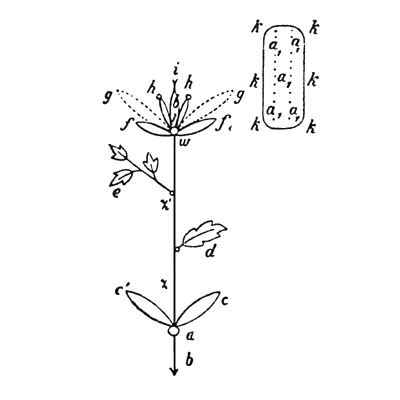
[ 15 ] Die ganze Pflanze stellt nur eine Entfaltung, eine Realisation des in der Knospe oder im Samen der Möglichkeit nach Ruhendem dar. Knospe und Same brauchen nur die geeigneten äußeren Einflüsse, um zu vollkommenen Pflanzenbildungen zu werden. Der Unterschied zwischen Knospe und Same ist nur dieser, daß der letztere unmittelbar die Erde zum Boden seiner Entfaltung hat, während die erstere im allgemeinen eine Pflanzenbildung auf einer Pflanze selbst darstellt. Der Same stellt ein Pflanzenindividuum höherer Art dar, oder, wenn man will, einen ganzen Kreis von Pflanzengebilden. Die Pflanze beginnt gleichsam mit jeder Knospenbildung ein neues Stadium ihres Lebens, sie regeneriert sich, sie konzentriert ihre Kräfte, um sie von neuem wieder zu entfalten. Die Knospenbildung ist also zugleich eine Unterbrechung der Vegetation. Das Pflanzenleben kann sich zur Knospe zusammenziehen, wenn die Bedingungen eigentlichen realen Lebens mangeln, um sich bei Eintritt derselben neuerdings zu entfalten. Die Unterbrechung der Vegetation im Winter beruht darauf. Goethe sagt darüber: 76Italienische Reise, 2. Dez. 1786. «Es ist gar interessant, zu bemerken, wie eine lebhaft fortgesetzte und durch starke Kälte nicht unterbrochene Vegetation wirkt; hier gibt's keine Knospen, und man lernt erst begreifen, was eine Knospe sei.» Was also bei uns in der Knospe verborgen ruht, ist dort offen am Tage; es ist also wahres Pflanzenleben, was in der letzteren liegt; nur fehlen die Bedingungen seiner Entfaltung.
[ 15 ] The entire plant represents merely an unfolding, a realization of the potential that lies dormant in the bud or seed. Buds and seeds need only the appropriate external influences to develop into fully formed plants. The difference between a bud and a seed is simply that the latter has the earth as the direct foundation for its unfolding, whereas the former generally represents a plant formation on the plant itself. The seed represents a plant individual of a higher order, or, if you will, an entire group of plant forms. With every bud formation, the plant begins, as it were, a new stage of its life; it regenerates itself and concentrates its forces in order to unfold them anew. Bud formation is thus at the same time an interruption of vegetation. Plant life can contract into a bud when the conditions for actual, real life are lacking, only to unfold anew when those conditions return. The interruption of vegetation in winter is based on this. Goethe says the following about it: 76Italian Journey, Dec. 2, 1786. “It is quite interesting to observe how vegetation that continues vigorously and is not interrupted by severe cold behaves; here there are no buds, and one only then begins to understand what a bud is.” What thus lies hidden in the bud here is openly visible there; it is therefore true plant life that lies in the latter; only the conditions for its unfolding are lacking.
[ 16 ] Man hat sich nun ganz besonders gegen den Begriff abwechselnder Ausdehnung und Zusammenziehung bei Goethe gewendet, Alle Angriffe darauf aber gehen von einem Mißverständnisse aus. Man glaubt, daß diese Begriffe nur dann Gültigkeit haben könnten, wenn sich eine physikalische Ursache für sie finden ließe, wenn man eine Wirkungsweise der in der Pflanze wirkenden Gesetze nachweisen könnte, aus welcher ein solches Ausdehnen und Zusammenziehen folge. Dies zeigt nur, daß man die Sache auf die Spitze statt auf die Basis stellt. Es ist nichts vorauszusetzen, was die Ausdehnung oder Zusammenziehung bewirkt; im Gegenteile: alles andere ist Folge der ersteren, sie bewirken eine fortschreitende Metamorphose von Stufe zu Stufe. Man kann sich eben den Begriff nicht in seiner selbsteigenen, in seiner intuitiven Form vorstellen; man verlangt, daß er das Resultat eines äußeren Vorganges darstellen soll. Man kann sich Ausdehnung und Zusammenziehung nur als bewirkt, nicht als bewirkend denken. Goethe sieht Ausdehnung und Zusammenziehung nicht so an, als ob sie aus der Natur der an der Pflanze vor sich gehenden unorganischen Prozesse folgen würden, sondern er betrachtet sie als die Art, wie sich jenes innere entelechische Prinzip gestaltet. Er konnte sie also nicht als Summe, als Zusammenfassung sinnenfälliger Vorgänge ansehen und aus solchen deduzieren, sondern er mußte sie als eine Folge des Innern einheitlichen Prinzips selbst ableiten.
[ 16 ] There has been particularly strong opposition to Goethe’s concept of alternating expansion and contraction, but all attacks on it stem from a misunderstanding. It is believed that these concepts could only be valid if a physical cause for them could be found, if one could demonstrate a mode of action of the laws operating within the plant from which such expansion and contraction would result. This merely shows that the issue is being viewed from the top down rather than from the ground up. Nothing is to be presupposed that causes expansion or contraction; on the contrary: everything else is a consequence of the former; they bring about a progressive metamorphosis from stage to stage. One simply cannot conceive of the concept in its own, intuitive form; one demands that it represent the result of an external process. One can conceive of expansion and contraction only as being caused, not as causing. Goethe does not view expansion and contraction as if they followed from the nature of the inorganic processes taking place in the plant, but rather regards them as the manner in which that inner entelechial principle takes shape. He could not, therefore, regard them as the sum or synthesis of perceptible processes and deduce them from such processes, but had to derive them as a consequence of the inner, unified principle itself.
[ 17 ] Das Pflanzenleben wird unterhalten durch den Stoffwechsel. In bezug auf diesen tritt eine wesentliche Verschiedenheit zwischen jenen Organen ein, welche näher der Wurzel sind, d. h. dem Organe, das die Nahrungsaufnahme aus der Erde besorgt, und jenen, welche den bereits durch andere Organe hindurchgegangenen Nahrungsstoff bekommen. Erstere erscheinen unmittelbar von ihrer äußeren anorganischen Umgebung abhängig, diese dagegen von den ihnen vorhergehenden organischen Teilen. Jedes folgende Organ erhält daher eine gleichsam für sich, durch das vorhergehende zubereitete Nahrung. Die Natur schreitet vom Samen zur Frucht in einer Stufenfolge fort, so daß das Nachfolgende als Resultat des Vorangehenden erscheint. Und dieses Fortschreiten nennt Goethe ein Fortschreiten auf einer geistigen Leiter. Nichts weiter als das von uns Angedeutete liegt in seinen Worten, «daß ein oberer Knoten, indem- er aus dem vorhergehenden entsteht und die Säfte mittelbar durch ihn empfängt, solche feiner und filtrierter erhalten, auch von der inzwischen geschehenen Einwirkung der Blätter genießen, sich selbst feiner ausbilden und seinen Blättern und Augen feinere Säfte zubringen müsse». Alle diese Dinge werden verständlich, wenn man ihnen den von Goethe gemeinten Sinn beilegt.
[ 17 ] Plant life is sustained by metabolism. In this regard, there is a fundamental difference between those organs that are closer to the root—that is, the organ responsible for absorbing nutrients from the soil—and those that receive nutrients that have already passed through other organs. The former appear to be directly dependent on their external inorganic environment, while the latter depend on the organic parts that precede them. Each subsequent organ therefore receives nourishment that has, as it were, been prepared for it by the preceding organ. Nature progresses from seed to fruit in a series of stages, so that what follows appears as the result of what preceded it. And Goethe calls this progression “progress on a spiritual ladder.” Nothing more than what we have indicated lies in his words: “that an upper node, in that it arises from the preceding one and receives the sap indirectly through it, obtains a finer and more filtered sap, also benefits from the influence of the leaves that has occurred in the meantime, must develop itself more finely, and must supply its leaves and buds with finer sap.” All these things become understandable when one interprets them in the sense intended by Goethe.
[ 18 ] Die hier dargelegten Ideen sind die im Wesen der Urpflanze gelegenen Elemente und zwar in der bloß dieser selbst angemessenen Weise, nicht so, wie sie in einer bestimmten Pflanze zur Erscheinung kommen, wo sie nicht mehr ursprünglich, sondern den äußeren Verhältnissen angemessen sind.
[ 18 ] The ideas set forth here are the elements inherent in the essence of the primordial plant, and specifically in the manner appropriate only to the plant itself—not as they appear in a particular plant, where they are no longer in their original form but are adapted to external conditions.
[ 19 ] Beim Tierleben tritt nun freilich etwas anderes ein. Das Leben verliert sich hier nicht in der Äußerlichkeit, sondern es separiert sich, sondert sich von der Körperlichkeit ab und gebraucht die körperliche Erscheinung nur noch als sein Werkzeug. Es äußert sich nicht mehr als bloßes Vermögen, einen Organismus von innen heraus zu gestalten, sondern es äußert sich in einem Organismus als etwas, was noch außer dem Organismus, als dessen beherrschende Macht, da ist. Das Tier erscheint als eine in sich beschlossene Welt, ein Mikrokosmos in viel höherem Sinne als die Pflanze. Es hat ein Zentrum dem jedes Organ dient.
[ 19 ] In the case of animal life, however, something different occurs. Here, life does not lose itself in outward appearance, but rather separates itself, detaches itself from physicality, and uses physical appearance merely as its tool. It no longer manifests itself as a mere capacity to shape an organism from within, but rather manifests itself within an organism as something that still exists outside the organism, as its governing power. The animal appears as a self-contained world, a microcosm in a much higher sense than the plant. It has a center to which every organ is subservient.
«So ist jeglicher Mund geschickt die Speise zu fassen,
Welche dem Körper gebührt, es sei nun schwächlich und zahnlos
Oder mächtig der Kiefer gezähnt; in jeglichem Falle Fördert
ein schicklich Organ den übrigen Gliedern die Nahrung.
Auch bewegt sich jeglicher Fuß, der lange, der kurze Ganz
harmonisch zum Sinne des Tiers und seinem Bedürfnis.» 77«Metamorphose der Tiere»; vgl. Natw. Schr., 1. Bd., S. 344.
“Thus every mouth is adept at taking in the food
that the body requires, whether it be frail and toothless
or powerful and well-toothed; in every case,
a suitable organ conveys the nourishment to the other limbs.
Likewise, every foot—whether long or short—
moves harmoniously in accordance with the animal’s senses and needs.” 77“Metamorphosis of Animals”; cf. Natw. Schr., Vol. 1, p. 344.
[ 20 ] Bei der Pflanze ist in jedem Organ die ganze Pflanze, aber das Lebensprinzip existiert nirgends als ein bestimmtes Zentrum, die Identität der Organe liegt in der Gestaltung nach denselben Gesetzen. Beim Tiere erscheint jedes Organ als aus jenem Zentrum kommend, das Zentrum bildet seinem Wesen gemäß alle Organe. Die Gestalt des Tieres ist also die Grundlage für sein äußerliches Dasein. Sie ist aber von innen bestimmt. Die Lebensweise muß sich also nach jenen inneren Gestaltungsprinzipien richten. Andrerseits ist die innere Bildung in sich unumschränkt, frei; sie, kann sich den äußeren Einflüssen innerhalb gewisser Grenzen fügen; doch ist diese Bildung eine durch die innere Natur des Typus und nicht durch mechanische Einwirkungen von außen bestimmte. Die Anpassung kann also nicht so weit gehen, daß sie den Organismus nur als ein Produkt der Außenwelt erscheinen ließe. Seine Bildung ist eine in Grenzen eingeschränkte.
[ 20 ] In a plant, the whole plant is present in every organ, but the life principle does not exist anywhere as a specific center; the identity of the organs lies in their being shaped according to the same laws. In an animal, each organ appears to originate from that center; the center, in accordance with its nature, forms all the organs. The form of the animal is thus the foundation of its external existence. However, it is determined from within. The mode of life must therefore conform to those internal principles of form. On the other hand, internal formation is in itself unrestricted and free; it can adapt to external influences within certain limits; yet this formation is determined by the internal nature of the type and not by mechanical influences from without. Adaptation, therefore, cannot go so far as to make the organism appear merely as a product of the external world. Its formation is limited within certain bounds.
«Diese Grenzen erweitert kein Gott, es ehrt die Natur sie;
Denn nur also beschränkt war je das Vollkommene möglich.» 78Metamorphose der Tiere, a. a. 0. S.345.
“No god expands these boundaries; nature honors them;
For only within such limits was perfection ever possible.” 78*Metamorphosis of Animals*, op. cit., p. 345.
[ 21 ] Wäre jedes tierische Wesen nur den im Urtier liegenden Prinzipien gemäß, so wären sie alle gleich. Nun aber gliedert sich der tierische Organismus in eine Menge von Organsystemen, die jedes bis zu einem bestimmten Grad der Ausbildung kommen können. Dieses begründet nun eine verschiedenartige Entwicklung. Der Idee nach gleichberechtigt mit allen andern, kann sich doch ein System besonders in den Vordergrund drängen, kann den im tierischen Organismus liegenden Vorrat von Bildungskräften auf sich verwenden und ihn den anderen Organen entziehen. Das Tier erscheint so nach der Richtung jenes Organsystems hin besonders ausgebildet. Ein anderes Tier erscheint nach einer anderen Richtung gebildet. Hierin liegt die Möglichkeit der Differenzierung des Urorganismus bei seinem Übergange in die Erscheinung in Gattungen und Arten.
[ 21 ] If every animal being were governed solely by the principles inherent in the primordial animal, they would all be the same. However, the animal organism is divided into a multitude of organ systems, each of which can reach a certain degree of development. This gives rise to diverse forms of development. Although, in theory, all systems are equal to one another, one system may nevertheless come to the fore, drawing upon the reservoir of formative forces inherent in the animal organism and diverting it away from the other organs. The animal thus appears to be particularly developed in the direction of that organ system. Another animal appears to be developed in a different direction. Herein lies the possibility of differentiation of the primordial organism as it manifests itself in genera and species.
[ 22 ] Die wirklichen (tatsächlichen) Ursachen der Differenzierung sind damit aber noch nicht gegeben. Hier treten in ihre Rechte: die Anpassung, welcher zufolge der Organismus den ihn umgebenden äußeren Verhältnissen gemäß gestaltet, und der Kampf ums Dasein, der darauf hinarbeitet, daß nur die den obwaltenden Umständen am besten angepaßten Wesen sich erhalten. Anpassung und Kampf ums Dasein könnten aber am Organismus gar nichts bewirken, wenn das den Organismus konstituierende Prinzip nicht ein solches wäre, das bei stets aufrecht erhaltener innerer Einheit die mannigfaltigsten Formen annehmen kann. Der Zusammenhang der äußeren Bildungskräfte mit diesem Prinzipe ist keineswegs so aufzufassen, als wenn die ersteren auf die letzteren etwa in der Art bestimmend einwirkten, wie ein unorganisches Wesen auf ein anderes. Die äußeren Verhältnisse sind zwar die Veranlassung, daß sich der Typus in einer bestimmten Form ausbildet; diese Form selbst aber ist nicht aus den äußeren Bedingungen, sondern aus dem inneren Prinzipe herzuleiten. Man wird bei dieser Erklärung die ersteren immer aufzusuchen haben, die Gestalt selbst aber hat man nicht als ihre Folge zu betrachten. Das Ableiten von Gestaltungsformen eines Organismus aus der umgebenden Außenwelt durch bloße Kausalität würde Goethe geradeso verworfen haben, wie er es mit dem teleologischen Prinzip getan hat, wonach die Form eines Organes auf einen äußeren Zweck, dem es zu dienen hätte, zurückgeführt wurde.
[ 22 ] However, this does not yet account for the real (actual) causes of differentiation. Here, two factors come into play: adaptation, by which the organism shapes itself in accordance with the external conditions surrounding it, and the struggle for existence, which ensures that only those beings best adapted to the prevailing circumstances survive. However, adaptation and the struggle for existence could have no effect whatsoever on the organism if the principle constituting the organism were not one capable of assuming the most diverse forms while maintaining its inner unity at all times. The relationship between the external formative forces and this principle should by no means be understood as if the former exerted a determining influence on the latter in the same way that one inorganic entity influences another. External conditions are indeed the cause that the type develops into a specific form; but this form itself must be derived not from external conditions, but from the internal principle. In this explanation, one must always look to the former, but the form itself must not be regarded as their consequence. Goethe would have rejected the derivation of an organism’s forms from the surrounding external world through mere causality just as he rejected the teleological principle, according to which the form of an organ was attributed to an external purpose it was supposed to serve.
[ 23 ] Bei denjenigen Organsystemen des Tieres, bei denen es mehr auf die Äußerlichkeit des Baues ankommt, z. B. bei den Knochen, da tritt auch jenes bei den Pflanzen beobachtete Gesetz wieder hervor, wie bei der Bildung der Schädelknochen. Die Gabe Goethes, die innere Gesetzmäßigkeit in rein äußerlichen Formen zu erkennen, tritt hier ganz besonders hervor.
[ 23 ] In those organ systems of animals where the external structure is of greater importance—for example, the bones—the same law observed in plants reemerges, as in the formation of the skull bones. Goethe’s gift for recognizing inner regularity in purely external forms is particularly evident here.
[ 24 ] Der Unterschied, der mit diesen Anschauungen Goethes zwischen Pflanze und Tier festgestellt wird, könnte belanglos erscheinen angesichts dessen, daß die neuere Wissenschaft Gründe zu berechtigten Zweifeln an einer festen Grenze zwischen Pflanze und Tier hat. Der Unmöglichkeit der Aufstellung einer solchen Grenze war sich aber Goethe schon bewußt (siehe Natw. Schr., 1. Bd., S. 11). Dennoch gibt es bestimmte Definitionen von Pflanze und Tier. Das hängt mit seiner ganzen Naturanschauung zusammen. Er nimmt in der Erscheinung überhaupt kein Konstantes, Festes an; denn in letzterer schwankt alles in steter Bewegung. Das im Begriffe festzuhaltende Wesen einer Sache ist aber nicht schwankenden Formen zu entnehmen, sondern gewissen mittleren Stufen, auf denen es sich beobachten läßt (siehe a. a. 0., S. 8). Es ist für Goethes Anschauung ganz natürlich, daß man bestimmte Definitionen aufstellt und diese trotzdem in der Erfahrung von gewissen Übergangsgebilden nicht festgehalten werden. Ja er sieht gerade darin das bewegliche Leben der Natur.
[ 24 ] The distinction between plants and animals established by Goethe’s views might seem insignificant in light of the fact that modern science has grounds for justified doubts regarding a clear boundary between plants and animals. Goethe, however, was already aware of the impossibility of drawing such a boundary (see Natw. Schr. , Vol. 1, p. 11). Nevertheless, there are specific definitions of plants and animals. This is connected to his entire view of nature. He assumes in appearance absolutely no constant, fixed element; for in the latter, everything fluctuates in constant motion. However, the essence of a thing that is to be captured in a concept is not to be derived from fluctuating forms, but rather from certain intermediate stages at which it can be observed (see op. cit., p. 8). It is entirely natural in Goethe’s view that one establishes certain definitions, even though these are not captured in the experience of certain transitional forms. Indeed, he sees precisely in this the dynamic life of nature.
[ 25 ] Mit diesen Ideen hat Goethe die theoretische Grundlage für die organische Wissenschaft begründet. Er hat das Wesen des Organismus gefunden. Man kann dieses leicht verkennen, wenn man verlangt, daß der Typus, jenes sich aus sich heraus gestaltete Prinzip (Entelechie), selbst durch etwas anderes erklärt werden solle. Aber dies ist eine unbegründete Forderung, weil der Typus, in intuitiver Form festgehalten, sich selbst erklärt. Für jeden, der jenes «Sich--nach-sich-selbst-Formen» des entelechischen Prinzipes erfaßt hat, bildet dieses die Lösung des Lebensrätsels. Eine andere Lösung ist unmöglich, weil jene das Wesen der Sache selbst ist. Wenn der Darwinismus einen Urorganismus voraussetzen muß, so kann man von Goethe sagen, daß er das Wesen jenes Urorganismus entdeckt hat. 79In der modernen Naturlehre versteht man unter Urorganismus gewöhnlich eine Urzelle (Urzytode), d. h. ein einfaches Wesen, welches auf der untersten Stufe der organischen Entwicklung steht. Man hat hier ein ganz bestimmtes, reales, sinnenfällig wirkliches Wesen im Auge. Wenn man im Goetheschen Sinne von Urorganismus spricht, so ist nicht dieses ins Auge zu fassen, sondern jene Essenz (Wesenheit), jenes gestaltende, entelechische Prinzip, welches bewirkt, daß jene Urzelle ein Organismus ist. Dieses Prinzip kommt im einfachsten Organismus ebenso wie im vollendetsten zur Erscheinung, nur in verschiedener Ausbildung. Es ist die Tierheit im Tiere, das, wodurch ein Wesen ein Organismus ist. Darwin setzt es von Anfang an voraus; es ist da, wird eingeführt und dann sagt er von ihm, daß es auf die Einflüsse der Außenwelt in dieser oder jener Weise reagierte. Es ist bei ihm ein unbestimmtes X, dieses unbestimmte X sucht Goethe zu erklären. Goethe ist es, welcher mit dem bloßen Nebeneinanderreihen der Gattungen und Arten brach und eine Regeneration der organischen Wissenschaft dem Wesen des Organismus gemäß vornahm. Während die Vor-Goethesche Systematik ebenso viele verschiedene Begriffe (Ideen) brauchte, als äußerlich verschiedene Gattungen existieren, zwischen denen sich keine Vermittlung fand, erklärte Goethe, daß der Idee nach alle Organismen gleich, nur der Erscheinung nach verschieden sind; und er erklärte, warum sie es sind. Damit war die philosophische Grundlage für ein wissenschaftliches System der Organismen geschaffen. Es handelte sich nur noch um die Ausführung desselben. Es müßte gezeigt werden, wie alle realen Organismen nur Offenbarungen einer Idee seien und wie sie sich in einem bestimmten Falle offenbaren.
[ 25 ] With these ideas, Goethe laid the theoretical foundation for organic science. He discovered the essence of the organism. It is easy to misunderstand this if one demands that the type—that principle which shapes itself out of itself (entelechy)—be explained by something else. But this is an unfounded demand, because the type, grasped in its intuitive form, explains itself. For anyone who has grasped that “self-forming-after-its-own-nature” aspect of the entelechic principle, this constitutes the solution to the riddle of life. No other solution is possible, because this is the very essence of the matter itself. If Darwinism must presuppose a primordial organism, then one can say of Goethe that he discovered the essence of that primordial organism. 79In modern natural science, the term “proto-organism” is usually understood to mean a proto-cell (proto-zyte), i.e., a simple entity situated at the lowest stage of organic development. Here, one has in mind a very specific, real, and tangibly concrete entity. When one speaks of a “primordial organism” in the Goethean sense, it is not this that is to be considered, but rather that essence (substance), that formative, entelechial principle which causes that primordial cell to be an organism. This principle manifests itself in the simplest organism just as it does in the most perfect one, only in different forms. It is the animality within the animal, that which makes a being an organism. Darwin presupposes it from the very beginning; it is there, is introduced, and then he says of it that it reacted to the influences of the external world in this or that way. For him, it is an indeterminate X; Goethe seeks to explain this indeterminate X. It was Goethe who broke with the mere juxtaposition of genera and species and undertook a regeneration of organic science in accordance with the nature of the organism. While the pre-Goethean taxonomy required as many different concepts (ideas) as there were externally distinct genera—between which no mediation existed—Goethe explained that, in terms of their idea, all organisms are the same, differing only in appearance; and he explained why this is so. This laid the philosophical foundation for a scientific system of organisms. All that remained was to carry it out. It would have to be shown how all real organisms are merely manifestations of an idea and how they manifest themselves in a specific case.
[ 26 ] Die große Tat, welche damit in der Wissenschaft getan war, wurde auch mannigfach von tiefer gebildeten Gelehrten anerkannt. Der jüngere d'Alton 80Goethes Naturwissenschaftliche Korrespondenz (1812-1832), hg. v. F.Th. Bratranek, 1. Bd., S. 28. schreibt am 6. Juli 1827 an Goethe: «Ich würde es für die schönste Belohnung erachten, wenn Euer Exzellenz, dem die Naturwissenschaft nicht allein eine völlige Umgestaltung in großartigen Überblicken und neuen Ansichten der Botanik, sondern selbst vielfache treffliche Bereicherungen in dem Gebiete der Knochenlehre verdankt, in vorliegenden Blättern ein beifallswertes Bestreben erkennten.» Nees von Esenbeck 81Ebenda, 2. Bd., S. 19 f. am 24. Juni 1820: «In ihrer Schrift, die Sie einen ˂Versuch, die Metamorphose der Pflanzen zu erklären˃, nannten, hat zuerst die Pflanze unter uns über sich selbst geredet und in dieser schönen Vermenschlichung auch mich, als ich noch jung war, bestrickt.» Endlich Voigt 82Ebenda, 2. Bd., S. 330 f. am 6. Juni 1831: «Mit lebhafter Teilnahme und untertänigem Dank habe ich die kleine Schrift über die Metamorphose empfangen, welche mich als so frühen Teilnehmer an dieser Lehre nun auch auf das verbindlichste historisch einverleibt. Es ist sonderbar, man ist gegen die animalische Metamorphose - ich meine nicht die alte der Insekten, sondern die von der Wirbelsäule ausgehende - billiger gewesen, als gegen die vegetabilische. Abgesehen von den Plagiaten und Mißbräuchen, möchte die stille Anerkennung darin ihren Grund haben, daß man bei ihr weniger zu riskieren glaubte. Denn beim Skelett bleiben die isolierten Knochen ewig dieselben, in der Botanik aber droht die Metamorphose die ganze Terminologie und folglich die Bestimmung der Spezies umzuwerfen, und da fürchten sich denn die Schwachen, weil sie nicht wissen, wohin so etwas führen könne.» Hier ist volles Verständnis der Goetheschen Ideen vorhanden. Es ist das Bewußtsein da, daß eine neue Art der Anschauung des Individuellen Platz greifen müsse; und aus dieser neuen Anschauung sollte erst die neue Systematik, die Betrachtung des Besonderen hervorgehen. Der auf sich selbst gebaute Typus enthält die Möglichkeit, bei seinem Eintreten in die Erscheinung unendlich mannigfaltige Formen anzunehmen; und diese Formen sind der Gegenstand unserer sinnlichen Anschauung, sie sind die im Raume und in der Zeit lebenden Gattungen und Arten der Organismen. Indem unser Geist jene allgemeine Idee, den Typus erfaßt, hat er das ganze Organismenreich in seiner Einheit begriffen. Wenn er nun die Gestaltung des Typus in jeder besonderen Erscheinungsform anschaut, wird ihm die letztere begreiflich; sie erscheint ihm als eine der Stufen, der Metamorphosen, in denen sich der Typus verwirklicht. Und diese verschiedenen Stufen aufzuzeigen, sollte das Wesen der durch Goethe zu begründenden Systematik sein. Sowohl im Tier - wie im Pflanzenreiche herrscht eine aufsteigende Entwicklungsreihe; die Organismen gliedern sich in vollkommene und unvollkommene. Wie ist dieses möglich? Die ideelle Form, der Typus der Organismen hat eben das Charakteristische, daß er aus räumlich zeitlichen Elementen besteht. Es erschien deshalb auch Goethe als eine sinnlich-übersinnliche Form. Er enthält räumlichzeitliche Formen als ideelle Anschauung (intuitiv). Wenn er nun in die Erscheinung tritt, kann die wahrhaft (nicht mehr intuitiv) sinnliche Form jener ideellen völlig entsprechen oder nicht; es kann der Typus zu seiner vollkommenen Ausbildung kommen oder nicht. Die niederen Organismen sind eben dadurch die niederen, daß ihre Erscheinungsform nicht völlig dem organischen Typus entspricht. Je mehr äußere Erscheinung und organischer Typus in einem bestimmten Wesen sich decken, desto vollkommener ist dasselbe. Dies ist der objektive Grund einer aufsteigenden Entwicklungsreihe. Die Aufzeigung dieses Verhältnisses. bei jeder Organismenform ist die Aufgabe einer systematischen Darstellung. Bei Aufstellung des Typus, der Urorganismen, kann aber hierauf keine Rücksicht genommen werden; es kann sich dabei nur darum handeln, eine Form zu finden, welche den vollkommensten Ausdruck des Typus darstellt. Eine solche soll Goethes Urpflanze bieten.
[ 26 ] The great contribution this made to science was also widely recognized by scholars with a deep education. The younger d’Alton 80Goethe’s Scientific Correspondence (1812–1832), ed. by F. Th. Bratranek, Vol. 1, p. 28. wrote to Goethe on July 6, 1827: “I would consider it the greatest reward if Your Excellency—to whom the natural sciences owe not only a complete transformation in the form of magnificent overviews and new perspectives in botany, but also numerous excellent contributions in the field of osteology—were to recognize in these pages a commendable endeavor.” Nees von Esenbeck 81Ibid., Vol. 2, p. 19 ff. on June 24, 1820: “In your treatise, which you titled ˂An Attempt to Explain the Metamorphosis of Plants˃, the plant first spoke to us about itself, and this beautiful personification also captivated me when I was still young.” Finally, Voigt 82Ibid., Vol. 2, p. 330 ff. on June 6, 1831: “It was with keen interest and humble gratitude that I received the short treatise on metamorphosis, which now, as an early adherent of this doctrine, incorporates me most graciously into its historical record. It is strange that people have been more lenient toward animal metamorphosis—I do not mean the old one of insects, but that which originates from the spine—than toward plant metamorphosis. Aside from the plagiarisms and abuses, this tacit acceptance may be rooted in the belief that one risks less with it. For in the skeleton, the isolated bones remain eternally the same, whereas in botany, metamorphosis threatens to overturn the entire terminology and, consequently, the classification of species , and this is what the weak fear, because they do not know where such a thing might lead.” Here, there is a full understanding of Goethe’s ideas. There is an awareness that a new way of viewing the individual must take hold; and it is from this new perspective that the new systematics—the consideration of the particular—should first emerge. The type, built upon itself, contains the potential to assume infinitely diverse forms as it manifests itself; and these forms are the object of our sensory perception—they are the genera and species of organisms living in space and time. By grasping that general idea—the type—our mind has comprehended the entire kingdom of organisms in its unity. When it now contemplates the configuration of the type in each particular form of appearance , the latter becomes comprehensible to it; it appears to it as one of the stages, the metamorphoses, in which the type is realized. And to elucidate these various stages should be the essence of the systematics to be established by Goethe. In both the animal and plant kingdoms, there is an ascending series of development; organisms are divided into perfect and imperfect forms. How is this possible? The ideal form, the type of organisms, is characterized precisely by the fact that it consists of spatial and temporal elements. It therefore also appeared to Goethe as a sensible-supersensible form. It contains spatio-temporal forms as an ideal intuition (intuitive). When it then appears in reality, the truly (no longer intuitively) sensible form may or may not correspond completely to that ideal form; the type may or may not reach its perfect development. Lower organisms are precisely lower because their outward form does not fully correspond to the organic type. The more the outward appearance and the organic type coincide in a given organism, the more perfect that organism is. This is the objective basis for an ascending series of development. The task of a systematic presentation is to demonstrate this relationship for every form of organism. However, when establishing the type—the primordial organisms—this cannot be taken into account; the sole concern must be to find a form that represents the most perfect expression of the type. Goethe’s primordial plant is intended to provide such a form.
[ 27 ] Man hat Goethe den Vorwurf gemacht, daß er bei Aufstellung seines Typus auf die Welt der Kryptogamen keine Rücksicht genommen habe. Wir haben schon früher darauf hingewiesen, daß dieses nur in völlig bewußter Weise geschehen kann, da er sich mit dem Studium dieser Pflanzen auch beschäftigt hat. Es hat aber seinen objektiven Grund. Die Kryptogamen sind eben jene Pflanzen, in denen die Urpflanze nur höchst einseitig zum Ausdrucke kommt; sie stellen die Pflanzenidee in einer einseitigen sinnenfälligen Form dar. Sie können an der aufgestellten Idee beurteilt werden; diese selbst aber kommt in den Phanerogamen erst zu ihrem völligen Ausbruche.
[ 27 ] Goethe has been criticized for failing to take the world of cryptogams into account when formulating his typus. We have already pointed out that this could only have been done in a fully conscious manner, since he did, in fact, engage in the study of these plants. However, there is an objective reason for this. Cryptogams are precisely those plants in which the primordial plant is expressed only in a highly one-sided manner; they represent the idea of the plant in a one-sided, sensually perceptible form. They can be judged by the established idea; this idea, however, only comes to its full expression in the phanerogams.
[ 28 ] Was aber hier zu sagen ist, ist dieses, daß Goethe diese Ausführung seiner Grundgedanken nie vollbracht hat, daß er das Reich des Besonderen zu wenig betreten hat. Daher bleiben alle seine Arbeiten fragmentarisch. Seine Absicht, auch hier Licht zu schaffen, zeigen uns seine Worte in der «Italienischen Reise» (27. September 1786), daß es ihm mit Hilfe seiner Ideen möglich sein werde, «Geschlechter und Arten wahrhaft zu bestimmen, welches, wie mich dünkt, bisher sehr willkürlich geschieht». Dieses Vorhaben hat er nicht ausgeführt, den Zusammenhang seiner allgemeinen Gedanken mit der Welt des Besonderen, mit der Wirklichkeit der einzelnen Formen nicht besonders dargelegt. Dies sah er selbst als einen Mangel seiner Fragmente an; er schreibt am 28. Juni 1828 darauf bezüglich an [F.J.] Soret von de Candolle: «Auch wird mir immer klarer, wie er die Intentionen ansieht, in denen ich mich fortbewege und die in meinem kurzen Aufsatze über die Metamorphose zwar deutlich genug ausgesprochen sind, deren Bezug aber auf die Erfahrungsbotanik, wie ich längst weiß, nicht deutlich genug hervorgeht.» [WA 44, 161] Dies ist wohl auch der Grund, warum Goethes Anschauungen so mißverstanden wurden; denn sie wurden es nur deshalb, weil sie überhaupt nicht verstanden wurden.
[ 28 ] What must be said here, however, is that Goethe never fully realized this elaboration of his fundamental ideas, that he did not venture far enough into the realm of the particular. Consequently, all his works remain fragmentary. His intention to shed light on this matter as well is evident from his words in the *Italian Journey* (September 27, 1786), that with the help of his ideas it would be possible for him to “truly define genera and species, which, it seems to me, has so far been done very arbitrarily.” He did not carry out this project; he did not specifically elucidate the connection between his general ideas and the world of the particular, with the reality of individual forms. He himself regarded this as a shortcoming of his fragments; on June 28, 1828, he wrote to [F.J.] Soret von de Candolle regarding this: “It is also becoming increasingly clear to me how he views the intentions that guide me—intentions that are indeed expressed clearly enough in my short essay on metamorphosis, but whose relevance to empirical botany, as I have long known, is not made clear enough. ” [WA 44, 161] This is likely also the reason why Goethe’s views were so misunderstood; for they were misunderstood solely because they were not understood at all.
[ 29 ] In Goethes Begriffen erhalten wir auch eine ideelle Erklärung für die durch Darwin und Haeckel gefundene Tatsache, daß die Entwicklungsgeschichte des Individuums eine Repetition der Stammesgeschichte repräsentiert. Denn für mehr als eine unerklärte Tatsache kann das, was Haeckel hier bietet, doch nicht genommen werden. Es ist die Tatsache*, daß jedes Individuum alle jene Entwicklungsstadien in abgekürzter Form durchmacht, welche uns zugleich die Paläontologie als gesonderte organische Formen aufweist. Haeckel und seine Anhänger erklären dieses aus dem Gesetze der Vererbung. Aber letzteres ist selbst nichts anderes als ein abgekürzter Ausdruck für die angeführte Tatsache. Die Erklärung dafür ist, daß jene Formen sowie jedes Individuum die Erscheinungsformen eines und desselben Urbildes sind, welches in aufeinanderfolgenden Zeitperioden die der Möglichkeit nach in ihm liegenden Gestaltungskräfte zur Entfaltung bringt. Jedes höhere Individuum ist eben dadurch vollkommener, daß es durch die günstigen Einflüsse seiner Umgebung nicht gehindert wird, sich seiner inneren Natur nach völlig frei zu entfalten. Muß das Individuum dagegen durch verschiedene Einwirkungen gezwungen auf einer niedrigeren Stufe stehenbleiben, so kommen nur einige von seinen inneren Kräften zur Erscheinung, und es ist dann bei ihm das ein Ganzes, was bei jenem vollkommeneren Individuum nur ein Teil eines Ganzen ist. Und auf diese Weise erscheint der höhere Organismus in seiner Entwicklung aus den niedrigeren zusammengesetzt oder auch die niedrigeren erscheinen in ihrer Entwicklung als Teile des höheren. Wir müssen daher in der Entwicklung eines höheren Tieres die Entwicklung aller niedrigeren wieder erblicken (biogenetisches Gesetz). Sowie der Physiker nicht damit zufrieden ist, bloß die Tatsachen auszusprechen und zu beschreiben, sondern nach den Gesetzen derselben forscht, d. h. nach den Begriffen der Erscheinungen, so kann es auch demjenigen, der in die Natur der organischen Wesen eindringen will, nicht genügen, wenn er bloß die Tatsachen der Verwandtschaft, Vererbung, Kampf ums Dasein usw. anführt, sondern er will die diesen Dingen zugrunde liegenden Ideen erkennen. Dieses Streben finden wir bei Goethe. Was dem Physiker die drei Keplerschen Gesetze, das sind dem Organiker die Goetheschen Typusgedanken. Ohne sie ist uns die Welt ein bloßes Labyrinth von Tatsachen. Dies wurde oft mißverstanden. Man behauptet, der Begriff der Metamorphose im Sinne Goethes wäre ein bloßes Bild, das sich im Grunde nur in unserem Verstande durch Abstraktion vollzogen hat. Es wäre Goethe unklar gewesen, daß der Begriff von Verwandlung der Blätter in Blütenorgane nur dann einen Sinn habe, wenn letztere, z. B. die Staubgefäße, einmal wirkliche Blätter waren. Allein dies stellt Goethes Anschauungen auf den Kopf. Es wird ein sinnenfälliges Organ zum prinzipiell ersten gemacht und das andere auf sinnenfällige Weise daraus abgeleitet. So hat es Goethe nie gemeint. Bei ihm ist dasjenige, welches der Zeit nach das erste ist, durchaus nicht auch der Idee, dem Prinzipe nach das erste. Nicht weil die Staubgefäße einmal wahre Blätter waren, sind sie letzteren heute verwandt; nein, sondern weil sie ideell, ihrem inneren Wesen nach verwandt sind, erschienen sie einmal als wahre Blätter. Die sinnliche Verwandlung ist nur Folge der ideellen Verwandtschaft und nicht umgekehrt. Heute ist der empirische Tatbestand der Identität aller Seitenorgane der Pflanze bestimmt, aber warum nennt man diese identisch? Nach Schleiden, weil sich dieselben an der Achse alle so entwickeln, daß sie als seitliche Hervorragungen hinausgeschoben werden, in der Weise, daß die seitliche Zellenbildung nur an dem ursprünglichen Körper bleibt und an der zuerst gebildeten Spitze sich keine neuen Zellen bilden. Dies ist eine rein äußerliche Verwandtschaft, und man betrachtet als die Folge davon die Idee der Identität. Anders ist die Sache wieder bei Goethe. Die Seitenorgane sind bei ihm ihrer Idee, ihrem inneren Wesen nach identisch; daher erscheinen sie auch nach außen als identische Bildungen. Die sinnenfällige Verwandtschaft ist bei ihm eine Folge der inneren, ideellen. Die Goethesche Auffassung unterscheidet sich von der materialistischen durch die Fragestellungen; beide widersprechen einander nicht, sie ergänzen einander. Goethes Ideen bilden zu jener die Grundlage. Nicht nur eine dichterische Prophezeiung späterer Entdekkungen sind Goethes Ideen, sondern selbständige theoretische Entdeckungen, die noch lange nicht genug gewürdigt sind, an denen die Naturwissenschaft noch lange zehren wird. Wenn die empirischen Tatsachen, die er benützte, längst durch genauere Detailforschungen überholt, teilweise sogar widerlegt sein werden; die aufgestellten Ideen sind ein für allemal grundlegend für die Organik, denn sie sind von jenen empirischen Tatsachen unabhängig. Wie jeder neu aufgefundene Planet nach Keplers Gesetzen um seinen Fixstern kreisen muß, so muß jeder Vorgang in der organischen Natur nach Goethes Ideen geschehen. Lange vor Kepler und Kopernikus sah man die Vorgänge am gestirnten Himmel. Diese fanden erst die Gesetze. Lange vor Goethe beobachtete man das organische Naturreich, Goethe fand dessen Gesetze. Goethe ist der Kopernikus und Kepler der organischen Welt.
[ 29 ] In Goethe’s concepts, we also find an ideal explanation for the fact discovered by Darwin and Haeckel that the developmental history of the individual represents a repetition of phylogenetic history. For what Haeckel offers here cannot be taken as anything more than an unexplained fact. It is the fact* that every individual undergoes, in abbreviated form, all those stages of development that paleontology simultaneously presents to us as distinct organic forms. Haeckel and his followers explain this through the law of heredity. But the latter is itself nothing other than a condensed expression of the aforementioned fact. The explanation for this is that those forms, as well as every individual, are manifestations of one and the same archetype, which, in successive periods of time, brings to fruition the formative powers potentially inherent within it. Every higher individual is more perfect precisely because it is not hindered by the favorable influences of its environment from unfolding completely freely in accordance with its inner nature. If, on the other hand, the individual is forced by various influences to remain at a lower stage, only some of its inner powers come to the fore, and what constitutes a whole in that individual is then only a part of a whole in the more perfect individual. And in this way, the higher organism appears in its development to be composed of the lower ones, or the lower ones appear in their development as parts of the higher one. We must therefore recognize in the development of a higher animal the development of all lower ones (the biogenetic law). Just as the physicist is not content merely to state and describe the facts, but investigates the laws governing them—that is, the concepts underlying the phenomena—so too, for anyone who wishes to penetrate the nature of organic beings, it is not enough to merely cite the facts of kinship, inheritance, the struggle for existence, etc., but must seek to recognize the ideas underlying these phenomena. We find this aspiration in Goethe. Just as Kepler’s three laws are to the physicist, so are Goethe’s ideas of type to the biologist. Without them, the world is for us a mere labyrinth of facts. This has often been misunderstood. It is claimed that the concept of metamorphosis in Goethe’s sense is merely a metaphor, one that has essentially taken shape in our minds through abstraction. It is said that it would not have been clear to Goethe that the concept of the transformation of leaves into floral organs only makes sense if the latter—for example, the stamens—were once actual leaves. But this turns Goethe’s views on their head. A sensually perceptible organ is made the first in principle, and the other is derived from it in a sensually perceptible way. This is not what Goethe ever meant. For him, that which is first in terms of time is by no means also first in terms of the idea or the principle. It is not because the stamens were once true leaves that they are related to the latter today; no, but because they are related ideally, according to their inner essence, they once appeared as true leaves. The sensory transformation is merely a consequence of the ideal relationship, and not the other way around. Today, the empirical fact of the identity of all lateral organs of the plant is established, but why are these called identical? According to Schleiden, it is because they all develop along the axis in such a way that they are pushed out as lateral protrusions, so that lateral cell formation remains only at the original body and no new cells form at the initially formed tip. This is a purely external kinship, and the idea of identity is regarded as its consequence. The matter is different again with Goethe. For him, the lateral organs are identical in their idea, in their inner essence; therefore, they also appear outwardly as identical formations. The sensory resemblance is, for him, a consequence of the inner, ideal one. Goethe’s conception differs from the materialist one in terms of the questions it raises; the two do not contradict each other, but rather complement one another. Goethe’s ideas form the foundation for the latter. Goethe’s ideas are not merely a poetic prophecy of later discoveries, but independent theoretical discoveries that are still far from being sufficiently appreciated and from which the natural sciences will continue to draw for a long time to come. Even if the empirical facts he used have long since been superseded—and in some cases even refuted—by more precise, detailed research, the ideas he formulated are, once and for all, fundamental to organic science, for they are independent of those empirical facts. Just as every newly discovered planet must orbit its fixed star according to Kepler’s laws, so must every process in organic nature occur according to Goethe’s ideas. Long before Kepler and Copernicus, people observed the phenomena in the starry sky. It was only later that the laws governing them were discovered. Long before Goethe, people observed the organic realm of nature; Goethe discovered its laws. Goethe is the Copernicus and Kepler of the organic world.
[ 30 ] Man kann sich das Wesen der Goetheschen Theorie auch auf folgende Weise klar machen. Neben der gewöhnlichen empirischen Mechanik, welche nur die Tatsachen sammelt, gibt es noch eine rationale Mechanik, welche aus der inneren Natur der mechanischen Grundprinzipien die aprioristischen Gesetze als notwendige deduziert. Sowie die erstere zur letzteren, so verhalten sich Darwins, Haeckels usw. Theorien zur rationalen Organik Goethes. Diese Seite seiner Theorie war Goethe vom Anfange an nicht sogleich klar. Später freilich spricht er sie schon ganz entschieden aus. Wenn er am 21. Januar 1832 an Heinr. Wilh. Ferd. Wackenroder schreibt: «Fahren Sie fort, mit allem, was Sie interessiert, mich bekannt zu machen; es schließt sich irgendwo an meine Betrachtungen an» [WA 49,211], so will er damit nur sagen, daß er die Grundprinzipien der organischen Wissenschaft gefunden habe, aus denen sich alles übrige müsse ableiten lassen. In früherer Zeit aber wirkte das alles unbewußt in seinem Geiste und er behandelte die Tatsachen darnach. 83Goethe empfand dies sein unbewußtes Handeln oft als Dumpfheit. Siehe K. J. Schröer, Faust von Goethe, 6. Aufl., Stuttgart 1926, Bd. II,S. XXXIV ff. Gegenständlich wurde es ihm erst durch jenes erste wissenschaftliche Gespräch mit Schiller, welches wir unten mitteilen. 84Natw. Schr., 1. Bd., S. 108 ff. Schiller erkannte sogleich die ideelle Natur von Goethes Urpflanze und behauptete, einer solchen könne keine Wirklichkeit angemessen sein. Das regte Goethe an, über das Verhältnis dessen, was er Typus nannte, zur empirischen Wirklichkeit nachzudenken. Er traf hier auf ein Problem, welches zu den bedeutsamsten des menschlichen Forschens überhaupt gehört: das Problem des Zusammenhangs von Idee und Wirklichkeit, von Denken und Erfahrung. Das wurde ihm immer klarer: die einzelnen empirischen Objekte entsprechen keines seinem Typus vollkommen; kein Wesen der Natur war mit ihm identisch. Der Inhalt des Typusbegriffes kann also nicht aus der Sinnenwelt als solcher stammen, obwohl er an derselben gewonnen wird. Er muß also in dem Typus selbst liegen; die Idee des Urwesens konnte nur eine solche sein, welche vermöge einer in ihr selbst liegenden Notwendigkeit einen Inhalt aus sich entwickelt, der dann in anderer Form - In Form der Anschauung - in der Erscheinungswelt auftritt. Es ist in dieser Hinsicht interessant, zu sehen, wie Goethe selbst empirischen Naturforschern gegenüber für die Rechte der Erfahrung und die strenge Auseinanderhaltung von Idee und Objekt eintritt. Sömmerring übersendet ihm im Jahre 1786 ein Buch, in dem er (Sömmerring) den Versuch macht, den Sitz der Seele zu entdecken. Goethe findet in einem Briefe, den er am 28. August 1796 an Sömmerring richtet, daß dieser zu viel Metaphysik mit seinen Anschauungen verwoben habe; eine Idee über Gegenstände der Erfahrung habe keine Berechtigung, wenn sie über diese hinausginge, wenn sie nicht im Wesen der Objekte selbst begründet ist. Bei Objekten der Erfahrung sei die Idee ein Organ, das als notwendigen Zusammenhang zu fassen, was sonst im blinden Neben- und Nacheinander bloß wahrgenommen würde. Daraus aber, daß die Idee nichts Neues zu dem Objekte hinzubringen darf, folgt, daß das letztere selbst, seinem eigenen Wesen nach ein Ideelles ist, daß überhaupt die empirische Realität zwei Seiten haben muß: die eine, wonach sie Besonderes, Individuelles, die andere, wonach sie Ideell-Allgemeines ist.
[ 30 ] One can also understand the essence of Goethe’s theory in the following way. Alongside ordinary empirical mechanics, which merely collects facts, there is also a rational mechanics that deduces a priori laws as necessary from the inner nature of the fundamental mechanical principles. Just as the former relates to the latter, so do the theories of Darwin, Haeckel, and others relate to Goethe’s rational organic theory. This aspect of his theory was not immediately clear to Goethe from the outset. Later, however, he expresses it quite decisively. When, on January 21, 1832, he wrote to Heinr. Wilh. Ferd. Wackenroder on January 21, 1832: “Continue to acquaint me with everything that interests you; it ties in somewhere with my reflections” [WA 49,211], he simply means to say that he has discovered the fundamental principles of organic science, from which everything else must be derivable. In earlier times, however, all of this worked unconsciously in his mind, and he dealt with the facts accordingly. 83Goethe often perceived this unconscious behavior as dullness. See K. J. Schröer, *Faust by Goethe*, 6th ed., Stuttgart 1926, Vol. II, pp. XXXIV ff. It only became concrete to him through that first scientific conversation with Schiller, which we reproduce below. 84Natw. Schr., Vol. 1, pp. 108 ff. Schiller immediately recognized the ideal nature of Goethe’s “primordial plant” and asserted that no reality could correspond to such a thing. This prompted Goethe to reflect on the relationship between what he called a “type” and empirical reality. Here he encountered a problem that ranks among the most significant in human inquiry: the problem of the connection between idea and reality, between thought and experience. This became increasingly clear to him: no individual empirical object corresponds perfectly to its type; no entity in nature was identical to it. The content of the concept of “type” cannot, therefore, originate from the sensory world as such, even though it is derived from that same world. It must, therefore, lie within the “type” itself; the idea of the primordial entity could only be one that, by virtue of a necessity inherent in itself, develops a content from within itself, which then appears in another form —in the form of intuition—in the world of phenomena. In this regard, it is interesting to see how Goethe himself, in contrast to empirical natural scientists, advocates for the rights of experience and the strict distinction between idea and object. In 1786, Sömmerring sent him a book in which he (Sömmerring) attempted to discover the seat of the soul. In a letter addressed to Sömmerring on August 28, 1796, Goethe found that the latter had interwoven too much metaphysics with his intuitions; an idea concerning objects of experience has no justification if it goes beyond them, if it is not grounded in the very nature of the objects themselves. In the case of objects of experience, the idea is an organ that serves to grasp, as a necessary connection, what would otherwise be merely perceived in blind juxtaposition and succession. However, since the idea must not add anything new to the object, it follows that the latter itself, by its very nature, is ideal, and that empirical reality must have two sides: one in which it is particular and individual, and the other in which it is ideal and universal.
[ 31 ] Der Umgang mit den zeitgenössischen Philosophen sowie die Lektüre der Werke derselben führte Goethe manchen Gesichtspunkt in dieser Hinsicht zu. Schellings Werk «Von der Weltseele» und dessen « [Erster] Entwurf eines Systems der Naturphilosophie» ([Goethes] Annalen zu 1798-1799) sowie Steffens «Grundzüge der philosophischen Naturwissenschaft» wirkten befruchtend auf ihn ein. Auch mit Hegel wurde manches durchgesprochen. Diese Anregungen führten endlich dahin, daß Kant, mit dem sich Goethe schon einmal, durch Schiller angeregt, beschäftigt hatte, wieder vorgenommen wurde. 1817 (siehe Annalen) betrachtete er geschichtlich dessen Einfluß auf seine Ideen über Natur und natürliche Dinge. Diesem auf das Zentrale der Wissenschaft gehenden Nachdenken verdanken wir die Aufsätze:
[ 31 ] Goethe’s interactions with contemporary philosophers and his reading of their works led him to consider various perspectives in this regard. Schelling’s work *On the World Soul* and his *[First] Draft of a System of Natural Philosophy* ([Goethe’s] *Annals* for 1798–1799), as well as Steffen’s *Fundamentals of Philosophical Natural Science*, had a stimulating effect on him. He also discussed various matters with Hegel. These inspirations ultimately led him to revisit Kant, whom Goethe had previously studied at Schiller’s urging. In 1817 (see Annals), he examined, from a historical perspective, Kant’s influence on his ideas about nature and natural phenomena. It is to this reflection, which delves into the very heart of science, that we owe the essays:
Glückliches Ereignis,
Anschauende Urteilskraft,
Bedenken und Ergebung,
Bildungstrieb,
Das Unternehmen wird entschuldigt,
Die Absicht eingeleitet,
Der Inhalt bevorwortet,
Geschichte meines botanischen Studiums
A Happy Occasion,
Contemplative Judgment,
Reflection and Resignation,
The Drive for Knowledge,
The Project Is Excused,
The Intention Is Set in Motion,
The Content Is Preface,
The History of My Botanical Studies
Entstehen des Aufsatzes über Metamorphose der Pflanzen.
The Writing of the Essay on the Metamorphosis of Plants.
[ 32 ] Alle diese Aufsätze sprechen den oben schon angedeuteten Gedanken aus, daß jedes Objekt zwei Seiten hat: die eine unmittelbare seines Erscheinens (Erscheinungsform), die zweite, welche sein Wesen enthält. So gelangt Goethe zu der allein befriedigenden Naturanschauung, welche die eine wahrhaft objektive Methode begründet. Wenn eine Theorie die Idee als etwas dem Objekte selbst Fremdes, bloß Subjektives betrachtet, so kann sie nicht behaupten, wahrhaft objektiv zu sein, wenn sie sich nur überhaupt der Idee bedient. Goethe aber kann behaupten, nichts zu den Objekten hinzuzufügen, was nicht schon in ihnen selbst läge.
[ 32 ] All of these essays express the idea already hinted at above, namely that every object has two sides: the first, immediate side of its appearance (form of appearance), and the second, which contains its essence . In this way, Goethe arrives at the only truly satisfying view of nature, which establishes the one truly objective method. If a theory regards the idea as something foreign to the object itself—as merely subjective—then it cannot claim to be truly objective if it makes use of the idea at all. Goethe, however, can claim to add nothing to the objects that is not already present within them.
[ 33 ] Auch ins Einzelne, Tatsächliche hin verfolgte Goethe jene Wissenszweige, auf welche seine Ideen Bezug hatten. Im Jahre 1795 (siehe K. A. Böttiger, Literarische Zustände und Zeitgenossen usw. I. Bd., Leipzig 1838, S. 49) hörte er bei Loder Bänderlehre; er verlor überhaupt in dieser Zeit die Anatomie und Physiologie nicht aus den Augen, was um so wichtiger erscheint, als er gerade damals seine Vorträge über Osteologie niederschrieb. 1796 wurden Versuche gemacht, Pflanzen im Finstern und unter farbigen Gläsern zu ziehen. Später wurde auch die Metamorphose der Insekten verfolgt.
[ 33 ] Goethe also delved into the specific, factual details of those branches of knowledge to which his ideas related. In 1795 (see K. A. Böttiger, *Literarische Zustände und Zeitgenossen*, etc., Vol. I, Leipzig 1838, p. 49), he attended Loder’s lectures on the theory of ligaments; indeed, he never lost sight of anatomy and physiology during this period, which seems all the more important given that he was writing down his lectures on osteology at precisely that time. In 1796, experiments were conducted to grow plants in the dark and under colored glass. Later, the metamorphosis of insects was also studied.
[ 34 ] Eine weitere Anregung kam von dem Philologen [F. A.] Wolf, der Goethe auf seinen Namensvetter Wolff aufmerksam machte [WA 27, 209 f.], welcher in seiner «Theoria generationis» schon im Jahre 1759 Ideen ausgesprochen hatte, die denen Goethes über die Metamorphose der Pflanzen ähnlich waren. Goethe wurde dadurch veranlaßt, sich mit Wolff eingehender zu beschäftigen, welches im Jahre 1807 geschah (siehe Annalen zu 1807 und Natw. Schr., 1. Bd., S. 5); er fand indes später, daß Wolff bei all seinem Scharfsinn gerade die Hauptsachen noch nicht klar waren. Den Typus als ein Unsinnliches, seinen Inhalt bloß aus innerer Notwendigkeit Entwickelndes, kannte er noch nicht. Er betrachtete die Pflanze noch als einen äußerlichen, mechanischen Zusammenhang von Einzelheiten.
[ 34 ] Another suggestion came from the philologist [F. A.] Wolf, who drew Goethe’s attention to his namesake Wolff [WA 27, 209 ff.], who, in his *Theoria generationis* as early as 1759, had expressed ideas similar to Goethe’s regarding the metamorphosis of plants. This prompted Goethe to study Wolff more closely, which he did in 1807 (see Annals for 1807 and *Natw. Schr.*, Vol. 1, p. 5); however, he later found that, for all his acumen, Wolff had not yet grasped the main points clearly. He was not yet familiar with the concept of the “type” as something non-sensory, whose content develops solely out of inner necessity. He still regarded the plant as an external, mechanical combination of details.
[ 35 ] Der Verkehr mit zahlreichen befreundeten Naturforschern sowie die Freude darüber, daß er bei vielen verwandten Geistern Anerkennung und Nachahmung seines Strebens gefunden hatte, brachten Goethe im Jahre 1807 auf den Gedanken, die bis dahin zurückgehaltenen Fragmente seiner naturwissenschaftlichen Studien herauszugeben. Von dem Vorhaben, ein größeres naturwissenschaftliches Werk zu schreiben, kam er allmählich ab. Es kam aber zur Herausgabe der einzelnen Aufsätze im Jahre 1807 noch nicht. Das Interesse an der Farbenlehre drängte die Morphologie wieder für einige Zeit in den Hintergrund. Das erste Heft derselben erschien erst im Jahre 1817. Bis 1824 erschienen dann zwei Bände, der erste in vier, der zweite in zwei Heften. Neben den Aufsätzen über Goethes eigene Ansichten finden wir hier Besprechungen bedeutenderer literarischer Erscheinungen aus dem Gebiete der Morphologie und auch Abhandlungen anderer Gelehrter, deren Ausführungen sich aber stets ergänzend zu Goethes Naturerklärung verhalten.
[ 35 ] His interactions with numerous fellow naturalists, as well as the joy he felt at finding that his endeavors had been recognized and emulated by many kindred spirits, led Goethe in 1807 to consider publishing the fragments of his scientific studies that he had kept private until then. He gradually abandoned his plan to write a major work on the natural sciences. However, the individual essays were not yet published in 1807. His interest in the theory of colors pushed morphology back into the background for some time. The first issue of the series did not appear until 1817. By 1824, two volumes had been published—the first in four installments, the second in two. In addition to essays on Goethe’s own views, we find here reviews of significant literary works in the field of morphology, as well as treatises by other scholars, whose arguments, however, always serve to complement Goethe’s explanation of nature.
[ 36 ] Zu einer intensiveren Beschäftigung fand sich Goethe in bezug auf die Naturwissenschaft noch zweimal aufgefordert. In beiden Fällen waren es bedeutende literarische Erscheinungen auf dem Gebiete dieser Wissenschaft, die mit seinen eigenen Bestrebungen innigst zusammenhingen. Das erste Mal ward durch die Arbeiten des Botanikers Martius über die Spiraltendenz die Anregung gegeben, das zweite Mal durch einen naturwissenschaftlichen Streit in der französischen Akademie der Wissenschaften.
[ 36 ] Goethe was prompted to engage more intensively with the natural sciences on two further occasions. In both cases, it was significant literary works in the field of these sciences that were most closely connected to his own endeavors. The first time, the works of the botanist Martius on the tendency toward spirals provided the inspiration; the second time, it was a scientific dispute within the French Academy of Sciences.
[ 37 ] Martius setzte die Pflanzenform in ihrer Entwicklung aus einer Spiral- und einer Vertikaltendenz zusammen. Die Vertikaltendenz bewirkt das Wachsen in der Richtung der Wurzel und des Stengels; die Spiraltendenz die Ausbreitung in den Blättern, Blüten usw. Goethe sah in diesem Gedanken nur eine mehr auf das Räumliche (vertikal, spiral) Rücksicht nehmende Ausbildung seiner bereits in der Schrift über die Metamorphose 1790 niedergelegten Ideen. Bezüglich des Beweises dieser Behauptung verweisen wir auf die Anmerkungen zu Goethes Aufsatz «Über die Spiraltendenz der Vegetation», 85Na-tw. Schr., 1. Bd., S.217ff. aus denen hervorgeht, daß Goethe in demselben nichts wesentlich Neues gegenüber seinen früheren Ideen vorbringt. Wir möchten dieses besonders an jene richten, welche behaupten, daß hier sogar ein Rückschritt Goethes von früheren klaren Anschauungen bis zu den «tiefsten Tiefen der Mystik» wahrzunehmen sei.
[ 37 ] Martius described the plant form in terms of its development as a combination of a spiral tendency and a vertical tendency. The vertical tendency causes growth in the direction of the root and the stem; the spiral tendency causes expansion in the leaves, flowers, etc. Goethe saw in this idea merely a further elaboration—one that took spatial aspects (vertical, spiral) into account—of the ideas he had already set forth in his 1790 treatise on metamorphosis. Regarding the evidence for this assertion, we refer to the notes on Goethe’s essay “On the Spiral Tendency of Vegetation,” 85Na-tw. Schr., Vol. 1, p. 217ff. from which it is evident that Goethe presents nothing substantially new in this essay compared to his earlier ideas. We would like to address this particularly to those who claim that a regression on Goethe’s part can even be perceived here—from his earlier clear insights to the “deepest depths of mysticism.”
[ 38 ] Noch im höchsten Alter (1830-32) verfaßte Goethe zwei Aufsätze über den Streit der beiden französischen turforscher Cuvier und Geoffroy Saint-Hilaire. In diesen Aufsätzen finden wir noch einmal in schlagender Kürze die Prinzipien von Goethes Naturanschauung zusammengestellt.
[ 38 ] Even in his twilight years (1830–32), Goethe wrote two essays on the dispute between the two French paleontologists Cuvier and Geoffroy Saint-Hilaire. In these essays, we once again find the principles of Goethe’s view of nature summarized with striking brevity.
[ 39 ] Cuvier war ganz im Sinne der älteren Naturforscher Empiriker. Für jede Tierart suchte er einen ihr entsprechenden, besonderen Begriff. So viele einzelne Tierarten die Natur darbietet, so viele einzelne Typen glaubte er in den gedanklichen Aufbau seines Systems der organischen Natur aufnehmen zu müssen. Die einzelnen Typen standen bei ihm aber ganz unvermittelt nebeneinander. Was er nicht berücksichtigte, ist folgendes. Mit dem Besonderen als solchem, wie es uns unmittelbar in der Erscheinung gegenübertritt, ist unser Erkenntnisbedürfnis nicht befriedigt. Da wir aber einem Wesen der Sinnenwelt mit keiner anderen Absicht gegenübertreten, als eben dieses Wesen zu erkennen, so ist nicht anzunehmen, daß der Grund, warum wir uns mit dem Besonderen als solchem nicht befriedigt erklären, in unserem Erkenntnisvermögen liege. Er muß vielmehr im Objekte selbst liegen. Das Wesen des Besonderen selbst ist in dieser seiner Besonderheit eben durchaus noch nicht erschöpft; es drängt, um verstanden zu werden, zu einem solchen hin, welches kein Besonderes, sondern ein Allgemeines ist. Dieses Ideell-Allgemeine ist das eigentliche Wesen - die Essenz - eines jeden besonderen Daseins. Das letztere hat in der Besonderheit nur eine Seite seines Daseins, während die zweite das Allgemeine - der Typus - ist (siehe Goethes «Sprüche in Prosa»; Natw. Schr., 4. Bd., 2. Abt., S. 374). So ist es zu verstehen, wenn von dem Besonderen als einer Form des Allgemeinen gesprochen wird. Da das eigentliche Wesen, die Inhaltlichkeit des Besonderen somit das Ideell-Allgemeine ist, so ist es unmöglich, daß das letztere aus dem Besonderen hergeleitet, von ihm abstrahiert werde. Es muß, da es nirgends seinen Inhalt entlehnen kann, sich diesen Inhalt selbst geben. Das Typisch-Allgemeine ist mithin ein solches, bei dem Inhalt und Form identisch sind. Deswegen kann es aber auch nur als ein Ganzes erfaßt werden, unabhängig vom Einzelnen. Die Wissenschaft hat die Aufgabe, an jedem Besonderen zu zeigen, wie dasselbe, seinem Wesen nach, sich dem Ideell-Allgemeinen unterordnet. Dadurch treten die besonderen Arten des Daseins in das Stadium gegenseitiger Bestimmtheit und Abhängigkeit. Was sonst nur als räumlichzeitliches Neben- und Nacheinander wahrgenommen werden kann, wird im notwendigen Zusammenhange gesehen. Cuvier wollte aber von letzterer Anschauung nichts wissen. Sie war hingegen diejenige Geoffroy Saint-Hilaires. So stellt sich in Wirklichkeit jene Seite dar, von welcher aus Goethe für jenen Streit Interesse hatte. Die Sache wurde vielfach dadurch entstellt, daß man durch die Brille modernster Anschauungen die Tatsachen in einem ganz anderen Lichte erblickte, als in dem sie erscheinen, wenn man ohne Voreingenommenheit an sie herantritt. Geoffroy berief sich nicht nur auf seine eigenen Forschungen, sondern auch auf mehrere deutsche Gesinnungsgenossen und nennt unter diesen auch Goethe.
[ 39 ] Cuvier was an empiricist in the tradition of the older naturalists. For each animal species, he sought a specific term that corresponded to it. He believed he had to incorporate as many distinct types into the conceptual framework of his system of organic nature as there were distinct animal species in nature. However, in his system, these distinct types stood side by side without any connection. What he failed to take into account is the following. Our need for knowledge is not satisfied by the particular as such, as it immediately presents itself to us in appearance. But since we approach an entity of the sensory world with no other intention than to recognize that very entity, it cannot be assumed that the reason we are not satisfied with the particular as such lies in our cognitive faculties. Rather, it must lie in the object itself. The essence of the particular itself is by no means exhausted in this particularity of its own; in order to be understood, it urges us toward something that is not a particular but a universal. This ideal-universal is the true essence—the core—of every particular existence. The latter has in particularity only one aspect of its existence, while the second is the universal—the type—(see Goethe’s “Prose Sayings”; Natural Scientific Writings, Vol. 4, Part 2, p. 374). This is how it is to be understood when one speaks of the particular as a form of the universal. Since the true essence—the content of the particular—is thus the ideal-universal, it is impossible for the latter to be derived from the particular or abstracted from it. Since it cannot borrow its content from anywhere else, it must provide this content for itself. The typical-universal is therefore one in which content and form are identical. For this reason, however, it can also be grasped only as a whole, independent of the particular. The task of science is to show, in every particular, how it, by its very nature, is subordinate to the ideal-universal. Through this, the particular kinds of existence enter into a state of mutual determination and interdependence. What can otherwise only be perceived as a spatial-temporal juxtaposition and succession is seen in the necessary connection. Cuvier, however, wanted nothing to do with the latter view. It was, on the other hand, the view held by Geoffroy Saint-Hilaire. This is, in reality, the perspective from which Goethe took an interest in that dispute. The matter was often distorted by the fact that, through the lens of the most modern views, the facts were seen in a completely different light than they appear when approached without bias. Geoffroy drew not only on his own research but also on that of several German like-minded colleagues, among whom he also mentions Goethe.
[ 40 ] Das Interesse, welches Goethe an dieser Sache hatte, war ein außerordentliches. Er war hocherfreut, in Geoffroy Saint-Hilaire einen Genossen zu finden: «Jetzt ist Geoffroy Saint-Hilaire entschieden auf unserer Seite und mit ihm alle bedeutenden Schüler und Anhänger Frankreichs. Dieses Ereignis ist für mich von ganz unglaublichem Wert und ich juble mit Recht über den endlichen Sieg einer Sache, der ich mein Leben gewidmet habe und die vorzüglich auch die meinige ist», sagt er am 2. August 1830 zu Eckermann. Es ist überhaupt eine eigentümliche Erscheinung, daß Goethes Forschungen in Deutschland nur bei den Philosophen, weniger aber bei den Naturforschern, in Frankreich hingegen bei letzteren bedeutenderen Anklang fanden. De Candolle schenkte der Goetheschen Metamorphosenlehre die größte Aufmerksamkeit, behandelte überhaupt die Botanik in einer Weise, welche den Goetheschen Anschauungen nicht ferne stand. Auch war Goethes «Metamorphose» bereits durch [F. de] Gingins-Lassaraz ins Französische übersetzt. Unter solchen Verhältnissen konnte Goethe wohl hoffen, daß eine unter seiner Mitwirkung besorgte Übersetzung seiner botanischen Schriften ins Französische nicht auf unfruchtbaren Boden fallen werde. Eine solche lieferte denn auch 1831 unter Goethes fortwährender Beihilfe Friedrich Jakob Soret. Sie enthielt jenen ersten «Versuch» von 1790 (vgl. Natw. Schr., 1. Bd., S. 17ff.); die Geschichte des botanischen Studiums Goethes (ebenda S. 61ff.) und die Wirkung seiner Lehre auf die Zeitgenossen (ebenda S. 194ff.), sowie einiges über de Candolle, französisch mit gegenüberstehendem deutschen Text.
[ 40 ] Goethe took an extraordinary interest in this matter. He was overjoyed to find a kindred spirit in Geoffroy Saint-Hilaire: “Now Geoffroy Saint-Hilaire is firmly on our side, and with him all the prominent scholars and followers in France. This event is of quite incredible value to me, and I rightly rejoice over the final victory of a cause to which I have dedicated my life and which is, above all, my own,” he told Eckermann on August 2, 1830. It is, in general, a curious phenomenon that Goethe’s research found greater resonance in Germany among philosophers than among naturalists, whereas in France it resonated more strongly with the latter. De Candolle paid the greatest attention to Goethe’s theory of metamorphosis and, in general, approached botany in a manner not far removed from Goethe’s views. Moreover, Goethe’s *Metamorphosis* had already been translated into French by [F. de] Gingins-Lassaraz. Under such circumstances, Goethe could well hope that a translation of his botanical writings into French, prepared with his collaboration, would not fall on barren ground. Such a translation was indeed delivered in 1831 by Friedrich Jakob Soret, with Goethe’s ongoing assistance. It included that first “Attempt” from 1790 (see Natw. Schr., Vol. 1, pp. 17ff.); the history of Goethe’s botanical studies (ibid., pp. 61ff.) and the impact of his teachings on his contemporaries (ibid., pp. 194ff.), as well as some remarks on de Candolle, in French with the German text in parallel.