

Introductions to Goethe's Scientific Writings
GA 1
Translated by Steiner Online Library
9. Goethe's Epistemology
[ 1 ] We have already indicated in the previous chapter that Goethe’s scientific worldview does not exist as a self-contained whole, developed from a single principle. We are dealing only with individual manifestations, from which we can see how this or that thought appears in the light of his way of thinking. This is the case in his scientific works, in the brief remarks on this or that concept as he presents them in the “Prose Sayings,” and in his letters to his friends. Finally, the artistic expression of his worldview—which, after all, also allows us to draw the most diverse conclusions about his fundamental ideas—is found in his poetry. However, while we unreservedly acknowledge that Goethe never articulated his fundamental principles as a coherent whole, we by no means consider it justified to claim that Goethe’s worldview does not spring from an ideal center that can be expressed in strictly scientific terms.
[ 2 ] Above all, we must be clear about what this is all about. What operated in Goethe’s mind as the inner, driving principle in all his creations—penetrating and animating them—could not, as such, in its particularity, push itself into the foreground. Precisely because, in Goethe’s work, it permeates everything , it could not, as a single entity , come to the forefront of his consciousness at the same time. Had the latter been the case, it would have had to appear to his mind as something self-contained and static, rather than—as was actually the case—always being active and dynamic. It is the task of the interpreter of Goethe to follow the manifold activities and manifestations of this principle, its constant flow, in order to then sketch it in conceptual outlines as a self-contained whole. If we succeed in articulating the scientific content of this principle clearly and precisely and in developing it comprehensively with scientific consistency, then Goethe’s exoteric explanations will appear to us in their true light, because we will perceive them as developing from a common center.
[ 3 ] In this chapter, we will examine Goethe’s theory of knowledge. As for the purpose of this discipline, a confusion has unfortunately arisen since Kant that we must briefly touch upon here before moving on to Goethe’s relationship to it.
[ 4 ] Kant believed that philosophy before him had been on the wrong track because it sought knowledge of the essence of things without first asking how such knowledge could be possible. He saw the fundamental flaw in all philosophy prior to his own as lying in the fact that people reflected on the nature of the object to be known before examining the act of knowing itself in terms of its capacity. He therefore made this latter examination the fundamental problem of philosophy, thereby inaugurating a new school of thought. Philosophy based on Kant has since devoted immense scholarly energy to answering this question; and today, more than ever, philosophical circles are seeking to come closer to solving this problem. Epistemology, however, which has now become the scientific question of the day, is nothing more than the detailed answer to the question: How is knowledge possible? Applied to Goethe, the question would then be: How did Goethe conceive of the possibility of knowledge?
[ 5 ] Upon closer examination, however, it becomes clear that the answer to the question posed by no means belongs at the forefront of epistemology. If I ask about the possibility of a thing, I must first have examined that thing. But what if the concept of knowledge held by Kant and his followers—the very concept about which they ask whether it is possible or not—were itself to prove utterly untenable, unable to withstand rigorous criticism? What if our process of cognition were something entirely different from what Kant defined? Then the entire endeavor would be in vain. Kant adopted the common conception of cognition and inquired into its possibility. According to this concept, cognition consists in the representation of relations of being that exist in themselves and lie outside of consciousness. However, one will not be able to determine anything about the possibility of cognition until one has answered the question of the “What” of cognition itself. Thus, the question: “What is cognition?” becomes the first question of the theory of knowledge. With regard to Goethe, it will therefore be our task to show what Goethe understood by “cognition” .
[ 6 ] The formation of a single judgment, the establishment of a fact or a series of facts—which, according to Kant, could already be called “knowledge”—is, in Goethe’s sense, by no means “recognition.” Otherwise, he would not have said of style that it rests on the deepest foundations of knowledge and is thereby in contrast to simple imitation of nature, in which the artist turns to the objects of nature, faithfully and diligently imitates their forms and colors with the utmost precision, and conscientiously never strays from it. This distancing from the sensory world in its immediacy is characteristic of Goethe’s view of true knowledge. What is immediately given is experience. In cognition, however, we create an image of what is immediately given that essentially contains more than what the senses—which are, after all, the mediators of all experience—can provide. In order to know nature in the Goethean sense, we must not merely capture it in its factuality; rather, it must reveal itself in the process of cognition as something substantially higher than what it appears to be at first encounter. The Millian school assumes that all we can do with experience is merely to group individual things into categories, which we then retain as abstract concepts. This is not true cognition. For those abstract concepts of Mill’s serve no other purpose than to summarize what presents itself to the senses with all the qualities of immediate experience. True cognition must acknowledge that the immediate form of the world as given to the senses is not yet its essential form, but that this is revealed to us only in the process of cognition. Cognition must provide us with what sensory experience withholds from us, yet which is nevertheless real. Millian cognition is therefore not true cognition, because it is merely a refined form of sensory experience. It leaves things as they are presented to the eyes and ears. We are not to transcend the realm of the experienceable and lose ourselves in a figment of the imagination, as metaphysicians of both older and more recent times were fond of doing, but rather we are to progress from the form of the experienceable—as it presents itself to us in what is given to the senses—to a form that satisfies our reason.
[ 7 ] The question now arises: How does what is directly experienced relate to the image of that experience that arises in the process of cognition? Let us first answer this question entirely on our own and then show that the answer we give is a consequence of Goethe’s worldview.
[ 8 ] At first, the world presents itself to us as a multiplicity in space and time. We perceive details that are spatially and temporally distinct: this color here, that shape there; this tone now, that sound then, and so on. Let us first take an example from the inorganic world and carefully distinguish what we perceive with our senses from what the cognitive process yields. We see a stone flying toward a pane of glass, piercing it, and then, after a certain time, falling to the ground. We ask: What is given here in immediate experience? A series of successive visual perceptions, based on the locations the stone has occupied one after another; a series of auditory perceptions as the pane shatters; the shards of glass flying away, and so on. If one does not wish to be mistaken, one must say: the immediate experience provides nothing more than this disjointed aggregate of perceptual acts.
[ 9 ] The same strict distinction between what is directly perceived (sensory experience) can also be found in Volkelt’s excellent work *Kant’s Theory of Knowledge Analyzed According to Its Fundamental Principles* [Hamburg 1879], which ranks among the best that modern philosophy has produced. However, it is by no means clear why Volkelt regards the disjointed images of perception as ideas, thereby cutting off the path to possible objective knowledge from the outset. To regard immediate experience from the outset as a whole composed of representations is, after all, decidedly a prejudice. When I have any object before me, I perceive its shape and color; I perceive a certain hardness in it, and so on. Whether this aggregate of images provided by my senses corresponds to something outside myself, or whether it is merely a figment of the imagination—I do not know this from the outset. Just as I do not recognize from the outset—without thoughtful consideration—that the warming of the stone is a consequence of the sun’s warming rays, so too do I not know what relationship the world presented to me has to my faculty of representation. Volkelt places the following proposition at the forefront of the theory of knowledge: “that we have a multiplicity of representations of such and such a nature.” It is true that we are given a multiplicity; but how do we know that this multiplicity consists of representations? Volkelt, in fact, does something highly impermissible when he first asserts that we must hold fast to what is given to us in immediate experience, and then makes the assumption—which cannot be given—that the world of experience is the world of representations. If we make a presupposition such as Volkelt’s, then we are immediately forced into the erroneous line of inquiry in epistemology described above. If our perceptions are representations, then all of our knowledge is representational knowledge, and the question arises: How is a correspondence between the representation and the object we represent possible?
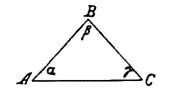
[ 10 ] But where has any real science ever had anything to do with this question? Consider mathematics! It has before it a figure created by the intersection of three straight lines: a triangle. The three angles «, p, y are in a constant relationship; together they form a straight angle or two right angles totaling 1800). This is a mathematical judgment. The angles t:, p, y are perceived. The above cognitive judgment arises on the basis of rational consideration. It establishes a connection between three perceptual images. There is no question of reflecting on any object lying behind the concept of the triangle. And this is how all sciences proceed. They weave threads from one mental image to another, creating order out of what is chaos to immediate perception; yet nowhere is anything other than the given taken into account. Truth is not the correspondence of a representation with its object, but the expression of a relationship between two perceived facts.
[ 11 ] Let us return to our example of the thrown stone. We connect the visual perceptions emanating from the individual locations where the stone is situated. This connection forms a curved line (line of throw); we arrive at the law of oblique projection; if we further take into account the material properties of the glass—that is, if we regard the flying stone as cause, the breaking of the pane as effect , and so on—then we have imbued the given with concepts to such an extent that it becomes comprehensible to us. This entire process, which synthesizes the diversity of perception into a conceptual unity , takes place within our consciousness. The ideal connection between the images of perception is not given by the senses, but is grasped by our mind entirely independently. For a being endowed with mere sensory perceptual faculties, this entire process would simply not exist. For such a being, the external world would simply remain that incoherent chaos of perceptions which we have characterized as what confronts us initially (immediately).
[ 12 ] Thus, the place where the images of perception appear in their ideal context, where the former are contrasted with the latter as their conceptual counter-image , is human consciousness. Even if this conceptual (law-like) connection is, in terms of its substantial nature, produced within consciousness, it does not follow from this that it is also merely subjective in terms of its significance. Rather, it arises just as much from objectivity in terms of its content as it arises from consciousness in terms of its conceptual form . It is the necessary objective complement to the perceptual image. Precisely because the perceptual image is incomplete and, in itself, unfinished, we are compelled to add the necessary complement to it as sensory experience. If what is immediately given were sufficient in and of itself—so that a problem did not arise at every point within it—we would never need to go beyond it. But the perceptual images do not follow one another in such a way that we can regard them as mutual consequences of one another; rather, they follow from something else that is closed off to sensory apprehension. Conceptual understanding stands in contrast to them and also grasps that part of reality which remains hidden from the senses. Cognition would be an utterly useless process if sensory experience were to present us with something complete. Any summarizing, ordering, or grouping of the facts presented to the senses would have no objective value whatsoever. Cognition has meaning only if we do not regard the form given to the senses as complete, if it appears to us as an incompleteness that still harbors something higher within itself, which, however, is no longer perceptible to the senses. This is where the mind comes in. It perceives that higher reality. Therefore, thinking must not be understood as if it were adding something to the content of reality. It is no more and no less an organ of perception than the eye and the ear. Just as the former perceives colors and the latter perceives sounds, so does thinking perceive ideas. Idealism is therefore quite compatible with the principle of empirical research. The idea is not the content of subjective thought, but the result of research. Reality presents itself to us when we confront it with open senses. It presents itself to us in a form that we cannot regard as its true form; we attain the latter only when we set our thinking in motion. To know means to add the perception of thought to the partial reality of sensory experience, so that its image may become complete.
[ 13 ] It all depends on how one conceives of the relationship between the idea and sensuous reality. By the latter, I mean here the totality of the perceptions conveyed to human beings through the senses. The most widely held view is that the concept is merely a means belonging to consciousness through which it appropriates the data of reality. The essence of reality lies in the things themselves in themselves, so that even if we were truly capable of getting to the very foundation of things, we could still only appropriate its conceptual image and by no means the foundation itself. This presupposes, then, two entirely separate worlds: the objective external world, which bears its essence—the grounds of its existence—within itself, and the subjective-ideal inner world, which is supposed to be a conceptual image of the external world. The latter is entirely irrelevant to the objective world; it is not required by it; it exists only for the knowing human being. The congruence of these two worlds would be the epistemological ideal of this fundamental view. I include in the latter not only the scientific orientation of our time, but also the philosophy of Kant, Schopenhauer, and the Neo-Kantians, and no less so the final phase of Schelling’s philosophy. All these schools agree in that they seek the essence of the world in a transsubjective realm and, from their standpoint, must admit that the subjective-ideal world—which is therefore for them merely a world of imagination—means nothing for reality itself, but solely something for human consciousness.
[ 14 ] I have already suggested that this view leads to the conclusion that there is a perfect congruence between concept (idea) and intuition. Whatever is found in the latter must also be contained in its conceptual counterpart, only in an ideal form. In terms of content, the two worlds would have to coincide completely. The relationships of spatio-temporal reality would have to be exactly replicated in the idea; only that instead of the perceived extension, shape, color, etc., the corresponding mental representation would have to be present. If, for example, I see a triangle, I would have to trace its outlines, the size and direction of its sides, etc., in my mind and construct a conceptual photograph of it. With a second triangle, I would have to do exactly the same thing, and so on for every object in the external and internal sensory world. In this way, every thing would be precisely reflected in my ideal picture of the world according to its location and properties.
[ 15 ] We must now ask ourselves: Does this conclusion correspond to the facts? Not at all. My concept of the triangle is a single one that encompasses all the individual, perceived triangles; and no matter how often I imagine it, it always remains the same. My various representations of the triangle are all identical to one another. I have, in fact, only one concept of the triangle.
[ 16 ] In reality, every thing presents itself as a particular, fully determined “this,” which is contrasted by an equally fully determined “that,” saturated with real reality. This multiplicity is contrasted by the concept as a strict unity. Within it, there is no particularization, no parts; it does not multiply; even when conceived an infinite number of times, it is always the same.
[ 17 ] The question now arises: What, then, is the actual bearer of this identity of the concept? It certainly cannot be its manifestation as an idea, for Berkeley was undoubtedly quite right in asserting that the idea of the tree at this moment has absolutely nothing to do with that of the same tree a minute later, if I keep my eyes closed between the two; nor do the various ideas of an object held by different individuals have anything to do with one another. Identity, therefore, can only lie in the content of the idea, in its What . The meaningful content must guarantee the identity to me.
[ 18 ] This, however, also refutes the view that denies the concept or idea any independent content. For this view holds that conceptual unity, as such, is entirely devoid of content; that it arises merely from the fact that certain characteristics of the objects of experience are omitted, while the common elements are highlighted and incorporated into our intellect for the purpose of conveniently summarizing the diversity of objective reality according to the principle of encompassing the entirety of experience with the mind using as few general units as possible—that is, according to the principle of the least expenditure of mental effort. Alongside modern natural philosophy, Schopenhauer takes this position. However, it is represented in its most abrupt—and therefore most one-sided—consequence in the short work by Richard Avenarius: “Philosophy as Thinking of the World According to the Principle of Least Effort: Prolegomena to a Critique of Pure Experience” [Leipzig 1876].
[ 19 ] However, this view is based solely on a complete misunderstanding not only of the meaning of the term, but also of the concept.
[ 20 ] To clarify this point, it is necessary to return to the principle that contrasts intuition—as a particular—with the concept—as a universal.
[ 21 ] One must ask: What, exactly, is the defining characteristic of the particular? Can it be defined conceptually? Can we say: This conceptual unity must be broken down into this or that concrete, particular multiplicity? No, is the unequivocal answer. The concept itself is entirely unaware of particularity. It must therefore lie in elements that are not at all accessible to the concept as such. But since we know of no intermediate link between intuition and concept—unless one were to invoke Kant’s fantastical, mystical schemata, which today can only be regarded as mere trifling—these elements must belong to intuition itself. The ground of particularity cannot be derived from the concept but must be sought within intuition itself. That which constitutes the particularity of an object cannot be conceived, but only intuitively perceived. This is the reason why any philosophy that seeks to derive (deduce) the entire intuitive reality of an object’s particularity from the concept itself is bound to fail. Herein also lies Fichte’s classic error, in that he sought to derive the entire world from consciousness.
[ 22 ] But anyone who accuses idealist philosophy of this impossibility as a flaw and thereby seeks to dismiss it is, in fact, acting no more reasonably than the philosopher [W. T.] Krug, a follower of Kant, who demanded that the philosophy of identity deduce his writing pen for him.
[ 23] What truly distinguishes intuition from the idea is precisely this element, which cannot be expressed in concepts and which must simply be experienced. Thus, concept and intuition stand opposite one another as sides of the world that are identical in essence but different in nature. And since the latter requires the former, as we have shown, it proves that its essence lies not in its particularity but in conceptual universality. This universality, however, must first be discovered in the subject as it appears; for although it can be derived by the subject from the object, it cannot be derived from the latter.
[ 24 ] The concept cannot derive its content from experience, for it does not incorporate the very characteristic of experience—its particularity. Everything that experience constructs is foreign to it. It must therefore provide its own content.
[ 25 ] It is commonly said that the object of experience is individual, that it is living intuition, whereas the concept is abstract, and—compared to intuition rich in content—poor, meager, and empty. But where is the richness of the determinations sought here? In their number, which—given the infinity of space—can indeed be infinitely large. Yet this does not make the concept any less fully determined. In the concept, number is replaced by qualities. But just as number is not found in the concept, so too does intuition lack the dynamic and qualitative aspects of characteristics. The concept is just as individual and just as rich in content as intuition. The only difference is that, in apprehending the content of intuition, nothing is required other than open senses and a purely passive attitude toward the external world, whereas the ideal core of the world must arise in the mind through its own spontaneous activity if it is to come to light at all. It is a completely trivial and idle saying to claim that the concept is the enemy of living intuition. It is its very essence, the actual driving and active principle within it; it adds its own content to that of intuition without abolishing the former—for, as such, it has no business interfering with it—and yet it is supposed to be the enemy of intuition! It is its enemy only when a philosophy that misunderstands itself attempts to spin the entire, rich content of the sensory world out of the idea. For then, instead of living nature, it delivers an empty scheme of phrases.
[ 26 ] Only in the manner we have indicated can one arrive at a satisfactory explanation of what empirical knowledge actually is. The necessity of progressing to conceptual knowledge would be utterly pointless if the concept added nothing new to sensuous intuition. Pure empirical knowledge would not be able to go a single step beyond the millions of details that are present to us in intuition. Pure empirical knowledge must, as a matter of consistency, negate its own content. For why create anew in the concept what is already present in intuition anyway? Consistent positivism, according to these considerations, would simply have to cease all scientific work and rely on mere chance. By failing to do so, it actually carries out what it theoretically denies. In general, both materialism and realism implicitly concede what we assert. Their approach is justified only from our point of view, while it stands in the most glaring contradiction to their own fundamental theoretical views.
[ 27 ] From our standpoint, the necessity of scientific knowledge and the transcendence of experience are explained entirely without contradiction. The sensory world presents itself to us as the first and immediate given; it appears to us as an immense enigma, because we can never find within it the driving, active force that governs it. Here reason steps in and, by means of the ideal world, confronts the sensory world with the fundamental essence that constitutes the solution to the enigma. Just as the sensory world is objective, so too are these principles. The fact that they do not appear to the senses, but only to reason, is irrelevant to their content. If there were no thinking beings, these principles would indeed never appear; yet they would be no less the essence of the world of phenomena.
[ 28 ] We have thus contrasted the transcendent worldview of Locke, Kant, the later Schelling, Schopenhauer, Volkelt, the Neo-Kantians, and modern natural scientists with a truly immanent one.
[ 29 ] The former seek the foundation of the world in something foreign to consciousness, in the transcendent; immanent philosophy seeks it in what appears to reason. The transcendent worldview regards conceptual knowledge as an image of the world; the immanent worldview regards it as the highest form of the world’s manifestation. The former can therefore provide only a formal theory of knowledge based on the question: What is the relationship between thought and being? The latter places the question “What is knowledge?” at the forefront of its theory of knowledge. The former proceeds from the prejudice of an essential difference between thought and being; the latter sets out without prejudice toward the only certainty—thought—and knows that it cannot find any being apart from thought.
[ 30 ] If we summarize the results obtained on the basis of epistemological considerations, the following emerges: We must start from the completely undetermined, immediate form of reality—from what is given to the senses before we set our thinking in motion—from what is merely seen, is merely heard, and so on. It is essential that we be aware of what the senses provide us and what thinking provides. The senses do not tell us that things stand in any relationship to one another, such as that this is the cause, that is the effect. To the senses, all things are equally essential to the structure of the world. The thoughtless observation does not know that the seed is at a higher level of perfection than the speck of dust on the street. To the senses, both are equally significant entities if they appear outwardly the same. At this level of observation, Napoleon is no more important in world history than John Doe in a remote mountain village. This is as far as contemporary epistemology has progressed. However, the fact that it has by no means thought through these truths exhaustively is shown by the circumstance that almost all epistemologists make the mistake of immediately attributing the predicate that it is “representation” to this provisionally indeterminate and undefined entity that we encounter at the first stage of our perception. This is, after all, a gross violation of our own, newly gained insight. Just as little as we know—when we remain at the level of immediate sensory perception—that the falling stone is the cause of the indentation at the spot where it fell, so little do we know that it is a representation . Just as we can arrive at the former only through manifold considerations, so too could we arrive at the realization that the world given to us is a mere representation—even if it were true—only through reflection. Whether what the senses convey to me is a real entity or merely a representation, the senses give me no insight into this. The sensory world presents itself to us as if shot from a pistol. If we wish to experience it in its purity, we must refrain from attributing any characterizing predicate to it. We can say only this: it presents itself to us; it is given to us. This tells us absolutely nothing about it itself. Only by proceeding in this way do we not block our path to an unbiased assessment of what is given. If we assign a characteristic to it from the outset, this impartiality ceases. If, for example, we say that the given is a representation, then the entire subsequent investigation can be conducted only under this presupposition. In this way, we would not be providing a theory of knowledge without presuppositions, but rather answering the question: What is cognition? on the premise that what is given to the senses is a representation. This is the fundamental flaw in Volkel’s theory of knowledge. At the very beginning of his work, he rigorously demands that the theory of knowledge must be free of presuppositions . Yet he begins with the statement that we possess a multiplicity of representations . Thus, his theory of knowledge is merely the answer to the question: How is cognition possible on the premise that what is given is a multiplicity of representations? For us, the matter will present itself quite differently. We take what is given as it is: as a multiplicity of—something that will reveal itself to us if we allow ourselves to be drawn away from it. Thus, we have the prospect of arriving at an objective knowledge, because we let the object speak for itself. We can hope that this entity we are facing will reveal to us everything we need, provided we do not prevent its manifestations from freely accessing our faculty of judgment through an inhibiting prejudice. For even if reality were to remain eternally enigmatic to us, such a truth would have value only if it were derived from the things themselves. But the assertion that “our consciousness is of such and such a nature, and therefore we cannot gain clarity about the things of the world” would be completely meaningless. Whether our mental faculties are sufficient to grasp the essence of things, we must test on the things themselves. I may possess the most perfect intellectual faculties; if things reveal nothing about themselves, my abilities are of no use to me. And conversely, I may know that my faculties are limited; yet I do not know whether they are nevertheless sufficient to recognize things.
[ 31 ] What we have further come to realize is this: What is immediately given leaves us unsatisfied in the form in which it is presented. It confronts us like a demand, like a riddle to be solved. It tells us: I am here; but just as I appear before you, I am not in my true form. As we hear this voice from outside, as we become aware that we are faced with an incompleteness—a being that conceals its better side from us—the activity of that faculty begins to stir within us, through which we gain insight into the other side of reality, through which we are able to supplement the incompleteness to form a whole. We become aware that we must supplement what we do not see, hear, etc., through thinking. Thinking is called upon to solve the riddle that perception presents to us.
[ 32 ] We can only gain clarity about this relationship when we examine why we are dissatisfied with sensory reality, but satisfied with conceptual reality . Sensory reality presents itself to us as something complete. It is simply there; we have contributed nothing to its being this way. We therefore feel as though we are facing a foreign entity that we did not produce—indeed, one whose production we were not even present for. We stand before something that has come into being. But we can only grasp that which we know how it came to be, how it came into existence; when we know where the threads are by which what appears before us is suspended. With our thinking, it is different. A thought-construct does not appear before me without my own active participation in its coming into being; it enters the field of my perception only insofar as I myself lift it up from the dark abyss of non-perception. A thought does not appear within me as a finished construct, like sensory perception; rather, I am aware that when I hold onto it in a completed form, I myself have shaped it into that form. What lies before me does not appear to me as the first, but as the last, as the conclusion of a process so intertwined with me that I have always stood within it. But this is precisely what I must demand of a thing that enters the horizon of my perception in order to grasp it. Nothing may remain obscure to me; nothing must appear as a finished whole; I must trace it myself to the stage where it has become a finished product. That is why the immediate form of reality—which we usually call experience —compels us to engage in scientific analysis. When we set our thinking in motion, we go back to the conditions of the given that were initially hidden from us; we work our way up from the product to the production; we reach a point where sensory perception becomes as transparent to us as thought. Our need for knowledge is thus satisfied. We can therefore only scientifically conclude a matter once we have completely (thoroughly) penetrated what we have directly perceived through thought. A process in the world appears to us as fully comprehended only when it is our own activity. A thought appears as the conclusion of a process within which we stand. But thinking is the only process in which we can place ourselves entirely within it, in which we can be absorbed. Therefore, to scientific observation, experienced reality must appear to arise from the development of thought in the same way as a pure thought itself. To investigate the essence of a thing means to position oneself at the center of the world of thought and to work from there until a mental construct emerges before our mind that appears identical to the experienced thing. When we speak of the essence of a thing or of the world in general, we can therefore mean nothing other than the comprehension of reality as thought, as idea. In the idea we recognize that from which we must derive everything else: the principle of things. What philosophers call the Absolute, eternal Being, the foundation of the world—what religions call God—we call, on the basis of our epistemological discussions, the Idea. Everything in the world that does not immediately appear as an Idea is ultimately recognized as arising from it. What superficial observation believes to be entirely separate from the Idea, deeper thought derives from it. No other form of existence can satisfy us except that which is derived from the Idea. Nothing may remain apart; everything must become part of the great whole encompassed by the Idea. But it demands no going beyond itself. It is the essence built upon itself, firmly rooted within itself. This does not lie in the fact that we have it immediately present in our consciousness. It lies in the idea itself. If it did not express its own essence, then it would appear to us just as the rest of reality does: in need of clarification. This seems, however, to contradict what we said above: that the idea appears in a form that satisfies us precisely because we actively participate in its coming into being. But this does not stem from the organization of our consciousness. If the idea were not an entity built upon itself, we could not have such a consciousness at all. If something does not have the center from which it springs within itself, but rather outside itself, then when it confronts me, I cannot declare myself satisfied with it; I must go beyond it, precisely to that center. Only when I encounter something that does not point beyond itself do I attain the awareness: now you stand within the center; here you can remain. My awareness that I stand within a thing is merely the consequence of the objective nature of that thing, namely, that it carries its principle within itself. By grasping the Idea, we reach the core of the world. What we apprehend here is that from which everything proceeds. We become one with this principle; therefore, the Idea—which is the most objective—appears to us at the same time as the most subjective.
[ 33 ] Sensory reality is so mysterious to us precisely because we cannot find its center within it. It ceases to be when we realize that it shares the same center as the world of thought that manifests itself within us.
[ 34 ] This center can only be a unified one. It must, after all, be such that everything else points to it as the basis for its explanation. If there were multiple centers of the world—multiple principles from which the world could be understood—and if one realm of reality pointed to this one, while another pointed to that world principle, then as soon as we found ourselves in a realm of reality, we would be directed only toward that one center. It would not even occur to us to ask about another. One region would know nothing of the other. They would simply not exist for one another. It therefore makes no sense at all to speak of more than one world. The idea is therefore, in all places of the world and in all consciousnesses, one and the same. The fact that there are different forms of consciousness, and that each conceives of the Idea, does not alter the matter. The content of the world’s Idea is self-contained and complete in itself. We do not create it; we merely seek to grasp it. Thought does not create it, but perceives it. It is not a producer, but an organ of perception. Just as different eyes see one and the same object, so do different consciousnesses think one and the same content of thought. The manifold consciousnesses think one and the same thing; they merely approach the One from different sides. That is why it appears to them in manifoldly modified forms. This modification, however, is not a difference in the objects themselves, but merely a perception from different angles. The diversity of human perspectives is just as explainable as the diversity that a landscape exhibits to two observers located in different places. If one is at all capable of penetrating into the world of ideas, one can be certain that, ultimately, one shares a world of ideas common to all human beings. At most, the issue may then be that we grasp this world in a rather one-sided manner, that we stand at a vantage point where it appears to us in the most unfavorable light, etc.
[ 35 ] We will likely never encounter the sensory world stripped entirely of all mental content. At most, in early childhood—when there is still no trace of thought—do we come close to pure sensory perception. In ordinary life, we are dealing with an experience that is half and half permeated by thought, one that already appears to have been raised, to a greater or lesser extent, from the darkness of mere perception to the bright clarity of intellectual comprehension. The sciences strive to completely overcome this darkness and leave nothing in experience that is not permeated by thought. What, then, has epistemology accomplished as a discipline in comparison to the other sciences? It has enlightened us regarding the purpose and task of all science. It has shown us the significance of the content of the individual sciences. Our epistemology is the science of the purpose of all other sciences. It has made it clear to us that what is gained in the individual sciences constitutes the objective basis of the world’s existence. The sciences arrive at a series of concepts; epistemology instructs us regarding the actual purpose of these concepts. With this characteristic result, our epistemology—held in the spirit of Goethe’s way of thinking—differs from all other contemporary epistemologies. It does not merely seek to establish a formal connection between thought and being; it does not merely seek to solve the epistemological problem logically, but aims to arrive at a positive result. It shows what the content of our thought is; and it finds that this “what” is at the same time the objective content of the world. Thus, epistemology becomes the most significant science for humankind. It enlightens people about themselves; it shows them their place in the world; it is therefore a source of satisfaction for them. It tells them, for the first time, what their calling is. In possession of its truths, humanity feels uplifted; its scientific inquiry takes on a new light. Only now does it know that it is most directly linked to the core of the world’s existence, that it reveals this core, which remains hidden from all other beings, that the world spirit manifests itself in it, that this spirit is inherent in it. He sees himself as the one who will bring the world process to completion; he sees that he is called to accomplish what the other forces of the world are unable to do, that he must place the crown upon creation. While religion teaches that God created humankind in His own image, our theory of knowledge teaches us that God guided creation only up to a certain point. There He brought forth humankind, and humankind—by recognizing itself and looking around—sets itself the task of continuing the work and completing what the primal force has begun. Humankind delves into the world and recognizes what can be further built upon the foundation that has been laid; it perceives the hint given by the primal spirit and carries out what has been hinted at.
[ 36 ] Thus epistemology is at the same time the doctrine of the meaning and purpose of humanity; and it addresses this task (the “purpose of humanity”) in a far more definitive manner than Fichte did at the turn of the 18th and 19th centuries. The thought processes of this powerful mind by no means lead to the full satisfaction that a genuine theory of knowledge must provide us with.
[ 37 ] Our task with regard to every individual existence is to work on it so that it appears to flow from the Idea, so that, as an individual, it completely dissipates and merges into the Idea, into whose realm we feel ourselves transported. Our mind has the task of developing itself in such a way that it is capable of penetrating all reality given to it in the manner in which it appears to emanate from the Idea. We must prove ourselves to be ceaseless workers in the sense that we transform every object of experience so that it appears as part of our ideal worldview. This brings us to the point where Goethe’s worldview begins. We must apply what has been said in such a way that we imagine the relationship between idea and reality that we have described to be a reality in Goethe’s own research; Goethe approaches things in the very way we have justified. He himself regards his inner workings as a living heuristic which, recognizing an unknown, intuited rule (the idea), seeks to find such rules in the external world and to introduce them into it (“Sprüche in Prosa,” Natw. Schr., Vol. 4, Part 2, p. 374). When Goethe demands that human beings instruct their senses (“Sprüche in Prosa,” ibid., p. 350), this simply means that human beings should not merely surrender to what their senses convey to them, but rather direct their senses so that they show them things in the proper light.