

Introductions to Goethe's Scientific Writings
GA 1
Translated by Steiner Online Library
10. Knowledge and Action in the Light of Goethe’s Philosophy
1. Methodology
[ 1 ] We have identified the relationship between the world of ideas derived from scientific thought and immediate, given experience. We have come to understand the beginning and end of a process: experience stripped of ideas and a conception of reality imbued with ideas. Between the two, however, lies human activity. It is up to human beings to actively bring about the emergence of the end from the beginning. The way in which they do this is the method. It goes without saying that our conception of this relationship between the beginning and the end of science will also require a specific method. From what must we proceed in developing this method? Scientific thought must, step by step, reveal itself as an overcoming of that obscure form of reality which we have designated as the immediately given, and as an elevation of it into the luminous clarity of the idea. The method will therefore have to consist in our answering the following question regarding every thing: What role does it play in the unified world of ideas; what place does it occupy in the ideal image I form of the world? Once I have understood this, once I have recognized how a thing relates to my ideas, then my need for knowledge is satisfied. There is only one unsatisfactory situation regarding the latter: when I am confronted with a thing that refuses to fit anywhere within the worldview I hold. The intellectual unease must be overcome that arises from the fact that there is something about which I would have to say: I see that it is there; when I encounter it, it looks at me like a question mark; but I can find nowhere within the harmony of my thoughts a point where I could place it; the questions I must ask regarding it remain unanswered; no matter how I turn and twist my system of thought. From this we see what we need with regard to every thing. When I encounter it, it stares at me as an individual entity. Within me, the world of thought presses toward that point where the concept of the thing lies. I do not rest until what first appeared to me as an individual entity appears as a link within the world of thought. Thus the individual entity dissolves as such and appears within a larger context. Now it is illuminated by the broader realm of thought; now it is a contributing element; and it is completely clear to me what it signifies within the great harmony. This is what takes place within us when we contemplate an object of experience. All progress in science rests on becoming aware of the point at which a phenomenon can be integrated into the harmony of the realm of thought. This must not be misunderstood. It cannot be meant to imply that every phenomenon must be explainable through established concepts; as if our world of ideas were closed off and everything newly experienced must correspond to some concept, which we already possess, . That drive of the world of thought can also lead to a point that has not yet been conceived by any human being. And the intellectual progress of the history of science rests precisely on the fact that thought brings new conceptual constructs to the surface. Each such conceptual construct is connected by a thousand threads to all other possible thoughts—in one way with this concept, in another way with that one. And therein lies the scientific method: that we demonstrate the concept of a single phenomenon in its connection with the rest of the world of ideas. We call this process: deriving (proving) the concept. All scientific thinking, however, consists solely in finding the existing transitions from concept to concept; it consists in allowing one concept to emerge from another. The back-and-forth movement of our thinking from concept to concept—that is the scientific method. One might say that this is simply the old story of the correspondence between the world of concepts and the world of experience. We would have to assume that the world outside of us (the transsubjective) corresponds to our conceptual world if we are to believe that this back-and-forth movement from concept to concept leads to a picture of reality. But this is merely a mistaken conception of the relationship between individual entities and concepts. When I encounter a phenomenon in the world of experience, I do not know at all what it is. Only when I have overcome it, when its concept has become clear to me, do I know what I have before me. But that does not mean that that individual phenomenon and the concept are two different things. No, they are one and the same; and what I encounter in particular is nothing other than the concept. The reason I see that entity as a separate entity, isolated from the rest of reality, is precisely that I do not yet recognize it in terms of its essence, that it has not yet appeared to me as what it is. From this follows the means to further characterize our scientific method. Every individual entity of reality represents a specific content within the system of thought. It is grounded in the totality of the world of ideas and can only be understood in connection with it. Thus, every thing necessarily requires a twofold act of thought. First, the thought that corresponds to it must be established with sharp contours, and then all the threads leading from this thought to the total world of ideas must be identified. Clarity in the particular and depth in the whole are the two most significant requirements of reality. The former is a matter for the intellect; the latter, a matter for reason. The intellect creates conceptual constructs for the individual things of reality. It fulfills its task all the more effectively the more precisely it delineates these constructs and the sharper the contours it draws. Reason must then integrate these constructs into the harmony of the entire world of ideas. This naturally presupposes the following: Within the content of the mental constructs created by the intellect, that unity already exists; the same life is already present; it is merely the intellect that artificially keeps everything separate. Reason, without obscuring clarity, merely reverses this separation. The intellect distances us from reality; reason leads us back to it. Graphically, this can be represented as follows:
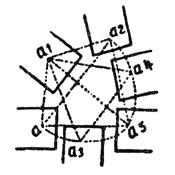
[ 2 ] In the surrounding structure, everything is interconnected; the same principle is at work in all its parts. The intellect creates the separation of the individual structures, because they do, after all, appear to us in the given as individuals, 91This separation is characterized by the fully extended, separating lines. and reason recognizes the unity. 92This unity is symbolized by the dotted lines.
[ 3 ] If we have the following two perceptions: 1. the incoming rays of the sun, and 2. a warm stone, then the intellect keeps the two things separate because they appear to us as two distinct entities; it identifies one as the cause and the other as the effect; then reason steps in, tears down the dividing wall, and recognizes the unity within the duality. All concepts created by the intellect— cause and effect, substance and property, body and soul, idea and reality, God and the world, etc., exist only to artificially separate the unified reality; and reason must, without blurring the content thus created, without mystically obscuring the clarity of the intellect, seek the inner unity within multiplicity. In doing so, it returns to that from which the intellect has strayed—to unified reality. If one wishes to have a precise nomenclature, one should call the constructs of the intellect “concepts,” and the creations of reason “ideas.” And one sees that the path of science is to rise from the concept to the idea. And this is the point where the subjective and objective elements of our cognition are laid bare for us in the clearest way. It is evident that this separation exists only subjectively; it is created solely by our intellect. The fact that I break down one and the same objective unity into mental constructs that differ from those of my fellow human beings cannot prevent me; this does not prevent my reason from returning, through synthesis, to the same objective unity from which we both began. Let the unified structure of reality be represented symbolically [Figure 1]. I divide it rationally as shown in Fig. 2; another person might divide it differently, as shown in Fig. 3. We grasp
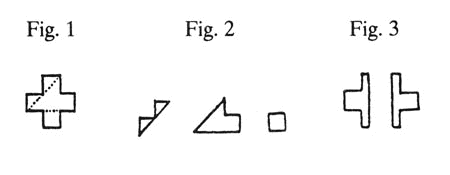
[ 4 ] we can rationally bring them together and arrive at the same concept. This explains to us how people can have such different concepts and such different views of reality, even though it can only be one . The difference lies in the diversity of our mental worlds. This sheds light for us on the development of various scientific viewpoints. We understand where the many philosophical viewpoints come from, and we do not need to award the palm of truth to just one of them. We also know what stance we ourselves must take in the face of the diversity of human views. We will not ask exclusively: What is true, what is false? We will always examine the manner in which a thinker’s intellectual world emerges from the harmony of the world; we will seek to understand rather than judge, and will not immediately regard as error that which does not correspond to our own view. Added to this source of diversity in our scientific viewpoints is a new one: that each individual has a different field of experience. After all, each person is confronted, as it were, with a segment of the total reality. Their mind processes this, and the mind serves as the mediator on the path to the idea. So even if we all perceive the same idea, this is always the case in different domains. Thus, only the final result, to which we arrive, can be the same; the paths , on the other hand, can be different. It does not matter at all whether the individual judgments and concepts that make up our knowledge agree with one another; what matters is only that they ultimately lead us to swim in the current of the idea. And in this current, all people must ultimately meet if vigorous thinking leads them beyond their own particular standpoint. It may well be that limited experience or an unproductive mind leads us to a one-sided, incomplete view; but even the smallest sum of what we experience must ultimately lead us to the idea; for we rise to the latter not through a greater or lesser amount of experience, but solely through our capacities as human beings. Limited experience can only result in our expressing the idea in a one-sided manner , in that we have few means at our disposal to express the light that shines within us; but it cannot prevent us at all from allowing that light to dawn within us. Whether our scientific or, indeed, worldview is complete is, apart from its intellectual depth, an entirely different question. If one now returns to Goethe, one will recognize many of his statements, when considered alongside our remarks in this chapter, as simple consequences of the latter. We regard this relationship as the only correct one between author and interpreter. When Goethe says: “If I know my relationship to myself and to the outside world, I call that truth. And so everyone can have their own truth, and yet it is always the same” (“Sprüche in Prosa”; Natw. Schr., Vol. 4, Part 2, p. 349), this can only be understood on the basis of what we have developed here.
2. Dogmatic and Immanent Methods
[ 5 ] A scientific judgment arises when we connect either two concepts or a perception and a concept. An example of the former is the judgment: “No effect without a cause”; an example of the latter is: “The tulip is a plant.” In everyday life, we also recognize judgments in which one perception is connected to another, e.g., “The rose is red.” When we form a judgment, we do so for one reason or another. Now, there can be two different views regarding this reason. One view assumes that the objective reasons why the judgment we form is true lie beyond what is given to us in the concepts or perceptions that enter into the judgment. According to this view, the reason why a judgment is true does not coincide with the subjective reasons for which we form this judgment. According to this view, our logical reasons have nothing to do with the objective ones. It may be that this view proposes some way to arrive at the objective reasons for our insight; the means available to our cognitive thinking are not sufficient for this. For cognition, the objective reality that determines my assertions lies in a world unknown to me; the assertion, with its formal reasons (consistency, support by various axioms, etc.), lies solely within my own world. A science based on this view is a dogmatic one. Such a dogmatic science is both theological philosophy, which is based on faith in revelation, and modern empirical science; for there is not only a dogma of revelation, there is also a dogma of experience. The dogma of revelation conveys to human beings truths about things that are completely beyond their field of vision. He does not know the world about which he is required to believe the ready-made assertions. He cannot access the grounds for these assertions. He can therefore never gain an understanding of why they are true. He cannot gain knowledge, only belief . On the other hand, however, the assertions of that empirical science are also mere dogmas—the science that believes one should remain at the level of mere, pure experience and merely observe, describe, and systematically compile its changes, without rising to the conditions that are not yet given in mere immediate experience. Even in this case, we do not arrive at the truth through insight into the matter itself, but rather it is imposed upon us from the outside. I see what is happening and what is there, and I take note of it; why this is so lies in the object itself. I see only the consequence, not the cause. The dogma of revelation once dominated science; today, it is the dogma of experience that does so. In the past, it was considered presumptuous to reflect on the reasons behind revealed truths; today, it is considered impossible to know anything other than what the facts state. The “Why they state it this way and not another” is considered unknowable and therefore unattainable.
[ 6 ] Our discussion has shown that the assumption of a reason why a judgment is true — apart from the reason why we recognize it as true — is an absurdity. When we advance to the point where the essence of a thing becomes clear to us as an idea, we perceive in the latter something entirely self-contained, something that supports and sustains itself, requiring no further explanation from outside, so that we can stop there. We see in the idea—if we only have the capacity to do so—that it contains within itself everything that constitutes it, that with it we have everything that can be sought. The entire ground of being has been absorbed into the idea, has poured itself into it unreservedly, so that we need look for it nowhere but in it. In the idea, we do not have a representation of what we seek in things; we have the very thing we seek. As the parts of our world of ideas converge in judgments, it is the ideas’ own content that brings this about, not reasons lying outside them. In our thinking, the substantive—and not merely the formal—reasons for our assertions are immediately present.
[ 7 ] This refutes the view that posits an absolute reality outside the mind, upon which all things—including thought itself—are founded. According to this worldview, the basis for existence cannot be found at all within what is accessible to us. It is not inherent in the world before us; it exists outside of it—a being in its own right that exists alongside it. This view can be called realism . It takes two forms. It either posits a multitude of real beings that underlie the world (Leibniz, Herbart), or a unified Reality (Schopenhauer). Such a being can never be recognized as identical with the idea; it is already presupposed to be essentially different from it. Anyone who becomes aware of the true meaning of the question concerning the essence of phenomena cannot be a proponent of this realism. What, after all, is the point of inquiring into the essence of the world ? It has no other purpose than that, when I encounter a thing, a voice within me asserts itself, telling me that the thing is, in the final analysis, something entirely different from what I perceive with my senses. That which it is, in addition, is already at work within me, pressing to come to light within me, while I perceive the thing outside of myself. It is only because the world of ideas at work within me urges me to explain the world around me in terms of that world that I demand such an explanation. For a being in whom no ideas are at work, the urge to explain things even further is absent; such a being is fully satisfied with sensory appearance. The demand for an explanation of the world arises from the need of thought to fuse the content accessible to it with appearing reality into a single whole, to penetrate everything conceptually; to transform what we see, hear , etc., into something we understand. Anyone who considers these statements in their full scope cannot possibly be a proponent of the realism characterized above. To seek to explain the world through a “real” entity that is not an idea is such a contradiction that one cannot even comprehend how it is possible at all that this view could have gained any followers. We can neither feel the need to explain the reality perceptible to us by means of something that does not assert itself within thought at all—indeed, that is supposed to be fundamentally different from the conceptual—nor is such an endeavor possible. First: Where would we get the need to explain the world by means of something that does not impose itself on us anywhere, that remains hidden from us? And suppose it were to present itself to us; then the question arises again: in what form and where? It cannot, after all, be within thought. And even if it were in external or internal perception? What sense would it make, then, to explain the sensory world through something qualitatively equivalent? That leaves only a third possibility: the assumption that we possess a capacity to access the non-conceptual and most real essence by means other than thought and perception. Anyone who makes this assumption has fallen into mysticism. We need not concern ourselves with it; for we are concerned only with the relationship between thought and being, between idea and reality . A mystic must write a theory of knowledge for mysticism. The position of the later Schelling, according to which we can, with the help of our reason, develop only the “What” of the content of the world, but cannot attain the “That” , strikes us as the greatest absurdity. For us, the “That” is the prerequisite for the “What,” and we would not know how to arrive at the “What” of a thing whose “That” had not already been established beforehand. The “that” is, after all, already inherent in the content of my reason, insofar as I grasp its “what” . Schelling’s assumption that we can have a positive content of the world without the conviction that it exists, and that we must first gain this “that” through higher experience , seems so incomprehensible to a self-understanding mind that we must assume Schelling, in his later years, no longer understood the standpoint of his youth, which made such a powerful impression on Goethe.
[ 8 ] It is not possible to assume higher forms of existence than those that pertain to the world of ideas. Simply because human beings are often unable to grasp that the existence of the idea is far higher and fuller than that of perceived reality, they seek yet another reality. He regards the existence of the idea as something chimerical, lacking any connection to the real, and is therefore not satisfied with it. He is simply unable to grasp the idea in its positivity; he perceives it only as an abstraction; he does not sense its richness, its inner perfection, and its substance. However, we must demand of education that it strive upward to that higher vantage point where even a being, which cannot be seen with the eyes or grasped with the hands but must be apprehended by reason, is regarded as real . We have thus, in fact, established an idealism that is at the same time realism . Our line of thought is this: thinking strives to explain reality from the idea. It conceals this striving in the question: What is the essence of reality? We inquire into the content of this essence itself only at the end of science; we do not proceed as realism does, which presupposes a real entity in order to then derive reality from it. We differ from realism in our full awareness that we have a means of explaining the world only in the idea . Realism, too, has only this means, but it is unaware of it. It derives the world from ideas, but it believes it derives it from another reality. Leibniz’s world of monads is nothing but a world of ideas; yet Leibniz believes it possesses a higher reality than a merely ideal one. All realists make the same mistake: they conceive of entities and fail to realize that they cannot escape the realm of the idea. We have rejected this form of realism because it is deluded about the ideal nature of the foundation of its world; but we must also reject that false idealism which believes that, because we cannot go beyond the idea, we cannot go beyond our consciousness, and that all the representations given to us and the entire world are merely subjective appearance, merely a dream that our consciousness dreams (Fichte). These idealists, in turn, fail to grasp that, although we cannot go beyond the Idea, we nevertheless in the Idea have the objective, that which is grounded in itself and not in the subject. They do not consider that, even if we cannot go beyond the unity of thought, we enter fully into objectivity through rational thought. The realists fail to understand that the objective is an idea; the idealists fail to understand that the idea is objective.
[ 9 ] We still need to address the empiricists of the sensible, who regard any explanation of reality through the idea as an impermissible philosophical deduction and demand that we confine ourselves to the sensually perceptible. Against this position, we can simply say that its demand can be nothing more than a methodological, merely a formal one. “We should limit ourselves to the given” simply means: we should appropriate what presents itself to us. As for the “what” of the given, this position can have the least to say about it; for this “what” must, after all, come to it from the given itself. How one can, while demanding pure experience, simultaneously demand not to go beyond the sensory world—since the idea can just as well fulfill the requirement of being given—is completely incomprehensible to us. The positivist principle of experience must leave the question entirely open—what is given—and thus aligns quite well with an idealist research result. In that case, however, this requirement also coincides with ours. And in our view, we unite all standpoints, insofar as they are justified . Our standpoint is idealism because it sees the foundation of the world in the idea; it is realism because it addresses the idea as the real; and it is positivism or empiricism because it seeks to arrive at the content of the idea not through a priori construction, but as something given. We have an empirical method that penetrates the real and ultimately finds satisfaction in the idealistic result of research. We do not engage in inference from a given—as something known—to an underlying, non-given, conditioning factor. We reject any inference in which any member of the inference is not given. Inference is merely a transition from given elements to other, equally given elements. In an inference, we connect a with b through c; but all of this must be given . When Volkelt says that our thinking compels us to make a presupposition out of the given and to go beyond it, we say: in our thinking, we are already compelled by that which we wish to add to the immediately given. We must therefore reject all metaphysics . Metaphysics, after all, seeks to explain the given by means of a non-given, inferred element (Wolff, Herbart). We see in inference merely a formal activity that leads to nothing new, that merely brings about transitions between positively present elements.*
3. The System of Science
[ 10 ] What form does the completed science take in the light of Goethe’s way of thinking? Above all, we must note that the entire content of science is a given; partly given as the sensory world from without, partly as the world of ideas from within. All our scientific activity will therefore consist in overcoming the form in which this total content of the given presents itself to us and transforming it into one that satisfies us. This is necessary because the inner unity of the given remains hidden in its initial form of appearance, where only the outer surface appears to us. Now, this methodological activity, which establishes such a connection, takes on different forms depending on the fields of phenomena we are examining. The first case is as follows: We have a multiplicity of elements given to us through the senses. These elements are interrelated. This interrelation becomes clear to us when we delve into the matter conceptually. Then one of the elements appears to us to be determined, to a greater or lesser extent and in this or that way, by the others. The conditions of existence of one element become comprehensible to us through those of another. We derive one phenomenon from another. We derive the phenomenon of the heated stone as an effect from the warming rays of the sun, as the cause. What we perceive in one thing is explained when we derive it from another perceptible thing. We see how the ideal law manifests itself in this realm. It encompasses the things of the sensory world and stands above them. It determines the lawful mode of operation of one thing by making it contingent upon another. Our task here is to arrange the sequence of phenomena in such a way that one necessarily follows from the other, so that they all constitute a whole that is thoroughly governed by law. The realm that is to be explained in this way is inorganic nature. Now, in experience, individual phenomena do not present themselves to us in such a way that what is next in space and time is also next in terms of inner essence. We must first move from what is next in space and time to what is next in concept. We must seek out phenomena that, in terms of essence, are immediately connected to a given phenomenon. We must strive to compile a self-complementing, self-sustaining, mutually supportive series of facts. From this we gain a group of mutually interacting, sensually perceptible elements of reality; and the phenomenon unfolding before us follows directly from the factors under consideration in a transparent, clear manner. We call such a phenomenon, following Goethe, an “urphänomen” or “fundamental fact.” This urphänomen is identical to the objective law of nature. The compilation discussed here can either take place purely in thought—as when I consider the three determining factors involved in a stone thrown horizontally: 1. the force of impact, 2. the gravitational pull of the Earth, and 3. air resistance—and then deduce the trajectory of the flying stone from these factors; or else: I can actually bring the individual factors together and then observe the phenomenon resulting from their interaction. This is the case with the experiment . While a phenomenon of the external world is unclear to us because we know only the effect (the appearance) and not the cause, the phenomenon provided by the experiment is clear to us, for we have brought the determining factors together ourselves. This is the path of natural science: it begins with experience to see what really is; proceeds to observation to see why this is really so; and then advances to experimentation to see what really can be. —
[ 11 ] Unfortunately, it seems that the very essay by Goethe that could best support these views has been lost. It was a continuation of the essay “The Experiment as Mediator Between Subject and Object.” Starting from the latter, we will attempt to reconstruct the possible content of the former based on the only source available to us: the correspondence between Goethe and Schiller. The essay “The Experiment, etc. . . .” emerged from the studies Goethe undertook to justify his work in optics. It was then set aside until, in 1798, the poet resumed these studies with renewed vigor and, in collaboration with Schiller, subjected the fundamental principles of the scientific method to a thorough investigation conducted with the utmost scientific rigor. On January 10, 1798 (see Goethe’s correspondence with Schiller), he sent the aforementioned essay to Schiller for consideration, and on January 13, he informed his friend that he intended to further elaborate on the views expressed therein in a new essay. He did indeed undertake this work, and as early as January 17, a short essay was sent to Schiller that contained a characterization of the methods of natural science. This essay is not included in his collected works. It would undoubtedly be the one that would provide the best insights for an appreciation of Goethe’s fundamental views on the scientific method. However, we can discern the ideas set forth in it from Schiller’s detailed letter of January 19, 1798 (Correspondence between Goethe and Schiller), bearing in mind that we find numerous examples and additions to what is hinted at there in Goethe’s *Prose Sayings*. 93Cf. Natw. Schr., Vol. 4, Part 2, p. 593, note. In my introduction, p. XXXVIII, to Volume 34 of this edition of Goethe’s works, I stated: “Unfortunately, the essay that could best support Goethe’s views on experience, experimentation, and scientific knowledge appears to have been lost.” However, it has not been lost but was found in the form cited above in the Goethe Archive. (See Weimar Goethe Edition, Part II, Vol. 11, p. 38ff.) It is dated January 15, 1798, and was sent to Schiller on the 17th. It presents itself as a continuation of the essay: “The Experiment as Mediator Between Subject and Object.” I derived the train of thought in the essay from the Goethe-Schiller correspondence and presented it in the aforementioned introduction, pp. XXXIX ff., exactly as it has now been found. In terms of content, the essay adds nothing to my remarks; however, it does confirm in every respect my view—derived from Goethe’s other works—regarding his method and mode of cognition.»
[ 12 ] Goethe distinguishes three methods of scientific research. These are based on three different conceptions of phenomena. The first method is ordinary empiricism, which does not go beyond the empirical phenomenon, beyond the immediate facts. It remains confined to individual manifestations. If ordinary empiricism is to be consistent, it must limit its entire activity to describing every phenomenon it encounters in precise detail, that is, to recording the empirical facts. For it, science would be nothing more than the sum of all these individual descriptions of recorded facts. In contrast to ordinary empiricism, rationalism constitutes the next higher stage. It addresses the scientific phenomenon. This approach is no longer limited to the mere description of phenomena, but seeks to explain them by uncovering their causes, formulating hypotheses, and so on. It is the stage at which the intellect infers causes and connections from phenomena. Goethe considers both the former and the latter methods to be one-sided. Ordinary empiricism is crude unscientific thinking because it never moves beyond the mere perception of contingencies; rationalism, on the other hand, projects causes and connections into the world of phenomena that are not actually present there. The former cannot rise from the abundance of phenomena to free thought; the latter loses that abundance as the secure ground beneath its feet and succumbs to the arbitrariness of the imagination and subjective whim. Goethe condemns the tendency to immediately link phenomena with conclusions based on subjective influences in the strongest terms, as in “Sayings in Prose”; Natw. Schr., Vol. 4, Part 2, p. 375: “It is a serious mistake—one that many an observer nevertheless commits—to link a conclusion immediately to an observation and to regard both as equally valid,” and: “Theories are usually the hasty conclusions of an impatient mind that would like to be rid of phenomena and therefore substitutes images, concepts, and often merely words in their place. One senses—and indeed sees—that this is merely a stopgap; but do not passion and partisanship always favor stopgaps? And rightly so, since they are in such great need of them.” (Ibid., p. 376) Goethe particularly condemns the abuse caused by the determination of causality. Rationalism, in its unbridled fantasy, seeks causality where the facts do not require it. In “Sayings in Prose” (ibid., p. 371), it states: “The most innate concept, the most essential one—that of cause and effect, becomes, in its application, the cause of countless, ever-recurring errors.” In particular, his craving for simple connections leads him to conceive of phenomena as if they were links in a chain, strung together according to cause and effect purely in terms of length ; whereas the truth is that any phenomenon caused by an earlier causal factor in time also depends simultaneously on many other influences. In this case, only the length and not the breadth of nature is taken into account. Both paths—common empiricism and rationalism—are, for Goethe, stepping stones toward the highest scientific method, but they are precisely only stepping stones that must be overcome. And this is achieved through rational empiricism, which deals with the pure phenomenon, which is identical to the objective law of nature. Ordinary empiricism, that is, immediate experience, offers us only individual, disconnected elements—an aggregate of phenomena. That is to say, it does not offer us this as the final conclusion of scientific inquiry, but rather as the first experience. Our scientific need, however, seeks only what is coherent and conceives of the individual only as a link in a chain. Thus, the need to understand and the facts of nature appear to diverge. In the mind there is only connection; in nature, only separation; the mind strives for the genus, while nature creates only individuals. The solution to this contradiction arises from the consideration that, on the one hand, the connecting power of the mind is devoid of content and thus, by itself alone, cannot recognize anything positive; that, on the other hand, the separation of natural objects is not grounded in their essence itself, but in their spatial appearance; that, rather, when we penetrate the essence of the individual, of the particular, it is this very essence that points us toward the genus. Because the objects of nature are separate in their appearance, the synthesizing power of the mind is required to reveal their inner unity. Because the unity of the understanding is empty in and of itself, it must fill it with the objects of nature. Thus, at this third stage , the phenomenon and the faculties of the mind converge and merge into one , and only now can the mind be fully satisfied. —
[ 13 ] Another area of research is that in which the individual, in its mode of existence, does not appear to us as the consequence of something else existing alongside it, and where we therefore do not comprehend it by appealing to something else of the same kind. Here, a series of sensually perceptible elements appears to us as the immediate manifestation of a unified principle, and we must penetrate to this principle if we are to understand the individual phenomenon. In this realm, we cannot explain the phenomenon through external influences; we must derive it from within. What was previously determinative is now merely causative. Whereas in the previous field I understood everything once I succeeded in viewing it as a consequence of something else—deriving it from an external condition—here I am forced to adopt a different line of inquiry. Even if I know the external influence, I have not yet gained insight into why the phenomenon unfolds precisely in this way and no other. I must derive it from the central principle of that thing upon which the external influence has acted. I cannot say: this external influence has this effect; but only: to this particular external influence, the internal principle of action responds in this particular way. What happens is the result of an inner lawfulness. I must therefore know this inner lawfulness. I must investigate what takes shape from within. This self-forming principle, which underlies every phenomenon in this realm—and which I must seek in everything—is the type. We are in the realm of organic nature. What is a primordial phenomenon in inorganic nature is, in organic nature, the type. The type is a general image of the organism: its idea; the animality within the animal. For the sake of context, we had to reiterate here the main points already discussed in an earlier section on the “type.” In the ethical and historical sciences, we are then dealing with the idea in the narrower sense. Ethics and history are ideal sciences. Their reality consists of ideas. — It is the task of the individual sciences to process the given material to such an extent that they bring it down to the primordial phenomenon, the type, and the guiding ideas in history. “If… the physicist can arrive at an understanding of what we have called a primordial phenomenon, then he is secure, and the philosopher with him; he, for he convinces himself that he has reached the limits of his science, that he finds himself at the empirical summit, where he can look back and survey experience in all its stages and look forward into the realm of theory, where he may not enter, but into which he can glimpse. The philosopher is secure, for he takes from the physicist’s hand a “last thing” that now becomes a “first thing” for him” (“Outline of a Theory of Colors” 720 [Natw. Schr., Vol. 3, p. 275 ff.])—For it is here that the philosopher enters the scene with his work. He takes hold of the primordial phenomena and places them in a satisfying ideal context. We see what, in the spirit of Goethe’s worldview, is to replace metaphysics: a consideration, synthesis, and derivation of the primordial phenomena in accordance with ideas. In this sense, Goethe repeatedly expresses his views on the relationship between empirical science and philosophy; particularly clearly in his letters to Hegel. In the *Annals*, Goethe repeatedly speaks of a schema of natural science. If such a schema were to exist, we would see from it how he himself conceived of the relationship of the individual primordial phenomena to one another; how he arranged them into a necessary chain. We also gain an idea of this when we consider the table he provides in Vol. 1, No. 4 of “On Natural Science” regarding all possible modes of action:
Random
Mechanical
Physical
Chemical
Organic
Psychological
Ethical
Religious
Ingenious
[ 14 ] In arranging the primordial phenomena, one should have followed this ascending sequence.*
4. On the Limits of Knowledge and Hypothesis Formulation
[ 15 ] There is much talk today about the limits of our knowledge. Our ability to explain what exists is said to extend only up to a certain point, at which we must stop. We believe we are on the right track regarding this question if we frame it correctly. For so often, it all comes down to asking the right question. A properly framed question dispels a whole host of errors. If we consider that the object in relation to which a need for explanation arises within us must be given, it is clear that the given itself cannot set a limit for us. For in order to lay claim at all to being explained and understood, it must present itself to us within the given reality. What does not enter the horizon of the given need not be explained. The limit could therefore lie only in the fact that, when confronted with a given reality, we lack the means to explain it. Yet our need for explanation arises precisely from the fact that what we wish to regard as a given—and through which we wish to explain it—forces its way into the horizon of what is given to us in thought. Far from the explanatory essence of a thing being unknown to us, it is rather this very essence that, through its appearance in the mind, makes explanation necessary. What is to be explained and by what it is to be explained are already present. It is merely a matter of connecting the two. Explanation is not a search for the unknown, but merely an examination of the mutual relationship between two known entities. It should never occur to us to explain a given fact by something of which we have no knowledge. There can therefore be no question of any fundamental limits to explanation. Now, of course, there is something to be considered that lends a semblance of validity to the theory of a limit to knowledge. It may be that we have a hunch that a real thing exists, yet it remains beyond our perception. We may perceive certain traces or effects of a thing and then assume that this thing exists. And here, perhaps, we can speak of a limit of knowledge. However, what we assume to be unattainable is not something from which anything would have to be explained in principle; it is something that can be perceived, even if it is not actually perceived. The obstacles preventing me from perceiving it are not fundamental limits of knowledge, but purely accidental, external ones. Indeed, they can certainly be overcome. What I merely suspect today, I may experience tomorrow. But this is not the case with a principle; there are no external obstacles—which, after all, usually lie only in place and time—for the principle is given to me internally. I do not intuit it from another source unless I perceive it myself.
[ 16 ] This is where the theory of the hypothesis comes into play. A hypothesis is an assumption we make, the truth of which we cannot verify directly, but only through its effects. We observe a series of phenomena. We can only explain it if we assume something that we do not perceive directly. Can such an assumption extend to a principle? Apparently not. For an inner reality that I presuppose without being aware of it is a complete contradiction. A hypothesis can only assume that which I do not perceive, but would perceive immediately if I removed the external obstacles. Although a hypothesis cannot assume what is not perceived, it must assume what is perceivable. Thus, every hypothesis is valid insofar as its content can be directly confirmed by future experience. Only hypotheses that can cease to be such are justified. Hypotheses about central scientific principles have no value. What is not explained by a positively established principle known to us is neither capable of nor in need of an explanation at all.
5. Ethical and Historical Sciences
[ 17 ] The answer to the question, “What is cognition?” has shed light on humanity’s place in the universe. It is therefore inevitable that the view we have developed regarding this question will also shed light on the value and significance of human action. We must, after all, attribute greater or lesser significance to what we accomplish in the world, depending on whether we regard our purpose as more or less significant.
[ 18 ] The first task we must now undertake will be to examine the nature of human activity. How does what we must regard as the effect of human action relate to other forms of agency within the world process? Let us consider two things: a natural product and a creation of human activity—the crystal form and, say, a wagon wheel. In both cases, the object before us appears to us as the result of laws that can be expressed in concepts. The difference lies solely in the fact that we must regard the crystal as the immediate product of the natural laws that govern it, whereas in the case of the wagon wheel, human beings step into the space between concept and object. What we conceive of as underlying the natural product as the real, we introduce into reality through our actions. In cognition, we come to know what the ideal conditions of sensory experience are; we bring to light the world of ideas that already lies in reality; we thus complete the world process in the sense that we summon into appearance the producer who eternally brings forth the products but who, without our thinking, would remain eternally hidden within them. In our actions, however, we complete this process by transforming the world of ideas—insofar as it is not yet reality—into reality. We have now recognized the idea as that which underlies all reality, as the determining factor, the intention of nature. Our cognition leads us to discern the tendency of the world process—the intention of creation—from the hints contained in the nature that surrounds us. Once we have achieved this, our action is tasked with independently contributing to the realization of that intention. And so our action appears to us directly as a continuation of the very kind of activity that also permeates nature. It appears to us as a direct outflow of the foundation of the world. Yet what a difference there is here compared to other (natural) activity! The natural product by no means possesses within itself the ideal lawfulness by which it appears to be governed. It requires the encounter with a higher form of thought—human thought; then to this appears that by which the former is governed. With human action, it is different. Here, the idea is immediately inherent in the active object; and if a higher being were to confront it, it could find nothing in its activity other than what that being itself has placed into its action. For a perfect human action is the result of our intentions and nothing else. When we observe a natural product acting upon another, the situation is as follows: We see an effect; this effect is determined by laws that can be expressed in concepts. But if we wish to understand the effect, it is not enough to associate it with any laws; we must have a second perceptible thing—which, however, must again be entirely reduced to concepts. When we see an impression in the ground, we look for the object that made it. This leads to the concept of such an effect, in which the cause of a phenomenon reappears in the form of an external perception—that is, but through concepts of force. Force can only confront us where the idea first appears in an object of perception and only then, in this form, acts upon another object. The opposite of this occurs when this mediation is absent, when the idea approaches the sensory world directly. There, the idea appears to be the cause itself. And this is where we speak of will . Will is thus understood as the idea itself as force. It is entirely inadmissible to speak of an independent will. When a person accomplishes something, one cannot say that will is added to the idea. To speak in this way is to have failed to grasp the concepts clearly, for what is the human personality, apart from the world of ideas that fills it? Nothing but an active existence. Anyone who conceives of it otherwise—as a dead, inactive product of nature—would indeed equate it with a stone on the street. This active existence, however, is an abstraction; it is not something real. It cannot be grasped; it is without content. If one wishes to grasp it, if one seeks content, then one obtains precisely the world of ideas embodied in action. E. v. Hartmann makes this abstraction into a second world-constituting principle alongside the idea. But it is nothing other than the Idea itself, merely in a particular mode of manifestation. Will without the Idea would be nothing. The same cannot be said of the Idea, for activity is an element of it, whereas the Idea is the self-sustaining essence.*
[ 19 ] This concerns the nature of human action. We now turn to another essential characteristic of human action, which necessarily follows from what has been said so far. Explaining a natural process involves tracing it back to its conditions: seeking out the cause of a given effect. When I perceive an effect and seek its cause, these two perceptions by no means satisfy my need for an explanation. I must go back to the laws according to which this cause brings about this effect. With human action, it is different. Here, the very regularity that conditions a phenomenon comes into play; what constitutes a product itself enters the scene of action. We are dealing with a manifest existence with which we can be satisfied, for which we need not inquire into the deeper underlying conditions. We have understood a work of art when we know the idea embodied in it; we need not inquire into any further lawful connection between the idea (cause) and the work (effect). We understand a statesman’s actions when we know his intentions (ideas); we need not go beyond what appears. Thus, natural processes differ from human actions in that, in the former, the law must be regarded as the conditioning background of phenomenal existence, whereas in the latter, existence itself is the law and appears to be conditioned by nothing but itself. Thus, every natural process is divided into a conditioning factor and a conditioned factor, and the latter follows necessarily from the former, whereas human action conditions only itself. But that is acting with freedom. As the intentions of nature—which lie behind phenomena and condition them—enter into human beings, they themselves become phenomena; but they are now, as it were, unbound. If all natural processes are merely manifestations of the Idea, then human action is the acting Idea itself.
[ 20 ] Since our theory of knowledge has come to the conclusion that the content of our consciousness is not merely a means of forming an image of the foundation of the world, but that this foundation of the world itself manifests in our thinking in its most essential form, we cannot help but recognize in human action the direct, unconditional action of that very foundation itself. We know of no ruler of the world who, from outside ourselves, sets the goal and direction of our actions. The ruler of the world has relinquished his power, has handed everything over to humankind—with the annihilation of his own distinct existence—and has assigned humankind the task: continue to act. Humanity finds itself in the world, beholds nature, and within it discerns the hint of something deeper, something that determines it—an intention. Its thinking enables it to recognize this intention. It becomes its spiritual possession. It has penetrated the world; it acts to carry on those intentions. Thus, the philosophy presented here is the true philosophy of freedom. It does not attribute human actions to either natural necessity or the influence of an otherworldly creator or ruler of the world. In either case, man would be unfree. If natural necessity were at work within him as it is in other beings, then he would perform his actions out of compulsion; in that case, he too would be bound by conditions underlying apparent existence, and there could be no question of freedom. Of course, it cannot be ruled out that there are countless human activities that fall solely under this category; however, these are not under consideration here. Insofar as human beings are natural beings, they must also be understood according to the laws governing natural processes. Yet neither as a rational nor as a truly ethical being can their conduct be explained by mere natural laws alone. It is precisely here that he steps out of the sphere of natural realities. And what has been established here applies to this highest potential of his existence, which is more ideal than reality. The course of human life consists in his development from a natural being into the kind of being we have come to know here; he is to free himself from all natural laws and become his own lawgiver.
[ 21 ] But we must also reject the influence of an otherworldly guide of human destiny. Even where such a guide is assumed to exist, there can be no question of true freedom. For then he determines the direction of human action, and man must carry out whatever that guide prescribes for him. He does not perceive the motivation for his actions as an ideal he sets for himself, but as a command from that guide; once again, his action is not unconditional, but conditional. Human beings would then not feel free, but dependent—merely a means to the ends of a higher power.
[ 22 ] We have seen that dogmatism consists in seeking the reason why something is true in something beyond our consciousness, something inaccessible (transsubjective), in contrast to our view, which holds that a judgment is true only because the reason for it lies in the concepts present in consciousness that flow into the judgment. Anyone who conceives of a foundation of the world outside our world of ideas imagines that the ideal reason why we recognize something as true is different from the reason why it is objectively true . Thus, truth is conceived as a dogma. And in the realm of ethics, the commandment is what in science is the dogma . When a person seeks the motives for his actions in commandments, he acts according to laws whose justification does not depend on him; he conceives of a norm that is prescribed for his actions from outside. He acts out of duty. Speaking of duty makes sense only within this framework. We must perceive the impulse from outside and recognize the necessity of following it; only then do we act out of duty. Our theory of knowledge cannot accept such action where human beings appear in their moral perfection. We know that the world of ideas is infinite perfection itself; we know that, with it, the impulses for our actions lie within us; and consequently, we must regard as ethical only such action in which the act flows solely from the idea of that act lying within us. From this perspective, a person performs an action solely because its reality is a need for him. He acts because an inner (personal) impulse, not an external power, drives him. The object of his action, as soon as he forms a concept of it, fulfills him to such an extent that he strives to realize it. The need to realize an idea, the urge to give form to an intention—this alone should be the sole driving force behind our actions. Everything that compels us to act should find its full expression in the idea. We then do not act out of duty; we do not act by following an impulse; we act out of love for the object toward which our action is directed. The object, as we conceive it, evokes within us the urge for an action appropriate to it. Such an action alone is a free one. For if, in addition to the interest we take in the object, a second, unrelated motive were to arise, then we would not want this object for its own sake; we would want something else and would carry out that which we do not want; we would perform an action against our will. This would be the case, for example, when acting out of egoism . In such cases, we take no interest in the action itself; it is not a need for us, but rather the benefit it brings us. Yet at the same time, we also experience it as a compulsion that we must perform that action solely for the sake of that end. The action itself is not a need for us; for we would refrain from it if it did not bring the benefit in its wake. But an action that we do not perform for its own sake is an unfree one. Egoism acts unfreely. In fact, every person acts unfreely who performs an action for a reason that does not follow from the objective content of the action itself. To perform an action for its own sake means to act out of love . Only those who are guided by a love of action and a devotion to objectivity act truly freely. Those who are incapable of this selfless devotion will never be able to regard their actions as free .
[ 23 ] If human action is to be nothing other than the realization of one’s own ideas, then it follows naturally that such ideas must reside within the individual. One’s mind must be productive. For what else could fill one with the urge to accomplish something, if not an idea taking shape within one’s mind? This idea will prove all the more fruitful the more clearly defined its contours and the more distinct its content are when it arises in the mind. For only that which is fully defined in its entire “whatness” can impel us with all its might toward realization. An ideal that is only vaguely conceived or left undefined is unsuitable as a driving force for action. What is there to inspire us in it, since its content is not openly and clearly evident? The impulses for our actions must therefore always take the form of individual intentions. Everything fruitful that human beings accomplish owes its origin to such individual impulses. General moral laws, ethical norms, and the like—which are supposed to apply to all people—prove to be completely worthless. If Kant considers only that to be moral which is suitable as a law for all human beings, then it must be said in response that all positive action would cease, and everything great would vanish from the world, if everyone were to do only what is suitable for all. No, it is not such vague, general ethical norms, but the most individual ideals that should guide our actions. Not everything is equally worthy of being accomplished by everyone, but rather this for one, that for another, depending on whether one feels called to a particular cause. J. Kreyenbühl has written excellent words on this subject in his essay “Die ethische Freiheit bei Kant” (“Ethical Freedom in Kant”) (Philosophische Monatshefte, Vol. XVIII, No. 3 [Berlin, etc., 1882, pp. 129ff.]): “If freedom is to be my freedom, if the moral act is to be my act, if the good and the right are to be realized through me, through the action of this particular individual personality, then a general law that disregards all individuality and particularity of the circumstances competing in the act, and commands me to examine before every action whether the underlying motive corresponds to the abstract norm of universal human nature, and whether it, as it lives and acts within me, could become a universally valid maxim, cannot possibly suffice for me.” ... “Such an adaptation to what is generally customary and common would make every individual freedom, every progress beyond the ordinary and mundane, and every significant, outstanding, and groundbreaking ethical achievement impossible.”
[ 24 ] These remarks shed light on the questions that a general ethics must answer. After all, the latter is often treated as if it were a set of norms by which human action must be guided. From this perspective, ethics is contrasted with the natural sciences and, more generally, with the science of being. For while the latter is supposed to convey to us the laws of what exists, of what is, ethics is supposed to teach us the laws of what ought to be. Ethics is supposed to be a code of all human ideals, a comprehensive answer to the question: What is good? Such a science, however, is impossible. There can be no general answer to this question. Ethical action is, after all, a product of what asserts itself within the individual; it is always given in the particular case, never in the general. There are no general laws regarding what one ought to do and what one ought not to do. One must certainly not regard the individual legal statutes of different peoples as such. They, too, are nothing more than the outflow of individual intentions. What this or that individual perceived as a moral motive has been communicated to an entire people, becoming “the law of this people” . A general natural law applicable to all people and all times is an absurdity. Concepts of law and morality come and go with peoples, and even with individuals. Individuality is always the determining factor. It is therefore inadmissible to speak of an “ethics” in the sense described above. But there are other questions to be answered in this science—questions that have, in part, been briefly addressed in these discussions. I will mention only a few: the distinction between human action and the workings of nature, the question of the nature of the will and of freedom, and so on. All these individual tasks can be subsumed under a single one: To what extent is man an ethical being? This, however, aims at nothing other than the understanding of man’s moral nature. The question is not: What should a human being do? but rather: What is that which he does, according to his inner nature? And with this, the dividing wall that separates all science into two spheres—a doctrine of what is and a doctrine of what ought to be—falls. Ethics, just like all other sciences, is a doctrine of what is. In this respect, the unifying feature running through all sciences is that they proceed from a given reality and advance toward its conditions. But there can be no science of human action itself; for it is unconditional, productive, and creative. Jurisprudence is not a science, but merely a collection of notes on those legal customs that are characteristic of a people’s individuality.*
[ 25 ] Human beings do not belong solely to themselves; as members, they belong to two higher totalities. First, they are members of their people, with whom they are united by shared customs, a shared cultural life, a language, and common views. But he is also a citizen of history, an individual link in the great historical process of human development. This dual affiliation with a whole seems to impair his free action. What he does does not seem to be solely an expression of his own individual self; he appears conditioned by the commonalities he shares with his people, and his individuality seems to be obliterated by the national character. Am I still free, then, if my actions can be explained not solely by my own nature but essentially also by the nature of my people? Do I not act this way precisely because nature has made me a member of this national community? And it is no different with the second affiliation. History assigns me the place of my activity. I am dependent on the cultural epoch into which I was born; I am a child of my time. But if one conceives of human beings simultaneously as beings that cognize and act, then this contradiction is resolved. Through his capacity for cognition, man penetrates the character of his national individuality; it becomes clear to him where his fellow citizens are heading. That which he appears to be so conditioned by, he overcomes and absorbs into himself as a fully comprehended concept; it becomes individual within him and takes on the full personal character that action derived from freedom possesses. The same applies to historical development, within which human beings act. They rise to an understanding of the guiding ideas and moral forces at work there; and then these no longer act as constraints upon them, but become individual driving forces within them. Human beings must work their way upward so that they are not led, but lead themselves. They must not allow themselves to be blindly guided by the character of their people, but must rise to an understanding of it, so that they consciously act in the spirit of their people. They must not allow themselves to be carried along by cultural progress, but must make the ideas of their time their own. Above all, this requires that a person understand his time. Then he will fulfill its task with freedom; then he will apply his own work in the right place. Here the humanities (history, cultural and literary history, etc.) must serve as intermediaries. In the humanities, human beings engage with their own achievements, with the creations of culture, literature, art, and so on. The spiritual is grasped by the spirit. And the purpose of the humanities should be none other than for human beings to recognize where chance has placed them; they should recognize what has already been accomplished, what is incumbent upon them to do. Through the humanities, human beings must find the right point from which to participate with their personality in the workings of the world. Human beings must know the spiritual world and, based on this knowledge, determine their part in it.*
[ 26 ] Gustav Freytag writes in the preface to the first volume of his *Images from Germany’s Past* [Leipzig 1859]: “All great creations of the national spirit—traditional religion, customs, law, and the formation of the state—are no longer, for us, the results of individual men; they are organic creations of a higher life, which at all times manifests itself only through the individual, and at all times synthesizes the spiritual substance of the individuals into a powerful whole... Thus, without resorting to anything mystical, one may well speak of a “national soul” . ... But the life of a people operates no longer consciously, as does the willpower of a man. The free, rational aspect of history is represented by the man; the power of the people works ceaselessly through the dark “compulsion” of a “primordial force.” Had Freytag examined this life of the people, he would likely have found that it dissolves into the actions of a sum of individual human beings who overcome that dark compulsion, raising the unconscious into their consciousness, and he would have seen how the emerges from the individual impulses of the will, from the free actions of human beings—that which he refers to as the “soul of the people,” as “dark compulsion” .
[ 27 ] But there is another factor to consider regarding a person’s role within his or her people. Every individual represents a spiritual potential, a sum of forces that seek to exert their influence wherever possible. Everyone must therefore find the place where their activities can be integrated into the organism of their people in the most effective way. Finding this place must not be left to chance. The constitution has no other purpose than to ensure that everyone finds an appropriate sphere of activity. The state is the form in which the organism of a people manifests itself.
[ 28 ] Ethnology and political science must investigate the extent to which the individual personality can achieve the status it deserves within the state. The constitution must spring from the innermost essence of a people. The national character expressed in a few sentences—that is the best constitution. A statesman cannot impose a constitution on the people. The leader of the state must explore the deep-seated characteristics of his people and, through the constitution, give the tendencies lying dormant within them the direction that corresponds to them. It may happen that the majority of the people wishes to follow a course that runs counter to its own nature. Goethe believes that in such a case, the statesman must be guided by the latter and not by the contingent demands of the majority; in this instance, he must represent the national character against the people (“Sprüche in Prosa,” Natw. Schr., Vol. 4, Part 2, pp. 480ff.).
[ 29 ] Here we must add a few words about the method of history . History must always bear in mind that the causes of historical events are to be found in people’s individual intentions, plans, and so on. It is a mistake to derive historical facts entirely from plans that underlie history. The question is always simply what goals this or that individual set for themselves, what paths they took, and so on. History must be grounded entirely in human nature. Their will, their tendencies, must be explored.
[ 30 ] We can now once again substantiate what has been said here about ethical science with quotations from Goethe. When he says: “The rational world is to be regarded as a great, immortal individual that inexorably brings about what is necessary and thereby even makes itself master over the contingent,” [“Prose Sayings,” ibid., p. 482], this can only be explained by the relationship in which we view human beings in the course of historical development. — The reference to a positive, individual basis for action lies in the words: “Unconditional activity, whatever its nature, ultimately leads to ruin” (ibid., p. 463). The same idea is expressed in: “Even the humblest person can be complete if he acts within the limits of his abilities and skills.” (Ibid., p. 443) — The necessity for a person to rise to the guiding ideas of his people and his time is expressed in (ibid., p. 487): “Let everyone ask himself by what means he can and will influence his time,” and (ibid., p. 455): “One must know where one stands and where others are headed.” Our view of duty is reflected in (ibid., p. 460): “Duty, where one loves what one commands of oneself.”
[ 31 ] We have indeed regarded human beings as thinking and acting beings who are entirely self-sufficient. We have described their world of ideas as coinciding with the foundation of the world, and we have recognized that everything they do must be viewed solely as an expression of their own individuality. We seek the core of existence within human beings themselves. No one reveals a dogmatic truth to them; no one drives them to act. They are sufficient unto themselves. They must be everything through themselves, nothing through another being. They must draw everything from within themselves—including the source of their own happiness. We have, after all, recognized that there can be no question of a power that directs human beings, that determines the direction and content of their existence, and that condemns them to a lack of freedom. If, therefore, human beings are to attain bliss, this can only happen through themselves. Just as no external power prescribes the norms of our actions, so too will no such power endow things with the ability to awaken in us a sense of satisfaction unless we do so ourselves. Pleasure and displeasure exist for human beings only when they themselves first attribute to objects the capacity to evoke these feelings within them. A creator who determined from the outside what should give us pleasure and what should cause us displeasure would lead us by the hand.*
[ 32 ] This refutes both optimism and pessimism. Optimism assumes that the world is perfect, that it must be the source of the highest satisfaction for human beings. But if that were the case, human beings would first have to develop within themselves those needs through which they would attain this satisfaction. He would have to derive from objects what he desires. Pessimism believes that the world is arranged in such a way that it leaves humans eternally unsatisfied, that they can never be happy. What a pitiful creature man would be if nature offered him satisfaction from outside! All lamentations about an existence that does not satisfy us, about this harsh world, must fade in the face of the thought that no power in the world could satisfy us if we did not first bestow upon it that magical power through which it uplifts and delights us. Satisfaction must come to us from what we make of things, from our own creations. Only that is worthy of free beings.