

The Circular Flow of Man's Life
within the World Of Sense, Soul And Spirit
GA 68b
5 April 1906, Berlin
Translated by Steiner Online Library
31. Planetary Evolution
[ 1 ] Ladies and gentlemen! Today I will be speaking on a very difficult—I would almost say troubling—topic: the evolution of a planet, focusing, of course, primarily on the evolution of our own planet in the theosophical sense. And perhaps more than with any of these other lectures, it will be necessary today to appeal to the listeners’ complete open-mindedness. For from the perspective to which we are currently almost exclusively accustomed—that is, approaching a question such as planetary evolution in a material, purely physical sense—what Theosophy has to say will, of course, seem entirely fantastical.
[ 2 ] Furthermore, the scope of what we have to discuss today is very broad. And the field of research in question is so remote that it is, of course, entirely impossible for me to speak to you in detail today—in a short lecture—about the manner in which such insights are gained. It will be completely impossible for me to provide a derivation of what I have to say. I will only be able to recount and draw your attention to what would require not just one, but many, many lectures—indeed, entire books—to discuss in detail. I will not even be in a position to present the subject to you as it appears to the so-called occultist or researcher of the occult, but I will have to resort to comparisons and analogies.
[ 3 ] I ask you to bear in mind that the way I will be addressing this topic today is not the same as the way in which the esoteric researcher or occultist arrives at these results; rather, any analogy I use today is merely a means of making myself understood. The insights themselves are derived from entirely different sources. And when we speak in detail about inner development in one of the upcoming lectures, we will also learn something about the sources from which insights such as today’s are drawn.
[ 4 ] According to the theosophical worldview—as I mentioned to you just now, particularly in connection with the lectures of the past few weeks—human beings are beings in the process of becoming, beings in the process of development.
[ 5 ] He looks toward a future perspective that entitles him to say that within his breast—again, by way of comparison—there is something spiritual, a state of peace, a divine spark; or rather, a state of peace, a divine seed. The human being of the future will be something entirely different from what he is today. Now the objection may be raised: How can a person know what he will be in the future? He can know it for the simple reason that he already carries within himself the predisposition, the seed of the future. The purpose of self-knowledge is none other than this: to study the predispositions and seeds that still lie deeply hidden within the human breast today, in order to discern from them what a person can become in the future. In this way, a person looks into his or her own future.
[ 6 ] On the other hand, all higher beings—you know from previous lectures that Theosophy speaks of beings higher than human beings—all divine beings are, according to the Theosophical worldview, entities that are similar to human beings who have undergone their development at a similar stage, albeit on different planes. One could say: The gods, too, went through their period of humanity in earlier epochs. They were human beings and have already become what human beings will become in the future. Thus, in the theosophical worldview, divine-spiritual beings are individualities that have advanced beyond the stage of humanity.
[ 7 ] Human beings are beings who have not yet risen to the level of divinity. In this sense, we must place human beings within a whole sequence of beings. Then we will have created the conditions necessary to view planetary development from the perspective of spiritual research. It should be expressly emphasized that this spiritual research, when understood in the proper sense, in no way contradicts the sensory scientific research of our day, any more than it contradicts an anatomist’s examination of the corpse of a great artist and the recording of his anatomical findings; just as it does not contradict what an art historian has to say about these artists, nor does what the researcher concerned with the material world has to say about the Moon, Sun, and Earth contradict what theosophy has to say about these celestial bodies. Both approaches coexist perfectly harmoniously. And even if the material scientist—certainly from the standpoint of a presumption of infallibility—sharply opposes the findings of spiritual research, we must nevertheless say that such opposition is no less possible than the opposition of the anatomist who dissects a corpse and finds something that contradicts what an art historian says about that person.
[ 8 ] Given this—when we look up at the celestial bodies, where we see not only material things but also, within these things, the expression of spiritual beings—we will also find this expression in human beings, in the thought that Goethe alluded to in *Faust* when he characterized the Earth Spirit:
In the torrents of life, in the storm of deeds
I surge back and forth
Weaving to and fro!
Birth and grave,
An eternal sea,
A shifting weave,
A glowing life.
Thus, at the whirring loom of time,
I weave a living garment for the Deity.
[ 9 ] Anyone who cannot bring themselves to recognize that it is a reality to speak of the spirit of Mercury and the Sun, and that what the eye sees and what we can investigate with our instruments relates to what is spoken of in Theosophy in exactly the same way as the outer bodies of the human being relate to his soul—for anyone who cannot rise to this level, theosophical findings will be spoken in vain.
[ 10 ] Back when scholarly research into spiritual matters was more conscious than it is today, the names of our celestial bodies—especially those belonging to our solar system—were understood in an entirely different sense. The ancient names Mercury, Mars, Jupiter, etc., did not refer merely to the material bodies; in these material bodies they saw the physical forms of spiritual beings. And the names referred to these spiritual beings, so that “Mercury” was originally the name for the planetary spirit of Mercury. The same applies to the Moon, the Sun, Mars, Venus, and so on. This is a prerequisite that we must absolutely adhere to if we are to understand what I have just said.
[ 11 ] First, let me illustrate the meaning of Earth’s evolution through a comparison. Transport yourself back to an earlier stage in Earth’s evolution—to the time that our natural science must also acknowledge: namely, the time before humans appeared on Earth. Our natural science does indeed identify such a point in time when various other lower beings existed in manifold forms, and a point in time when human beings, essentially in their present form as sensory-real beings, entered this Earth’s evolution. Do not get upset about the phrasing. It is meant to convey nothing more than this: if we go back in scientific research, we will find a point in time when human beings were not yet present.
[ 12 ] Let us consider the Earth as it appears at this point in time. We are at the point in time when human beings could not possibly have altered this Earth in any way. Nothing on this Earth had been shaped by human beings. For they were not even here yet. We must therefore say: The point in time we are now speaking of presents the Earth to us as it was shaped by the forces of nature. However, in order for human beings to be able to intervene with their own cultural work—in a spiritual-religious sense—it would look as though I had to say: The Earth has been entrusted to humankind by the hand of the gods, without human intervention.
[ 13 ] Now begins humanity’s gradual work on the earth. If we follow purely historical research, we learn that it teaches us how humans first began to work the earth using primitive tools. We imagine how stones were carried by humans from both sides of the Nile, and how the pyramids were then constructed. Looking even further back, we see how people created the first cultural achievements using simple tools fashioned from flint. As we proceed further, we see how humans increasingly brought the forces of nature under their control. It then becomes clear to us that what catches our eye today would not exist if the human mind and human hands had not been at work. Let us try to transport ourselves back to a time when no human hand, no human mind, had yet been at work. Try to understand what the things around you are. They are the result of natural forces, but also the result of human labor. Thus, we look back to the moment when human labor began.
[ 14 ] Let us now let our gaze wander up to our own time, when human labor has transformed this planet. Let us compare the surface of our Earth with the surface of that time. Let us put ourselves in the place of an observer who is outside our Earth, comparing these two points in time, and who can then say: This is the Earth before human labor had intervened, and on the other hand, this is what human labor has done. — These human activities can continue. They will increasingly reshape the Earth. In your mind, you can at least imagine a later stage in Earth’s development where, once again, an impartial observer looks at this Earth, but now in such a way that, when viewing it from the outside, it would seem to him as if you were looking at this room. Here, there is nothing left that is merely a natural phenomenon. You will find no trace of the original forces as they flow freely in nature. Everything is artificially constructed. Thus, you could imagine a stage in Earth’s development where, in fact, everything that can be transformed by human hands has actually been transformed by them, so that the observer would see an Earth transformed into a work of art. However, nature would still need to be transformed even further by human labor and conquered by humankind.
[ 15 ] But nothing prevents us from thinking that electricity and other forces of nature, which have been placed at the service of humankind—indeed, that even far more significant forces of the earth—can be placed at the service of human culture. Here we see the earth, in its present stage of development, having reached a certain goal. We carry out our work in such a way that humanity performs it toward this goal. If we could not intervene in the growth of plants, if things were not as they have turned out, we could not master the forces behind the emergence of higher life forms; rather, only the inanimate, the mineral realm, could be completely transformed, so that the form of the planet would be the result of its work toward the ultimate goal of the Earth.
[ 16 ] Now let us look back once more to the time when human labor had not yet begun. The theosophical worldview regards everything that already existed, everything that had already developed, in no other way. Everything that has come into being and come to pass has thus come about in a manner similar to those processes I have just outlined to you by way of comparison. The beings of whom I have spoken—who have ascended from humans to gods, and whom humans regard as the Higher Ones—carried out their work at that time. Just as a younger being, when the Earth has reached its goal, will receive the Earth from the hands of human beings and then be able to continue working on it, so too did human beings receive this planet from the hands of the gods. What they found there was brought into being by the gods, in exactly the same way and form as human beings brought the Earth into being. Thus, before there was any culture on this planet Earth—before a simple human being, using simple tools or, let us say, with his hands, had in any way touched anything on Earth—the Earth was the work of the gods. From that point on, humankind, in its own way, took over the work of the gods.
[ 17 ] Let us look at the matter from a different perspective—from the standpoint of knowledge. Human beings seek to explore what surrounds them; they seek to reflect on what, in a conceptual sense, exists in and about the world. I have often used this analogy: If there were no water in this glass, I could not scoop any out. All our thoughts, when we reflect on the world, have meaning. If they are to have meaning for the world, they must be within the world. Of course, it would be utterly ridiculous to try to think about a world in which no thoughts are embodied. When a person thinks about the world and arrives at thoughts about it, the world must—figuratively speaking—have been constructed according to those thoughts. When a person now investigates the laws and arrives at the laws of nature, what then are these laws of nature—which are expressed in thought—for him? Nothing other than what he draws from them, just as he scoops water from the glass. And just as the watchmaker has shaped the watch according to his thoughts, and another person, without knowing the watchmaker, can later take the watch apart more effectively, so too does a person come along and dissect the world afterward. He does not need to know the one who put the thoughts into it at all. And it would be strange to say: No watchmaker put the thoughts into the clockwork.
[ 18 ] Modern science has so often said: We do not need spiritual creators of the world. Science has finally led us to view this world in purely mechanical terms and to understand how its individual parts interlock. So we do not need a Creator. — That is just as sensible as claiming that because someone knows how to take a watch apart, there is no need to assume the existence of a watchmaker. The fact that the world can be understood mechanically is no proof that it was not originally constructed according to divine thought. So when we observe nature in its natural forces and infer laws from them, for philosophy these natural forces are the expression of primordial divine thoughts, and the work of human beings in art consists of thoughts about a later work of the same kind as the work of the gods on nature outside. When the theosophist looks at a rock, a crystal, or even a plant—although the matter becomes more difficult here—he says to himself: All of this came into being in the same way in spirit as a machine, a work of art, or a work by a painter or musician. It is only that the latter are more recent products of the human spirit—which is a god-in-the-making—while the former arise from the mature spirit of God, which has long since transcended the human level. This is the Spirit.
[ 19 ] Now let’s take a closer look at this. If we look at human beings as they are today and how they live, [and] if we go back just a little in history, [we] learn that everything that surrounds us has been created relatively recently, and that centuries ago, people worked with entirely different, more primitive tools. And if we go back even further, these cultural tools become increasingly primitive, and cultural history shows us that people living in the earliest times carved knives and tools out of stone. Thus we arrive at a primitive human being on Earth who, in terms of everything that is today the result of intellectual culture, was still very far behind. The intellect of that human being—whom modern science so readily calls “primitive man”—was very primitive. We see, then, that intellectual capacity developed and took shape during this period. In this way, we ourselves trace the development of the intellect back in time. Research into human history does not go any further than this.
[ 20 ] But now spiritual research—theosophical research—begins. It speaks, in the most serious sense, of evolution—the evolution of everything that exists in our surroundings. Just as the intellect has developed gradually—beginning with the ability to create only very primitive tools such as flint knives and the like, and to grind grain between two millstones—so the intellect was not only primitive, but it did not exist at all. The intellect, this intellectuality, has come into being. Intellectuality begins there—based on precisely the same spiritual facts as our science is based on material facts—to further investigate the things of which cultural history speaks. Cultural history unearths from the earth’s strata whatever it finds. Human beings apparently had a completely different facial expression. Their brain was the tool of the spirit, which was not yet as developed as it would later become. But from there we go back to even more distant primeval times. And what I have mentioned many times before, I must bring up again here to bring everything together into a whole. We return to human ancestors whom geology, however, cannot account for—who did not yet make tools, who did not yet possess what we call mental power or intellectuality, but who, in return, possessed other spiritual powers. From the material sciences, you know that the Earth has not always looked as it does today, that it has undergone continuous changes in its form, that where there is land today there was once sea, and that where there is sea today there was once land. The theosophical worldview speaks of facts that even the natural scientist admits, at least hypothetically. The part of the Earth’s surface that is now covered by the Atlantic Ocean—lying between Europe, Africa, and America—was once land. This is a fact for spiritual research. [Arldt’s] treatise on Atlantis provides information only about the animal and plant kingdoms. Theosophical research, however, addresses the form of human beings. The intellect was not yet developed at that time; other spiritual faculties were predominant then.
[ 21 ] By way of comparison, you can understand how this came about. When sighted animals migrate into dark caves, they lose their sense of sight. Other faculties develop. The power of sight recedes. Thus, a general pattern can be observed in evolution: as one ability develops, another must gradually recede. Thus, with the development of reason and intellectuality, other spiritual powers that humans once possessed recede.
[ 22 ] A certain kind of clairvoyance—a dim, shadowy form of clairvoyance—was a remarkable spiritual power among the people of ancient Atlantis. These were people whose forebrains were not yet developed. Such was the case with the Atlantean people, whose forebrains had not developed; they were not intellectual, but were endowed with a certain kind of clairvoyance. The capacity for reflection had not yet developed in them. Therefore, [the Atlantean] could not have had a culture. He could not make knives or axes for himself; he simply lived in a completely different way, but in a certain sense he was clairvoyant. His consciousness was developed in such a way that he could not only perceive in his surroundings what the senses convey—what enters the human soul through the gates of the senses—but his soul was also capable of perceiving spiritual realities, albeit in a very subtle way. When he came near another person, he did not merely perceive what that person looked like, nor did he merely perceive what that person saw; rather, he could vividly perceive the moral qualities of the other person. He could perceive the soul, the inner life, the instincts, the passions, and the desires with a very different kind of mental disposition. When he came near a person who had wild desires, he experienced something else; today we would call it hallucinations. Color formations arose within him, reflecting what lived within that being. Thus, a completely different kind of perception existed in those times. This is roughly how we have characterized the Atlantean population.
[ 23 ] This pursuit of knowledge was also linked to another practical activity. You can read more about these matters in my journal *Lucifer — Gnosis*, in the essays by “13.” There it is described how people worked back then. They had no tools, but just as they were clairvoyant, so too were they, in a certain sense, endowed with magical will. They were capable of accomplishing what people today can no longer do. They were capable of promoting a plant’s growth, of making it grow faster. I could tell you many other things as well. But I think that is enough, for it could be interpreted in the most questionable way. You can see, however, that we are looking back here to a period in Earth’s development that featured a very different kind of human being. But you must bear this in mind: a different being, standing at the center of such a development, also requires a very different environment.
[ 24 ] If we examine the Earth itself during those ancient times, we find that it was quite different. The distribution of water, mist, clouds, and air that we see around the Earth today did not yet exist in ancient Atlantis. It was entirely different. The air, so to speak, was literally saturated with water. We were not dealing with a distribution of water in the air like we have today, but rather with a constantly misty atmosphere. When Germanic mythology speaks of a “land of mist,” this is a remnant of ancient Atlantis with its misty atmosphere. It was only during the later stages of Earth’s formation that the conditions we have in our environment today took shape. Only with this environment was the progress of sensory and intellectual development possible. Thus we look back upon a different form of human beings and the Earth itself. In a certain sense, we must regard human beings spiritually as divine, yet this spirituality differs considerably from that of our time. The spirituality of that era has receded. But the knowledge that has shaped the intellect has come to the fore in our time. It has pushed the other aside.
[ 25 ] A different stage of development will indeed come for humanity, in which the two will be united: self-assured intellectual insight combined with clairvoyance that has taken a back seat. This is what already stands out in clairvoyance as a prophecy of later epochs. The Atlantean was not yet significantly different from people today, but he was different in a certain way. If I may put it crudely and trivially, I would say: He was not yet embodied in such dense matter; he was not yet as hardened in his physical form as he has been since that time. Just as when you trace the animals upward through the cartilaginous and bony fish, arriving at beings embodied in less dense matter, so too did we have people back then who possessed a finer organism, which they were then better able to control.
[ 26 ] The naturalist [Lord Kelvin] takes us back to such times—albeit hypothetically. The naturalist has calculated when the Earth must have been in a state that did not yet support life. Based on the amount of heat it still loses today—and which it must once have possessed—it must once have been so warm that the beings that live on it today—such as plants, animals, and humans—could not have lived there at that time. Whether this hypothesis is more or less well-founded—it is nonetheless ingenious and rests on sound foundations. It is calculated that 30 million years ago, the Earth was in a state in which there was no plant kingdom, no animal kingdom, and no human kingdom. These were in a completely different state than planetary beings.
[ 27 ] Let us trace it back to a state that is increasingly molten and increasingly ethereal. Thus, what a human being carries as a physical body did not yet exist at that time. If you hold fast to the thought I have presented to you, you will be able to visualize it and imagine how the spiritual part of the human being could have existed back then, just as the spiritual and soul elements in the animal and plant worlds could have existed on this planet before they emerged in plants, animals, and humans. We trace humanity back to a time when it was physically softer, and then even further back to a time when it was much more subtle—to states that, compared to our present-day flesh, appear gelatinous, and further back still, ethereal, and even earlier, spiritual—so that as we look into the past, we always find it becoming increasingly spiritual. This is how we must view all beings.
[ 28 ] We return here to an Earth planet that, in its form, does not yet constitute a solid skeletal framework for our Earth at all, but rather a soft, nebulous mass. If you now continue to observe the beings we have traced back to this point, we find that the Earth planet is by no means as material as natural science portrays it. We find it still in a liquid state, where plant, animal, and human forms have already appeared. But we also find it already populated by beings in a spiritual state. Thus we see how the Earth continues to develop.
[ 29 ] I would like to use a comparison to clarify something that is, of course, somewhat difficult to grasp. Consider today’s coal—you dig it out of the ground. Today, it is lifeless. If you look back millions of years into the past, this coal was still part of vast, expansive forests. These forests, with their trees and shrubs, perished, were covered by the earth, and—over the course of millions of years—transformed into what we excavate as coal. This is the dead remains of former plant structures. The plant has turned to stone.
[ 30 ] So much for the external, material perspective. Spiritual research reveals something else entirely. The spiritual researcher observes how the living becomes lifeless, how a stone has emerged from the living. But spiritual research states: Any stone—whether you take a rock crystal or another type of rock—all have come into being in a manner similar to that of coal. Nothing living has ever arisen from the inanimate. Just as a plant would not grow out of coal, so too has nothing living ever arisen from anything inanimate. The opposite is true: the inanimate arose from the living. But what we see around us in the form of stones, rocks, and crystals is nothing other than fossilized life. The inanimate has emerged from the living. Thus, the Earth was once a body that contained nothing inanimate at all. The inanimate—the rock—is only a later deposit, a sedimentation from within the living. And the question is already posed entirely incorrectly when someone seeks to investigate how the living arises from the dead, for only the dead arises from the living.
[ 31 ] When you look at a gelatinous lower animal, as we conceive of them in the context of materialistic natural science, when you imagine how its individual parts are differentiated and how human beings, however, evolved from an undifferentiated, uniform body, and how, from such a being, beings with cartilage and beings with bones arose—whose skeletal structure is a kind of fossilization — then the entire skeletal structure of the Earth is fossilized, crystallized; it is what life has left behind. If we trace this in relation to another form of our Earth, with matter that grows ever thinner and thinner, we find: Everything changes; the inanimate ceases to exist. This thin matter is, at the same time, animate. And finally—if you continue this line of thought, I need only hint at it—you will go back even further to times when you can find confirmation of the even higher principle that, just as the inanimate later arose from the animate, so too did the material-animate arise from the spiritual. Just as the inanimate is not the origin of life, so too is mere life not the origin of the spiritual; rather, the spiritual is the origin of life.
[ 32 ] However, in a remotely similar way, we must imagine that our Earth was once a spiritual being, and that life developed from this spiritual being through a kind of solidification, just as the living later developed from the non-living. And so we trace the Earth back to the state in which it was a spiritual being. At that time, the human soul itself existed in a completely different form. As we trace humanity further and further back, it becomes apparent that humans possessed entirely different abilities—clairvoyant abilities. Yet the farther back we trace them, the more their independence fades from view. We find humanity in a state of absolute dependence as part of the divine beings who constituted this Earth in its original state. Thus we look back upon an original state of the Earth in which humanity was a limb of the gods, had not yet severed itself from the general divine existence, and was a limb of their organism, just as your hand is a limb of your own organism.
[ 33 ] Thus, human beings form a part of this spiritually conceived state of the Earth; this is how we have traced the history of the Earth. Now, please go over with me once more what is happening on this Earth. We must now imagine that, first, the spiritual aspect separates, leaving behind a living entity; it solidifies into a living form and animates a spiritual aspect, so that we now have an Earth consisting of spirit and matter. And the living aspect is linked to a mineral and inanimate component. The human being is a true dual being; if we trace their development, we must observe how, on the one hand, the physical organism has taken shape and, on the other hand, a spiritual aspect has developed. This spirit was originally contained within the Spirit-Earth. However, the spirit must be conceived of as developing in an entirely different direction than the body. Consider this: When you look at the body—judging by its external structure, it appears as the perfect embodiment of this outer, sensory reality. In terms of its spirit, however, it appears in such a way that we look toward a magnificent, powerful future. Our soul-spiritual qualities appear to us at first only as potential. This will make it plausible to you that we are dealing with two lines of development on our Earth.
[ 34 ] First, we must observe the initial state of our Earth. It develops in such a way that, up to a certain point in time, minerals, plants, animals, and the human form—this sentient being—have emerged. This brings us to the point in time when they become bearers of the spirit. There they are fertilized by a part that did not enter into the matter that had previously come into being. Let’s consider an analogy. Suppose someone comes to you and says: “Here I have water. This is a specific substance, and I will cool part of this water so that chunks of ice form.” — If someone were to say, “Ice is also water, just in a different form,” we would have to agree. But if someone were to come and say, “It is ice and not water,” that would be nonsense. So we can also say: Matter is nothing other than spirit. It relates to spirit as ice relates to water; it is condensed, hardened spirit—crystallized spirit, if you will.
[ 35 ] Let us trace the Earth’s spiritual state up to a certain point in time. At that point, the spirit transforms into this material form. Humans, animals, plants, and minerals come into being. This is the point in time I described earlier—the point at which no human had yet worked on this Earth out of an inner impulse. The sensory being existed there, just as ice exists within water. Imagine the ice right in the middle, but with water still surrounding it. As soon as the human being, as a sensory being, had attained the necessary perfection, he was enabled to receive the spiritual spark and allow himself to be enlivened by it. He absorbed the divine spark from the spiritual realm into himself. Humanity had advanced to a certain sensory stage of development. Humanity is a true witness to the Spirit and, as a little god, begins to continue the work of the former gods as its own cultural endeavor.
[ 36 ] This is how you can imagine the evolution of a planet—from the Spirit to life, and from there to the non-living. The fertilization of the highest form of life occurs through the Spirit, and the Spirit’s continued work toward its own distinct nature takes place through matter. There we have a planet before us. Now you will ask: This planet Earth—where did it get the capacity to crystallize from within itself precisely this mineral kingdom with crystals shaped in such a way, and plants, animals, and human beings shaped in such a way? — If something is to crystallize in a glass, the forces capable of bringing about crystallization must be present in that form.
[ 37 ] Within the theosophical worldview, we know that each individual human being has an eternal, imperishable core of being, and that this core did not come into existence at the moment of birth. We are familiar with the doctrine of repeated earthly lives; we know that people have certain destinies, for the simple reason that in previous earthly lives, each person has brought everything upon themselves. In various lectures, we have been given a description of the soul’s development across different earthly lives; we have seen that this life unfolds between two incarnations. A human being is nothing other than the reincarnation of a previous human being. We know this from the teachings on reincarnation and karma.
[ 38 ] In a universal sense, we are dealing with an incarnation of the planets themselves. Just as a person who does not believe in spiritual miracles but in spiritual facts of nature does not assume that the human soul arises out of nothing, so too did the scholars of the 17th century not assume that earthworms arose from river mud. Thus, it is nothing other than that the spiritual-soul aspect develops only out of the spiritual-soul aspect itself. This is certainly evident from the experience of earlier stages of development. Likewise, we must consider the fact that the Earth now brings forth such plants, animals, and human forms from within itself. We must then seek the cause in earlier incarnations of our Earth. Just as there is an interval between two human incarnations, so there is an interval between two planetary incarnations. Just as we speak of human beings and incarnations, so we speak of planets and “manvantaras.” Thus we see that the Earth is a reincarnated planet from the past, and between two such planets lies an interval, a “Pralaya.” Thus we look back on a different state in which this Earth was not yet the kind of planet it is today; rather, we look back on an imperfect state of our Earth. Just as human beings in their present incarnation possess abilities and powers they have drawn from the events and experiences of life, so has the Earth as a whole evolved from earlier incarnations in order to come to know the regular forms of minerals, plants, and animals. Thus we have our present planet and a predecessor. A few more words about this predecessor. What characteristics did this predecessor apparently possess? Spiritual research can trace them precisely, but I do not wish to present them to you today—because they might seem like mere speculation. What abilities did it acquire to bring human beings specifically to the point where they could be imbued by a spirit? Right up until that point, human beings had been a kind of higher animal; they had come very close to the threshold where evolution begins. As for the rest, I can only hint at it. To understand the progress that has taken place from an earlier planet to our present one, we must grasp the true meaning of Earth’s evolution. Occultism teaches that this meaning is as follows: The occultist knows this—the spirit of Earth’s evolution is love, and the spirit of the previous one is wisdom. Love is expressed in our stages of development, and wisdom in the earlier ones. You can also grasp this relatively clearly by comparison. Once you grasp it, you will find that our entire material earthly structure is embodied wisdom. Look at a rock crystal. One must study, apply one’s intellect to understand it; one must calculate. The spirit that is extracted from it must have been put into it. Natural scientists have not yet advanced far enough to comprehend these forms. The deeper we delve into them, the more we will realize that we are not dealing with ignorance, but with wisdom. Look at a human femur; examine it through a microscope. You will not find a compact mass there. You will find delicate beams, more beautiful than the finest house. For everything is arranged in such a way that the greatest load can be borne with the least exertion of force. When a beam is positioned at a certain angle, material can be saved. Here, this marvelous structure is on display.
[ 39 ] The anatomist knows how the marvelous structure of the human heart moves us, and that it is more perfect than what humans develop in their souls today. These are passions and desires. No matter how much one may purify them, they are not like the marvelous structure of the heart. People drink coffee, tea, and beer, thereby either inhibiting or stimulating the heart’s activity. Throughout the entire development of the Earth, you could trace a structure imbued with wisdom. This is what has taken shape as the fundamental material framework. Thus, we look back upon a framework that was nothing other than the foundation for a new incarnation. Everything that was to be built as this fundamental framework was laid down back then. What is now happening on Earth among human beings is the result of what passions, drives, and desires have stimulated and caused. Consider an uncivilized “Negro”; his soul blindly follows instincts and passions. There are no moral concepts there. Man devours his fellow man. Gradually, the soul purifies itself. Yet the foundational framework—which is so imperfect in its passions—is wisely constructed. When Earth’s evolution began anew, it reshaped the foundational framework acquired earlier. What is to take place on this Earth is the purification of drives, passions, and instincts. Everything has come into being—including the wise fundamental structure—just as instincts and drives, moral concepts, and so on, as well as religious creativity and the “foremind” of a soul, emerged from our Earth. Thus, they arise piece by piece from earlier elemental states, just as the wisdom of the construction of our fundamental structure did.
[ 40 ] Do not believe that this or that—the thigh or the heart—arises out of nothing and thus becomes the bearer of passions and morality. To progress from blind drives and instincts to the purity of moral wisdom, this wisdom of the foundational structure first had to develop through long experience. This heart had to take shape from the experiences of the earlier planetary spirit. Thus, the wisdom that underlies the fundamental structure of our Earth is the experience of an earlier planetary incarnation of the Earth spirit. On Earth, we have a different purpose. Here, wisdom is not acquired through experience; rather, what has been wisely constructed—the refinement of drives, desires, and passions—is instilled and imparted. Beings refine themselves by living in an external relationship with one another. This external relationship of the earthly world is egoism, as it exists in all beings. It is love. This tendency toward the development of love is just as much the purpose of earthly evolution as the development toward wisdom was the purpose of the stage preceding it. When earthly evolution has reached its goal, then everything that is still egoism today in human beings and other beings will have been transformed into love.
[ 41 ] And the subsequent incarnation will carry love within itself, just as the Earth carried wisdom within itself. Thus, a primordial planet that acquires wisdom transforms into everything that human beings here accomplish in advancing Earth’s development toward embodied love. When we look to the future, this implies a forward-looking perspective—a view of humanity becoming divine and making itself the bearer of love, only to pass it on again to its successor, to which it will once more belong as a higher being, just like the more highly developed beings who presided over Earth’s evolution and still preside over it today.
[ 42 ] Now I can only add what true occultism has to say about the outward manifestation of this sense of development. Just as something must always be cast off when a higher stage of development takes place, so it is with our plants today. Originally, they did not exist in their present form. They can only thrive in mineral soil; from it they can grow. So if we speak of what was originally mere life, and of the fact that the mineral realm crystallized out only gradually, then our present-day plants did not exist in that original life—but other plant forms did. On the one hand, these plant forms were related to the mineral kingdom, and on the other hand, they evolved into today’s plant kingdom, which cannot survive without the mineral kingdom. This is the essence of higher evolution: that it establishes itself on a foundation. The plant has pressed down upon a part of the mineral kingdom—the foundation upon which it stands. The animal kingdom has separated itself from the plant kingdom and feeds on it. The plant kingdom assimilates the carbon dioxide that humans exhale and exhales oxygen, which humans need. If you look into the human world itself, you can say to yourself that the master of the outer world— [the] human being—can only live on the basis of—as revealed in the 13th chapter of the Gospel of John, where Christ Jesus demonstrates that he is aware that a higher being can only rise on the foundation of a lower one, just as the plant can only grow on mineral soil, and the animal on plant soil. Everything is supportive and healing on the soil of the Apostles. Hence the great gratitude expressed in the parable of the washing of the feet. The Spirit is at the same time the source of this soil, but the substantiality of the soil must always be set aside so that finer, younger things can develop upon it.
[ 43 ] Thus, the later form that took on a spiritual nature could only develop through the exclusion of matter. Just as primordial life expelled the mineral kingdom, so too was the Moon expelled. Thus, the Moon’s matter is to be regarded as the cast-off brother of Earth’s development, which was united with it in its earlier planetary existence. The Moon has been cast off and still maintains a spiritual connection to Earth. It is as necessary to this Earth as the mineral kingdom is to the plant kingdom, and as the plant kingdom is to the animal kingdom.
[ 44 ] If we go further back, we will see not only the Earth united with the Moon—with what esoteric researchers have called the Moon; today’s Moon is merely the cast-off corpse. The situation is similar with the Sun. With this, I have been able to show you a perspective on how the theosophical view looks into planetary evolution. The planets, as they appear to us in the sky today, are seen by theosophical research as being related in a certain way. What is the Sun today, what is the Moon today, arose in the course of evolution. They represent different phases of evolution. If you look back to your own origins, you will be able to say to the child: “This represents an image of my own development.” In a certain sense, occultists view the planets in such a way that they appear as stages of childhood in relation to Earth’s development. Other planets appear as those that reached the stage in which Earth finds itself today much earlier.
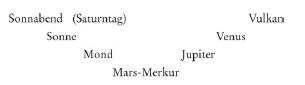
[ 45 ] The occultists thus depict this development by arranging the seven planets in a row, the individual members of which share a kinship expressed in the successive stages of human development. Just as this arrangement represents what can also exist side by side, so too does the esoteric researcher perceive this side-by-side relationship in what each individual can also experience—namely, this development through forms preserved in the planets neighboring Earth. Esoteric science expresses this through mnemonic symbols. These are the names of the days of the week. “Cheap philosophy”—many will object. The seven days of the week represent the planets of Earth’s own evolution. We must begin with Saturday. The Mars evolution [takes place] on Earth. The evolution in which humanity intervenes and which will persist until the end of evolution is called the Mercury evolution by esoteric research. Thus, the correspondences are:
Saturday is ruled by Saturn,
Sunday is ruled by the Sun
Monday is ruled by the Moon
Tuesday is ruled by Mars
Wednesday is ruled by Mercury
Thursday is ruled by Jupiter
Friday is ruled by Venus
[ 46 ] Thus, in the names of the days of the week, in a wide variety of languages, you will find a symbol for planetary development everywhere.
[ 47 ] I was able to follow this development only for a short while—namely, from Earth back to the Moon. Thus you can see that—and how—theosophical research brings meaning and significance to this development. Those who have a sense not only for our research but also for the deeper forces—the forces at work in evolution—have always understood that the Earth has emerged from a process of evolution and is moving toward a further stage of evolution; that it is the planet that represents the stage of love in evolution and develops wisdom through love into a higher form. The next thing that surrounds us, then, are the currents of the Earth’s evolution, which manifest as a tendency toward love.
[ 48 ] One of the great minds expressed this in a poem when he sought to depict the meaning of Earth’s evolution, when he looked up toward the next goal of Earth’s evolution, when he looked up toward that which human beings cannot see beyond. It appeared to him then as a vision of the divine Spirit, as a circle within which the infinity of the divine Spirit can express itself. To this outstanding spirit, it seems utterly inconceivable that human evolution—the entire meaning of planetary evolution—could find expression in the small spirit of the Earth. Yet the spirit of the Earth reveals to him what its essence is, what has come to be from earlier forces, and what will be transformed into later forces. And when I speak from the human point of view, the meaning of planetary evolution appears to us as the evolution toward love. Dante, the great thinker and poet, also expresses this in the words:
The circle that thus appeared within you
like light reflected back,
as I gazed at it for a time from all sides,
seemed to me, in itself, in its own color
to be painted with our image,
which is why my gaze became completely absorbed in it.
Just as the geometer is wholly absorbed
in measuring the compass, and, pondering
cannot find the principle he needs:
so it was with me at that new sight.
I wanted to see how the image
related to the circle, and how it fit within it;
but my own wings were not enough for this,
until my spirit was struck by a flash of lightning,
which brought it what it longed for.
Here the power of the lofty imagination faltered,
yet already my desire and will were stirred,
just as a wheel driven by a steady rotation,
by the love that moves the sun and the stars.