

Awareness - Life - Form
GA 89
5 November 1904
Translated by Steiner Online Library
Planetary Development X
[ 1 ] A being undergoes seven times seven times seven metamorphoses to journey from the beginning to the end of evolution:
7 States of Consciousness
7 Realms or States of Existence
7 States of Form
[ 2 ] The seven states of consciousness that a being goes through are:
Deep trance
Dreamless sleep
The dream state
The waking state
The mental state
The supermental state
The spiritual state.
[ 3 ] The seven realms or states of existence are:
The First Elemental Kingdom
The Second Elemental Kingdom
The Third Elemental Kingdom
The Mineral Kingdom
The Plant Kingdom
The Animal Kingdom
The Human Kingdom.
[ 4 ] The seven states of form, or metamorphoses of form, are:
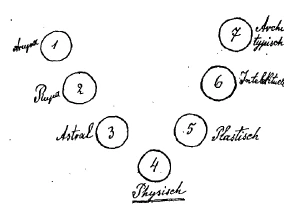
[ 5 ] These seven globes, or states of form, are in truth not seven different globes, but only one sphere; this sphere passes through seven successive states. One state must always be transformed into the next. For this to occur, an entity is necessary that represents a certain amount of power and transforms the sphere from one state into the next. Such an entity is called Prajapati. Such exalted spiritual entities, who possess such immense power, acquired this power in previous evolutions. They have undergone a long period of training. As a result, they have become energies capable of transforming one sphere into another in the new universe.
[ 6 ] These seven states of form are experienced in all seven realms of existence and in all seven states of consciousness. We now understand that these entities (Prajapatis) can accomplish in the other cycles what they accomplish in one cycle—for example, on Earth, on the Moon, and so on—so that like states can always be brought about by like entities.
[ 7 ] This is how it happens in all cycles, on all seven planets. The Prajapatis of form exist once and for all; here they are the lowest Prajapatis, who are responsible for bringing about the final transformation and who spring into action whenever a transition is necessary.
[ 8 ] The Arupa state and the archetypal state differ significantly from the other five states. In reality, the form state actually begins on the Rupa plane. On the Arupa plane, there is no form yet, only the potential for it, and on the archetypal plane, form gives itself its own form; there, it is pure life. Therefore, the first and seventh states of form are actually states of life, in which the seventh is always the status nascendi (emergence) of the subsequent first, or in which the seventh (the archetypal) has become what was in the status nascendi in the first.
[ 9 ] The archetypal state of form is one in which form has become life, and the arupic state is one in which form is still life. Strictly speaking, therefore, we have only five Prajapatis of form, because two of the seven already belong to the higher Prajapatis of consciousness. One might perhaps say that stages of life and states of form are merely condensed states of consciousness, or the passive side of active consciousness, or even the actual negative side of the worldview, while consciousness is the positive side. Thus, the first and last of the Prajapatis of the states of form already belong to the higher hierarchy of the Prajapatis of consciousness.
[ 10 ] Every being also passes through the realms of life. This brings us to the Prajapatis of the cycles, each of whom governs a realm of life. There are seven states of life, which are transformed into one another by seven entities. Each time we complete the seventh round, we encounter a state that corresponds to that of the first round, but on a higher level. Humanity entered the earthly evolution with the awakening of bright daytime consciousness; now it is developing this further, and by the end of the seventh round, humanity will have achieved in its development what it possessed in potential in the first round, at the very beginning.
[ 11 ] These seven rounds are the seven days of creation in Genesis. We are now in the fourth day of creation. In the second chapter of Genesis, we find a specific description of the fourth round: the creation of humankind, which took place at the midpoint of the Lemurian era. It is not until the seventh day that humankind has attained its true likeness to God with regard to its physical, astral, mental, and arupa bodies. What was substance at the end of the lunar evolution becomes potential at the beginning of the terrestrial evolution.
[ 12 ] Strictly speaking, only six cycles can be called the cycles of life, since the seventh cycle is a cycle of the next higher state of consciousness. Therefore, there are actually only six states of life and, consequently, only six Prajapatis of life. We count one Prajapati of Life among the seven Prajapatis of Consciousness, and two Prajapatis of Form are added to these as well. Thus, we actually have ten Prajapatis of Consciousness, one of which is the Prajapati that bridges the six Prajapatis of Life, and two Prajapatis that bridge the Prajapatis of Form. This results in:
10 Prajapatis of Consciousness
6 Prajapatis of Life
5 Prajapatis of Form
[ 13 ] or ten + six + five = a total of 21 Prajapatis.
[ 14 ] This is referred to in stanza 4 of the Book of Dzyan in H. P. Blavatsky’s *The Secret Doctrine*: “The One from the Egg, the Six, the Five.” The number Ten is mentioned: the One from the Egg = 0. From the Egg (0), the 10 Prajapatis of Consciousness, first came the first Prajapati of Life, followed by six other Prajapatis of Life and five Prajapatis of Form = 1065, whose sum of digits is 21 (the value of Jehovah).
[ 15 ] On the chakras of the astral body: Just as the human physical body has senses, so too does the human astral body have senses. They are arranged in a line. One of these senses is located above the larynx. These senses are called chakras, or sacred wheels. In the average person, they are immobile, but in the seer they are mobile and rotate. The chakra above the larynx is essentially a leaf-shaped formation. All astral chakras are called lotus blossoms. The chakra located above the larynx is called the sixteen-petaled lotus blossom. This wheel has formed gradually over the course of human evolution. It was not until the Lemurian race, in the middle of the Lemurian era, that the capacity for imagination and thought began to develop little by little, and it was not until the last Lemurian race that it had developed to a reasonable degree. At that time, the first of the lotus petals blossomed, and each subsequent race, under normal development, added another petal, namely:
[ 16 ] seven leaves in the seven subraces of the fourth root race, the Atlantean,
[ 17 ] seven leaves in the seven sub-races of the fifth root race, the Aryan race (five so far, since we are in the fifth sub-race),
[ 18 ] a leaf in the first subrace of the sixth root race.
[ 19 ] Then all 16 leaves of the imagination light up. By the third subrace of the fourth root race, memory has also developed. The flow of memory also gradually passes into the wheels through five subraces of the fourth Atlantean root race, seven subraces of the fifth root race, and four subraces of the sixth root race.
[ 20 ] The average person has thus now developed thirteen layers of the power of imagination, and memory has reached the tenth layer. When memory—which began at the fourth petal of the imagination—meets the current of the imagination, the chakra begins to rotate; this occurs in the normally developed human being of the fourth subrace of the sixth root race. The wheel then spins like a whirlwind. With each successive race, the light passes to another spoke of the wheel, or rather to another petal of the lotus blossoms.
[ 21 ] With the first subrace of the sixth root race, the wheel is fully formed. The average human still lacks three spokes, which are currently still dark space. The wheel has not just one hub, but two.
[ 22 ] The second current intersects the first: in the third subrace of the Atlanteans, memory is added to the power of imagination. Memory extends through the fourth subrace of the sixth root race. Then it is lost, because it will have become superfluous.
[ 23 ] When memory emerged in the fourth subrace, the enlightenment of the imagination had progressed as far as the fourth spoke; three subraces had no memory. The final part of the stream of memory meets the other stream. In the fourth subrace of the sixth root race, the wheel begins to turn. Once this wheel is set in motion, human beings will convey their words to the astral world. What human beings then speak will have an immediate effect on their fellow human beings. For example, fellow human beings will feel the goodwill expressed through the word; they will feel every word.
[ 24 ] The human Manu of the sixth root race—who will lead this race, and who is the first human Manu—can only speak to humans once humanity is ready to speak with the Master; and this will only be possible once this chakra is fully developed, when the human word flows directly into the stream of the wheels. The average human achieves this in the fourth subrace of the sixth root race. Falling behind would mean that not all 16 spokes are developed. Then the human being would not be able to speak before the Master, so that at this stage of evolution he could not be guided by the Master. It is particularly important to develop this chakra, and this depends on whether the human being can break the habit of wounding himself through his voice.
[ 25 ] Human beings have 16 opportunities—through 16 subraces—to develop this chakra. If they do not, they will follow the 16 paths of ruin through the Word.
[ 26 ] In the next metamorphoses, the [last petals of the sixteen-petaled lotus flower] continue to develop—first as three-dimensional forms, then as thought-matter, and finally as archetypes. Then, in the next cycle, the sixteen-petaled lotus flower will truly be a vegetative leaf on the physical plane. Its spokes will then be actual leaves, and the mineral aspect will have completely disappeared. In the seventh root race, the chakra known as the two-petaled lotus flower, located between the eyebrows, will be developed.
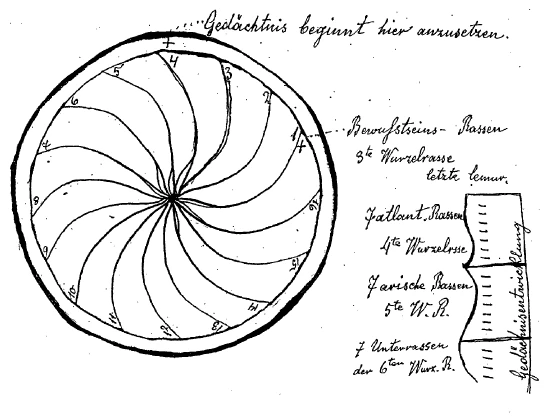
[ 27 ] The two pages of Rudolf Steiner’s notes (reduced in size) on the following pages are evidently related to this lecture.
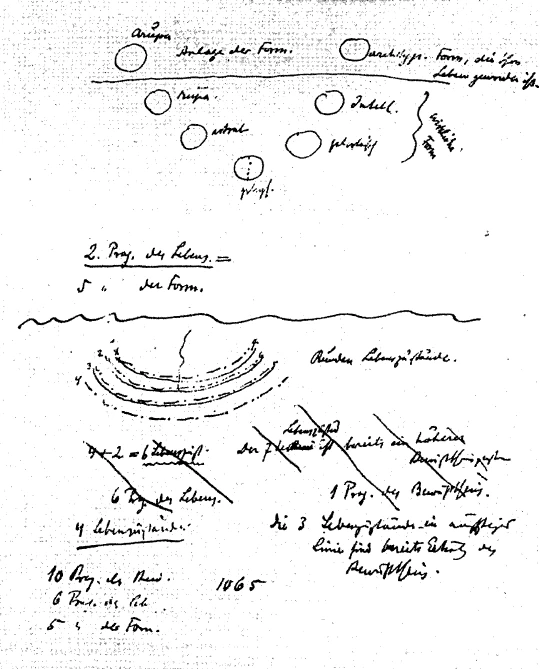
[ 28 ] Arupa / the foundation of form / archetypal / form that has already / become life Rupa / intellectual / real / astral form / plastic / physical _
[ 29 ] 2. Prajapati of Life / 5. Prajapati of Form / Cycles of Life States
[ 30 ] 4 States of Life / The 3 states of life in ascending / order already represent an elevation of / consciousness
[ 31 ] 10 Praj. of Consciousness / 6 Praj. of Life / 5 Praj. of Form / 1065
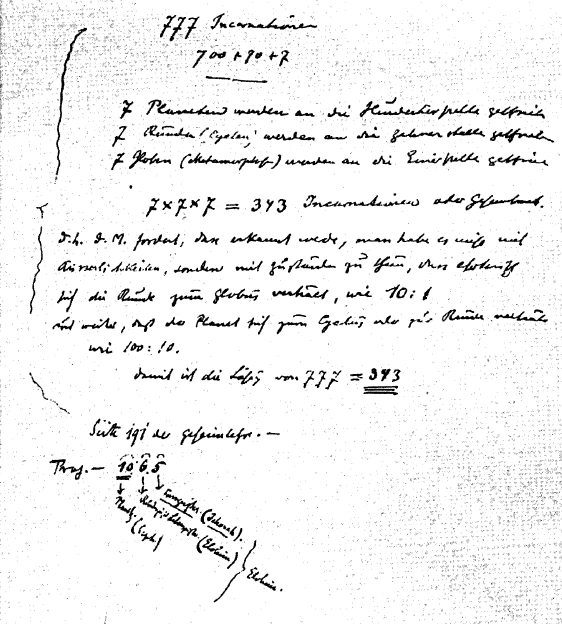
[ 32 ] 777 incarnations / 700 + 70 + 7
[ 33 ] 7 planets are written in the hundreds place
[ 33 ] 7 planets are written in the hundreds place
[ 35 ] 7 globes (metamorphoses) are written in the ones place
[ 36 ] 7 × 7 × 7 = 343 incarnations or total metamorphoses
[ 37 ] That is to say, the Master insists that one recognize that one is dealing not with / external appearances, but with states of being; that, esoterically, / the circle relates to the globe as 10: 1 / and furthermore, that the planet relates to the cycle or circle / as 100: 10 / thus the solution is 777 = 343
[ 38 ] Page 191 of The Secret Doctrine — / Praj. — 10 6 5 / Form Spirits (Jehovah) / Rounds: Life Spirits (Elohim) / Plan. (Seph.)