

Growth From The Inside Out
Sometimes if feels like something is wrong when the old falls away. People fall out of our lives, skin sloughs off, we experience a dying away as we work on ourselves. Transformation is a messy business. But if we contemplate the plant world, we find that growing, blooming and dying away is the natural order of things. As we grow from within, the old exterior falls away. Like a ring torus, the cycle continues to flow. Rudolf Steiner had the following discussion with teachers at the end of August of 1919 as the summer foliage was beginning to fade and autumn approached. He recalled the twenty-first verse of the anthroposophical calendar in that discussion.
I feel a strange power bearing fruit,
Gaining strength, bestowing me on myself,
I sense the seed ripening
And presentiment weaving, full of Light,
Within me on my selfhood’s power.
"RUDOLF STEINER: Now we arrive at the difficult task before us today. Yesterday I asked you to consider how you would prepare the lessons in order to teach the children about the lower and higher plants, making use of some sort of illustration or example. I have shown you how this can be done in the case of animals—with a cuttlefish, a mouse, a horse, and a person—and your botany lessons must be prepared in the same spirit. But let me first say that the correct procedure is to study the animal world before coming to terms with the natural conditions of the plants. In the efforts necessary to characterize the form of your botany lessons—finding whatever examples you can from one plant or another—you will become clear why the animal period must come first.
Perhaps it would be a good idea if we first ask who has already given botany lessons. That person could speak first and the others can follow.
Comment: The plant has something like an instinctive longing for the Sun. The blossoms turn toward the Sun even before it has risen. Point out the difference between the life of desire in animals and people, and the pure effort of the plant to turn toward the Sun. Then give the children a clear idea of how the plant exists between Sun and Earth. At every opportunity mention the relation of the plant to its surroundings, especially the contrast between plants and human beings, and plants and animals. Talk about the outbreathing and in-breathing of the plant. Allow the children to experience how “bad” air is the very thing used by the plant, through the power of the Sun, to build up again what later serves as food for people. When speaking of human dependence on food you can point to the importance of a good harvest, and so on. With regard to the process of growth it should be made clear that each plant, even the leaf, grows only at the base and not at the tip. The actual process of growth is always concealed.
RUDOLF STEINER: What does it actually mean that a leaf only grows at the base? This is also true of our fingernails, and if you take other parts of the human being, the skin, the surfaces of the hands, and the deeper layers, the same thing applies. What actually constitutes growth?
Comment: Growth occurs when dead matter is “pushed out” of what is living.
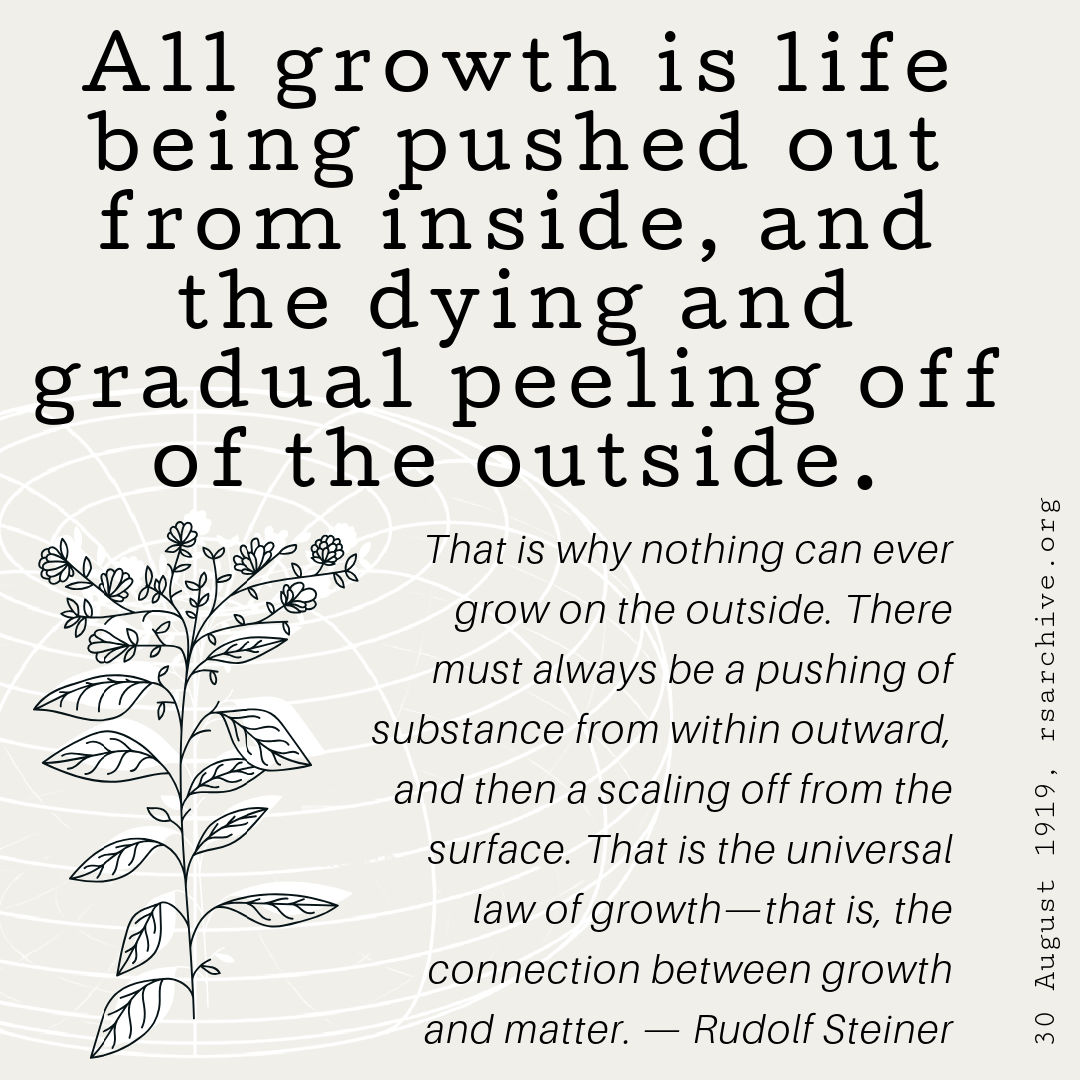
RUDOLF STEINER: Yes, that’s right. All growth is life being pushed out from inside, and the dying and gradual peeling off of the outside. That is why nothing can ever grow on the outside. There must always be a pushing of substance from within outward, and then a scaling off from the surface. That is the universal law of growth—that is, the connection between growth and matter.
Comment: Actually the leaf dies when it exposes itself to the Sun; it sacrifices itself, as it were, and what happens in the leaf also happens at a higher level in the flower. It dies when it is fertilized. Its only life is what remains hidden within, continuing to develop."
Read more: Rudolf Steiner, Discussions with Teachers, Discussion Nine, GA 295, 30 August 1919, Stuttgart.