Self-Knowledge and God-Knowledge I
Theosophy, Christology and Mythology
GA 90a
13 August 1904, Berlin
Translated by Steiner Online Library
52. Ancient Wisdom
[ 1 ] Today’s topic is what was actually the nature of what is called “Ancient Wisdom” and how it came to Earth.
[ 2 ] There are two kinds of knowledge and insight. Let’s imagine the inventor of a clock—he makes one, two, three clocks based on the plan he originally had. So first came the idea, then came the actual reality. This is one kind of knowledge about a thing.
[ 3 ] To understand the other approach, let’s imagine that the watchmaker has died; the watches are still there, and someone else studies them, figures out the design, and makes other watches. He has the same knowledge, but acquired it in a different way; for him, the sensory watch came first, then the idea; for the other, the idea came first.
[ 4 ] These two ways of acquiring knowledge also exist in the vast universe. A thought that corresponds to the laws of reality and exists prior to the object of the senses is called an “intuitive thought.” It is born of the mind itself, a child of the mental world. The other is a child of the sensory world; it is called an “inductive thought.”
[ 5 ] Now let’s see what the difference would be between the former and the students. The inventor will be able to share his thoughts because he is a creator, a maker—because he was there when the sensory world emerged from the mental realm. The one who imitated it will also /gap in the transcript]
[ 6 ] The same distinction exists between the first teachers of humanity and all those who came later. For the first teachers of humanity participated in creation; they were among its creators, and they played a part when the world was still a cosmic thought. They [gap in the transcript]
[ 7 ] The first Arhats or Mahas were involved in the creation of the world. In the middle of the third root race, when the human kingdom came into being, A [gap in the transcript] also incarnated. They brought knowledge from the workshop with them, and that is “ancient wisdom”; they brought with them what they had experienced firsthand.
[ 8 ] The insight one gains afterward is the same as that which the original great minds derived from the very laws of creation. [Gap in the transcript] If one truly knows something, then one also possesses those laws by which the world was created. Manas and Mahat are therefore the same in terms of content. Only Manas is within us: the “I.” And Mahat is spread out like a tableau over the entire world. Only the manner of being is different; the content is the same. The more our knowledge increases, the more /gap in the transcript]
[ 9 ] What was learned at that time from the creative activity of the artists was the first wisdom, and it is therefore more than what all science can attain. This occult statement, that the world has its origin in cosmic thoughts and that knowledge culminates in human thought formation /gap in the transcript]
[ 10 ] The Self enters into the formation of the world; outside the Self lies Mahat. The Self, the Creator, encompasses Mahat. The process consists of the Self expanding its sphere to encompass the entire Mahat, and in the end, Mahat itself is within the Self. What is the difference? At the beginning, Mahat is outside the Self; at the end, Mahat is within the Self.
[ 11 ] The beginning and the end thus differ only in that the “I” sacrificed itself as a unique being and, as the reward for this sacrifice, acquired Mahat as its essence.
[ 12 ] The process of world formation consists in the fact that the “I,” which was previously excluded from Mahat, subsequently has Mahat as its content. It is not Mahat, but the “I” that has undergone a development. Significant sentence: The world is enclosed in cosmic thought formation [gap in the transcript], the “I” outside.
[ 13 ] This is only partly true, because in reality the “I” is a part of Mahat. For us, every thought is a part of Mahat; let us try to symbolize one as its content. Let us take the sentence: “Evolution consists in every part of Mahat growing to the point where it becomes identical with the whole of Mahat.” What takes place is the assimilation of all individual parts into the whole Mahat. The great sacrifice takes place. The whole Mahat imparts its essence to all its parts; that is development. The purpose of the world is for the Whole to impart its essence to each of its parts. It is certain that the Whole was perfect in the beginning; but if it had no parts, it would remain as it is. Since it has them, it has imparted its entire essence to each of the parts, so that its own perfection is ultimately contained in each of its parts.
[ 14 ] Beginning: Mahat is distinct from the “I”
[ 15 ] Conclusion: Mahat is in the “I”
[ 16 ] The beginning and the end thus differ only in that the “I” sacrificed itself as a unique being and, as the reward for this sacrifice, received Mahat as its essence.
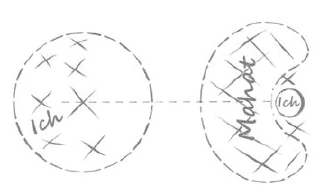
[ 17 ] [ 18 ] Evolution consists in each part of Mahat growing to the point where it becomes identical with the whole of Mahat. The “great sacrifice” takes place: the whole of Mahat imparts its essence to all its parts. This is development.