

Notes from Mathilde Scholl 1904–1906
GA 91
19 October 1904, Berlin
Translate the original German text into any language:
Versions Available:
Notes from Mathilde Scholl 1904–1906, tr. SOL
1. Unterschied Zwischen Rechnung [und] Operation
1. The Difference Between Calculation [and] Operation
[ 1 ] Wenn wir die Beziehungen zwischen Größen auffassen, haben wir allgemeine Arithmetik. [Die] besondere Arithmetik beschäftigt sich mit bestimmten Mengen von Einheiten. Algebra ist nach «Algeber» (arabischem Mathematiker) benannt.
[ 1 ] If we conceive of the relationships between quantities, we have general arithmetic. Special arithmetic deals with specific quantities of units. Algebra is named after “Algeber” (an Arabic mathematician).
[ 2 ] Erste Beziehung zwischen den Zahlen: Addition. Eine Zahl wird um die andere vermehrt: \(a + b\) und so weiter. Dies wird auf eine Reihe ausgedehnt:
[ 2 ] First relation between numbers: addition. One number is added to another: \(a + b\) and so on. This is extended to a series:
\(a + b + c + d + e + f\) und so weiter.
\(a + b + c + d + e + f\) and so on.
[ 3 ] Zweite Beziehung:
[ 3 ] Second relation:
[ 4 ] Subtraktion; man nimmt von einer Zahl eine andere weg: \(a - b\). Dies erweitert: \(a - b - c - d - e\) und so weiter.
[ 4 ] subtraction; you take one number away from another: \(a - b\). This expands: \(a - b - c - d - e\) and so on.
[ 5 ] Eine Voraussetzung hierbei ist notwendig, nämlich dass \(a\) größer ist als \(b\).
[ 5 ] One prerequisite is necessary here, namely that \(a\) is greater than \(b\).
\(a \gt b\) (dann ist \(a\) größer als \(b\))
\(a = b\) (dann ist \(a\) gleich b)
\(a \lt b\) (dann ist \(a\) kleiner als \(b\))
\(c =\) das Resultat: \(a - b = c\).
\(a \gt b\) (then \(a\) is greater than \(b\))
\(a = b\) (then \(a\) is equal to \(b\))
\(a \lt b\) (then \(a\) is less than \(b\))
\(c =\) the result: \(a - b = c\).
[ 6 ] Wenn \(a\) größer ist als \(b\), dann ist die Frage, wie viel bleibt übrig, wenn ich \(b\) von \(a\) wegnehme? \(c\) bleibt übrig. \(c\) ist die Zahl, um welche a größer ist als \(b\). Wenn \(a\) gleich \(b\) ist, dann ist \(c = 0\). Wenn \(a\) kleiner ist als \(b\), dann bleibt auch ein \(c\), zum Beispiel: \(3 - 5 = ?\) Hierbei fragt man, wie viele Einheiten fehlen dem \(a\), wenn \(a\) nicht so groß ist wie \(b\).
[ 6 ] If \(a\) is greater than \(b\), then the question is how much remains if I take away \(b\) from \(a\)? \(c\) remains. \(c\) is the number by which \(a\) is greater than \(b\). If \(a\) is equal to \(b\), then \(c = 0\). If \(a\) is smaller than \(b\), then there is also a \(c\), for example: \(3 - 5 =?\) Here you ask how many units are missing from \(a\) if \(a\) is not as large as \(b\).
| \(3 - 5 = -2\) | \(a - b = -c\) das negative Verhältnis |
|
| \(5 - 3 =\) positiv | \(5 - 3 = +2\) | \(a - b = +c\) |
| \(3 - 5 =\) negativ | \(3 - 5 = -2\) | \(a - b = -c\) |
| \(3 - 5 = -2\) | \(a - b = -c\) the negative ratio |
|
| \(5 - 3 =\) positive | \(5 - 3 = +2\) | \(a - b = +c\) |
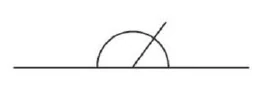
| \(3 - 5 =\) negative | \(3 - 5 = -2\) | \(a - b = -c\) |
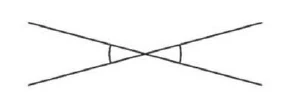
[ 7 ] [Das bedeutet: Für] eine Zahl, die minus ist, heißt [das]: Es lag eine Subtraktion vor; bei dieser Subtraktion war der Minuend zu klein. — Eine negative Zahl kann man nur als Ergebnis einer Rechnungsoperation verstehen.
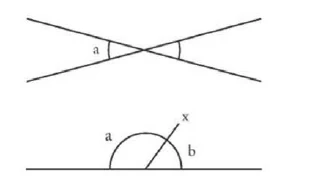
[ 7 ] [This means: For] a number that is minus, it means: There was a subtraction; in this subtraction, the minuend was too small. — A negative number can only be understood as the result of an arithmetic operation.
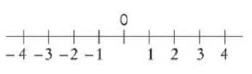
[ 8 ] Die Addition kann so sein, dass einige Zahlen einander gleich sind oder alle sich gleich sind.
[ 8 ] The addition can be such that some numbers are equal to each other or all are equal to each other.
\(a + b + a + c\) und so weiter, oder
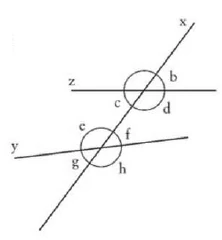
\(a + a + a + a + a + a\) und so weiter
\(a + b + a + c\) and so on, or
\(a + a + a + a + a + a\) and so on
[ 9 ] Wenn bei der Addition alle Zahlen einander gleich sind, haben wir Multiplikation. Die Zahl, die sagt, wie oft die gleiche Zahl steht, heißt Multiplikator.
[ 9 ] If all numbers are equal in the addition, we have multiplication. The number that tells you how many times the same number is in the sum is called the multiplier.
\(a \times b\) heißt: \(a\) ist \(b\) mal zu addieren.
oder \(a \cdot b\): \(a\) ist mit \(b\) zu multiplizieren.
\(a \cdot b \cdot c \cdot d\) (heißt: \(a\) wird mit \(b\), \(c\), \(d\) und so weiter nacheinander multipliziert.)
\(a \times b\) means: \(a\) is to be added to \(b\) the same number of times.
or \(a \cdot b\): \(a\) is multiplied by \(b).
\(a \cdot b \cdot c \cdot d\) (means: \(a\) is multiplied by \(b\), \(c\), \(d\) and so on one after the other).
[ 10 ] Bei der Subtraktion kann es sein, dass man verschiedene Zahlen abzieht:
\(a - b - c - d - e - f\) und so weiter, oder gleiche, zum Beispiel \(a - b - b - b - b - b\) und so weiter.
[ 10 ] When subtracting, you may subtract different numbers:
\(a - b - c - d - e - f\) and so on, or the same ones, for example \(a - b - b - b - b - b\) and so on.
[ 11 ] Die Frage ist: Wie oft kann ich b von a abziehen?
\(a : b\) ist Division (oder eine versteckte Subtraktion)
[ 11 ] The question is: how many times can I subtract b from a?
\(a : b\) is division (or a hidden subtraction).
[ 12 ] Der Divisor ist eigentlich ein Minuend. Der Dividend ist eigentlich ein Subtrahend.
[ 12 ] The divisor is actually a minuend. The dividend is actually a subtrahend.
[ 13 ] Es ist ein spezieller Fall der Subtraktion.
[ 13 ] It is a special case of subtraction.
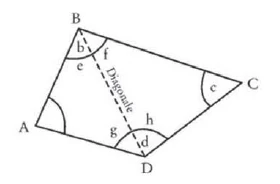
[ 14 ] \(a \cdot b \cdot c \cdot d \cdot e \cdot f\)
\(a \cdot a \cdot\) undso weiter, m mal (heißt: dieselbe Zahl immer wieder mit sich selbst multipliziert), wird bezeichnet durch \(a^m\) (\(a m\) mal)
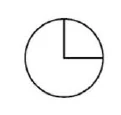
\(a \cdot a \cdot a \cdot a \cdot a \cdot a\) und so weiter, \(m\) mal (heißt: dieselbe Zahl immer wieder mit sich selbst multipliziert), wird bezeichnet durch \(a^m\) ( \(a m\) mal)
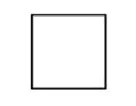
[ 14 ] \(a \cdot b \cdot c \cdot d \cdot e \cdot f\)
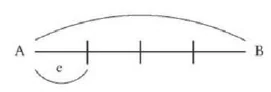
\(a \cdot a \cdot\) and so on, m times (meaning: the same number multiplied over and over again by itself), is denoted by \(a^m\) (\(a m\) times)
\(a \cdot a \cdot a \cdot a \cdot a \cdot a\) and so on, multiplied by \(m\) (meaning: the same number multiplied over and over again by itself) is designated by \(a^m\) ( \(a m\) times)
[ 15 ] \(a^m = P\) (\(a m\) mal genommen gibt \(P\) = Potenzierung.)
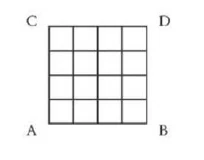
\(a\) zur mten [Potenz] \(=\) P
[ 15 ] \(a^m = P\) (\(a m\) times taken gives \(P\) = exponentiation).
\(a\) to the mth [power] \(=\) P
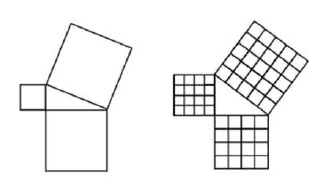
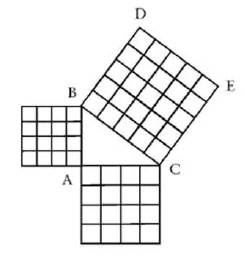
[ 16 ] \(a =\) Wurzel, Grundzahl oder Basis.
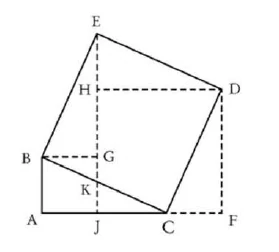
\(m =\) der Exponent.
\(P =\) die Potenz.
[ 16 ] \(a =\) the root, the base or the factor.
\(m =\) the exponent.
\(P =\) the power.
[ 17 ] Die fünfte Rechnungsoperation ist Potenzieren.
[ 17 ] The fifth arithmetic operation is exponentiation.
[ 18 ] Wenn P bekannt ist und m bekannt ist und a gesucht wird:
\(\sqrt[m]{P} = x\) Radizieren oder Wurzel ziehen.
[ 18 ] If P and m are known and a is sought:
\(\sqrt[m]{P} = x\) Square root.
[ 19 ] abgekürztes Dividieren:
\(P\) = Radikant
\(m =\) Wurzelexponent
\(x(a) =\) Radix
[ 19 ] abbreviated division:
\(P\) = radicand
\(m =\) root exponent
\(x(a) =\) radix.
[ 20 ] Wenn \(m\) unbekannt ist, schreibt man \(a^x = P\).
Zu welcher Zahlpotenz muss man a erheben, um \(P\) zu bekommen?
\(x = log_a P\) (eingerückter Exponent ist Logarithmus)
\(2 = log_3 9\) (\(2\) ist gleich log von \(9\) in Bezug auf die Wurzel \(3\))
[ 20 ] If \(m\) is unknown, write \(a^x = P\).
To what power of a do you have to raise a to get \(P\)?
\(x = log_a P\) (the exponent in the parenthesis is the logarithm)
\(2 = log_3 9\) (\(2\) is equal to the log of \(9\) with respect to the root \(3\))
[ 21 ] Logarithmieren ist die siebte Rechnungsoperation.
[ 21 ] Taking logarithms is the seventh arithmetic operation.
[ 22 ] \(a \cdot b\)
\(+a \cdot +b\)
\(+a \cdot +a \cdot +a \cdot +a + b - mal\)
\(+a \cdot +b = +ab\)
\(-a \cdot +b = -ab\)
\(+a \cdot -b = -ab\)
\(-a \cdot -b = +ab\)
[ 22 ] \(a \cdot b\)
\(+a \cdot +b\)
\(+a \cdot +a \cdot +a \cdot +a + b - times\)
\(+a \cdot +b = +ab\)
\(-a \cdot +b = -ab\)
\(+a \cdot -b = -ab\)
\(-a \cdot -b = +ab\)
[ 23 ] Gleichwertige Zahlen miteinander multipliziert geben ein positives Resultat; ungleichwertige geben ein negatives Resultat.
[ 23 ] Multiplying equivalent numbers by each other yields a positive result; non-equivalent numbers yield a negative result.
[ 24 ] \(+a \cdot -b = -c\)
\(+a \cdot +b = +c\)
\(-a \cdot +b = -c\)
\(-a \cdot -b = +c\)
[ 24 ] \(+a \cdot -b = -c\)
\(+a \cdot +b = +c\)
\(-a \cdot +b = -c\)
\(-a \cdot -b = +c\)
[ 25 ] Gleichartige Zahlen durch einander dividiert geben ein positives, ungleichartige durch einander dividiert geben ein negatives Resultat.
[ 25 ] Similar numbers divided by each other give a positive result, unlike numbers divided by each other give a negative result.
[ 26 ] \(a^b = c\) where \(+a\) und \(+c\)
[ 26 ] \(a^b = c\) where \(+a\) and \(+c\)
[ 27 ] oder \(-a\) und \(+c\)
[ 27 ] or \(-a\) and \(+c\)
[ 28 ] \(\sqrt[b]{c} = a\)
[ 29 ] \((+a)^+b = +c\)
[ 30 ] \((-a)^+b = +c\)
[ 28 ] \(\sqrt[b]{c} = a\)
[ 29 ] \((+a)^+b = +c\)
[ 30 ] \((-a)^+b = +c\)
[ 31 ] \(c\) negative \(= -c\)
\(a^x = -c\)
\(\sqrt[x] - c = a\)
[ 31 ] \(c\) negative \(= -c\)
\(a^x = -c\)
\(\sqrt[x] - c = a\)
[ 32 ] Um eine negative Potenz zu bezeichnen, müssen imaginäre Zahlen gefunden werden, die weder positiv noch negativ sind.
[ 32 ] To denote a negative power, imaginary numbers must be found that are neither positive nor negative.
[ 33 ] Ein Dreieck ist eine von drei geraden Linien begrenzte Figur. Man hat zu unterscheiden die Dreiecke nach Größe ihrer Seite und ihrer Winkel. Wir unterscheiden zunächst ein Dreieck, bei dem alle drei Seiten gleich sind, nennen es gleichseitiges Dreieck, das auch alle drei Winkel gleich hat. Ein Dreieck, bei dem nur zwei Seiten gleich sind und die dritte ungleich, heißt gleichschenkliges Dreieck. Es hat zwei Winkel gleich, die der ungleichen Seite anliegen. Dann eins, das ungleichseitig ist; dabei sind alle Seiten und Winkel ungleich. Größenverhältnisse der Winkel eines Dreieckes.
[ 33 ] A triangle is a figure bounded by three straight lines. We distinguish triangles according to the size of their sides and their angles. First, we distinguish a triangle in which all three sides are equal, calling it an equilateral triangle, which also has all three angles equal. A triangle in which only two sides are equal and the third unequal is called an isosceles triangle. It has two equal angles, which are adjacent to the unequal side. Then one, which is unequal; all sides and angles are unequal. Size ratios of the angles of a triangle.
[ 34 ] 2. Nebenwinkel
[ 34 ] 2. Secondary angle
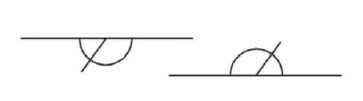
[ 35 ] Messen des Winkels: Die Winkel werden gemessen nach der verhältnismäßigen Größe des Kreisbogens. Man misst einen Winkel, indem man um den Winkel einen Kreis zieht.
[ 35 ] Measuring the angle: The angles are measured according to the relative size of the arc. You measure an angle by drawing a circle around it.
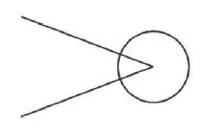
[ 36 ] Man teilt den Kreis zuerst in vier Teile, dann nochmal in zwei Teile, dann jeden derselben in fünf und davon jeden in \(9\) Teile = \(4 \times 2 \times 5 \times 9 = 360°\) (Grad). So viel der Winkel von den \(360°\) hat, so groß ist er.
[ 36 ] First divide the circle into four parts, then again into two parts, then each of these into five and each of these into \(9\) parts = \(4 \times 2 \times 5 \times 9 = 360°\) (degrees). The angle is as large as the angle is of the \(360°\).
[ 37 ] Zwei Nebenwinkel machen immer zusammen \(180°\).
[ 37 ] Two minor angles always add up to \(180°\).
[ 38 ] Zwei Scheitelwinkel.
[ 38 ] Two vertex angles.
[ 39 ] Man benennt den Winkel, indem man einen Buchstaben hineinschreibt.
[ 39 ] You name the angle by writing a letter in it.
[ 40 ] \(\angle a\) heißt Winkel \(a\)
[ 40 ] \(\angle a\) is called angle \(a\)
[ 41 ] \(\angle a = \angle b\) als Scheitelwinkel
[ 41 ] \(\angle a = \angle b\) as vertex angles
[ 42 ] \(\angle a + \angle b = 180°\) als Nebenwinkel
[ 42 ] \(\angle a + \angle b = 180°\) as an angle between
[ 43 ] Vier Paar Gegenwinkel
[ 43 ] Four pairs of opposite angles
[ 44 ] \(x\) die schneidende Linie
\(y\), \(z\) die geschnittenen Linien
[ 44 ] \(x\) the intersecting line
\(y\), \(z\) the lines intersected
[ 45 ] Wenn zwei gerade Linien von einer dritten geschnitten werden, so entstehen vier Paar Gegenwinkel, nämlich solche, die auf derselben Seite der schneidenden und auf derselben Seite der geschnittenen Linie liegen.
[ 45 ] When two straight lines are intersected by a third, four pairs of opposite angles arise, namely those that lie on the same side of the intersecting line and on the same side of the intersected line.
[ 46 ] Wechselwinkel sind solche, die auf verschiedenen Seiten der schneidenden und auf verschiedenen Seiten der geschnittenen Linien liegen. Vier Paar Wechselwinkel.
[ 46 ] Alternate angles are those that lie on different sides of the intersecting line and on different sides of the line being cut. Four pairs of alternate angles.
[ 47 ] Anwinkel sind diejenigen, welche auf derselben Seite der schneidenden und auf verschiedenen Seiten der geschnittenen Linie liegen. Vier Paar Anwinkel.
[ 47 ] Angles are those that lie on the same side of the intersecting line and on different sides of the line being cut. Four pairs of angles.
[ 48 ] \(a\) und \(b\) sind Gegenwinkel
[ 48 ] \(a\) and \(b\) are opposite angles.
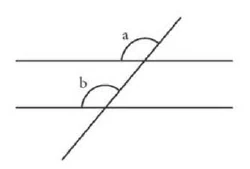
[ 49 ] Wenn zwei Parallele von einer dritten geschnitten werden, so sind die Gegenwinkel alle einander gleich.
[ 49 ] If two parallels are intersected by a third, then the opposite angles are all equal to each other.
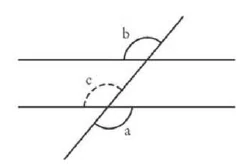
[ 50 ] \(b\) und \(a\) sind Wechselwinkel.
[ 50 ] \(b\) and \(a\) are alternate angles.
[ 51 ] Voraussetzung sei: \(b\) und \(a\) seien Wechselwinkel bei [zwei geschnittenen Parallelen].
[ 51 ] Assume that \(b\) and \(a\) are alternate angles at [two intersecting parallels].
[ 52 ] Wechselwinkel zwischen parallelen Geraden müssen immer einander gleich sein.
[ 52 ] Alternate angles between parallel lines must always be equal.
[ 53 ] \(b\) und \(a\) Wechselwinkel \(=\) Voraussetzung.
[ 53 ] \(b\) and \(a\) alternate angles \(=\) assumption.
[ 54 ] Beweis:
[ 54 ] Proof:
[ 55 ] \((\angle b = \angle c)\)
\(\angle b = \angle c\) als Gegenwinkel
\(\angle a = \angle c\) als Scheitelwinkelergo: \(\angle a = \angle b\)
[ 55 ] \((\angle b = \angle c)\)
\(\angle b = \angle c\) as opposite angle
\(\angle a = \angle c\) as vertex angleergo: \(\angle a = \angle b\)
[ 56 ] Wenn zwei Größen einer Dritten gleich sind, sind sie auch untereinander gleich.
[ 56 ] If two quantities of a third are equal, they are also equal to each other.
[ 57 ] Dies ist ein Axiom, worauf sich der Beweis stützt. Ein Axiom ist ein Satz, der eines Beweises weder fähig noch bedürftig ist.
[ 57 ] This is an axiom, on which the proof is based. An axiom is a proposition that is neither capable nor in need of proof.
[ 58 ]
[ 58 ]
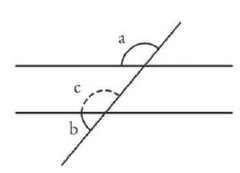
[ 59 ] \(a\) und \(b\) sind Anwinkel
[ 59 ] \(a\) and \(b\) are angles.
[ 60 ] Beweis:
[ 60 ] Proof:
[ 61 ] \(\angle a\) und \(\angle b\) sind Anwinkel (Voraussetzung)
\(\angle a = \angle c\) als Gegenwinkel
\(\angle b + \angle c = 180\)° als Nebenwinkel
ergo: \(\angle b + \angle c = 180°\)
Beweis, dass zwei Anwinkel immer \(180°\) sind.
[ 61 ] \(\angle a\) and \(\angle b\) are angles (assumption)
\(\angle a = \angle c\) as opposite angle
\(\angle b + \angle c = 180\)° as adjacent angle
ergo: \(\angle b + \angle c = 180°\)
Proof that two angles are always \(180°\).
[ 62 ] Axiom: In jeder Rechnungsoperation kann eine Größe durch eine ihr gleiche ersetzt werden, ohne dass in der Rechnungsoperation dadurch etwas geändert wird.
[ 62 ] Axiom: In every calculation, one quantity can be replaced by another equal to it without changing the calculation.
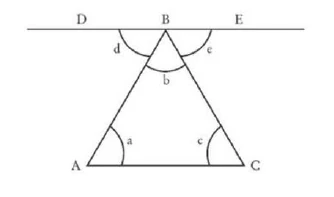
[ 63 ] \(ABC\) ein Dreieck (Voraussetzung)
\(DE || AC\)
\(\angle a = \angle d\) als Wechselwinkel
\(\angle c = \angle e\) als Wechselwinkel
\(\angle b = \angle b\)
[ 63 ] \(ABC\) a triangle (assumption)
\(DE || AC\)
\(\angle a = \angle d\) as alternate angles
\(\angle c = \angle e\) as alternate angles
\(\angle b = \angle b\)
[ 64 ] \(\angle d + \angle b + \angle e = 180°\)
ergo: \(\angle a + \angle b + \angle c = 180°\)
[ 64 ] \(\angle d + \angle b + \angle e = 180°\)
ergo: \(\angle a + \angle b + \angle c = 180°\)
[ 65 ] Die Summe der drei Winkel eines beliebigen Dreiecks ist [\(180°\)].
[ 65 ] The sum of the three angles of any triangle is [\(180°\)].
[ 66 ] \(A B C D\) Viereck. Voraussetzung
\(\angle e + \angle a + \angle g = 180°\)
\(\angle f + \angle h + \angle c = 180°\)
\(\angle c + \angle a + \angle g + \angle f + \angle h + \angle c = 360°\)
\(\angle a + \angle b + \angle d + \angle c = 360°\)
ergo: In jedem Viereck ist die Summe der \(4\) Winkel \(360°\)
[ 66 ] \(A B C D\) quadrilateral. Given
\(\angle e + \angle a + \angle g = 180°\)
\(\angle f + \angle h + \angle c = 180°\)
\(\angle c + \angle a + \angle g + \angle f + \angle h + \angle c = 360°\)
\(\angle a + \angle b + \angle d + \angle c = 360°\)
ergo: In every quadrilateral, the sum of the \(4\) angles is \(360°\)
[ 67 ] Linie: Raumgröße von einer Dimension - Länge
Fläche: Raumgröße von zwei Dimensionen — Länge + Breite
Körper: Raumgröße von drei Dimensionen - Länge + Breite + Dicke
?: Raumgröße von vier Dimensionen
[ 67 ] Line: spatial size of one dimension - length
Area: spatial size of two dimensions - length + width
Body: spatial size of three dimensions - length + width + thickness
?
Spatial size of four dimensions
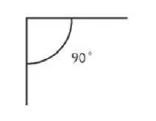
[ 68 ] Ein zweidimensionaler Raum abgegrenzt ist eine Fläche. Ein rechter Winkel hat zwischen den Schenkeln ¼ Kreisbogen.
[ 68 ] A two-dimensional space is bounded by a surface. A right angle has a quarter of a circular arc between its legs.
[ 69 ] Ein Quadrat ist eine Fläche, die begrenzt ist von vier gleichen Linien und die vier rechte Winkel hat.
[ 69 ] A square is a surface that is bounded by four equal lines and has four right angles.
[ 70 ] Linie mit vier Maßeinheiten, \(e\) eine Längeneinheit, \(ab = 4 \times e\) (\(4 \times\) die Einheit), \(A B = 4 \times e\)
[ 70 ] Line with four units of measurement, \(e\) one unit of length, \(ab = 4 \times e\) (\(4 \times\) the unit), \(A B = 4 \times e\)
[ 71 ] Man kann eine Länge messen, indem man ausmisst, wie oft die Einheit darauf enthalten ist.
[ 71 ] You can measure a length by counting how many times the unit is included.
[ 72 ] \(e\) (Größe \(e\)) zum Quadrat ergänzt ist Flächeneinheit. Flächeneinheit ist ein c, das über die Längeneinheit beschrieben ist.
[ 72 ] \(e\) (size \(e\)) squared is the unit area. The unit area is a c described in terms of the unit length.
[ 73 ] Flächeneinheit. Frage: Wievielmal größer als die Flächeneinheit ist das ganze Quadrat, wenn die Seite viermal größer ist als die Längeneinheit?
[ 73 ] Area unit. Question: How much larger than the area unit is the whole square when the side is four times larger than the length unit?
[ 74 ] \(A B C D = AB^2\)
[ 74 ] \(A B C D = AB^2\)
[ 75 ] Man findet die Fläche eines Quadrates, indem man eine Seite mit sich selbst multipliziert und zum Quadrat erhebt.
[ 75 ] The area of a square is found by multiplying one side by itself and raising it to the power of two.
\(1^2 = 1\)
\(2^2 = 4\)
\(3^2 = 9\)
\(4^2 = 16\)
\(5^2 = 25\)
\(6^2 = 36\)
\(7^2 = 49\)
\(8^2 = 67\)
\(9^2 = 81\)
\(10^2 = 100\)
\(1^2 = 1\)
\(2^2 = 4\)
\(3^2 = 9\)
\(4^2 = 16\)
\(5^2 = 25\)
\(6^2 = 36\)
\(7^2 = 49\)
\(8^2 = 67\)
\(9^2 = 81\)
\(10^2 = 100\)
[ 76 ] Die zwei Seiten eines rechten Winkels bilden die Katheten. Die gegenüberliegende Linie ist die Hypotenuse.
[ 76 ] The two sides of a right angle form the cathets. The opposite line is the hypotenuse.
[ 77 ] \(3^2 = 4^2 = 5^2\)
[ 77 ] \(3^2 = 4^2 = 5^2\)
\(BDEC = BC^2\)
\(HEFJ = \angle ABC + HJCE\)
\(CE =BC\)
\(HEFJ = \angle ABC + HJCE\)
\(CE =BC\)
\(ABC = BDG\)
\(JKC = BGK\)
\(BDEC = BGHECB + BGD + HCE\)
\(HEFJ = HJCE + CEF\)
\(HJGB = HBJK + BGK\)
\(HJCE + EEF + BGK + ABKJ =\)\(BGHECJKB + ABC + ABKJ\)
\(BGHEC + ABC + ABJK + JKC\)
\(BDEC = BC^2\)
\(HEFJ = \angle ABC + HJCE\)
\(CE =BC\)
\(HEFJ = \angle ABC + HJCE\)
\(CE =BC\)
\(ABC = BDG\)
\(JKC = BGK\)
\(BDEC = BGHECB + BGD + HCE\)
\(HEFJ = HJCE + CEF\)
\(HJGB = HBJK + BGK\)
\(HJCE + EEF + BGK + ABKJ =\)\(BGHECJKB + ABC + ABKJ\)
\(BGHEC + ABC + ABJK + JKC\)
\(BEDC = BC^2\)
\(BGE = DCF\)
\(EHD = BAC\)
\(BKCDHG = BKCDHG BGK = JKC\)
folglich
\(BKCDHG + ABC + DFC =\)
\(KKCDHG + BGE + EHD\)
\(BEDC = BC^2\)
\(BGE = DCF\)
\(EHD = BAC\)
\(BKCDHG = BKCDHG BGK = JKC\)
therefore
\(BKCDHG + ABC + DFC =\)
\(KKCDHG + BGE + EHD\)
[ 78 ] \(EB = BC\), \(ED = BC\), \(CD = BC\)
\(ABC\), \(BGE\), \(EHD\), \(DFC\) sind rechtwinklige Dreiecke auf gleichen Hypotenusen, folglich gleich, da alle Winkel sich entsprechen; folglich Dreieck \(EGB = DCF\) und \(EHD = ABC\); [unleserlich] \(BGHD:CK\) ist sich selbst gleich.
[ 78 ] \(EB = BC\), \(ED = BC\), \(CD = BC\)
\(ABC\), \(BGE\), \(EHD\), \(DFC\) are right triangles on equal hypotenuses, and therefore equal, since all the angles correspond; therefore, triangle \(EGB = DCF\) and \(EHD = ABC\); [illegible] \(BGHD:CK\) is equal to itself.