

The Temple Legend and the Golden Legend
GA 93
29 May 1905, Berlin
Translate the original German text into any language:
Versions Available:
13. Über Den Verlorenen Und Wiederzuerrichtenden Tempel im Zusammenhang mit der Kreuzesholz- oder Goldenen Legende III
13. Concerning the Lost Temple and How it is to be Restored III
(In connection with the Legend of the True Cross, or Golden Legend)
Die Kreuzesholzlegende und die weltgeschichtliche Bedeutung des Salomonischen Tempels
[ 0 ] Not translated
[ 1 ] Nachdem wir schon einige Male über das Christentum und seine Entwickelung in der Gegenwart und Zukunft gesprochen haben, sind wir soweit gekommen, daß wir heute auch einmal die Bedeutung des Kreuzsymboles - nicht so sehr geschichtlich als tatsächlich - zu betrachten haben.
[ 1 ] Since we have spoken several times about Christianity and its present and future development, we have reached the point where today we have also to consider the meaning of the Cross symbol—not so much historically as factually.
[ 2 ] Sie wissen ja, was für eine umfassende sinnbildliche Bedeutung das Kreuzsymbol für das Christentum hat; und heute möchte ich nun gerade den Zusammenhang des Kreuzsymboles mit der weltgeschichtlichen Bedeutung des Salomonischen Tempels beleuchten.
[ 2 ] You know, of course, what an all-embracing and symbolical meaning the emblem of the Cross has had for Christianity; and today I would like just to shed light on the connection between the Cross symbol and the significance of Solomon's Temple for world history.
[ 3 ] Es gibt ja eine sogenannte heilige Legende über die ganze Entwickelung des Kreuzes, und zwar haben wir darin weniger das Kreuzeszeichen oder die allgemeine Weltsymbolik des Kreuzes vor Augen, als vielmehr jenes bestimmte, besondere Kreuz, von dem der Christ spricht, jenes Kreuz eben, an dem der Christus Jesus gekreuzigt worden ist. Nun wissen Sie aber auch, daß das Kreuz ein allgemein menschliches Symbol ist, und es sich nicht nur im Christentum, sondern in den religiösen Anschauungen und Sinnbildern aller Völker findet, so daß seine Bedeutung eine allgemein menschliche sein muß. Was uns aber heute besonders interessiert, das ist, wie das Kreuzsymbol diese grundlegende Bedeutung im Christentum erhalten hat.
[ 3 ] Indeed there exists a so-called holy legend about the whole development of the Cross; in it we are dealing less with the Cross sign or its universal symbolical meaning, than with that very special and particular Cross of which Christ speaks, the very Cross on which Christ Jesus was crucified. Now you know too that the Cross is a symbol for all men, and it is found not only in Christianity, but in the religious beliefs and symbolism of all peoples, so that it must have the same common significance for all mankind. However, what particularly interests us today is how the Cross symbol acquired its basic significance for Christianity.
[ 4 ] Die christliche Legende über das Kreuz ist folgende; von ihr gehen wir aus:
[ 4 ] The Christian legend about the Cross 1Parts of this legend are to be found in The Golden Legend or Lives of the Saints, a collection of legends from the thirteenth century by Jacobus de Voragine, translated into English by William Caxton (edited by F.S. Ellis, Temple Classics, 1939). In this the death of Adam is described and how he sent ‘Seth his son into Paradise for to fetch the oil of mercy, where he received certain grains of the fruit of the tree of mercy by an angel ...
‘And then he laid the grains or kernels under his father's tongue and buried him in the vale of Hebron; and out of his mouth grew three trees of the three grains, of which trees the cross that our Lord suffered his passion on was made ...’ In another place in the same work we are told more about the history of the wood of the cross. Under the section headed ‘The Invention of the Holy Cross’ it is stated:
‘... it is read in the Gospel of Nicodemus that, when Adam waxed sick, Seth his son went to the gate of Paradise terrestrial for to get the oil of mercy for to anoint withal his father's body ...
‘In another place it is read that the angel brought him a branch, and commanded him to plant it in the Mount of Lebanon. Yet find we in another place that he gave him of the tree that Adam ate of, and said to him that when that bare fruit he should be guerished and all whole. When Seth came again lie found his father dead and planted this tree upon his grave, and it endured there unto the time of Solomon. And because he saw that it was fair, he did hew it down and set it in his house named Saltus. And when the Queen of Sheba came to visit Solomon she worshipped this tree, because she said the Saviour of all the world should be hanged thereon ...
‘Then, after this history, the cross by which we be saved came of the tree by which we were damned.’
This extract of The Golden Legend by William Caxton differs from the German version in that some details given by Caxton are omitted in the German and vice versa. The fact that the tree was not found suitable for the building and was used as a bridge over which the Queen of Sheba was to pass is not mentioned in the English text.
In Bilder Okkulter Siegel und Säulen. Der Munchner Kongress, Pfingsten 1907, und seine Auswirkungen, Bibl. 284, there is a comprehensive note dealing with the source of the Temple Legend. It is there said that, according to the research of Otto Zockler (Das Kreuz Christi, chapter headed: ‘Medieval Legends concerning the Wood of the Cross,’ Gutersloh 1875—preserved in the University Library, Basle) the legend about the three seeds from the Tree of Life forms part of a complicated series of legends from the twelfth century onwards. The earliest literary mention of Adam being buried on Golgotha is quoted by the Alexandrian Church Father, Origen, from a tradition out of the second century, to which was added the tradition of Seth's journey to Paradise which is recorded in the third century in the Nicodemus Gospel, which originally contained an account of the fetching of the Oil of Mercy for the healing of Seth's sick father, Adam. It was only in later centuries that the genealogical connection between the wood of the Tree of Paradise and the Cross of Christ was established in its various forms.
This legend, including the elaborations concerning Seth's journey to Paradise for the three seeds, was freely quoted by Rudolf Steiner on many occasions including: The present lecture on 29th May 1905, lectures in Leipzig on 15th December 1906 (Bibl. 97), in Berlin on 17th December 1906 (Bibl. 96), in Munich on 21st May 1907 (Bibl. 284), in Cassel on 29th June 1907 and in Basle on 25th November 1907 (both in Bibl. 100) and in Dornach on 19th December 1915 (Bibl. 165).
In his lecture in Cassel, The Golden Legend was characterised as having provided a subject for occult instruction since the most ancient times and, referring to Seth, it interprets his mission as of one who could see ‘into the end times, when the harmony between the two principles of mankind would be re-established.’ By the two principles is meant the two trees pertaining to the red and purple blood which are represented in the two pillars of the Temple.
As is evident from the interpretation of the legend by spiritual science the pictures which it presents are symbolic of the Fourth Degree in the Rosicrucian initiation, which is characterised by the ‘Finding of the Philosopher's Stone’ and is also known as the guldene, or ‘golden degree.’ This gives us an esoteric explanation of why it was usually referred to by Rudolf Steiner as The Golden Legend.
There is a much longer and more detailed version of this legend in an old Cornish legend (The Ancient Cornish Drama, edited and translated by Edwin Norris, Oxford University, 1859).
In this version there is not only the account of the fetching of the Oil of Mercy by Seth, but also of the attempt by Solomon to incorporate the wood from this tree into the Temple and its final rejection.
The portion of this drama relating to the Oil of Mercy is also to be found in Lyra Celtica, an anthology of Celtic poetry edited by E. A. Sharp and J. Matthay Oohn Grant, Edinburgh, 1932). is as follows: we shall begin with it.
[ 5 ] Das Holz oder der Baum, aus dem das Holz des Kreuzes genommen worden ist, ist nicht einfach Holz, sondern - so erzählt die Legende — war ursprünglich ein Sproß vom Baume des Lebens, der für Adam, den ersten Menschen, abgeschnitten worden ist. Durch Adams Sohn Seth wurde dieser Sproß in die Erde gepflanzt, und dieser junge Baum hat drei Stämme getrieben, die miteinander verwachsen sind. Später habe sich Moses den berühmten Stab auch aus diesem Holz gearbeitet. Dann spielt in der Legende dasselbe Holz wiederum eine Rolle im Zusammenhang mit dem Jerusalemtempel des Königs Salomo. Es sollte nämlich beim Tempelbau als ein wichtiger Pfeiler verwendet werden. Aber da stellte sich etwas Eigentümliches heraus. Es zeigte sich, daß er in keiner Weise hineinpassen wollte. Er ließ sich in den Tempel nicht einfügen und so legte man ihn denn als Brücke über einen Fluß. Hier kam er wenig zur Geltung, bis jene Königin von Saba kam, die, als sie darüberging, sah, um was es sich bei diesem Brückenholz handelte. Sie hat auch hier wiederum zuerst gefunden, was dieses Brückenholz bedeutet, das da zwischen den zwei Gebieten, dem diesseitigen und dem jenseitigen Ufer, zum Überschreiten des Flusses lag. Sodann wurde aus diesem Holz das Kreuz gezimmert, an dem der Erlöser gehangen hat, und dann hat es seine verschiedenen weiteren Wanderungen angetreten.
[ 5 ] The wood or tree from which the Cross had been taken is not ordinary wood, but—so the legend relates—was, in the beginning, a scion of the Tree of Life, which had been cut for Adam, the first man. This scion was planted in the earth by Adam's son, Seth, and the young tree developed three trunks which grew together. The famous rod of Moses 2Also, according to a mystic Hebrew source, the rod of Moses inscribed with the unutterable name of God is nothing else than the Tree of Life. In the Midrasch Wojoscha (the smaller Midrasch commentary on the later legends of the Old Testament) it is said: ‘I (Moses) asked her (Zippora) where he (Jithro) obtained this tree? She answered: It is the rod which the Holy One, Blessed may He be! created on the sabbath eve after having created His world. The Holy One, Blessed may He be! handed it to the first man, who handed it to Chanoch, who handed it to Noa, who handed it to Sem, who handed it to Abraham, who handed it to Jacob, who brought it with him to Egypt and gave it to Joseph his son. When Joseph died, the Egyptians plundered his house and brought this roc to Pharoah's palace. My father Jithro was one of Pharoah's great astrologers, he saw the rod, conceived a desire for it, stole it and brought it to his own house. On this rod was inscribed the unutterable name of God and the ten plagues which the Holy One, Blessed may He be! would one day cause to fall on the Egyptians in the land of Egypt ... And how many days and how many years did this rod lie already in my father's house until the day when he took it in his hand, went out into the garden and planted it in the ground. When he returned to the garden to fetch it he found that it had already sprouted and grown blossoms.’ (Quoted from Hans Ludwig Held: ‘Von Golem und Shem.’ from the periodical: Das Reich, January 1917). was later cut from this wood. Then, in the legend, the same wood plays a role in connection with King Solomon's Temple in Jerusalem. That is, it was to have been used as a main pillar, in building the Temple. But then something peculiar came to light. It appeared that it would not fit in any way. It would not let itself be inserted in the Temple, and so it was laid across a brook, as a bridge. Here it was little valued until the Queen of Sheba came; as she was crossing it, she saw what the point about this piece of wood was. Here indeed she had for the first time met again with the meaning of the wood [used for this] bridge, which lay there between the two spheres, between the bank on this side and the bank on the other side, for crossing over the stream. So then, the Cross on which the Redeemer hung was made out of this [same] wood, after which it set out upon its various further travels.
[ 6 ] Sie sehen also, daß es sich in dieser Legende um etwas handelt, was mit der Entstehung und Entwickelung des Menschengeschlechts zusammenhängt. Adams Sohn Seth soll jenen Sproß dem Baum des Lebens entnommen haben, der dann drei Sprosse trieb. Diese drei Sprosse symbolisieren die drei Prinzipien, die drei ewigen Mächte der Natur, Atma, Buddhi, Manas, die zusammengewachsen sind und jene Dreiheit bilden, die die Grundlage von allem Werden und aller Entwickelung ist. Sehr charakteristisch ist es, daß Seth, jener Sohn Adams, der an die Stelle des von Kain getöteten Abel getreten ist, diesen Sproß in die Erde einpflanzt.
[ 6 ] Thus you see that the point of this legend is to do with the origin and evolution of the human race. Adam's son Seth is supposed to have taken this scion from the Tree of Life, and it then grew three trunks. These three trunks symbolise the three principles, the three underlying forces of nature, Atma, Buddhi and Manas, which have grown together and form the trinity which is the foundation of all growth and all development. It is apt that Seth—the son of Adam who took the place of Abel, murdered by Cain should have planted the scion in the earth.
[ 7 ] Sie wissen, daß wir es einerseits zu tun haben mit der Kainsströmung und andererseits mit der Strömung der Abel-Seth-Nachkommen. Die Kainssöhne, die die äußere Welt bearbeiten, pflegen vorzüglich die Wissenschaften, die Künste. Sie sind es, die aus der äußeren Welt die Bausteine zu dem Tempel herbeitragen. Durch ihre Kunst sollte der Tempel gebaut werden. Die Nachkommen aus dem Geschlechte von Abel-Seth sind die sogenannten Gottessöhne, die das eigentliche Spirituelle der Menschennatur pflegen. Diese beiden Strömungen waren immer in einer Art Gegensatz. Auf der einen Seite haben wir das weltliche Treiben der Menschen, das Ausgestalten jener Wissenschaften, die der menschlichen Behaglichkeit oder dem äußeren Leben überhaupt dienen; auf der anderen Seite stehen die Gottessöhne, die sich mit der Ausgestaltung der höheren Attribute der Menschen beschäftigen.
[ 7 ] You know that on the one hand we are dealing with the Cain current [of evolution] and on the other hand with the descendants of Abel and Seth. The sons of Cain, who work upon the outer world, cultivate the sciences and arts in particular. They are the ones who bring in the stones from the outer world to build the Temple. It is through their art that the Temple is to be built. The descendants of the line of Abel/Seth are the so-called Sons of God, who cultivate the true spiritual part of man's nature. These two currents were always somewhat in antithesis. On the one hand we have the worldly activity of man, the development of those sciences which serve man's comfort and outward life in general; on the other hand we have the Sons of God, occupied with the development of man's higher attributes.
[ 8 ] Wir müssen uns dabei klarmachen, daß diejenige Anschauung, aus der die heilige Kreuzeslegende hervorgegangen ist, streng unterscheidet zwischen dem, was durch Wissenschaft und Technik bloß äußeres Bauen am Weltentempel ist, und dem, was als religiöse Durchtränkung, als religiöser Einschlag für die Heiligung des ganzen Menschheitstempels wirkt. Erst dadurch, daß dieser Menschheitstempel eine höhere Aufgabe erhält, daß sozusagen das äußere Gebäude, das nur einer bloßen Nützlichkeit dient, sich zum Ausdruck des Gotteshauses gestaltet, wird das äußere Gebäude eine Umhüllung für das spirituelle Innere, in dem die höheren Aufgaben der Menschheit gepflegt werden. Erst dadurch, daß die Stärke zum Streben zur göttlichen Tugend, daß die äußere Form zu der Schönheit, daß das Wort, das dem äußeren Verkehr der Menschen dient, in den Dienst der göttlichen Weisheit gestellt wird, also erst dadurch, daß das Weltliche zum Göttlichen umgeformt wird, erreicht es seine Vollendung. Sind die drei Tugenden Weisheit, Schönheit und Stärke die Hüllen des Göttlichen, dann wird der Tempel der Menschheit vollendet sein. So stellte sich die Anschauung, welche im Sinne dieser Legende wirkt, die Sache vor.
[ 8 ] We must make ourselves clear about it: the viewpoint from which the Legend of the True Cross springs, makes a firm distinction between the mere outward building of the World Temple through science and technology, and what as religious warp and woof works towards the sanctification of the whole Temple of Humanity., Only because this Temple of Humanity is given a higher task—only because the outer building, so to speak, serving as it does only our convenience, makes itself into an expression of the House of God—can it become a receptacle for the spiritual inner part in which the higher tasks of humanity are nurtured. Only because strength is transformed into striving for heavenly virtue outward form into beauty, the words of man's ordinary intercourse into the words that serve divine wisdom, and thus only because the worldly is remodelled into the divine, can it attain its perfection. When the three virtues, Wisdom, Beauty and Strength, become the receptacle of the divine, then will the Temple of Humanity be perfected. That is how the viewpoint underlying this legend looks at the matter.
[ 9 ] Wir müssen uns also ganz im Sinne der Legende vorstellen, daß bis zum Erscheinen des Christus Jesus auf Erden zwei Strömungen vorhanden waren. Die eine, die den weltlichen Tempel baute, die die Taten der Menschen ausprägte, damit dann später das göttliche Wort, das durch den Christus Jesus auf die Erde gekommen war, aufgenommen werden konnte. Ein Wohnhaus sollte bereitet werden der Erscheinung des göttlichen Wortes auf der Erde. Daneben sollte sich einstweilen das Göttliche selbst als eine Art von Nebenströmung in der zweiten Strömung durch die Zeiten heraufentwickeln. Daher unterschied man die Menschensöhne, das Kainsgeschlecht, die das Weltliche vorbereiten sollten, von den Gottessöhnen, den Söhnen des Abel-Seth, die das Göttliche pflegten, bis beide Strömungen die Ehe miteinander eingehen konnten. Christus Jesus vereinigte diese beiden Strömungen. Der Tempel sollte erst äußerlich errichtet werden, bis dann in Christus Jesus der erschien, der ihn in drei Tagen von neuem aufrichten konnte. Auf der einen Seite haben wir also die Strömung der Kainssöhne und auf der anderen Seite die Strömung der Nachkommen von Abel-Seth, welche beide die Entwickelung der Menschheit vorbereiten, damit dann der Gottessohn die beiden Seiten vereinigen, die beiden Strömungen zu einer einzigen machen konnte. Das ist in tiefsinniger Weise in der heiligen Legende zum Ausdruck gekommen.
[ 9 ] We must therefore picture—quite in the sense of this legend—that up to the appearance of Christ Jesus on earth, there were two tendencies: the one, that built the earthly temple, that had its impact on the doings of men, so that at a later time the Divine Word that had come to earth through the Christ Jesus, could be received. A dwelling had to be prepared for the appearance of the Divine Word on earth. Next, the Divine itself should for a while develop itself upwards over the course of time as a kind of parallel tendency to the second current. Hence a distinction is made between the sons of men, the descendants of Cain, who were to prepare the worldly aspect, and the sons Abel/Seth, who cultivated the divine aspect, until the two streams could be united with each other, Christ Jesus united these two streams. The Temple had first to be built outwardly, therefore, until, in the shape of Christ Jesus, He should arrive Who was able to raise it up again in three days. On the one hand, then, we have the current of the Sons of Cain, and on the other that of the Abel/Seth line, both of which are preparing the development of mankind, so that the Son of God can then unite the two sides, and make the two streams into one. This finds expression in the holy legend in a profound way.
[ 10 ] Seth selbst ist derjenige, der jenen Sproß, den er für Adam dem Baume des Lebens entnommen hat, in die Erde pflanzte und einen dreisprossigen Baum züchtete. Was bedeutet dieser dreisprossige Baum? Zunächst nichts anderes als die Dreiheit Atma, Buddhi, Manas, die dreifache höhere Natur des Menschen, die in die niederen Prinzipien eingepflanzt wird. Aber im Menschen ist sie zunächst wie verschleiert; der Mensch ist zunächst durch seine drei Körper, den physischen, ätherischen und astralischen Körper, wie eine äußere Umhüllung der eigentlichen göttlichen Dreiheit Atma, Buddhi, Manas. Sie müssen sich also vorstellen, daß die Dreiheit von physischem, ätherischem und astralischem Leib wie eine äußere Darstellung der oberen Kräfte Atma, Buddhi, Manas ist. Und so wie der Künstler äußere Formen gestaltet, eine bestimmte Idee in Farben darstellt, so stellen auch diese drei Hüllen gleichsam ein Kunstwerk dar. Wenn Sie sich vorstellen, daß die höheren Prinzipien wie die Idee eines Kunstwerkes sind, so haben Sie halbwegs eine Vorstellung von dem, was das Leben dieser drei Körper ausmacht.
[ 10 ] Seth himself is the one who planted the scion that he had taken for Adam from the Tree of Life, and raised a tree with three trunks. What is the meaning of this triple stemmed tree? Nothing else at all than the trinity, Atma, Buddhi and Manas, the threefold higher nature of man which will be implanted in his lower principles. But within man this is veiled at first. Through his three bodies—physical, etheric and astral—man is at first like an outer covering for the real divine trinity, Atma, Buddhi and Manas. You must imagine, therefore, that the trinity of physical, etheric and astral body are like an outer representation of the higher forces of Atma, Buddhi and Manas. And just as the artist fashions outer forms or expresses a certain idea in colours, so these three coverings also express a work of art. If you conceive these higher principles as the idea of a work of art, you will have come half way to grasping how the life of these three bodies is made up.
[ 11 ] Nun wohnt ja der Mensch in seiner physischen, ätherischen und astralischen Hülle mit seinem Ich, durch das er diese dreifache Natur so umwandeln soll, damit die drei höheren Prinzipien hier auf der Erde ihren entsprechenden Wohnplatz erhalten und sich heimisch fühlen können. Dafür sollte der alte Bund sorgen. Er sollte durch die Künste des Kainsgeschlechtes Menschensöhne in die Welt bringen und durch diese Menschensöhne sollte alles Äußere geschaffen werden, was dem physischen, ätherischen und astralischen Leibe dient. Was ist das alles?
[ 11 ] Now man is indeed living in his physical, etheric and astral sheaths, together with his ‘I’, through which he will so transform his threefold nature that the three higher principles find their appropriate dwelling place and feel at home here on earth. That had to be provided for by the Old Covenant. Through the arts of the race of Cain, it had to bring Sons of Men into the world, and through these Sons of Men were to be produced all the outward things that would serve the physical, etheric and astral bodies. What outward things were these?
[ 12 ] Was dem physischen Leib dient, ist zunächst alles, was durch die technischen Künste eingerichtet wird zur Befriedigung des physischen Leibes und zu seiner Behaglichkeit. Was wir dann an gesellschaftlichen, staatlichen Einrichtungen und Organisationen haben in bezug auf das Zusammenleben der Menschen, was sich auf Ernährung und Fortpflanzung bezieht, dient zum Aufbau des Lebensleibes. Und auf den Astralkörper wirkend haben wir das Gebiet der sittlichen Vorschriften, der Ethik, was die Triebe und Leidenschaften in Ordnung bringen, die astralische Natur regeln und auf eine höhere Stufe heben soll.
[ 12 ] The things which serve the physical body are firstly all that is contrived by technology to satisfy the physical body and provide for its comfort. Then, what we have in the way of the social and political institutions which [regulate] men's living together, what relates to nourishment and reproduction [of the race], all serve the development of the etheric body. And working upon the astral body we have the sphere of moral codes and ethics, bringing the instincts and emotions under control, which regulate and raise up the astral nature to a higher stage.
[ 13 ] So bauten die Kainssöhne den ganzen alten Bund hindurch diesen dreistufigen Tempel auf. Er ist, so wie er sich zusammensetzt aus unseren äußeren Einrichtungen — Sie können dabei an unsere Wohnungen, Werkzeuge, an das Gesellschafts- und Staatswesen, die sittlichen Einrichtungen denken -, in allem diesem ist er der Bau der Kainssöhne, der den unteren Gliedern der menschlichen Natur dient.
[ 13 ] Thus, during the Old Covenant, the Sons of Cain were building the Three-tiered Temple. In all this, since it is made up of our outer institutions—in which you can includeour dwellings and tools, the social and political organs, the system of morals—is the building of the Sons of Cain, that serves the lower members of man's nature.
[ 14 ] Daneben arbeitete die andere Strömung, welcher die Göttersöhne, ihre Schüler und ihre Nachfolger vorstehen. Von dorther haben wir die Diener der göttlichen Weltordnung, die Diener der Bundeslade. In ihnen haben wir etwas, was als eigene Strömung hergeht neben den Dienern der Welt. Sie nahmen eine besondere Stellung ein. Erst als der Salomonische Tempel errichtet war, sollte ja die Bundeslade hineingestellt werden, das heißt, alles andere sollte gleichsam hingeordnet werden zu der Bundeslade, sich um sie gruppieren. Alles was früher weltlich war, sollte ein äußerer Ausdruck, ein Bau werden für das, was die Bundeslade für die Menschheit bedeutet. Derjenige wird sich am besten den Tempel Salomos vorstellen, der sich ihn vorstellt als etwas, was äußerlich, als Physiognomie zum Ausdruck bringt, was die Bundeslade als Seele sein soll.
[ 14 ] The other tendency worked alongside, presided over by the Sons of God, their pupils and followers. From this stream come the servants of the divine world order, the attendants of the Ark of the Covenant. In them we find something which, as a separate current, runs parallel to [that of] those who serve the external world. They occupied a special position. Only after Solomon's Temple hadbeen erected was the Ark of the Covenant to be placed inside it; that is to say, everything else had to be made subservient to the Ark of the Covenant, to be arranged around it. Everything which was formerly of a worldly nature was to become an external expression, an outer covering, for what the Ark of the Covenant meant for mankind. The meaning of the Temple of Solomon will best be understood by whoever visualises it as something which expresses outwardly in its physiognomy what the Ark of the Covenant should be, in its soul nature.
[ 15 ] Was die äußeren drei Körper des Menschen belebt hat, ihnen das Leben gegeben hat, ist von den Göttersöhnen entlehnt dem Baum des Lebens. Das ist sinnbildlich ausgedrückt in jenem Bauholz, das später zum Kreuz Christi verwendet worden ist. Den Göttersöhnen war es zuerst gegeben. Was taten sie damit? Was bedeutet im tieferen Sinn das Kreuzesholz? Es liegt eine ungeheuer tiefe Bedeutung in dieser heiligen Legende vom Kreuzesholz.
[ 15 ] What has given life to man's outward three bodies, has been taken by the Sons of God from the Tree of Life. That is symbolically expressed in that building wood later used for Christ's Cross. It was first given to the Sons of God. What did they do with it? What is the deeper meaning of the wood of the Cross? In this holy legend about the wood of the Cross lies a very deep meaning.
[ 16 ] Welche Aufgabe hat denn überhaupt der Mensch bei seiner irdischen Entwickelung? Er soll seine jetzigen drei Körper, die er erhalten hat, um eine Stufe höher hinaufheben. Also, er soll den physischen Körper hinaufheben in ein höheres Reich und er soll auch den Äther- und Astralleib hinaufheben in ein höheres Reich. Diese Entwickelung obliegt dem Menschen. Das ist ihr eigentlicher Sinn: unsere drei Körper zu drei höheren Gliedern der ganzen göttlichen Weltordnung zu machen.
[ 16 ] For what in general is the task of the human being in his earthly evolution? He has to raise the present three bodies with which he is endowed to a higher stage. Thus, he must raise his physical body to a higher realm and likewise his etheric and astral bodies. This development is incumbent upon humanity. That is the real sense of it: to transform our three bodies into the three higher members of the whole divine plan of creation.
[ 17 ] Höher als dasjenige, was der Mensch zunächst physisch hat, liegt ein anderes Reich. Welchem Reich aber gehört der Mensch seiner physischen Natur nach an? Seiner physischen Natur nach gehört er auf der gegenwärtigen Stufe seiner Entwickelung dem Mineralreich an. Die physischen, chemischen, mineralischen Gesetze herrschen in unserem physischen Leib. Aber auch seiner geistigen Natur nach gehört er dem Mineralreich an, denn er begreift mit seinem Verstande nur das Mineralreich. Das Leben als solches lernt er erst allmählich begreifen. Gerade deshalb leugnet die offizielle Wissenschaft das Leben, weil sie noch in dieser Entwickelungsphase ist, daß sie nur das Tote, das Mineralische begreift. Sie ist dabei, dieses in der feinsten Weise zu begreifen. Daher begreift sie auch den menschlichen Körper nur insofern, als er ein Totes, ein Mineralisches ist. Sie behandelt ihn im Grunde wie ein totes Produkt, mit dem man arbeitet wie mit einem Stoff im chemischen Laboratorium. Man führt andere Stoffe in ihn ein, wie man in eine Retorte Stoffe einführt. Auch wenn der Arzt, der heute ganz in der mineralischen Wissenschaft erzogen ist, an dem menschlichen Körper herumoperiert, ist es so, als wenn dieser nichts anderes wäre als ein maschinelles Produkt.
[ 17 ] There is another kingdom above that which man has immediately and physically around him. But to which kingdom does man in his physical nature belong? At the present stage of his evolution, he belongs with his physical nature to the mineral kingdom. Physical, chemical and mineral laws hold sway over man's physical body. Yet even as far as his spiritual nature is concerned, he belongs to the mineral kingdom, since he understands through his intellect only what is mineral, Life, as such, he is only gradually learning to comprehend. Precisely for this reason, official science disowns life, being still at that stage of development in which it can only grasp the dead, the mineral. It is in the process of learning to understand this in very intricate detail. Hence it understands the human body only in so far as it is a dead, mineral thing. It treats the human body basically as something dead with which one works, as if with a substance in a chemical laboratory. Other substances are introduced into [the body], in the same way that substances are poured into a retort. Even when the doctor, who nowadays is brought up entirely on mineral science, sets about working on the human body, it is as though the latter were only an artificial product.
[ 18 ] Wir haben es also in zweifacher Beziehung mit dem Leib des Menschen auf der Stufe des mineralischen Reiches zu tun: der Mensch ist seinem physischen Leib nach in dem Mineralreich verwirklicht und er begreift mit dem bloßen Verstande auch nur das Mineralreich. Das ist eine notwendige Durchgangsstufe für den Menschen. Wenn er aber nicht bloß auf den Verstand, sondern auf die Intuition, die spirituelle Kraft sich verläßt, dann werden wir uns klar sein, daß wir einer Zukunft entgegengehen, in der unser toter, mineralischer Leib entgegenarbeitet einem Lebendigen. Und unsere Wissenschaft muß da vorangehen, muß vorbereiten, was mit dem leiblichen Wesen in Zukunft geschehen soll. Sie muß in der nächsten Zukunft selbst etwas werden, was das Lebendige in sich enthält, sie muß das, was auf der Erde lebt, als etwas Lebendiges begreifen. Denn in einem tieferen Sinne ist es wahr, daß die Gedanken der Menschen es sind, die das Künftige vorbereiten. Mit Recht sagt daher ein alter indischer Spruch: Was du heute denkst, das wirst du morgen sein.
[ 18 ] Hence we are dealing with man's body at the stage of the mineral kingdom in two ways: man has acquired reality in the mineral kingdom through having a physical body, and with his intellect is only able to grasp facts relating to the mineral kingdom. This is a necessary transitional stage for man. However, when man no longer relies only on the intellect but also upon intuition and spiritual powers, we will then be aware we are moving into a future in which our dead mineral body will work towards becoming one that is alive. And our science must lead the way, must prepare for what has to happen with the bodily essence in the future. In the near future, it must itself develop into something which has life in itself,recognise the life inherent in the earth for what it is. For in a deeper sense it is true, it is the thoughts of man that prepare the future. As an old Indian aphorism rightly says: What you think today, that you will be tomorrow.
[ 19 ] Das ganze Weltensein entspringt nicht aus dem toten Stofflichen, es entspringt aus dem lebendig Gedanklichen. Was äußerer Stoff ist, ist ein Ergebnis des lebendig Gedanklichen, so wie das Eis ein Ergebnis des Wassers ist. Die stoffliche Welt ist gleichsam gefrorene Gedanken. Wir müssen sie wiederum auflösen in ihre höheren Elemente, indem wir das Leben in den Gedanken ergreifen. Wenn wir das Mineralische in das Lebendige hinaufleiten können, wenn wir den Gedanken der ganzen Menschennatur umgestalten, dann erreichen wir, daß unsere Wissenschaft eine Wissenschaft des Lebens und nicht des toten Stoffes wird. Wir rücken damit das unterste Prinzip — zunächst in unserem Verständnis und später auch in Wirklichkeit — hinauf in das nächste Reich. Und so rücken wir ein jedes Glied der menschlichen Natur — das ätherische und das astralische ebenfalls - um eine Stufe höher hinauf.
[ 19 ] The very being of the world springs out of living thought; not from dead matter. What outward matter is, is a consequence of living thought, just as ice is a consequence of water; the material world is, as it were, frozen thoughts. We must dissolve it back again into its higher elements, because we grasp life in thought. If we are able to lead the mineral up into life, if we transform [it into] the thoughts of the whole of human nature, then we will have succeeded, our science will have become a science of the living and not of dead matter. We shall raise thereby the lowest principle [of man]—at first in our understanding, and later also in reality—into the next sphere. And thus we shall raise each member of man's nature—the etheric and the astral included—one stage higher.
[ 20 ] Was der Mensch einstmals gewesen ist, das nennen wir in der theosophischen Sprache die drei Elementarreiche. Diese gehen unserem mineralischen Reich, in dem wir heute leben, voran, das heißt, dem Reich, in dem unsere Wissenschaft sich erschöpft und in dem unser physischer Körper lebt. Die drei Elementarreiche sind verflossene Stadien. Erst in ihren Anfängen sind aber die drei höheren Reiche, die sich auf dem Mineralreich aufbauen: das Pflanzenreich, das Tierteich und das Menschenreich.
[ 20 ] What man formerly used to be, we call, in theosophical terminology, the three Elementary Kingdoms [See the chart at the end of the notes to Lecture 10]. These preceded the Mineral Kingdom in which we live today; that is, the Kingdom to which our science restricts itself, and in which our physical body lives. The three Elementary Kingdoms are bygone stages [of evolution]. The three Higher Kingdoms—the Plant Kingdom, the Animal Kingdom and the Human Kingdom—which will develop themselves out of the Mineral Kingdom, are as yet only at a rudimentary stage.
[ 21 ] Diese drei Reiche muß das unterste Prinzip des Menschen noch ebenso durchlaufen, wie es heute das mineralische Reich durchläuft. So wie der Mensch heute seiner physischen Natur nach im Mineralreich wohnt, so wird er später im Pflanzenreich wohnen und dann zu noch höheren Reichen aufsteigen. Heute stehen wir unserer physischen Natur nach im Übergangsstadium vom Mineral- zum Pflanzenreich, unserer ätherischen Natur nach im Übergang vom Pflanzenzum Tierreich und unserer astralischen Natur nach im Übergang vom Tierreich zum Menschenreich. Und erst mit dem, was wir als Ansatz haben aus der Weisheitsregion, wo wir mit unserer eigenen Natur hinausragen aus dem, was astralische Natur ist, da ragen wir über die drei Reiche hinaus in das göttliche Reich hinein.
[ 21 ] The lowest principle in man, [the physical body,] must indeed still pass through these three kingdoms, just as it is at present passing through the Mineral Kingdom. Just as today man lives in the Mineral Kingdom with his physical nature, so in the future he will live in the Plant Kingdom, and then rise to still higher Kingdoms. Today with our physical nature we are in a transitional stage between the Mineral and Plant Kingdoms, with our etheric nature in transition from the Plant Kingdom to the Animal Kingdom, and with our astral nature in transition from the Animal Kingdom to the Human Kingdom. And finally, we extend beyond the three Kingdoms into the Divine Kingdom, with that part which we have in the Sphere of Wisdom, where we extend in our own nature beyond the astral.
[ 22 ] So ist also der Mensch in einem Aufstieg begriffen. Aber nicht eine äußere Einrichtung, nicht ein äußerer Bau bewirkt das, sondern das Lebendige selbst, das in uns erwacht, das nicht bloß die äußeren Bausteine zusammensetzt, sondern gestaltend, wachsend wirkt. Diese Kraft des Lebens muß in die Entwickelung eingreifen und sie muß zunächst des Menschen Innerstes ergreifen; sein religiöses Leben muß von dem Lebendigen ergriffen werden. Deshalb war es wie eine Vorbereitung, was die Kainssöhne während des alten Bundes für die unteren Glieder der Menschennatur geleistet haben und wie ein prophetischer Hinweis auf die Zukunft war es, was die Propheten, die Hüter der Bundeslade, geleistet haben. Das Göttliche sollte aber nun heruntersteigen in die Bundeslade, in die Seele, um als Allerheiligstes in dem Tempel selbst zu wohnen.
[ 22 ] Thus man is engaged in an ascent. But this is not brought about by any outer contrivance or construction, but by the living self which is awakened in us; which does not use mere outward building stones, but works in a creative and growing way. This force of life must enter into evolution and must first take hold of man's innermost being; his religious life must be gripped by living forces. Therefore what the Sons of Cain did for the lower members of man's nature during the Old Covenant was a kind of preparation, and what the prophets, the guardians of the Ark of the Covenant, did was like a prophetic forecast of the future. The Divine should now descend into the Ark of the Covenant, into the soul, so that it may itself dwell in the Temple as Holy of Holies.
[ 23 ] Diese lebendigen Kräfte, die verwandelnd und umgestaltend wirken, die in der Umgestaltung der Natur lebendig wirkenden Kräfte, sie waren schon dem ersten Menschen, Adam, mitgegeben worden vom Baum des Lebens. Aber sie waren anvertraut denjenigen, die sich nicht mit dem äußeren Bau beschäftigten, den Gottessöhnen, den Söhnen von Abel und Seth. Durch das Christentum sollten nun diese Kräfte Allgemeingut werden. Die beiden Strömungen sollten sich miteinander verbinden. Und christlich ist heute im Grunde genommen alles, was von der Anschauung ausgeht, daß kein Äußeres, kein Tempel, kein Haus, keine Gesellschaftseinrichtung entstehen sollten, die nicht durchglüht sind von innerem Leben, von der lebendigmachenden anstelle der bloß zusammensetzenden mineralischen Kraft.
[ 23 ] Adam, the first man, was already endowed, from the Tree of Life, with these living forces of metamorphosis and transformation, the creatively working forces that re-shape Nature. But [these forces] were entrusted to those not engaged in the work of outward building, to the Sons of God, the sons of Abel and Seth. Through Christianity, these forces should now become common property; the two streams should unite together. And it is basically a Christian attitude today which holds that nothing external, no temple, no house, no social institution, ought to be created, that is not red hot with inner life, with the life-giving force rather than the mineral force that can only manipulate things.
[ 24 ] Der erste Versuch, der gemacht wurde, um die niedere Natur des Menschen hinaufzuleiten zur höheren, war, wie wir gesehen haben, der Salomonische Tempel. Das Fünfeck war als das große Symbol am Eingang zu sehen, denn zum fünften Prinzip sollte der Mensch streben, das heißt, die menschliche Natur sollte sich aus den niederen Prinzipien zu dem Höheren hinaufentwickeln, sollte ihre einzelnen Glieder veredeln.
[ 24 ] The first attempt which was made to guide the lower nature of man to a higher stage was Solomon's Temple, as we have seen. The pentagon was to be seen at the entrance as the great symbol, for man was to strive towards the fifth principle [of his nature]; that is to say, human nature had to raise itself up from the lower principles to the higher, each member [of man's being] was to be ennobled.
[ 25 ] Und hier kommen wir zu jener tiefen Bedeutung, die das Kreuz hat und die bewirkte, daß es als Symbol jene grundsätzliche und tatsächliche Bedeutung im Christentum gefunden hat. Was ist das Kreuz? Drei Reiche sind es, zu denen die Menschennatur hinaufstrebt: das Pflanzenreich, das Tierreich und das Menschenreich. Heute ist der Mensch im Mineralreich verwirklicht, dazu gehört Pflanze, Tier, Mensch. Fassen Sie das so auf, wie es in allen Weisheitsbekenntnissen heißt, daß der Mensch als seelisch-geistiges Wesen ein Teil der Allseele ist, dessen, was zum Beispiel Giordano Bruno die Weltseele genannt hat. Vielleicht wie ein Tropfen der Weltseele, die wir als großes Meer uns denken, ist die einzelne Seele. Nun hat schon Plato davon gesprochen, daß die Weltenseele an den Weltenleib gekreuzigt worden ist.
[ 25 ] And here we come to the Cross's real meaning, which has led it to acquire such basic and real significance as a symbol of Christianity. What is the Cross? There are three Kingdoms towards which mankind is striving—the Plant Kingdom, the Animal Kingdom and the Human Kingdom. Today man finds his reality in the Mineral Kingdom, to which plants, animals and man belong. You should see it as it is meant in all creeds of wisdom, that man as a being of soul and spirit is a part of the universal soul, the world soul as Giordano Bruno, for example, called it.3Philotheus Giordano Bruno (1548–1600) De rerum Principiis Elementis et Causis, Dialogue: ‘Universal reasoning is the most inward, real and individual faculty and a potential part of the World Soul.’ Perhaps the individual soul is like a drop in the world soul which we can imagine as a great ocean. Now Plato said about this, that the world soul has been crucified on the world body.4See note 10 to the preceding lecture.
[ 26 ] Die Weltenseele, wie sie sich im Menschen ausprägt, ist heute ausgespannt im mineralischen Reich. Sie soll sich darüber erheben, sich hinaufgestalten zu den drei höheren Reichen. Dazu muß sie in den nächsten drei Runden noch verkörpert werden im Pflanzen-, Tier- und Menschenreich. Die vierte Runde ist nichts anderes als die Verkörperung der Menschenseele im Mineralreich, die fünfte Runde diejenige im Pflanzenreich, die sechste diejenige im Tierreich, und erst die siebente Runde ist die Verkörperung im eigentlichen Menschenreich, wo der Mensch ganz ein Ebenbild der Gottheit sein wird. Bis dahin hat er noch dreimal den Weltenleib zu seiner Hülle zu nehmen.
[ 26 ] The world soul, as it expresses itself in man, is spread out over the Mineral Kingdom. It must raise itself above this, and evolve upwards to the three higher Kingdoms. Hence it must become incorporated in the Plant, Animal and Human Kingdoms during the next three Rounds. The fourth Round is nothing else than the incorporation of the human soul into the Mineral Kingdom, the fifth Round into the Plant Kingdom, the sixth into the Animal Kingdom, and finally the seventh Round is the embodiment of man into the Human Kingdom proper, in which man will become wholly an image of the Godhead. Until then man has to take the world body as his sheath three times.
[ 27 ] Blicken wir auf diese Menschenzukunft hin, so stellt sie sich uns als eine dreifache Stofflichkeit oder Materialität dar: als pflanzliche, tietische und menschliche. Diese menschliche ist aber nicht diejenige Stofflichkeit, die wir heute haben, denn das ist die mineralische, denn der Mensch ist ja heute erst in dem mineralischen Zyklus angelangt. Erst wenn das unterste Reich das Menschenreich sein wird, wenn es keine niederen Wesen mehr geben wird, wenn der Mensch alle Wesen erlöst haben wird durch die Kraft seines eigenen Lebens, dann wird er in der siebenten Runde angelangt sein, wo Gott ruht, weil der Mensch selbst schafft. Dann ist der siebente Schöpfungstag da, wo der Mensch ein Ebenbild Gottes geworden sein wird. Das sind die Stufen in der Schöpfungsgeschichte.
[ 27 ] If we take a look at mankind's future, it presents itself to us as threefold materiality—vegetable, animal and human. This human [substance] is not the same, however, as the substantiality we have today; for the latter is mineral, since man has indeed so far only arrived at the mineral cycle [in his evolution]. Only when the lowest Kingdom has [become] the Human Kingdom, when there are no more lower beings, when all beings have been redeemed by man through the force of his own life, then he will have arrived in the seventh Round, where God rests, because man himself creates. Then will have come the seventh Day of Creation, in which man will have taken on the likeness of God. These are the stages in the story of creation.
[ 28 ] Nun sind heute Pflanze, Tier und Mensch, wie sie vor uns dastehen, erst die Keime zu dem, was sie werden sollen. Die Pflanze ist heute erst eine sinnbildliche Hindeutung auf etwas, was in höherer Glorie und Klarheit erst im nächsten menschlichen Entwickelungszyklus erscheinen soll. Und wenn der Mensch die Tierheit überwunden, abgestreift haben wird, dann wird er etwas sein, wovon er heute auch erst nur eine Andeutung ist. So sind Pflanzen-, Tier- und Menschenreich die drei stofflichen Reiche, die der Mensch noch zu durchlaufen hat; sie sind sein Weltenleib und die Seele hat an diesen Weltenleib gekreuzigt zu sein.
[ 28 ] Now plant, animal and man, as they stand before us today, are only the germ of what they are to become. The plant of today is only a symbolical indication of something which is to appear in the next human evolutionary cycle in greater glory and clarity. And when man has overcome and stripped off animality, he will have become something of which today he is only a hint. Thus the Plant, Animal and Human Kingdoms are the three material kingdoms through which man has to pass; they are to be world body, and the soul has to be crucified on this world body.
[ 29 ] Nun machen Sie sich einmal den Gegensatz zwischen Pflanze, Tier und Mensch klar. Die Pflanze ist das genaue Gegenbild des Menschen. Es hat dies eine sehr tiefe, sinnvolle Bedeutung, wenn wir die Pflanze als das genaue Gegenbild des Menschen und den Menschen als die umgekehrte Pflanzennatur auffassen. Die äußere Wissenschaft beschäftigt sich mit solchen Dingen nicht, sie nimmt die Dinge, wie sie sich den äußeren Sinnen darbieten. Die Wissenschaft aber, welche mit Theosophie etwas zu tun hat, betrachtet die Bedeutung der Dinge in ihrem Zusammenhang mit der ganzen übrigen Entwickelung. Denn jedes Ding ist, wie Goethe sagt, nur als ein Gleichnis aufzufassen.
[ 29 ] Be clear from now on about the respective positions of plant, animal and man. The plant is the precise counterpart of man. There is a very deep and significant meaning in our conceiving the plant as the exact counterpart of man, and man as the inverse of plant nature. Outer science does not concern itself with such matters; it takes things as they present themselves to the outer senses. Science connected with theosophy, however, considers the meaning of things in their connection with all the rest of evolution. For, as Goethe says,5Second part of Faust, end chorus: ‘All things transitory are but a likeness.’ each thing must be seen only as a parable.
[ 30 ] Die Pflanze hat ihre Wurzel im Boden und entfaltet die Blätter und Blütenorgane der Sonne zu. Die Sonne hat heute in sich die Kraft, die mit der Erde einmal verbunden war. Die Sonne hat sich ja von unserer Erde getrennt. Die ganze Sonnenkraft also ist etwas, womit unsere Erde einst durchsetzt war. Da lebte die Kraft der Sonne in der Erde. Die Pflanze sucht heute noch, indem sie ihre Blütenorgane der Sonnenkraft entgegenhält, jene Zeiten auf, in denen die Sonnenkraft mit der Erde verbunden war. Sonnenkraft heißt Ätherkraft der Pflanze. Indem die Pflanze ihre Fortpflanzungsorgane der Sonne entgegenhält, zeigt sie ihre tiefe Verwandtschaft mit der Sonne; ihr Fortpflanzungsprinzip ist okkult verknüpft mit der Sonnenkraft. Das Haupt der Pflanze dagegen, das in dem Dunkel der Erde steckt, ist zugleich verwandt mit der Erde. Erde und Sonne sind zwei Gegenpole in der Entwickelung.
[ 30 ] The plant has its roots in the earth and unfolds its leaves and blooms to the sun. At present the sun has in itself the force which was once united with the earth. The sun has of course separated itself from our earth. Thus the entire sun forces are something with which our earth was at one time permeated; the sun forces then lived in the earth. Today the plant is still searching for those times when the sun forces were still united with the earth, by exposing its flowering system to those forces. The sun forces are the [same as those which work as] etheric forces in the plants. By presenting its reproductive organs to the sun, the plant shows its deep affinity with it; its reproductive principle is occultly linked with the sun forces. The head of the plant, [the root] which is embedded in the darkness of the earth,is on the other hand similarly akin to the earth. Earth and sun are the two polar opposites in evolution.
[ 31 ] Der Mensch ist die umgekehrte Pflanze; sie hat die Geschlechtswerkzeuge der Sonne zugekehrt, den Kopf nach unten. Beim Menschen ist es genau umgekehrt: er trägt den Kopf nach oben, den höheren Welten zugewandt, um den Geist aufzunehmen, die Geschlechtsorgane hat er nach unten. Das Tier steht mitten darinnen, steht zwischen Pflanze und Mensch. Es hat die halbe Wendung erst gemacht und bildet so gewissermaßen einen Querriegel zu der Richtungslinie von Pflanze und Mensch. Es trägt sein Rückgrat in horizontaler Richtung, dadurch die Linie, die durch Pflanze und Mensch gebildet wird, in Kreuzesform durchschneidend. Denken Sie sich das Pflanzenreich nach unten wachsend, das Menschenreich nach oben und das Tierreich so waagerecht wachsend, dann haben Sie aus Pflanzen-, Tier- und Menschenreich das Kreuz gebildet.
[ 31 ] Man is the inverse of the plant; [the plant] has its generative organs turned towards the sun and its head pointing downwards. With man it is exactly the opposite; he carries his head on high, orientated towards the higher worlds in order to receive the spirit—his generative organs are directed downwards. The animal stands halfway between plant and man. It has made a half turn, forming, so to speak, a crosspiece to the line of direction of both plant and man. The animal carries its backbone horizontally, thus cutting across the line formed by plant and man, to make a cross. Imagine to yourselves the Plant Kingdom growing downward, the Human Kingdom upward, and the Animal Kingdom thus horizontally; then you have formed the Cross from the Plant, Animal and Human Kingdoms.
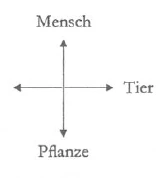

[ 32 ] Das ist das Kreuzsymbol.
[ 32 ] That is the symbol of the Cross.
[ 33 ] Es stellt die drei Lebensreiche dar, in die der Mensch einzutreten hat. Pflanzen-, Tier- und Menschenreich sind die drei nächsten stofflichen Reiche. Aus dem Mineralreich wächst das ganze heraus; es ist heute die Grundlage. Das Tierreich steht wie eine Art von Stauung zwischen dem Pflanzen- und dem Menschenreich und die Pflanze ist eine Art Gegenbild des Menschen. Damit hängt es zusammen, daß des Menschen Leben, dasjenige, was im Menschen physisch lebt, seine beste Verwandtschaft findet mit dem, was in der Pflanze lebt. Das könnte in vielen Vorträgen tief begründet werden, heute kann ich das nur andeuten. Wenn der Mensch seine physische Lebenstätigkeit erhalten will, so kann er es am besten durch die Pflanzennahrung, weil er dann aufnimmt, was ursprünglich mit der physischen Lebenstätigkeit der Erde eine Verwandtschaft hat. Die Sonne ist die Trägerin der Lebenskraft und die Pflanze ist das, was der Sonnenkraft entgegenwächst. Und der Mensch muß dieses, was in der Pflanze lebt, mit seiner Lebenskraft vereinigen. So sind seine Ernährungsstoffe okkult mit der Pflanze gleich. Das Tierreich stellt eine Stauung, eine Zurückstauung dar. Es unterbricht daher in Kreuzesform den Fortgang der Entwickelung, um einen neuen Ansatz zu beginnen.
[ 33 ] It represents the three Kingdoms of Life, into which man has to enter. The Plant, Animal and Human Kingdoms are the next three material Kingdoms [to be entered by man]. The whole evolves out of the Mineral Kingdom; this is the basis today- The Animal Kingdom forms a kind of dam between the Plant and Human Kingdoms, and the plant is a kind of mirror image of man. This ties up with human life—what lives in man physically—finding its closest kinship with what lives in the plant. It would take many lectures to confirm that thoroughly; today I can only hint at it. When man wants to maintain his physical life activity, he can best do so with a plant diet, since he would then be consuming what originally had an affinity with the physical life activity of the earth. The sun is the bearer of the life forces, and the plant is what grows in response to the sun forces. And man must unite what lives in the plant with his own life forces. Thus his food-stuffs are, occultly, the same as the plant. The Animal Kingdom acts as a dam, a drawing back, thereby interposing itself crosswise against the development process, in order to begin a new flow.
[ 34 ] Mensch und Pflanze sind einander entgegengesetzt, aber miteinander verwandt. Das Tierische aber - und was im Astralleib zunächst zum Ausdruck kommt, ist das Tierische - ist eine Durchkreuzung der zwei Prinzipien des Lebens. Der menschliche Ätherleib wird auf einer höheren Stufe die Grundlage abgeben für den unsterblichen Menschen, der nicht mehr dem Tode unterworfen sein wird. Der Ätherkörper löst sich heute noch mit dem Tode des Menschen auf. Je mehr der Mensch sich aber vervollkommnet und läutert von innen heraus, desto mehr erhält er an Beständigkeit, desto weniger geht er zugrunde. Alles, was in bezug auf diesen Ätherkörper gearbeitet wird, trägt zu seiner Unsterblichkeit bei. In diesem Sinne ist es richtig: je natürlicher die Entwickelung und je mehr sie auf die Kräfte des Lebens hingeleitet wird — es ist damit nicht hingedeutet auf das Genitalische und das Leidenschaftliche des Tieres -, desto mehr bemächtigt sich des Menschen die Unsterblichkeit.
[ 34 ] Man and plant, while set against each other, are mutually akin; whereas the animal—and all that comes to expression in the astral body is the animal—is a crossing of the two principles of life. The human etheric body will provide the basis, at a higher stage, for the immortal man, who will no longer be subject to death. The etheric body at present still dissolves with the death of the human being. But the more man perfects and purifies himself from within, the nearer will he get to permanence, the less will he perish. Every labour undertaken for the etheric body contributes towards; man's immortality. In this sense it is true that man will gain more mastery of immortality, the more evolution takes place naturally, the more it is directed towards the forces of life—which does not mean towards animal sexuality and passion.
[ 35 ] Das Tierische ist ein Strom, der das menschliche Leben unterbricht, es war jene Verzögerung, die notwendig war zur Umkehr des Lebensstromes. Der Mensch mußte sich eine Zeitlang mit dem Tierischen verbinden, weil die Umkehr stattfinden mußte. Aber er muß sich davon wieder freimachen und wieder in den Strom des Lebens einlenken.
[ 35 ] Animality is a current which breaks across human life it was a retardation, necessary for a turning point in the stream of life. Man had to combine with animality for a while, because this turning point had to take place. But he must free himself from it again and return again to the stream of life.
[ 36 ] Beim Beginn unserer Menschwerdung war uns die Kraft des Lebens mitgegeben. Das ist symbolisch ausgedrückt in der Legende damit, daß Adams Sohn Seth von dem Baum des Lebens den Sproß nimmt, den die Göttersöhne dann weiter kultivieren, jene dreifache Menschennatur, die veredelt werden soll. Dann formt sich Moses seinen Stab aus diesem Holz des Lebens. Dieser Mosesstab ist nichts anderes als das äußere Gesetz. Was ist aber äußeres Gesetz?
[ 36 ] At the beginning of our human incarnations on earth we were endowed with the force of life. That is symbolically expressed in the legend, where Adam's son, Seth, took the scion from the Tree of Life; this was then further cultivated by the Sons of God, [which expressed] that threefold human nature, which had to be ennobled. After that, Moses cut his rod from this wood of life. This rod of Moses is nothing else than the external law. But what is external law?
[ 37 ] Äußeres Gesetz ist vorhanden, wenn derjenige, der einen äußeren Bau aufrichten soll, einen Plan hat — das sind die gesetzmäßigen Zusammenhänge auf dem Papier -, und dann werden die äußeren Bausteine seinem Plane gemäß behauen und aufeinandergefügt. Auch das, was als Gesetz einem Staatenplan zugrunde liegt, ist äußeres Gesetz. Die Menschen stehen unter dem Stabe des Moses. Auch der, der aus Furcht oder aus Hoffnung auf Belohnung die Sittengesetze befolgt, befolgt nur das äußere Gesetz. Aber auch derjenige befolgt nur das äußere Gesetz, der die Wissenschaft nur in einer äußeren Weise betrachtet. Denn was hat er anderes als äußere Gesetze! Alle Gesetze, die wir in der Wissenschaft kennenlernen, sind solche äußeren Gesetze. Durch diese können wir aber nicht jenen Übergang zu der höheren Menschennatur finden, sondern nur das Gesetz des alten Bundes befolgen, das ist der Stab des Moses. Aber ein Vorbild sollte dieses äußere Gesetz sein für das innere Gesetz. Der Mensch soll lernen, dem Gesetz im Inneren zu folgen. Es muß dieses innere Gesetz der Impuls des Lebens werden beim Menschen, aus dem inneren Gesetz heraus muß er lernen, das äußere Gesetz zu befolgen. Nicht der verwirklicht das innere Gesetz, der einen Bauplan anfertigt, sondern der, der aus innerlichem Impuls heraus den Tempel baut, so daß also die Seele übergeht in die Zusammenfügung der Bausteine. Nicht der lebt in dem inneren Gesetz, der den staatlichen Gesetzen nur folgt, sondern der, dem sie Impuls seines Lebens sind, weil sie mit seiner Seele verwachsen sind. Und nicht derjenige ist ein sittlicher Mensch, der die Sittengebote aus Furcht oder wegen Belohnung befolgt, sondern der, welcher sie befolgt, weil er sie liebt.
[ 37 ] External law is present when someone who has to erect An external building has a plan—that is, a systematic scheme on paper—so that the outward building stones can be shaped and fitted together according to the plan. Thus, the law underlying the plan of a state is external law. Mankind is under Moses' rod. And anyone who follows a moral code out of fear or in hope of reward, is only following the external law. Moreover, whoever looks at science only in an external way, is only following external law; for what else can there [then] be in it but external laws! All the laws we are acquainted with in science are such external laws; through them, however, we will never find that way through to higher human nature, but will only follow the law of the Old Covenant, which is the Rod of Moses. However, this external law should be a model for the inner law. Man must learn inwardly to follow law. This inner law must become for man the impulse of life; out of the inner law he must learn to follow external law. One does not make the inner law reality by concocting a plan; instead one has to build the Temple out of inner impulse, so that the soul streams forth in the work of joining the stones together. He who lives in the inner law is not the one who merely follows the laws of the state, but he to whom they are the impulse of his life, because his soul is immersed in them. And it is not he who follows a moral code out of fear or because of reward who is a moral person, but he who follows it because he loves it.
[ 38 ] Solange die Menschen nicht reif waren, die Gesetze innerlich aufzunehmen, solange in dem Gesetz der Stab des Moses vorhanden ist, der die Menschen unter ein Joch zwang, so lange lag das Gesetz in der Bundeslade. Bis dann das paulinische Prinzip, das Prinzip der Gnade über den Menschen kam und er die Möglichkeit bekam, frei zu werden vom Gesetz. Darin liegt die Tiefe der paulinischen Auffassung, daß sie einen Unterschied macht zwischen Gesetz und Gnade. Wenn das Gesetz von Liebe durchglüht ist, wenn sich die Liebe mit dem Gesetz verbunden hat, dann ist es die Gnade. So ist der paulinische Unterschied zwischen Gesetz und Gnade aufzufassen.
[ 38 ] As long as mankind was not ripe for following the law inwardly, as long as man was under a yoke, and the Rod of Moses was present, in the law, so long would the law lie in the Ark of the Covenant; until the Pauline principle, the principle of grace came to man, giving him the possibility of becoming free from the law. The profundity of the Pauline doctrine lies in its making a distinction between law and grace. When law becomes inflamed with love, when love has united with the law, that then is grace. That is how the Pauline distinction between law and grace is to be understood.
[ 39 ] Nun können wir die Legende vom Kreuz auch noch weiter verfolgen. Als Brücke zwischen zwei Ufern wird das Holz verwendet, weil es als Pfeiler in den Salomonischen Tempel nicht taugte. Dies war eine Vorbereitung. Die Bundeslade war im Tempel, aber das fleischgewordene Wort war noch nicht da. Als Brücke über einen Fluß wird das Kreuzesholz gelegt, aber erst die Königin von Saba erkannte den Wert des Holzes für den Tempel, der im Bewußtsein der ganzen Menschenseele leben soll. Nun wird dasselbe Holz verwendet, um das Kreuz, an dem der Erlöser hängt, daraus zu zimmern. Derjenige, der die beiden früheren Strömungen vereinigt, der die weltliche und die spirituelle Strömung ineinanderlaufen läßt, der Christus ist selbst vereint mit dem lebendigen Kreuz. Daher kann er das Holz des Kreuzes tragen als etwas, was er auf seinen Rücken nimmt, als etwas, was außer ihm lebt. Er ist selbst vereint mit dem Holz der Brücke, daher kann er das tote Holz auf sich nehmen.
[ 39 ] Now we can follow the legend of the Cross still further. The wood was used as a bridge between two riverbanks. because it did not suit as a pillar in Solomon's Temple. This was a preparation. The Ark of the Covenant was in the Temple, but the Word-become-Flesh was not yet there. The wood of the Cross was laid as a bridge across a stream; only the Queen of Sheba recognised the worth of the wood for the temple, which should live in the consciousness of the soul of all humanity. Now the same wood was used for the construction of the Cross on which the Redeemer hung. He who unites the two earlier currents [of evolution], who allows the worldly and the spiritual to flow into each other, the Christ, is Himself joined to the living Cross. That is how He can carry the wood of the Cross as something [external] which He carries on His back. He is Himself united with the wood of the bridge, and can therefore take the dead wood upon Himself.
[ 40 ] Der Mensch ist jetzt eingezogen in die höhere Natur. Früher lebte er in der niederen Natur. Im Sinne des Christentums lebt er jetzt in der höheren Natur, und das Kreuz - die niedere Natur - trägt er wie ein Fremdes weiter durch seine innere lebendige Kraft. Jetzt wird die Religion lebendige Kraft in der Welt, jetzt hört das Leben in der äußeren Natur auf, das Kreuz wird völlig Holz. Der äußere Leib wird nun zum Vehikel der inneren lebendigen Kraft. Da vollzieht sich das große Geheimnis: das Kreuz wird auf den Rücken genommen.
[ 40 ] Man is today drawn into higher nature. Formerly he lived in lower nature. In the Christian sense he now lives in higher nature, and the Cross—the lower nature—he carries forward as something alien, through his inner living forces. Religion now becomes the living force in the world, now the life in external nature ceases, the Cross becomes entirely wood. The outer body [of man] now becomes a vehicle for the inner living force. There the great mystery consummates itself: the Cross is taken on [man's] back.
[ 41 ] Schön und bedeutsam hat auch unser großer Dichter Goethe in dem «Märchen von der grünen Schlange und der schönen Lilie» die Idee der Brücke zum Ausdruck gebracht da, wo er eine Brücke bauen läßt, indem die Schlange sich wie eine lebendige Brücke über den Fluß legt. Alle tiefer Eingeweihten haben dieses selbe Symbol für ein und dieselbe Sache.
[ 41 ] Our great poet Goethe presented the idea of the bridge in a beautiful and significant way in his ‘Fairy Story of the Green Snake and the Beautiful Lily,’6Goethe: Fairy Tale of the Green Snake and the Beautiful Lily, Floris Books, 1979. See also Goethe's Standard of the Soul as illustrated in Faust and in the Fairy Story of the Green Snake and the Beautiful Lily, Anthroposophical Publishing Company, London, 1925; and Goethe's Secret Revelation and the Riddle of Faust, Rudolf Steiner Publishing Company, London, 1933. where he has a bridge being built, by the snake laying itself across the river as a living bridge. All the more advanced initiates use this same symbol for one and the same thing.
[ 42 ] So haben wir die heilige Legende vom Kreuz in ihrer tiefen inneren Bedeutung kennengelernt. Wir haben gesehen, wie der Umschwung vorbereitet wurde, welcher sich durch das Christentum vollzogen hat und sich durch die Verchristlichung der Welt immer mehr und mehr vollziehen muß in der späteren Zeit. Wir haben gesehen, wie das Kreuz, insofern es Abbild der äußeren drei Körper ist, abstirbt, wie es nur eine äußere Verbindung zwischen den drei niederen und den drei höheren Reichen, zwischen den beiden Ufern, die durch den Strom getrennt sind, herstellen kann — Pfeiler im Salomonischen Tempel konnte das Kreuzesholz nicht werden -, bis es der Mensch als sein eigenes Symbol erkennt. Erst dann, wenn er sich selbst opfert, seinen eigenen Körper zum Tempel macht und fähig wird, das Kreuz selbst zu tragen, ist die Verbindung der zwei Strömungen ermöglicht.
[ 42 ] Thus we have become acquainted with the deep inner meaning of the holy legend of the Cross. We have seen how the revolution was prepared for, which Christianity brought about, and which must fulfil itself more and more as time goes on by Christianising the world. We have seen how the Cross, inasmuch as it is the image of the three external bodies, dies; how it is only able to form an external union between the three lower and the three higher Kingdoms, between the two banks divided by the stream—the wood of the Cross could not become a pillar in Solomon's Temple—until man recognises it as his own particular symbol. Only then, when he sacrifices himself, makes his own body into the Temple, and becomes able to carry the Cross, will the merging of the two streams be made possible.
[ 43 ] Daher haben auch die christlichen Kirchen das Kreuzeszeichen schon in ihrer Anlage. Damit soll ausgedrückt sein, daß das lebendige Kreuz hineingeheimnißt ist in den äußeren Tempelbau. Jene zwei Strömungen aber, auf der einen Seite das göttlich Lebendige und auf der anderen Seite das weltlich Mineralische, haben sich in eins zusammengefügt in dem am Kreuze hängenden Erlöser, wo die höheren Prinzipien im Erlöser selbst, die niederen im Kreuze liegen. Und daß fortan dieser Zusammenhang ein organischer, ein lebendiger sein soll, drückt besonders tief der Apostel Paulus aus. Ohne das, was wir heute durchgenommen haben, kann man die Schriften des Apostel Paulus nicht verstehen. Ihm war es klar, daß jener alte Bund zu Ende gehen muß, welcher einen Gegensatz zwischen dem Menschen und dem Gesetz errichtet. Erst wenn der Mensch das Gesetz mit sich vereinigt, es auf seinen Rücken nimmt, es trägt, dann wird es keinen Widerspruch mehr geben zwischen der inneren Menschennatur und dem äußeren Gesetz. Dann ist das erreicht, was das Christentum erreichen will.
[ 43 ] That is why the Christian churches have the symbol of the Cross in their foundations; thereby expressing the secretion of the living Cross in the outward edifice of the Temple. However, these two streams, the living divine stream on the one hand, and the worldly mineral stream on the other, have become united in the Redeemer hanging on the Cross, where the higher principles are in the Redeemer Himself, and the lower ones in the Cross. And henceforth this connection must now become organic and living, as the Apostle Paul expressed particularly deeply. Without [a knowledge of] what has been discussed today, the writings of the Apostle Paul cannot be understood. It was clear to him that the Old Covenant, which creates an antithesis between man and the law, must come to an end. Only when man unites himself with the law, takes it upon his back, carries it, will there no longer be any contradiction between man's inner nature and the external law. Then that which Christianity seeks to achieve, is achieved.
[ 44 ] «Die Sünde ist durch das Gesetz in die Welt gekommen.» Das ist ein tiefer Ausspruch des Paulus. Wann ist die Sünde in der Welt? Wenn eben ein Gesetz da ist, das übertreten werden kann. Wenn aber das Gesetz so mit der menschlichen Natur vereinigt ist, daß das, was der Mensch tut, das Gute ist, dann kann es keine Sünde geben. Nur so lange widerspricht der Mensch dem Kreuzgesetz, als es nicht in ihm lebt, solange es äußerlich ist. Daher sieht Paulus den Christus am Kreuz als die Überwindung des Gesetzes und die Überwindung der Sünde an. Ein Fluch ist es, am Holze des Kreuzes zu hangen, das heißt, dem Gesetze zu verfallen. Sünde und Gesetz gehören zusammen nach dem alten Bund, Gesetz und Liebe gehören zusammen nach dem neuen Bund. Es ist ein negatives Gesetz, welches verbunden ist mit dem alten Bund; ein positives Gesetz, das lebt, ist aber das Gesetz des neuen Bundes. Der hat das Gesetz des alten Bundes überwunden, der es mit seinem eigenen Leben vereinigt hat. Der hat es aber auch geheiligt.
[ 44 ] ‘With the law sin came into the world.’ 7‘With the law sin came into the world.’
The Epistle of Paul to the Romans, Chapter 5, verse 13 and Chapter 8, verse 2. That is a profound saying of Paul's. When is there sin in the world? Only when there is a law which can be broken. But when the law becomes so united with human nature that man only does good, then there can be no [more] sin. Man only contradicts the law of the Cross as long as it does not live within him, but is something external. Therefore Paid sees the Christ on the Cross as the conquest of law and the conquest of sin. To hang on the Cross means to be subjected to the law—and that is a curse. Sin and the law belong together in the Old Covenant, the law and love belong together in the New Covenant. It is a negative law which is involved in the Old Covenant; but the law of the New Covenant is a living positive law. He who united the Old Covenant with His own life is the One who has overcome it. He has at the same time sanctified it.
[ 45 ] Das ist gemeint mit jenen paulinischen Worten, die im GalaterBrief (3. Kapitel, 11-13) zu lesen sind: «Daß aber durch das Gesetz niemand gerecht wird vor Gott, ist offenbar, denn der Gerechte wird seines Glaubens leben. Das Gesetz aber gründet sich nicht auf den Glauben, sondern der Mensch, der es tut, wird dadurch leben. Christus aber hat uns losgekauft von dem Fluch des Gesetzes, da er ward ein Fluch für uns, denn es steht geschrieben: Verflucht ist jedermann, der am Holze hänget.»
[ 45 ] That is what is meant by those words of Paul which are to be found in the Epistle to the Galatians, Chapter 3:11–13.: ‘But that no man is justified by the law in the sight of God, is evident, for the just shall live by faith and the law is not of faith, but the man that doeth them shall live in them. Christ hath redeemed us from the curse of the law, being made a curse for us, for it is written: Cursed is every one that hangeth on a tree.’
[ 46 ] Mit dem Wort «Holze» verbindet Paulus die Begriffe, die wir heute behandelt haben. So müssen wir immer tiefer eindringen in dasjenige, was die großen Eingeweihten gesagt haben. Nicht dadurch nähern wir uns dem Christentum, daß wir es sozusagen unseren Anforderungen anpassen, anpassen dem dem Höheren abgeneigten materialistischen Verstande von heute, sondern dadurch, daß wir uns immer mehr und mehr in die Höhen des Geistigen erheben. Denn das Christentum ist aus der Einweihung heraus geboren, und erst dann werden wir es verstehen und daran glauben können, daß unendliche Tiefen in dem Christentum enthalten sind, wenn wir nicht mehr der Meinung sind, wir müßten dem heutigen Verstand das Christentum annähern, sondern wenn der dem Höheren abgeneigte materialistische Verstand sich wieder zum Christentum erhebt. Der heutige Verstand muß sich vom Mineralisch-Toten zum Lebendig-Geistigen erheben, wenn er das Christentum verstehen will.
[ 46 ] With the word ‘tree’ [literally ‘wood’ in the German Bible] Paul connects the concept with which we have been dealing today. We must indeed keep penetrating deeper into what the great initiates have said. We do not come closer to Christianity by adapting it to what might be termed our demands, by adapting it to the contemporary materialist judgments that deny anything higher—but by continually raising ourselves further into spiritual heights. For Christianity was born of initiation and we shall only understand it and be able to believe that it contains infinite depths, if we abandon the view that we have to bring Christianity nearer to contemporary ideas; but instead raise our anti-spiritual materialist thinking back again to Christianity. The contemporary view must raise itself from what is mineral and dead to what is living and spiritual, if it is to understand Christianity.
[ 47 ] Ich habe diese Anschauungen vorgetragen, um zum Begriffe des neuen Jerusalem zu kommen.
[ 47 ] I have presented these views so as to arrive at a conception of the New Jerusalem.