Basic Elements of Esotericism
GA 93a
30 October 1905, Berlin
Translated by Steiner Online Library
Lecture XXVII
[ 1 ] The course of evolution in the world unfolds before us in three stages: consciousness, life, and form. Consciousness, in its various forms, is expressed through the seven planets: Saturn, the Sun, the Moon, Earth, Jupiter, Venus, and Vulcan. On each planet, it passes through seven stages of life, and each kingdom of life passes through seven states of form.
[ 2 ] Our physical Earth is one such state of form—the fourth state of form, or globe, within the fourth kingdom of life of the fourth planet, or state of consciousness. Let us now imagine the Earth as it is today and ask ourselves: What are we doing here?—We take the objects out in space, initially from the mineral kingdom, and use them to create works of art. In doing so, we combine; we form a whole out of individual parts. This is a creative process within form. Now, something new can also come into being in another way—namely, in a manner similar to how, for example, stems, leaves, and flowers arise from a plant’s root. This flower is not assembled like a machine, through combination, but must grow forth from what is already there. This is a process within life. Something new is created from what is already there.
[ 3 ] In the third type of production—that which arises from consciousness—something emerges in such a way that we can say: Essentially, there was nothing there before—a nothing.
[ 4 ] Let us go back to the very beginning of such planetary evolution, right to the start of Saturn’s evolution. What do we observe there? There was not yet a physical planet; not even a planet in the finest form of arupa existed—rather, we are still before the moment when Saturn first came into being. Nothing from our planetary chain exists there yet; but the entire fruit of the preceding planetary chain is present—much like when we wake up in the morning, having done nothing yet, and our mind contains only the memory of what we did the previous day. Thus, when we place ourselves entirely at the very beginning of Saturn’s development, we find in the manifesting spirits the memory of a previous planetary chain—of what had been before.
[ 5 ] Now let us transport ourselves to the end of the planetary chain, to the time when the volcanic stage is coming to an end. Throughout the planetary chain, what was present as a potential at the beginning has gradually come to light as creation. So we first have an outpouring of consciousness; drawing from the content of the past, from memory, consciousness creates the new. So at the end there is something that was not there at the beginning: namely, all experiences. What was there at the beginning has flowed out into a multitude of things and beings. A new consciousness has emerged at the end with new content—a new content of consciousness. It is something that has emerged from nothing, from experiences. When we consider renewal in life, we must tell ourselves that there must be a seed that makes this possible. But the new content of consciousness at the end of a planetary evolution has in fact emerged from nothing, from experiences; no foundations are needed for this—it creates something that arises from nothing. One cannot say that when one personality looks at another, it has taken something away from the other, even if it subsequently carries the memory of that other personality within itself. This memory has emerged from nothing. This is a third kind of creation: out of nothing. The three kinds of creation are therefore as follows:
Combining existing parts (Form)
Bringing forth new structures with new meaning from existing foundations (Life)
Creating out of nothing (Consciousness).
[ 6 ] These are three definitions of entities that give rise to a planetary chain and form the foundation of a planetary chain. They are called the three Logoi. The third Logos brings forth from the combination. When something else emerges from a single substance with new life, it is the second Logos that brings it forth. But wherever we have something emerging from nothing, there we have the first Logos. Therefore, the first Logos is often called that which is hidden within things themselves; the second Logos, the substance resting within things that creates the living from the living; and the third Logos, the one who combines all that exists and composes the world from things.
[ 7 ] These three Logoi are constantly intertwined and interpenetrating in the world. The first Logos also experiences inner wisdom and will. The creation of the first Logos involves experience—that is, gathering thoughts from nothing and then creating again according to those thoughts from nothing. Creation out of nothing, however, does not mean that there was absolutely nothing there to begin with, but rather that experiences are gained in the course of development and that something new is created in the course of becoming—that what is there, as it were, melts away, and something new is created out of that experience.
[ 8 ] This act of creation happens something like this: Someone looks at another person and commits the image to memory. If he were as creatively gifted as the First Logos, he might say to himself: Yes, I have seen NN, and I also know the concept of the inverse of NN. I can also form a negative image of him: So where there is black, there is white, and vice versa. In this way, from the experience of the object and its negative, he has created a completely new entity. He could endow this with life. It would be a new entity that did not exist before. Now let’s assume that someone does this with many people, and those many people were to perish; then, based on his experiences, the observer would be able to create a new world.
[ 9 ] When we observe the world, we constantly see the three Logoi interacting with one another. Let us imagine, within our planetary system, the workings of the three Logoi in relation to human beings. Let us imagine the starting point of Saturn’s evolution, when nothing yet existed. What happens there? Everything that existed before is, as it were, poured out. All things that were there before are poured forth. What arises in this way would be the very first outpouring of substance from the sum of past experiences. Everything that was previously absorbed is poured forth in the form of substance. This also contains the substance from which humanity will later emerge. At first, this substance exists merely as substance. This outpouring must then be continuously built up and combined. This combination of the outpoured substance is a new creation. This is initially a creation of the Third Logos; that is, following the outpouring of the substance, a creation of the Third Logos.
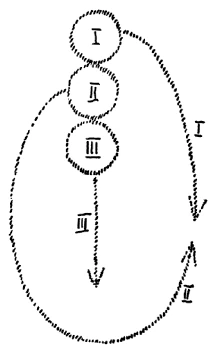
[ 10 ] What does this mean for human beings? For human beings, it means that, first of all, all the parts that will form their physical body are brought together. Back then, on Saturn, human beings were veritable automatons. If someone had spoken a word into them at that time, they would have repeated it. The forms of beings are created. This is called the work of the Third Logos, and it continues into the Solar Age, when human beings also receive the etheric body—that is, life. This is the work of the Second Logos. Now let us move on to the Earth Age. There, human beings themselves acquire consciousness—that is, the ability to gather experiences out of nothingness. This is the work of the First Logos. The human being on Saturn receives that which is form within them from the Third Logos. The human being on the Sun receives that which is life within them from the Second Logos. The human being on Earth receives that which becomes consciousness within them from the First Logos.
[ 11 ] We need to gain a slightly clearer understanding of the concept of consciousness. To do so, we must thoroughly work out the concept of consciousness on a specific plane. Human beings are conscious, but the question is where their consciousness is located. A human being is currently conscious on the physical plane when we speak of waking consciousness. But waking consciousness could just as easily be on the astral plane. If a creature’s life is on the physical plane and its consciousness is on the astral plane, then it is an animal.
[ 12 ] In humans, consciousness is located in the head. In animals, such as the tiger, consciousness exists on the astral plane. It creates a certain point of contact outside the head through which it influences the tiger. When the tiger feels pain, that pain is also transmitted to the astral plane. In the tiger, the organ responsible for this is located in front of the head, at the point where the human forehead is. In humans, this point is already enclosed within the head and filled with the forebrain; consciousness has been captured by the brain and the frontal skull and is therefore on the physical plane. In the tiger—and indeed in all animals—the focal point of consciousness lies in front of the head, in the astral realm; from there it enters the astral world. With plants, it is different again. If we could trace their consciousness, moving from top to bottom, we would always emerge at the tip of the root. If we then follow the line of growth, we would arrive at the center of the Earth. There lies the focal point of all sensations, the point where the consciousness of plants is absorbed. It is directly connected to the mental world. The entire plant world has its consciousness in the mental realm.
[ 13 ] In the entire mineral world, consciousness resides in the highest realms of the mental world, on the Arupa plane. The consciousness of stones is such that if we were to seek that point, we would find it as a kind of solar atmosphere. When we work with the mineral world here on Earth—when we tap stones—every single action has a certain relationship to this solar atmosphere. There, one can sense what human beings are doing here. So we have a series of beings on the physical plane whose consciousness, however, lies on different planes.
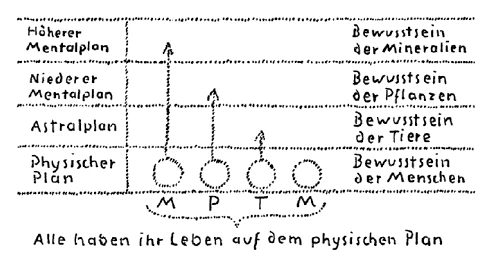
[ 14 ] Humans and animals differ in that their consciousness exists on different planes. There are also other beings besides minerals, plants, animals, and humans. There are beings whose consciousness is in the physical plane and whose body is in the astral plane. Such a being is, so to speak, the reverse of an animal. Such beings truly exist; they are the elemental beings. To understand them, let us first clarify what belongs to the physical plane.
[ 15 ] The physical realm consists of: first, solid earth; second, water; third, air; and fourth, ether (heat ether, light ether, chemical ether, and life ether). Let us focus on the four lower forms of our physical plane and set the ethereal world apart from them.
[ 16 ] Consciousnesses can exist in all four forms of the physical plane, while the body of such a being resides in the astral plane. Imagine a consciousness in solid earth, with the body in the astral plane; or a being whose consciousness is in water, and whose body is in the astral plane; then one with its consciousness in the air and its body in the astral; and one with its consciousness in fire and its body in the astral. Modern humanity knows little about these beings; in our time, they are known only through poetry. Miners, however, know such beings very well. A gnome is perceptible only to those who can see on the astral plane, but miners sometimes possess such astral vision; they know that gnomes are real. Thus, there are actually consciousnesses present within our Earth, and what the natural scientist today calls the laws of nature are the thoughts of beings who think on the physical plane but have their bodies on the astral plane. When physics refers to a “law of nature,” we can say to ourselves: these are the thoughts of a being whose body resides on the astral plane. The forces of nature are creative beings, and the laws of nature are their thoughts.
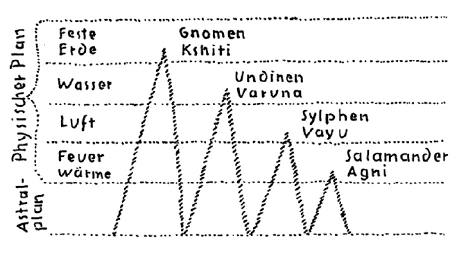
[ 17 ] In the Middle Ages, alchemists attempted to enslave spirits. Goethe was well aware of this; Faust wants “fire-air”; this is where the salamander is supposed to emerge, a being whose body exists on the astral plane. So we are surrounded by beings whose consciousness is actually in fire, and we cause them pain when we light a fire, because this brings about a certain change in the being’s body on the astral plane. When we light a flame, we alter this astral being. Likewise, when we bring about changes in other realms of the elements and the forces of nature, we alter something in these astral beings. We are constantly populating the astral plane with beings by doing this or that. If we think this idea through clearly, we grasp the meaning of the church ceremony: namely, not to perform arbitrary acts on the physical plane, but rather those that are meaningful, thereby giving rise to meaningful beings on the astral plane. For example, when one burns incense, one is performing a deliberate act; one burns certain substances and creates beings of a specific kind. When one swings a sword through the air in four directions, one creates a specific being. Likewise, the priest, when he makes certain hand movements accompanied by specific sounds—such as the vowels 0, i, and u—reinforced by the repetition: “Dominus vobiscum.” The sound is arranged in a regular pattern; the air is set into specific vibrations, which are amplified by performing specific hand movements, and a sylph is evoked. Likewise, the signs, handgrips, and words of the Freemasons bring forth specific formations that express a lawfulness in the physical world. Through the deliberate use of these words, one creates a bond from one to the other; one envelops oneself in astral matter that has been created through signs, handgrips, and words.
[ 18 ] Of course, people do all of this constantly in everyday life as well, but there they do so unsystematically, creating contradictory entities. The art lies in working upward from the physical plane toward higher, harmonious planes. In ritual ceremonies, specific actions are intended to create harmonious entities rather than contradictory ones. At first, human beings are incapable of bringing these things into harmony. But for everything that human beings create in this way on the astral plane, there are certain guiding entities. Thus, we have a world of elemental beings around us, with a king. Among the Indians, the king of the gnomes is called Kshiti, the supreme gnome; the supreme being among the undines is Varuna; the supreme being among the sylphs is Vayu; and everything that has its consciousness in fire is directed by the king of fire, Agni. In all activities involving fire and water and so on, we are dealing with these specific deva beings. All fire that we have here on Earth is the substance woven from the beings that belong to Agni. Ceremonial magic is the lowest form of sorcery and consists of mastering certain techniques on the physical plane in order to create specific forms and entities on the astral plane. There are schools where ceremonial magic is still practiced today. Such practices foster a strong inclination toward the astral world and very often lead to suicide, because the person then functions almost exclusively in the astral world and has lost the habit of engaging with the physical world for its own sake. They have developed an inclination toward the other world, and the physical body then often becomes a hindrance to them.
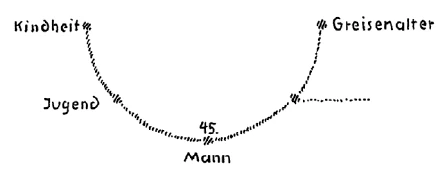
[ 19 ] Now you will also understand the connection with the fire cult that has emerged in the history of religion. The followers of Zarathustra attempted, through the priests’ fire sacrifices, to actually create certain forms on the astral plane. On Earth, everything now takes place on the physical plane. But as can be seen from what has been said, astral beings are constantly being formed under the influence of our actions. All actions are accompanied by astral beings. These are our skandhas, which carry out our karma. But all physical events also leave astral beings behind in the astral plane. For example, Cologne Cathedral corresponds to a very specific being on the astral plane. Through everything that happens on Earth—once all physical matter has been transformed and the Earth dissolves—the next astral globe is formed of its own accord. It simply exists as the astral entities, as the effects of all earlier physical processes. That is why human beings must continually work within karma. In the next life, they must set right the grotesque astral entities they have botched; otherwise, these would exist as meaningless creatures on the next globe. This is karma that human beings must rectify. What takes place on a large scale on Earth also takes place on a small scale within human beings. Consider a child. You raise it incorrectly; you spoil it with treats and so on. This not only results in physical effects but also continually influences the astral body, so that you actually alter the astral body as well. What you teach the infant physically is transferred into its astral body; it exists there in the form of specific structures. However, what has been imprinted in this way is gradually worked out again. In old age, the sins committed against the child take their toll. These sins persist throughout one’s entire lifetime and are of great importance, especially for the final stage of a person’s life. After the midpoint of life, a kind of reversal occurs; the astral realm then begins to influence the physical plane. In childhood, a person lays the foundation in the astral realm for what they will experience in old age. If a person recognizes the wrongs committed against them and subsequently works on themselves, they can then heal the damage in the astral body; otherwise, they will collapse in old age under the very same weaknesses of their childhood. However, only what one consciously works into the astral body has a balancing effect on it. If one does not later consciously bring forth the opposite qualities, one cannot rid oneself of these faults.