

At the Gates of Theosophy
GA 95
4 September 1906, Stuttgart
Translated by Steiner Online Library
Fourteenth Lecture
[ 1 ] Yesterday we outlined the various areas through which students of Eastern and Christian training attain higher levels of knowledge; today I would like to describe to you, in a similar manner, the stages through which Rosicrucian training progresses.
[ 2 ] One must not imagine that this Rosicrucian training contradicts the other two. It has existed since approximately the 14th century, and it had to be introduced at that time because humanity still needed another form of training. In the circles of the initiated, it was foreseen that people would come who would be led astray in their faith by the gradually developing knowledge. Therefore, a form had to be created for those who found themselves caught in the conflict between faith and knowledge. In the Middle Ages, the greatest scholars were also the most devout and pious people; but even long afterward, those advanced in the natural sciences could not conceive of any contradiction between faith and knowledge. It is said that the Copernican system shook the foundations of faith, but this is entirely unjustified, since Copernicus had dedicated his book to the Pope! Only in very recent times has this conflict gradually arisen. The Masters of Wisdom foresaw this, and therefore a new path had to be found for those who had been led away from the faith by science. For those who are deeply engaged in science, it is necessary to follow this Rosicrucian path in order to become an initiate, for the Rosicrucian method demonstrates that the highest knowledge of the material world can indeed coexist with the highest knowledge of the supersensible spiritual truths; and it is precisely through the Rosicrucian method that one who might otherwise have strayed from the Christian faith due to a so-called science can come to recognize it all the more clearly. Through this method, everyone can understand the truth of Christianity even more fully and with deeper insight. There is only one truth, yet one can reach it by various paths, just as the various paths diverge at the foot of the mountain but all converge at the summit.
[ 3 ] The essence of Rosicrucian training can be described as true self-knowledge. To achieve this, one must distinguish between two things; and as a Rosicrucian student, one must not merely distinguish between them in theory, but also in practice—that is, apply them to one’s daily life. There are two kinds of self-knowledge: lower self-knowledge—which the Rosicrucian student calls “self-reflection”—through which one is to overcome the lower self; and higher self-knowledge, born of self-renunciation.
[ 4 ] What, then, is lower self-knowledge? It is the knowledge of our everyday self—of what we already are, of what we carry within us—as they say, a glimpse into our own inner life. One must realize, however, that this alone cannot lead to the higher self, for when a person looks within, they find only what they are; yet it is precisely this that they must transcend in order to overcome the self of ordinary life. But how? Most people are convinced that their own qualities are the very best, and they find those who do not share them unappealing. Anyone who has moved beyond this view—not just in theory, but in their feelings—is already on the path to true self-knowledge. One can move beyond this self-reflection through a specific method that can always be applied whenever one finds five minutes of time. One must start from the following principle: All the qualities you possess are one-sided; you must recognize in what ways your traits are one-sided, and you must seek to harmonize them. — This is a principle that is most suitable not only in theory but also in practice. Anyone who is diligent must examine whether they are being so in the wrong area. Quickness is also one-sided; I must complement it with careful deliberation. Every quality has its opposite; one must acquire it and then seek to harmonize the contrasting qualities—for example: haste with deliberation, being quick yet thoughtful, being thoughtful yet not sluggish. Then one begins to work beyond oneself. This is not part of meditation; it must be achieved separately.
[ 5 ] This harmonization consists, in particular, of paying attention to small details. For example, someone who has a tendency not to let others finish speaking must pay close attention to this and resolve for a period of six weeks: From now on, you will remain completely silent in the presence of others for as long as possible. — Then one should get into the habit of speaking neither too loudly nor too softly. Such things, which people usually do not even consider, are part of this intimate inner self-development, and the more insignificant the traits one addresses, the better. If one manages not only to acquire certain moral, intellectual, or emotional qualities but also to break any external habit, this is particularly effective. It is less a matter of exploring one’s inner self in the ordinary sense than of perfecting the qualities one has not yet sufficiently developed, and of supplementing what one already possesses with an opposing quality. Self-knowledge is one of the most difficult things for a person, and it is precisely those who believe they know themselves best who are most easily deceived. They think too much about themselves. The constant fixation on oneself and the constant use of the word “I”—I think, I believe, I consider this to be right—one should break this habit even in one’s way of speaking. Above all, one must rid oneself of the notion that one’s own opinion matters more than that of other people. Let’s take, for example, a very intelligent person. If he displays his intelligence in a group of people who are at a much lower level, it is very out of place: after all, he is displaying it only for his own sake. He should, however, act in accordance with the spirit of the others. Agitators, in particular, violate this rule very easily.
[ 6 ] To this must be added what is known in occult terms as patience. Most people who want to achieve something cannot wait because they believe they are already ready to receive everything. This patience stems from strict self-discipline. This, too, is connected with self-knowledge.
[ 7 ] Higher self-knowledge begins only when we start to say: Our higher self does not lie at all in what constitutes our everyday self. It is found throughout the entire world outside—up among the stars, in the sun and the moon, in stone, in animals: everywhere is the same essence that is within us. —When someone says, “I want to cultivate my higher self and withdraw; I want nothing to do with anything material,” they completely fail to recognize that it is precisely this Self that is everywhere outside, and that their own higher self is only a small part of this great Self out there. Certain “spiritual” healing methods make this mistake, which can be very disastrous; they instill in the sick person the idea that nothing material exists, and thus there are no illnesses either. This is based on a false self-understanding and is, as already noted, very dangerous. While such a healing method bears a Christian name, it is actually anti-Christian.
[ 8 ] Christianity is a worldview that sees a revelation of the Divine in everything. In every material thing, we are under an illusion if we do not regard it as an expression of the Divine. If we deny the external world, we deny the Divine; if we negate the matter in which God has revealed Himself, then we negate God. It is not a matter of looking within ourselves, but rather we must seek to recognize the Great Self that shines within us. The lower self says: I am standing here and freezing. — The higher self, on the other hand, says: I am also the cold, for I live as the one Self in the cold and make myself cold. — The lower self says: I am here; I am in the eye that sees the sun. — The higher self, on the other hand, says: I am in the sun and see into your eyes through the sunbeam.
[ 9 ] To truly step outside of oneself means self-renunciation. Therefore, the Rosicrucian training is aimed at bringing the lower self out of the human being. In the Theosophical Movement, the very worst mistake was made at the outset by saying: “One must turn away from the external and look within oneself.” — That is a great illusion. One finds only one’s lower self, the fourth principle, the lower “I,” which imagines itself to be divine but is not divine at all. One must step outside oneself to recognize the divine. “Know thyself” also means “overcome thyself.”
[ 10 ] The areas covered by Rosicrucian training are as follows, and they must go hand in hand with the development of the six qualities already mentioned: control of thought, initiative in action, serenity, impartiality or positivity, faith, and inner balance.
[ 11 ] The training itself consists of the following:
[ 12 ] 1. Study. Without study, today’s European cannot come to understand things for himself. He must first try to bring forth within himself the thoughts of all humanity. He must learn to think in terms of the world system. He must tell himself: If others have thought this, then it must be human, and I want to try and see how one can live with it. - One need not swear to it as if it were a dogma, but one must get to know it through study. The student must learn about the evolution of the suns and planets, the Earth, and humanity. These ideas, handed down to us for study, purify our spirit. Clinging to these rigorous lines of thought, we climb our way up to forming strictly logical thoughts ourselves. This study, in turn, purifies our thoughts, so that we learn to think strictly logically. When we study a very difficult book, for example, it matters less to grasp the content than to follow the author’s train of thought and learn to think along with him. That is why one must not consider a book too difficult; that would simply mean one is too lazy to think. The best books are precisely those that one must study over and over again, those that one does not understand right away, those that one must think through sentence by sentence. In study, it is not so much the “what” that matters as the “how.” Through the great truths—such as the laws of the planets—we develop broad lines of thought, and that is the essence of the matter. There is also a great deal of selfishness involved when someone says, “I want more moral teachings and none about planetary systems.” — True wisdom leads to a moral life.
[ 13 ] 2. The second is imagination, the acquisition of imaginative insight. What is it, and how does one attain it? One arrives at it in the following way: One walks through the world and observes it strictly according to Goethe’s principle, “Everything transitory is but a parable.” For Goethe was a Rosicrucian, and he can introduce us to the life of the soul. Every thing must become a parable in multiple ways. Let’s suppose I walk past a fall crocus: through its shape and color, it is a symbol of mourning to me. Another flower, the windflower, is a symbol of need; a red flower that boldly raises its petals upward can be a sign of cheerfulness to me, and so on. A brightly colored animal can be a metaphor for coquetry. Often the metaphors are already expressed in the names themselves—for example, weeping willow, forget-me-not, and so on. The more one thinks in this way—that external things become symbols of moral qualities—the more easily one can rise to this imaginative insight. Such allegories can also be found in people. For example, one can study a person’s temperament by observing their gait. Just observe the dragging, slow stride of the melancholic, the firm, determined stride of the choleric, and the light, almost tiptoeing stride of the sanguine.
[ 14 ] Once you have practiced this for a while, you move on to the exercises for actual imagination. For example, you hold up a natural plant, look at it closely, immerse yourself completely in it, draw forth the innermost part of your soul, and place it, so to speak, into the plant, as described in my essays “How Does One Attain Knowledge of the Higher Worlds?” This brings about imagination. Through this, one attains astral vision. After some time, one actually notices a small flame emerging from the plant; this is the astral significance of what is growing. Another example: One places a seed in front of oneself and then sees the entire plant—as it will actually be later on—appear in one’s mind’s eye. These are exercises for imagination to which the Rosicrucians devote a great deal of attention.
[ 15 ] 3. The third is what is called the study of occult script. For there is indeed an occult script through which one can penetrate more deeply into things. Let me give you an example so that you can see what I actually mean: With the downfall of ancient Atlantis, a new culture—the ancient Indian culture—began. The symbol of such a stage of development—where one cultural epoch ends and another begins—is the vortex. Such vortices also exist in nature: stellar nebulae, such as the Orion Nebula, for example, and so on. There, too, one world perishes, and a new one emerges. At the dawn of the ancient Indian culture, the Sun was in Cancer; during the Persian culture, the Sun was in Gemini; during the Egyptian culture, in Taurus; and during the Greco-Roman culture, in Aries. Since Cancer is the astronomical sign, it was also the sign marking the dawn of the ancient Indian culture.
[ 16 ] Another example is the letter M. Every letter has an occult origin. Thus, M is the sign of wisdom. It originated from the shape of the upper lip and is also the symbol for ocean waves; therefore, wisdom is symbolized by water. These signs always allude to meaningful things. Numerous such symbols are taught in Rosicrucian training.
[ 17 ] 4. Bringing Rhythm to Life. Transitioning from a chaotic to a rhythmic life. Children have the advantage of going to school; adults, unfortunately, often lack a schedule. One must try to set aside certain hours of the day for meditation. Regulating the breath does not play as significant a role as it does for Eastern practitioners, but it is also part of the training, and the Rosicrucian knows that simply by meditating, the quality of the air one breathes improves.
[ 18 ] 5. The Correspondence Between the Microcosm and the Macrocosm. This refers to the connection between the great world and the small world, or between the human being and the external world. You know that the human being developed gradually; its individual constitutional elements formed in the course of evolution. On the ancient Sun, the human being did not yet have an astral body. For this reason, certain organs could not yet develop. One such organ is, for example, the liver. A being that has only an etheric body does not have a liver, not even in embryonic form. Although the liver is not possible without the etheric body, it is created only by the astral body. Similarly, a being can never have warm blood unless it arose at the time when the “I” developed.
[ 19 ] Although higher animals are also warm-blooded, they diverged from humans when humans developed the “I.” Thus, every organ of the human body, even the smallest, belongs to one of its essential components. The liver corresponds to the astral body, and the blood to the “I.” And when a person now objectively directs his attention to himself, as if to an object—for example, by concentrating on the point at the root of the nose and associating it with a specific word given to him by the occult teacher—he is led to that which corresponds to this point, and he comes to know it. In this way, the person who concentrates on this point under specific guidance will come to know the nature of the “I.” Another exercise, performed much later, focuses on the interior of the eye; through this, one comes to know the inner nature of light and the sun. One comes to know the nature of the astral body by concentrating on the liver using specific words.
[ 20 ] True self-development occurs when one is led out of oneself through every organ to which one directs one’s attention. This method has become particularly effective in recent times because humanity has become so materialistic. In this way, through the material, one arrives at the source of the material—at the creative forces that formed these organs.
[ 21 ] 6. Dwelling or immersing oneself in the macrocosm. This is the same as what has been described as dhyana, or spiritual contemplation. It occurs as follows: One immerses oneself in the organ of contemplation—for example, the interior of the eye. After concentrating on this for a while, one lets go of the image of the external organ, so that one thinks only of what the eye has pointed to: the light. Through this, one reaches the Creator of the organ and emerges into the macrocosm. Then one feels the body growing ever larger, as large as the entire Earth—indeed, it even grows beyond the Earth—and all things are within it. One then lives within all things.
[ 22 ] 7. The seventh state corresponds to the Eastern concept of samadhi; in Rosicrucian training, it is called godliness. One lets go of the final thought, but retains the power of thought. The content of thought ceases, but the activity of thought remains. Through this, one rests in the divine-spiritual world.
[ 23 ] These stages of Rosicrucian training are more inward in nature and require a subtle cultivation of the higher life of the soul. In our materialistic age, widespread superficiality is a major obstacle to the necessary internalization of the entire life of the soul; it must be overcome. This training is tailored to Europeans; it requires a certain amount of soul energy, but it is not difficult. Anyone who is truly serious can carry it out. Yet Goethe’s saying applies here as well: “It is easy, yet the easy is difficult.”
[ 24 ] My dear friends! We have now discussed the various methods of training; and I would like to conclude these lectures by giving you some insight into the connection between human beings and the entire Earth, so that you may see how human beings are connected to everything else that takes place on Earth.
[ 25 ] I have described to you the evolution of the human being and how he can become an ever higher being. Humanity as a whole will, in the course of its evolution, achieve everything that each individual can achieve for himself through occult training. What, then, is happening to the Earth while human beings and humanity are developing in this way? For the occultist, the Earth is not what it is to the ordinary geologist or naturalist, who sees it, as it were, merely as a large, lifeless sphere that looks much the same on the inside as on the outside—except, at most, that the substances within are liquid. It is quite incomprehensible how this dead sphere is supposed to give rise to all manner of beings.
[ 26 ] We know that our Earth exhibits very specific phenomena that profoundly influence the fate of many beings; yet modern science regards these as unrelated to that fate. For example, earthquakes and volcanic eruptions intervene in the fate of hundreds and thousands of people. Does human will have any influence on this, or is it mere chance? Are there dead laws that rage blindly, or is there a connection between these events and human will? What of the person who perishes in an earthquake? What does the occultist say about the Earth’s interior?
[ 27 ] The secret science of all ages states the following about the Earth’s interior: We must imagine the Earth as consisting of a series of layers, which, however, are not sharply demarcated from one another as in an onion, but rather merge smoothly into one another. The outermost layer, the mineral mass, relates to the interior as the shell does to the whole egg. This outermost layer is called the mineral Earth. Beneath it lies something that cannot be compared to any substance on Earth; it is called the liquid Earth. However, this is not actually a liquid in the conventional sense, for our liquids are also mineral in nature; this layer possesses special properties. This substance begins here to exhibit spiritual qualities, consisting in the fact that, if brought into contact with anything living, it would immediately drive out and destroy that life. The occultist can examine this layer through pure concentration.
[ 28 ] 3. Air-Earth: This is a substance that annihilates sensation; if, for example, it is brought into contact with pain, it transforms it into pleasure, and vice versa. Sensation is, so to speak, extinguished in the very way it exists, just as the second layer extinguishes life.
[ 29 ] 4. The Water or Form-Earth: This layer consists of forces that make every thing materially what happens spiritually in Devachan. There we have the negative images of physical things. Here, for example, a cube would be destroyed, but its negative image would come into being. The form is, so to speak, transformed into its opposite; all its properties disperse into the surrounding space. The space itself that the cube occupied is empty.
[ 30 ] 5. The Fruit-Earth: This substance is full of bursting energy for growth. Every particle of it continues to grow immediately like a sponge, becoming ever larger, and can only be held together by the upper layers. It serves as the life force behind the forms of the preceding layer.
[ 31 ] 6. Fire-Earth: This substance, as such, possesses sensation and will. It feels pain; it would scream if it were kicked. It consists, so to speak, entirely of passions.
[ 32 ] 7. The Earth Mirror, Earth Reflector: This layer gets its name from the fact that, when one concentrates on it, its substance transforms all the properties of the Earth into their opposites. If one chooses not to see everything above it, but instead looks down directly into this layer with the mind and then, for example, holds up something green, the green appears red; every color appears as its complementary color. A polar reflection occurs—a reversal into its opposite. Sadness would be transformed into joy by this substance.
[ 33 ] 8. The Fragmenter: If one concentrates on it using developed occult power, something quite strange becomes apparent. For example, a plant appears there multiplied countless times, as does everything else. But the essential point is that this layer also fragments moral qualities. It is to blame, through the force it radiates onto the Earth’s surface, for the very existence of strife and disharmony on Earth. People must work together in harmony to overcome the fragmenting force of this layer. To this end, this force was placed within the Earth so that people could develop harmony on their own. All evil is substantially prepared and organized here. Quarrelsome people are constituted in such a way that this layer exerts a particular influence on them. All those who have written from an occult perspective knew this. Dante describes this layer in his Divine Comedy as the Gorge of Cain. The conflict between the two brothers, Cain and Abel, originates from there. This layer has substantially brought evil into the world.
[ 34 ] 9. The Earth's core: This is essentially the source through whose influence black magic arises in the world. The power of spiritual evil emanates from here.
[ 35 ] From the above, we can see that human beings have a connection to all these layers, for they constantly radiate their power. Human beings are under the influence of these layers and must continually overcome their forces. Once human beings on Earth themselves begin to radiate life—once they exhale life-sustaining energy—they will overcome the Fire-Earth. When they spiritually overcome pain through serenity, they will overcome the Air-Earth, and so on. When harmony prevails, the Destroyer will be vanquished. When white magic prevails, there will be no more evil in the world. Thus, the evolution of humankind signifies a transformation of the Earth’s interior. In the beginning, the Earth’s body was such that it hindered everything that was developing. Ultimately, the entire Earth, transformed by the power of humankind, will be a spiritualized Earth. In this way, humankind imparts its essence to the Earth.
[ 36 ] Now it may happen that the substantial passion of Fire-Earth becomes rebellious. Stirred up by human passions, it penetrates the fruit-earth, then forces its way through the channels into the upper layers and even flows into the solid earth, shaking it and causing an earthquake. If this passion of the fire layer expels the earth’s inner substance, a volcano is formed. This has a great deal to do with human beings. In the Lemurian race, the upper layer was still very soft, and the Fire layer was still far above. Now there is a connection between human passion and the passionate substance of this layer. So when a person is very evil, he intensifies this passion. This is what happened at the end of the Lemurian era. Through his passion, the Lemurian made the fiery earth more rebellious and in this way brought the entire Lemurian continent to ruin. Nowhere else can one find the true cause of this downfall except in what they themselves have drawn up from the Earth. Today the layers have become denser and more solid, but human passions are still connected to the passion layer of the inner Earth; an accumulation of evil passions and forces still causes earthquakes and volcanic eruptions.
[ 37 ] We can see how human beings, through their destiny and free will, are connected to what is happening through two examples that have been thoroughly investigated from an occult perspective. It has been found, in fact, that people who perished in an earthquake became spiritual, faith-filled individuals in their next incarnation. They had reached a stage where all it took was this single blow to show them the transience of earthly existence. This had such a profound effect in Devachan that, as a result for their next life, they learned that the material is transitory, while the spirit is what overcomes. Not all of them came to this realization, but many live in this way today as members of various spiritual and theosophical movements.
[ 38 ] In the other example, researchers studied people whose births coincided with an earthquake or a volcanic eruption. They discovered that, strangely enough, all of these people had grown up to be quite materialistic. The earthquake or volcanic eruption was not the cause; rather, it was the many materialistically minded souls who, ripe for birth, worked their way into the physical world through their astral will and unleashed the forces of the fire layer, which then shook the earth at the moment of their birth.
[ 39 ] Thus, human will is connected to what is happening on Earth. As human beings transform themselves, they simultaneously transform their dwelling place. Through their own spiritualization, they spiritualize the Earth. One day, on a future planet, they will have ennobled this Earth through their own creative power. At every moment that we think and feel, we contribute to the great edifice of the Earth. The leaders of humanity look into such interconnections and seek to channel into humanity those forces that work in the interest of evolution. One of the most recent of these movements is the Theosophical movement. It is meant to have a harmonizing and balancing effect down to the deepest recesses of the human soul. Anyone who still places their own opinion above love, or the desire to be right above peace, has not yet fully grasped the theosophical idea. The spirit of love must permeate even one’s opinions. Anyone engaged in occult development learns this as a natural necessity; otherwise, they will not progress. They renounce their own opinions entirely and seek only to be an instrument of the objective truth that comes from the spirits and flows through the world as the one great truth; and the more one renounces oneself and becomes a mouthpiece for the one great truth—no longer taking one’s own opinion into account—the more one practices the true theosophical spirit. This is extraordinarily difficult today. But theosophical teaching itself is a peacemaker. When we come together to live by the teaching, it brings peace. But when we bring in what is outside, we bring discord into it, and that should actually be impossible.
[ 40 ] Thus, the theosophical worldview must evolve into a feeling, into something I would like to call a spiritual atmosphere in which theosophy lives. You must have the will to understand; then theosophy will hover like a unified spirit over the gatherings, and it will also have an impact on the world at large.
FAQ
[ 41 ] In earlier times, the human etheric body was still separate from the physical body, as was, of course, the sense of self. The soul worked on the physical body from the outside. The same is still true of the etheric body of today’s horse.
Where do the names of the zodiac constellations come from?
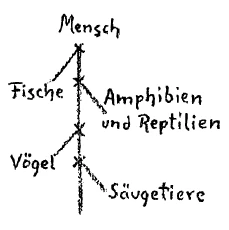
[ 42 ] The entire animal kingdom was once contained within human beings; that is to say, human beings stood at a stage between today’s animal kingdom and the human kingdom. In order to continue developing, they had to expel from themselves those parts that could not keep pace with their evolution. At that time, they expelled what now constitutes our animal kingdom. Originally, then, animals were far less distinct from humans than they are now. They then gradually degenerated. However, the separation of the animal kingdom did not occur suddenly, but rather very gradually. First the fish, then the reptiles and amphibians, then the birds and mammals. And within these groups, too, there was again only a gradual separation. For example, the predators were separated earlier than the apes. When the lions were separated out, the constellation in which the Sun was located was named Leo, and when humanity separated out the nature of the bull, the constellation was named Taurus. The names of the four apocalyptic beasts in the Book of Revelation point to the same thing. They are called the eagle, the lion, the bull, and the man. But this does not yet explain the names of all the zodiac constellations.
[ 43 ] The Moon of earlier times—before the Earth had solidified—consisted of soft plant matter, like living peat or a mass of spinach, interwoven with a woody framework that has since hardened into rock. Within this soft mass lived the lunar plants—actually plant-animals—which occupied a position between today’s animals and plants. They thus lived within plant matter. During the Earth’s separation—when the four kingdoms of nature—minerals, plants, animals, and humans—were formed—some did not undergo the complete transformation into today’s plants. This is how parasitic plants came into being.
“Before the voice can speak before the masters, the wounded must unlearn it.” (From Light on the Path by Mabel Collins.)
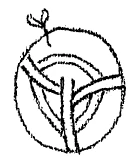
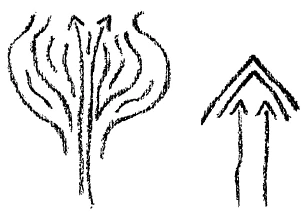
[ 44 ] When we send out a thought of love, it forms a beautiful thought-form, resembling a flower that gently opens and completely envelops the one to whom the thought of love is directed. If we think a thought of hatred, it forms a sharp, angular shape, closed at the top, designed to wound. What we call the “Master” is the divine voice that speaks within us. It speaks constantly, but we do not always let it out. The thought of love is open, allowing the Master’s voice to resonate through it. But the closed thought-form of hatred leaves no way out for the divine thought-form, so that it must remain unheard.
A lie is murder in the astral realm.
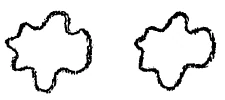
[ 45 ] Let’s suppose I have the following thought: I met a person. This creates a very specific thought form. Now I say the same thing to someone else: I met a person. — Once again, the same thought form is generated. The two thought forms encounter each other and reinforce one another. But if I lie and say, “I did not meet that person”—then a thought form is generated that is opposite to the first one. The two thought forms collide and destroy each other. The explosion takes place in the liar’s astral body.
How can you protect your astral body from negative influences?
[ 46 ] The best way to do this is by being pure and truthful oneself. However, as a special means of protection, one can also form an astral shell—a blue veil—through vigorous concentration of the will. One tells oneself firmly and emphatically: “All my good qualities shall surround me like a shield!”
Why did the early Christians use the symbol of the fish in addition to that of the lamb?
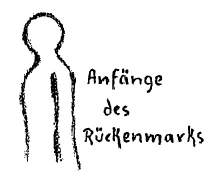
[ 47 ] In fish, especially in the amphioxus, the spinal cord begins to form. Human beings once were in this early stage; they still had the nature of fish within them, were entirely soul, and worked on their bodies from the outside. Then they separated themselves from the fish. The brain later developed from the spinal cord. - Goethe already knew this. Dr. Steiner found this as a small note written in pencil in a notebook while he was working in the Goethe Archive in Weimar. - Through this, the human being becomes a self. But this self is ennobled by Christianity, and that is why the fish is the symbol of Christians. The legend of Jonah tells the same story. Jonah—the human being—is first outside the fish, that is, working from the outside as a soul. Then he becomes a self and slips into the fish—the physical body. At initiation, the human being leaves the physical body again.
Can you see physical objects after death?
[ 48 ] After death, one sees nothing physical, but rather the corresponding astral forms—astral force-images—and devachanic forms. The mineral aspect is absent; it appears as a void, like a photographic negative. One sees a clock in Devachan because human intention is involved. Thus, one sees every human creation there.
| Atma | transformed physical body | |
| Budhi | transformed etheric body | |
| Manas | ||
| Kama Manas | Self | |
| Kama | Astral body | |
| Prana | Etheric body | |
| Physical body |
[ 49 ] The universal life-force is called Prana. It flows like water; but when it is shaped—just as water is poured into a vessel—and poured into the physical body, it is called the etheric body. Similarly, the universal astral matter is called Kama, which means “matter of desire.” When formed into a body, it is called the astral body. The “I” is the center of the person. Kama extends into it, as does Manas. The “I” is thus a mixture of Kama and Manas. Kama must be completely transformed and refined so that it becomes Manas. When the etheric body is refined, Budhi arises, and Atma arises through the transformation of the physical body.
| The Mental Realm | ||
| Arupa | VII | Causal Body |
| VI | Causal Body | |
| V | Causal Body | |
| Akasha Chronicle | ||
| Rupa | IV | Ether Circle |
| III | Air Circle | |
| II | Oceanic region, like the blood in the human body | |
| I | Continental region |
[ 50 ] The continental realm contains all physical matter; the maritime realm, all life; the air realm, all sensations; and the etheric realm, all thoughts. At the boundary of the etheric realm lies the Akashic Records. They contain everything that has ever been thought. Beyond the Akashic Records lies everything that has not yet been thought—Arupa. All newly conceived thoughts, all inventions, and so on originate from the Arupa region. Those who have developed Kama Manas reach the etheric sphere after death, where they encounter independent thoughts. The “I” shapes the astral body so that it becomes Manas. All Manas that has not yet been drawn into the astral is Arupa.
Denial of Life and Affirmation of Life.
[ 51 ] Schopenhauer says that the irrational will builds the world. Reason must therefore destroy it so that the world may perish. Through this, humanity will be redeemed. Schelling, Hegel, and Fichte advocate a different approach, which can be expressed in the words: “From God—to God!” Let us consider the negation and affirmation of life in a parable: I show someone a piece of magnetic iron and tell him that there is an invisible force within the iron called magnetism. He replies: “I want nothing to do with this force; I affirm the iron.”—In much the same way, the person who, when faced with the things of the world, says he affirms the world acts. Certainly, he affirms the world, but he denies the invisible forces within it. Only the one who seeks spiritual beings truly affirms life. The other denies half of life. Some Theosophists say: “I don’t care about the world; I only want to develop my higher self.” — In truth, these people seek only the lower human being. The higher human being is everywhere outside of us. When I feel the whole world within me, then I have found myself—my higher self. My self is outside of me. Knowledge of the world is knowledge of the self!
What effect does suggestion have?
[ 52 ] The suggestion affects the “I.” The higher bodies are lifted out of the physical body, and the “I”-body then unconsciously follows the hypnotist without a physical brain. The physical brain—which controls actions—is disconnected. It is different for the initiate. He retains control and consciousness even without a physical brain and therefore cannot be hypnotized.
“Pistis Sophia.”
[ 53 ] This book is written in Coptic and contains much of Christ’s teachings during the initiation of his disciples, as well as many inner interpretations of the parables. The 13th chapter is the most significant. The αίμαρμένη (Haimarmene) is Devachan. The entire supersensible world is divided into twelve eons. These are the seven divisions of the astral plane and the five lowest divisions of Devachan. From Devachan, straying spirits can be purified. The Purifier of Light before Christ is Melchizedek. He is the one referred to when speaking of the ἐπίσκοπος (Episkopos) of Light.
[ 54 ] The term ἄρχοντες (Archons) refers to the evil powers.
Question not recorded.
[ 55 ] Strife and debate are not the domain of Theosophy. We should not waste time on arguments, but speak only to those who have a heart and mind open to Theosophy.
Why does Christ say, “I am the way, the truth, and the life”—when great religious leaders had already shown the way before him?
[ 56 ] One must first put oneself in the mindset of that time. Back then, when one heard the outward word, one also heard its spiritual content at the same time. Then consider the following: Christ was the embodiment of the second Person of God. No religious founder before him had embodied the full abundance of the Logos within himself. But whatever divine essence was embodied in his predecessors was already a part of the Logos—that is, Christ himself. He thus includes everything that came before him in the words: “I am the Way, the Truth, and the Life.” These words can also be taken literally in another sense. The founders of religions before Christ showed the way and taught the truth, but they did not exemplify the divine mystery of humanity. They could therefore say: “I am the way and the truth.” — Christ alone can say: “I am the way, the truth, and the life.” — Now, Elijah is called “the way” and Moses “the truth.” At the Transfiguration, Christ appears, and with him Elijah and Moses. The Transfiguration thus declares: “I am the way, the truth, and the life.” — Buddha’s entry into Nirvana—his death—is the same as Christ’s Transfiguration. Thus, where Buddha’s ministry ends, Christ’s ministry—his life—actually begins.