

The Christian Mystery
GA 97
16 February 1907, Leipzig
Translated by Steiner Online Library
21. Who are the Rosicrucians?
[ 1 ] For those who study theosophical literature, the name “Rosicrucians” carries a sense of something vague and unclear, as if there were a mystery behind it. Many see it as a term for people who, in the 18th century, dabbled in magic—both possible and impossible. In works by scholars seeking to study the Rosicrucians from a scientific and historical perspective, one senses a benevolent shrug when they write, for example: “There was once a kind of brotherhood that held high ideals and ideas of moral progress.” — Perhaps their symbolic formulas are still mentioned there. In any case, scholarly works will repeatedly emphasize that the Rosicrucians have fallen into decay. If the Rosicrucians had ever been what is said of them, then Rosicrucianism would be the most perverse thing imaginable. In truth, they represent something that belongs to the most valuable aspects of humanity. Outwardly, one could not fathom it. The secrets have never been committed to books. If anything of it became known, it was only through betrayal or the like, and that could then easily be regarded as folly or superstition. Such a view has nothing to do with what Rosicrucianism was. However, something of what Rosicrucianism encompasses can be found in a book published in 1616. The author’s name was Johann Valentin Andreae. It was titled The Chemical Wedding of Christian Rosenkreutz and depicts the journey of a person who became a Rosicrucian. Later, Andreae published a book about which it was unclear whether it was serious, a joke, or a retraction.
[ 2 ] In our discussion today, we will uncover what may already be made public regarding the true nature of Rosicrucianism. Initiation has existed throughout the ages. People are at different stages of development. There are highly evolved individuals who are initiated into the deepest mysteries of the universe, who know something of how the worlds are formed, how the Earth came into being, and how human beings attain ever higher stages of development. When it is said that the initiate is knowledgeable, this is often taken too lightly. To know what the true mystery of humanity is, to know what humanity’s future holds—that is the greatest thing a human being can learn. Yes, there is a knowledge that has a downright deadly effect on the unprepared. If it were disclosed today without further ado, humanity would be doomed. Humanity would be divided; the majority would be destroyed, while the smaller portion would benefit from it. The secret can never be coaxed out of the initiate by an uninitiated person; not even through torture or martyrdom. If you were to demand it from an initiate, he would never reveal the ultimate secret of the world to an uninitiated person. The mere thought of having to reveal the secret would drive him mad or lead to his death. I will present to you, in a metaphor, the perspective of the entire development connected with this secret: an avenue that grows narrower and narrower—or so it seems—even though the great secret will one day be revealed to all people.
[ 3 ] Rosicrucianism is a form of initiation. It was founded by Christian Rosenkreutz. There are various paths of initiation. One was taught by the ancient Rishis, the Indians; this is the Eastern path of yoga. Then there was the Christian-Gnostic path, and the third is the Rosicrucian path. All three paths lead to the summit of initiation. However, people usually fail to consider how fundamentally different the spiritual and physical constitutions of Indians and Europeans are. It would be impossible even for the European body to follow the Indian path. Furthermore, the influence of external conditions in all their great diversity is not taken into account. You can see, for example, that in India certain diseases—such as cholera and smallpox—take a completely different course in hot countries than in cold ones. The environment is entirely different and accordingly affects all aspects of the human being. It was therefore a strange notion to believe that yoga training would be feasible for Europeans. That was a mistake. However, it was not known that since the 14th century, the Rosicrucians have been following a path of development.
[ 4 ] The Rosicrucian path is by no means unchristian. For many people who are fervent and firmly grounded in Christianity, the Christian-Gnostic path is the right one, and they reach the highest peaks on it. But the number of such individuals is dwindling. Rosicrucianism holds the deepest mysteries of Christianity, but it also offers the possibility of dispelling all the doubts into which people are now led by popular—or even less popular—views. No one today is protected from the most bitter doubts that assail them from all sides. Through Christian education alone, they would not be able to confront these doubts in the proper way, nor would they know how to protect and defend themselves. You must not take this in a superficial way. If, for example, someone were to say, “I do not read Haeckel; I shut myself off in my Christian worldview,” nothing would be achieved by that. We live in a world in which human beings are completely imbued with civilization. When we use railroads or newly developed sources of light, we are making use of the laws of nature. No matter how much a person may shut himself off: in every locomotive, in every artificial flame, these thoughts—which live in the spiritual realm—make themselves known to him. If someone were to limit themselves solely to reading the Bible, their astral body—their soul body—would still be surrounded at night by all manner of destructive soul-states. You do not know why you become nervous. The one who knows the thoughts flowing in unconsciously understands this. This is not about materialistic science as such, but about the entire spiritual atmosphere in which we live. In the 12th century, religious fervor still prevailed; the Church was the spiritual and physical center. People who had worked hard would take refuge in the house of spiritual powers and find peace there. Things have changed today. Rosicrucian training takes these facts into account; it anticipates everything that modern people are confronted with.
[ 5 ] What, then, is Rosicrucian training? Here you will come to know lofty ideals. Anyone who wishes to undergo this training must turn to one who possesses the relevant knowledge. From the very first steps they take, the student sees what is essential. What the Rosicrucian training brings about is a complete transformation of the human being. Only by acquiring the abilities of the higher world can a person become a citizen of that world.
[ 6 ] Seven components, or practices, are part of the Rosicrucian secret training. First: proper study; second: mastery of the imagination; third: learning occult script; fourth: discovery of the Philosopher’s Stone; fifth: knowledge of the human being himself, the world in miniature, the microcosm; sixth: knowledge of the macrocosm; seventh: understanding what godliness is. There are often variations in the order, so that a teacher, depending on the student’s individuality, may, for example, choose what is listed fifth as the fourth.
[ 7 ] You may ask: Is there still a genuine Rosicrucian Order today? Yes, there is, and it will only attain its greatest significance in the future. These Rosicrucian brothers also have certain distinguishing marks. Not many can step into the public eye; some operate entirely in silence. Those who seek them will find them, and those who do not find them may assume that the time has not yet come for them. But the encounter will inevitably take place. Often it looks like a true coincidence. For example, you might have to wait three hours in a waiting room because a train line is snowed in. A stranger approaches you, seemingly by chance. You have found your teacher in him. This is just one example I’m giving you here.
[ 8 ] First: Proper study. What is meant by this? You are guided into worlds of which the ordinary person has no conception. It is necessary to find one’s way within them. A dreamer who lacks a firm foundation in his thinking is not suited for this. Sound thinking is a prerequisite. One must look around; one must strive to observe one’s surroundings with a clear eye, but also be able to shut off one’s senses. This expresses a truth that not everyone appreciates—not even the greatest philosophers. Eduard von Hartmann, for example, stated it time and again: In every act of thinking, something of the senses still remains, be it an impression of sound or color. — It is an incredible act of immodesty to claim that thinking that contains nothing sensory is impossible. What leads to such senseless thinking is now presented in spiritual scientific literature and in lectures.
[ 9 ] Those who prove themselves suitable are led deeper into this knowledge. But the elementary part of this knowledge is accessible to a large portion of humanity. The study that is made available to people today—which leads away from the sensory realm of the world—consists of training the mind. These have nothing to do with what surrounds us in the sensory world. Anyone who wishes to penetrate even deeper must direct their mind toward intensified mental training. I attempted to provide guidance toward such senseless thinking in the two writings: The Philosophy of Freedom and Truth and Science. It is this: Anyone who begins to immerse themselves in these books will notice how one thought follows another in a specific, necessary sequence of thought. All who strive to rise higher thereby receive the means for true spiritual growth.
[ 10 ] Second: The appropriation of imagination. Here, imagination differs from ordinary thinking. Think of Goethe’s words: “Everything transitory is merely a parable.” When you see a person with a smiling or sorrowful expression, you will not say that a wrinkle is forming on their face or that a tear is rolling down their cheek; rather, you will say to yourself that this is the expression of a cheerful soul, and that one of a sad one. The outer reveals the inner to you; it is a symbol, a parable for the soul’s experience. Everyone will admit this when it comes to human beings. Everyone knows the difference between a human head and its image. The geologist describes the Earth to you without being concerned with anything other than its purely physical structure. People do not know that the Earth’s body is the body of a being, and that certain plants are expressions of the cheerful and the sad Earth spirit. Goethe knew how to speak of this; he knew how to regard the Earth as a body and knew what permeates it. In Faust, he has the Earth spirit say:
In the torrents of life, in the storm of deeds
I surge back and forth,
Weaving to and fro!
Birth and grave,
An eternal sea,
A shifting weave,
A blazing life,
Thus I create at the whirring loom of time
And weave a living garment for the Deity.
[ 11 ] Everything on Earth is a parable for what is happening inside the Earth. People wander about on the Earth’s body. From my body—so the Earth might say—grows that which provides people with their bread. - In that passage from the Gospel of John: “He who eats my bread tramples me underfoot,” one of the deepest mysteries of the worldview is expressed.
[ 12 ] One develops imagination by seeing a parable in every thing. To do this, however, one must first have learned logical thinking. But in Rosicrucian training, no one will choose a different parable. Everyone perceives in everything a parable of the Eternal. I must here present in the form of a dialogue what lies behind an allegory that was first taught in the medieval temples and then in the Rosicrucian schools. The teacher said to the student: Look at the plant, how its root penetrates the soil and how it turns its calyx—the seat of the reproductive organs—toward the sunlight. The calyx is kissed chastely by the sun’s ray, and through this a new being comes into being. The sun’s ray is also called the sacred lance of love. Even Darwin says: “The root of the plant is comparable to the head.” — Man is an inverted plant. His reproductive organs are modestly turned toward the center of the earth. The animal stands between man and plant. The three kingdoms of nature are symbolically represented by a cross.
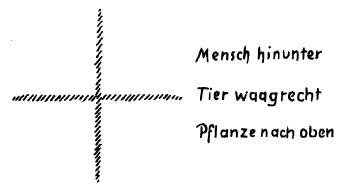
[ 13 ] Plato says: The soul of the world is crucified at the cross of the body of the world.
[ 14 ] Now the Rosicrucian teacher instructs the student: “Compare, then, carnal matter with chaste, plant-like matter—but a time will come when man will be purified of his desires and passions, and he will mature to a level where he shines toward the spiritual sun, as chaste and desireless as the chaste plant.” Through this ideal, he will purify his flesh so that fertilization takes place chastely and purely. This ideal is represented in medieval teachings by the Holy Grail. The chalice is a sacred symbol of what human sensuality must become when it resembles the calyx of a plant. Then it will be kissed by the white dove—the chalice is depicted with the dove above it. To spiritualize the world in this way, to see one’s surroundings in such images, elevates one to the contemplation of astral images. The mind and feelings give rise to the imagination.
[ 15 ] Third: Learning the occult script. The occult script consists of imitating the inner currents of nature. One such symbol is the vortex symbol. If you could see the Orion Nebula in its entirety, you would perceive it as two interlocking sixes. Here you see a world passing away and a world coming into being within the nebula. It is the same everywhere. When a plant produces a new fruit, nothing at all passes from the old plant into the new one. Nothing other than the forces themselves cause a new plant to form. There, too, you would see only the vortex coiling inward and coiling outward. Likewise, you could see how an old culture coils inward upon itself and a new one winds its way out. This spiritual process can help us understand such a written character.
[ 16 ] Eight hundred years before the birth of Christ, the sun entered the sign of Aries, or the Lamb. Every spring, it moves a little further. Now the vernal equinox is in the constellation of Pisces. In earlier times, people believed that Aries brought them all blessings—the new strength of spring. They even associated the Savior with it. In the early days of Christianity, their symbol was the cross with the lamb. Before the sun entered the constellation of Aries in the spring, it was in the constellation of Taurus. At that time, the Egyptians worshipped Apis, and the Persians worshipped the Mithraic bull. After the Flood, the sun was in the constellation of Cancer. Cancer was given this occult symbol:

[ 17 ] And so there are many such lines, but also colors. And one learns such symbols, which lead us into the forces and powers of nature. One learns to develop the will through occult writings.
[ 18 ] Fourth: The discovery of the Philosopher’s Stone. In the 18th century, this was understood to be a secret. Someone had even published something about it at that time. It is something everyone knows. The Philosopher’s Stone is at the same time the most precious thing a human being can attain, what a human being can make of his or her own organism in order to achieve higher development.
[ 19 ] Here I would like to share with you a parable from Vedanta philosophy: Once, people wanted to test whether a person could live without eyes. After a year, the person in question said: “Yes, I have lived, but as a blind man.”—Then he tried to live without ears, and after a year he reported: “Yes, I have lived without ears, but as a deaf man.”—His voice was taken away, and he lived as a mute. Now they were to take his breath away as well, but that was impossible: without breath, he could not live. Breath brings us the air of life. “And God breathed into the man the breath of life, and he became a living soul.” With every breath, we inhale oxygen and exhale carbon dioxide. In plants, the cycle is reversed. Plants build their bodies from carbon. That is why, even after millennia, we still find plants fossilized in coal. Human beings contain carbon within themselves; they inhale oxygen, and carbon dioxide is produced and expelled. Animals do the same. Now, the Rosicrucian School teaches a special form of the respiratory process, and through this, human beings learn the process that plants carry out within themselves. Then human beings will be able to transform carbon within themselves: they will themselves convert the blue, returning blood into red blood. They will absorb the nature of plants and will one day do what plants do today. The Rosicrucian says: Today your body is built of flesh; one day you will build it yourself through your breath. The nature of the plant will manifest within you, but you will not sleep as it does; you will be present with clairvoyant awareness.
[ 20 ] Humanity is moving toward this ideal: to build its body from carbon—ordinary coal is the Philosopher’s Stone. It will not be black coal, but transparent, water-clear carbon, once the human body has become star-like. These are not merely chemical processes, but lofty ideals. The Rosicrucian gradually undergoes this process, and later all of humanity will ascend to this level.
[ 21 ] Fifth: The recognition of human beings as a microcosm. The world is spread out throughout the rest of nature, and human beings are the essence of it. Everything in the world is spread out as letters, and human beings are the word formed from them. At the beginning of the 19th century, Oken and Schelling put forward quite correct fundamental ideas on this subject. They sought to clarify the essence corresponding to a particular organ. Oken took a somewhat grotesque approach when he declared: “The tongue is a squid.”—Goethe says: “The eye is formed by light for light.”—We recognize the true nature of light only when we find within the human being that which corresponds to light.
[ 22 ] The teacher gives the student a guiding principle: to focus on a single point—that organ behind the bridge of the nose—and the student comes to understand the nature of human dream consciousness in addition to today’s clear consciousness. And a person comes to know the whole world when they immerse themselves in the spleen, the liver, and other organs. Once they have expanded their consciousness through this inner immersion—though brooding on these things can be dangerous—they will become one with the whole world.
[ 23 ] Sixth: Knowledge of the Macrocosm. Whoever has understood what has been said above will also recognize the Creator behind all creatures.
[ 24 ] Seventh: Recognition of Divinity. On the seventh stage, a person reaches a point that evokes a sense of the universe from the depths of the human soul and—something they are only entitled to at this stage—a sense of spiritual bliss. Only through the knowledge of the macrocosm do they learn to immerse themselves in this sense of the universe. A clear immersion into all individual things is: divinity. There, one learns what lies behind nature as a soul. Someone once said to me: “I never thought that the stone felt anything when it was struck.”—The spirit of the mineral kingdom experiences the striking of the stone as the highest delight, as a blissful feeling. While it may seem to us that the marble quarry must be suffering, for the spirit of the stone it is the highest bliss. Now you might ask: Why aren’t these details revealed? Someone once said that this could be extremely useful for humanity. I replied: People would seek to derive selfish advantage from it, and this secret can only be placed in the service of humanity in the most selfless way.
[ 25 ] The Rosicrucians knew this secret, as do those who now walk the earth and serve human progress; they share what serves progress—they who know how the “Chemical Wedding” can take place.