

Nature and Spirit Beings
Their Influence on Our Visible World
GA 98
4 December 1908, Munich
Translated by Steiner Online Library
8. The elemental Realms, their Characteristics, and their Effects
[ 1 ] What has traditionally been called the elemental realms is not as easy to understand as one might think at first glance. For these elemental realms belong to that which lies beyond the world of perception, beyond what immediately presents itself to the senses.
[ 2 ] The best way to approach this subject is to start with what is perceptible to the senses—the realms that are present in the sensory world of human observation. There, spread out before our senses on the physical plane, we have four kingdoms: the mineral kingdom, the plant kingdom, the animal kingdom, and the human kingdom. This is what everyone knows. Now let us clarify exactly what is meant by these four kingdoms, because not everyone has a clear grasp of their precise definitions. That is why it is not so easy to gain an understanding of the first, second, and third elemental kingdoms. Precisely when speaking of such difficult matters, one must be mindful from the outset that one will not reach any real goal if one believes that a concept—once pinned down, once boxed in—can then be retained within that box. In the physical-sensory world, this is still possible; there, things stand side by side, neatly demarcated from one another—such as a book, a piece of chalk, or a rose—and we can stick to applying a single concept to each individual thing. Once we have named an object, we can count on having something definite and distinct. But if we turn to the astral plane, which directly adjoins our world and penetrates it most closely, this is no longer the case: there is a world of eternal motion. Consider the human astral body—that which surrounds the human being as the aura and is the expression of instincts, desires, and so on—and you will see that this astral body is in a constant ebb and flow of colors and forms that change from moment to moment: new colors shine forth, while others fade away. This is how it is with human beings. Now there are beings that flit about on the astral plane. Their astral bodies do not belong to a physical body, yet they are no less changeable and shifting; every second they take on a different form, color, and luminosity. Everything on this astral plane is the constant expression of what lies within these beings. We would find ourselves in a very tight spot if we tried to make our concepts there as rigid and unchanging as they are on the physical plane; we must adapt to the fluidity of the forms; we must have flexible concepts and be able to apply a concept sometimes in one way, sometimes in another.
[ 3 ] This is true to an even greater extent in the higher worlds. From a higher perspective, everything that exists in the physical world is an expression of the forces and beings of those higher worlds. Such forces and beings are hidden in everything we see around us. This is precisely what accounts for the diversity of beings in the physical world. You see, for example, the mineral kingdom all around you; all seemingly lifeless beings on our Earth—all minerals—belong to it. You are told at first that these minerals on Earth have no etheric body, no astral body, and no “I” of their own. But this applies only to the physical world. One must know this in order to gain clarity about what exists on the physical plane. But if someone comes along and says, “A mineral is something that has only a physical body”—that is just as false as it is true when someone says, “The mineral kingdom is something that has only a physical body on the physical plane.” —For from a true, spiritual perspective, the mineral has only its physical body here on the physical plane and nothing else. If we wish to find the etheric body, we must ascend to the astral plane; that is where the etheric body is to be found. The moment a person becomes an astral clairvoyant, they see the mineral’s etheric body on the astral plane and, here on the physical plane, only its physical body. And viewed more broadly, the mineral also has an astral body; but this is not to be found on the astral plane—rather, one must seek it in the lower regions of Devachan. On the higher mental plane—the Arupa mental plane—resides the “I” of the mineral; from there, the mineral is directed by its “I.” To create a mental image of this in rough terms, you must say to yourself: I imagine a person who is clairvoyant up to the Devachan plane. To this clairvoyant, who can still see on the Arupa plane, minerals appear similar to human fingernails, for minerals are, as it were, the fingernails of beings whose “I” resides in the upper Devachan. You cannot create a mental image of fingernails without the human being; the same is true of the mineral and its “I.”
[ 4 ] Let us consider a rock crystal here on Earth: if you look away from it, there in the astral world is the etheric body that animates the physical body. But you would not be able to perceive there that the mineral is suffering in any way if you were to inflict harm upon it. It is only in Devachan that you will find the pleasure and joy, the suffering and pain of the mineral—but in a way quite different from the mental image usually held. The mineral’s perception of pain is not like that of animals; one must not imagine that the mineral feels pain when it is hammered and shattered. When workers in a quarry shatter the minerals—seemingly damaging them—this is, in Devachan, actually a feeling of well-being, a sensation of pleasure for the minerals. For them, therefore, it is exactly the opposite of what occurs in the human and animal kingdoms. When you enter the Devachan plane, you can encounter the spirits of the minerals there. However, a mineral personality consists not merely of a single mineral but of an entire system—just as your individual fingernails do not possess distinct souls. If someone were to form a mental image of everything astral being on the astral plane, they would be mistaken. It is so natural to always seek the astral on the astral plane; but a clear distinction must be made between the inner nature of a being and the environment in which it lives. Just as your “I” has no physical nature and yet lives on the physical plane, so the astral body of the mineral does not live on the astral plane, but in the lower Devachan. We must not take these concepts schematically, but must work our way toward a more precise definition of things.
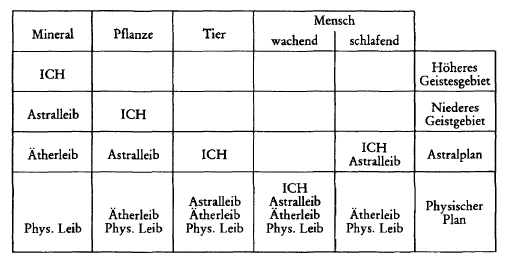
[ 5 ] Let us now consider the plant as it appears to us; here on the physical plane, it has the physical body and the etheric body. It has both of these here, but where must you look for the plant’s astral body? — In the astral world, and the “I” in the lower regions of Devachan. Let us move on to the animal. In the physical-sensory world, the animal has the physical body, the etheric body, and the astral body, but its “I” resides on the astral plane. This means that just as you encounter human beings here as persons—as distinct, individual entities—so too will you find the animal “I’s” on the astral plane as distinct personalities. We must understand them as follows: All groups that share the same form have a common “I.” Human beings differ from them in that each one has an individual “I.” On the astral plane, there is the lion “I,” the tiger “I,” and so on; there they are distinct entities; the individual “I’s” of each species populate the astral plane just as human beings populate the physical-sensory world. For human beings, however, the physical body, the etheric body, the astral body, and the “I” have descended to the physical plane. But this is true only in the waking state; with a sleeping person, the situation is different. In the physical world, there is the physical body and the etheric body; on the astral plane, there is the astral body and the “I.” Thus, in the sleeping state, the fourfold human being is distributed between the physical plane and the next higher plane, the astral plane. On the physical plane, the human being then has the value of a plant (see diagram on p. 134).
[ 6 ] We have already seen here the different ways in which we must use terms such as “astral” and so on. We will only arrive at a thorough understanding when we realize that things cannot be moved around like pieces on a chessboard. When we now consider the human being itself, we must view this human being in the following way. We have the physical body, the etheric and astral bodies, and the ego. It has already been emphasized here on several occasions that it is essential that we be clear about the relationship between these four members. It is easy to think that the physical body is the most imperfect and the lowest. In a certain sense, however, it is the most perfect, for it has undergone four successive stages of development: on Saturn, the Sun, the Moon, and the Earth. The etheric body has attained only three degrees of perfection; it was added to the physical body only on the Sun; it is destined to rise higher, although today it is not yet as perfect as the physical body. The astral body was added only on the Moon; it has attained only a twofold degree of perfection. The ego is the “baby” among the four members of the human being; it was added only on Earth and is still in the early stages of its development; it exerts a constantly corrupting influence on the other bodies. Any anatomist who observes the wonderfully organized physical body marvels at the perfection of the heart and the brain. How imperfect, by contrast, are the desires and impulses of the ego! The ego has a craving for wine, beer, and so on, which have a destructive effect throughout one’s entire life, and yet the physical body withstands these attacks for decades. Now we must make it clear to ourselves how the ego has been incorporated into the physical body and how the physical body first came into being.
[ 7 ] First came the Saturn evolution. That was the first phase of development for the precursor of our physical body. At that time, the human physical body had the cosmic value of a mineral. If you look at a mineral today, you see in it a stage of existence that has remained behind; it has preserved the stage that the physical body had on Saturn. However, you must not create a mental image of the physical body as it looked like our present-day minerals—that would be entirely wrong; today’s minerals are the most recent forms of evolution. In particular, the human body was not as dense back then; the density of the physical human body was very low.
[ 8 ] We must create a mental image of the relationships between the material levels. The first is what we call earth—that is, everything that is today generally referred to as a solid body: iron, copper, zinc, and so on; everything that is solid is earth. Second: everything that is liquid is water—for example, mercury; even if you liquefy iron, it is still water. Every liquid metal is water in the sense of Spiritual Science. Third: if you cause the water to evaporate or transform anything into a vapor—including metal vapor—it becomes air. Spiritual Science goes even further: it shows that air as such can be further rarefied, can transition into even more subtle states. Here one must go beyond what is currently understood in physics; here the spiritual researcher posits the ether of warmth or fire. For the spiritual researcher, fire is something that belongs in the line of earth, water, and air, whereas modern science sees in it merely a state of matter.
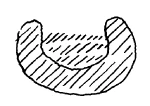
[ 9 ] On Saturn, heat was the substance of the human physical body. On the Sun, the human physical body was condensed to the density of air; then the etheric or Life-Body became embedded within it and transformed the physical body; thus we have a human physical body with an etheric body woven into it; this etheric body is single-membered, while the physical body is two-membered on the Sun. We must distinguish within the physical body on the Sun between a more perfect and a less perfect part—one that has not yet been permeated by the etheric body. In this picture of the physical body on the Sun, we must imagine that the inner part has not yet been touched by the etheric body; this is equivalent to the state of the physical body as it already existed on Saturn. Thus, we already have a part at the plant stage that is interwoven with another part that is still at the mineral stage; but the two are completely interwoven (see Figure 1).
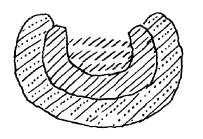
[ 10 ] We now turn to the physical body on the Moon. Here, it had already condensed to the level of water. Integrated into it are the etheric and astral bodies. Three distinct parts can be distinguished here. One is permeated by both the etheric and astral bodies, one only by the etheric body, and one has remained mineral (see Figure 2).
[ 11 ] Now let us consider the physical body on Earth. This is where the “I” comes into play. On Earth, there are four interwoven members. The first part is permeated by the etheric body, the astral body, and the “I”; the second part by the etheric and astral bodies; the third part only by the etheric body; and a fourth member is still at the mineral stage. It has the nature of a mineral and still stands on the Saturn stage today. These four members can be precisely distinguished within the physical body. The first member, into which all four members are woven, consists of the red blood cells. Wherever we have red blood, the four members are woven into it (see Figure 3).
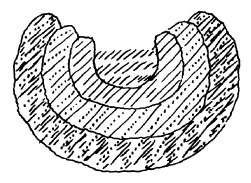
[ 12 ] The nerves are the second link. Wherever there are nerves, the physical body, the etheric body, and the astral body are interwoven with them. Wherever there are glands, the physical body and the etheric body are interwoven with them. All the sense organs, all the physical apparatus in the human being, have reached only the level of a mineral. They follow exactly the same laws as minerals. The eye and the ear belong to the mineral inclusions; there are also such parts in the brain. You see how tempting it sometimes is to become a materialist, because something that is mineral permeates the entire body. When the materialist says that the brain is mineral, he is partly right if he considers only that one aspect. In particular, there are very specific regions in the forebrain that, although permeated by other influences, are governed solely by mineral forces. If we were to consider bones and muscles, it would become even more complicated.
[ 13 ] Once the “I” had entered into human beings, it began to develop the soul of feeling, the soul of understanding, and the soul of consciousness, and in doing so, it formed the bones and muscles. It takes years just to distinguish these things properly if one wants to examine them closely. One must patiently follow the process step by step.
[ 14 ] When we look at a sleeping person, we see the physical body and the etheric body lying in bed. But this physical body is very complex. While the person is awake, the astral body and the “I” work within it through the blood. So when the physical body lies in bed and the person is asleep, what happens then? — What the etheric body can sustain is probably still being sustained; but the astral body and the “I” would have to contribute to the maintenance of the blood, so that death would occur for the blood every night, for it depends on the “I” and the astral body; but these abandon the body treacherously. The entire nervous system, too, is callously abandoned, and the astral body would also have to assist in its maintenance. We are thus faced with the remarkable fact that, strictly speaking, the blood and the nervous system would have to die off every night; they would be at the mercy of death if it were up to the human being. Other beings must step in; other entities must take over the human being’s work. Other beings must intervene from other worlds to properly preserve what the human being so callously abandons. Let us try to explain what kind of beings these are—those who intervene to give the human being the possibility of preserving his blood.
[ 15 ] We can form a mental image of these beings in the following way. Let us ask ourselves: Where, exactly, does the human “I” live when it lives here on the physical plane? In which of the three kingdoms? — You must ask yourselves: What can we actually perceive without clairvoyance? — We can only perceive the mineral kingdom. This is what is peculiar about human beings: they do not even fully comprehend the plant until they possess astral clairvoyance. Because human beings currently perceive only the mineral aspect of the plant, materialists claim that the plant is merely a conglomeration of mineral processes. Once a person has worked on themselves to the point of reaching the first stage of clairvoyance, the life of plants and the laws of life will be just as clear to them as the laws of the mineral world are to us now.
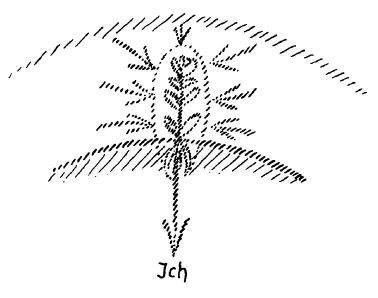
[ 16 ] When you assemble a machine or build a house, they are constructed according to the laws of the mineral world. A machine is built according to the laws of the mineral world, but we cannot build a plant in the same way. If you want a plant, you must leave this work to the entities that underlie nature. In the future, it will be possible to create plants in the laboratory, but only when this becomes a sacrament, a sacred act, for humankind. Only when humankind has become so serious and purified that the laboratory bench becomes an altar for them will they be permitted to represent living beings. Until then, not the slightest detail will be revealed about how living beings are put together. In other words: The “I” as a knowing entity lives in the mineral kingdom and will ascend to the plant kingdom, where it will learn to comprehend it just as it does the mineral kingdom today. Later, it will also learn to comprehend the laws of the animal kingdom and then those of the human kingdom. All people will learn to comprehend the inner nature of plants, animals, and human beings; these are prospects for the future. What one truly understands, one can also represent—for example, a clock. Modern human beings will never be able to represent anything from living nature without the help of the beings who stand behind nature, as long as it does not become a sacramental act for them. Only then will they ascend from the mineral kingdom to the plant kingdom. Human beings today are human, but they perceive only within the mineral kingdom. The human “I” lives in human form, but when the human “I” looks out into the environment, it perceives only within the mineral kingdom. This “I” therefore initially possesses only the ability to experience the blood in a mineral way, for it cannot do more than that. Even though during the day the “I” lives in the blood—inhabiting and experiencing it—it does so only in a mineral way. How does it do this? — When you look out into the world, your perception reveals to you the laws of the mineral kingdom. Observe this peculiar form of human activity. You look out with your senses and take in the laws of the mineral world, imprinting these laws upon the blood while you are awake; you press them into the entire blood, animating the blood in a mineral sense. This is the unique process of what occurs through cognition. If you create a mental image of the human being schematically (see drawing), the laws of the mineral world flow toward him from all sides. However, they do not stop at the sense organs but flow with the blood through the entire human body while awake.
[ 17 ] What does the plant world do? — You will come to understand how it is with plants if you carefully consider the following. You have always been told that the “I” works on the other bodies and transforms the astral body into the Spirit-Self. To the same extent that this happens, the laws of the plant kingdom flow into the human nervous system. When a person reaches the next stage of clairvoyance, the laws of the animal kingdom flow into their glandular system, and when a person works to transform the physical body, the laws of the human kingdom itself flow into the human body. All of this is intended for the waking state and for the states of higher clairvoyant consciousness. Human beings have thus now reached the stage where the “I” allows the laws of the mineral kingdom to flow into the blood. The “I” can do this only in the waking state; only then do the mineral laws enter the blood. When a person sleeps, the blood must also be nourished. And because this blood has been worked upon through four stages, three other forces must come into play. First, a force that is most closely related to the way in which the “I” works into the blood; this force is one that has not descended to the physical plane. The blood would die off if another “I” were not working on it while the human being sleeps. Another “I,” which has remained above on the astral plane, intervenes and temporarily takes over the work on the blood. When we consider human blood—this “special sap”—we see that during waking hours, the human “I” acts upon it on the physical plane, while at night, an “I” located on the astral plane acts upon the blood. Such “I’s” exist.
[ 18 ] I have previously spoken to you about the “I”s on the astral plane—the group “I”s of the animals; now we have another kind of “I” that lives on the astral plane and exerts an influence on human beings, animating the blood while the human “I” has left it. How? What do they bring into the blood? — That which has been necessary in the human body since the time of Saturn: fire, warmth. These are spirits who have never descended to the physical plane—spiritual beings who live on the astral plane and have a body of fire. In the mineral kingdom, every thing appears to us in a certain state of warmth. Thus, you encounter warmth in your surroundings as a property of solid, liquid, and gaseous bodies. Try to imagine warmth in isolation—it does not exist on the physical plane. But on the astral plane, you would find such ebbing and flowing heat, such fire that moves back and forth as an independent entity, and within it, beings incarnated just as we ourselves were on Saturn. These enter the blood at night and enliven it with their heat. But something else must also take place, for the blood is also separated from the astral body, and the astral body is also necessary for its formation. It is therefore not enough for these “I”-beings to approach at night and work on the human being with their warmth-body; rather, other such beings must also be present who can act upon the blood in the same way the astral body does. These beings have their “I” on the Devachan plane; this “I” possesses a much higher body that has not even condensed to the level of warmth. The “I” that I described first has never descended as far as the physical world; it has remained on the astral plane. The second “I” has descended even less far; it has never entered the astral plane and has remained on the Devachan plane. It permeates the blood and brings about in it the same effects that the human astral body produces during the day.
[ 19 ] So you see how we are indeed watched over and protected at night by higher beings who do not live in the mineral kingdom. The human “I” descended as far as the mineral kingdom and will then ascend to the plant kingdom and so on. These other “I’s” have gradually remained behind the human kingdom: they form the hidden realms, the elemental realms, which lie beyond our physical world and exert their influence upon it. The first being that acts in the blood at night has a body of warmth, just as you have a physical body; it permeates the blood with warmth and meanwhile lives on the astral plane in its body of warmth, and through this body of warmth it belongs to the third elemental kingdom. These beings of the third elemental kingdom are the companions of the group souls of the animals; they belong to the same region. And these “I’s”—what can they actually do? — They do not need to be able to do what the human “I” can do, which has descended into the physical-sensory world; but they can replace the human “I” from the astral plane. These “I’s” act from the astral plane just as the animal group “I’s” do upon animals; therefore, we perceive them as beings similar to the animal group “I’s”—that is, they animate the human astral body with instincts, desires, and passions. Now, when we have an astral body before us, what lives within this astral body? — In addition to the “I,” there are beings living within it whose “I” resides on the astral plane. They permeate the astral body just as maggots permeate cheese. This is the third elemental kingdom; this kingdom shapes the instincts and passions that are animalistic.
[ 20 ] Behind this lies another realm: the second elemental realm. It acts and shapes within a purer element; it forms and structures the shapes of plants; it also acts upon human beings through their many plant-like elements: nails, hair, and so on. These are not permeated by the astral body, but only by the etheric body; therefore, they are not sensitive to pain. Hair and nails are products from which the astral body has already withdrawn; one can cut them without causing pain; the astral body used to be present in them. Much in the human being is of a plant nature, and the beings of the second elemental kingdom act upon all these plant elements. Thus, the forces that build up the plant’s body are forces of the second elemental kingdom. In plants, the plant-I—which permeates the etheric and astral bodies—and these beings of the second elemental kingdom work together. The plant-I on the Devachan plane is a companion to the beings of the second elemental kingdom. And while the plant-I acts upon the plant from within, these beings act upon it from without, shaping it and causing it to blossom and flourish. The entire plant is permeated by the etheric body. However, the plant does not have its own astral body; rather, the entire astral body of the Earth is the shared astral body of the plants. The plant ego is located at the center of the Earth for all plants. All the group egos of the plants are centralized at the center of the Earth. That is why, when you pull up a plant, you cause the Earth pain; but when you pick a flower, it brings the Earth such a sense of well-being as a cow feels when her calf suckles her milk. It is also a wonderful experience when you harvest the crops and grains in the fall—to see how great waves of well-being sweep across the Earth! The beings who work from the second elemental kingdom and cause the plants to take shape flock to the plant from all sides like butterflies. They work on the renewal of the leaves, flowers, and so on. This is what influences the plant from the second elemental kingdom.
[ 21 ] There is also a first elemental kingdom, which gives minerals their form. Animals derive their instinctive form from the beings of the third elemental kingdom. The leaves and other parts of plants are shaped by the second elemental kingdom; it works primarily through repetition. The formative forces of minerals, which act from the formless, are to be found in the higher Devachan. These three elemental kingdoms interpenetrate and flow into one another. Anyone who imagines them as separate can never arrive at realistic mental images. In the plant kingdom, you have the plant kingdom and the mineral kingdom; in the animal kingdom, you have the animal kingdom, the plant kingdom, and the mineral kingdom interwoven. In the case of human beings, the “I” is added. It was only with the arrival of the “I” that the human kingdom came into being on Earth. The “I” is what makes a human being a human being; it finds its expression in the blood. However, the “I” can only penetrate the mineral kingdom through recognition; it must leave the other kingdoms to the beings of the elemental realms. Within the mineral kingdom lies not only the mineral kingdom itself but also the first elemental realm; this is why we have a shaped mineral kingdom. The plant is only a plant shaped by the second elemental kingdom; otherwise, it would be spherical. The animal is endowed with instincts and so on because the third elemental kingdom is also involved. Our world is something that is interwoven; only when we make our concepts more fluid can we gradually come to understand the matter.
[ 22 ] If we want to create a mental image of how this relates to the third elemental kingdom in the animal kingdom, we can illustrate it with an example. You are all familiar with the flight of birds. Birds follow very specific migration routes, from the northeast to the southwest, and from the southwest to the northeast. Who directs these migrations?—The group souls of the birds. In these migrations, the impulse for regular wanderings across the Earth is expressed; here, the species or group souls of the animals are in charge. In contrast, the beings of the third elemental kingdom—the companions of the animal group souls—give the animal its form so that it can possess this instinct, so that it has a vehicle for the instinct. To put it simply: the “I’s” that constitute the animal group souls form a community on the astral plane; the beings of the third elemental kingdom form another community. But they must work together in sweet harmony: one group provides the instincts, while the other provides the bodies, shaping and forming them so that the instinct can be lived out.
[ 23 ] The physical forms of plants originate from the beings of the second elemental kingdom. Everything that gives form to minerals comes from the beings of the first elemental kingdom. The forces of minerals—those that act as repulsion and attraction, the atomic forces—originate from the group-Ichen of the minerals. What gives form to minerals are the beings of the first elemental kingdom.
[ 24 ] This opens up a perspective on where to look for the effects of the realms in our world. However, one must engage with these things very closely. Thus, one can say to a plant: “You are a living being; you owe that to the plant-self. But the beings of the second elemental realm give you your form.”
[ 25 ] Thus, the various kingdoms are now brought together. There are seven of them. The first elemental kingdom is the one that gives form to minerals, such as crystals. The second elemental kingdom is active in shaping plant forms. The third elemental kingdom animates the blood during sleep and, at the same time, shapes the instinctual life of animals. The mineral kingdom is the one into which an “I” can work; the plant kingdom is one into which an “I” can shape a plant world; the animal kingdom is the one into which an “I” can shape an animal world; and the human kingdom is the one into which an “I” can shape a human world. From this, one can see that patience is essential to mastering Spiritual Science. The world is complex in its structure; the highest truths are not the simplest. It is an exceedingly foolish claim to assert that one can grasp the highest things with the simplest concepts. This stems solely from laziness. One realizes that one cannot understand a clock right away, yet one wants to understand the world immediately. If one wishes to recognize the Divine, one needs endless patience, for the Divine contains everything. To understand the world, one wants to apply the simplest concepts. That is mere convenience, however piously the soul may express it. The divine is profound, and it takes an eternity to recognize it. Human beings may well carry the spark of the divine within them, but it is only by gathering the facts of the world that one can recognize the essence of the divine.
[ 26 ] We must first learn great patience and the renunciation of knowledge. One must mature before forming a judgment. The world is infinite in every respect. And one must have the humility to say that, in a sense, everything is only half true. One must transform everything into moral impulses, including the division of the human being into ten and twelve members. Spiritual Science provides images to which the feelings should be attuned. Spiritual Science is of value only if we not only draw knowledge from it but are also filled with the noblest feelings for the depth of our surroundings. The greater this, the greater becomes the longing for the Divine. Precisely because the Divine appears to human beings as something removed to distant heights, they should strive all the more to become strong so that they may in turn attain it.