

Human Development and Christ-Knowledge
GA 100
22 November 1907, Basel
Translated by Steiner Online Library
The Gospel of John VII
[ 1 ] In a text such as the Gospel of John, everything is significant and important, and nothing could be expressed any differently than it is written there. Why, for example, does the Holy Spirit appear in the form of a dove? It would take a series of lectures to explain this. But one can at least gain some insight into it by viewing human evolution from a different perspective than has been done so far. In earlier lectures, the assertion—which seems outrageous to those who think in scientific terms—was already made that human beings were already present at the beginning of evolution and that they participated in Earth’s evolution as their own. However, it must of course not be forgotten that early humans were organized and constituted quite differently from those of today. Even the Atlantean human differed greatly in appearance from today’s human. This difference is even greater in the case of humans from the Lemurian era, and even greater still in the case of humans from the time when the Moon and Sun were still connected to our planet.
[ 2 ] To gain an understanding of how spiritual science views evolution, we must start with the most obvious point. Not all people living on Earth today are at the same stage of development. Alongside peoples who have reached a high level of culture, there are indigenous peoples who lag far behind in cultural development. A view has emerged in modern natural science—and it is held with great tenacity, even though recent facts contradict it—that the more highly developed peoples are descended from those who are less advanced in their development. This view does not correspond to the findings of spiritual science. Let us mention here, for example, the peoples who became known through the discovery of America, and briefly describe an episode that provides insight into the spiritual life of these peoples. As is well known, the white settlers had driven the Native American population farther and farther into the interior of the country and had not kept their promise to give them land. A chief of these Native Americans once said to the leader of a European expedition: “You palefaces have taken our lands from us and promised to give us others. But the white man has not kept his word to the brown man, and we know why. The pale man has little symbols in which magical beings dwell, and from them he seeks out the truth.” But what he learns is not the truth, for it is not good. The brown man does not seek the truth in such small magical symbols. He hears the “Great Spirit” in the rustling of the forest, in the trickling of the stream. Through lightning and thunder, the “Great Spirit” reveals to him what is right and wrong.
[ 3 ] In the American race, we find a primitive indigenous population that has remained far, far behind, even in terms of religious worldview. Yet it has preserved its belief in a monotheistic spirit that speaks to it through all the sounds of nature. The Native American has such an intimate relationship with nature that he still hears the voice of the supreme creative spirit in all of its manifestations, whereas the European is so steeped in materialistic culture that he can no longer perceive the voice of nature. Both peoples share the same origin; both descend from the inhabitants of Atlantis, who held a monotheistic faith born of spiritual clairvoyance. But the Europeans have ascended to a higher cultural level, while the Native Americans have remained stagnant and have thus fallen into decadence. One must always bear this developmental process in mind. It can be illustrated as follows. Over the course of millennia, our planet changes, and this change also brings about the evolution of humanity. The side branches that no longer fit into the circumstances become decadent. We thus have a straight trunk of development and branching side branches that decay (see diagram).
[ 4 ] Going further back from the point in the Atlantean era when Europeans and Native Americans were still united, we arrive at a time when the human body was still relatively soft, with a gelatinous consistency. There we see beings branching off and falling behind once again. These beings continue to evolve, but along a descending line, and from them arises the ape species.
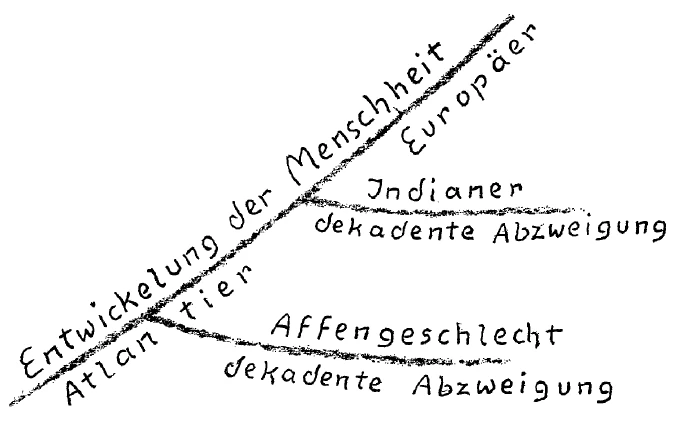
[ 5 ] We must not say that humans are descended from apes, but rather that both humans and apes are descended from a form that, however, had a completely different appearance from that of apes and modern humans. The divergence occurred at a point where this primordial form had the possibility, on the one hand, to evolve into a human being and, on the other hand, to degenerate into a distorted image of a human being. We shall pursue the theory of evolution only as far as is necessary to establish the connection with what has been said in earlier lectures. Among the ancient Atlanteans, the etheric body was still outside the physical body. Today, only the human astral body—and specifically during sleep—is outside the physical body. Therefore, today humans are only able to overcome the fatigue of the physical body during sleep, because then their astral body is outside the physical body and thus has the opportunity to act upon it. Further influences on the physical body are no longer possible. Only the remnants of such influences remain in phenomena such as blushing when ashamed, turning pale when frightened or startled, and so on. However, the further back we go into the Atlantean era—and the more the etheric body was outside the physical body—the more it was able to exert a transforming influence on the physical body. The etheric body’s dominion over the physical body was so great in earlier times because the physical body was still much more pliable and supple than it is now. At a stage of human development when the physical body had only a delicate, rudimentary skeletal structure, the power of the etheric body over the physical body was so great that human beings had the ability to extend an arm or a hand at will, to extend fingers from it at will, and so on. Such things seem absurd to modern humans. It would be entirely incorrect to imagine Lemurian humans as being like those of today. The Lemurian human did not walk on his limbs like a modern human; he was, more or less, an aerial being. All the organs of modern humans were present only in a rudimentary form; he was capable of metamorphosis. It is entirely incorrect to imagine that the Lemurian people were similar to modern humans, even if in a grotesque form. Even in the Atlantean epoch, the human body was still malleable and could be reshaped from within by the will. The reason for this was that the etheric body, as mentioned above, was still partially outside the physical body. Thus, the etheric body worked on the outer form, and those beings who did not work on their bodies in the proper way evolved into what we today call apes. This is how these caricatures of modern humans came into being. They are descended from us, not we from them. One might ask here: Why did the apes in particular branch off; why did a portion of them remain at a lower level as soulless beings—here the higher soul is meant, not the astral body? Different conditions simply arose. Human beings adapted to them, but the apes were unable to do so. Their physical bodies became rigid, whereas human beings were able to keep their physical bodies supple and malleable.
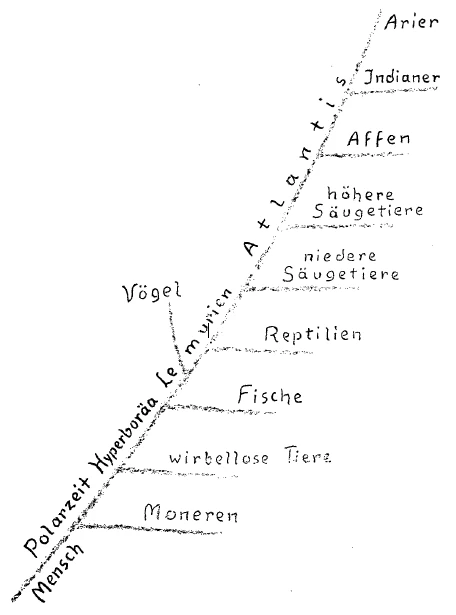
[ 6 ] At the beginning of Earth’s evolution, we must imagine human beings as having a subtle etheric body. They gradually transformed this body. A clairvoyant at that time would have perceived human beings as spheres. The illustration on page 243 is intended to explain the evolutionary lineage.
[ 7 ] Quite late in the Atlantic Era, the species that would later evolve into today’s apes branched off. Earlier in the Atlantic Era, certain higher mammals branched off; certain lower mammals branched off during the earliest part of the Atlantic Era. At that time, physical man was at the developmental level of a mammal; however, while mammals remained at this stage, man continued to evolve. In even earlier times, man was at the developmental level of a reptile. The body was quite different from that of a modern reptile, but the reptile emerged as its physical development fell into decline. Human beings developed their inner faculties, whereas the reptile lagged behind. It is a backward-developing brother of humankind. Even earlier, the lineage that became the bird species branched off. And going back even further, human beings stood at the stage preserved in today’s fish species. At that time, there was nothing higher on Earth than complex fish forms. In time immemorial, humankind stood at the level of an invertebrate animal. And branching off in the most ancient times, and thus surviving to our own day, is the single-celled organism that Haeckel calls Monera, which represents a brother of humankind that branched off in the most ancient times. If we construct the human family tree from this evolutionary series, it will correspond exactly with the family tree that Haeckel established in his writings:
| 1. Monera | 8. Gills and Intestines |
| 2. Unicellular Organisms | 9. Protostomes |
| 3. Multicellular organisms | 10. Craniates |
| 4. Coelomates | 11. Roundmouths |
| 5. Protostomes | 12. Primitive fish |
| 6. Flatworms | 13. Lobe-finned fish |
| 7. Cord worms | 14. Amphibian fish |
| 15. Gilled amphibians | 20. Marsupials |
| 16. Scaled amphibians | 21. Prosimians |
| 17. Proreptiles | 22. Dog-faced apes |
| 18. Mammalian reptiles | 23. Great apes |
| 19. Primitive mammals | 24. Ape-men |
| 25. Speaking humans | |
[ 8 ] We could just as easily adopt Haeckel’s evolutionary tree; the only difference is that Haeckel posits that animal forms arise first and then evolve up to humans, whereas we see humans as the primordial form and regard the animal world merely as a branch off that path—as degenerate humans. In fact, humans are the firstborn of the Earth; they have evolved in a direct line, leaving the other beings behind at the various stages.
[ 9 ] If we consider the time when birds and reptiles diverged, we see that physical human forms did indeed exist at that time—some resembling the later species of birds, and others resembling the later reptiles. The seer looks back to that distant time when the spiritual essence of the human being had not yet taken possession of its body. He sees the group soul of humanity hovering around the bird-like body. It was here that those spiritual beings remained who had no need to descend into the physical plane. After they had come down to this level of the physical world, they developed upward again toward the spiritual. These are beings of the astral plane, the world of the Holy Spirit, who have retained the air sphere as their realm, just as human beings take possession of the physical earth, the earth sphere, as their realm. One must also imagine these beings in bird form when they are to make themselves physically visible to us. Therefore, the writer of the Gospel of John must depict the Holy Spirit—which descends into the conscious soul of Jesus and fills it as the spiritual self—under the symbol of a dove. This symbol appears to us as one of wondrous depth when we consider it in the context of human evolution.
[ 10 ] Let us now relate what is written in the Gospel of John to the development of humanity on Earth from yet another perspective. In doing so, let us briefly recapitulate a concept from the Rosicrucian School. At a certain stage of development, the student is told something like the following: Let us consider the plant in relation to the human being. The plant directs its roots downward, toward the center of the Earth, the seat of its “I.” It turns its reproductive organs chastely toward the sun, toward the light. In the light of the sun, it opens its blossom and allows the fruit to ripen. In esoteric science, this fertilizing effect of the light is called the touch of the sun’s sacred lance of love. It draws forth the blossom and brings about the fertility of the earth. What the plant sinks into the earth—the root—corresponds to the head of the human being. Human beings turn their heads toward the sun, toward the light. And what the plant turns toward the light—its reproductive organs—they modestly turn toward the earth. Human beings are the inverted image of the plant. The animal stands midway between the two. The plant is depicted vertically, oriented toward the earth; human beings are depicted just as vertically, turned away from the earth; the animal is depicted horizontally. Thus the shape of the cross is formed. Plato expresses this by saying: The world soul is crucified on the ancient world cross. — The cross is a cosmic symbol, set within the development of the worlds. Deep shivers ran through the student’s chest when he was able to look in this way into the unfolding of world development. In the same way, we also see in the plant a kindred being from the distant past. Originally, human beings, too, were ethereal beings of plant substance. At that time, human beings possessed the material nature that plants still possess today. Had human beings not transformed the plant substance into flesh, they would have remained chaste and pure like the plant. They would never have known desire or passion. But this state could not be maintained, for then human beings would not have awakened to self-consciousness. They would have remained forever in the dreamlike state in which plants still find themselves today. Human beings had to be permeated by desires and passions; they had to be brought into a fleshly existence. Not all organs were transformed from plant-based to flesh-based substance at the same time. The organs that express the lowest instincts were the last to be incorporated into the development of the physical body. And they, too, are already in a state of decay. The reproductive organs retained their plant-like character the longest. Ancient legends and myths still tell us of hermaphrodites; these were beings who possessed no sexual organs of flesh and blood, but rather ones of plant substance. Some believe that the fig leaf worn by the first humans in Paradise was an expression of shame. No, this story preserves the memory that human beings once had reproductive organs of a plant-like nature instead of flesh-and-blood ones. And now a glimpse into the future: What are still lower organs in the human body today—what was incorporated into physicality last of all—will also be the first to fall away, disappear, and wither from the human body. Humanity will not remain at its present stage. Just as it descended from the pure chastity of the plant into the sensuality of the world of desires, so will it ascend again from this with a pure, purified substance to a chaste state.
[ 11 ] Certain organs of the human body are in a state of decay, others have reached the peak of their developmental capacity; still others are only at the beginning of their development. The former include the reproductive organs; the latter include the brain; and those that are still in their embryonic stage include the heart, the larynx, and everything related to the formation of speech. From these will emerge organs that will replace the reproductive organs in their functions and far surpass them. They will become voluntary organs in the highest sense. When human beings create forms in the air through speech and, in the future, the word will have a creative effect, then human beings will have returned to that chastity which the plant has preserved; but it will be a conscious chastity. For the esoteric researcher, the heart, too, is only at the beginning of its development. It is not the pump that materialistic thinkers portray it to be. The belief that the heart is the cause of blood circulation is erroneous. As horrifying as it may sound: the movement of the heart is the result of blood circulation. In the future, when humankind has reached a higher stage of development, the heart, too, will be subject to conscious will. The potential for this already exists, namely the striated structure that the heart exhibits, just like all voluntary muscles. Then humankind will consciously create its own kind through the Word; then human substance will be chaste and purified. What, on a lower level, was stretched out toward the sun as a plant’s calyx—what received the sunbeam as an arrow of love—will, on the higher level of future humanity, be turned back toward the cosmos as a chalice fertilized by the spiritual. This is symbolized by the Holy Grail, the radiant chalice, the attainment of which was the sublime goal envisioned by the knights of the Middle Ages.
[ 12 ] Let us now consider the plant and its relationship to the earth. The plant has only a physical body and an etheric body; therefore, the plant is capable of only the kind of consciousness that a human being experiences during sleep. While the animal has a group consciousness, the plant’s consciousness is concentrated at the center of the Earth. Plants are so connected to the Earth that they can be regarded as parts of it. It is not the individual plants that have an astral body, but rather they are embedded in the Earth’s astral body. The Earth’s astral body interacts with that of the Sun. We also find a process similar to the alternation between sleep and waking consciousness in humans within the higher organism of the Earth. As a result, plants sprout in the summer; they germinate, grow, and bloom toward the sun. In winter, the astral body of the sun withdraws from the Earth. The astral body of the Earth is left to its own devices; it withdraws into the center of the Earth; vegetation on Earth lies dormant. The seer can observe this relationship between the two astral bodies with great precision. Because this withdrawal of the astral body results in a standstill in vegetation and in life activity—and thus also in an interruption of consciousness—human beings had to develop their own astral body in the course of their evolution, for only in this way could they attain continuous consciousness.
[ 13 ] While we have thus far considered the significance of Christ for the development of humanity, let us now turn to an examination of the significance of this Spirit for cosmic development. The beings who, at the very beginning of Earth’s evolution, had already attained that state of perfection which humanity will not reach until the end of Earth’s evolution, have their abode in the Sun. Christ, as a cosmic force, belongs to these beings. Thus, at the beginning of our present Earth evolution, his astral body was connected to the astral body of the Sun. He had his abode in the Sun. With the appearance of Christ on Earth, the astral body of this cosmic force of the Christ Spirit simultaneously descended to Earth, and since then his astral body has remained in constant connection with the astral body of the Earth. Through the appearance of Christ on Earth, the astral body of the Earth received a completely new substance from that of the Sun. Anyone who, at the time of Christ, had looked down upon the Earth from another planet would have perceived the addition of this new substance to the Earth’s astral body through the change in the color radiation of that astral body. Through the union of his astral body with that of the Earth, the Solar Spirit, Christ, simultaneously became the Earth Spirit. The Christ Spirit is both the Solar Spirit and the Earth Spirit. From the moment Christ walked upon the Earth, he has remained in constant connection with it. He has become the planetary spirit of the Earth; the Earth is his body, and he guides the Earth’s evolution. This union took place on Golgotha, and the Mystery of Golgotha is the symbol of what occurred at that time for the Earth’s evolution.
[ 14 ] Four main races share possession of the Earth’s surface: the white, yellow, red, and black races. The sphere of air, however, which surrounds the Earth on all sides, is a unified whole. This is alluded to in chapter 19:23: “But the soldiers, after they had crucified Jesus, took his garments and divided them into four parts, one part for each soldier, and also the tunic. But the tunic was seamless, woven in one piece from top to bottom.” The garments of Christ are the symbol of the Earth’s surface, whereas the tunic, woven in one piece, symbolizes the atmospheric sphere, which encompasses the Earth on all sides, undivided and indivisible. It must, however, be emphasized once again that this symbol is also, at the same time, a historical fact. In light of this, the following statement by the Master can also be understood. He says: “Whoever eats my bread tramples me underfoot” (13:18). If Christ is the planetary spirit, if the earth is his body, is it not justified to say that people eat his flesh and drink his blood and trample him underfoot? If this Spirit refers to the fruits harvested from the earth, can He not say, “This is my body,” and, pointing to the pure plant juices, “This is my blood”? (6:56.) And do people not walk upon the body of this planetary Spirit by trampling Him underfoot? He did not say this in a negative sense, but to point to the fact that the earth is the true body of Christ. This passage from the Gospel, too, is to be taken literally. And the memory of this great truth is to be kept alive for posterity through the Mystery of the Lord’s Supper. Only those who are able to appreciate the value of this momentous event for the entire course of cosmic development can truly appreciate the profound meaning of the Lord’s Supper. They see the power of Christ sprouting in the plants that the earth sends forth toward the light of the sun in the spring; they know that the Incarnation of Christ is not merely a human event—it is a cosmic event.