

The Apocalypse of John
GA 104
22 June 1908, Nuremberg
Translated by Steiner Online Library
Fifth Lecture
[ 1 ] Yesterday we saw how the human race will develop once our present cycle of time has come to an end; how it will, so to speak, split into two currents—the good and the evil races—and how the mysteries of this future will be unveiled to us through the seven seals, which are symbolically broken in the Book of Revelation. Following this general discussion of how what is being prepared in the souls of human beings during our present cycle of time manifests itself in outward appearance, one might easily ask: How is it that the author of the Apocalypse discusses precisely the first of the seals in such terrifying imagery? — We can best answer this question by inserting an interim reflection into our entire apocalyptic discussion today.
[ 2 ] So far, we have sought to substantiate the assertion that the Apocalypse of John represents an initiation—the Christian initiation—and that through this Christian initiation, the future of humanity is revealed. We will now best bring everything else to mind by looking back today and once again bringing the eras of humanity’s past development to mind. And we will do this only to the extent necessary for explaining the Apocalypse. You are already familiar with the main features involved here. You know that our Earth, as it now serves as the dwelling place of human beings, had its beginning in the distant past; yet as Earth, it was the reincarnation of another planetary entity, commonly called the Old Moon, or the Cosmos, or the Planet of Wisdom—in contrast to our present-day Earth, which we designate as the Cosmos or the Planet of Love. But even this Cosmos of Wisdom, or the Old Moon, is merely the reincarnation of an even earlier state, which we call the Solar Planet—not the fixed star Sun, but the Solar Planet. And this Solar Planet is the reincarnation of the Old Saturn. Thus, we must distinguish four successive states of our planetary existence, which we call Saturn, Sun, Moon, and Earth.
[ 3 ] Now, to the extent that it is necessary for our explanation of the Book of Revelation, let us describe these four states of our planetary existence. If you use clairvoyance to go back to the ancient Saturn existence, you will encounter a strange planet. This ancient Saturn is a celestial body on which there is still nothing to be found of what we today call minerals—solid, earthy substances. Nothing exists of our present-day animal and plant life, nothing of what we today call water or liquid substances, and nothing of what we know as air currents or gases. If you were to imagine that, with today’s eyes—which, of course, did not yet exist back then—you were somewhere in outer space and were approaching this Saturn, you would not be able to see anything in its initial state, for it does not yet shine. So with your eyes, you would not yet be able to see this Saturn from the outside during the first half of its existence. If you were to approach it and enter the space it filled, you would perceive something—if you could already use your present-day senses there—as if you were crawling into a heated oven. You would be able to distinguish this space from the rest only by the fact that this spherical space is warmer than its surroundings. Heat is the only aspect of our present conditions that we encounter in ancient Saturn. But it is a peculiar kind of heat. This heat would not seem to you to be uniform in all places. You might find that it is warmer in some places and colder in others, so that if you were to connect the points of equal heat with lines, figures would emerge that are perceptible only through the variation in thermal states. Everything is heat, but organized, differentiated heat. If you were to fly through the entire planet Saturn in this way, you would say to yourself: There is definitely something there, but it is something I can perceive only through the different thermal states.
[ 4 ] These differentiated states of warmth are the only aspect of our Earth’s present characteristics that already existed back then, and it was in such warmth that the first rudiments of the physical human body were expressed at that time. What existed then is still within you today; it has merely withdrawn from your outer, spatial existence into your inner being. It is the warmth of your blood. If you were to form figures out of the warmth of your blood, you would have the echoes of what existed of your physical body on ancient Saturn. The warmth you carry in your blood today is the earliest form of the physical body, its oldest part, so that you could even say: All of Saturn consisted of blood warmth. — But you would also be able to find something similar to figures that could be sketched today if you were to trace the various paths of your blood according to their different thermal states. That is the physical existence of this ancient Saturn. Of our present-day material conditions, it possesses only the warmth. Of all the beings that populate the Earth today, only the human being existed there—and of the human being, only this rudimentary form of the physical body was present. Saturn consisted solely of such predispositions for physical human bodies, which were formed from heat. Just as a blackberry today is composed of individual little balls, so was Saturn composed at that time—but of human beings such as have now been described. In contrast, it was initially surrounded by spiritual beings. Just as the Earth is surrounded by air today, so was Saturn enveloped by a spiritual atmosphere. There lived beings who had varying degrees of development, but who all needed Saturn as their dwelling place for their stage of existence at that time. It was necessary for them. Without this dwelling place, these beings could not have survived. There were, for example, beings who also had seven principles, but not in the same way as modern humans. Human beings have their seven principles—which we call the seven spirits of God—arranged such that one begins with the physical body. Those beings were not like that. There were, for example, beings whose lowest principle was an etheric body. They possessed a physical body by anchoring their etheric bodies into the physical bodies of Saturn and thus making use of them. So this Saturn is, in relation to today’s Earth, a world body that is substantially very fine. It did not even possess, of our substances, the fine air—the gases. Those were already too coarse for it. It had only heat, and spiritual beings in the vicinity of that heat.
[ 5 ] Now, as a result of the beings in its vicinity continuing to evolve, Saturn underwent various transformations. One of these transformations is easy to describe: in the middle of its development, it actually begins to glow on the outside. So that, when observed, it initially appears as a dark, warm body, but then begins to glimmer and, toward the end, emits a faint radiance into the world. This spiritual atmosphere surrounding Saturn, which contains various beings, includes, among others, a very specific type of being that is of particular interest to us. Around the middle of Saturn’s development, these beings pass through the stage that human beings are currently undergoing on Earth. These are the spirits of personality. On this ancient Saturn, they have reached a stage in its center where they are, so to speak, human. Of course, you will not make the mistake of asking: “Well, did they have bodies like those of people today?”—It would be a tremendous mistake to imagine that these beings had human physical bodies. The human stage can be passed through in a wide variety of forms. And these spirits of personality passed through their human stage on Saturn in such a way that they first used, as a physical body, the heat that was present down there on Saturn; as an etheric body—for they did not yet have one either—they used what was in the atmosphere; and finally, they also used what was present as astral substance. They did not yet possess any of these themselves. Essentially, at that time they had an “I-bearer,” an “I,” and this “I,” which stood at the human stage and lived just as today’s human “I” does on Earth, went through these various stages of humanity on Saturn in a different form and in a different way. So, roughly in the middle of Saturn’s evolution, we have the spirits of personality—the primordial forces as human beings. If you count it that way, what I have just listed constitutes the middle stage of Saturn’s evolution. Three others precede it, and three others follow it. These are called Saturn cycles or Saturn epochs. If you imagine the entire history of Saturn’s development, you can picture it like this:
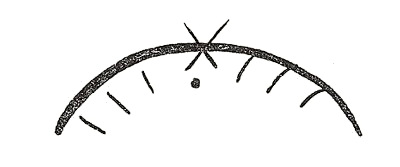
[ 6 ] At the center (X) stand the spirits of the personality. On each of the three preceding and the three following stages—just as our Earth can be divided into epochs according to the number seven, so too can this Saturn evolution— in each of these epochs, corresponding beings become human; on each stage, certain beings do so—always when the time has come specifically for them to utilize what is found on Saturn in order to undergo the human experience. Thus we have seven kinds of beings on Saturn who have passed through their human stage there, who have advanced as far as the human stage, and who therefore, in the subsequent stages, no longer need to ascend all the way to the human level. Today’s human being is not yet a human being on Saturn. Those beings who became human beings here on Saturn—whose representatives are the spirits of personality—continue to advance and are now elevated above human beings; they have, so to speak, humanity within them. They carry it within themselves as a stage of development that is now behind them.
[ 7 ] After Saturn had undergone its development for some time, the entire evolutionary process shifted into a spiritual sphere—a state that was not outwardly perceptible to senses such as those of modern humans—and then the second incarnation of our Earth planet, the Sun planet, emerged. It was distinguished by the fact that, relatively early in its development, it had already reached the stage where it radiated light. This was because it consisted not only of heat, but because the thermal matter had already condensed into gaseous, air-like matter. It had no water yet, nor anything solid; it consisted of air- and gas-like matter. But because of this, it was already capable of being a luminous body. As a result, seen from today’s perspective, it was already a planet radiating out into space. Now that this planet had developed to this stage, it became possible for the etheric body to be integrated into the first rudimentary form of the human physical body. Thus, the human being now consisted of the physical and etheric bodies, whereas on Saturn he had only the first rudimentary form of the physical body. However, the human being was not yet ready to have his own astral body. Consequently, the forms of human beings looked quite different from what they do today. Human beings had the form of plant life. They possessed a physical and an etheric body like plants, but on the Sun they looked quite different from plants today.
[ 8 ] This progression of evolution was linked to the appearance of a second type of being on the Sun. On Saturn, there were only human beings; no other beings existed there. It consisted solely of human beings, just as a blackberry consists of small berries. However, some of these human prototypes had remained behind at the Saturn stage; they had not achieved everything that was to be achieved. These lagging entities, who come from Saturn, are therefore unable to acquire an etheric body and must still be endowed with only a physical body on the Sun. They have thus only reached the stage of the humans on Saturn. These beings, who possess only a physical body on the Sun, are the earliest precursors of our present-day animals. Thus, on the Sun, we have human forms with physical and etheric bodies, and animal forms with merely physical bodies.
[ 9 ] Once again, it is the case that, in the midst of the Sun’s existence, certain beings pass through the human stage. Modern humans have not yet been able to do so. We call the spiritual beings from the sphere of the Sun who are now passing through the human stage “fire spirits” or “archangels.” Today, they are two levels above human beings. They carry humanity within themselves. In a different form, they have experienced the same things that human beings experience today in their earthly existence. But the Sun, too, passes through seven epochs, and at each stage there are beings who have attained the level of the human stage, so that we again have seven phases of development during the Sun’s existence. When they look back on their own past, they see, as it were, a cosmic age of life about which they can say: Even though there was no solid ground beneath me and no liquid globe, I nevertheless experienced back then what human beings experience today. “I can therefore empathize with and experience what human beings experience on Earth.” — That is what these beings can say today. They understand this because they, too, have experienced within themselves what human beings experience today in their earthly existence.
[ 10 ] Now comes, once again, a kind of intermediate state in which the luminous planet gradually fades from external observation—if such observation were even possible—and disappears even from certain forms of clairvoyant observation, remaining perceptible only to the highest forms of clairvoyance. Then it emerges once more into a new form of existence, into a third state, which we call the lunar state. This is the third incarnation of our planet, the ancient Moon. It has now progressed so far in the development of its substance that it has condensed what was formerly merely gas on the Sun into water. Because the watery element has become integrated, the astral body can be incorporated into the human being—who is gradually developing once more, like a plant from a seed—so that the human being now consists of three parts: the physical, the etheric, and the astral bodies. He is not yet truly human, for he has not yet incorporated an “I” into these three bodies.
[ 11 ] At every stage, certain beings are left behind. The beings who were left behind on the Sun—who were unable to reach the lunar stage and are only now passing through their solar stage on the Moon—therefore have no way of incorporating an astral body at this time; even on the Moon, they consist only of a physical and etheric body. These are specifically those who had already been left behind on the Sun but who, in the meantime, had developed to the point where they were able to incorporate an etheric body. These, in turn, are the ancestors of today’s animals. The beings, however, who had not yet reached the stage on the Moon where they could incorporate an etheric body—these are the ancestors of even lower-standing beings: of today’s plant world. We thus have three kingdoms on the Moon: the human kingdom, consisting of a physical body, an etheric body, and an astral body; the animal kingdom, consisting of a physical body and an etheric body; and the plant kingdom, consisting solely of a physical body.
[ 12 ] Again, there are certain beings who go through their human stage roughly in the middle of their lunar existence. These are the spirits commonly referred to in spiritual science literature as the spirits of twilight—the angels. They, too, carry within themselves the memory of humanity. And again, the Moon has seven such stages. At each stage there are beings who are currently able to undergo human existence. It is always the case that some beings rush ahead while others lag behind. Thus, on the Moon as well, there are seven stages of beings who had undergone their human existence by the time the Moon’s evolution had come to an end.
[ 13 ] However, in order to fully understand the Moon, we must now mention something important that took place during the evolution of the ancient Moon. When this ancient Moon began its evolution, it was—at least shortly after the beginning—a liquid sphere. Had it continued to evolve in this way through its seven stages, it would not have been able to provide humanity with the proper foundation for its further development. It became capable of serving as a precursor to Earth humanity only because it first split into two celestial bodies. One of these was the precursor to today’s Sun, and the other—the one that separated—was the precursor to today’s Earth; but you must imagine this Earth combined with today’s Moon, so that the Earth and Moon of today were one back then. So imagine these two bodies—the Earth plus the Moon on the one hand, and the Sun on the other—now separated from one another, with the ancient Moon as a watery body and the ancient Sun on its way to becoming a fixed star. Something very essential was connected to this splitting. Above all, it was the Sun that carried out the separation and took the finest parts—the most ethereal matter—with it, while the coarsest matter remained in the Moon, that is, in what is now the Earth plus the present-day Moon. Hence, the Sun is endowed with immensely fine matter, while the Moon becomes a much denser body, a watery mass. Because the Sun took the finest and most spiritual forces with it, it could now also serve as a setting for much more highly developed beings. In fact, many of those high beings who were still able to endure life on Saturn would have been hindered in their development had they remained bound to the Moon any longer. They needed a setting composed of the finest substances; only there could they develop. Thus, they had drawn upon the suitable setting and continued their development on the Sun. In contrast, those human embryos—consisting of a physical body, an etheric body, and an astral body—as well as animal and plant embryos, remained bound to the Moon, which had undergone a thickening due to the departure of the finer matter.
[ 14 ] This ancient moon looks quite strange now. Back then, you wouldn’t have found things like rocks or farmland—even though it was already orbiting its sun. There were no minerals there yet. The main mass of this moon, on which these beings hopped about, so to speak, was a kind of mush—a real kind of mush, much like cooked lettuce or cooked spinach. Such a mush was the basic mass of this moon, just as the basic mass of our Earth is farmland. Embedded within it were masses similar to, say, wood and tree bark. If you climb a mountain today, you walk on rocks. Back then, you would have walked on a surface that, when solid, was like wood—like a wooden plateau. Instead of granite, you would have found stumps that were roughly comparable to wood. This is, of course, only a figure of speech. Such was the basic substance, and growths were constantly sprouting from it. So that was the lowest kingdom—today’s mineral kingdom—which at that time stood right in the middle between what are now the mineral and plant kingdoms. It was alive in a certain sense. There were constantly new growths forming there. It was not like today. When topsoil lies there, if you want to remove it, you have to carry it away physically. This mass of the ancient Moon died off—but not like individual plants—and reformed itself. It was constantly in a state of inner, living activity and movement. The fundamental mass of the ancient Moon was in a state of constant dying off and continuous proliferation. And from this fundamental ground, another kingdom grew forth. For the earlier kingdoms had changed as a result of the Moon’s separation from the Sun. On the Sun, they roughly corresponded to our kingdoms. As a result of the Moon’s separation, the old plant kingdom had been pushed down by half a level, as had the other kingdoms, so that the next kingdom was a kind of animal-plant kingdom. It did, however, grow out of the ground; such animal-plants grew out of it. They were plant-like, but if one attacked them, they had sensations; they squeaked and the like. They were actually half animal and half plant—plant insofar as they grew out of the ground and were largely firmly rooted in it, and animal insofar as they possessed some capacity for sensation. And the kingdom that preceded ours consisted of human-animals—beings that stand right in the middle between modern humans and modern animals, higher than modern apes but not yet as advanced as modern humans. That was roughly the form of our human ancestors on the Moon.
[ 15 ] Legends and myths, in particular, have wonderfully preserved these things. Just consider how a German legend has preserved this secret that lies behind it all. Certain beings always remain behind. Even those beings that stood right in the middle between today’s plants and today’s animals—beings that could take root only in plant-based soil, such as the lunar soil—have remained behind and are therefore unable to thrive on mineral soil in our present-day Earth formation. Our modern plants can grow there, but those that stood right in the middle between plants and animals—those that needed living soil—cannot, if they have been left behind, grow in the mineral realm. Mistletoe is such a plant. It must therefore parasitize in today’s plant world because it is a being that has been left behind. It no longer possesses any feeling, even though the astral body enveloping the mistletoe is quite different from that of other plants. And German mythology sensed this: that the mistletoe does not actually belong to our earthly realm, that it is alien to it. The myth celebrates in the god Baldur the god of the earthly sun, the earth’s power. No earthly being could ever approach him with hostility. That is why the god whom German legend recognized as such a straggler—that is why Loki—cannot kill Baldur with any creature of the earth. He must have him killed with the mistletoe branch, because it is foreign among the creatures of the earth and can therefore serve the straggler Loki, who is not related to the earth gods. Profound wisdom lies behind such legends. In this Baldur-Loki legend, we sense this ancient wisdom everywhere, even in the customs associated with mistletoe. If you were to study them, you would find that what is said about them stems from ancient wisdom.
[ 16 ] Then, in the second half of the Moon’s evolution, the time came when the beings developing on both the Sun and the Moon had achieved what they were meant to achieve during the ancient Moon period. And then they united once more. The Sun and the Moon again traveled a stretch of their evolutionary path together as one body.
[ 17 ] Then the state of evolution darkened, passed through the purely spiritual state that some are accustomed to calling Pralaya, and now our Earth’s evolution dawned. In the beginning, the dawning world body contained not only the substance of our present-day Earth, but also what you would obtain if you took the substance of the present-day Sun, the present-day Earth, and the present-day Moon, combined them, and stirred them together in a giant pot. That is roughly how you can imagine the state of development of our Earth at its inception. This stage of development is initially a kind of repetition of the Saturn stage, then of the Sun and Moon stages. What is most important for us now is that human beings only truly become human in the modern sense in the middle of Earth’s evolution. In our Earth’s evolution, too, we must distinguish seven stages. We are in the fourth. Three have preceded it, and three will follow. The fourth main cycle was the one in which our present human race was to become human. Just as, in all these cycles on Saturn, the Sun, and the Moon, certain beings reached the human stage—on Saturn the Asuras or primal forces, on the Sun the archangels, on the Moon the angels—so, too, there were always beings who remained behind. And so there were also beings who could no longer attain the human stage on the Moon—beings left behind, such as angels—who were only now able to make up for their human stage on the Earth during the first three Earth epochs. Humanity reached this stage in the fourth epoch. Before humanity, three other beings had already passed through the human stage on Earth. And the fourth of the beings to pass through the human stage on Earth is humanity itself. At that moment in cosmic evolution when humanity is just about to become human, all the beings who have been able to pass through the human stage—from Saturn, through the Sun, the Moon, and Earth, up to humanity—are beings who have, to a greater or lesser extent, advanced beyond humanity. But they are all capable of looking back and remembering the stage at which they themselves went through the human stage. They could look down upon the human being in the making and say to themselves: “This one is now becoming something we have already been, something for which we have understanding, even though we experienced it under different circumstances.” — They were therefore able to guide and regulate his development from the spiritual realm.
[ 18 ] Let us count how many such beings there are who can look back on the human stage and who can understand the developing human being: seven from the Saturn stage, plus seven from the Sun stage, plus seven from the Moon stage, plus three from the Earth stage—that makes twenty-four beings. Twenty-four “human beings” look down upon modern humanity. These are the beings whom we have, for good reason, called the regulators of evolution, the regulators of time. Time is connected to evolution. They are the twenty-four elders we encounter in the Book of Revelation. These are the very same beings described to us when we approach the mystery of the seven seals. They are described to us as the true guides of destiny, the very Alpha and Omega. Thus we have found the twenty-four elders here once again, and you can see how the apocalyptic writer who composed this important document has wonderfully woven into his imagery what we ourselves can discover through contemplation of the spiritual evolution of the world.
[ 19 ] However, certain beings had remained behind at each stage, so that the Saturn beings who remained behind on the Sun emerged as the first precursors of the present animal kingdom, and the Sun beings who remained behind at the Moon stage emerged as the first precursors of the present plant kingdom. It was only on Earth that a stage of development emerged as the mineral kingdom. We have emphasized that there was no mineral kingdom on the Moon yet. One would not yet have been able to walk on rocks on the Moon. At the time when present-day human beings began to pass through their human stage, the mineral masses—the first crystals—emerged from the world body that now stood between the substance of the Moon and the present-day substance. That was the moment when the mineral kingdom burst forth. And you will find this bursting forth described in a most unique way in the Book of Revelation, where John says: “Around the throne was something like a sea of glass.”—This “sea of glass” is meant to symbolize the emergence, the sprouting forth of the mineral kingdom in its earliest form. Thus we also see this mystery of cosmic evolution hinted at in the Book of Revelation. And we have thus also come to realize that, to this extent, the Apocalyptic writer, in his powerful images, intends to depict nothing other than what we ourselves can recognize from spiritual life in the evolution of the Earth. In doing so, however, the Apocalyptic writer has led us, right at the beginning of his book, up to the heights where human beings can behold the images of future stages of evolution.
[ 20 ] And now we have a solid foundation on which to build upon what we have already come to know as the first epochs of humanity’s future development. As an interim reflection, we have now cast a glance into the past, back to the point where humanity is ready to become human, where the mineral kingdom bursts forth. And now we will see how things continue up to our own time, and from there into the future. We will find the connection to the mystery of the seven seals and their unsealing, leading up to the pouring out of the bowls of wrath.