

Cosmos, Earth and Man
GA 105
5 August 1908, Stuttgart
Translated by Steiner Online Library
Second Lecture
[ 1 ] The best way to get a feel for our topic—given the broad scope we have set for ourselves—is to first try to form a more intimate understanding of the two opposites that immediately come to mind when we relate the world and the Earth to one another. These two opposites are: the spiritual-soul aspect and the physical-material aspect. Let us attempt to discuss them in relation to a phenomenon that is more or less enigmatic to modern people and that confronts us precisely through the ancient Egyptian worldview and way of life in what is known as “temple sleep.” Temple sleep, after all, is rooted in the other distinctive fact that among the Egyptian priestly sages—and indeed in the ancient culture of humanity as a whole—wisdom was conceived as intimately connected with the art of healing and with health. Modern people, however, have only a very vague understanding of the intimate connections between wisdom and health, between science and the art of healing, when compared to those ancient conceptions; and it will be the task of spiritual science to once again direct humanity’s attention to that concept of the spiritual through which wisdom, the art of healing, and health can be brought into a closer connection. In this context, we also recall something that resonates with various remarks we made yesterday. We recall that ancient figure we were compelled to think of when we visualized the image of the Madonna with her Child, as Raphael painted it in the Sistine Madonna; we recall Isis with the child Horus. She is the goddess whose temple bore the inscription: “I am who was, who is, and who will be—no mortal can lift my veil.” This goddess was associated in a mysterious way with all the arts of healing; she was regarded, in fact, as the teacher of the Egyptian priests in matters of healing. And even in the final days of antiquity, a remarkable account was told about this Isis; in this account, we are made aware that Isis, even during the time when she was raised to the ranks of the immortals, took a special interest in the art of healing and in the health of humankind. All of this points to very mysterious connections.
[ 2 ] Now we must briefly sketch the nature of the temple sleep, which was one of the remedies used by the Egyptian priests. In those days, anyone whose health had been impaired in any way was generally not treated with external remedies; there were very few such remedies to begin with, and they were used only in rare cases. Instead, in most cases, the person in question was taken to the temple and induced into a kind of sleep there. This was no ordinary sleep, however, but a kind of somnambulistic sleep that was so intensified that the person became capable not only of having chaotic dreams but also of seeing actual visions. During this temple sleep, he perceived ethereal forms in the spiritual world, and the priest-sages understood the art of influencing these ethereal images of the person; they could direct and guide them. Let us suppose that such a patient was put into temple sleep. The healing priest was at his side. Once the somnambulistic sleep had set in, so that the patient was living in a world of ethereal forms, the priest would guide the process through the power inherent in him by virtue of his initiation—a power that was possible only in those ancient times when conditions of existence still prevailed that no longer exist today, or at least are extremely rare— he would guide the entire state of sleep through this power, through these forces. And he shaped and formed the ethereal visions and beings in such a way that, as if by magic, the figures that the ancient Atlanteans had once seen as their gods actually appeared before the sleeper. Such divine figures, of which the various peoples have retained only a memory—for example, in Germanic, Norse, and also Greek mythology—but especially certain figures associated with the healing principle, were now presented to the soul of the one who lay in temple sleep. Had the person remained conscious as in his waking state, there would never have been any possibility of allowing such forces to act upon him; this was possible only in such a somnambulistic sleep. The priest-sages thus guided the “dream life” in such a way that powerful forces were unleashed in this ethereal vision, and these forces had an ordering and harmonizing effect on the bodily forces that had been thrown into disorder and disharmony. This was possible because of the subdued sense of self. The temple sleep thus had a very real significance. But we now also see why this healing effect of the priest-sages was actually linked to the wisdom that could be bestowed upon people only through their initiation. This connection lies clearly before us. It was the priestly sages, after all, who—by reviving the ancient practice of looking into the higher worlds—possessed, precisely through their wisdom, the higher powers that flowed from the spiritual realm, where the spiritual could act upon the spiritual. Thus they gained the ability to allow the spiritual to act upon the spiritual, and through this, wisdom came into that intimate connection with the life of health in the first place.
[ 3 ] In ancient times, this lifting oneself up toward the spiritual realm was a healing element, and it would be good if people could learn to understand this again, for then they would also come to understand the great mission of the anthroposophical movement. For what else is this mission but to lead human beings up into the spiritual worlds, so that they may once again look into the worlds from which they descended! True, in the future no somnambulistic sleep will be imposed upon people; self-consciousness will be fully preserved; yet a powerful spiritual force will become active within human nature, and then the possession of wisdom and insight into the higher worlds will once again be something that can have an ordering and healing effect on human nature. Today, this connection between the spiritual and the healing is so hidden that people who are not initiated in any way into the deeper wisdom of the mysteries know little about it; they are simply unable to perceive the subtle realities that exist. But anyone who can look more deeply into these matters knows on what profound inner conditions healing can depend. Let us take, for example, a person afflicted by a certain illness—an illness with inner causes, not, say, a broken thighbone or an upset stomach, for these also involve external causes. Anyone who wishes to delve deeper into these matters will very soon realize that a person who engages frequently and willingly with mathematical concepts possesses entirely different conditions for healing than someone who does not care to engage with them. This is a fact that points to the remarkable connection between a person’s spiritual life and the conditions of their physical health. Of course, this does not mean that mathematical thinking heals a person. We must understand this more precisely: different conditions for healing are necessary for a person who is capable of grasping mathematical concepts than for one who is not. Let us suppose that two people are afflicted with the exact same illness. In reality, this does not happen, but we can consider it as a hypothetical scenario. One wants nothing to do with mathematical concepts, while the other engages with them intensively. It could then be the case that it would be completely impossible to restore the non-mathematician to health, whereas you could heal the other person with the appropriate means. This is a very real scenario.
[ 4 ] Another example: Two people may have completely different health conditions—one is an atheist in the worst sense of the word, and the other is a deeply religious person. Once again, it may happen that, if both are afflicted by the same illness, you can cure the religious person with the same remedies but not the other. These are connections that seem downright absurd to today’s way of thinking—at least to the majority of humanity. And yet, this is how it is.
[ 5 ] Where does this come from? It stems from the fact that so-called “senseless” ideas exert a completely different influence on human nature than those that are “full of sensibility.” Just consider the difference between a person who hates mathematics and one who loves it. One says: “Am I supposed to think all this up? But I only want what I can see externally with my senses!” - However, it is of great benefit to the innermost being of a human being to live in concepts that cannot be seen; and it is equally beneficial to live in religious concepts, for these, too, relate to things that cannot be grasped with the hands, that do not pertain to the external, material world—in a word, concepts free from sensuality. These are things that will one day—when people once again turn their attention more toward the spiritual—have a great influence on educational principles. Let’s take, for example, the simple concept: three times three is nine. Children form such a concept best when it happens in a way that is free from the senses. It is not good if they spend too long laying out three times three beans side by side, because then they never move beyond the sensory concept. But if you accustom the children—perhaps at first, but not for too long—to counting on their fingers, and then to follow the process mathematically through pure thinking, this concept has a healing and ordering effect on the children. We can see how little the present age understands such things from the fact that, particularly in education, the opposite is happening. Hasn’t the calculator made its way into our schools, where addition, subtraction, and so on are supposed to be made clear to the sensory eye through all sorts of beads? What should be grasped purely in the mind, they want—as they say—to illustrate sensually in this way. That may be convenient, but anyone who considers this to be pedagogically sound knows nothing of that deeper curative education rooted in the power of the spiritual. A person whom you have accustomed from childhood to living in sensory images—because their nervous system functions under pathological conditions—will not be as easy to heal as someone who has been accustomed to non-sensory images from their youth. The more you accustom a person to thinking independently of things, the easier it will be to heal them. That is why it was always customary in the ancient traditions to use all kinds of symbolic figures, triangles, and number combinations; the purpose of this—in addition to the other value these things held—was to lift people beyond the mere observation of what is depicted. If I place a triangle in front of me and merely look at it, that has no particular value. If, on the other hand, I perceive in it the symbolization of the higher trinity of the human being, that is a concept that is healing for the spirit. And now imagine that spiritual science will lead people to the perception of the spiritual. We are guided from what takes place on Earth to what took place on the ancient Sun, the Moon, and Saturn. With physical, sensory eyes, you cannot see the events of those times today, nor can you reach up with your sensory hands to the ancient Moon or the ancient Sun. But if, without the aid of external sensory crutches, you lift yourself up to the things that once were, then you acquire concepts that have a balancing and harmonizing effect on your entire life, including your physical life. Thus, spiritual science will once again become a great, comprehensive remedy, as it once was in the hands of the ancient Egyptian priests, who, however, required a process of attuning the ego to this end, as was practiced during the temple sleep.
[ 6 ] The spiritual worldview is a healing worldview. Of course, some will object: Are all anthroposophists healthy people, or are there not also sick people among them? We must realize that, fundamentally, the individual has very little control over his or her health and illness. A large part of the causes of illness lies outside the individual personality. You may have the healthiest concepts today—concepts that, if you were living under perfectly healthy conditions, would never cause you to become ill from within—but there are other causes that lie beyond the power of the individual human being today, for example, the hidden causes of heredity, the influence of one person on another, the influence of an unnatural environment, and so on. All these are factors that, in a mysterious way, constitute external causes of illness; they can all be eliminated only through a healthy anthroposophical way of thinking over the course of time. But even if one sees that today even the most inwardly healthy people can become ill, even seriously ill, one must nevertheless not regard this as evidence that spiritual science will not have a healing effect on humanity over the course of the centuries—and I say centuries, not millennia. Oh, before the eyes of those who recognize the spirit lies a future in which there will be no inner causes of illness for those who bring about the inner and outer conditions of spiritual wisdom. There will always be external causes; these can only be eliminated by the increasing prevalence of a healing art grounded in spiritual science. We see: if we correctly understand the effect of the spiritual, then the “temple sleep” holds no mystery for us.
[ 7 ] So what was conjured up in the etheric visions as a healing force before the temple sleepers? The images of the Atlantean gods, whom we ourselves knew as etheric beings, among whom people once lived when they were outside their physical bodies and in a state of etheric clairvoyance.
[ 8 ] And if we now go even further back in human evolution, far beyond the Atlantean era, we arrive at a time when human beings were just becoming what they are today, when they were just beginning to develop the individual personality they possess today. We call this era the Lemurian era. The Atlantean continent, from which the peoples spread to Africa, Europe, and Asia, was destroyed by massive floods. Lemuria, the continent where humanity lived before the Atlantean era, was destroyed by the forces of fire, by volcanic catastrophes. It was, however, during the Lemurian era that human beings first acquired their sense of self. This marked a monumental turning point in human evolution. How does a human being attain this sense of self? It is generally difficult for today’s materialistic mindset to imagine this ancient state of humanity. If you were to imagine the human being of that time as he is today—that is, with flesh and blood, bones and muscles—you would have a completely false impression. The human being of that time had a far more ephemeral, softer form; everything was almost fluid. What later became muscles and bones only hardened over the course of time. We are going back to a time when the process of human reproduction was entirely different. People back then lived more in the atmosphere surrounding the Earth, which, however, was not pure air as it is today, but was filled with all kinds of vapors. People lived there as true ethereal beings, and the outer currents flowed in and out of them. It was, in fact, almost as if we were looking at a cloud today that is constantly changing its shape; only the form of early humans was somewhat more solid and defined. It was also during that time that what we now call the sexes first emerged; in those days, an ancient asexual mode of reproduction within the human race was replaced by a sexual one. That, however, took place millions and millions of years ago, long before the present day.
[ 9 ] It was only with sexual reproduction that the incorporation of the “I” into humanity first began. Previously, human beings were still prompted by entirely different influences to bring forth their own kind; external influences prompted him to do so—influences that lay in the sphere around him. This was the form of reproduction in that era when human beings did not yet possess an “I,” when they were still endowed with a dim, clairvoyant consciousness, when they still, so to speak, rested entirely in the bosom of the Deity. They could not say, “I am.” What he felt was something like this: He saw that when he did anything, it made an impression on his surroundings, and he felt his existence within his surroundings. He could not say, “I am here”—but rather he said, “My surroundings allow me to be here.” — He lay in the bosom of the living earth, and the living forces of the earth flowed in and out. At that time there were still no unhealthy forces; there was still no illness, not even death as we understand it today. Only when human beings were left at the mercy of their “I” through sexual reproduction did illness and death enter humanity. If we picture all this correctly, then we must say: Back then, the human being was not fertilized by his own kind, but just as he breathes today, so did he absorb the substances from his environment; and the forces of fertilization were contained within that environment. What penetrated him fertilized him; it caused him to bring forth his own kind. And these were healthy forces within the human being himself and in what he brought forth as his own kind. The ancient Egyptian priests, however, knew this, and they said to themselves: The further one directs people’s gaze back to earlier states, the more one brings them into conditions where there are no diseases. Even the mere sight of the ancient Atlantean divine figures could have a healing effect, but this was even more so the case when the priests directed the visions in such a way that the temple sleeper had before him those primeval human figures who had not yet been fertilized by their own kind, but who received their fertilization from their surroundings. There, before the sick person lying in temple sleep, stood the figure of the woman who gave birth to her own kind without being fertilized by her own kind. There stood before him the woman who brings forth life, the woman with the child, who is a virgin, the goddess who was a companion of humanity in that Lemurian age and who has since vanished from the sight of humanity. In ancient Egypt, she was called the holy Isis. Humanity could normally see this Isis only back then, when death had not yet taken hold; at that time, people in their normal state of consciousness were companions of such figures, who hovered around them and brought forth their own kind in a virginal manner. And when Isis was no longer the visible companion of humanity—when she was taken up into the circle of the gods—she still took an interest in the health of human beings from the spiritual world, so the priests said. And when people were led, in an extraordinary way—such as during temple sleep—to a vision of those ancient figures, of that sacred image of Isis, the goddess still exerted a healing influence, for she is the principle within humanity that existed before the mortal shell enveloped human beings. No mortal has ever lifted her veil, for she is the being who existed when death had not yet entered the world at all. She is that which is rooted in the eternal; she is the great healing being whom humanity will regain when it once again immerses itself in spiritual wisdom.
[ 10 ] Thus we see what has remained of that wondrous symbol of the Virgin Mother with the Child, which has been preserved in the image of the Madonna—and we can say this with all conviction on the basis of spiritual science: in the healing image of the Madonna. For the image of the Madonna is—within the limits that have been discussed—a remedy. If it is treated in such a way that it continues to have an effect on the human soul even while the soul is asleep and can, for example, dream of this image of the Madonna, then it still possesses a healing power even today.
[ 11 ] And now we ask ourselves: Where, then, at that time—when human beings were not yet fertilized by their own kind—where, then, were the fertilizing forces?
[ 12 ] Imagine our Earth as a solid core surrounded by all kinds of viscous, bubbling substances and water vapor, and within that, semi-aqueous formations—and within those, the Lemurian human. This Earthly body is irradiated by the Sun, which at that time could not yet be perceived by the human eye because the sense organs were not yet developed. But this Sun acts through the veil of mist and clouds, and with the power of the sunbeams, the Earth also absorbs the fertilizing forces. Thus, what human beings absorb flows to the Earth from the invisible, spiritual solar beings. So we have an Earth that is illuminated from the outside by the Sun, which human beings cannot yet see; yet this Earth is irradiated not only by the forces of heat but, at the same time, by the very same force that today lives in the power of fertilization. Thus, the Sun and the Earth are connected. This force, which acts upon those human forms that reproduce asexually, was perceived as a masculine force; it was poured out as a product of the Sun over the entire Earth. Such were the conditions in the very earliest Lemurian period.
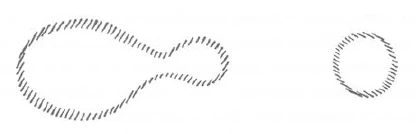
[ 13 ] And then we go back to a time when conditions were entirely different, to a distant past when the Sun—which has since separated from our Earth—was still connected to it. For once, our Earth and the Sun were one body. Everything that is finer and more ethereal is, in a certain sense, still connected within this shared body. Let us consider that moment when the Sun and Earth were still connected like a cake pan, such that one part—a smaller sphere, namely the Earth and the Moon—hung from the Sun. So let us imagine: the Sun as a great ethereal body, with the Earth and Moon hanging from it together. At that time, the rays of force still flowed together from the Sun to the Earth and from the Earth to the Sun, for both were, in a certain sense, one body.
[ 14 ] We can best understand the significance of this development if we ask ourselves what would have happened if the Sun had simply turned away from the Earth entirely after it had split off; if it had no longer sent its rays and currents to the Earth; if, so to speak, the Earth had been left entirely on its own immediately after the split. All life on Earth would have withered, ossified, and frozen solid; the Sun’s life-giving influence had to remain. One must perceive this interaction between the Sun and the Earth as a collaboration between two principles: one leading to densification and solidification, the other inspiring and giving rise to progressive life. And so it was later as well. From the Sun flowed, as always, that which is progressive life.
[ 15 ] And now we go back to an even earlier time, a time when the two bodies were still one, when the forces of the sun and the Earth still flowed together completely.
[ 16 ] As you can see, we have gone through various stages of development on our Earth. We have an ancient past, when the Earth was still inside the Sun’s body, when it was still one with the Sun; then a second period, when the Earth was only loosely connected to the Sun; then a third, when the two bodies separated completely from one another. It was actually during this third period that the “I” first entered human beings, and that is also when sexual reproduction began. This was followed by the fourth period, the Atlantean period, and finally the post-Atlantean period, in which we now live.
[ 17 ] For those who look more deeply into the fabric of the universe, everything that happens outwardly is under the influence of spiritual beings. Once upon a time, the Sun and the Earth were one. We will discuss the development of the Moon later. At that time, this common body was also permeated by spiritual-divine beings acting in unison. High spiritual beings were necessary who could exercise control over the forces that were still undivided at that time.
[ 18 ] And now let us imagine that evolution has progressed a bit further, with the sun’s body expanding outward. What happens then? The highest beings and the finest substances depart with the sun; they then exert their influence on Earth from the outside. Those beings who represent what is truly alive—the ever-inspiring life—dwell on the Sun; and on Earth dwell the beings who, if left alone, would inevitably bring about densification, stagnation, and darkness. In this second stage, therefore, light and darkness work together.
[ 19 ] In the third stage of Earth’s development, human beings are endowed with the “I.” This marks the beginning of a period in which their self-conscious “I” dwells within them. Human beings perceive this self-aware “I” particularly through its contrast: they increasingly fall into a state in which they have one consciousness that is brighter and another that is dark; the former comes to them from the sun, the latter primarily from the earth. The “I,” the eternal core, must alternate between a state in which it exists in an eternal form and one in which it can be born and die. But those entities that always possess what human beings can only possess alternately depart from the earthly body. First to depart is the entity that exerts a fertilizing influence; it takes up residence primarily on the Sun. And the entity that maintains the form in permanence, in duration, departs with the Moon. The Sun and the Moon gradually separate from the Earth. With the Sun, all those entities depart which would have plunged the Earth into a life of turmoil had they remained united with it; with the Moon, the forces depart that would have caused hardening and solidification, forces that remain permanently in their form. The Earth is, as it were, in the middle between the two. Human beings on Earth thus alternate between activities influenced on the one hand by the Sun and on the other by the forces of the Moon. These beings, who were once companions of humankind, have now, so to speak, been drawn toward the Sun and the Moon.
[ 20 ] In the fourth period, there are those beings who have already condensed into an etheric-divine body and who, in a certain sense, are subject to human weaknesses. These are etheric gods, and human beings lived alongside them during the Atlantean era. And in the post-Atlantean era, humanity loses its connection even with these etheric gods; it is completely cast out into the physical world; the gate leading to the higher spiritual world is shut tight.
[ 21 ] But something remains from those ancient times that acts as a memory of the spiritual worlds, and through the law of repetition, everything that a person once experienced in life gradually emerges in their consciousness. In life, he had once gone through a number of periods in which he had stood in ever-changing relationships to the gods. Now he is going through those same periods once more, but in his consciousness. The great Atlantean flood was followed by a time of the ancient Indian culture, when human beings relived in their souls and spirits that era with its high gods, when the Earth and the Sun were still united. The lofty, sublime Deity who at that time guided and directed all that existed—humanity experienced this Deity during the first post-Atlantean cultural epoch and gave it a name that remained as a tradition for later times: Brahman, the All-One. The deity who truly once existed among humankind—for in the earliest period of Earth’s development, humankind had been a companion of Brahman—was venerated in ancient Indian culture; humankind experienced this deity through recognition, in a state of high abstraction.
[ 22 ] And then came a culture in which humankind experienced, through insight, the second age, when the sun, with its life-giving powers, was separated from the forces of darkness. Therefore, the people of this second cultural epoch perceived, through their insight, a divine duality. They reenacted in religious insight what had once existed in life, and this duality was preserved as the opposition between Ormuzd and Ahriman—the good and the negative deities—took shape in Persian culture. It was nothing other than a re-experiencing—but now in insight—of what human beings had once truly lived through.
[ 23 ] And then we come to the time when the Sun and the Moon had emerged—the Sun with its fertilizing powers, the Moon with the powers that gave form: a transient form for human beings, to be sure, but an enduring one for the gods. And humanity perceived this difference, in turn, in the contrast between those earlier solar forces and those that were now at work—and working differently than before. And humanity perceived these solar forces as the forces of Osiris in Egypt. Osiris is the force of the sun as it acted during the third period of Earth’s evolution, and we see the religion of Osiris arise during the third cultural epoch. And Isis is the power of the Moon before its complete separation from the Earth, before the separation of the sexes, when it still acted as a virginal reproductive force. Isis fled to the Moon, where she became frozen.
[ 24 ] And in the fourth epoch, that of Greco-Latin culture, humanity experienced in its polytheism a resonant echo of the Atlantean era with its many ethereal divine figures.
[ 25 ] And we now, in the fifth cultural epoch, have nothing to repeat. Let us keep this thought close to our hearts: We have nothing to repeat, no old memories. For we have brought forth a fifth epoch that reaches into the future, whereas the four earlier epochs were repetitions. Our era need not give birth to an ancient wisdom, but rather to a new wisdom that can not only point to the past but must also have a prophetic, apocalyptic effect on the future. We see an ancient wisdom preserved in the mysteries of past cultural epochs; an apocalyptic wisdom, for which we must sow the seed, must be our wisdom. We need a principle of initiation once again so that the original connection with the spiritual world can be reestablished. That is the task of the anthroposophical world movement. No wonder so many people have lost their wisdom, for without the principle of initiation, it is difficult today to attain wisdom—more difficult than in the past, when one need only refresh the memory of ancient experiences and could experience the fruits of earlier developments. Today it is difficult—which is why we understand that, for people today, the sensory world without God is bleak and empty. But even if it seems as though the ancient spiritual world has died out, it is still there—active and life-giving—and if people are willing, they will once again find a connection with the spiritual world. Provision has been made for this: precisely when the ancient memories seemed to be fading away in the Greco-Roman era, a wondrous seed for all subsequent ages was planted in the cold soil of the earth—the seed we call the Christ principle. It is in connection with this Christ Principle that apocalyptic wisdom—the true, new spiritual insight—will be found, a wisdom that not only looks back to past times in remembrance but also points prophetically toward the future, and thereby calls people to action and to creative work. That active, that productive wisdom has, of course, emerged from what was sown as a seed in the past.
[ 26 ] Thus we see the connection between the past and the future, which already presents itself to us today as a field of work. We see the entire horizon of the future unfolding before us, and when we speak of the world, humanity, and the Earth, we will not merely be speaking of the past, but also of the forces of the future; for the world is not merely something connected to the past, but something that is evolving into the future, and our Earth still has a long way to go into the future. Humanity, however, will be even more of a product of the future than the Earth, and if we wish to come to know it fully, then we must not only look into the past; we must also study what is at work today and what will be at work in the great dawn of the world.