

Occult Reading and Occult Hearing
GA 156
13 December 1914, Dornach
Translated by Steiner Online Library
How does one bring Being into the World of Ideas? II
[ 1 ] Yesterday I pointed out that much will depend on how at least the main concepts and ideas of Spiritual Science are incorporated into general spiritual culture. Yesterday I attempted to cite a few examples of how one might conceive of the human way of thinking truly and correctly assimilating the most fundamental mental images of the physical body, the etheric body, the astral body, and the I, and making these mental images truly fruitful for the most diverse areas of life and science.
[ 2 ] Today I would like to point out another example. What we distinguish as the physical body, the etheric body, the astral body, and the I—these are members of the human soul, or we might also say of human spiritual life, which, naturally on a much higher plane, relate to one another in much the same way as, I might say, on a lower plane, the individual color nuances of our color scale. And just as there can be no true understanding of the inner nature of light and its inner relationships to the rest of the world without imagining this structure of color nuances, so too can there be no true understanding of the soul without having mental images of how such soul components as the ego, astral body, etheric body, and physical body relate to one another. But just as the individual colors do not simply stand side by side but merge into one another, so that one cannot always specify exactly on the color scale where one nuance ends and another begins, so it is with these soul members: they merge into one another, and it is only our intellect that actually separates them in the way we usually do.
[ 3 ] Now it is important, for example, to consider the transition of the “I” and the astral body. What we call the human “I” truly merges into the astral body, just as the red hue of the color spectrum merges into the orange hue. We need only remind ourselves of what we are actually talking about when we speak of the human ego. We speak of the human ego, and we must of course be quite clear that the true nature of the ego lies outside of everything that can be observed as the physical human body. The ego is experienced solely through inner experiences. As is well known, the etheric body and the astral body are not experienced directly at all; rather, the physical body is experienced through external observation, through external perception, and the I in its manifold experiences is experienced inwardly. This is certainly the case for experience on the physical plane. Between the physical body and the I within stand the astral body and the etheric body; both belong, we might say, to those aspects of reality that are not directly experienced by the human being on the physical plane. Neither can the etheric body be directly observed externally without prior esoteric training, nor can the astral body be experienced. It contains all that which is often referred to as the sum of subconscious or unconscious soul experiences.
[ 4 ] The self is composed of the most diverse experiences of consciousness. And now let us single out one such experience of consciousness—or rather, a specific type of conscious experience. Conscious life is indeed very diverse, but as I said, we want to highlight a very simple, elementary type of experience: the experience of taste. Just as the ego experiences visual, auditory, olfactory, and imaginative experiences, so too does it have experiences of taste—interaction with the external physical world. I am referring to the very ordinary taste experiences associated with nutrition, not those that are called artistic.
[ 5 ] What we experience when we have a taste sensation is an experience of the self, insofar as this taste experience occurs consciously for us. So, when we put food in our mouths and have a taste sensation, that taste sensation is an experience of our self. The manifold taste sensations are, in fact, manifold experiences of the self.
[ 6 ] Now, it is precisely through taste experiences that we can, in an interesting way, study the transition from the ego to the astral body, from conscious experiences to subconscious experiences. It is not difficult to observe that taste experiences, so to speak, fade away once the food has traveled a certain distance. For conscious life, the taste experiences then fade away, but this is only apparent. In reality, speaking in broad terms, the taste experience of the mouth passes into the taste experience of the entire organism; and the entire organism is, in essence, permeated by taste experiences as food enters our body, during digestion, and so on; and what we consciously taste is only a small part of that general tasting experienced by our entire body.
[ 7 ] It is not only the sensory nerves in our mouth that taste, but our entire digestive tract tastes; and as nutrients pass into the body, into the blood, and so on, the entire organism tastes once again what the digestive organs have prepared for it. One could say that the entire organism is permeated by taste sensations. And this organism is so permeated and imbued with taste sensations that one can speak of differentiated tastes. One can speak of organ-specific tastes. Each organ has its own specific taste experience; the stomach has its own specific taste experience, and the liver, lungs, and heart have their own particular taste experiences. General taste differentiates into organ-specific taste.
[ 8 ] Here we see how the sphere of ego experiences merges into the sphere of astral experiences. For these differentiated organ tastes are subconscious; they do not come to a person’s consciousness, and yet they are infinitely significant. For the normal development of human life depends entirely on the normal development of these organ tastes, and aging consists in part of the astral body gradually becoming dulled with regard to the habit of tasting. Please understand me correctly. The astral body becomes dulled with regard to the habit of tasting; but the word “habit” is used here in the sense in which I used it yesterday; little by little it becomes dulled. But when the stimulus is no longer exerted on the astral body—and thereby also on the etheric body and the physical body—which finds its expression in the act of tasting, then the very possibility ceases to exist that the astral body might, through taste experiences, permeate the life events of the etheric body and the physical body. A good deal of what we call aging is based on the astral body becoming dulled in relation to taste, and the fact that a single human organ loses its fresh capacity for tasting—that is, is no longer permeated by its astral body in the appropriate way—gives rise to organ diseases.
[ 9 ] Now you understand that certain perspectives arise under these circumstances. The first perspective, which is important from an educational and health standpoint: having a well-developed sense of taste should not be underestimated. I have already elaborated on this for our friends on an occasion when I spoke about the education of the child. It is important to realize that one should develop a living relationship with the various foods when eating, that one is, so to speak, not indifferent to whether one eats lettuce or spinach, but that one should have a living relationship with the distinctions of the plant world in lettuce and spinach. For what one experiences in tasting lettuce and spinach are living relationships between the macrocosm and the microcosm, and these living relationships continue in the subconscious taste experience of the astral body, which permeates all the organs. Those who become vegetarians, for example, should by no means associate this with a false asceticism, using their vegetarianism, for instance, to numb themselves as much as possible to the friendly relationship with the essence of nature; rather, they should cultivate the ability to taste the subtle differences between the various types of food. This is particularly possible as a vegetarian, because one is then able—if the word is not misunderstood, I would like to say—to taste those subtle, refined differences between the individual plants and what is prepared from them as food, whereas, of course, if one is not a vegetarian, one encounters more brutal differences in meat dishes. For if we become desensitized in this regard, we truly risk extending this desensitization from the conscious aspect of astral taste experiences into the subconscious aspect of taste experiences. In doing so, however, we block the vital influences emanating from the astral body onto the lower members of our organism. And it is an uncomfortable sight to enter some vegetarian restaurants and see how people pile a mountain of all sorts of jumbled-together foods onto their plates and shove them into their mouths without understanding, while at the same time acting particularly superior toward what the ordinary person regards as a friendly relationship with their natural environment in terms of taste experiences.
[ 10 ] That is one thing, my dear friends. Once our understanding of external experiences related to eating is permeated by an understanding of the astral body and its mode of operation, then a truly healthy dietary regimen will emerge, and we will need it, because that unconscious instinctual life will gradually be lost to the human race and must be replaced by a conscious relationship with the cosmic environment.
[ 11 ] But on the other hand, another perspective also emerges, and that is that there really is a specific relationship between the entire plant world, which spreads out across the earth, and the human organism, the microcosm. And this relationship is expressed in the specific taste of an organ. It is truly a fact, and not merely a symbol, when I say: any plant that grows outside appeals to only one very specific human organ; other organs do not find it appealing. A specific organ can be stimulated by the forces of this plant, while another cannot. Once these relationships are studied, something very important will have been gained.
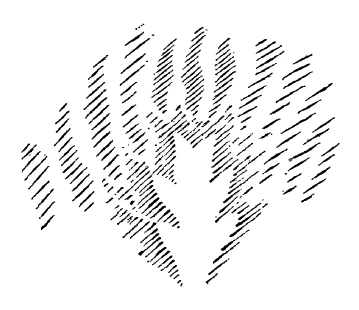
[ 12 ] I have told you on various occasions: Although the plant, in its physical form, consists of the physical body and the corresponding etheric body, it extends, as it were, by developing upward, its flowering into the surrounding astral realm; and when we look out over a flower bed, we find astrality spread out over the plants, astrality that belongs to the plants. Not every plant has its own specific astral body, but it is nevertheless the case that the general astral realm—which is spread out over the surface of the earth just as the air is physically spread out—becomes specialized. That which, as it were, descends from the astral body of the Earth into a particular flower—let us say the lily—manifests itself differently from that which descends into a clover flower. There the general astrality becomes specific.
[ 13 ] This connection that exists between the astral nature of the Earth and the vast expanse of vegetation also exists internally between the human astral body and its individual organs. In this respect, too, the human being is indeed a microcosm, except that an unhealthy relationship can arise between the human astral body and its individual organs, in that individual organs lose their lively sense of taste and become dulled. The relationship that exists between the general astral nature of the Earth and the entire plant cover is essentially—I say essentially—a healthy one, and when one discovers the relationships between the individual plants and the human organs, one also finds the possibility of stimulating the organs again by introducing the substances of the individual plants and making them healthy from within. For when one introduces the substances of a particular plant into the human organism, one thereby introduces the relationship that the plant has to the general astral nature of the Earth. Now, if this connection to the astral nature of the Earth has become dulled in individual organs of the human organism, it can be stimulated again—even in the human astral body—by introducing the forces of the plant in question into the human organism.
[ 14 ] You can see in this the possibility of establishing a plant system that corresponds in a certain way to the human organism, and which at the same time represents a rational system of specific remedies for specific organ diseases. This would go beyond purely empirical, trial-and-error experimentation, and by drawing parallels between the characteristics of human organs and the properties of the plant world, one could truly and rationally advance toward a rationalization of plant therapy, at least initially.
[ 15 ] All these perspectives come together in an immensely fruitful way when one is truly willing to engage with them in order to make anthroposophy or Spiritual Science fruitful for life. And just imagine, after the few examples that could be given yesterday and today, what wonderfully stimulating tasks for contemporary life actually arise from spiritual knowledge! One can only hope that humanity will not be too lazy in the near future to devote itself to a greater extent to the integration of science with what Spiritual Science is able to offer in detail.
[ 16 ] It is certainly of the utmost importance to share the central insights of Spiritual Science with humanity, for if these central insights were not shared, the foundation for further development would be lacking. But instead of presenting these central insights in the way many are tempted to do—by endlessly repeating the same things in all sorts of new, literarily poor rehashing of what is already available—we should instead focus on expanding the individual aspects of these central insights and truly integrating Spiritual Science insights into science and life. I mention this because there are indeed quite a few people within our movement—and among them certain individuals stand out in particular—who find it more convenient to repeatedly reproduce and repeat what is already available in the literature, rather than engaging in the task of introducing Spiritual Science knowledge into the fields that are particularly close to their hearts.
[ 17 ] When one considers this, what is emphasized time and again takes on a more nuanced meaning: Spiritual Science must become a pervasive attitude in human life. When we experience so painfully in our time how human thinking, human judgment, and human action have led to a point that demands infinite sacrifice, and on the other hand shows how human judgment and human feeling have reached a dead end, this should be accepted as a significant sign of the times indicating that a revitalization of the soul’s powers is necessary for humanity. This should be regarded as the main point: that a revitalization of the soul is necessary now.
[ 18 ] It is not so much the listing of this or that program point, as was customary in the era immediately preceding our own sad epoch, but rather the living, active engagement with knowledge from Spiritual Science that will bring about a more worthy epoch—one we can lead out of the chaotic events of our present. The less one believes that there is already something in any real sphere of European humanity that must now be defended—the less one believes this, and the more one believes that a new future is to be expected and hoped for, a more spiritual future, a future of more spiritual views—the more one will strike the right note.
[ 19 ] The fact that there has always been a sense of foreboding regarding what Spiritual Science must now bring into clear consciousness has often been touched upon, particularly here, and has even been supported by external evidence. Time and again we must be reminded that while Spiritual Science is, in a certain sense, something radically new in our time, it was nevertheless well prepared for within the broader context of modern spiritual life, so that wherever there is a vibrant spiritual life, intuitions have arisen—not only regarding spiritual scientific insights, but also regarding the profound significance of these spiritual scientific insights. You see, an interesting example is the following: A European thinker once tried to reflect on which influences had become particularly significant in his inner life. This European thinker, who was thus reflecting on which influences had become particularly significant in his inner life, then mentioned three relatively recent thinkers who had had a great influence on his life. He mentions Emerson—whom you have also heard characterized from certain perspectives in these lectures—he mentions Ruysbroek, and the German mystic Novalis. These three spirits have had a special influence on this Central European spirit—as he himself explains. Now this European spirit seeks to establish a certain standard for what must enter into people’s spiritual lives if those lives are to truly experience the necessary new inspiration, and here this spirit says something most remarkable. He says: If one turns one’s gaze, for example, to Shakespeare or Sophocles, one finds that human conflicts are portrayed there, but ultimately—so the speaker argues—what kind of conflicts are these that unfold around Hamlet and Ophelia, around Antigone or Electra? Certainly—he argues—these are conflicts of the utmost significance for the earthly beings called human beings, but—so the person in question argues—if a spirit were to come down from another planet, that is, from entirely different experiences, from a planet where experiences are of a completely different nature, it would not be particularly interested in what takes place around Ophelia or around Wallenstein or around Mary Stuart. That may interest Earthlings; but if a spirit were to come from another planet, it would demand that humans have something to tell it that interests not merely earthly beings, but beings who, in a broader sense, belong to the cosmos. And such souls—says the thinker in question—are still quite few in number, those who have something to say that could also offer something to a spirit descending to Earth. And among these souls, the thinker in question counts the poet Novalis. He finds the soul experiences in Novalis’s poetry so subtle, so intimate, so drawn from that which can interest not only human beings, which does not merely live in the temporal, but which weaves and lives in the eternal, so that a being descending from another planet might also take an interest in a spirit such as Novalis. I would like to read to you the words he wrote when he came to know Novalis, or rather, when he came to know what Novalis has to offer in terms of his soul experiences. They are very beautiful words, so beautiful that I would like to read aloud what this thinker has to say specifically regarding the Novalis experiences:
[ 20 ] “But if further proof were needed,” says the thinker in question, drawing on his own experience with Novalis—an experience he believes would also interest the spirits of other planets: “But if further proof were needed, she”—namely the human soul—“would lead him among those whose works border on silence. She would open the gate to the realm where some loved her for her own sake, without caring about the small gestures of her body. Together they would ascend to the lonely highlands, where consciousness rises a degree, and where all those plagued by anxiety about themselves attentively roam the immense ring that links the phenomenal world with our higher worlds. She would go with him to the boundaries of humanity; for at the point where man seems to end, he probably begins, and his most essential and inexhaustible parts lie only in the invisible, where he must be constantly on guard. Only on these heights are there thoughts that the soul can approve of, and mental images that resemble it, and that are as commanding as the soul itself. There, humanity has reigned for a moment, and these dimly lit peaks are perhaps the only lights that announce the Earth to the spirit realm. Their reflection truly bears the color of our soul. We feel that the passions of the mind and body would resemble the tolling of bells in the eyes of a higher reason; but in their works, the aforementioned men have emerged from the small village of the passions and have spoken things that are of value even to those who are not of the earthly community.”
[ 21 ] These are truly beautiful, magnificent words! The person in question believes he experienced them through Novalis—beautiful, magnificent words that describe how humanity must truly attain something that is directly connected to the eternal, something that leads us beyond mere earthly experiences into the experiences of the cosmos. The words I have read to you were spoken by Maurice Maeterlinck about Novalis, though some time ago, not in recent months! But you can see from this that everywhere among those who are capable of thinking—in the times when they are capable of thinking—there is a true, genuine awareness of the path into the spiritual world that human development must truly take.
[ 22 ] I would like to give you another example. In Spiritual Science today, we speak quite deliberately of how, through initiation, one can achieve a self-experience in the ego and astral body, separate from the physical body and etheric body—a conscious self-experience, similar to the unconscious self-experience that occurs during sleep. At the same time, however, Spiritual Science is able to provide the necessary insights into the experience of death. For what the spiritual scientist experiences outside the body with regard to the physical body and the etheric body is, after all, the same as what the soul experiences after death when it looks back upon its physical body and the destinies of the etheric body; so that the person engaged in Spiritual Science speaks in a special way of a beholding of the physical body merging into the world process, of the etheric body merging into the world process, from that standpoint which the soul attains when it has passed through the gate of death. Is it not true that it means infinitely much for the further development of the whole of human consciousness, of the whole of human spiritual cultural life, that such mental images can enter into this spiritual cultural life—such as the mental image that human beings will increasingly come to know that, once the soul has passed through the gate of death, it will look back upon the whole of its past life and upon what is happening to the body, just as you now look back in your memory on your experiences in ordinary life between birth and death. Once it has become—to use a trivial expression—second nature to look back after death on the experiences in the body, just as one now looks back on experiences from earlier times in life between birth and death, once it has become a matter of course to look back in this way, then something tremendous will have been achieved. And from various things I have discussed with you, you will see how necessary it is that such an awareness be achieved as quickly as possible for humanity at large.
[ 23 ] And now let us see whether these mental images, which are now presented with full awareness and in such clear outlines even within elementary Spiritual Science, whether such mental images—if we look to an intuitive understanding—were always entirely foreign to the human race before Spiritual Science emerged. When Fichte delivered a series of lectures in which he sought to transform the educational methods of his people—a transformation similar to that brought about by Pestalozzi, only on a more universal scale—Fichte said that there were certainly many people who could not come to terms with the mental image that such thoughts could, in a sense, reshape and revitalize the human race. Such people cling to the old ways that are in their mental images, Fichte meant. And now he sought a comparison to express quite clearly what they have learned and to which they cling. Fichte sought a comparison, and this comparison is very remarkable. I will read it to you.
[ 24 ] “The times,” says Fichte—he means all the people of the time who do not have a mental image of what could emerge from the old— “The present age appears to me like a shadow standing over its own corpse, from which an army of diseases has just driven it out, wailing and unable to tear its gaze away from the shell it once so loved, and desperately trying every means to get back into the dwelling of the plagues. True, the life-giving breezes of the other world, into which the departed has entered, have already taken her in and surround her with a warm breath of love; true, secret voices of the sisters already greet her joyfully”— —by this he means the other spiritual beings with whom we are surrounded— “and welcome her; indeed, it is already stirring and expanding within her in all directions to develop the more glorious form into which she is to grow; but she still has no sense of these breezes or hearing for these voices, or, if she did, she is consumed by grief over her loss, with which she believes she has lost herself as well.”
[ 25 ] Yes, isn’t it as if someone from the Spiritual Science were to draw a comparison from the Spiritual Science regarding the observation of a corpse after death? So spoke Fichte in 1808. We see from this how everything tends toward the Spiritual Science, and how in the finest minds the Spiritual Science arises as an intuition, but, as this example shows, as an intuition that expresses itself in very specific forms.
[ 26 ] You will understand, given what you are accustomed to hearing from me, and especially given how you are accustomed to hearing it, what such words mean. But might not a very specific sensation, a very specific feeling, arise in people’s souls when they read something like this, which was spoken in 1808? Could not a very specific feeling arise in the souls that take human culture seriously? Could not these souls say to themselves: Given that such intuitions existed, should we not have held fast to them and actually have made much more progress by now in the understanding of the world as it relates to Spiritual Science? And then such souls might perhaps come to the realization: Let us be ashamed! — If only such feelings were to arise in a great many souls, it would be a great blessing for the development of humanity’s spiritual life. But I think many souls will continue to choose the easier path for a long time to come, accepting what pleases them—for example, in speeches such as those given by Fichte—but skimming over those things that do not please them. And if one draws their attention to it, they will say: Well, yes, great minds are certainly allowed to be a bit of a maverick in certain respects. And then they make comparisons that are not based on reality at all.
[ 27 ] The whole of life can be permeated by what Spiritual Science, through its mental images, stirs up in the human soul. And truly, our building was created for no other purpose than to demonstrate as vividly as possible how life can be permeated by mental images of Spiritual Science, and it will display all the details it contains.
[ 28 ] This building must not commit a sin against people’s naive way of life and sensibility. All those who insist, time and again, that artistic creation must proceed as unconsciously as possible believe that they themselves—or others—do not commit this sin. In truth, it is simply more convenient for artistic creation to proceed unconsciously than for it to be elevated to the level of knowledge. For knowledge, when it becomes knowledge of the cosmos, is just as naive as the primitive unconscious, which is so often presented in life—out of human convenience—as a necessity in art, in expressions such as those I have just cited.
[ 29 ] Consider the following: if you draw this conclusion from various discussions, you will also gain the impression that Spiritual Science can—and must—provide important impulses even for specific artistic details. When we look at a human being in the light of today’s Spiritual Science, we know that this person did not develop in the way that modern natural science one-sidedly presents, but that this person required a Saturn, Sun, and Moon phase of development, followed by the Earth’s development up to the present, in order to become what they have become. And we know, when we consider the individual parts of the outer physical human form, that entire generations of beings from the higher hierarchies have worked on it over long periods of time, and that their activity was as specific as we have described in the Saturn, Sun, Moon, and Earth evolutions.
[ 30 ] We know that what appears today as a fully formed part of the human being—the head, for example— first had to pass through the solar, lunar, and the entire earthly evolution to date in order to become what it is today; that it had to be transformed and reshaped; that it first existed during the solar evolution; that it reappeared and was reshaped during the lunar evolution; and that it was reshaped again during the earthly evolution. When one then considers how the human being ought actually to be studied, one will come to first sense the entire complexity of this human organization and its connection to the macrocosm, and then gradually learn to recognize it as well.
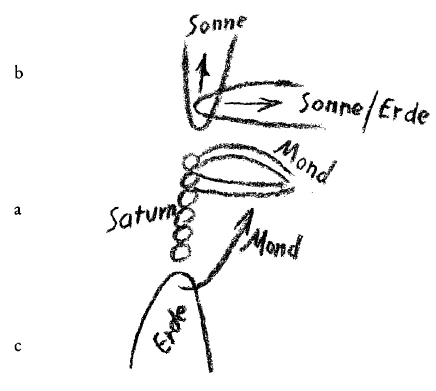
[ 31 ] Today I would like to touch on just a few points that will be explored in greater detail in the coming days. I am bringing them up because they will lead us to a concluding thought. As I said, I will elaborate on them further in the coming days. For example, our organism has limbs whose configuration still very clearly bears the original impulses of the ancient Saturn evolution, but which have been transformed and reshaped in many ways, so that one cannot readily recognize them in their present form without studying the Akashic Records. Schematically represented (see drawing on p. 148, a), the bones enclosing the spinal cord were first formed during the ancient Saturn evolution, while still in the element of warmth, and have been continually reshaped in subsequent evolutions. The bones that develop into the ribs were then added during the Moon evolution. They have been reshaped to a lesser extent because their initial formation occurred less long ago.
[ 32 ] Other organs were first positioned facing upward during the Sun stage of evolution and were subsequently transformed. What we today call the human skull, the human head, was first formed during the Sun stage of evolution and was then transformed many times over. But if only what the Sun’s evolution gave to humanity with regard to the skull had taken place, then humans would have to carry their heads in a way they cannot—namely, so that it would always be pointing upward. Therefore, during Earth’s evolution, under the influence of the Sun, a ninety-degree rotation occurred, so that what should have been pointing upward is now oriented this way. So instead of drawing the solar arrow for Earth’s evolution like this, we must now draw it like this (see drawing). It is part of the normal evolution that the human form has undergone under the influence of the cosmos that the shape of the head, having been directed upward, has been turned forward, has been rotated forward.
[ 33 ] Those spirits, now, that have remained behind in the lunar stage of development have brought with them the impulse to make humans lift their heads upward by permeating and influencing them. People who have a tendency to hold their noses high in an unfriendly manner, as the saying goes, are seduced by such Luciferic spirits. There is a real basis for this. It is truly a physiognomic-cosmic truth, and one is absolutely correct when saying of someone who holds their nose high: “Well, Lucifer is sitting on the back of their neck!” That is absolutely true. Therefore, it will be of infinite importance for life to truly understand these cosmic relationships.
[ 34 ] If we consider the human limbs—arms and legs—the legs are limbs that are directly part of the Earth’s evolution and are entirely attuned to the Earth. The arms, however, are such in their normal development that if human beings had merely followed the development of the Earth, they would be able to lower their arms only downward. By being able to raise them upward as well, they direct them voluntarily toward the development of the Moon; that is, with every raising, they give them a Luciferic character. Anyone with a keen sense of feeling therefore perceives every arm movement performed in this way (arms raised forward and upward) as something possessing a Luciferic character. Let us take this in, and now imagine a person who simultaneously bows the head and raises the hand, but in such a way that these two movements are held together in a single human gesture: the person bows the head and raises the arm. This bowing of the head is a counteraction against the Luciferic nature of the head. The raising of the arm is: bringing something Luciferic into the arms. But now it is this: by allowing Lucifer to enter the arm, and by resting the bowed head with the forehead on the arm, one redeems the Luciferic force flowing through the arm through the counteraction of the Christ force in the head. One redeems, as it were, Lucifer in the arm through Christ in the head.
[ 35 ] Draw the human figure in the correct gesture, with the head resting on the arm; in this gesture, you have expressed it. The human being forms a gesture that expresses: Lucifer is redeemed through Christ! — And if you add, for example, a bending of the knees, you have intensified this gesture. Raise both arms upward, and suppress the force of the lift, as happens when folding the hands (that is, raising the arms with the hands folded), and then try to counter the Luciferic force flowing upward with your folded hands by, as it were, paralyzing it, and thus countering the Christ force.
[ 36 ] Human gestures become an expression of the entire life of the world, of the world’s spiritual life. One must feel how deeply the arrangement of the human form in art can be enriched by such knowledge of the mysteries of the cosmos! But you can also ask yourself this: What has happened as a result of the head’s—so to speak—Luciferic upward orientation having been turned forward—through the influence of the sun on Earth—and the human being standing on Earth with the head turned forward? Through this, the human being has become an earthly being! That which is not an earthly being cannot, therefore, have legs and feet in the human sense. The human being does not derive his head—and thus also his face—from the Earth, but from the cosmos; yet its form arises through its turning toward the Earth. If we take other genii, other spirits, we cannot possibly endow them with human legs. To depict genies that do not belong to earthly existence with human legs is simply wrong—it is indeed wrong. This can truly be understood through insight into Spiritual Science. And our art must take these perceptions, which arise from insight into Spiritual Science, into account in every respect in our architecture.
[ 37 ] So you see that this can truly provide a new impetus for artistic creation. When Spiritual Science is no longer viewed as a dry theory, but as something that enters into people as sensation and feeling, then it will be recognized that it can have a fertilizing effect on all endeavors of human cultural development. A small beginning is to be made with this in our building.