

Artistic and Existential Questions
in the Light of Spiritual Science
GA 162
23 May 1915, Dornach
Translate the original German text into any language:
Versions Available:
Whitsuntide in the Course of the Year, tr. Watkins
Erster Vortrag
Whitsuntide in the Course of the Year
[ 1 ] Der Mensch nimmt wahr an sich und in der Natur dasjenige, was man Wachsen nennt, und dasjenige, was man Zerstören, Zerstörung, was man Auflösung nennt. Und seine Vorstellungen richtet der Mensch aus selbstverständlichen Instinkten, aus der physischen Welt heraus eigentlich so ein, daß er mit einem gewissen Glauben an die Wirklichkeit sich dann durchdringt, wenn er Aufbau, Wachsen an sich und in der Natur wahrnimmt. Und über dasjenige, was gewissermaßen aus der Wirklichkeit herausgeht, was die Wirklichkeit verliert, über das bildet sich der Mensch Vorstellungen dadurch, daß er den Blick auf das Zerstörende, die Zerstörung, auf die Auflösung richte, so daß es dem Menschen ganz natürlich erscheint, etwas als aus der Wirklichkeit hinausgehend zu bezeichnen, wenn er daran wahrnimmt, es löse sich auf, es gehe allmählich ins sogenannte Nichts der physischen Welt über.
[ 1 ] Man perceives in himself and in nature both what we call growth and what we call destruction, or perhaps dissolution. And he instinctively forms his ideas in such a way that he is permeated with a certain belief in reality when, whether in himself or in nature, he perceives building up—growth: He forms ideas about what in a sense goes outside reality, loses reality, by directing his glance to destruction, to dissolution; so that it seems quite natural to him to describe what thus goes outside reality, when he perceives it being dissolved, as gradually passing over into the so-called nothingness of the physical world.
[ 2 ] Wenn man — das ist oftmals betont worden — wirklich zu Vorstellungen über die geistige Welt kommen will, dann muß man die Vorstellungen, die man in der physischen Welt gewonnen hat, vielfach modifizieren. Über vieles muß man andere Vorstellungen sich bilden, als man sie zunächst in der physischen Welt gewinnt, wenn man überhaupt mit seinem Denken an die geistige Welt herantreten will. Und ganz besonders bedeutsam ist es, daß wir uns einen Begriff bilden, der im Grunde genommen schon überall in unseren geisteswissenschaftlichen Betrachtungen ausgebreitet liegt, den wir uns aber, ich möchte sagen, nicht oft genug vor die Seele rücken können: es ist der Begriff von einem Zusammenhang unseres Bewußtseins mit entsprechenden Vorgängen in unserem physischen Organismus während des Lebens in der physischen Welt. Wir werden niemals das Wirken des Bewußtseins in der physischen Welt begreifen, wenn wir es nicht zusammenbringen können mit dem Begriffe der Zerstörung, der Auflösung. Würde in uns als physische Wesenheiten nur Wachstum, nur Entwickelung sein, so würden wir niemals bewußte Wesen in der physischen Welt sein können. Dasjenige, was in uns sich darstellt durch Wachsen, durch Sprossen, Sprießen, das führt niemals in der physischen Welt zu einem Bewußtsein. Bewußtsein kann erst da beginnen, wo in die Wachstumsprozesse eingegriffen wird mit Zerstörung, mit auflösenden, mit abbauenden Prozessen. Auf solcher Grundlage müssen wir uns auch vertraut machen mit den Vorstellungen, welche die Initiation über die sogenannte menschliche Entwickelung ergibt.
[ 2 ] I have often said that if we want really to arrive at ideas concerning the spiritual world, we must modify in many respects those ideas acquired in the physical world. We must have different ideas from those acquired in the physical world if we wish to enter at all with our thinking into the spiritual world. It is especially important that we should form a concept which is actually found everywhere in our study of spiritual science, but which we cannot too often bring before our souls—the concept of a connection during physical life between our consciousness and the corresponding processes in our physical organism, We shall never grasp the working of consciousness in the physical world unless we can connect it with the concept of destruction or dissolution. Were there only growth, only development in us as physical beings, we could never be conscious beings in the physical world. In this physical world what is represented in growth, in budding and sprouting, never leads to consciousness. Consciousness can begin only where the processes of growth are invaded by destruction, by processes of dissolution. On this basis we should make ourselves familiar with the ideas which initiation gives us concerning man's so-called evolution
[ 3 ] Wir wissen ja, daß das Kind zunächst hineinwächst in die Welt wie in einer Art von Traumleben. Dieses Traumleben des Kindes ist aber verknüpft mit Wachstum, mit sprießenden, sprossenden Vorgängen; und in einem je früheren Lebensalter des Kindes wir den Blick auf dasselbe hinwenden, um so mehr Sprießendes, Sprossendes tritt uns entgegen. Und erst wenn die Individualität im menschlichen Organismus so viel Gewalt bekommt, daß sie sich auflehnen kann gegen das Sprießen und Sprossen und eingliedern kann dem Sprießen und Sprossen Zerstörungsprozesse, dann tritt volleres und immer volleres Bewußtsein auf. In dem Maße, in dem wir imstande sind, abzubauen dasjenige, was da innere Natur in uns aufbaut, in dem Maße werden wir uns bewußt.
[ 3 ] We know that at first the child grows into the world as in a kind of dream. This dream-life of the child is, however, closely united with his growth, with all the sprouting and budding processes; and the younger the child whom we consider, the more do these budding and sprouting processes meet our eye. Only when the individuality in the human organism gains sufficient power to oppose the sprouting and budding, and can bring into them processes of dissolution, does fuller and more complete consciousness appear. We become conscious to the extent to which we are capable of pulling down in us what inner Nature builds up.
[ 4 ] Wenn derjenige, der durch die Initiation gegangen ist, hinblickt darauf, wie Bewußtsein im Menschen entsteht, dann findet er, daß jeder bewußte Gedanke, der gefaßt wird, jede bewußte Empfindung, die sich geltend macht, damit verbunden sind, daß Zerstörungsprozesse den Aufbauprozessen des Organismus abgerungen werden. Man sieht auf die Zerstörung hin, indem man hinblickt auf bewußtes Leben. Und man muß sich gewöhnen, nicht bloß ein positives Gefühl von Wirklichkeit zu haben, indem man Prozesse des Sprießens, des Sprossens, des Wachsens sieht, sondern man muß sich dazu aufraffen, Gefühl gerade für bewußtes Geistesleben dadurch zu haben, daß man darauf hinblickt, inwiefern sich dieses bewußte Geistesleben in der physischen Welt abspielt, daß man hinblickt auf Absterbeprozesse, auf Zerstörungsprozesse. Darum müssen wir ja die bewußten Prozesse mit den unbewußten Prozessen des Schlafes vertauschen, damit dasjenige, was wir während des wachen Gedankenlebens zerstört haben, wiederum aufgebaut werden kann durch die unbewußten Kräfte der Natur in unserem Organismus. Das ist der Pendelschlag des Lebens; daß die Seelenkraft, indem sie zum Bewußtsein aufwacht, dasjenige abträgt, zerstört, was die bloße Natur im Menschenorganismus schafft; und daß von dem Augenblick an, wo die Seele im Schlafe das natürliche Leben des Leibes verläßt, die Prozesse, die Tätigkeiten des Sprießens, des Sprossens wiederum vor sich gehen. Daher ist es nicht richtig, wenn man glaubt, daß verglichen werden dürfe das wache Tagesleben des Menschen mit dem Leben zur Sommerzeit, wenn die Erde sprießt und sproßt. Nein, die Erde selber als geistige Wesensgestalt wird wach indem Moment, wo gegen den Herbst zu die Absterbeprozesse beginnen; und das vollwache Leben der Erde ist während der Winterzeit. Während der Sommerzeit aber, während die sprießenden, sprossenden Prozesse da sind, ist das Schlafesleben der Erde. Der Erdengeist schläft während des Sommers und wacht während des Winters.
[ 4 ] When anyone who has gone through initiation observes how consciousness arises in man, he finds that every conscious thought that is grasped, and every conscious feeling that asserts itself, are bound up with the fact that processes of destruction are contending with the building-up processes in the organism. When we look at conscious life we look at destruction; and we must accustom ourselves to have not merely a positive feeling for reality wherever we see a process of sprouting, budding, a process of growth, but we must rise to a feeling for the conscious life of the spirit by observing what part this conscious life of spirit plays in the physical world, by observing, that is, the processes of death and destruction. It is for this reason that we have to alternate the conscious processes with the unconscious processes of sleep, so that what we have destroyed during our waking life of thought may be built up again by the unconscious forces of nature in our organism. That is the swing of life's pendulum—that the soul force when it wakes to consciousness wears out and destroys what mere nature creates in the human organism; and that from the moment the soul, in sleep, forsakes the natural life of the body, from that moment the processes, activities, of sprouting and budding go forward. Hence it is not correct to believe that man's waking life is to be compared with life in summertime, when the earth is budding and sprouting. No! the earth itself as spiritual being wakes when towards autumn the dying processes begin, and it is during the winter that the earth is fully awake. During summer, during the budding and sprouting processes, we have the sleeping life of the earth. The Earth-Spirit sleeps during the summer and during the winter it wakes.
[ 5 ] Ich habe ja schon angedeutet, daß es aus der geistigen Intuition hervorgegangen ist, daß der Moment, wo der Mensch sich verbinden soll mit dem, was die Erdenentwickelung in das vollste Wachleben rufen soll, mit dem Christus—Impuls, in die Mitte der Winterzeit verlegt worden ist, nicht in die Sommerzeit: das Christfest. Dagegen in jener älteren Zeit, wo der Menschen Wissen hervorgegangen ist aus einem Miterleben mehr des Schlafzustandes der Erde, wo sich die Seele des Menschen in die schlafende Erdenseele zu versenken hatte, um die Imagination, die traumhafte Imagination der alten Geistesanschauung zu bekommen, da war die entsprechende Festeshandlung in der heißen Sommerzeit vorzunehmen: das Johannifest. Das Johannifest bedeutet ein Sich—Verbinden, ich möchte sagen, ein Sich—Verbinden in Traum und Rausch mit dem schlafenden, träumenden Erdengeist. Das Weihnachtsfest bedeutet ein bewußtes Sich—Verbinden mit dem wachenden Erdengeist. — Gerade durch solche Vorstellungen kommen wir wiederum hinein in ein Erfühlen des Zusammenhanges des Menschen mit dem Kosmos. Wir kommen hinein in einer konkreten Weise. Nicht indem wir im allgemeinen davon schwärmen, daß der Mensch ein Mikrokosmos gegenüber dem Makrokosmos sei, sondern dadurch, daß wir uns wirklich Erkenntnisse davon verschaffen, wie das große Wesen Erde schläft und wacht im Gegensatz zu dem Menschen, der innerhalb vierundzwanzig Stunden sein Schlafen und Wachen vollbringt, während die Erde, der Erdengeist dieses Schlafen und Wachen in Jahrestrist vollbringt.
[ 5 ] I have previously pointed out that it is due to spiritual initiation that the moment of time when man is destined to unite himself with what in earth-evolution should call up the fullest waking life—with the Christ Impulse—that this moment has been placed in the middle of winter, not in the summer, namely, the Christmas festival. On the other handy I have also called attention to how in more ancient times, when manes knowledge proceeded more from his participation in the sleeping condition of the earth, when his soul had to sink into the sleeping Earth-soul in order to have Imagination, the. dream-like Imagination of the old spiritual vision, then the corresponding festival, the John festival, had to be held during the heat of summer. This festival might be said to signify union in dream and ecstasy with the sleeping, dreaming spirit of the earth. The Christmas festival signifies a conscious union with the waking Earth-spirit. It is just through conceptions such as these, my dear friends, that we come to feel man's renewed connection with the cosmos We enter into this connection concretely, not by merely enthusing in a general way about man being a microcosm of the macrocosm, but by gaining accurate knowledge of how the mighty Earth-being sleeps and wakes, taking the whole year for this alternation, whereas man sleeps and wakes in the course of twenty-four hours.
[ 6 ] Nun müssen wir die Blicke noch einmal genauer auf dasjenige wenden, was sich in der physischen Welt als Bewußtsein darlebt. Nehmen wir einmal an, wir bezeichneten dasjenige, was sprießendes, sprossendes Leben unseres Nervensystems ist, schematisch durch eine solche Zeichnung:
[ 6 ] And now we must turn our gaze with more precision to what we experience in the physical world as consciousness. Let us sketch diagrammatically the sprouting, budding life of our nervous system (see diagram).
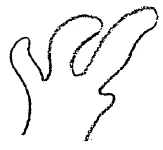
[ 7 ] In der Tat erschaut ja das Hellsehen das sprießende, sprossende Leben, zum Beispiel des Nervensystems, namentlich des Gehirns, wie eine solche feurige Welle. Nun, in Wahrheit ist aber außerhalb dieses sprossenden, sprießenden Lebens—des Menschen Seelenleben. Würde ich das menschliche Seelenleben für die Nacht zu zeichnen haben, für das Schlafen, so würde ich es ganz außerhalb dieser Figur zu zeichnen haben; für das wache Tagesleben aber müssen wir das Seelenleben als sich durchdringend mit diesem sprießenden, sprossenden, ich möchte sagen, feurigen Leben uns vorstellen:
[ 7 ] Clairvoyance actually sees the sprouting, budding life, for example, of the nervous system, especially of the brain, in this form of a fiery wave. Now the human life of soul is in truth outside this sprouting, budding life, Were I to draw the human soul-life as it is in the night, in sleep, I should have to draw it completely outside this figure; in waking life, however, we must picture the soul-life as permeating itself with this budding, sprouting, let us say, fiery life.
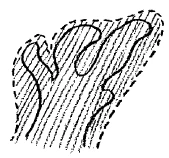
[ 8 ] Wenn also das Seelenleben nur das physisch—organische Leben durchdringen würde, so würde kein Bewußtsein entstehen. Wie entsteht Bewußtsein? Da muß zunächst das Seelische am Physischen arbeiten. Im Physischen sind zunächst sprießende, sprossende Wachstumsprozesse, feine Wachstumsprozesse, die meinetwillen über das Nervenleben zerstreut sind. Diese Wachstumsprozesse werden abgebaut, sie werden zerstört. Es entsteht ein ganz ähnlicher Prozeß, wie er entsteht, wenn die sprießende, sprossende Pflanze allmählich übergeht ins Welken und ins Verdorre, so daß das Seelenleben in diesem sprießenden, sprossenden Leben Zerstörungsprozesse anrichtet, die ich durch diese Einschnitte oder Unterbrechungen des Schraffierten hier zeichne.
[ 8 ] Thus were the soul-life to permeate the physical organic life only, no consciousness would arise, flow does consciousness arise? For that, the soul must work upon the physical. In the physical to begin with are budding, sprouting processes of growth which are as it were distributed over the life of the nerves. It is these processes of growth that are now broken down and destroyed. A process arises similar to what takes place when the budding and sprouting plant gradually withers and decays; thus the soul life induces processes of destruction in this budding, sprouting life. The destructive processes I indicate here by holes in the shading.
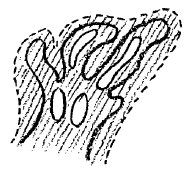
[ 9 ] Also, wenn wir wach leben, so zerstört zunächst unser Seelenleben die physischen Wachstumsprozesse, baut sie ab. Und von dem, was da geschieht, von diesem Abbauen weiß der Mensch in der Regel nichts. Erst die hellseherische Betrachtung gibt uns die Möglichkeit, wirklich uns zu sagen: Indem du dich mit der geistigen Welt — ich sage jetzt ausdrücklich nicht mit der physischen Welt, sondern mit der geistigen Welt — in Beziehung setzest, mußt du, wenn du dir Vorstellungen machen willst, in dir etwas zerstören.
[ 9 ] When we are awake, therefore, our soul-life destroys the physical processes of growths breaks them down. Man as a rule knows nothing of this destruction. Clairvoyant vision alone perceives it and makes it possible to say: “Now that you have put yourself into relation with the spiritual world (I say expressly with the spiritual not the physical world) if you wish to have ideas you must destroy something in you.”
[ 10 ] Sehen Sie, das ist das furchtbar Erschütternde im Initiationsprozeß, daß man dieses Zerstören sieht, daß man weiß, indem man sich mit irgendeinem Wesen, etwa einem Angelos—, Archangeloswesen der geistigen Welt in Beziehung setzt und Vorstellungen darüber gewinnen will, das heißt sie wirklich wahrnehmen will, muß man in sich etwas zerstören.Nicht durch die Initiation wird etwas zerstört, sondern durch sie wird nur gewußt, was im alltäglichen Wahrnehmungsprozeß zerstört wird.
[ 10 ] What makes initiation such a shattering experience is that we perceive this destruction, that we know that If we bring ourselves into relation, let us say, with an Angel or an Archangel being of the spiritual world and want to gain some ideas concerning that being, that is, if we want to perceive the being truly, we must first destroy something in ourselves.
[ 11 ] Man tut das auch, wenn man sich mit einer Blume, einem Tier in Verbindung setzt; nur weiß der Mensch es nicht im gewöhnlichen Verlauf des Lebens. Man fängt erst an es zu wissen, wenn diese Zerstörungsprozesse nun wie Spiegel zurück in das Seelenleben wirken. Das ist die Wandlung. Also denken Sie: Sie sehen eine rote Blume an. Dasjenige, was Sie mit der roten Blume erleben, das veranlaßt Sie zunächst, in sich einen Zerstörungsprozeß hervorzurufen. Das wissen Sie bloß nicht. Aber was da zerstört ist, das spiegelt sich in der Seele zurück, und das bewirkt, daß Sie dann die rote Blume als Vorstellung, als Wahrnehmung haben. Sie müssen also zuerst in sich selber ein Abbild schaffen von der roten Blume dadurch, daß Sie die sprießenden, sprossenden Prozesse abbauen, und indem Sie diese abbauen, schaffen Sie das, was Sie dann sehen. In solchen Abbauvorgängen, denen wieder Aufbauvorgänge folgen, besteht das bewußte Leben. Es ist ein inneres Arbeiten an dem eigenen Organismus, wie es im Grunde genommen schließlich auch allem menschlichen Kulturarbeiten zugrunde liegt. — Wenn wir Kulturarbeiten verrichten, so zerstören wir auch die Natur zunächst. Wir können kein Haus bauen, wenn wir nicht das Holz von draußen nehmen, indem wir zerstören, und dann dasjenige, was Zerstörungsprodukt ist, was wir aus der Natur herausgerissen haben, dann aufbauen zu unseren Kunstprodukten. So machen wir es im Grunde genommen mit aller Künstlerschaft. Hier machen wir es gerade so wie das Zerstörende, Abbauende an dem sprießenden, sprossenden Prozesse es macht: diese heben gewisse Wachstumsprozesse auf; und das, was dadurch eingebettet wird in den Organismus als ein herausgepreßtes Totes in das Lebendige, das ist der Inhalt des bewußten Seins. Wir versetzen fortwährend Totes in das Lebendige, indem wir Bewußtsein entwickeln; und je bewußter wir uns werden, desto mehr pressen wir in unseren lebendigen Menschen einen toten hinein.
[ 11 ] Not that anything is actually destroyed by initiation, but through initiation we become conscious of what is all the time being destroyed in the everyday process of perception. It is just the same when we put ourselves in relation with a flower or an animal, only in the usual course of life we are not aware of it. We begin to know of it only when these processes of destruction work back as reflection into the life of the soul. That is the change. Suppose, for examples you see a red flower. What you experience in the red flower causes you to call forth in yourself a process of destruction, You are, however, unaware of this. But what is destroyed is reflected into your soul and brings about that you have the red flower as an idea, as a perception. Thus you must first create in yourself a copy of the red flower by destroying the sprouting and budding processes, and while you destroy these you create what you then see. Conscious life consists in such processes of destruction, which again are followed by building-up processes It is an inner working at one's own organism and, strictly speaking, lies at the root of all works of human culture. When we instigate cultural work we also destroy something in nature. We cannot build a house if we do not go outside to get wood for it by a process of destruction, and what is thus the product of destruction, torn away from nature, we build up into our artistic creations. Strictly speaking, we do this in all works of art. We do just the same as the destroying, demolishing processes do to the budding, sprouting, which arrest processes of growth. What is embedded into the living organism as an inserted element of death forms the content of conscious being. Every time we display consciousness we are planting what is dead into what is alive, and the more conscious we become the more do we insert a dead man into our living man.
[ 12 ] Der Schlaf hat dann die Aufgabe, die toten Einschlüsse wieder aufzulösen bis auf gewisse Reste, die da bleiben und die durch das ganze physische Leben in der gleichen Weise als Prozesse durchgehen und dem Gedächtnis, der Erinnerung zugrunde liegen. Würde alles durch den Schlaf wieder aufgelöst werden, so würden wir kein Gedächtnis, keine Erinnerung haben. Also Sie sehen, wir müssen uns bekanntmachen mit einem richtigen Winter in unserem Leben, wenn wir Bewußtsein erringen wollen. Bewußt sein wollen heißt über das sprießende, sprossende Sommerleben das zerstörende, verdorrende Winterleben ausbreiten. Wir müssen Winter machen in uns, wenn wir bewußt sein wollen. Wir müssen also in einer gewissen Weise den Winter schätzen lernen, weil, wenn es immer Sommer wäre im Leben, der Geist im Physischen nicht bewußt erleben könnte, sondern immer unbewußt bliebe.
[ 12 ] Then sleep has the task of dissolving away these dead elements, all but certain remains which, persisting as processes throughout the whole of physical life, lie at the foundation of memory, Were everything to be dissolved by sleep, we should have no memory, no recollection. Thus you see if we want to acquire consciousness we have to recognise in our life a real winter. Consciousness means spreading the destroying, withering life of.nter over the budding, sprouting summer life, We have to make winter within us if we wish to become conscious. Thus we must in a sense learn to value the winter, because were it always summer in our life the spirit could not experience the physical consciously but would remain for ever unconscious.
[ 13 ] Noch ein anderes mag Ihnen aber hervorgehen aus diesen Betrachtungen. Der materialistische Weltbetrachter wird leicht sagen: Ja, in.die Art und Weise, wie das Bewußtsein im physischen Leibe arbeitet, kann man ja nicht hineinschauen. — Gewiß, solange man nicht Geisteswissenschaft studiert, kann man nicht hineinschauen. Wenn man aber durch Geisteswissenschaft erfährt, daß ein Parallelismus besteht, wie er angedeutet worden ist, der Parallelismus zwischen dem einzelnen Leben des Menschen und dem Leben des Erdengeistes, dann kommt man ja zu folgendem. Dann sagt man sich, wenn man einen Begriff sich machen will von dem schlafenden Menschen, von dem, was eigentlich der schlafende Mensch ist: Nun, dann stelle man sich einfach hin während der sprießenden, sprossenden Sommerzeit und sehe an, wie da alles sprießt und sproßt. Wie es da draußen.in der Erde zugeht, so geht es — nur im kleinen, so daß man es nicht sehen kann — vor sich in der physischen Natur des Menschen. Einfach Sommer würde man erleben im Menschen, wenn man den schlafenden Menschen betrachtet, und Winter würde man erleben im Menschen, wenn man den wachenden Menschen betrachtet. Will man wissen, wie es das Bewußtsein macht, indem es sich des physischen Leibes als eines Werkzeuges bedient, dann muß man darauf hinblicken, wie im Herbst alles beginnt zu dorren, zu welken, alles beginnt abzusterben, wie man sagt. Und mit dem, was man sich da äußerlich als Bild machen kann von der Winterzeit, hat man eine rechte Vorstellung von dem, was das wachende Bewußtsein im physischen Organismus des Menschen verrichtet, indem es sich des physischen Leibes als Werkzeug bedient.
[ 13 ] Something more may arise out of these considerations, my dear friends. A materialistic observer of the world may easily say: It is not possible to look into the way in which consciousness works in the physical body. But when through spiritual science we learn that a parallel exists, in the way referred to, between the individual life of man and the life of the Earth-spirit, then we come to the following conclusion - that if we wish to have a concept of sleeping man and what he really is, all we need do is to imagine ourselves in the budding; sprouting life of summer where everything buds and blossoms. What goes on outside in the earth goes on in miniature and imperceptibly in manes physical nature. We should simply experience summer in man when we look at him asleep, and winter when we look at him awake. If we wish to know what happens to consciousness when it makes use of the physical body as instrument, we must observe how in autumn everything begins to dry up and wither, everything begins to die away, In the external picture we can make of winter we have a true idea of what the waking consciousness brings about in man's physical organism by using it as an instrument.
[ 14 ] Daher kommt es auch, daß, wenn die Seele außerhalb des Leibes ist und dieses hellseherische Bewußtsein hinblickt auf den Leib, aus dem jetzt die Seele draußen ist, dieses hellseherische Bewußtsein den Leib wahrnimmt wie eine sprossende, sprießende Welt. Es ist eine kindliche Vorstellung, wenn man glaubt, daß der Hellseher, wenn er mit seiner Seele außerhalb des Leibes ist, den Leib so sieht, wie man einen anderen Menschen im physischen Leben sieht. Das ist ja das Falsche, daß die Menschen sich vorstellen, daß der Mensch daliege und die Seele darüber schwebe und die Seele so zurückblicke auf den Leib und den Menschen da unten liegen sehe. Das ist aber nicht der Fall. In dem Augenblick, wo die Seele herausgeht, wird der Leib zur Welt, zur Sommerwelt; und wenn die Seele hellsehend bleibt und in den Leib wieder hineingeht, so erlebt sie den persönlichen, den individuellen Winter in sich.
[ 14 ] That is why when the soul is outside the body and clairvoyant consciousness looks at the body out of which the soul has departed, it perceives the body as a budding, sprouting world. It is childish to believe that the clairvoyant, when outside the body with his soul, sees the body in the same way as in physical life we see another human being. We are wrong in thinking that the man lies there with his soul hovering above and that the soul looks back on the body and sees the man lying there beneath. That is not so. The moment the soul goes forth, the body becomes the world, a summer world; and if the soul remains clairvoyant on returning to the body, it experiences in itself the personal, individual winter.
[ 15 ] Einen innigen Zusammenhang also entdecken wir auf diese Weise zwischen dem Leben des Menschen und dem Leben der Erde. Wenn wir nun dieses Leben der Erde uns vorhalten und blicken zunächst auf die Sommerzeit hin, dann zeigt uns, außer uns hingestellt, diese Sommerzeit alles dasjenige, was gleichartig auch in uns wirkt und webt, wirkt und webt.aber an uns im schlafenden Zustande. Und wenn wir nun nach einem Ausdruck suchen, der uns in Kürze die Empfindung von diesem Wirken und Weben im Schlafzustande geben soll, dann ist es der Ausdruck: Das ist alles die Welt des Geborenwerdens, des Entstehens. Und wenn wir uns selber in dieser Welt fühlen, dann können wir sagen: Aus dem Göttlichen sind wir geboren. — Denn insofern wir mit unseren eigenen Kräften dieser Welt angehören, dieser sprießenden und sprossenden Welt, müssen wir sagen: «Ex Deo nascimur. Aus dem Göttlichen sind wir geboren.» Dieses «Ex Deo nascimur» konnten die Menschen sagen zu jeder Zeit der Erdenentwickelung, und werden es auch in Zukunft zu jeder Zeit der Erdenentwickelung sagen können. |
[ 15 ] We can thus discover an inner connection between the life of man and the life of the earth. When we consider the life of the earth and look first at summer time, outside us we see in this summer time what works and weaves in us in the same way but works and weaves during our sleeping condition. If we now seek to express in a few words the feeling of this working and weaving in sleep, we can do so as follows. All this is the world of coming to birth, of arising, And when we feel ourselves in this world, we can say, “OUT OF THE DIVINE WE ARE BORN”. For in so far as with our own forces we belong to this world, this budding and sprouting world, we must say: EX DEO NASCIMUR, Out of the Divine we are born. Man has been able to say EX DEO NASCIMUR at every stage of earth evolution and will be able to say it also in each future evolutionary stages
[ 16 ] Dagegen ist es für unseren Zeitenzyklus, der nach dem Eintritt des Mysteriums von Golgatha liegt, wesentlich, daß wir verstehen, daß ja in uns wirken die Kräfte des absterbenden Lebens, die Kräfte des hinschmelzenden, des sich auflösenden Lebens, und daß mit diesem Hinschmelzen, Sich-Auflösen des Lebens das Bewußtsein zusammenhängt. Das Bewußtsein der Erde, das wache Erdenleben finden wir zur Winterzeit. Wir müssen, um im Winter mit der Erde zu leben in der physischen Welt, untertauchen in das Ersterbende. Aber nach dem Mysterium von Golgatha tauchen wir unter, indem wir den Christus-Impuls mit in dieses Ersterbende hineinnehmen: «In Christo morimur.» Und wir machen dies zum Geleitspruch durch die andere Hälfte des Jahres, indem die Erde wacht, wacht im ersterbenden Leben: «In dem Christus sterben wir.»
[ 16 ] On the other hand it is essential for our own cycle of time, which follows the Mystery of Golgotha, that we should now understand that the forces of dying life work in us; melting forces, dissolving life, and that with this melting away, this dissolution of life, consciousness is connected. We find the consciousness of the earth, the waking earth-life, in the winter time. In order in winter to live with the earth in the physical world, we must dive down into what is dying, But since the Mystery of Golgotha, we do this by taking the Christ Impulse with us into what is dying: IN CHRISTO MORIMUR. We make this into a guiding motto through the other half of the year, when the earth is awake, awake in the dying life: IN CHRISTO MORIMUR.
[ 17 ] Und so teilt sich uns das Erdenjahr in zwei Hälften, in diejenige Hälfte, die zu Johanni ihren Höhepunkt hat und für die uns der Spruch gilt: «Ex Deo nascimur», und in die andere Hälfte, die um die Weihnachtszeit ihren Höhepunkt hat und für die uns der Spruch gilt: «In Christo morimur.»
[ 17 ] Thus the earth's year is divided for us into two halves, into the half which has its culminating point at Midsummer, for which the saying holds good: EX DEO NASCIMUR, and the other half which has its culminating point at Christmas time, for which we have the saying: IN CHRISTO MORIMUR.
[ 18 ] Man soll nicht glauben, daß, richtig gefaßt, die Anschauung von dem Menschen als Mikrokosmos gegenüber dem Makrokosmos nur eine abstrakte ist. Man soll auch nicht glauben, daß man mit abstrakten Vorstellungen dieser Anschauung gegenüber viel ausrichten kann. Man soll sich vielmehr klar sein, daß man immer mehr und mehr diese Anschauung trifft, wenn man zu dem wirklichen Leben des Erdengeistes wirklich kommt.
[ 18 ] We should not think that the correct conception of man as the microcosm of the macrocosm is merely an abstraction, Nor should we think that we can do very much if we hold to abstract ideas about it. Rather should we be clear that we shall meet this conception more and more on really coming to the true life of the Spirit of the Earth.
[ 19 ] Sehen Sie, wenn man so im Winter die Erde betrachtet mit ihrem ersterbenden, erfrierenden Leben, so ist dieses ersterbende, erfrierende Leben der Ausdruck des Denkens, des Fühlens und Empfindens des wachenden Erdengeistes. Aber diesen Erdengeist müssen ‚wir uns im Zusammenhang denken mit dem, was uns zunächst als unsere Welt umgibt. Wir müssen uns gleichsam die Welt vorstellen wie ein großes Geistwesen, welches an der Erde sein physisches Werkzeug hat. Und diese Vorstellung von dem, was die Erde denkt, was die Erde insbesondere wachend zur Winterzeit denkt, bekommt man dann, wenn man die ganze Art, wie die Erdenumgebung in die Erde hineinwirkt, in Betracht zieht. Denken Sie sich in einer Winternacht den Blick hinausgerichtet auf die Sterne, etwa inmitten der Sterne den Mond, so muß man sagen: Die Konstellation dieser Sternenwelt, die ist ein äußerer Ausdruck, ein Bild desjenigen, was bewußt auf der Erde gedacht wird, und wir leben darinnen, indem das Weltenall mit der Erde in ein Verhältnis eingeht. Da sehen Sie lebendig uns drinnen stehend in dem Erdendenken, in dem, was die Erde umwebt und umspült als Erdendenken [im Winter so], wie wir im Sommer im Erdenschlafe drinnen stehen, lebendig mit unserer eigenen Seele.
[ 19 ] You see, when we observe the earth in winter with its dying, freezing life, this dying, freezing life is the expression of the thinking, feeling and perception of the waking Earth-spirit. But we must think of the Earth-spirit in connection with what surrounds us as our immediate world. We should picture the world, as it were, as a great spiritual being having the earth as physical instrument. And we get this idea of what the earth is thinking, especially of what it is thinking during winter, when we consider the whole manner in which the surroundings of the earth work into the earth. Imagine yourself on a night in winter, with your gaze directed to the stars, with perhaps the moon among the stars, and you have to say that the whole constellation of this starry world is an outward expression, a picture, of what is thought consciously on the earth, and we live in it because the cosmos enters into relation with the earth. You then see how we are standing in a living way within the thinking of the earth, in all that weaves and waves around the earth as earthly thinking, just as in summer, livingly with our own soul, we are within the earth-sleep;
[ 20 ] Und doch müssen wir uns im Sommer wachend in das Erdenleben hineinstellen. Wir müssen, ich möchte sagen, alle astralen Kräfte anwenden, damit wir nicht verfallen dem Erdenschlafe. Viele Menschen schlafen ja bei der Soemmerhitze wirklich sehr leicht ein, weil ihre astralischen Kräfte nicht stark genug sind, sich gegen den allgemeinen Erdenschlaf aufrechtzuerhalten. Wenn wir selber schlafen während der Sommerzeit, dann ist unsere Tätigkeit gleichartig mit der Erdentätigkeit. Im Winter müssen wir uns wiederum im Unterbewußten solche Kräfte entwickeln für den Schlaf, die dem allgemeinen Erdenleben widerstreben, und für das Wachleben haben wir während der Winterzeit diejenigen Kräfte nötig, die in der Richtung des Wachlebens des Erdengeistes liegen. So, möchte ich sagen, schwingen wir mit unserem eigenen Leben, mit den kleinen Schwingungen unseres eigenen Lebens mit in den Jahresschwingungen des Erdenwesens, des bewußten Erdenwesens. Und dieses bewußte Erdenwesen, das ist ganz und gar abhängig von der Konstellation der Sterne. Und da bekommen Sie einen lebendigen Eindruck von dem Durchwebtwerden des eigenen Seelenlebens durch das Sternenleben auf dem Umwege des Erdenschlafens und des Erdenwachens. Da bekommen Sie eine lebendige Vorstellung von dem, was Astrologie wirklich sein sollte, wenn sie überhaupt ernsthaft in Betracht kommen soll. Deshalb ist es so, wie ich oftmals sagte: Astrologie ist entweder der purste Dilettantismus oder aber sie kann nur errungen werden als Wesensglied einer wirklichen Vertiefung in geisteswissenschaftliche Studien und Erkenntnisse.
[ 20 ] Nevertheless, in summer we should take our place consciously in the life of the earth. We should call on. our astral forces so as not to succumb to the earth-sleep, Many people very easily fall asleep in the heat of summer, because during the universal sleep of the earth their astral forces are not strong enough to keep them awake. If we ourselves sleep during the summer time our activity is only equal in value to that of the earths In winter we should develop in the subconscious the forces for sleep which withstand the universal earth-life, whereas for the waking life during winter we need the forces lying more in the direction of the waking life of the Earth-spirit. So we might say we swing with our own life, with the lesser oscillations of our own life, within the yearly oscillations of the Earth-being, of the conscious Earth-being. And this conscious Earth-being is completely dependent on the star constellations There you have a living impression of the way in which our own soul-life is interwoven indirectly with the life of the stars in the sleeping and waking of the earth This gives us a living picture of what astrology is really meant to be, if it is at all to be taken seriously. Therefore, as I have often said Astrology is either the purest dilettantism, or it can only be striven for as an essential part in the deep study and knowledge of spiritual science.
[ 21 ] Ich habe in den letzten Zeiten oft betont, wie notwendig es ist, daß sich diejenigen, die der Geisteswissenschaft nahestehen, solche Vorstellungen aneignen, die aus dem bloß Gedanklichen ins Lebendige führen. Denken Sie, daß da ganz neue Seiten des Lebens sich erschließen, wenn wir nun wissen, daß das Bewußtsein in Abbau, in Zerstörung begründet ist, daß Zerstörung da sein muß, damit innerhalb des Physischen das Bewußtsein Werkzeuge haben kann. Denn wahrhaftig, ebensowenig, wie wir in der physischen Welt arbeiten können, ohne die Natur zu zerstören, ebensowenig können wir in uns bewußt werden, ohne daß die Wachstumsprozesse in uns zerstört werden. Hinschauen muß das Hellsehen auf diese fortdauernden Zerstörungsprozesse, rückhältlos hinschauen auf sie, wie, man möchte sagen das ganze Leben hindurch ein sukzessiver Tod sich abspielt, damit Bewußtsein sein kann. Und die Initiation besteht ja darin, daß man im Bild wie konzentriert empfängt diesen sonst auf die ganze Zeit zwischen Geburt und Tod ausgedehnten Zerstörungsprozeß. Aber im wirklichen physischen Tod ist er also konzentriert; und wenn der physische Tod nicht eintreten würde, so würden wir niemals ein Bewußtsein entwickeln können in der geistigen Welt nach dem Tode. Der Tod, das heißt die Zerstörung des physischen und des Ätherleibes, ist die Grundbedingung für die Entwickelung des Bewußtseins in der Zeit zwischen dem Tod und einer neuen Geburt. Wie die Pflanze nicht da sein kann, wenn die Wurzel nicht da ist, so könnte das Bewußtsein zwischen dem Tod und einer neuen Geburt nicht da sein, wenn es nicht herauswurzelte aus dem Todesprozesse. Wie wir uns in den ersten Jahren unseres physischen Lebens die Möglichkeit erringen müssen, seelisch zu zerstören die zuerst wachsenden, sprießenden Prozesse, und das Bewußtsein erst in dem Grade erwacht, wie wir Zerstörungsprozesse hineinbetten können in die Wachstumsprozesse, wie erst wenn diese Kraft der Zerstörungsprozesse einen genügenden Grad erlangt hat, ein Bewußtsein sich überhaupt bildet, so müssen wir den ganzen Leib zerstören, abwerfen; und die Tat, die wir damit tun, dieses Abwerfen zunächst des physischen, dann des Ätherleibes, diese Tat ist die Ausgangstat für das Bewußtsein zwischen dem Tod und einer neuen Geburt. Damit erwerben wir uns die Fähigkeit des Bewußtseins zwischen dem Tod und einer neuen Geburt, daß wir — man darf schon sagen, denn es entspricht der Richtigkeit — uns sozusagen töten können, das heißt die Prozesse durchmachen können, die im Tode vor sich gehen.
[ 21 ] Recently I have often emphasised, my dear Friends, how necessary it is that those who are drawn to spiritual science should acquire conceptions that will lead them from what is merely the content of thought into living reality, Think what entirely new sides of life open to us when we know that consciousness is based on a breaking-up, destruction, and that there has to be destruction for consciousness to have its physical instruments. For in very truth just as we cannot work in the physical world without destroying nature, so we cannot become conscious without the destruction in us of our processes of growth. Clairvoyance has to look upon these continuous processes of destruction, it has without bias to see how our whole life through, a gradual death is taking place for consciousness to be able to exist. Initiation consists in our receiving as it were a concentrated picture of this process of destruction spread out over the whole time between birth and death. This process is concentrated in actual physical death; were not physical death to come about, in the spiritual world after death we should never be able to develop consciousness. Death, the destruction of the physical and etheric bodies, is the primary condition for the development of consciousness in the time between death and a new birth. As a plant cannot be there if the root is not, so the consciousness between death and a new birth cannot exist if it is not rooted in the process of death. As in the first years of physical existence we have to strive for the possibility of destroying from the standpoint of the soul the early processes of budding and growth, consciousness only awaking to the extent to which we can embed the processes of destruction into the processes of growth—as only when the force of the destructive process has reached a certain stage a consciousness develops—so we have to destroy and discard the whole body. And the act we thus perform, this shedding first of the physical and then of the etheric body, is the starting point for the consciousness between death and a new birth. We acquire the faculty of consciousness between death and a new birth by being able to kill ourselves—we may be allowed to say this, for it corresponds with the truth—by being able, that is, to undergo the processes that take place in death.
[ 22 ] Wie das Leben hier zwischen der Geburt und dem Tode seinen Ausgangspunkt hat zuerst in dem bloß pflanzlichen Kindesleben, so hat das Leben zwischen dem Tod und einer neuen Geburt seinen Ausgangspunkt in dem Todesprozesse. Da sehen wir also auf radikale Zerstörungsprozesse hin. Und das ist eben wichtig, daß wir uns in einer solchen Weise aneignen die Möglichkeit eines Hineinlebens in den gesamten Verlauf der Natur und des ganzen, auch geistigen Weltenalls.
[ 22 ] As life here between birth and death has its starting point in the merely plant-like life of the child, so the life between death and a new birth has its starting point in the process of death. We are here looking at strictly destructive processes, and it is important that we should adapt ourselves to the possibility of sharing in the life of the whole course of nature and that of the entire spiritual cosmos.
[ 23 ] Wenn Sie das neuere Geistesleben betrachten, dann werden Sie finden, daß im Grunde genommen immer mehr und mehr — ich habe auch darauf schon aufmerksam gemacht — die Entwickelung des Menschen sich zurückzieht von dem inneren Prozeß des Daseins, und man die Welt nur äußerlich ansehen will. Es entwickelt sich immer mehr und mehr die Abneigung, die ganze Natur anzusehen; und es entwickelt sich auch mehr und mehr die Hinneigung, bloß, ich möchte sagen die Hälfte der Natur zu betrachten, nämlich die wachsenden, sprießenden, sprossenden Prozesse. Da, wo die Vernichtung beginnt, da, denkt man, höre das Dasein eben auf. Der Materialist kann gar nicht anders als so denken, denn er kann ja niemals Vorstellungen über das geistige Leben in der physischen Welt gewinnen, weil diese Vorstellungen über das geistige Leben in der physischen Welt eben da beginnen, wo die Zerstörungsprozesse beginnen. Aber er will nur die sprossenden Prozesse untersuchen, weil für ihn eigentlich nur die das Reale sind. Wenn etwas anfängt abzuwelken, da fängt er schon wiederum an, dasjenige zu untersuchen, was dann hinüberwächst, oder er untersucht in dem absterbenden Prozesse dasjenige, was dann als chemischer Rest übrigbleibt, das heißt auch wiederum das, was sich da herausentwickelt als das Entstehende. Das Wichtige ist, man will nicht hinlenken das Auge auf die eine Hälfte, auf das Vergehen. Aber [nur] aus dem Vergehen allein kann man eine Anschauung gewinnen über das Dasein des bewußten Seelenlebens. Das ist eine ungeheuer wichtige Vorstellung.
[ 23 ] If you examine the modern life of spirit, my dear friends, you will find that in reality—I have pointed to this before—the development of man is gradually withdrawing more and more from the inner process of existence, and only the external world is considered. There is a growing disinclination to look at the whole of nature, the tendency being more and more to consider only half of her—the growing, budding and sprouting forces. Where annihilation begins, there existence is thought to cease. The materialist cannot think otherwise, since he can never form ideas about spiritual life in the physical world, because these ideas about spiritual life in the physical world begin just where the processes of destruction begin. He wants to investigate only the growing processes for to him they are the sole reality. When anything begins to wither he sets out to investigate what grows up over it, or he seeks in the dying process the chemical remains, that is the material, the physical. The important point is that man has no wish to direct his attention to the other half, to the dying. Yet it is only from what passes away that men can acquire an insight into the existence of the conscious soul-life. This is a vastly important truth
[ 24 ] Indem sich die neuere Weltanschauung in der eben angedeuteten Weise entwickelt hat, indem sie nur immer den Blick hingerichtet hat auf das Sprießende, Sprossende, hat sie sich auch in die Unmöglichkeit versetzt, Geistiges zu schauen, denn das Geistige schlüpft aus den Dingen dort hervor, wo sie anfangen sich aufzulösen. So lange sie sprießen und sprossen, da arbeitet das Geistige in den Wesen drinnen, da tritt es nicht als Geistiges auf, da offenbart es sich äußerlich durch die materiellen Prozesse. Wenn das Geistige an sich erscheinen soll, dann müssen Zerstörungsprozesse vor sich gehen. Die Geister der Blüten, die Elementargeister der Pflanzen dürfen nicht bleiben, wenn die Blüten aufwachen, wenn die Blüten sich entwikkeln, wenn die Sonne hervorzaubert durch ihre tönende Welle das sprießende und sprossende Leben. «Trifft es euch, so seid ihr taub!» Man lese diese Worte vom Beginne des zweiten Teiles von Goethes «Faust» mit Verstand: Da müssen sie untertauchen; sie können dann heraus, wenn das sprießende, sprossende Leben zurücktritt.
[ 24 ] That the modern world-outlook, because it has developed in the way indicated because it always directs attention to what is budding and sprouting, has deprived itself of the power to see the spiritual, the spiritual only betraying its presence in things when they begin to disintegrate. As long as there is budding and sprouting, the spiritual works within the beings, not appearing as spirit but manifesting externally through material processes. If the spiritual is to appear in the beings, processes of destruction must take place. The spirits of the blossoms, the elementary spirits of the plants, may not remain when the blossoms open and the flowers are developed, when the sun with its sounding waves charms forth the budding, sprouting life. “If it strikes you, you are deaf.” Read these words at the beginning of Part II in Goethe's “Faust” with understanding, The spirits must dive down, They can emerge only when the budding and sprouting life withdraws.
[ 25 ] Sehen Sie, so lebendig ist die dichterische Anschauung zum Beispiel bei Goethe, daß er durchaus das empfindet: Wie nun das Sprießende, Sprossende der Sonnenoffenbarung hervorkommt, da müssen sich die Elfenwesen wieder zurückziehen. Wir haben das ja dargestellt zur Freude unserer Kleinen, die sich sehr gerne geduckt haben, als sie das hörten. Aber das wird Ihnen ersichtlich sein, daß gewissermaßen aus dem Anblick der physisch absterbenden Welt, das Geisternebelreich und schließlich überhaupt das Geisterreich ersteht. Es ist nicht so ganz ohne Sinn, wenn die Volksvorstellung sagt, daß die Bäume erst faulen müssen, um geistig zu werden, und uns nur da, wo sie faulen, Geist erscheinen lassen. Wenn wir hinausgehen und irgendwo einen faulenden, dürren Baumstamm haben, dann zeigt er eigentlich erst das Geist-Erscheinen. Es muß überall erst Zerstörung da sein, wenn das Geistige erscheinen soll.
[ 25 ] You see, the poetic perception of Goethe was so living that he thoroughly realised how the budding and sprouting that comes forth with the rising of the sun makes it necessary for the elves to recede. But this will become clear to us, my dear friends, that at the sight of the physically dying world there arises first the misty realm of the spirit and then the whole true spirit realm. It is not without meaning when in folklore we hear that to become spiritual the trees must first decay, that only when they are decaying do they let us see the spirit. If we go out into the country and see a decaying, dried-up tree-trunk, it is really showing for the first time its spiritual appearance. There must everywhere first be destruction before the spiritual is to appear.
[ 26 ] Allerdings besteht das neuere Geistesleben gerade darin, daß sich gewissermaßen die Seelen zurückgezogen haben von einem so intimen Miterleben mit der Außenwelt, daß man wirklich auch das Vergehende und damit das Geistig-Lebendige fühlen kann. Und daher ist es so, daß die Menschen, wenn man ihnen heute von dem Geistigen redet, sich überhaupt gar keine Vorstellung machen können. Denn die Welt betrachten sie nur soweit sie sprießt und sproßt; wenn sie [damit] aufhört, wenn sie sich abbaut, ja dann geht sie eben aus der Wirklichkeit hinaus. Wenn man nun den Menschen von dem wirklichen, wahren Leben spricht und davon, daß Geistiges aufsteigt aus dem Vergehen, da finden sie, daß sie von irgend etwas hören, was ihnen gar nichts gibt, gar nichts sagt. Und so kann es denn wirklich passieren, daß man heute zu einer äußeren Versammlung, die noch nicht vorbereitet ist durch gewisse geisteswissenschaftliche Begriffe, redet von dem, was als Geistiges in der Welt lebt, und die Leute nicht wissen, ob man ihnen überhaupt von irgend etwas redet. Und so ist denn für solche Leute die Weltanschauungsfrage vollständig in das Gebiet des Gleichgültigen gekommen. Es ist ihnen schon ganz gleichgültig geworden, was man als den Dingen zugrunde liegend findet.
[ 26 ] Modern spiritual life, it is true, consists just in this—that souls have withdrawn from such an intimate living together with nature that they are able to feel the decaying forces and in them all that is spiritually alive. Hence it is that today when we speak of the spiritual, people can form no conception of it at all, for they only consider the world in so far as it buds and sprouts. When it ceases to do this, when decay sets in, for them it leaves the field of reality. If you speak to them of the realm of true life, if you say that the spiritual rises out of the dying, if you tell them all this, you will find that they are listening to something that has absolutely no meaning for them. It may actually happen that if you are speaking today to a gathering of people who have had no previous preparation through spiritual science and you talk of the spiritual living in the world, they have no notion of what is in question. To such people world-conceptions are a matter of complete indifference, They take no interest in discovering; what may be found at the basis of things.
[ 27 ] Da kann man etwas erleben, wie es einmal bei einem Vortrage geschah. Sie wissen ja, unser innerstes Bestreben ist, diejenigen fern zu halten, die zumeist als die wenigst [Vor]gebildeten in den Vorträgen sitzen: das sind diejenigen, die in den Zeitungen schreiben; die verstehen ja zumeist am allerwenigsten von dem, was da geredet wird. Aber zuweilen kommt es vor, daß solche ganz gescheiten Leute der Gegenwart doch nicht ferne gehalten werden können. Es kann ja nicht überall so radikal vorgegangen werden, wie jüngst an einem ‚Orte Österreichs, wo einfach, als der Journalist angekommen ist, unser Vorsitzender gesagt hat: Sie werden ja doch nichts verstehen, bleiben Sie lieber weg. — Der Mann hatte noch dazu ein gekauftes Billett, [nicht einmal ein Freibillett]. Es kann ja nicht überall so gehen. Und so kam es wirklich ein anderes Mal auch vor, daß der Berichterstatter geschrieben hat: Ja, was soll denn überhaupt die ganze Geisteswissenschaft? Es ist doch klar: der eine stellt sich die Welt so vor, der andere so. Alles das hat gleiches Recht. — Und so breitet sich die üppigste Interesselosigkeit, gleichzeitig mit ungeheuerster Frivolität über alles, was Weltanschauungsfrage ist, an vielen Orten in unserer Zeit aus. So ist einmal über einen Vortrag geschrieben worden: «Nun ja, der eine sieht eben die Welt an als einen Baukasten, der andere braut Krötengallen mit Gedärmen von Tigern zusammen, der dritte ist Monist, der vierte starrt in das Dickicht und denkt gar nichts dabei, der fünfte sieht durch zwei Brillen die Seelenkräfte an, und so könnte» — sagt der Betreffende — «man noch weiter fortfahren.» Es ist ihm also alles gleichgültig.
[ 27 ] One can have the same kind of experience that we once had at a lecture. You know that we try as far as possible to keep away those who are generally the least cultured of those attending our lectures, those who write for the newspapers. As a rule they understand the minimum of what is spoken about, But sometimes it happens that these very clever people of the present day cannot be kept away. One cannot always act in such a drastic way as was done recently at a certain place in Austria when a reporter came to the lecture and our chairman said to him: “You will certainly not understand anything and had better stay away.” The man had actually bought a ticket. It can't always happen like that, It happened on another occasion that a reporter wrote: “What is this spiritual science meant to be? It is obvious that one person pictures the world in one way and another somehow else, Everyone has a right to his opinion.” Thus in our time you find all over the place complete lack of interest mixed with utter frivolity whenever a world-conception is in question. And this was once written about a lecture: “One person sees the world as a box of bricks, another makes a brew of toads gall with tiger's intestines, a third is a monist, a fourth stares at the confusion without thinking at all, a fifth looks through two pairs of spectacles at the forces of the soul and so (says the writer) we could go on indefinitely.” He is completely indifferent to all these points of view.
[ 28 ] Diese Interesselosigkeit gegenüber dem geistigen Ergreifen der Welt, die ist nicht im Schwinden, sondern die ist gerade im Ausbreiten, die wird immer zunehmen, wenn nicht geisteswissenschaftliche Vertiefung in unsere Welt hineindringt. Geisteswissenschaftliche Vertiefung wird ja den allergrößten Wert dadurch haben, daß sie eben nicht bloß das Begriffsvermögen, das Ideenvermögen der Menschen in Anspruch nimmt, sondern daß sie die ganze Seele der Menschen ergreift, durchtränkt, daß der Mensch sich wirklich darinnenstehend fühlt als der Mikrokosmos im Makrokosmos, daß er wirklich im einzelnen darinnen erlebt dasjenige, was, ich möchte sagen, sich erst aufbaut auf den Zerstörungsprozessen. Dadurch erlangen wir ja allein ein wirkliches Miterleben mit den Toten, daß wir indem Zerstörungsprozeß des Todes den Prozeß sehen, aufgrund dessen sich erhebt das geistige Sein des Menschen nach dem Tode, das dann wirkt bis zu einer neuen Geburt.
[ 28 ] This lack of interest towards a spiritual comprehension of the world is not diminishing, it is increasing, and will go on doing so unless a deepening comes about in the world through spiritual science, Deepening through spiritual science will prove of the greatest value, my dear friends, because it does not merely call upon man's faculty for forming concepts and ideas, but seizes upon his whole soul and permeates it so that he actually feels himself as microcosm in the macrocosm, and really experiences individually what has first to build itself up on the processes of destruction. We can attain an actual living-together-with-the-dead only when we can see in the destructive process of death a process that makes a foundation upon which the spiritual being of man rises after death—a process continuing to work up to the time of a new birth.
[ 29 ] So muß denn Geisteswissenschaft zugleich werden ein Hineinleben in die Wahrheit der Dinge, ein Ergriffenwerden von der Wahrheit der Dinge. Neueres Geistesleben ist ein Sich-Entfernen von der Wahrheit, ein Gleichgültigwerden. Es wird einem gleichgültig, ob man hellseherisch in die Dinge hineinschaut oder ob man «Krötengalle mit Tigerdärmen zusammenbraut». In kulturell-ethischer Beziehung ist das neuere Geistesleben auf dem Wege der frivolsten, der zynischen Gleichgültigkeit gegenüber allem Dasein, das in den Tiefen der Wesen vorhanden ist. Demgegenüber entwickelt sich die Geisteswissenschaft, und sie kann sich naturgemäß entwickeln, da die Seele des Menschen einfach dadurch, daß er sich für die Ergebnisse der Geistesforschung interessiert, ergriffen, hineingetragen und verwoben wird in den kosmischen Prozeß. Man braucht nicht hell. sehend zu sein, sondern nur wacker mitzuerleben die Ergebnisse des Hellsehertums, sich bekannt zu machen mit der Geisteswissenschaft, da wird man von dem, was man da als geisteswissenschaftliche Begriffe aufnimmt, gepackt und hineingetragen in ein lebendiges Miterleben und Mitempfinden des Kosmos. Dazu ist allerdings notwendig, daß man nicht bloß Geisteswissenschaft so betrachtet wie etwas, wodurch man sein Leben genießt, sondern immer wieder und wiederum das, was Geisteswissenschaft gibt, in seiner Seele lebendig macht, und weiter und weiter dringend in Gedanken durcharbeitet; man braucht zunächst nicht hellseherisch zu sein, aber man muß sich gewöhnen, die Dinge des Lebens von den verschiedenen Seiten im geisteswissenschaftlichen Sinne zu betrachten. Daher werden die Dinge bei uns von den verschiedensten Seiten her charakterisiert. Dann packen einen einfach die Erlebnisse und tragen die Seele mit ihrem Empfinden, wenn auch noch nicht mit ihrem Erkennen, hinein in das Leben der geistigen Welt und in das sich materiell offenbarende Geistige. |
[ 29 ] Thus spiritual science must mean both familiarizing ourselves with the truth of things and letting the truth of things take hold of our very being. Modern spiritual life is a withdrawal from the truth, a becoming apathetic It is becoming a matter of indifference whether there is real clairvoyant vision or whether “toads' gall is brewed with tiger's intestines”. In its culture and ethics modern spiritual life is on the way to the most frivolous and cynical indifference towards all existence that has to do with the depths of being, On the other hand, spiritual science is developing and can develop in a natural way, since the human soul, simply by interesting itself in the results of spiritual investigation, is taken hold of by the cosmic process, carried into it, interwoven with it. It is not necessary to be clairvoyant, but only to enter honestly into the experiences resulting from clairvoyance, getting to know spiritual science; then one will be laid hold of and carried along by what is received through anthroposophical concepts into a living mutual experience and mutual feeling with the cosmos, For this it is certainly necessary that spiritual science should not be looked upon as something adding to the enjoyment of life, but again and again we must penetrate further with our thought into what spiritual science gives. We need not be clairvoyant at first but must accustom ourselves to consider the things of life from many aspects, in the sense of spiritual science. Hence among us things are described from the most varied aspects. Then the experiences take hold of one and carry the soul in feeling if not with knowledge right into the life of the spiritual world, into the spiritual manifesting in the material.
[ 30 ] Aber damit stellt sich dasjenige, was Geisteswissenschaft bewirken will in Erkenntnis, in Kunst, in dem religiösen Empfinden, in dem ethischen Wollen, hinein in unser Geistesleben als etwas, wovon man sich bewußt sein muß, daß es als ein Neues in der heutigen Bildung aufgeht. Und derjenige, der Geisteswissenschafter ist, muß sich dieser Neuheit bewußt werden. Ich habe das gestern in einem anderen Falle angedeutet, nämlich mit Bezug darauf, daß wir selbst den Christus-Impuls neu zu gestalten haben und daß unsere ChristusFigur gegenüber dem Michelangeloschen Christus eigentlich sehr verändert gestaltet ist. So gründlich müssen wir mutvoll unser Denken und Empfinden gegenüber der Welt neu gestalten können. Dann wird die Menschheit wiederum eine Ahnung bekommen von demjenigen, was ganzes Leben ist, wirkliches intensives, lebendiges Leben. Denn das hat aufgehört; wo wir hinschauen in unserer Umgebung, hat das aufgehört, dasjenige, was noch Goethe empfand als er sagte: Die Kunst muß sein der Ausdruck, der wahre Ausdruck lebendiger Weltengesetze. Sie muß sein eine Interpretation geheimnisvoller Naturgesetze. — Das wird in unserer Gegenwart nicht mehr verstanden. Daher sieht man, wie auf allen Gebieten sich allmählich von dem inneren wirklichen Wahrheitsleben abgliedert dasjenige, was als Erkenntnis auf der einen, was als Kunst auf der anderen Seite auftritt. Man spricht heute in der Kunst so gerne von Kompositionen, von Zusammenstellungen einzelner Glieder. Es ist schon ganz, ich möchte sagen entschwunden, was Kunst in älteren Zeiten war und was sie wieder werden muß: ein Herauserschaffen aus der Wahrheit der Dinge selber. Es ist im eminentesten Sinne, man möchte sagen eine ahrimanische Verschwörung gegen die Wahrheit, die durch die Welt gegenwärtig zieht und die sowohl auf künstlerischen wie auch auf Erkenntnisgebieten zutage tritt.
[ 30 ] But now my dear friends, in what spiritual science wishes to bring about in knowledge, in art, in religious feeling, and in ethical will—spiritual science takes its place in our spiritual life as something of which we have to be conscious that it is a new element in modern culture. Any anthroposophist must become conscious of this new thing. Yesterday I pointed this out in another connection—namely, that it is necessary for us to give a new form to the Christ Impulse, that our figure of the Christ is essentially different in form from that of Michelangelo's . Our thinking and feeling have to be thoroughly transformed in face of the new standpoint. Then men will begin to have an inkling of what life is as a whole—intensive, living life, For this has ceased. Wherever we look in our environment there is no longer the feeling Goethe expressed when he said: “Art must be the expression, the true expression, of living cosmic laws.” Art has to be an interpretation of the mysterious laws of nature. Today there is no longer any understanding for that. Hence one sees that in all spheres there is a gradual falling away from the real inner life of truth, in what appears as knowledge on the one hand, and on the other as art. In art today we are fond of speaking of compositions, of juxtapositions of individual parts. What art was in olden times, what it must again become—a creating out of the truth of the things themselves—has vanished. In the fullest sense there is an ahrimanic conspiracy against truth, which is spread abroad in the world, and this appears today in the sphere of art as well as in that of science. In the sphere of science we see everywhere a clinging to what is merely perceived by the senses.
[ 31 ] Auf dem Erkenntnisgebiete sehen wir ja überall ein Haften an dem bloß sinnenfällig Wahrgenommenen. Wir sehen Ähnliches auch in der Kunst. Wir sehen, wie allmählich in den Menschen die Möglichkeit erstirbt, die innere Wahrheit der Dinge zu fühlen und zu empfinden. Und so können Kunstwerke entstehen und sogar, ich möchte sagen weit über die gebildete Welt hin bewundert werden, wie der Roman «Jean-Christophe» von Romain Rolland.
[ 31 ] In art, too, we see what resembles this. We see, in man, the possibility of feeling and perceiving the inner truth of things gradually dying out. Thus works of art can be produced and admired throughout the civilised world like “Jean Christophe”, the novel by Romain Rolland.
[ 32 ] Aber wenn jemand aus wirklicher Kunst heraus bildet, jemand, der innere Wahrheit, innere waltende Wahrheit empfindet, der braut nicht ein solches «Kunstwerk» wie den «Jean-Christophe» zusammen; der weiß, daß die Individualität eines Beethoven, Richard Wagner, Strauß, Gustav Mahler jede für sich innere Wahrheit haben. Braut man sie zusammen, so erzeugt man ein widerwärtiges Chaos einer dekadenten Kunst, wie es dieser widerwärtige «Jean-Christophe» ist, der aber zum Leidwesen aller derjenigen, die mit wirklicher Kunst etwas zu tun haben — es muß auch solches gesagt werden —, über die ganze gebildete Kulturwelt hin bewundert wird, bewundert wird, weil, ich möchte sagen eine geheime Verschwörung besteht gegenwärtig gegen die wirkliche wesenhafte Wahrheit. Ja, man merkt gar nicht einmal, daß man sich durch die Bewunderung eines solchen sogenannten Kunstwerkes gegen die Wahrheit, gegen die wirkliche, wesenhafte Wahrheit versündigt, wenn man statt lebendiger Individualitäten, die aus dem lebendig Einheitlichen heraus gebildet sind, ein chaotisches, törichtes Zeug, das aus allem Möglichen [zusammen]komponiert ist, gelten läßt.
[ 32 ] Anyone who creates out of true art, who feels inner truth, inner ruling truth, will never jumble together such a “work of art” as “Jean Christophe”; he would know that the individuality of a Beethoven, Richard Wagner, Strauss, Gustav Mahler, has its inner truth for each one of them. If we jumble them all together, we produce a vexatious chaos of decadent art like this tiresome “Jean Christophe”, which, however, to the regret of all concerned with real art, is admired throughout the civilised world. It is admired, let me say, because today there is a secret conspiracy against the real, essential truth. Indeed, people are no longer aware that they are sinning against the real, essential truth in admiring this so-called literary work and in letting pass as valid not the living individualities built up from a unity that is alive, but a chaotic, foolish work that is all patched together.
[ 33 ] Man muß schon nach den verschiedenen Quellen des Verkehrten hinschauen, aus denen in unserer Gegenwart die Seelen so gerne schöpfen; man muß ruhig und mutig dieses Verkehrte sich eingestehen, um das ganz Bedeutsame des Impulses der Geisteswissenschaft, um sein Eingreifen in die lebendige Wahrheitswelt der Menschheit sich zum Bewußtsein zu bringen. Dann aber wird man auch verstehen, daß wir in einem Zeitalter leben, in dem klar werden muß das, was uns anschaut: auf der einen Seite Sommerleben, sprießendes, sprossendes Leben: «Ex Deo nascimur»; [auf der anderen Seite Winterleben,] Zerstören des Lebens, aber hervorgehend Geist aus diesem zerstörten Leben in unserer Zeit nach dem Mysterium von Golgatha: «In Christo morimur.» Aber stehen bleiben darf die Menschheit in der Zukunft nicht allein auf diesem Boden, sondern wenn dieses sprießende und sprossende Sommerleben kommt, wenn der Schlaf des Erdengeistes kommt, dann müssen wir die Kraft finden, in den Schlaf des Erdengeistes hinein ein höheres, aus den Ergebnissen der hellseherischen Wissenschaft herauskommendes Leben der Seele zu entwickeln. Dann müssen wir sagen: So wie die Welt ist, ist Sommerleben «Ex Deo nascimur»; Winterleben — so wie die Welt ist und und wie das Mysterium von Golgatha hineingestellt ist — «In Christo morimur». Aber indem wir dem Schlafe des äußeren Erdenorganismus entgegengehen, dem Sommerleben, seien wir uns bewußt, daß wir hineintragen können in diese Zeit dasjenige, was wir nun fühlen aus diesem wirklichen Miterleben der geistigen Welt heraus das, was der Geist hineinträgt in die Zeit, da die Erde schläft: Pfingststimmung. Wenn wir so recht empfunden haben «In Christo morimur», dann tragen wir die Pfingststimmung in diesen Schlafzustand der Erde hinein, indem wir hineinnehmen die Impulse, die uns Geisteswissenschaft geben kann.
[ 33 ] We must, my dear friends, be alive to the various sources of perversion out of which the soul willingly creates at the present time; we must calmly and courageously acknowledge what is thus perverted so as to bring to consciousness the significance of the impulse of spiritual science and its intervention in man's living world of truth. Then we shall understand. that we live in an age in which we must be clear that what confronts us as summer-life, budding, sprouting life, is EX DEO NASCIMUR; diminishing life, the destroying of the soul-life, but spirit issuing forth from this destruction in our life since the Mystery of Golgotha—IN CHRISTO MORIMUR. But in the future men must not remain standing on this ground; when this budding, sprouting life of summer when comes, when the Earth-spirit sleeps, we must find the strength to develop and carry into the sleep of the Earth-spirit a higher force arising from the life of soul resulting from clairvoyant knowledge. Then we have to say: As the world in summer is EX DEO NASCIMUR, so the world in winter; and since the Mystery of Golgotha, is IN CHRISTO MORIMUR. But as we go to meet the sleep, the summer life, the sleep of the external organism of the earth, let us be conscious that we can carry into this time what we now experience out of this actual living together with the spiritual world, what the spirit carries into this time of the earth's sleep—the mood of Whitsuntide. If we have felt: IN CHRISTO MORIMUR aright, we shall bear the Whitsun mood into this sleep-condition of the earth by receiving the impulse spiritual science is able to give.
[ 34 ] Wir sind aus dem Göttlichen geboren, das sprießende, sprossende Natursommerleben ist Zeuge dafür. Wir leben mit dem Christus, das fühlen wir; indem wir in die Winterzeit hineinleben, da die Erde wacht, nehmen wir die Christus-Impulse mit hinein in das Naturersterbende Leben: «In Christo morimur.»
[ 34 ] We are born out of the Divine; the summer life of budding, sprouting nature is witness to this We live with the Christ, and feel that we do, by living ourselves into the winter; when the earth wakes we take the Christ Impulse with us into the life of dying Nature: IN CHRISTO MORIMUR.
[ 35 ] Aber indem wir wiederum dem Sommer entgegengehen mit dem Mysterium von Golgatha, tragen wir Pfingststimmung in das Leben hinein, damit es wache in der Finsternis des Sommers, im Sprießenden und Sprossenden, daß inmitten schlafender Erdengeister wir selber im Geiste erwachen: «Per spiritum sanctum reviviscimus.»
[ 35 ] But by going forward again to meet the summer with the Mystery of Golgotha, we carry the Whitsun mood into life so that it may awake in the darkness of summer, in the budding and sprouting and that amidst the sleeping Earth-spirits we ourselves awake in spirit: PER SPIRITUM SANCTUM REVIVISCIMUS.