

Chance, Necessity, and Providence
Imaginative Insight and Processes after Death
GA 163
5 September 1909, Berlin
Translated by Steiner Online Library
Seventh Lecture
[ 1 ] I have often mentioned that we can only gain the right insights from Spiritual Science if we strive to go ever further and further in our positive, concrete understanding of the reality of the \WWesens, about which Spiritual Science seeks to inform us. I have already mentioned here that one must certainly first know that the human being carries within itself a physical body, an etheric body, an astral body, and so on. One must know how these individual members relate to one another, at least outwardly. But then, if one wishes to receive the right impulses from Spiritual Science, it is not enough to remain at these—I would say—abstractions; rather, the point is to truly come to know the connections, the world connections, through which one is placed, by means of these human members, within the whole of world events.
[ 2 ] Our physical body places us within the physical world; it places us on the physical plane. Through the laws of heredity in the physical evolution of humanity, our physical body makes us similar to our parents, ancestors, and so on. It makes us similar in that it itself bears within it certain prerequisites for this resemblance to our ancestors. In many other ways as well, we are placed within the physical world through the physical body. Yesterday we drew attention to how, as a human being gradually advances toward what is called clairvoyant knowledge, they become independent in their relationship to the world from the instrument we call the physical body.
[ 3 ] The next step is that human beings no longer use the physical body as a direct instrument for their interaction with the world, but rather their etheric body; and that in place of the mental images and insights we gain through our physical body—that is, through its sense organs and brain—imaginative insight takes their place. And yesterday I tried to describe in a somewhat more vivid way how the soul feels itself changing as it undergoes the transition from using the physical body to using the etheric body.
[ 4 ] Certainly, a person always uses their etheric body when they are not asleep. However, a person uses their etheric body in such a way that this etheric body weaves within the physical body, and both are used simultaneously in the waking state of the physical plane. But one can come to understand the peculiarities of what this etheric body actually is by, so to speak, separating it from its connection with the physical body and using it alone, without the physical body, as an instrument. We know that, in a completely natural way, immediately after death, a person finds themselves in a situation where, having shed their physical body—even if only for a short time—they use their etheric body alone until that, too, is shed.
[ 5 ] Thus we must distinguish—I would say—between the first fact of death: the separation of the human being from the physical body, and the second fact of death, which follows shortly thereafter: the separation from the etheric body. The physical body, as I said, binds us, so to speak, to everything we have on the physical plane. To what does the etheric body bind us? This etheric body binds us to everything we have in connection with the cosmos, with the extraterrestrial, with that which lives within us without our being able to say that it originates directly from the physical world. If a person, let us say, has a physically defective ear from the outset, he will not be able to become a musician; but a physically defective ear is the result of physical heredity. This is merely a radical example that illustrates how we are embedded in the ongoing process of heredity. But we must move from what our physical body prepares us for to what our etheric body prepares us for. This becomes more evident in our actual soul dispositions. Only the dull-witted person can fail to take into account that human beings are very differently disposed in soul terms. The narrow-minded materialist is sometimes not particularly interested in the intimate differences between people in terms of their souls; he wants only to examine the world of external forms; but anyone who is truly attentive to life will readily notice how no human being is alike another in terms of individuality.
[ 6 ] Those who have lived with theosophical mental images for some time are satisfied to say: Well, it’s only natural that people are individually different, for there is reincarnation—a series of repeated earthly lives—and what we bring with us as conditions from past lives manifests itself as our individual differences. — That is, of course, entirely correct, but correctness alone is not enough if we want to understand the world. For just imagine that a person were born with a keen musical ear, but were denied the means of musical education in the world: that musical ear would remain undeveloped. That he can receive a musical education is certainly connected to his musical ear; but the external means must be available for this—the environment into which the person is placed or will be placed must be there, and the conditions must be present. There are souls who are satisfied with a one-sided explanation of the facts, who keep falling back on it—like a cat on its paws—saying: Well, everything is done by the human being’s higher I, or the higher Self. The higher Self is actually the whole world!” — Certainly, such things may be true, but they are by no means sufficient to explain the facts of the world. It is true that we are predisposed in various ways by our karma, by an inner karma. It is quite true that the differences among human individualities depend on how these people have developed in their successive lives; but it is not enough merely to know that a person goes through various earthly lives and develops their individuality—we must also know where the possibility comes from that we can now truly live out what we have acquired as individuality.
[ 7 ] Consider the life between death and a new birth. You are familiar with various aspects of this, particularly from the published series *Life Between Death and a New Birth*. From this, you can gather that in the life between death and a new birth, the various factors must come together that prepare a person for a new birth, for a new incarnation into a physical body. But there must be a possibility in the spiritual world for a person to receive what is necessary so that their individual aptitudes can be developed. One can imagine that we have gone through an earthly life, and in that earthly life we have, in a certain way, created the conditions for a subsequent earthly life; yet between death and a new birth we do not find the opportunity to truly bring to fruition what we have planted within ourselves as a predisposition for a future earthly life. A plant seed may have excellent potential; but if it cannot be planted in soil favorable to it, it is impossible for it to develop. No matter how much potential may lie within our individuality, if we are unable to find circumstances in the spiritual world between death and a new birth that affect us in the same way that fertile soil affects a plant seed, then the conditions for a future incarnation that have been planted within us simply cannot be developed.
[ 8 ] We can surmise from this that the world conceals profound mysteries, which we can gradually uncover as we shed light on the concrete, actual conditions of life through Spiritual Science. For a few catch-all theories—buzzwords, as they say—that human beings have various earthly lives and carry these lives forward through their individuality, are not enough; they do not explain, not least, what touches us in life as the mystery of life. One must find the right perspectives everywhere—as I have emphasized especially in recent days. And there are indeed many things that strike us as profound mysteries in life, which must be solved for us at least to a certain extent if we are not to feel like powerless fighters in life—who, though they see the mysteries that life presents to them, would nevertheless be powerless to overcome these mysteries of life.
[ 9 ] There is a mystery here, and I mention it in advance because it connects the spiritual seeker with the question of how the conditions for the development of our individuality are brought about. I will describe it in more detail later. It is the mystery that presents itself to us in life when we see at what different ages people die. One person—it’s easy to say—lives to a ripe old age, while another dies quite young. People die at every age. One might, I would say, utter this without giving it a second thought. And people are least inclined to perceive the mystery in this phenomenon, which repeats itself constantly. But it is precisely in these most mundane facts of life that the greatest mysteries are revealed.
[ 10 ] We come closer to solving this mystery when we consider, even briefly, the relationship of the human etheric body to the world as a whole. Everyone knows—for this is a fact of external life—that we age in terms of our physical body. We grow older and older. And everyone knows what aging entails. But with regard to our etheric body, the opposite is true: there, in fact, we are becoming younger and younger—truly younger! And when we have become very old, we are old in relation to our physical body, but young in relation to our etheric body. Some of you have already heard me speak about this in lectures, but today I would like to address this topic once more in a different context. We must develop our etheric body over the course of our earthly life in such a way that, when we reach the end of our earthly life, our astral body is so embedded within this etheric body that it feels, within it, exactly as it must be in order to enter the next life in the appropriate manner. One can truly say: When a person has grown old, gray, and wrinkled, their etheric body blossoms and becomes fresh; for their astral body must then accustom itself to living within an etheric body in such a way that the seed of the new life is already present within it. How this astral body will then permeate the physical body of the child in the next earthly incarnation, and how it will work within it, must already be expressed in a certain way through life with the newly formed etheric body.
[ 11 ] It is remarkable how secrets have often been preserved in the genius of language. I have already pointed this out on other occasions: In Goethe’s *Faust*, you will find a beautiful word used in place of “to be born”; in *Faust* it says, “Become young in the age of mist”—he does not say “to have been born,” but rather “to have become young”—becoming young as opposed to growing old. So when one is born, one “becomes young.”
[ 12 ] This is, of course, based on the mental image that the pre-existence of the soul precedes the child’s birth. But the powers that this soul develops in order to work through the child’s body must be acquired when the etheric body becomes young again during physical aging in the last, preceding life.
[ 13 ] Materialists find particular support for their materialistic theories in the fact that even people who are brilliant—or considered to be brilliant—can sometimes become mentally deficient in old age. It is cited with particular relish that Kant became mentally impaired in old age. But the people who invoke such examples do not understand how that which functions as the soul here on the physical plane can manifest itself only through the physical organs. Kant’s brain was simply no longer capable of serving as an instrument for the soul forces that had developed within him. That is why he appeared to be mentally impaired at the end of his life. The soul was already living within him—that was truly the case—and was preparing to organize the next physical body; but it could not function within his previous physical body in such a way that the previous physical body would have been a proper instrument.
[ 14 ] Now there is a great, enormous difference—one that will become clear to you if you take what I have just said as a given—an enormous difference between dying at a very old age and dying in youth, perhaps even as a child. For if one dies in youth, the etheric body has not yet become so young. When speaking of the physical human being, one can say: he ages. When speaking of the etheric body, one would actually have to say: it grows younger. That would be a perfectly correct term! It would be good if our language were enriched by such words. The etheric body grows younger, but it has not yet grown that much younger when a person dies in youth. I once tried to hint at this by saying: When a person dies in youth or childhood, their etheric body is, in essence, unspent. This etheric body would have been sufficient for a whole lifetime. One could have lived to be sixty or eighty years old with this etheric body at one’s disposal, had one not died young. But just as no force is lost in the outer physical world, so too is the force of such an etheric body not lost. It remains intact. We simply need to examine the specific, distinctive nature of this force in somewhat greater detail.
[ 15 ] When a person reaches what is called a normal age—that is, the age of seventy or eighty—his etheric body has become very young. And within this rejuvenated etheric body resides, I would say, the sum total of their life—the result of their life—which is expressed within it, and the astral body then takes possession of it. For this is how it happens: Let us imagine for a moment that a person has shed their physical body, and the etheric body has stepped out of the physical body. While the etheric body is still within the physical body, it cannot unfold the actual powers it has acquired during life, because it is bound within the physical body. Imagine that in the life we most recently lived on Earth, we acquired this or that ability. This means that we acquired this ability with the physical body we have from the previous incarnation. But for what we gain in the present incarnation, we do not yet have the organs; we must first develop them for the next incarnation. But this potential is contained within the etheric body, which is more elastic and fluid than the physical body. It simply cannot unfold as long as the etheric body is enclosed within the physical body. Once the physical body has been shed, the etheric body becomes free. And this etheric body now appears, initially bearing the entire sum of the life we have just lived, once we have passed through death. That is why it also reveals the entire panorama of life, which unfolds over the course of a few days, encompassing the whole of our past life, so that we can absorb everything we can learn and draw it from this panorama of life. This takes place precisely during these few days in which we survey this panorama of life.
[ 16 ] When our astral body enters the physical and etheric bodies every morning upon waking, it must adapt to what has become of the physical and etheric bodies from the previous incarnation; there it encounters everything that one has become. The astral body never enters the etheric body in such a way that it can make use of what the etheric body has become only in the present incarnation. But now, after death, this is the case. It is so connected to the etheric body that the astral body senses, perceives, and feels what one has as a conclusion, as a result, of the life that has just ended. And when the astral body separates from the etheric body after a few days, the entire outcome of life is contained within the astral body because it has drawn it out of the etheric body and experienced it there for a few days. It takes no longer than a few days for the astral body to live through the entire outcome—the sum total of life—within the etheric body, which has now been set free. It then takes a long time for it to shape what it has now experienced in such a way that a new earthly life can be fashioned.
[ 17 ] Yes, you see, there is a great deal involved in crafting a new earthly life. And if it were left entirely up to human wisdom to craft a new earthly life on its own, nothing proper would certainly come of it. Just imagine for a moment that you were to shape the entire physical instrument of a human being from your own consciousness. You’d have to know it, wouldn’t you? But any glance at external science tells us just how little a human being knows about the composition of his own physical body! Between death and a new birth, he is able to shape the physical body in such a way that this physical body—right down to its finest details—is truly suited to expressing what has been predisposed from the previous earthly life.
[ 18 ] If someone were to ask you: How should I handle a particular twist of the brain so that I give it—in its own line—the twist that corresponds exactly to what I acquired in my previous life? Yes, if you were to decide whether I should twist it a little here or perhaps do it this way (a drawing is made) — you wouldn’t be able to decide if someone were to examine you, nor could you say: ‘If you twist this brain fold this way, it corresponds to the fact that you were an orator in your previous incarnation, and you can then develop that further.’ How could you possibly answer that with the consciousness of the physical plane? Between death and a new birth, the human being must answer this, for in the new etheric body, he must arrange for this fine chiseling of his organs. All of this must take place. — What is necessary for this can easily be described in a single word, but I wanted to evoke a sense of what that word encompasses: Wisdom is necessary for this, wisdom! And this wisdom must truly be within the human being.
[ 19 ] Even though Kant had become mentally impaired in his old age, his soul—that is, his astral body, insofar as it was contained within his newly woven etheric body—was wise, for it already possessed that wisdom within itself; it was simply that the “I” could not bring it up into consciousness through the brain. His soul possessed within itself the wisdom that was now to emerge between death and a new birth, and that was to enter, as wisdom, into Kant’s new incarnation at a later time. Kant had grown old. The older one becomes in the physical body, the more this aspect of wisdom becomes evident in the human being.
[ 20 ] But for those who die young, it is different; in their case, the etheric body has not “rejuvenated” to the same extent, and the result is that less of the wisdom acquired on Earth is stored in this etheric body, for it is indeed the wisdom acquired on Earth. Instead, there is something else within it: In the old, not yet “rejuvenated” etheric body of someone who died young, there is all the more will within it; a direct element of will, an element of love, and a creative element of love are present within it. For this is the difference between the etheric body of a person who has lived to old age—which is more permeated with the character of wisdom—and the etheric body of a person who has died young, which is permeated with the element of will. The etheric body of a person who died young radiates love—warm love, the warm etheric essence of love. The etheric body of a person who lived to old age radiates a wisdom-filled, luminous aura.
[ 21 ] Now we can answer the question that interests us by asking Spiritual Science: What would happen if, in some way, all people could live to be eighty or ninety years old—that is, grow very old—and if no one died young at all? What would happen then? — Then all the etheric bodies, once abandoned by their souls, would be imbued with loving wisdom. In the course of their historical development, people on Earth would have the opportunity to learn a great deal during their physical lives between birth and death, for the physical bodies would be formed with wisdom. People would, so to speak, be born undifferentiated—one would be just like the other—but they could learn a great deal on the physical plane. I would say they would be constructed with subtle wisdom and could learn a great deal here on the physical plane. However, such learning would be associated with an extraordinarily unstable constitution. Because everything would be so extraordinarily fine—I would say, mechanistically and wisely formed—in their physical organism, human beings would, so to speak, have an unstable equilibrium from which they could easily lose their balance. One could learn a great deal, but one would become terribly nervous, as we say today in the “nervous age.” It would be a humanity that is constantly fidgeting and constantly losing its balance—a humanity highly gifted for learning on the physical plane, but quite fidgety. It is better to say “fidgety” than “nervous.” Why shouldn’t we name things in a way that conveys the right feeling? Because, you see, in the past—just a few centuries ago—people throughout Europe used the term “nervous” to describe someone who was strong, robust, and well-nerved—someone who was resilient and could endure a great deal. Since such people no longer set the tone as they once did, this word has come to be applied to the exact opposite. But human development would come to a standstill if everyone were to grow old, if no one were to die young; the spiritual differentiation that we bring with us when we enter an incarnation from the spiritual world would cease to exist. The possession of predispositions—being endowed, as it were, with spiritual gifts—would be entirely absent. People would, so to speak, all enter the world quite alike, undifferentiated, and would become different only by finding themselves in various circumstances on the physical plane and learning different things; they would cope with all circumstances in much the same way. Karma would guide them into what is particularly suited to them through their physical hereditary traits. Moreover, the world would lack precisely what we regard as a predisposition for specific spiritual qualities. The inner life of the human being, in all its diversity, would be absent.
[ 22 ] But just as everything in the world is not based solely on one-sidedness, but—as I have explained to you—must be based on balance, so human life must be based on the fact that, on the one hand, a person can pour into their physical organism what is accumulated as wisdom during the maturation of the etheric body for a subsequent physical life. [On the other hand, the impulses of the will of those who have died young are needed.] I have already explained to you with many examples how children who die very young leave their etheric bodies unused. We ourselves live in the aura of an etheric body, as I explained, here in this building. From that etheric body come the impulses that can provide artistic inspiration in the building. I have described how a child associated with the building left behind his or her etheric body after death, and how this etheric body forms an aura in which our building is embedded. And if one can perceive the kinds of impulses that can arise from this etheric body, then one has support for the artistic impulses that are to be lived out in the building.
[ 23 ] This is generally the case with the etheric bodies of those who have died young; they return, for they have not yet been purified to the point where the element of will has been completely weakened—rather, will and creative love-force accompany them into the spiritual world. And there must now be a continuous interaction between the fully matured etheric bodies and the less matured etheric bodies. There is a constant mutual support in the spiritual world between what ascends from the earth in the etheric bodies of very old people and these etheric bodies of young people—or, of course, those that lie in between. When very young children die—just as it says in *Faust*: “those born at midnight”—their etheric bodies are very old, senile, yet strong in will. Such etheric bodies will be able to exert a powerful influence precisely on those etheric bodies that have now passed through a long life, those originating from people who have grown old physically.
[ 24 ] Just imagine what a brilliant idea it was of Goethe’s to have the aged, hundred-year-old Faust, as he ascends to heaven, surrounded by the ethereal bodies of very young boys, “midnight-born,” suggesting that such an exchange must take place!
[ 25 ] This interaction takes place constantly. So we can say: In the spiritual world, we have the etheric bodies of people who have grown old physically; various processes take place within them (see illustration, purple); then we have the etheric bodies of people who died young (red), in which various processes are also taking place: there is an interaction, a mutual exchange. And what we encounter in the life between death and a new birth arises from the facts brought about by this exchange between the etheric bodies of those who died young and those who died of old age. We need this interaction. Human development on Earth could not proceed in the proper way at all if the interaction between the etheric bodies of those who died young and those who died old did not take place in the spiritual world.
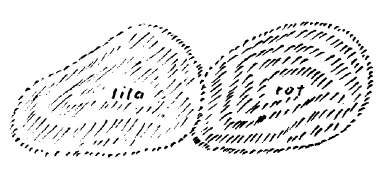
[ 26 ] And the leaders of this activity are to be found in the region within the hierarchy of the Angeloi, so that in the spiritual world in which we are directly embedded, we must truly recognize such an interplay between one type of etheric body and another. Just as two rivers might flow together into one, so do these forces flow together. But then they are organized, regulated, and guided in the proper way. And this is accomplished by beings from the hierarchy of the Angeloi. In addition to their other tasks, these beings also have this task. So when a human being with special aptitudes is able to enter the world, it stems from the fact that between death and a new birth, there is not merely the possibility that wisdom—materialistic wisdom gathered on Earth—is imprinted into the physical bodies, but that what was not yet fully developed for the Earth—etheric bodies originating from those who died young— is also present as effects, as forces that can be woven into the process where human aptitudes are formed.
[ 27 ] You can see how Spiritual Science, when one truly delves into its mysteries, can lead to a living sense of feeling and perception. When an elderly person dies, Spiritual Science enables us to rise to the mystery of their death in a spiritual sense. For we tell ourselves: people grow old so that the development of humanity—insofar as the physical instruments of the body can be used—may proceed in the right way for all time to come. We foresee the fruits of humanity’s earthly development; we sense them in advance with every death of an elderly person. When we allow ourselves to be influenced by the other perspective that can give us insight as we look into the future, we tell ourselves: there must always be special predispositions in the ongoing development of humanity; one person must be predisposed to this, another to that; right up to genius, right up to genius itself, these predispositions must exist. This could never be the case if people did not also have to die young in the world! And when we look up to particularly brilliant individuals, their brilliance is owed to the fact that people must also die young. Thus we contemplate the mystery of the death of those who die young, telling ourselves: The early death of those who die young is also wisely woven into the entire fabric of existence. For from the early death of those who die young arise the seeds of the spiritual aptitudes that humanity needs for its further development.
[ 28 ] As soon as we are able to rise above our personal feelings toward death and consider what all of humanity needs, we begin to see the wisdom in the deaths of both young and older people. This is what is significant: that Spiritual Science, when pursued in a truly genuine and sincere manner, does not merely provide us with theories, but that theories properly understood always lead to feelings and emotions through which we can gain more harmony in life than we would have without Spiritual Science. This is why we should study Spiritual Science: so that when there are dissonances in life that we can no longer bear as dissonances, we may, by looking more deeply behind these dissonances, arrive at an understanding of harmony—of harmonious unity.
[ 29 ] We also learn to understand the sacrifices we must make in life through Spiritual Science. We learn to understand many things that cause us pain when we realize that it is only through our experience of pain that the entire universe can exist in accordance with its true wisdom. We need only be able to rise to the level of realizing that, for example, no Homer, no Shakespeare, no Goethe, Michelangelo, Raphael, or any of the hundreds and hundreds upon whom the further development of humanity depends—insofar as that development requires genius—could have existed if the groundwork for it had not been laid by the fact that people must also die young.
[ 30 ] This has nothing to do with individuality; rather, those who die young, by sacrificing their etheric body in their youth, provide the entire cosmos with fertile ground for the maturation of humanity’s inner spiritual potential.
[ 31 ] We grow together with the universe by not treating Spiritual Science as an abstraction, but rather as a search for those impulses that flow warmly into our souls, reconciling us with the world; that deeply move our souls by showing us that we humans must indeed endure pain, but must endure it for the sake of the harmony of the entire universe.
[ 32 ] It is not always easy to shift one’s gaze in this way from the life of an individual to the life of the entire world. But as the goal we are to attain is difficult, so too do our strengths grow; and as we acquire, through suffering, a sense of the whole, this sense of the totality of the world order will grip the innermost depths of our souls all the more intensely and intimately. And through this, we will prepare ourselves to be members of the world order whom the gods can use.