

The Riddle of Man
The Spiritual Background of Human History
GA 170
3 September 1916, Dornach
Translate the original German text into any language:
Versions Available:
The Riddle of Humanity, tr. Logan
Fünfzehnter Vortrag
Lecture Fifteen
[ 1 ] Wenn wir überschauend noch einmal zurückblicken auf die Dinge, die wir gestern besprochen haben, so kann sich uns darüber ein Gesamtresultat ergeben. Gewiß, es ist ja etwas kompliziert, die Einzelheiten, die gestern besprochen worden sind, zu verfolgen. Aber es hat sich Ihnen gewiß dieses Resultat zusammengestellt, daß unsere zwölf Sinnesgebiete, wie wir sie kennengelernt haben, so aufzufassen sind, daß an ihrer Gestaltung beteiligt ist nicht nur das regelmäßig fortlaufende Evolutionsprinzip, sondern daß beteiligt ist das ahrimanische und das luziferische Prinzip. Wir sehen daraus, daß wir uns schon in bezug auf dieses Ahrimanische und Luziferische objektiver verhalten müssen, als das sehr häufig geschieht, aus dem einfachen Grunde, weil an unserer Gesamtmenschheitsgestaltung ja in einer so eingreifenden Weise das ahrimanische, das luziferische Prinzip beteiligt sind. Nun, wenn wir uns aber erinnern, daß Ahrimanisches und Luziferisches nur dann in der Entwickelung des Menschen von Schaden ist, wenn sie deplaciert sind, wenn sie nicht an der rechten Stelle auftreten, so werden wir uns auch vorstellen können, daß das ahrimanische Prinzip, das wir gestern am oberen Ende unserer Sinnesreihe, und das luziferische Prinzip, das wir am unteren Ende verfolgen konnten, gewissermaßen auf irrtümliche Weise, auf unrechtmäßige Weise eingegriffen haben, nicht so, wie sie gewissermaßen zugelassen worden sind in der Evolution. Und dann entstehen die verschiedenen Verirrungen des Menschen. Diese Verirrungen müssen möglich sein, sonst könnte der Mensch nicht aus eigenem, freiem Willen heraus seine Wege im Weltenall gehen. Es muß sowohl möglich sein, daß dasjenige, was wir gewissermaßen nur durch Ahrimans Macht haben können, abirren kann, als auch, daß dasjenige, was wir durch Luzifers Macht haben können, abirren kann, und daß wir im steten Aufrechterhalten gegen das Ahrimanische und das Luziferische, im Beherrschen dieser Mächte, gerade den rechten Weg in unserer Evolution finden.
[ 1 ] The particular details of the things we discussed yesterday are complicated and difficult to follow. But we can nevertheless come to some general conclusions by reviewing the picture they form as a whole. No doubt you have already concluded that the twelve senses with which we have become acquainted are not formed solely in accordance with the principles of regular evolutionary progress. The ahrimanic and luciferic principles have also participated in their development. From this we can see that it is necessary to be much more objective about these luciferic and ahrimanic elements than is frequently the case, for the simple reason that they have played such a decisive role in the formation of the collective human constitution. Now, we should remind ourselves that Lucifer and Ahriman only create hindrances for human development when they are displaced and appear where they are not supposed to appear. So it is also easy to imagine that when, as we saw yesterday, the ahrimanic principle influences the upper end of the series of the senses, and the luciferic principle influences the lower end, they are not acting legitimately and in accordance with the evolutionary roles allotted to them. And various human aberrations then arise as a consequence. The aberrations must be possible, as otherwise a human being could not determine his path in the cosmos through the use of his own free will. Finding the right path for our development depends precisely upon learning to maintain our sovereignty against the ahrimanic and luciferic influences. It depends on constant struggle to maintain our balance between these two powers, so it is inevitable that the things that only the power of Lucifer and Ahriman can give us, also make it possible for us to go astray.
[ 2 ] Vieles könnte erklärt werden, wenn solche Wahrheiten, wie die gestern skizzierten, weiter ausgeführt würden; denn in diesen Wahrheiten liegen wirklich die Schlüssel zu unendlich vielen Lebensrätseln, die dem Menschen gerade in der Gegenwart entgegentreten. Aber es ist eben nicht möglich, in der Gegenwart — auch in unseren Kreisen — über diese Konsequenzen zu sprechen, Konsequenzen, die sich aus ganz objektiven geisteswissenschaftlichen Grundlagen zwar ergeben, aber über die heute nicht gesprochen werden kann. Wir wollen nun auch in bezug auf die Lebenskräfte, auf die Lebensimpulse, von denen wir gezeigt haben, daß sie gewissermaßen wie ein inneres planetarisches System sind, zu sprechen kommen. Geradeso, wie wir die zwölf Sinnesbezirke ins Auge fassen, können wir die Lebensgebiete ins Auge fassen: Atmung, Wärmung, Ernährung, Absonderung, Erhaltung, Wachstum, Reproduktion. Das sind die sieben Lebensimpulse, gleichsam das Planetensystem, das im Menschen ist, im Gegensatze zu dem Tierkreissystem der zwölf Sinnesgebiete. Aber so, wie auf das Tierkreissystem der zwölf Sinnesgebiete Ahrimanisches und Luziferisches Einfluß hat, etwas anderes hervorgebracht hat, als in der regelrecht fortgehenden Evolution liegt, so ist das auch mit diesen sieben Lebensimpulsen der Fall. Wiederum können wir sagen: Diese drei Lebensimpulse, die äußeren, die mehr den Menschen mit der Außenwelt in Verbindung setzenden Lebensimpulse können ahrimanisch beeinflußt werden, und die mehr dem inneren Lebensprozeß entsprechenden Lebensimpulse können luziferisch beeinflußt werden. Nur in der Mitte gleicht gewissermaßen die Absonderung etwas aus, was mehr durch seine natürliche Gestaltung schon von selbst im Gleichgewicht ist.
[ 2 ] Many things would be clarified by a further elucidation of truths such as those that were sketched yesterday, for they contain the key to countless riddles of life which confront present-day humanity. But it is not possible at present to speak about these consequences, even though they follow from entirely objective, spiritual-scientific considerations—not even in our circles. What we want to discuss now are the life forces, the impulses of life which we have described as a kind of internal planetary system. We can view the seven life processes just as we have viewed the twelve regions of the senses. Breathing, warming, nourishment, secretion, maintenance, growth, reproduction—those are the seven life processes which make up the inner human planetary system and which contrast with the inner zodiac formed by the twelve senses. But luciferic and ahrimanic influences have distorted these seven life impulses—just as they have distorted the zodiac system of the twelve senses—to produce something other than would have been produced if evolution had proceeded along its rightful course. Again we can say that the outermost three life processes, those which have more to do with bringing a person into relation with the outer world, are subject to ahrimanic influence; and the life impulses that have more to do with the internal life process are subject to luciferic influence. Only in the middle is there a kind of balance—in excretion, which tends of itself, because of its natural structure, to remain in balance.
[ 3 ] Bei der Atmung liegt etwas vor, was so bezeichnet werden kann: Wir atmen wirklich nicht bloß so, wie wir atmen würden, wenn nur die regelmäßig fortwirkenden göttlich-geistigen Impulse in der Atmung tätig wären, diejenigen Impulse, von denen der Beginn des Alten Testamentes spricht, wie wenn in der Atmung nur die Jahve-Kraft da wäre. Wir atmen so, wie es der Umgestaltung unseres Atmungssystems durch ahrimanische Kräfte entspricht, die nun ebenfalls eingegriffen haben in das menschliche Leben in der atlantischen Zeit. Wir atmen nämlich nicht bloß, sondern wir verbrauchen unseren Organismus durch die Atmung. Und in diesem Verbrauchen äußert sich ein gewisses Lebenswohlgefühl. In der Tat, im Laufe unseres Lebens zwischen Geburt und Tod liegt das vor, daß wir in einer gewissen Weise energischer den Atmungsprozeß betreiben, als es uns zugeteilt ist. Das Verbrauchen unserer Lebenskräfte hängt sehr stark mit diesem ahrimanischen Einfluß zusammen. Etwa, grob gesprochen, könnte man sagen: Wir würden weniger Sauerstoff einatmen in der gleichen Zeit, wenn der ahrimanische Einfluß nicht da wäre, und es würde nicht in einer so intensiven Weise, wie es jetzt der Fall ist, der Prozeß des Alterns stattfinden, jenes Verbrauchens unseres Organismus, der sich im Altern ausdrückt, im Älterwerden, in dem Sinne, daß man das Alterwerden sieht, daß es nicht bloß Zurücklegung von Jahren ist. Das hängt vielfach mit diesem ahrimanischen Einfluß auf den Atmungsprozeß zusammen.
[ 3 ] Breathing involves something that can be described as follows: We do not breathe as we would breathe if only regular, progressive, divine-spiritual impulses were active in the breath—the impulses mentioned at the beginning of the Old Testament; more than the power of Jehovah is active in our breathing. For, during the Atlantean period, ahrimanic forces caused our breathing system to be modified and these modifications now affect the way we breathe. Thus, we not only breathe, we consume our organism. And we experience this consumption as a kind of feeling of well-being. It is a fact that, during the course of our life between birth and death, we use our breathing process more energetically than was intended. The consumption of our life forces is very closely connected to this ahrimanic influence. One can say, broadly speaking, that if it were not for this ahrimanic influence we would not inhale as much oxygen in a given period of time, and the consumption of our organism associated with the process of ageing would not be as intense as it now is—I mean ageing in the sense that it involves something that can be seen and not just the passage of years. This is related in many ways to ahrimanic influences on the process of breathing.
[ 4 ] Die Wärmung ist durch den ahrimanischen Einfluß verbunden mit einem stärkeren Verbrennungsprozeß in unserem Organismus, als er bei regulärer Evolution stattfinden würde; Verbrauchen ist gleich Verbrennen. Wir verbrennen uns in der Tat selber.
[ 4 ] Because of ahrimanic influences in our organism, things are burnt up more quickly than a regular evolution would dictate: consumption is a kind of incineration. We actually burn ourselves up.
[ 5 ] Und die Ernährung ist durch den ahrimanischen Einfluß verbunden mit einer Ablagerung, so daß dasjenige, was wir als Nahrung aufnehmen, nicht bloß verarbeitet wird, sondern daß es gewissermaßen fast wie Fremdstoff sich einlagert in den Organismus. Die Fettbildung, das Fettansetzen, das ist der geläufigste Prozeß, der hierher gehört. Dieses Fettansetzen, das ist ein solcher Prozeß, der hier von seiner ahrimanischen Seite erläutert werden muß. Er könnte selbstverständlich auch von der luziferischen Seite erläutert werden, das würde aber auf ein anderes Kapitel führen. Also Ablagerung, die Möglichkeit, die Ernährungsstoffe abzulagern, so daß sie bleiben, daß sie gewissermaßen Fremdstoffe werden, Verbrauchen, Verbrennen, Ablagern, das ist auf ahrimanischen Einfluß zurückzuführen bei diesen drei Lebensimpulsen. — Die Absonderung scheidet in gewisser Weise aus.
[ 5 ] Through ahrimanic influence, nourishment includes the forming of deposits, so that our nourishment is not merely processed, but is also stored away in our organism as virtually foreign matter. The most familiar process involved here is the production and storage of fat. The process of getting fat has to be explained here by referring to its ahrimanic side. Of course it also has its luciferic side, but that is a different matter. So storage, the possibility of accumulating food we have eaten so that it remains with us and is stored in our organism as virtually foreign matter, can also be traced to ahrimanic influences: consumption, combustion and storage. Secretion is, in a sense, a special case; it is an exception.
[ 6 ] Die Erhaltung erleidet einen luziferischen Einfluß. Alle Kräfte gestalten unsern inneren Erhaltungsprozeß um, und das, was da zustande kommt, ist sogar ähnlich der Ablagerung. Alle Anlagen, die wir in uns haben zur Verkapselung, Verknöcherung, zum Sklerotischwerden, sind mit auf dieses Gebiet zu setzen. Verhärtung im ganzen, könnte man es nennen. Wir verhärten unseren Organismus im Laufe unseres Lebens. Das geschieht durch einen luziferischen Einfluß, ist auch mit luziferischen Wirkungen verbunden. Denn diese Verhärtungsprozesse empfinden wir eigentlich, bis sie über ein gewisses Ziel hinausschießen, bis sie dann zur Sklerose, zu anderen Erkrankungszuständen werden, als ein gewisses fortdauerndes Wohlgefühl im Organismus. Erst wenn die Sache über einen gewissen Punkt hinausgeht, empfinden wir es nicht mehr als ein Wohlgefühl, sondern als eine Krankheit, sei es als Sklerose, sei es als Starbildung oder dergleichen.
[ 6 ] Maintenance has undergone luciferic influences. All forces are modified by our inner process of maintenance, and the result of this is very similar to the process of storage. All our predispositions towards cyst-formation, towards becoming ossified and sclerotic, belong in this category. We harden our organism during the course of our life. This happens through luciferic influences and is connected with luciferic interventions. Until these processes of hardening exceed a certain degree and manifest as sclerosis and other symptoms of illness, we experience them as a kind of underlying feeling of organic well-being. We only cease to experience it as a feeling of well-being when matters go beyond a certain point; then it becomes an illness-as sclerosis, as glaucoma, or some other, similar illness.
[ 7 ] Auch der Wachstumsprozeß erleidet einen luziferischen Einfluß, und der drückt sich so aus, daß ohne diesen luziferischen Einfluß der Mensch wachsen würde, ohne daß zwischen der Geburt und dem Tode im Verlaufe des Wachstums eine besondere Diskontinuität auftreten würde. Aber weil der luziferische Einfluß da ist, wird gerade in den ersten Stadien des Wachstums, gerade in den ersten Perioden des Wachstums der luziferische Einfluß sehr stark und gestaltet den bloßen Wachstumsprozeß um zum Reifungsprozeß. Das Reifen, die Reifung, Geschlechtsreife, das ist eine luziferische Umgestaltung des bloßen Wachstumsprozesses. Und alles, was damit verbunden ist, zeigt, daß eben die ursprüngliche Evolutionsanlage, die nicht zu dieser Diskontinuität des Reifens führt, den Menschen in ein kontinuierliches Wachstum hineindrängen würde. Die Reifung beim weiblichen und männlichen Geschlecht und alles, was damit zusammenhängt, die Umbildung, die in den Jahren der Reife stattfindet bis zur Stimmumbildung, das alles hängt mit diesem luziferischen Einfluß zusammen.
[ 7 ] The process of growth has also suffered from luciferic influences. Without these, a person's growth would be a continuous process between birth and death. Without luciferic influences there would be no particular discontinuities in the process of human growth. But the luciferic influence manifests itself immediately and powerfully during the first stages of growth. There it turns the process of growth into a process of maturation. Maturation, sexual maturation, is a luciferic modification of straightforward processes of growth. Everything that is associated with it shows that this discontinuity is not in accordance with the original evolutionary disposition, which would lead to a continuous process of growth. Everything that is connected with the sexual maturation of a man or woman, all the various modifications right down to the change of voice, are connected with this luciferic influence.
[ 8 ] Das Wirken des luziferischen Einflusses auf dieReproduktion macht die Reproduktion zur Generation, zur äußeren physischen Fortpflanzungsmöglichkeit. Ursprünglich, durch die fortschreitenden göttlichgeistigen Kräfte, ist der Mensch ja dazu veranlagt, nur sich selbst zu reproduzieren, das heißt, er muß ja immer sich reproduzieren, nicht wahr? Damit er wachsen kann, müssen immer Teile neu entstehen: eine innere Reproduktion. Daß die äußere Reproduktion dazukommt, daß die Reproduktion zur Generation wird, das ist auf den luziferischen Einfluß zurückzuführen. Sie wissen ja, daß insbesondere das letztere — der luziferische Einfluß auf Reproduktion, Wachstum sehr deutlich wiederum in der Bibel angedeutet wird. Man braucht ja die Bibel nur zu lesen, so wird man aus den gewaltigen, titanischen Bildern, die dort vorhanden sind, wahrhaftig das herauslesen können, was Ihnen jetzt auch angeführt worden ist. Sie sehen also, da haben wir auch ein Zusammenwirken von Luziferischem und Ahrimanischem.
[ 8 ] Luciferic influences have turned reproduction into procreation, into the possibility of external, physical propagation. In accordance with the original, progressive, divine-spiritual powers, a human being should only be able to reproduce himself. And we must reproduce ourselves continuously, must we not? In order for us to grow, an inner process of reproduction must take place, new parts must constantly be forming. It is due to luciferic influences that external reproduction has been added to this. As you know, this latter luciferic influence on growth and reproduction, in particular, is also described in very clear terms in the Bible. One only has to turn to the Bible. There you will find powerful, titanic pictures which truly show the very things I have been describing. So you see that we are dealing, once again, with a collaboration between Lucifer and Ahriman.
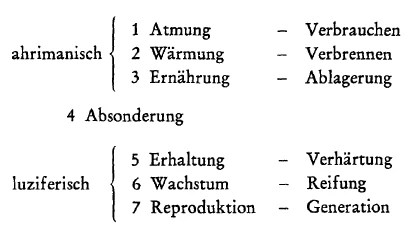
Ahrimanic = 1 Breathing—Consumption 2 Warming—Combustion 3 Nourishing—Conservation
4 Secretion
Luciferic = 5 Maintaining—Sclerosis 6 Growing—Maturation 7 Reproducing—Procreation
[ 9 ] Wenn Sie nun überschauen, was wir so über die zwölf Sinnesgebiete und über die sieben Lebensprozesse sagen, gewissermaßen über den inneren Tierkreis und über das innere Planetensystem des Menschen, so kommen Sie darauf, sich zu gestehen, daß ein Wissen, welches diese Dinge bloßlegt, anders beschaffen sein muß als dasjenige, was man heute gewöhnlich Wissen nennt. Das heutige Wissen, die heutige Erkenntnis tippt gewissermaßen nur an die Außenfläche, an die Oberfläche der Dinge. Aber man muß sich Begriffe, Vorstellungen, die an der Schwelle der geistigen Welt liegen, erwerben. Man braucht nicht drinnenzustehen in der geistigen Welt, sondern nur Vorstellungen durch die Geisteswissenschaft selber sich zu erwerben suchen, die ja an der Schwelle zur geistigen Welt liegen, und man wird fühlen, daß dadurch dieses Wissen, diese Erkenntnis viel aktiver, viel innerlich intensiver wird, daß sie wirklich fähig wird, einzudringen in das, was in den Wesen kraftet, also für unsere Fälle hier: was im Menschen selber kraftet. Wir müssen gewissermaßen miterleben das Weltenall, nicht bloß uns hinstellen als Zuschauer und es von seiner Oberfläche aus auf uns wirken lassen. Man muß miterleben, was in den Wesen drinnen kraftet, lebt, webt. Es wird wirklich nicht nur ein anderes Wissen erworben durch die Geisteswissenschaft, sondern ein andersartiges Wissen. Sie können nicht, wenn Sie bloß sich so verhalten wie ein heutiger Anatom oder Physiologe, auseinanderhalten im Atmungsprozeß den Teil, der gewissermaßen regulär ist, und den Teil, der ahrimanisch ist, weil das natürlich gleichzeitig geschieht, weil man gewissermaßen hineinschlüpfen muß in den Atmungsprozeß und ihn erleben muß. Dann erlebt man schon das Ineinanderspielen der beiden Kräfte, Impulse. Dieses Untertauchen in die Welt, das ist etwas, was gerade unserer gegenwärtigen Zeit verlorengegangen ist, und insbesondere der gegenwärtigen Wissenschaft vielfach verlorengegangen ist. Man glaubt ich habe das öfter betont — so leicht, daß dieses aktive, innerlich tätige, dieses in die Dinge untertauchende Wissen, so daß man nicht bloß zu den Oberflächen, sondern zu den Kräften kommt, entweder überhaupt nie ein Wissen war oder der Menschheit längst verlorengegangen ist. Das ist nicht richtig. Denn so sehr Jange ist es der Menschheit gar nicht verlorengegangen. Man braucht nur ein wenig zurückzugehen im Laufe der Jahrhunderte, dann hat man durchaus die Möglichkeit, zu studieren, wie in gar nicht weit zurückliegender Zeit dieses innerlich aktive Wissen vorhanden war. Nehmen Sie den Lebensprozeß. Er ist zunächst ein ganzer, er konstituiert uns ja, er macht uns aus, dieser Lebensprozeß. Aber es sind ineinanderspielend sieben Impulse — wirklich ein inneres Planetensystem. Ich habe Sie darauf aufmerksam gemacht — erinnern Sie sich an unsere Betrachtungen in diesen Wochen —, daß man sich wird an manches Paradoxe gewöhnen müssen, wenn man eine wirkliche Erkenntnis wird haben wollen.
[ 9 ] Surveying what has been said about the twelve zones of the senses and the seven life processes—about the human being's inner zodiac and inner planetary system—you will have to confess that knowledge that is capable of bringing such things to light must be pursued differently from what is usually called knowledge today. Today's knowing, today's knowledge, only touches the outermost surface of things, so to speak. But we must achieve ideas and concepts that are capable of reaching to the threshold of the spiritual world. One does not have to be in the spiritual world, all one has to do is to try, through spiritual science, to formulate ideas which are truly appropriate to the threshold of the spiritual world. Then one will feel how this leads to a knowing and a knowledge that is much more active and inwardly intense, and that is actually capable of penetrating to what is active within a being—in the present case, to what is active within the human being himself. It is not enough to station ourselves opposite the cosmos as mere observers, content to watch how its outer surface affects us; to a certain extent we must participate in the cosmos. One must participate in the forces at work within a being, in what lives and weaves within it. Spiritual science does not only lead us to further knowledge, it leads us to a different kind of knowing. As a typical contemporary anatomist or physiologist it will be impossible for you to distinguish what is ahrimanic in the process of breathing from what is, so to speak, regular, since all of these naturally occur at the same time and it is necessary to slip into the very process of breathing and experience it. Then one does indeed experience the interplay of both forces, of both impulses. This manner of submerging oneself in the world is one of the things that our present age has lost, especially in our present-day sciences, where it has been lost many times over. As I have often pointed out, it is so easy to believe that this active, inwardly engaged manner of knowing either never existed, or that it has long since been lost to humanity—this way of knowing which submerges in the being of things and leads one beneath the surface to the real forces. But that is not so. Actually, it was not even so very long ago that men lost it. You only have to go back a little way in the course of the centuries. You will discover this inwardly active knowing persisted into times not long past. Consider the life process. To begin with, it forms the whole out of which we are composed—indeed, we are constituted by this life process. But it is really an inner planetary system composed of seven interacting impulses. As I said before—just remember what we have been considering this week—if one wants to have real knowledge, one must accustom oneself to some paradoxes.
[ 10 ] Ich habe gesagt: Was im Menschen vor sich geht und was der heutige materialistische Darwinismus im Menschen sucht, das wird man nicht als eine Erklärung ansehen dessen, was im Menschen vorgeht, sondern das gerade als eine Erklärung des Makrokosmos, des Universums. Und umgekehrt: In dem, was draußen die großen astronomischen Prozesse sind, darin wird man die Erklärung finden für das, was im Menschen ist. Da muß man aber lebendig im Weltenprozeß drinnenstehen, da muß man wirklich untertauchen. Da muß man nicht bloß von der Oberfläche aus den Weltenprozeß ansehen. Sonne, Mond, Mars, Merkur, Jupiter und so weiter so äußerlich anschauen, wie sie über den Himmel hinübergehen, das ist eben an der Oberfläche anschaulich, sondern miterleben das, was sie tun bei ihrem Gang durch das Weltenall, das ist nötig, miterleben die Kräfte, die ausstrahlen, differenziert ausstrahlen, das heißt, von jedem dieser Planeten anders, so daß differenzierte Kräfte da draußen sind. Aber wenn es richtig ist, daß das Universum das, was in uns ist, erklärt, so liegt Ihnen der Gedanke, der ganz richtig ist, auch nicht mehr ferne: Wenn man die Kräfte, die in den Planeten stecken, nun wirklich lebendig kennt, so muß in diesem lebendigen Erfassen etwas liegen, was begreiflich macht das menschliche Leben. Aus dem Universum herein durch lebendige Erkenntnis das menschliche Leben verstehen, das ist das, was mit dasjenige ist, was durch die jetzige Geisteswissenschaft gewollt ist, was aber auch früher da war. Es ist gar nicht notwendig, allzuweit im Mittelalter zurückzugehen, da findet man merkwürdige, dann in den Druck übergegangene Aussprüche, die eigentlich gewöhnlich nicht verstanden werden oder heute ziemlich äußerlich erklärt werden, die aber darauf hindeuten, wie in gar nicht weit zurückliegenden Jahrhunderten noch ein lebendiges Wissen, allerdings dazumal atavistischer Art, vorhanden war:
[ 10 ] I said that what occurs in a human being, and what today's materialistic Darwinism is trying to discover in the human being, will not provide an explanation for what happens in man. Rather will it explain the macrocosm, the universe. And the reverse is also true: the explanation for what is within the human being will be found in the large-scale astronomical processes of the external world. To do so, however, it is necessary to submerge in the world processes and live within them. One cannot merely gaze at the world process from outside. How Sun, Moon, Mars, Jupiter, and so on, travel across the heavens is something that can be observed superficially, from the surface. But in order to experience the effect they have as they pursue their course through the cosmos, it is necessary to participate in the differentiated forces which emanate from them. In other words, one must livingly experience the differentiated forces that are at work in the universe. A distinctive force radiates from each planet. But if you can entertain the thought that what exists within us is explained by what is to be found in the universe, you are not far removed from a further thought, one that is quite correct: a really living acquaintance with the powers that reside in the planets makes human life understandable. The spiritual science of the present seeks to understand human life on the basis of what the universe tells us about it. Such knowledge once existed. It is not necessary to go very far back into the Middle Ages to discover some extraordinary sayings that found their way into print. Nowadays, either they are not understood, or they are explained superficially. But these sayings show that there was a living understanding of these matters just a few centuries ago, even though it was an atavistic understanding:32‘O Sun, of this world thou king ...’
This verse is to be found among a series of similar verses in texts attributed to the fifteenth century author, Basilius Valentinus. They have been published repeatedly since the seventeenth century. The version used by Rudolf Steiner agrees with that in Basilius Valentinus, Chymische Schtiften, Hamburg, 1717, p.144.
O Sonn’, ein König dieser Welt
Luna dein Geschlecht erhält
Merkur kopuliert euch fix
Ohn’ Venus’ Gunst erreicht ihr alls nichts
Die Marten sich als Mann erwählt
Jovis G’nad ist euch unverloren
Daß Saturn, alt und greis
In vielen Farben sich erweis.
O Sun, of this world thou king,
All thy race fair Luna doth sustain
And Mercury nimbly binds you in marriage,
Though all in vain lacking Venus' patronage.
As chosen man Mars sets his face,
Sustained for you is Jupiter's grace
That thereby Saturn old and grey
Himself in many colours doth array.
[ 11 ] Hier haben Sie solch einen Spruch, der anzeigen soll, welche Kräfte gewissermaßen lokalisiert sind in dem, was nun nicht äußerlich, bloß in der Oberfläche der Dinge angeschaute Planeten sind, sondern was die innerlich lebendigen Wesenheiten der Planeten sind. Die Kräfte des ganzen Planetensystems sind in diesem Spruch ausgedrückt, aber so, daß er, wenn man sie erfaßt, verständlich macht, wie sie im Menschen wirken. Was ist denn ausgedrückt in einem solchen Spruch? In einem solchen Spruch ist ausgedrückt — ich will ungefähr es umschreiben, was ausgedrückt ist —: Hier leben wir im physischen Leib zwischen Geburt und Tod; das hängt im großen und ganzen zusammen mit den Kräften, welche die Erde von der Sonne hat. Aber es braucht noch andere Kräfte, damit das Menschengeschlecht wirklich da sei. Damit das Menschengeschlecht nicht bloß so da sein kann, wie es fertig ist durch die Sonne, sondern sich auch fortpflanzen kann, damit das Geschlecht erhalten bleibt, dazu müssen die Kräfte von dem Mond ausgehen:
[ 11 ] There you have one of these sayings, one that points to the inner, living being of the planets. It refers to the forces that are revealed when the regions of the planets are not just considered externally and superficially. This saying expresses the powers that live in the whole of the planetary system, but it expresses them so as to show how they manifest in the human sphere. What do such sayings express? Here is a paraphrase of what is expressed: Between birth and death we live here in a physical body. This depends, by and large, on forces the Sun gives to the Earth. But other forces are also necessary to the existence of humankind. Man needs to do more than just manifest his completed form through the forces of the Sun. Humanity must be able to procreate and maintain itself and, for this, forces that emanate from the Moon are required:
[ 12 ] Luna dein Geschlecht erhält.
[ 12 ] All thy race fair Luna doth sustain
[ 13 ] Aber die beiden Kräfteimpulse, der Sonnenimpuls und der Mondimpuls, sie werden zusammengehalten durch den Merkurimpuls:
[ 13 ] Furthermore, the forces that emanate from Sun and Moon are united by Mercurial impulses:
[ 14 ] Merkur kopuliert euch fix —
[ 14 ] And Mercury nimbly binds you in marriage
[ 15 ] Dadurch wird der ganze Prozeß schon immer geistiger. Unser physisches Dasein, daß wir einfach als Menschengestaltung dastehen, ist von der Sonne abhängig, daher ist die Sonne der König dieser Welt, als physische Sonne gefaßt. Nur dadurch, daß der Christus herabgestiegen ist und von der Sonne auf die Erde gekommen ist, dadurch ist die Sonne auch geistig. Aber so, wie die Sonne zunächst als physischer Körper ist, so macht sie es uns möglich, daß wir als physische Menschen auf der Erde leben. |
[ 15 ] And so the whole process already begins to become more spiritual. Our physical being—the very fact that we possess a human form—is dependent on the Sun. Thus, the Sun, taken as a physical being, is the king of this world. The Sun also exists spiritually for us, but only because the Christ has descended from the Sun to the Earth. But, taken in the first place as a physical body, it is the Sun that makes it possible for us to live as physical men on the Earth.
[ 16 ] Luna dein Geschlecht erhält
[ 16 ] All thy race fair Luna doth sustain
[ 17 ] geht in das Geistige über. Das geht noch mehr über: Merkur kopuliert euch fix
[ 17 ] makes the transition to the spiritual. It goes still further in that direction with: And Mercury nimbly binds you in marriage
[ 18 ] und noch mehr ins Geistige geht über: Ohn’ Venus’ Gunst erreicht ihr alls nichts
[ 18 ] and still more so with: Though all in vain lacking Venus' patronage
[ 19 ] das heißt, es muß das da sein, was an Venusimpulsen kommt und das Ganze durchstrahlt, gleichsam durchwärmt, durchglüht. Vom Mars geht dasjenige aus, was wiederum der Venusimpuls braucht, damit er sich damit verbinde und seine Widerlage habe daran. Und noch geistiger, aber im Physischen geistig, ist das, was vom Jupiter ausgeht: «Jupiters Gnade». Und der Mensch kommt erst dadurch innerhalb des Menschengeschlechts so zustande, wie er ist, daß dasjenige, was als Saturnkraft immer wirkt, was die älteste Kraft ist und jetzt in der äußersten Peripherie gewissermaßen wirkt, aus dem Geistig-Seelischen heraus so wirkt, daß auch im Menschen das Geistig-Seelische das Physische voll durchdringen kann. Denn wir würden nur Fleisch und Blut sein können durch die Sonne. Durch den Saturn sind wir nicht bloß Fleisch und Blut, sondern von Seele und Geist durchstrahltes und durchwärmtes Fleisch und Blut. Seele erweist sich in uns durch die Saturnkraft, welche die älteste ist, «alt und greis»:
[ 19 ] which is saying that the Venus impulses must radiate through the whole and warm it through, as it were, until it glows. The Venus impulse, in its turn, needs support. It needs to be connected with forces that originate in Mars. What issues from Jupiter is even more spiritual, but in a physical sense: ‘Jupiter's grace’. And only through the constant influence of the Saturn forces can a man finally make his appearance as a member of the human race. This oldest of the powers now works from the outermost periphery; it works from out of the realms of soul and spirit, enabling them to wholly penetrate the physical human constitution. Through the agency of Saturn we are not mere flesh and blood; rather are we flesh and blood that is warmed by the soul and spirit streaming through it. The most ancient of the powers in us, the power of Saturn, ‘old and grey’, enables the soul to be manifested in us:
Daß Saturn, alt und greis,
In vielen Farben sich erweis.
That thereby Saturn old and grey
Himself in many colours doth array.
[ 20 ] Denn unser Inkarnat hat das Seelisch-Geistige ausgedrückt im Physischen: In unserer Hautfärbung, in unserem Inkarnat sind in der Tat alle Farben.
[ 20 ] For our soul-spiritual nature is physically expressed by the colour of our skin. And all the colours are actually contained in this colour.
Daß Saturn, alt und greis, In vielen Farben sich er weis.
That thereby Saturn old and grey
Himself in many colours doth array.
[ 21 ] Es gab also ein Wissen, das in solchen ungelenken, ungeschickten alten Sprüchen erhalten ist, das uraltes Wissen ist, das verlorengegangen ist in unserer heutigen Oberflächlichkeit und das wieder gesucht werden muß.Da wo der vierte nachatlantische Zeitraum zu Ende geht, vom fünfzehnten, sechzehnten Jahrhundert ab, da versickert auch dieses alte atavistisch-hellseherische Wissen, und das rein physische Wissen tritt an die Stelle, das an der Oberfläche haftet, das nicht mehr untertaucht in die Dinge. Und durch die Geisteswissenschaft muß wiederum das in die Dinge untertauchende Wissen gesucht werden. Dazumal hat man so gesprochen. Jetzt sprechen wir so, wie wir gestern und heute unsere zwölf Sinnesgebiete, unsere sieben Lebensimpulse, Lebensbewegungen zu charakterisieren versuchten in ihrem Drinnenstehen im geistigen Weltenwalten. So wird wiederum auftauchen ein verlorenes Wissen; aber auftauchen wird müssen ein verlorenes Wissen vom Menschen, in einer anderen Weise erfaßt, erfaßt vollbewußt, während das, was in diesen Sprüchen lag, nicht vollbewußt war. Diejenigen Menschen, die diese Sprüche gekannt haben, sie haben sie aus alten Traditionen gekannt. Hätte man die Leute, die wirklich die Kraft eines solchen Spruches in sich gefühlt haben, gefragt, wo sie das her haben, so würden sie gesagt haben: Ja, wir kennen den Spruch: O Sonn, ein König dieser Welt, Die Luna dein Geschlecht erhält... und so weiter, und wenn man dasjenige, was darin ist, versteht, so versteht man den Lebensprozeß der Menschheit; aber wie man dazu kommt, solches zu verstehen, das können wir nicht wissen. — So würden sie gesagt haben.
[ 21 ] These stiff, clumsy old verses preserve an ancient wisdom. Such wisdom once existed; it has been lost in our present-day superficiality and now we must try to find it again. From the fifteenth and sixteenth centuries onward, as the fourth post-Atlantean period came to an end, the stream of this old atavistic wisdom also ran dry. It was replaced by purely physical wisdom, which stays on the surface of things instead of entering into them. Through spiritual science we must once more seek a wisdom that enters into the nature of things. Once people spoke as we spoke yesterday and today, attempting to characterise the twelve zones of our senses and the seven impulses of life, the seven life-movements, and to show how they participate in the spiritual forces that rule the cosmos. A lost wisdom will thus begin to re-emerge; but, as this lost wisdom emerges it must be grasped in full consciousness, not as it was grasped during the period of these verses, when men were not fully conscious. The people who knew these old verses had learned them from old traditions. And if you had asked those who really felt the power of these verses within themselves how they had come by this knowledge, they would have said, ‘It is true that we know this verse, “O Sun, of this world thou king, all thy race fair Luna doth sustain ...” and that if you understand it, you understand the human life processes. But we have no idea how one comes to understand such things.’ That is how they would have answered you.
[ 22 ] Das ist gelehrt worden von geistigen Wesenheiten in alten Zeiten durch jenen Prozeß, wo in Reimen geschrieben worden ist dasjenige, was durch göttliche Inspiration herabgekommen ist aus der geistigen Welt auf die Erde, ohne daß das ein vollbewußter Prozeß war. In der Sprache ist aufbewahrt worden uralte Weisheit, sie liegt in dem, was die Sprache an Begriffen und Ideen herausgebildet hat. Deshalb war es auch, daß parallel ging dem Materialisierungsprozeß des Wissens, dem Materialisierungsprozeß der Erkenntnis das Nicht-mehr-Verstehen der Geistigkeit der Sprache. Wenn man selbst noch ins achte, neunte, zehnte Jahrhundert zurückgehen würde heute, so würde man finden, wenn man nicht jene Fable convenue, die heute als Geschichte gilt, sondern wirkliche Geschichte betrachtet, daß die Leute gewußt haben: Sprache ist etwas, was mit Prozessen der geistigen Welt zusammenhängt. Sie haben es nicht gesagt, gerade in Europa nicht gesagt, so wie wir es jetzt sagen: Ein aus dem fortlaufenden Evolutionsprozeß des Göttlich-Geistigen und aus dem Luziferischen oder aus dem Ahrimanischen hervorgehender Prozeß ist dieses Sprache-Haben der Menschen. So haben sie nicht gesagt. Aber ein unterbewußtes Empfinden haben sie davon gehabt, indem sie wußten, daß so, wie die Sprache im gewöhnlichen Leben verwendet wird, sie etwas ist, was der Mensch nicht ganz zu Recht hat. Sie muß geadelt werden dadurch, daß man gewissermaßen zusammendrängt die höchsten Wahrheiten in heiligen Sprüchen, die man auch heilig hält. Daher wurden die Wahrheiten alle gerade in solchen Sprüchen formuliert. Ich habe einen ungeschickt geformten Ausspruch gewählt, einen Ausspruch, der sozusagen noch in den spätesten Zeiten zu finden ist, als die vierte nachatlantische Zeit schon im Abglimmen war; aber trotzdem ist der Spruch so, daß er gerade in seiner Ungeschicklichkeit eine gewisse Feierlichkeit hat. Durch dieses, was sich ausgoß in einen solchen Spruch, sollte gleichsam paralysiert werden der ahrimanische Einfluß. Durch das Gefühl von Heiligkeit, das man in ihm empfand, sollte eben dem Ahrimanischen ein Gefühl entgegengehalten werden, das eben dieses Ahrimanische paralysiert. Da haben Sie das Gleichgewicht. Das Ahrimanische, das von außen kommt, wird durch ein Gefühl, durch ein heiliges Gefühl von innen im Gleichgewicht erhalten. Daher jene eigentümliche Stellung zur Sprache in älteren Zeiten, die dann ganz verlorengegangen ist und eben auch einem äußerlichen Verhältnis zur Sprache, zum Sprachgeiste Platz gemacht hat.
[ 22 ] In ancient times spiritual beings taught such things. This came about through a process that was not fully conscious. The divine inspirations that descended to Earth from the spiritual world were written down in verses. The concepts and ideas of the verses preserved an ancient wisdom. This is also the reason why the loss of understanding for the spirituality of speech ran parallel to the process by which wisdom and knowledge were materialised. If we could go back to the truly historical period of the eighth, ninth and tenth centuries—not to that fable convenue that passes for history these days—we would find that people knew that speech is related to processes in the spiritual world. They did not express it in the way we have just expressed it, especially not in Europe. They did not say that the ability to speak is the result of a process that diverges from the progressive direction of evolution and is subject to ahrimanic and luciferic influences. But they had a subconscious feeling for it, knowing that human beings do not really have the right to possess speech as it is ordinarily used. Speech had to be ennobled before high spiritual truths could be compressed into holy verses. And the verses were regarded as holy. That is precisely why the truths were formulated in such verses. I have chosen a clumsily shaped verse, one that could still have been found in the late afterglow of the fourth post-Atlantean period. Nevertheless, the verse is shaped so that its very clumsiness lends it a certain festive air. The ahrimanic influences were paralysed, so to speak, by what was poured into the mould of such verses. The feeling of holiness which these verses conveyed countered ahrimanic influences with a feeling which paralysed them. Thus there is a balance. The ahrimanic that comes from without was held in balance from within by a feeling, a feeling of holiness. This led to the extraordinary attitudes toward speech that were held in ancient times, attitudes which have been lost entirely because they had to make way for an external relationship with speech and the spirit of speech.
[ 23 ] Als kurze Zeit erst heraufgegangen waren die Zeiten des fünften nachatlantischen Zeitraums, da kündigte sich der moderne Materialismus an. Die Sprache hatte man so angesehen in früheren Zeiten, daß sie wie eine Art Gebärde gewirkt hat, die hinwies auf das Wirkliche, aber nicht selber ein Wirkliches war. Ich habe schon öfter versucht, klarzumachen, was da eigentlich gemeint ist. Wenn man sagt: Hund oder Wolf oder Lamm, so sind das Sprachausdrücke. Die heutigen Sprachtheoretiker werden nicht fertig mit diesen, weil sie eigentlich nach ihrer Ansicht nichts bedeuten. Denn wenn da ein solches Vierfüßiges steht, nennt man es Hund, wenn da ein anderes Vierfüßiges der gleichen Art steht, nennt man es auch Hund. Das Wort bezeichnet alle beide als Hund, es bezeichnet den einzelnen Hund und doch alle als «Hund». Diesen Zwiespalt empfinden die heutigen Menschen: daß das Wort eigentlich in der Luft schwebt. Weil sie nicht mehr das Geistige in den Dingen sehen — das Geistige ist für sie ein Nichts —, so ist auch das, was das Wort bedeutet, ein Nichts geworden. Ich habe es klargemacht dadurch, daß ich sagte: Die Menschen meinen, das sei eben ein bloßes Nomen, ein Wort: Lamm, Wolf. Aber man kann sich überzeugen, daß das nicht ein bloßes Nomen, bloßes Wort ist, wenn man versucht, einen Wolf abzuschließen und so lange zu nähren mit lauter Lammfleisch, das heißt Lamm-Materie, bis seine ganze Materie ausgewechselt ist. Dann ist nichts mehr von der alten Wolfsmaterie in ihm. Ist der Wolf darum nun ganz Lamm geworden? Sicherlich nicht! Der «Wolf» ist noch etwas anderes als seine Materie. Die materialistischen Ansichten sind eigentlich so töricht, daß sie sehr leicht zu widerlegen sind. Denn durch solch eine Betrachtung, wie sie eben gezeigt worden ist, ist ja der Materialismus natürlich gleich aus der Welt geschafft. Aber wenn man nicht mehr das im Auge haben kann, was die Wolfheit im Wolf und die Lammheit im Lamm ist, dann kommt man auch mit den Worten nicht zurecht.
[ 23 ] The heralds of modern materialism appeared a short time after the beginning of the fifth post-Atlantean epoch. In earlier times, speech had been regarded as a kind of gesture, a gesture that pointed to reality but is not in itself real. I have frequently attempted to clarify what this actually means. If one says, ‘dog’ or ‘wolf’ or ‘lamb’, one is using a linguistic expression. Contemporary speech theorists are unable to come to terms with these expressions because they believe that they do not refer to anything. For when we encounter one four-footed creature we call it a dog, and if some other four-footed creature of the same kind comes along, we also call it a dog. The word designates them both as dogs; the word ‘dog’ is applied to one dog and to all. People of today experience a split: words seem to hang in thin air. They no longer see the spirit in things—for them, the spirit is a non-entity—so that the things signified by the words have also become non-entities. I made this clear when I said that people claim words are merely names—that ‘lamb’ and ‘wolf’ are nothing but words. But if one pens up a wolf and feeds it with nothing but mutton—in other words, with matter from sheep—until all of its original matter has been exchanged, one can prove for oneself that these are not merely words, merely names. For now none of the original matter would be present in the wolf. But has the wolf become a thorough-going lamb? Certainly not! There is more to the ‘wolf’ than just matter. Materialistic views really are so foolish that it is very easy to disprove them. For observations such as I have just described really do quite effortlessly knock materialism out of the ring. It ceases to be possible to come to terms with words, however, when one is no longer able to consider what the wolfness of the wolf is, and the lambness of the lamb.
[ 24 ] Es war aber zunächst die Aufgabe dieses fünften nachatlantischen Zeitraumes, materialistisch zu werden. Der Materialismus mußte gewissermaßen eingeleitet werden. Daher mußte für diesen fünften nachatlantischen Zeitraum richtig in Angriff genommen werden die Inaugurierung, ich möchte sagen, die Initiation der Welt mit dem Materialismus, mit materialistischem Fühlen, Denken und Empfinden. Das mußte von zwei Seiten aus geschehen. Erstens mußten die Menschen hingewiesen werden darauf, wie das Heil der Menschheit — das natürlich bloß das Heil für die materialistische Strömung im fünften nachatlantischen Zeitraum ist, aber das wird ja immer dann als allgemeingültig erklärt — in dem bloßen materiellen Behandeln der Welt liegt. In den Zeiten, die noch solche Sprüche gehabt haben, da wurde die Welt nicht bloß materiell behandelt; da fühlte man sich noch drinnen in einer lebendigen Realität, die ausströmte von dem ganzen Leben des Planetensystems, wie es sich ja ausdrückt in einem solchen Spruch. Und das Verständnis für einen solchen Spruch kann man haben. Aber es mußte der Menschheit beigebracht werden, was sie früher nicht gehabt hat: das Außerliche, Mechanische, Materialistische zu behandeln, um in dem zunächst das Wichtigste, das nächste Wichtigste für den fünften nachatlantischen Zeitraum zu finden. Denn die Geisteswissenschaft muß in diesem fünften nachatlantischen Zeitraum von unserer Zeit an eintreten; aber nach den Hindernissen, die ihr entgegenströmen, werden Sie beurteilen können, daß sie nicht schnell sich geltend machen wird, und daß sie ihre volle Bedeutung ja erst im sechsten nachatlantischen Zeitraum erhalten wird. Das ist es. Denn sie wird im fünften nachatlantischen Zeitraum immer alles Materialistische als einen wesentlichen Gegner haben. Das ist das eine.
[ 24 ] Nevertheless, the initial task of the fifth post-Atlantean epoch was to develop materialism. To a certain extent, it was necessary for materialism to be introduced. Therefore, this fifth post-Atlantean epoch requires one to really wrestle with the inauguration of materialism—or, better said, the initiation of the world into materialism and into materialistic thinking, feeling and experiencing. That had to come from two sides. In the first place, people had to be convinced that the salvation of humanity lay in materialism and in treating the world as nothing but matter—naturally, it was only salvation for the materialistic streams of the fifth post-Atlantean epoch, but it always was presented as being universal. In the times when people still remembered these old verses, the world was not treated as if it were nothing but matter. In those times, as is expressed in such verses, it was still possible to experience oneself as participating in the living reality radiating from the whole life of the planetary system. And such verses can be understood. But in order to do so, humanity must acquire something it has not had before: it must be able to deal with the external, mechanical, materialistic world in order to discover the next, central task of the fifth post-Atlantean epoch. For, from the present time onward, spiritual science must begin to play a role in this epoch. But, as you will be able to judge from the resistance which it encounters, it will not establish its validity quickly and will only realise its full significance during the sixth post-Atlantean epoch. That is how things stand. For everything materialistic will continue to be a source of essential opposition during the whole of the fifth post-Atlantean epoch. That is one aspect.
[ 25 ] Und das andere ist, daß die Sprache verkannt wird, daß den Worten, die nicht unmittelbar nur sinnliche Eigenschaften bedeuten, kein Wirklichkeitscharakter zugemessen wird. Das mußte einmal vor die Menschheit hingestellt werden. Der Menschheit mußte einmal gesagt werden: Eure Sprache bildet Worte, aber diese Worte hat nur eine abgelaufene Zeit, welche in Vorurteilen, in Aberglauben lebte, als Bezeichnungen für Reales gehalten. In Wahrheit müßt ihr euch frei machen von dem Inhalt der Worte, denn Worte bedeuten Idole. Damit hat Bacon, Baco von Verulam, auch im Auftrag der geistigen Welt, eingeleitet die Verkennung der Sprache in unserem neueren nachatlantischen Zeitraum, die Austreibung des Gefühls in der Menschheit, daß in der Sprache Spirituelles enthalten ist. Alle Gehaltsbegriffe, Gemeinsamkeitsbegriffe nannte er Idole, und er unterschied diese Idole in verschiedene Gattungen; denn er hat das gleich sehr gründlich gemacht.
[ 25 ] Another aspect is the way in which speech is misunderstood. Words are treated as if they have nothing to do with reality unless they directly refer to properties perceivable by the senses, and nothing else. At some time mankind had to be faced with this. Mankind had at some time to confront the assertion, ‘There are words in your language that have nothing to do with reality; in past times one thought they had, but this was the result of superstitions and unfounded preconceptions. In truth, it is necessary for you to free yourselves from the content of words, for words refer to idols.’ Thus did Bacon, Bacon of Verulam, introduce the misunderstanding of speech into our newly-arrived, fifth post-Atlantean epoch. Under the direction of the spiritual world, he began to drive out mankind's old feeling that language can contain the spirit. He referred to all substantial concepts and all universal concepts as idols. And he distinguished various categories of idols, for he went about his work very thoroughly.
[ 26 ] Erstens, sagte er, haben die Menschen solche Worte, mit denen sie glauben, etwas Reales bezeichnen zu können, die einfach dadurch entstehen, daß die Menschen zusammenleben müssen: Vorurteile, Idole des Stammes, des Volkes, Idola tribus. Dann versucht der Mensch, wenn er die Welt begreift, irrtümlich Geistiges hineinzumischen in seine Anschauungsweise. Das, was im Menschen als Erkenntnis entsteht, entsteht wie in einer Höhle; aber indem er die Außenwelt in diese Höhle hereinspediert, bildet er Worte für das, was er erkennen will. In diesen Worten liegt wiederum der Hinweis auf Unwirkliches. Das sind die Idole der Höhle: Idola specus. Dann entstehen Idole, das heißt Bezeichnungen für Nichtigkeiten, für Nichtreales dadurch, daß die Menschen nicht nur in Stämmen, in Völkern durch das Blut zusammen sind, sondern daß sie sich selbst Gemeinschaften machen, in denen sie dies oder jenes verwalten — sie verwalten ja immer mehr und mehr, und zuletzt wird alles verwaltet werden; der Mensch wird dahin kommen, daß er nicht in der Welt gehen darf, ohne daß an seiner linken Seite ein Arzt und an seiner rechten Seite ein Polizeimann ist, damit er vollständig «verwaltet» ist, nicht wahr. Nach Bacon werden dadurch auch gewisse Irrealitäten geschaffen. Diese Irrealitäten, die da geschaffen werden und in den Worten ihren Ausdruck finden, das sind die Idole des Marktes, des Zusammenlebens auf dem Markte: Idola fori. Und dann sind die Idole da, die entstehen durch die Wissenschaft, welche bloße Namen sucht. Das sind natürlich fürchterlich viele Idole. Denn nehmen Sie alle unsere Zyklen mit dem, was sie bezeichnen von Spirituellem, und legen Sie sie Bacon vor, so sind alle Worte für die spirituellen Dinge solche Idole. Diese Idole, das sind eigentlich die gefährlichsten, meint Bacon, weil man darinnen besonderen Schutz zu haben glaubt, nämlich ein wirkliches Wissen: das sind die Idola theatri. Das ist das innere Theater, das sich der Mensch aufbaut, eine Art Spektakel von Begriffen, ebenso unwirklich wie die Figuren auf dem Theater. Alles, was in Worten ausdrückbare Idole sind, gehört diesen vier Gattungen an.
[ 26 ] Firstly, he said, there are certain words that have simply arisen out of people's need to live together. Men believe that these words designate something real. These words are idols of the clan, of the people, idols of the tribe. Then, once men start to understand the world, they attempt to mix an erroneous spirituality into their way of seeing things. The knowledge mankind obtains arises as though in a cave; but to the extent that he hauls the external world into this cave, man creates words for what he would like to know. These words also refer to something unreal. They are the idols of the cave: idola specis. There are still other kinds of idols—words, that is—that designate non-existent entities. These arise out of the fact that men are not just gathered together into races or peoples by virtue of their blood relationships, but because they also form associations in order to manage one thing and another—and, indeed, more and more is being managed, so that ultimately everything will be managed. Soon a person will not be able to walk about in the world without having a doctor on his left side and a policeman on his right to see that he is thoroughly ‘managed’. Is that not so? Bacon says that other unreal entities, along with the words that express them, have arisen because of this. These unreal entities stem from our living together in the market-place; they are the idols of the market-place: idola fori. Then, there are yet other idols which arise when science creates mere names. Naturally, there are frightfully many of this kind. For if you were to set all our lecture cycles before Bacon, with all they contain about spiritual matters, all the words referring to spiritual things would be idols of this kind. These are the idols that Bacon believes to be the most dangerous, for one feels especially protected by them, believing that they contain real knowledge: these are the idola theatri. This theatre is an inner one where mankind creates a spectacle of concepts for itself. The concepts are no more real than are the characters on the stage of a theatre. All the idols expressed in words are of these four kinds.
[ 27 ] Und das Heil der Menschen in bezug auf Erkenntnis besteht nun darinnen — das ist ja inauguriert worden durch Baco von Verulam —, daß man diese Idole durchschaut, den Idolcharakter, den idologischen Charakter, den Nichtigkeitscharakter der Idole durchschaut, um den Blick allmählich nur auf die Wirklichkeit zu richten. Wenn man aber alle diese Gattungen von Idolen wegläßt, dann bleibt nichts zurück als dasjenige, was die fünf Sinne sind. Davon kann sich jeder überzeugen. Und hingewiesen werden sollte die Menschheit des fünften nachatlantischen Zeitraums darauf, daß man zwar diese Idole, die sich in den Worten ausdrücken, braucht wie eine Art Münze des Stammes, der individuellen Erkenntnis, des Marktes des Zusammenlebens oder gar der wissenschaftlichen Betrachtung, des inneren Theaters, aber daß sie nur in ihrer Richtigkeit erkannt werden, wenn man sie in ihrem Idolcharakter, in ihrem Nichtigkeitscharakter begreift, sie für nichts hält, und für wirklich nur dasjenige hält, was man angreifen, was man mit Augen schauen kann, was man im chemischen Laboratorium, im physikalischen Kabinett, auf der Klinik untersuchen kann. Das klassische Inaugurationsbuch für diese Art, die Welt anzuschauen, ist enthalten in der bedeutsamen Schrift von den Idolen, die Baco von Verulam für den fünften nachatlantischen Zeitraum verfaßt hat. Und gerade an einer solchen Schrift sehen Sie, daß auch dasjenige, wogegen man sich von einem gewissen Standpunkte zu wenden hat, nach einer richtigen Weltenordnung in die Welt tritt. Es mußte der fünfte nachatlantische Zeitraum entwickeln den Materialismus; daher mußte da sein, aus der geistigen Welt herausgekommen, das Programm des Materialismus. Und der erste Teil des Programms dieses Materialismus ist die Lehre von den Idolen, die Abstreifung des alten aristotelischen Vorurteiles, daß in den Worten Kategorien enthalten sind, die etwas bedeuten für die Wirklichkeit.
[ 27 ] And learning to see through these idols is to provide the salvation of human knowledge-this was inaugurated by Bacon of Verulam. The idols must be understood, their idol-like character, their character of unreality, must be recognised, so that we can at last turn our attention towards reality. But if all these species of idols are removed, nothing remains but the five senses. Everyone can prove this for themselves. Notice has thereby been served on humanity of the fifth post-Atlantean epoch: although we need the idols and the words that express them as a kind of common currency, they are only seen in the correct light when we recognise their character as idols, their unreal character. We need them as currency for the tribe, or for individual knowledge, or the market-place we share. We even need them for scientific investigations, for the inner theatre. But only that which the hands can grasp and the eyes can see is to be accepted as real—only what can be investigated in the chemical laboratory, in the experiments of the physicist, in the clinic. The important book which gave Bacon of Verulam's doctrine of the idols to the fifth post-Atlantean epoch inaugurated this way of looking at the world; it is the classic source. And such a book shows us how the very thing that, from a certain point of view, must be resisted, nevertheless can make its appearance in the world in accordance with the rightful cosmic plan. The fifth post-Atlantean epoch had to develop materialism. Therefore the programme for materialism had to be introduced from out of the spiritual world. And the first stage of the programme of materialism is contained in the doctrine of the idols, which did away with the old Aristotelian doctrine that words refer to categories which have real significance.
[ 28 ] Die Menschheit ist heute schon sehr weit fortgeschritten auf der Bahn, alles dasjenige, was nicht sinnlich wahrnehmbar ist, für Idole zu halten. Bacon ist der große Inaugurator der Idolwissenschaft. Begreiflich muß es daher sein, daß derselbe Kopf, der also die Menschen hinweisen sollte auf den Idolcharakter der Sprache, benutzt werden mußte von der geistigen Welt, um zu inaugurieren auch in praktischer Beziehung dasjenige, was gewissermaßen wie ein materialistisches Paradies auf Erden erscheint. Man mußte allerdings das so einkleiden, daß es wirklich einen paradiesartigen Charakter hat, aber einen paradiesartigen Charakter für die materialistische Gesinnung, die auftreten mußte in der fünften nachatlantischen Zeit. Daher mußte wie ein Gegenbild das praktische Ideal dastehen. Eine Zeit, welche so über die Sprache denkt, die muß ihr Ideal sehen darinnen, das Mechanische bis hinaus in die nächsterreichbaren Himmelssphären zu suchen. Daher entstehen aus demselben Kopf heraus, aus dem die Lehre von den Idolen gekommen ist, die Ideale des Materialismus des fünften nachatlantischen Zeitraums. Ein heute noch unerfülltes Ideal, wir finden es bei Bacon: künstlich Wetter zu machen. Man wird es machen! Auch dieses Ideal aus der «Nova Atlantis» des Bacon wird sich noch erfüllen. Wir lesen bei Bacon zuerst den Hinweis auf lenkbare Luftschiffe, wir finden zuerst bei ihm die Idee des Tauchbootes. So weit sind wir ja inzwischen schon. Es ist Bacon, Baco von Verulam, der große Inaugurator auch der praktischen Materialistik, bis zu diesen praktischen Mechanismen, die für die fünfte nachatlantische Zeit gelten.
[ 28 ] Today, humanity is already very advanced along the course of regarding anything that is not perceivable by the senses as idols. Bacon is the great inaugurator of the science of idols. Why, then, should the spiritual world not employ the same head that was intended to draw mankind's attention to the idol-like character of speech, to introduce also the practical details of what more or less appears to be a materialistic paradise on earth? In any case, it was essential to present it in a light that would seem paradisiacal to the materialistic frame of mind that had to emerge in the fifth post-Atlantean epoch. This age needed some corresponding practical ideal. An age which had these views on language was bound to respond to the idea or applying its mechanics to neighbouring spheres of the heavens. Thus the ideals of the materialism of the fifth post-Atlantean epoch are born from the same head that gave us the doctrine of idols. One of the not-yet-fulfilled ideals that you can find in Bacon is the idea of artificially-created weather. But that will come! This ideal from Bacon's Nova Atlantis will also be fulfilled. In Bacon we encounter for the first time the idea of airships that can be guided, and the idea of boats that can submerge. This far we already have progressed in the intervening time. For Bacon, Bacon of Verulam, the great inaugurator, was also a practical materialist, capable of conceiving of these practical mechanisms that are appropriate to our fifth post-Atlantean period.
[ 29 ] Immer können wir, wenn es sich darum handelt, den Grundcharakter eines bestimmten Zeitraumes anzugeben, hinweisen, wie aus den Untergründen der Welt sich die Impulse hineinschieben. Idoltheorien, die Erfindung, Wetter zu beherrschen, in der Luft zu segeln, unter dem Meere zu segeln, das gehört zusammen. Das ist Idee und Ideal, das zusammengehört, das tritt so in den fünften nachatlantischen Zeitraum herein. Man muß diese Dinge objektiv beurteilen, man muß sich klar darüber sein, daß, wenn man das Wort nicht mißbraucht, wenn man es nicht als Idol ansieht, aber auch nicht zum Idol macht, es dann anders angewendet werden kann. Planvoll ist die Evolution der Menschheit. Planvoll treten die einzelnen Impulse nach und nach in der Evolution in Erscheinung. Aber mit dem, was so als Idoltheorie und als «Nova Atlantis» hereintritt, mit dem ist ausgelöscht dasjenige, was noch die letzten Reste waren der großen atavistischen spirituellen Theorie und Anschauung und Empfindung. Und die müssen wiedererobert werden mit einer neuen spirituellen Wissenschaft, die jetzt mit vollem Bewußtsein hereinkommt. Im vierten atlantischen Zeitraum, der alten Atlantis, faßte einer jene Ideen, die dazumal aufgetreten sind, durch welche die alte atlantische Zeit in ihren Materialismus hineingegangen ist. Sie wissen, er ist beschrieben in unseren Schriften. Wie dazumal im vierten Zeitraum der atlantischen Zeit der Materialismus der alten Atlantis als Idee entstehen mußte durch einen Kopf der alten atlantischen Zeit, so mußte im fünften nachatlantischen Zeitraum die «Nova Atlantis» entstehen, die für diesen fünften nachatlantischen Zeitraum etwas Ähnliches geben sollte. Man kommt diesen Dingen nicht nahe, wenn man sie nicht so betrachtet, wie man wissenschaftliche Dinge betrachtet. Wenn man auf Feinheiten der Weltgeschichte hinzuschauen vermag, dann findet man schon auch diese tieferen Zusammenhänge. Aber man muß heute schon die Geisteswissenschaft zugrunde legen. Und die gewöhnliche Geschichte ist eine Fable convenue; da werden nur diejenigen Dinge erzählt, von denen die einzelnen Nationen und Völker und Staatsangehörigen hören wollen. Die wirkliche Geschichte muß aus der geistigen Welt heraus geholt werden.
[ 29 ] One can always discover impulses that are intruding, as though from the substrata of the world, when one is trying to strike the fundamental character of a particular period of time. Inventions for controlling the weather, for sailing in the air, for sailing under the sea, belong with those of the theory of idols. Those are ideas and ideals that belong together, and so it is that they appear in the fifth post-Atlantean epoch. These things must be judged objectively. One needs to see clearly that words can be employed differently without either viewing them as idols or by turning them into idols. There is a plan behind human evolution. Gradually, according to plan, various impulses appear in the course of evolution. Now that the theory of idols and all that is contained in Nova Atlantis has made its appearance, the last remnants of the great atavistic spiritual theories, views and experiences have been extinguished. So this ground must be recaptured by a newly-appearing spiritual science, proceeding now in the full light of consciousness. During the fourth Atlantean Epoch, someone formulated the ideas that introduced materialism into the ancient Atlantean period. This is described in my writings. Just as it was necessary, in the fourth epoch of Atlantis, for the materialism of Atlantis to be formulated in the head of an old Atlantean, so the fifth post-Atlantean epoch needed its Nova Atlantis, which has a similar function for this epoch. These things cannot be grasped unless they are considered in the light of spiritual science. A person who can observe the fine details of history will find these deeper connections. But today a foundation in spiritual science is necessary. For ordinary history is just a fable convenue; it only says what the various nations, races, peoples and citizens want to hear. Real history has to be obtained from the spiritual world.
[ 30 ] Und solche Persönlichkeiten, die gewissermaßen tonangebend sind, wie Baco von Verulam, Lord Bacon, bei denen ist viel weniger wichtig die Biographie, als dasjenige, was uns enthüllt, wie sie drinnenstehen im Gesamtentwickelungsprozeß der Menschheit.
[ 30 ] Personalities like Lord Bacon, Bacon of Verulam, more or less set the tone of an age. In the case of such persons, the biography is of much less importance than what is revealed by their place in the entire process of developing humanity.