

The Riddle of Man
The Spiritual Background of Human History
GA 170
5 August 1916, Dornach
Translated by Steiner Online Library
Fourth Lecture
[ 1 ] If we compare the way people today speak about the soul and the body with the way—let’s just say—these matters were discussed in ancient Greece—we don’t even need to go back any further— we find that in ancient Greece, the relationship between the soul and the body was taken into account far more than in our time, although it is extremely important to realize that within the Greek worldview, there could be no question of a materialistic interpretation of the connection between the soul and the body. When someone today speaks of this or that convolute of the brain as a speech center, they are interpreting the situation in a rather materialistic way. In most cases, they assume that speech sounds are more or less generated at the relevant location in the brain in a purely mechanical way. Or at the very least, even if they are not directly materialists, they conceive of the connection in such a way that anyone who understands the true relationship must regard their statement as more or less materialistic. The Greeks spoke much more profoundly of the intimate relationship between the soul and the body, without any materialistic undertones, because they still had a living sense that when we speak of things in the external world, we speak of them as revelations, as manifestations of the spiritual. People today, who speak of the speech center in the brain, do not consider that this speech center is itself built up out of something spiritual, that what is materially present is merely a sign, a symbol, or a parable of a spiritual reality lying behind it—quite apart from what takes place in the human soul as a spiritual process. The Greeks always held this view: to regard the whole human being, as he stands in the physical world, as a parable, as a symbol of the supersensible-spiritual reality that lies behind it. It must certainly be admitted that this concept is not entirely easy for most people today, because the soul, even if it does not want to, is already strongly attached to materialistic ideas. Just suppose for a moment what was already mentioned, at least in passing, in the last lecture: the human head is actually formed in the spiritual world, its structure established there; between the last death and this birth, the head has essentially been formed. Isn’t it true that one would expect, so to speak, a person today to say: “We know perfectly well that the head develops in the mother’s body during pregnancy, and it is sheer madness to claim that it is primarily formed during the long period between the last death and this birth or conception.” — Anyone who thinks entirely in materialistic terms today—and, one might almost say, thinks this way as a matter of course—must regard the assertion just made as more or less a kind of madness.
[ 2 ] But, you see, if you imagine the matter in the following way, you will already arrive at the possibility of forming a corresponding thought.
[ 3 ] Of course, before conception, everything that is essential to the human head is invisible; naturally, no meteor plunges from the heavens into the mother’s womb. But the forces at work here—namely the formative forces, the shaping forces of the human head—are active in the period between death and a new conception. Imagine, as it were, an invisible form of the head that has been formed—one that can only be depicted visually; thus, the lines I am now indicating here are, of course, invisible. All of this consists solely of forces (see drawing).
[ 4 ] One should not imagine these forces as having the physical form of the head. But there are forces at work that bring about and determine this physical form of the head. And during the period of the human head’s development in the womb, matter attaches itself to these forces; it attaches itself in accordance with these forces. It is not the form of the head that is formed, but rather the head is formed according to the form that is transferred from cosmic expanses into the womb. That much is certainly true. Physical matter attaches itself to these forms, and only then does it naturally become visible. In a sense, matter crystallizes around certain invisible formative forces. Certainly, forces related to heredity also play a role, but the principal formative forces of the head are of cosmic origin—they are, I would say, certain crystallizing forces to which matter attaches itself in the womb.
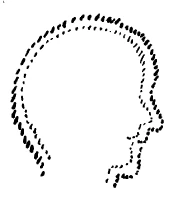
[ 5 ] So you really have to keep in mind that what you see is, in a sense, “shot at”—matter that has been struck. The lines of force come from the cosmos. You see, you can really imagine the material aspect of the head as, for example, when you have a magnet and iron filings arrange themselves along certain lines of force; yes, the iron filings align themselves along the invisible lines of force of the magnet. Just as invisibly as the magnet emits its rays, you must also imagine the form of the head as it works its way in from the cosmos. And just as the iron filings align themselves according to the magnetic lines, so does what the mother imparts align itself according to the cosmic forms that are incorporated into the head.
[ 6 ] If you take this idea as a starting point, you will already be able to form a corresponding conception of the fact that work is being done on the human head during the period between death and a new birth, and that the formative forces for the rest of the organism—though again only to a greater or lesser extent, not completely—are drawn from the earthly realm, from what lies in the hereditary relationships across the generations. In this respect, the human being is of both earthly and cosmic origin: primarily of cosmic origin with regard to the head, and primarily of earthly origin with regard to the rest of the body. The deepest of mysteries are at play in these matters, and one can only ever discuss individual aspects of them; immensely profound secrets, which shed light not only on the origin of humanity but actually on the entire cosmos—on the understanding of the entire cosmos—are at work here.
[ 7 ] From this perspective, we can already view human beings as a kind of dual being. And because they are such dual beings, when studying them, one must make a clear distinction between everything that belongs to the head and is connected to it, and everything that belongs to the rest of the organism and is connected to it.
[ 8 ] And this brings us to a matter that is exceptionally difficult to understand, especially in our present age. For today, people want to explain everything in the same way, to treat everything the same. This is impossible when one takes reality into account, and materialistic science takes reality into account the least of all! Everything that belongs to the human body, with the exception of the head, must be viewed in such a way that this human body—apart from the head—is a pictorial, allegorical representation of the spiritual forces that lie behind it. Everything connected with the head is not, in the same sense, a pictorial representation, but rather a symbolic representation. In a picture, what is depicted bears even more resemblance to what underlies it than in a mere symbol. The painter and the sculptor attempt to reproduce certain similarities to the original in their works; the writer, on the other hand, conveys very little resemblance to the original through letters. Letters are, in the extreme case, signs; paintings and sculptures are images that still bear a great deal of resemblance to the original.
[ 9 ] Now, the difference we are considering here is not as great as that between an image and a written text, but the situation is similar. The rest of the body—that is, everything except the head—is more of an image; everything on the head is more of a sign pointing to what underlies it. There is less similarity between what we see with our physical eyes on the head and what underlies the head than between what we see with our physical eyes on the rest of the body and what underlies it. This is already very strongly evident when observing the etheric body; even more so when observing the astral body or even the “I.” So, in the case of the head, we are dealing more with signs in the forms, in the expression, and so on; in the case of the rest of the body, we are dealing more with a representation, with a greater resemblance between what our physical eyes see and what underlies it spiritually in terms of forces—supersensible and invisible forces. This distinction must be made; for today there is a tendency to view both in the same way. People are most inclined to say, “Everything transitory is merely a parable.” That is indeed true—but a parable to varying degrees. I would like to regard the whole human being as a parable of the supersensible, but in this way: the body is a pictorial parable; but in a higher sense, even the head is a parable. And this is connected to the fact that the rest of the body is shaped more by the earthly forces in whose midst we live between birth and death, while the head is determined more by those forces in whose midst we live between death and a new birth—or, rather, a new conception. But if we wish to consider the complete human being in relation to his passage, on the one hand, through life between birth and death, and, on the other hand, through life between death and a new birth, then we must indeed also take into account something that always remains strictly supersensible in the human being, even here in the physical world.
[ 10 ] That which is unique to human beings and remains strictly supersensory in them is, as I would say, since time immemorial, with three words to which great, characteristic significance has always been attached—words that, like many such terms, sometimes become clichés, but need not be clichés if one takes them in their full meaning: In the course of their development, human beings grow into truth, beauty, and goodness. The True, the Beautiful, the Good—these are, as I said, the three concepts that have been much discussed since time immemorial. Even a superficial examination can reveal to you a certain connection with regard to these three ideas. What is usually called truth is connected with the life of the imagination; what is called beauty, with the life of feeling; and what is called goodness, with the life of the will. One could also say: morality is connected with the life of the will. All aesthetic enjoyment or aesthetic creation—that is, everything aesthetic—is connected to the life of feeling. Everything that pertains to truth is connected to the life of the imagination.
[ 11 ] Of course, these things are always meant in the narrower sense. One aspect flows into the other. They are always only the significant aspects of truth. As a person immerses themselves in moral life, aesthetic life, and the life of truth, they develop here on the physical plane. But only a thoroughly crass materialist could believe that what is actually meant by the concepts of morality, aesthetics, and truth could imply anything physically tangible. These three things point quite clearly to a supersensible realm within which human beings live here in the physical world.
[ 12 ] Well, from this point of view, it is important to understand the insight from the humanities that emerges when one asks: How does that which human beings strive for as truth come about—as well as that which they strive for as artistic and aesthetic enjoyment or as artistic and aesthetic creation, and that which they must strive for as morality? You see, everything that is true is connected, first and foremost here in the physical world, with the forces developed through the physical head. And this is such that what is true is based on the interaction between the physical head and the earthly external world—extending, of course, into the cosmos, but primarily to the earthly external world. So one can say: What is true involves a relationship between our head and the external world.
[ 13 ] What is the situation when it comes to beauty and aesthetics? All such things are based on relationships; truth, on the relationship between the head and the external world. What kind of relationship is at play here in the aesthetic and the artistic? What comes into play is the relationship between the head and the rest of the body. It is very important to make this clear to oneself in the proper way. You see, complete, unconditional, absolute waking consciousness is, after all, necessary for grasping the truth here in the physical world. Anyone who readily accepts dreams as true, in the same sense that we recognize truth here on the physical plane, is unhealthy, isn’t that so? So, for complete waking consciousness, our head comes into play—our head as an organ. And what is required for the consciousness of truth—and what must be developed in this regard—rests, here on earth, primarily on the interrelationship between the head and the external world, including, of course, the spiritual aspect of the external world that we can reach; but it is precisely the world that surrounds us. When it comes to the aesthetic, what comes into play is what lives in the head and what lives in the rest of the organism; for the aesthetic arises when either our head dreams of what is happening in the rest of the organism, or the rest of our organism dreams of what is happening in the head. It is an interplay that is not entirely exhausted in ordinary imaginative life, but is based on something already subconscious; which is precisely due to the fact that, when we enjoy beauty, our body is actually in an inner, more subconscious interplay with our mind. This ebbs and flows; it is a back-and-forth ebb and flow of the very same element that we otherwise experience in dreams. And that is the main point of aesthetic enjoyment: the head dreaming of the contents of the rest of the body, or the rest of the body dreaming of the contents of the head. And then we bring this back from within ourselves into waking consciousness. This waking consciousness is only the second aspect. What lies occultly at the foundation of every life in aesthetic enjoyment and in the artistic is this undulation, this interweaving between the head and the rest of the organism. In the case of lower aesthetic enjoyments, the head dreams of the body, and in the case of higher and highest aesthetic enjoyments, the body dreams of the head.
[ 14 ] Much of what I would like to call—forgive me for this barbaric neologism—the widespread “Botokudism,” that is, people’s Botokuden-like attitude toward aesthetics, is based on this fact that I have just presented to you. Isn’t it true that all people strive for truth; for what is conscientious and good as well? But when it comes to aesthetics, a Botokuden-like mindset is widespread in many circles. A sense of beauty is not regarded as necessary for human beings here in the physical world to the same extent as truth and goodness. Someone who does not strive for truth has a human flaw; someone who resists goodness also has a human flaw. But you would not automatically regard a person who understands nothing of the Sistine Madonna—and you will admit to me that there are many people who cannot appreciate the artistic qualities of such a work of art—as afflicted with a human flaw. It is a common human understanding that one does not do this. But this is based precisely on the fact that, fundamentally, the aesthetic is something quite internal—in that it is something a person arranges with themselves, an interplay between their head and the rest of their body—and that, in a sense, with regard to the aesthetic, a person is thereby responsible only to themselves and to no one else. Someone who has no regard for the truth becomes harmful to the rest of humanity; someone who has no regard for goodness becomes harmful to the rest of humanity, and, as we know, to the spiritual world as well. Someone who is merely a “Botokude” with regard to the sense of beauty loses something for themselves, but they do not harm the rest of humanity—except for the few who themselves find it unattractive that so few people have a receptivity to beauty.
[ 15 ] Our materialistic age actually has the most erroneous conception of the Good; for the Good is regarded as if it approached human beings in the same way as the True. But that is utter nonsense. The Good signifies an interrelationship between the human body and the external world, except that now the head is included as part of the whole body.
[ 16 ] So, of course, these things are all interconnected! When we speak of the pursuit of truth, we have the mind in relation to the external world; when we speak of the pursuit of beauty, we have the mind in relation to the body; and when we speak of morality, we have the body in relation to the external world—but in such a way that the mind is now included with the body, that is, the whole human being in relation to a—and now exclusively spiritual—external world. Everything moral is based on a relationship of the whole human being to the external world—not to the physical external world, but to that which surrounds us in terms of spiritual forces and powers.
[ 17 ] My dear friends, you know that when I speak of materialistic science, I am speaking of something legitimate, not something illegitimate; I have given many lectures here on how legitimate materialism is in the natural sciences, provided it stays within its limits. But when it comes to the relationship between morality and human beings, this materialism in science is still far from being able to say the right thing—for the simple reason that our materialistic science still suffers today from a fundamental flaw that must first be remedied. I have, of course, mentioned this fundamental flaw on several occasions; but when one speaks of it, it is as if, to today’s scientists, one were speaking as a complete amateur.
[ 18 ] You know that modern science speaks of humans having two kinds of nerves: so-called sensory nerves, which are responsible for sensation and perception, and motor nerves, which are said to convey the impulses and actions of the will. Sensory nerves that travel from the periphery into the interior of the human body, and motor nerves that travel from the interior of the human body to the periphery. So a nerve that transmits the command from the brain for me to raise my hand would be a motor nerve; when I touch something and perceive it as warm or smooth, that would be a sensory nerve. So there are two kinds of nerves, according to today’s anatomists and physiologists. This is utter nonsense. But it will be a long time before this is recognized as nonsense. Although we know—anatomically speaking—that there is no difference between motor and sensory nerves, it will still be a long time before people accept that there is only one kind of nerve, and that motor nerves are nothing other than sensory nerves. For motor nerves do not serve to stimulate the will; rather, they serve to perceive the process triggered by the will. So, when I move a hand, in order to be fully conscious of it, I must perceive the movement of the hand. It is simply an internal sensory nerve that perceives the movement of the hand. Of course, I am well aware of all the objections that can be raised against this, such as the cases of people with spinal cord injuries and the like; but if one understands these things in the proper way, they are not objections, but rather proof of precisely what I am saying now.
[ 19 ] So there are not these two types of nerves that haunt materialistic science today, but only one type of nerve. The so-called motor nerves exist solely so that movement can be perceived; they are also sensory nerves, in that sensory nerves located internally extend toward the periphery of the body in order to perceive. But, as I said, this will only be recognized gradually; and only then will it be possible to understand the relationship between morality and the will—and directly to the whole human being—because morality truly acts directly upon what we call the “I.” From there, it then radiates down into the astral body, into the etheric body, and from there into the physical body. So when an action is performed out of morality, the moral impulse radiates, as it were, into the “I,” from there into the astral body, from there into the etheric body, and from there into the physical body. There it becomes movement; there it becomes what the human being does outwardly—that which can only be perceived through the so-called motor nerves.
[ 20 ] Morality is truly something that acts directly upon human beings from the spiritual world, something that exerts a stronger influence from the spiritual world than, for example, beauty and truth. With truth, the situation is such that we find purely spiritual truths situated within a sphere in which physical truths must also have a say. In a manner similar to how ordinary physical perception is mediated through the senses, spiritual truths enter us indirectly through the mind. Moral impulses, even when we grasp them purely spiritually as moral ideas, do not come via the detour of the mind, but rather touch the whole human being. This must be noted as a fact: they affect the whole human being.
[ 21 ] To fully understand this matter, it is very important that you consider how the distinction between the head and the rest of the human body is further expressed. The human head is such that what we call the physical body and the etheric body are most prominent there; these are particularly well-developed here on the physical plane in the head. When I have such a head before me on the physical plane, I must say: Yes, this expresses to me as a sign: physical form, physical body, etheric body; but the astral body is less so, and the “I”—that remains almost outside; it is almost entirely soul-related for the head; it cannot penetrate very deeply into the formative forces of the head. So in the case of the head, the “I” is actually very soul-related; it permeates and imparts soul-force to the head, but as a soul element it is quite independent. This is not the case with the rest of the body. There—as paradoxical and strange as it may sound, yet it is true—the physical and etheric are actually much less present in the physical body; rather, the “I” and the astral body are more active there; the “I” in the circulation of the blood. All these forces that regulate the circulation of the blood are actually an outward expression of the “I.” And everything else that lives in the body is very strongly an expression of the astral, whereas what is actually physical in the physical body—I mean, what is governed by physical forces, what is subject to physical forces—as well as what is governed by etheric forces, cannot be perceived so directly.
[ 22 ] In this regard, of course, people will be terribly mistaken. If one applies materialistic standards, everyone will say: When a person breathes, that is, after all, a physical process; air enters the body; as a result of breathing, a certain process takes place in the blood, and so on—all physical processes. Of course, these are all physical processes, but the forces underlying them—in the chemical processes of the blood—originate from the “I.” The truly physical aspect is actually given much less attention when it comes to the human body. Physical forces express themselves in the human body, for example, when a child first crawls and then gradually transitions to an upright position. This is one way of overcoming gravity; these peculiar relationships between balance and the effects of gravity are always present within the human being. But this is not actually physically visible; it is what we in spiritual science call the physical body: although they are physical forces, they are, as such, essentially invisible forces. It is like having a balance scale and a lever: in the middle is the fulcrum; on one side, a force acting as a result of a weight; and on the other side, another force acting as a result of a weight. The forces at work here are not the strings from which the weights hang; rather, they are invisible, yet they are still physical forces. Thus, we must conceive of what we call “physical” in the human physical body largely as forces.
[ 23 ] And when we turn to the etheric realm, there is still quite a lot that goes unnoticed—for these are physical processes that take place in the etheric body, processes that occur when sensory perception is at work, when the sense of taste is active in the taste buds. But all of these are, in essence, very subtle processes.
[ 24 ] Then we come to what takes place in the muscles and so on—what can be perceived physically from the outside as a parable or an image, but which depends on astral forces. What takes place in the nerves, too, depends on the astral realm.
[ 25 ] And then we come to blood circulation, to the forces of the “I.” Just as the “I” and the astral body are active in everything we have inherited through the succession of generations, in the same way they are not active in the human head—especially not the “I.” One could say that the “I” is very active in the head when a person is awake; but it is actually never the case that it carries out such inner activity in the head as it does in the rest of the body, in the blood—and the blood that flows to the head is, after all, dependent on the rest of the body. That is why, as I said, one cannot separate these things in this way. One influences the other. But what constitutes the impulse of the blood does not originate in the head; rather, it is forced into the head. This emanates from the “I,” insofar as it is dependent on the body.
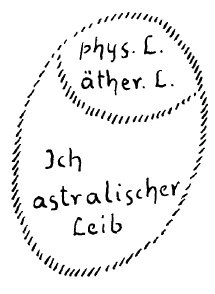
[ 26 ] So one can truly say: When we look at a person’s head, the most striking and important feature is what is projected into the physical body and the etheric body. If we look at the rest of the body, the most important thing is what pulsates within it and gives it strength—that which comes from the “I” and the astral body. So, if you take this contrast—the head on the one hand and the rest of the body on the other—we would have, prominently in the head: the physical body and the etheric body, and, relatively independent and permeating them, the astral body and the “I.” In the rest of the body, we would have the “I” and the astral body, which are actively at work within the physical processes; and the rest actually lies at the foundation as an invisible framework—a physical and etheric framework—that is usually not noticed at all. The “I” is truly physically present in our blood circulation.
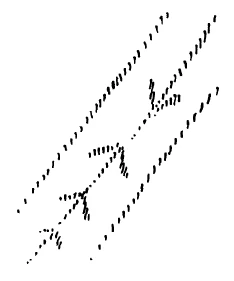
[ 27 ] Now, what we might call the moral-etheric aura—how does it affect us? First of all, it affects the whole human being. But it affects the “I,” and the “I” actually acts throughout the rest of the body—in the blood, for example. Isn’t it true that the “I” is the most essential element in the blood? Morality acts upon the blood. You need not focus so much on the physical blood, which is really only there—I would say—to fill the space where the “I” forces are at work, but rather understand the blood in the sense of what I have said. So morality acts upon the “I.” What acts in our blood as “I”-forces, so to speak, encounters the forces of morality. When a human being stands here in the physical world, it is indeed the case that what pulses in their blood encounters, spiritually speaking, the forces that flow in from the moral sphere—and this occurs in such a way that the truly moral impulse drives out that which, so to speak, rises up from the blood. So imagine we have a stream of blood here, and within it the “I” flows and morality takes effect (see drawing $.69). Then morality must counteract the “I” that is initially flowing; it must be the counterforce to this flowing “I.” This is indeed the case. When someone is under a strong moral impulse, there is a direct effect of the moral impulse on the blood. This precedes even the perception of the moral event, the moral process taking place in the mind. That is why Aristotle, who saw these things—not only the physical but also the moral—with even greater precision, uttered a wonderful statement: that morality is based on a faculty, that is, it is independent in terms of its actual activity, independent of intellectual judgment.
[ 28 ] The head observes, to put it bluntly. So, as we go about our lives here on the physical plane, there is an interaction between certain forces—which, as the “I,” underlie the pulsation of our blood—and the moral impulses that flow into us from a spiritual world. This interaction essentially rests on the fact that we are in waking consciousness with our entire body; that is already part of being in waking consciousness. The “I” must truly pulsate as a conscious “I” in the blood. You might say—and I’d like to interject this, so to speak—: “Yes, but during sleep, the ‘I’ and the astral body are outside; they are outside the physical body and the etheric body.” If it is mainly the “I” and the astral body that are active here, then there is indeed nothing left of the “I” and the astral body inside during sleep. But the forms and movements remain, don’t they! — Certainly, the essential part is outside, but actually—as I have often emphasized—this “being outside” essentially refers to the head region. I have explicitly stated that the interaction between the “I” and the astral body, when it does not act upon the head, is all the more intense in relation to the rest of the organism. This has often been said here. In the rest of the organism, the “I” and the astral body are not so separated.
[ 29 ] But even when morality encounters the “I” forces within our blood sphere, it still flows in in such a way that it passes through the head. That is why I have said before: It belongs here—it belongs to the whole body. It must pass through the head; it must not flow directly into the body. This means that the human being must be awake. For if the human being were asleep and the ego and the astral body were outside the head, morality could not flow through the spiritual realm but would have to flow through the physical and etheric realms—with which it has absolutely nothing to do—into the head and into the physical body. That would be impossible.
[ 30 ] If you are completely honest with yourself, you can convince yourself of what I am about to say through something very simple. Just ask yourself whether you are quite so moral while asleep or in a dream—if morality is not simply a reminiscence of physical life! Morality in dreams—or what we call morality—is sometimes in a pretty bad state, isn’t it? It can, of course, be somewhat amoral—that is, the standard of morality may not apply at all, as is the case with the plant kingdom. But the moral impulse as such can only apply to waking consciousness. So you see how, in morality, we have an effect from our spiritual environment that acts directly upon those forces within us that constitute the “I-radiation.”
[ 31 ] Let us now turn to beauty, to that which has an aesthetic effect. We already know that it is based on an interaction between the head and the rest of the body. It is as if the head dreams of the rest of the body, and the rest of the body dreams of the head. If we examine what underlies this, we find that everything aesthetic also stems from certain impulses in the spiritual environment, which stimulate this interaction within us. Those whom I mentioned earlier as representing the Botokudian element are not very receptive to these impulses; they are not stirred by what internally evokes this interaction. But these impulses do not act upon the ego; rather, they act directly upon the astral body, whereas moral impulses act directly upon the ego. And that unconscious aspect which lies within the moral realm—which constitutes the character of the unconscious, semi-subconscious conscience—is based precisely on the fact that the moral passes through the head and—since the “I” is not so intensely connected to the head—enters the more subconscious realm of the body, taking hold of the whole human being. That which comes from the aesthetic sphere now acts directly upon the astral body. And it acts in such a way that precisely this peculiar interplay arises between the astral body—which is intensely connected to all activity, whether nervous or muscular activity of the body—and the astral body, which is less intensely connected to the muscular and nervous activity of the head. The astral body simply has a different relationship to the head than it does to the rest of the body. As a result, the human being possesses these two forms of astral nature: a somewhat freer astral nature in the head region, and an astral nature bound to physical processes in the rest of the body. And these bound and free forms of astral nature interact with one another through aesthetic impulses. It is a surging and interweaving of these forces.
[ 32 ] And when we come to the realm of truth: Truth is also something supernatural, but it acts directly upon the mind. Truth as such is directly connected to the activities and processes of the head. But the distinctive feature of everything that is truth is that it affects human beings—and is therefore perceived—in such a way that it flows directly into the etheric body. You can deduce this from many of the discussions that have taken place. Since truth lives within the human being in the form of thoughts, it lives in the etheric body—as I have often said—and lives there with the thoughts in the etheric body. Truth directly affects the etheric part of the head and is naturally transmitted from there as truth to the physical part of the head.
[ 33 ] You see, this is how human beings are moved by truth, beauty, goodness, knowledge, aesthetics, and morality. Knowledge, perception, and truth affect a person in such a way that the external world acts directly from the outside—flowing through the “I” and the astral body, insofar as they participate in the head region—all the way into the etheric body. There, the etheric body is directly affected. And because a person does not immerse their consciousness so deeply into their etheric body, truth appears to them as something already complete. This is precisely what is so startling and surprising about initiation: that one begins to perceive truth—as it pulses into the etheric body—as something just as free as one otherwise perceives the pulsing of morality or beauty into the astral body. This is what is so startling and surprising, fundamentally because it brings a person who has undergone any kind of initiation into a much freer relationship with truth—and thereby into a much more responsible relationship with truth. If truth enters us entirely unconsciously, then it is a finished product, and we simply say, using ordinary logic: “This is true; this is false.” In that case, one has a much lesser sense of responsibility toward the truth than when one knows that the truth is, at its core, just as dependent on deep-seated feelings of sympathy and antipathy as morality and beauty are, so that one has a certain free relationship to the truth.
[ 34 ] Here, once again, lies a mystery, namely a significant subjective mystery, which manifests itself in the fact that some who do not approach the experience of initiation in a proper, dignified manner do not gain from their sense of truth in such a way that they develop a greater sense of responsibility; rather, they lose the sense of responsibility they have toward the truth that has been imposed upon them and slip into a certain element of untruth. Oh, there are so many significant aspects here in human development toward spiritual truth, which, in its highest purification, is wisdom. As it flows, so to speak, through the ego and the astral body, it acts directly upon the etheric, upon the human etheric body. Beauty acts upon the human astral body; the ego permeates the moral realm; the moral impulse acts upon the ego. Truth, therefore, having flowed into us from the cosmos, from the universe, has only to act upon the physical body; it must only be imprinted in the physical body—that is, in the physical brain; it becomes perception in the physical realm. Beauty, as it flows in from outside—from the universe—into our astral body, must still act upon the etheric body, and then upon the physical body. The Good—the impulse of the Good—acts upon the “I,” and must act so strongly upon the “I” that it in turn radiates further into the astral body, the etheric body, and the physical body, where it can then become effective in the physical body.
[ 35 ] This is how human beings relate to the True, the Beautiful, and the Good. In the True, they open their etheric body—first the etheric part of the head—directly to the cosmos. In the Beautiful, they open their astral body directly to the cosmos. In morality, they open their “I” directly to the cosmos. In Truth—we will elaborate on these matters further tomorrow and then also discuss the laws of life between birth and death, as well as between death and a new birth—in Truth we have something that has long been prepared for human beings. In Beauty we have something that has been prepared for a relatively shorter time; and in Morality we have something that is only now beginning on Earth. That which lives in Truth—which is purified into wisdom—actually begins its first stages during the Solar Evolution, then reaches its peak in a certain sense during the Lunar Evolution, continues to unfold during the Earth Evolution, and will essentially already be completed by the time of what we know as the Jovian Evolution. By then, the human being will have attained a certain full completion with regard to the content of wisdom. Beauty—which is a very inner matter for human beings—begins during the Lunar evolution, continues during the Earth evolution, and will reach its completion during the Venus evolution, which we call the Venus evolution. These things are all such that, where names are chosen from the occult, they already have their proper meaning. It is not without reason that I call this evolution the “Venus evolution”; it is already called that in reference to the relevant processes.
[ 36 ] During the lunar evolution, one could not yet speak of morality, for at that time human beings were still bound by necessity—almost a natural necessity—in regard to their actions. Morality begins only on Earth. And it will reach its fulfillment in the volcanic stage of development, when everything that pulsates in the fiery processes of the blood will be a purified “I”—an “I” purified by morality, an “I” completely embraced by morality: when the human “I” forces and the moral forces will be one and the same, and his blood—that is, his blood warmth (for the material is, after all, only the outward sign)—when his blood warmth will be the sacred fire of the volcano. We will continue discussing these matters tomorrow.