

The Riddle of Man
The Spiritual Background of Human History
GA 170
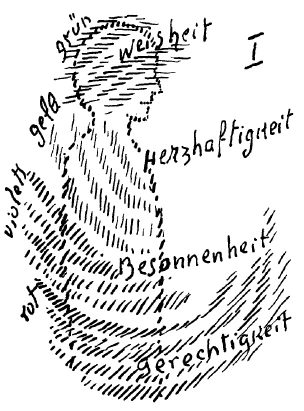
6 August 1916, Dornach
Translated by Steiner Online Library
Fifth Lecture
[ 1 ] Today, I will essentially use this time to lay out some foundational concepts, from which certain points will then emerge that we plan to address tomorrow—concepts that will serve as extensions of what was discussed yesterday.
[ 2 ] Let us remember that human beings enter physical life—the life they spend between birth and death on the physical plane—through birth, or, shall we say, through conception. Let us remember how human beings enter this physical life, just as we have described it over the years. We know, of course, that the human being is, in a certain sense, a convergence of the lower kingdoms of nature—the mineral, plant, and animal kingdoms—and then rises above these three kingdoms, which are, as it were, united within him in a symbiosis. But as a spiritual-soul being, he grows into these three kingdoms. So we can say: As the human being descends to the physical plane, he grows into the mineral, plant, and animal kingdoms and becomes human. Now, after death, he ascends again. Something similar applies from a spiritual perspective: Just as this growing into the kingdoms of physical existence takes place, something very similar occurs in the spiritual realm. Of course, in all such descriptions that I am giving here, you must always be clear that everything we have already said about humanity’s growth into the spiritual world after passing through the gate of death remains true, and that what we are now considering as further elaborations applies only to this. So we can say: Human beings grow into the spiritual world in such a way that they are received by the moral realm, the aesthetic realm, the realm of wisdom, or the realm of truth. Of course, when we speak here in life of the moral realm—the realm of the good—the aesthetic realm—the realm of the beautiful—and the realm of truth and wisdom, we mean these things in a more or less abstract sense. In the spiritual world, however, the forces into which a human being grows—and which he leaves behind again when he enters physical existence—are quite concrete; they are actual spiritual forms of existence. We simply summarize them with such names. Now, that which receives the human being when he ascends into the spiritual world is, in a sense, present here on Earth in his aura as remnants. As a physical being on the physical plane, a human being grows into the mineral, plant, and animal kingdoms after having left the kingdom of wisdom, beauty, and morality. But the radiations from these three spiritual kingdoms still penetrate into his aura; so that the whole human being—if we include the spiritual aspect of the human being in our conception of the human—lives, first of all, in what is mineral, plant, animal, and physical-human, and furthermore also in what, in a sense, surrounds them, radiates through them, and interweaves with them from the three spiritual realms, which outshine and out-illuminate them. Now, through a kind of schematic diagram—which, as I said, is meant to be just that, a schematic diagram—we can visualize what is actually involved in the nature of the human being. What I am about to sketch is entirely schematic, but it can explain a great deal to you if you examine it thoroughly. To make things as clear as possible, I would like to represent everything that belongs to the “I” in this way (green). Everything that belongs to the astral body is yellow; everything that belongs to the etheric human is purple; and everything that belongs to the physical human is red. (See drawings)
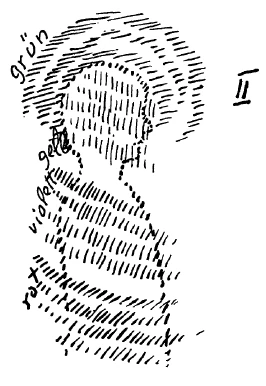
[ 3 ] And now let us take a schematic look at human beings. Let us consider them as they exist within the universe as moral beings—that is, as human beings who share in the moral forces of the universe. Then let us consider them as human beings who share in the aesthetic impulses of the universe, in the sense we discussed yesterday. And then let us consider human beings in terms of how they share in the impulses of wisdom. So, in a sense, we want to outline a “psychic physiology”—please forgive this somewhat contrived term, but you will understand what I mean by it—which is, of course, meant in an imaginative sense. When we consider the human being insofar as he is situated within the sphere of morality, we are particularly reminded of what I explained yesterday: that the Greeks felt and sensed the relationship between the spiritual-soul and the physical even more keenly than is the case today. That is why Plato, for example, still very clearly depicted this unique relationship: how human beings are grasped and seized by moral impulses emanating from the spiritual universe. Plato says: There are actually four virtues. The whole human being is encompassed by the totality of morality. — But all of this must, of course, be taken with a grain of salt. Of course, if the whole human being is encompassed, he would in turn be divided according to the individual virtues. The first virtue Plato speaks of is wisdom—wisdom taken here as a virtue, not as a science. Because this wisdom as a virtue is related to what is experienced in truth, the forces that wisdom draws specifically from the sphere of morality also turn toward the head of the human being, so that we can represent the matter as follows: (Figure 1). Plato thus said: In the moral person, the head is governed by wisdom, and the chest by what one might call the virtue of heartiness—I can find no better word—courage, competence, but a competence that encompasses these heartfelt powers: spiritual competence.
[ 4 ] A wise person—the word used here in the sense of virtue—is one who does not merely give in to his animal instincts, but who, based on morality, has certain ideas that he grasps and by which he guides himself. But the moral impulse already radiates into the physical, into the bodily realm, even when this moral impulse is grasped in the ideas of moral wisdom. Therefore, we can say: Morality radiates into the human being in such a way that we may imagine this radiation entering the “I” (green). This, then, would be the Platonic sphere of wisdom of morality.
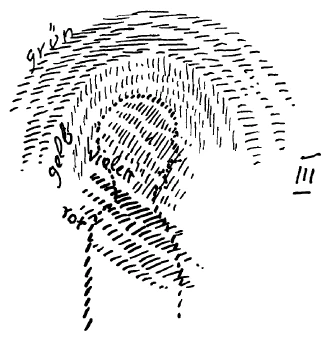
[ 5 ] The chest region, which encloses the heart, is the area where heartiness, courage, and spiritual strength radiate from the sphere of morality. We can say: There, morality takes hold by radiating outward, particularly into the astral realm, and animates the chest region containing the heart. We can therefore depict this outward radiation as shown (yellow). Thus, we have: wisdom as a virtue in the head region (green), and heartiness as a virtue in the chest region (yellow).
[ 6 ] A third virtue is what Plato calls prudence, or sophrosyne, and he attributes it to the lower abdomen, which is quite correct. The lower abdomen is the source of human instincts, but the person who masters these instincts through reflection, empathy, and compassion is a prudent person. Merely acting on one’s instincts—something even animals do—is not a virtue; rather, it is the exercise of these instincts with the highest possible degree of consciousness that constitutes prudence. This is then captured in the etheric body, because thoughts, prudence, and courage—insofar as they are human—are captured in the etheric body. We must therefore depict this in the diagram (purple). As I explained yesterday, the sphere of morality already encompasses the physical human being as a whole. The head is included in this, as I explicitly stated yesterday.
[ 7 ] And Plato calls dikaiosyne the fourth comprehensive virtue, which now flows throughout the entire physical body—which, as I showed you yesterday, is actually invisible. We must translate this as “justice,” although the word “justice” in modern languages does not fully correspond to it; for we must understand justice in this way: that a person knows how to direct themselves—justly, in accordance with a direction—that they follow a human direction in life. So it is not merely the abstract word “justice” that is meant, but rather the act of giving oneself direction, knowing one’s way, and orienting oneself in life. Thus we can say: The inflow of the sphere of morality into the entire physical body manifests as justice (red). In this way, we have schematically indicated how the impulses of morality radiate into the human being through the human aura.
[ 8 ] Now let us suggest how aesthetic impulses radiate into human beings (Drawing II). Here, the elements are shifted slightly—specifically, shifted up by one. One must then draw what was previously depicted inside the head higher up, so that it seems to hover around the head. In the aesthetic realm, the “I” is enveloped, and the aesthetic flows directly into the astral body, giving the impression that the head is being enveloped by the “I” in the aesthetic realm. Anyone who has even a little feeling and sensitivity to beauty can already sense—without being particularly highly clairvoyant—how, when looking at any work of art, they actually live in an environment surrounding the head. In contrast, a person’s immediate experience takes place inside the head; there, the astral body is engaged, so that we would have to draw the rays like this:
[ 9 ] In contrast, the chest region is engaged with beauty in such a way that this ebb and flow—which I described yesterday—can take place; one might say that the ethereal now radiates through the chest region. And what is truly beautiful has such an effect that, apart from the head aura, the head, and the chest region, nothing else should really be taken into account. Thus, that in which sophrosyne dwells should, in reality, not be taken into account at all in the contemplation of beauty. Our materialistic age, however, is characterized precisely by the fact that it has drawn the sexual sphere so heavily into artistic contemplation—a folly of our materialistic age—for the sexual sphere is absolutely irrelevant to the contemplation of beauty; rather, it is absolutely excluded. Thus, we would have to relegate to the physical realm (red) only the very lowest level of aesthetic contemplation, which no longer belongs to the realm of art.
[ 10 ] Now let us apply the same pattern to human beings insofar as they strive for truth (Figure III). Here, too, it is shifted—shifted outward, so to speak. I said yesterday: In the pursuit of truth, the “I” and the astral body are permeated, and the truth flows directly into the etheric part of the head, where thoughts are generated. So I must draw it in such a way that I depict here, directly for the head, the inflow of the ether into the etheric body of the head, where thoughts are generated. In contrast, when we grasp the truth—something one only realizes after initiation—it first acts outside of us in the aura through the “I” and the astral body, then flows into the etheric part of the head, and the chest region is already experienced here as the physical body (red). If we want to feel the truth—and we must feel it—then it must work its way down; it must radiate down into the chest region; the spiritual must be experienced in the same way as morality.
[ 11 ] So that is all that pertains to the physical plane; it all exists within the aura of the physical plane. The entity we enter after death shares in the aura of the physical plane. Just as we are connected to the forces of the mineral, plant, and animal worlds through our physical organism, we are connected to the forces of the spiritual world in this way through the sphere of morality, the sphere of aesthetics, and the sphere of wisdom.
[ 12 ] Although some of what I am about to say is still very poorly formulated—it may be better articulated later—I would still like to present it to you today because it belongs within the overall context. One could say: While we are connected here to physical becoming through the physical body, we are connected through the brain to elemental beings, specifically those belonging to the sphere of wisdom. What is already inside in Drawing II and is marked in yellow is still outside in Drawing III. Further outside is the green that surrounds the head here (Drawing II). In this green, in which the “I” lives and in which the elemental beings live with us—in this green that, from an aesthetic perspective, directly surrounds our head—there we would find the elemental beings of whom myths and legends speak and to whom they give names: elves, albs, and so on; this is what surrounds our head when we experience aesthetic enjoyment.
[ 13 ] Here (Drawing III), however, we are surrounded by even more ethereal beings that belong to the astral sphere. If one were to depict, for example, how a person, upon waking from sleep, immerses themselves in the sphere of truth, one could express this through certain words—how they are there—though this is not visible in the physical realm—surrounded, enveloped, and seized as perception, as truth, takes hold of them; how he is grasped there, how he is received—this could be described with certain words. The words are still inadequate today; perhaps they will improve later; but I still want to put into words how a person, after waking up, immerses himself in this sphere, the sphere of wisdom and truth. Regarding the spirits that surround and take hold of him there, one could then say:
You who shine in the sky from a circle of light,
[ 14 ] — speaking to the spirits! —
Let it—the mind—
Let it now comprehend in a purely spiritual way,
Let it quell the confused delusions of its brain;
[ 15 ] — the orderly train of thought that dispels delusion —
It soothes the confused delusions of his—the human’s—mind
It untangles the doubt of burning, anxious striving,
[ 16 ] — just feel the words! Doubt is dispelled and banished as wisdom shines through
His inner self is led astray.
[ 17 ] — he would be following the wrong path if he were to follow only the world of dreams; by immersing himself in wisdom, this spiritual world that surrounds him purifies his inner self of the wrong path
There are four goals of daily experience;
[ 18 ] — we will come back to this later; everything here can be broken down into four parts —
There are four goals of daily life;
Now, without timidity, he leads him forward.
[ 19 ] — guiding people toward their goals —
First, strive toward the radiant countenance,
Then hold fast to the spirit’s struggle.
Soon the wingless mind will be strengthened,
And, set free, it can fulfill the day.
[ 20 ] — freed from everything dreamlike, involuntary, and necessarily determinative —
Fulfill the spirit’s truest duty,
Carry him through the holy light.
[ 21 ] This is how one might speak to the spirits that take hold of a person as he awakens to the life of wisdom.
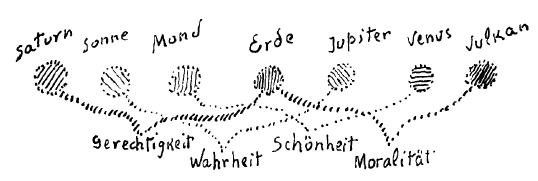
[ 22 ] As a person awakens to a life of beauty, spirits hover around them—well, I can explain that to you better. — So this applies to the spirits living in the “I” sphere:
You who circle this head in the air,
Show yourselves here in the noble manner of the elves,
Soothe the heart’s fierce turmoil,
[ 23 ] — it goes straight to the heart —
Removes the fiery, bitter arrows of accusation,
[ 24 ] — A reproach for a matter of conscience, but one that evokes pleasure or displeasure; thus, viewed from an inner aesthetic perspective, the undulating
Cleanses one's inner self of the horror one has experienced.
[ 25 ] — in the past, we dealt with the brain; now, we deal with the inner self
His inner self is cleansed of the horrors he has endured.
Four are the pauses of the night’s repose,
Now, without delay, he fills them with joy.
First, he lays his head upon the cool pillow,
[ 26 ] — this corresponds to the earlier words: “First, strive toward the light-filled face” —
Then bathe him in the dew from the waters of Lethe;
[ 27 ] — this is what wisdom is: Then hold fast to the Spirit’s struggle
The limbs, stiffened by cramps, are soon jointed,
[ 28 ] — which, in terms of wisdom, means: The wingless mind will soon be strengthened
As he rests, ready to face the day.
[ 29 ] — which means: Can he get through the day free
Fulfilling the elves' noblest duty,
[ 30 ] — these are the elemental beings. Here (Drawing III) they are the spirits who dwell in the etheric realm; therefore, it must be said: Fulfill the spirits’ truest duty. Carry him through the sacred light
Return him to the holy light.
[ 31 ] Here (Figure I) we are dealing with the influence exerted by the entire sphere of the world: morality. I said: The entire universe exerts an influence on the whole human being. We must present it this way:
You who illuminate this head with the strength of your deeds,
[ 32 ] — Will, morality, gives way to action —
You whose mind shines with the strength of action,
May you soon prove yourselves in righteous works for the world.
[ 33 ] — because the fulfillment of the will follows from him in true worldly work — and prudence:
Boldly slay the torment of madness,
[ 34 ] — what radiates from the body as an instinct; I explained yesterday how moral impulses are related to what arises from the bodily instincts. —
Boldly vanquish the torment of madness,
Sublimate the dark force of burning desire,
Carry his being away to a spiritual destiny
[ 35 ] — the mere pursuit of animal instincts. —
There are four paths of human addiction,
[ 36 ] — what used to be called an addiction was something that arose solely from the instincts, from the flesh —
Break free from the bonds of sickness.
Overcome the groans of the fire of the senses,
Illuminate what dies in pleasure.
Enlivened, you will hear in response,
What strength seeks for all eternity.
[ 37 ] — because the karma of an action has an effect throughout eternity
May the world’s workings strive,
Awaken him to a life of grace.
[ 38 ] Here you have the three ways in which a person is affected in their aura by the surrounding world.
[ 39 ] How is the wise man seized by the spirits that take hold of him?
You who shine in his mind from a circle of light,
Now grasp it in the manner of a pure spirit,
Quell the confused delusions of his mind;
Unravel the doubt of his burning, anxious striving,
Guide his inner self from its wrong path.
There are four goals of daily experience;
Now, without timidity, lead him forward.
First, strive toward the light-filled countenance,
Then hold fast to the spirit’s struggle for strength.
Soon the wingless mind will be strengthened,
And, set free, it can fulfill the day.
Fulfill the spirit’s truest duty,
Carry him forth through the holy light.
[ 40 ] The aesthetic realm into which Faust immerses himself is particularly evident in the third act of the second part, in his union with Helena, with beauty:
You who hover around this head in ethereal circles,
Show yourselves here in the noble manner of the elves,
Soothe the heart’s fierce turmoil,
Remove the searing, bitter arrows of reproach,
Purify his inner self of the horror he has endured.
Four are the pauses of the night’s repose,
Now, without delay, fill them kindly.
First, lower his head upon the cool pillow,
Then bathe him in the dew from Lethe’s stream;
Soon his limbs, stiff with cramps, will be supple again,
As he rests, strengthened, awaiting the day.
Fulfill the fairest duty of the elves,
Return him to the sacred light.
[ 41 ] Moral Sphere:
You whose minds are illuminated by the strength of your deeds,
Prove yourselves soon in righteous works for the world.
Boldly slay the torment of folly,
Sublimate the dark force of burning desire,
Deliver its essence from spiritual doom.
Four are the paths of human addiction,
Break free from their sickly embrace.
Conquer the groans of the fire of the senses,
Enlighten what dies in pleasure.
Enlivened, you will respond,
That which strives for power throughout the ages.
Seek the striving of the world’s workings,
Awaken it to a life of grace.
[ 42 ] You see, when one approaches things spiritually and truly grasps the spiritual, only then do many things reveal their full depth. For now, all of a sudden, the Faust of the second part stands before us—which Goethe allows to be enveloped by the circle of elves—just as the aesthetic person stands within the aesthetic-spiritual sphere. And parallel to this is the standing within the sphere of truth and wisdom and within the sphere of morality.
[ 43 ] When one grasps these things, one really must also draw on one’s feelings. One is almost reminded of Nietzsche’s words: “The world is deep, and deeper than the day imagines!” Here, “the day” refers to physical experience, physical perception, and physical sensation. “The world is deep, and deeper than the day is thought!” It truly is, especially when one includes the human being in his full wholeness as part of this world—this human being who lives on the cosmic path of his evolution and of whom we can actually grasp very little in our present existence. That is to say: we still grasp very little of ourselves in our present existence. There is so much—so infinitely much—in what we have become, and in all that we will one day need to know as we pass through the spheres of Jupiter, Venus, and Vulcan; and there is so much within us of what is yet to come within our earthly evolution! Only gradually do we rise from what still echoes the concepts of the present age to that which—because it is already more spiritual—becomes difficult for human beings to grasp, and which present-day humanity still comprehends very little through its familiar concepts. If we consider human beings as they live on Earth today, then one could say that one might say, already lies within them in seed form what will develop during the Jupiter, Venus, and Vulcan periods. But human beings are equally the result of the Saturn, Sun, Moon, and Earth spheres. I said yesterday: Wisdom and truth are already laid down on the Sun and will be completed on Jupiter. Let us also illustrate this graphically.
[ 44 ] The embryonic stage of truth on the Sun will have reached a certain completion on Jupiter; so we can say: The true development of truth takes place from the Sun to Jupiter; on Jupiter, it will have become entirely inner; then it will simply be wisdom: Truth becomes wisdom!
[ 45 ] On the Moon, then, begins what constitutes the aesthetic sphere. This will be completed on Venus. We can illustrate it something like this: Moon, completed on Venus; so here we have the development of beauty. As you can see, this extends beyond.
[ 46 ] In fact, all of this lies deep within us, in the subconscious—what is contained in these two currents, and also in the third; for during the Earth’s evolution, what we might call the sphere of morality now begins. It reaches its conclusion on the volcano. So we have a third current, which again transcends the others: the current of morality. In addition, we have a fourth current, which will be completed once the Earth has reached the goal of its evolution. Morality begins with the Earth. But it, in turn, concludes a higher order—an order that has already begun on Saturn—so that we now have an order, a current, from Saturn to Earth, and this is now called “justice,” in the sense in which I explained the word earlier. You know that on Saturn the senses were first instilled. These senses would scatter human beings in all directions. As you know, we distinguish twelve senses—as the senses develop through the Sun, Moon, and Earth, they would guide human beings toward orientation and justice, where moral justice is then first encompassed when it is grasped by the moral nature of the Earth; moral justice exists only on Earth. What acts inwardly, as a central force in contrast to the peripheral nature of the senses, is the sphere or current of justice.
[ 47 ] Everything that is depicted in this way is contained within the human being, and you all know that people are generally aware of only a small fraction of what is at work, alive, and active within them. But it is at work, active, and alive at the very core of their being. One might well ask: Is it really the case that human beings grasp so little—as it often seems—of how they are immersed in a vast current of being and emerge from this vast current of being, and how little they know of all that they are?
[ 48 ] This awareness is not entirely confined to circles of initiates; rather, it does reach out to people. There really are people who—one might say—through a natural gift, sometimes feel themselves being drawn upward in particularly inspired moments, sensing what is at work and alive down below in the currents into which human beings are immersed. This manifests itself in the most diverse ways. There are individuals who, in a higher sense than is often the case with the outward, philistine conception of religion, sense this deeper aspect within the human being. People often speak of guilt, and certain pastors seek to deepen people precisely by instilling in them a strong sense of guilt. But that is only a superficial understanding. The superficial is certainly justified, but one can go deeper. And deeper-thinking people also sense—linked to what is otherwise merely a sense of guilt—this rising resonance and radiance of a force emanating from the depths of human existence. If people did not have such shyness and such fear of getting to know themselves, they would come to know themselves much more often. But even the subconscious soul pushes back what reigns in those depths, because human beings unconsciously harbor fear, shyness, and anxiety toward themselves, toward their vastness and their depths. Yet once it begins to shine and radiate upward, it truly feels as if everything about what is shining and radiating upward were enigmatic. And one feels a deep connection with people who have experienced such things through genuine inner spiritual experience.
[ 49 ] How beautifully this Irish work expresses how, in the surging dreams of the soul’s life, that which dwells in the depths of the human soul rises before us. Imagine a person who has left behind the day’s work and the day’s burdens, who has retired to rest, but who, out of that rest, out of the darkness and gloom, feels before him—as if it were tangible, as in a powerful dream of the soul—that very thing from which the human being rises. This is how a Polish poet once described it:
And in the secret magic of the night,
There, before my palace,
Built from the misty web of my dreams,
Unheard-of flowers with dead eyes
Of a treacherously grinning Medusa
In the moonlight-saturated dew
Grew into monstrous forms—
As the moon crept into my bedchamber
And lay down upon the bed of my exhaustion,
Then I was roused from sleep by the lustful,
Monstrous desire,
Which made my lips tremble in frenzied stammering
And my eyes blaze with a feverish fire
For your creature!
Mea culpa, mea maxima culpa!
— My fault, my great fault! —
[ 50 ] These beautiful Irish words by Jan Kasprowicz are indeed a truly wonderful experience—questioning, yet at the same time offering a touching glimpse of the answer. Inquisitive, because in a sense, this lyrical work embodies a transition: a memory of the day passing through the aesthetic into the moral sphere—mea culpa, mea maxima culpa. One must not shy away from the questioning that arises from the surging undercurrent of life. These things are not meant to instill fear, but to spark questions. The “unheard-of flowers with dead eyes, like a treacherously grinning Medusa,” are beings of inquiry, figures of inquiry, shaped from the plant kingdom. And as for how this relates to the moon—we need only recall the lunar currents, and then we will understand that moonlight, with its gentle ebb and flow, unites outer physical reality with the spiritual experience. It is truly a wondrous spiritual experience with which we are dealing here:
And in the secret magic of the night,
There, before my palace,
Built from the misty web of my dreams,
Unheard-of flowers with dead eyes
Of a treacherously grinning Medusa
In the moonlight-saturated dew
Grew into something monstrous
As the moon crept into my bedchamber
And lay down upon the bed of my exhaustion, —
Then the lustful,
Monstrous desire
[ 51 ] — do you remember the third address, to the spirits in the sphere of morality —
Then I was roused from sleep by the lustful,
monstrous desire,
that made my lips tremble as they stammered
and my eyes blaze with a feverish fire
for your body!
Mea culpa, mea maxima culpa!
[ 52 ] Then imagine the moral sphere shining forth, which overcomes the groans of the fires of the senses, which illuminates what dies in pleasure, and which, as it is enlivened, will resonate with that which draws strength for all eternity.
[ 53 ] One must indeed draw on one’s feelings if one wishes to penetrate to the very depths of that with which human beings are connected. For only in this way can one gradually form a conception of how human beings immerse themselves in the realms of spirituality, morality, and aesthetics—in the realm of the imaginative and the realm of truth—just as they immerse themselves in the mineral, plant, and animal realms upon entering the physical plane. Human beings are human throughout all these realms, and the human being descends through the mineral, plant, animal, and human realms, and ascends into the moral, the aesthetic, and the realms of truth and wisdom. And humanity is embedded in the stream of existence, which, in a wondrous way, flows through the spheres of development of Saturn, the Sun, the Moon, and Earth, Jupiter, Venus, and Vulcan—spanning them and thereby connecting the individual forces with one another—and endows humanity, in the course of its evolution, with all that has been allotted to it from the deeper impulses of the universe.