

The Riddle of Man
The Spiritual Background of Human History
GA 170
5 August 1916, Dornach
Translate the original German text into any language:
Versions Available:
The Riddle of Man, tr. SOL
Vierter Vortrag
Fourth Lecture
[ 1 ] Wenn wir die Art, wie heute der Mensch über Seelisches und Leibliches spricht, vergleichen mit der Art, sagen wir nur, wie in Griechenland darüber gesprochen worden ist — wir brauchen gar nicht weiter zurückzugehen —, so finden wir, daß in Griechenland der Beziehung zwischen dem Seelischen und dem Leiblichen weit mehr noch Rechnung getragen ist als in unserer Zeit, wobei es außerordentlich wichtig ist, sich klarzumachen, daß innerhalb der griechischen Weltanschauung von einem materialistischen Ausdeuten des Zusammenhanges zwischen Seelischem und Leiblichem nicht die Rede sein konnte. Wenn heute jemand davon spricht, daß diese oder jene Stirnwindung Sprachzentrum ist, so deutet er sich die Sachlage recht materialistisch. Zumeist denkt er überhaupt, daß an der betreffenden Stelle des Gehirns der Sprachlaut mehr oder weniger erzeugt wird, rein mechanisch. Oder wenigstens denkt er, auch wenn er nicht direkt Materialist ist, sich doch den Zusammenhang so, daß derjenige, der den wahren Zusammenhang kennt, die Aussage als mehr oder weniger materialistisch auffassen muß. Der Grieche hat viel weitergehend von der innigen Beziehung zwischen dem Seelischen und Leiblichen gesprochen, ohne materialistische Nebenempfindungen dabei zu haben, weil er noch ein lebendiges Gefühl davon hatte, daß, wenn wir von den Dingen der Außenwelt sprechen, wir von diesen Dingen so sprechen, daß sie Offenbarungen, Manifestationen des Geistigen sind. Der heutige Mensch, der vom Sprachzentrum im Gehirn spricht, denkt nicht daran, daß aus irgendeinem Geistigen heraus dieses Sprachzentrum erst aufgebaut ist, daß dasjenige, was materiell da ist, nur wie ein Zeichen, wie ein Symbol, wie ein Gleichnis eines dahinterstehenden Geistigen ist, ganz abgesehen von dem, was sich in der menschlichen Seele als Geistiges abspielt. Daran hat der Grieche immer gedacht: den ganzen Menschen, wie er dasteht in der physischen Welt, als ein Gleichnis anzusehen, als ein Symbol des ÜbersinnlichGeistigen, das dahintersteht. Es ist ja durchaus zuzugeben, daß diese Vorstellung heute den meisten Menschen nicht ganz leicht wird, weil die Seele, selbst wenn sie es nicht will, heute schon stark an materialistischen Vorstellungen haftet. Nehmen Sie nur einmal an, was ja schon, wenigstens andeutungsweise, in dem letzten Vortrage gesagt worden ist: Der Kopf des Menschen wird eigentlich in der geistigen Welt gebildet, in der geistigen Welt veranlagt; zwischen dem letzten Tode und dieser Geburt ist der Kopf im wesentlichen gebildet worden. Nicht wahr, man möchte sozusagen den Menschen in der Gegenwart kennen, der nun nicht sagen wird: Man weiß doch ganz genau, daß der Kopf im Leibe der Mutter während der Zeit der Schwangerschaft entsteht, und es ist doch eine Verrücktheit, zu sagen, daß er hauptsächlich in der langen Zeit gebildet wird, die zwischen dem letzten Tode und dieser Geburt oder Empfängnis liegt. — Wer heute ganz materialistisch denkt, und, man möchte fast sagen, naturgemäß so denkt, der muß die eben angeführte Behauptung mehr oder weniger als eine Art Verrücktheit ansehen.
[ 1 ] If we compare the way people today speak about the soul and the body with the way—let’s just say—these matters were discussed in ancient Greece—we don’t even need to go back any further— we find that in ancient Greece, the relationship between the soul and the body was taken into account far more than in our time, although it is extremely important to realize that within the Greek worldview, there could be no question of a materialistic interpretation of the connection between the soul and the body. When someone today speaks of this or that convolute of the brain as a speech center, they are interpreting the situation in a rather materialistic way. In most cases, they assume that speech sounds are more or less generated at the relevant location in the brain in a purely mechanical way. Or at the very least, even if they are not directly materialists, they conceive of the connection in such a way that anyone who understands the true relationship must regard their statement as more or less materialistic. The Greeks spoke much more profoundly of the intimate relationship between the soul and the body, without any materialistic undertones, because they still had a living sense that when we speak of things in the external world, we speak of them as revelations, as manifestations of the spiritual. People today, who speak of the speech center in the brain, do not consider that this speech center is itself built up out of something spiritual, that what is materially present is merely a sign, a symbol, or a parable of a spiritual reality lying behind it—quite apart from what takes place in the human soul as a spiritual process. The Greeks always held this view: to regard the whole human being, as he stands in the physical world, as a parable, as a symbol of the supersensible-spiritual reality that lies behind it. It must certainly be admitted that this concept is not entirely easy for most people today, because the soul, even if it does not want to, is already strongly attached to materialistic ideas. Just suppose for a moment what was already mentioned, at least in passing, in the last lecture: the human head is actually formed in the spiritual world, its structure established there; between the last death and this birth, the head has essentially been formed. Isn’t it true that one would expect, so to speak, a person today to say: “We know perfectly well that the head develops in the mother’s body during pregnancy, and it is sheer madness to claim that it is primarily formed during the long period between the last death and this birth or conception.” — Anyone who thinks entirely in materialistic terms today—and, one might almost say, thinks this way as a matter of course—must regard the assertion just made as more or less a kind of madness.
[ 2 ] Aber, sehen Sie, Sie kommen, wenn Sie sich die Sache in der folgenden Art vorstellen, schon zu der Möglichkeit, einen entsprechenden Gedanken zu gewinnen.
[ 2 ] But, you see, if you imagine the matter in the following way, you will already arrive at the possibility of forming a corresponding thought.
[ 3 ] Natürlich, vor der Empfängnis ist alles das, um was es sich handelt am menschlichen Kopf, unsichtbar; es fährt natürlich kein Meteor aus Himmelshöhen in den Leib der Mutter hinein. Aber die Kräfte, die in Betracht kommen, namentlich auch die Formungskräfte, die gestaltenden Kräfte des menschlichen Hauptes, die sind tätig in der Zeit zwischen dem Tod und einer neuen Empfängnis. Denken Sie sich gewissermaßen eine unsichtbare Form des Kopfes ausgebildet, die man nur sichtbar zeichnet, also die Linien, die ich jetzt hier andeute, die sind natürlich dann unsichtbar. Das alles sind nur Kräfte (siehe Zeichnung).
[ 3 ] Of course, before conception, everything that is essential to the human head is invisible; naturally, no meteor plunges from the heavens into the mother’s womb. But the forces at work here—namely the formative forces, the shaping forces of the human head—are active in the period between death and a new conception. Imagine, as it were, an invisible form of the head that has been formed—one that can only be depicted visually; thus, the lines I am now indicating here are, of course, invisible. All of this consists solely of forces (see drawing).
[ 4 ] Diese Kräfte muß man sich auch nicht so vorstellen, daß sie die physische Form des Kopfes haben. Aber es sind Kräfte vorhanden, welche diese physische Form des Kopfes bewirken, bedingen. Und während der Vorbereitungszeit des menschlichen Hauptes im Mutterleibe setzt sich die Materie an diese Kräfte an; im Sinne dieser Kräfte setzt sich die Materie an. Nicht die Form des Kopfes wird gebildet, sondern nach der Form, die aus kosmischen Weiten in den Mutterleib versetzt ist, wird der Kopf gebildet. Das ist schon einmal wahr. An diese Formen setzt sich die physische Materie an, und dann wird es natürlich erst sichtbar. Es kristallisiert sich die Materie gewissermaßen um bestimmte unsichtbare Bildekräfte. Gewiß, es spielen noch die mit der Vererbung zusammenhängenden Kräfte hinein, aber die hauptsächlichsten Bildekräfte des Kopfes sind kosmischen Ursprungs, sind gewisse Kristallisationskräfte, möchte ich sagen, an die sich die Materie im Mutterleib ansetzt.
[ 4 ] One should not imagine these forces as having the physical form of the head. But there are forces at work that bring about and determine this physical form of the head. And during the period of the human head’s development in the womb, matter attaches itself to these forces; it attaches itself in accordance with these forces. It is not the form of the head that is formed, but rather the head is formed according to the form that is transferred from cosmic expanses into the womb. That much is certainly true. Physical matter attaches itself to these forms, and only then does it naturally become visible. In a sense, matter crystallizes around certain invisible formative forces. Certainly, forces related to heredity also play a role, but the principal formative forces of the head are of cosmic origin—they are, I would say, certain crystallizing forces to which matter attaches itself in the womb.
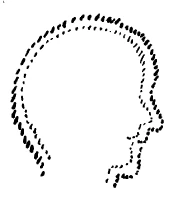
[ 5 ] Also das muß man schon festhalten, daß das, was man sieht, gewissermaßen angeschossen ist, angeschossene Materie. Die Kraftlinien, die sind aus dem Kosmos. Sehen Sie, das Materielle des Hauptes können Sie sich wirklich so vorstellen wie etwa, wenn Sie einen Magneten haben, und sich nach bestimmten Kraftlinien Eisenfeilspäne anordnen; ja, die Eisenfeilspäne ordnen sich nach den unsichtbaren Kraftlinien des Magneten an. So unsichtbar wie der Magnet seine Strahlen aussendet, müssen Sie sich auch die Form des Kopfes vorstellen, wie sie aus dem Kosmos hereinwirkt. Und wie sich die Eisenfeilspäne nach Maßgabe der magnetischen Linie ordnen, so ordnet sich das, was die Mutter hergibt, nach Maßgabe der kosmischen Formen, die dem Haupte eingegliedert sind.
[ 5 ] So you really have to keep in mind that what you see is, in a sense, “shot at”—matter that has been struck. The lines of force come from the cosmos. You see, you can really imagine the material aspect of the head as, for example, when you have a magnet and iron filings arrange themselves along certain lines of force; yes, the iron filings align themselves along the invisible lines of force of the magnet. Just as invisibly as the magnet emits its rays, you must also imagine the form of the head as it works its way in from the cosmos. And just as the iron filings align themselves according to the magnetic lines, so does what the mother imparts align itself according to the cosmic forms that are incorporated into the head.
[ 6 ] Wenn Sie diese Vorstellung zu Hilfe nehmen, dann werden Sie sich schon einen entsprechenden Gedanken bilden können davon, daß an dem menschlichen Haupt gearbeitet wird während der Zeit zwischen dem Tod und einer neuen Geburt, und daß die Bildekräfte für den übrigen Organismus — aber auch wiederum nur mehr oder weniger, nicht vollständig — angesetzt werden vom Irdischen aus, von dem, was in den Vererbungsverhältnissen durch die Generationen liegt. Insoferne ist der Mensch irdischen und kosmischen Ursprungs, kosmischen Ursprungs in bezug auf seinen Hauptesteil in der Hauptsache, irdischen Ursprungs in bezug auf seinen übrigen Leib. In diesen Sachen spielen die allertiefsten Mysterien, und man kann immer nur einzelne Dinge daraus besprechen; ungeheuer tiefgehende Geheimnisse, die aufschlußgebend sind nicht nur für die Menschheitsentstehung, sondern eigentlich für den ganzen Kosmos, für das Verständnis des ganzen Kosmos, spielen da hinein.
[ 6 ] If you take this idea as a starting point, you will already be able to form a corresponding conception of the fact that work is being done on the human head during the period between death and a new birth, and that the formative forces for the rest of the organism—though again only to a greater or lesser extent, not completely—are drawn from the earthly realm, from what lies in the hereditary relationships across the generations. In this respect, the human being is of both earthly and cosmic origin: primarily of cosmic origin with regard to the head, and primarily of earthly origin with regard to the rest of the body. The deepest of mysteries are at play in these matters, and one can only ever discuss individual aspects of them; immensely profound secrets, which shed light not only on the origin of humanity but actually on the entire cosmos—on the understanding of the entire cosmos—are at work here.
[ 7 ] So können wir den Menschen von diesem Gesichtspunkte aus schon als eine Art Doppelwesen auffassen. Und weil er ein solches Doppelwesen ist, muß man beim Studium scharf unterscheiden zwischen all dem, was zum Haupt gehört und mit dem Haupt zusammenhängend ist, und dem, was zum übrigen Organismus gehört und mit ihm zusammenhängt.
[ 7 ] From this perspective, we can already view human beings as a kind of dual being. And because they are such dual beings, when studying them, one must make a clear distinction between everything that belongs to the head and is connected to it, and everything that belongs to the rest of the organism and is connected to it.
[ 8 ] Und da kommen wir zu einer Sache, die insbesondere für unsere jetzige Zeit dem Verständnis außerordentlich große Schwierigkeiten macht. Denn heute will man eigentlich alles in gleicher Weise erklären, alles über einen Leisten schlagen. Das kann man nicht, wenn man Realitäten ins Auge faßt, und die materialistische Wissenschaft faßt am wenigsten Realitäten ins Auge! Alles, was zum menschlichen Leibe gehört, mit Ausschluß des Hauptes, muß so betrachtet werden, daß dieser menschliche Leib — abgesehen vom Haupt — eine bildhafte, gleichnishafte Darstellung dessen ist, was an geistigen Kräften dahintersteht. Alles, was mit dem Haupt zusammenhängt, ist nicht in demselben Sinne eine bildhafte Darstellung, sondern mehr eine zeichenhafte Darstellung. Beim Bilde hat das, was im Bilde ist, noch mehr Ähnlichkeit mit dem, was zugrunde liegt, als beim bloßen Zeichen. Der Maler, der Bildhauer versucht in den Bildern gewisse Ähnlichkeiten mit dem Originale wiederzugeben; derjenige, der etwas schreibt, gibt in den Buchstaben sehr wenig Ähnlichkeit mit dem Original. Buchstaben sind im äußersten Falle Zeichen; Gemälde, Bildhauerwerke sind Bilder, die haben noch sehr viel zu tun mit dem Original.
[ 8 ] And this brings us to a matter that is exceptionally difficult to understand, especially in our present age. For today, people want to explain everything in the same way, to treat everything the same. This is impossible when one takes reality into account, and materialistic science takes reality into account the least of all! Everything that belongs to the human body, with the exception of the head, must be viewed in such a way that this human body—apart from the head—is a pictorial, allegorical representation of the spiritual forces that lie behind it. Everything connected with the head is not, in the same sense, a pictorial representation, but rather a symbolic representation. In a picture, what is depicted bears even more resemblance to what underlies it than in a mere symbol. The painter and the sculptor attempt to reproduce certain similarities to the original in their works; the writer, on the other hand, conveys very little resemblance to the original through letters. Letters are, in the extreme case, signs; paintings and sculptures are images that still bear a great deal of resemblance to the original.
[ 9 ] Nun ist der Unterschied, den wir hier ins Auge fassen, nicht so groß wie der zwischen einem Bild und einem Geschriebenen, aber ähnlich liegen die Dinge. Der übrige Leib, also außer dem Haupte, ist mehr Bild; alles, was am Haupte ist, ist mehr Zeichen für das, was zugrunde liegt. Es ist zwischen dem, was wir mit physischen Augen am Haupte sehen, und dem, was dem Haupte zugrunde liegt, eine geringere Ähnlichkeit als zwischen dem, was wir mit physischen Augen sehen beim übrigen Leib und dem, was ihm zugrunde liegt. Das drückt sich schon bei der Betrachtung des Ätherleibes sehr stark aus; noch mehr bei der Betrachtung des astralischen Leibes oder gar des Ich. Also beim Haupt haben wir es mehr mit Zeichen zu tun in den Formen, im Ausdruck und so weiter; beim übrigen Leib haben wir es mehr mit Abbildung zu tun, mit einer größeren Ähnlichkeit zwischen dem, was unsere physischen Augen sehen, und dem, was geistig zugrunde liegt an Kräften, an übersinnlichen und unsichtbaren Kräften. Diesen Unterschied muß man machen; denn heute liegt die Tendenz vor, beides in gleicher Weise zu betrachten. Der Mensch bekennt sich am liebsten dazu, daß er sagt: «Alles Vergängliche ist nur ein Gleichnis.» Das ist ja richtig — aber in verschiedenem Grade ein Gleichnis. Ich möchte den ganzen Menschen als ein Gleichnis des Übersinnlichen betrachten, aber so: ein bildhaftes Gleichnis ist der Leib; aber im höheren Sinne sogar Gleichnis ist das Haupt. Und das hängt damit zusammen, daß der übrige Leib mehr gebildet wird durch die irdischen Kräfte, in deren Mitte wir zwischen Geburt und Tod leben, und das Haupt mehr bestimmt wird durch diejenigen Kräfte, in deren Mitte wir zwischen dem Tod und einer neuen Geburt leben beziehungsweise einer neuen Empfängnis. Wollen wir aber den vollständigen Menschen betrachten mit Bezug auf sein Durchgehen einerseits durch das Leben zwischen Geburt und Tod, und andererseits durch das Leben zwischen dem Tod und einer neuen Geburt, dann müssen wir allerdings auch noch etwas ins Auge fassen, was ja am Menschen immer, auch hier in der physischen Welt, streng übersinnlich bleibt.
[ 9 ] Now, the difference we are considering here is not as great as that between an image and a written text, but the situation is similar. The rest of the body—that is, everything except the head—is more of an image; everything on the head is more of a sign pointing to what underlies it. There is less similarity between what we see with our physical eyes on the head and what underlies the head than between what we see with our physical eyes on the rest of the body and what underlies it. This is already very strongly evident when observing the etheric body; even more so when observing the astral body or even the “I.” So, in the case of the head, we are dealing more with signs in the forms, in the expression, and so on; in the case of the rest of the body, we are dealing more with a representation, with a greater resemblance between what our physical eyes see and what underlies it spiritually in terms of forces—supersensible and invisible forces. This distinction must be made; for today there is a tendency to view both in the same way. People are most inclined to say, “Everything transitory is merely a parable.” That is indeed true—but a parable to varying degrees. I would like to regard the whole human being as a parable of the supersensible, but in this way: the body is a pictorial parable; but in a higher sense, even the head is a parable. And this is connected to the fact that the rest of the body is shaped more by the earthly forces in whose midst we live between birth and death, while the head is determined more by those forces in whose midst we live between death and a new birth—or, rather, a new conception. But if we wish to consider the complete human being in relation to his passage, on the one hand, through life between birth and death, and, on the other hand, through life between death and a new birth, then we must indeed also take into account something that always remains strictly supersensible in the human being, even here in the physical world.
[ 10 ] Das, was dem Menschen eigen ist und an ihm streng übersinnlich bleibt, das bezeichnet man ja, ich möchte sagen, seit relativen Urzeiten mit drei Worten, denen man immer eine große typische Bedeutung beigelegt hat, die auch zuweilen, wie viele solche Worte, zu Phrasen werden, aber eben nicht Phrasen sein müssen, wenn man sie ihrer vollen Bedeutung nach nimmt: Der Mensch lebt innerhalb seiner Entwickelung sich ein in die Wahrheit, in die Schönheit, in die Güte. Das Wahre, Schöne, Gute, das sind ja die drei Begriffe, von denen, wie gesagt, seit relativen Urzeiten viel gesprochen wird. Schon eine oberflächliche Betrachtungsweise kann Ihnen einen gewissen Zusammenhang mit Bezug auf diese drei Ideen enthüllen. Das, was man gewöhnlich als Wahrheit bezeichnet, hängt mit dem Vorstellungsleben zusammen, was man als Schönheit bezeichnet, mit dem Gefühlsleben, was man als Güte bezeichnet, mit dem Willensleben. Man kann auch sagen: mit dem Willensleben steht im Zusammenhang die Moralität. Alles ästhetische Genießen oder ästhetische Hervorbringen, also alles Ästhetische steht im Zusammenhang mit dem Gefühlsleben. Alles Wahrheitsmäßige steht im Zusammenhang mit dem Vorstellungsleben.
[ 10 ] That which is unique to human beings and remains strictly supersensory in them is, as I would say, since time immemorial, with three words to which great, characteristic significance has always been attached—words that, like many such terms, sometimes become clichés, but need not be clichés if one takes them in their full meaning: In the course of their development, human beings grow into truth, beauty, and goodness. The True, the Beautiful, the Good—these are, as I said, the three concepts that have been much discussed since time immemorial. Even a superficial examination can reveal to you a certain connection with regard to these three ideas. What is usually called truth is connected with the life of the imagination; what is called beauty, with the life of feeling; and what is called goodness, with the life of the will. One could also say: morality is connected with the life of the will. All aesthetic enjoyment or aesthetic creation—that is, everything aesthetic—is connected to the life of feeling. Everything that pertains to truth is connected to the life of the imagination.
[ 11 ] Die Dinge sind natürlich immer wieder im engeren Sinne gemeint. Eines spielt ja ins andere hinüber. Es sind nur immer die signifikanten Dinge der Wahrheit. Indem sich der Mensch einlebt in das moralische Leben, in das ästhetische Leben, in das Wahrheitsleben, entwickelt er sich hier auf dem physischen Plane. Aber nur ein ganz krasser Materialist könnte den Glauben haben, daß mit dem, was eigentlich durch die Ideen: Moralität, Ästhetisches, Wahrheitsgemäßes gemeint ist, irgend etwas physisch Greifbares angedeutet werden könnte. Es weisen diese drei Dinge durchaus auf ein Übersinnliches hin, in dem der Mensch hier in der physischen Welt lebt.
[ 11 ] Of course, these things are always meant in the narrower sense. One aspect flows into the other. They are always only the significant aspects of truth. As a person immerses themselves in moral life, aesthetic life, and the life of truth, they develop here on the physical plane. But only a thoroughly crass materialist could believe that what is actually meant by the concepts of morality, aesthetics, and truth could imply anything physically tangible. These three things point quite clearly to a supersensible realm within which human beings live here in the physical world.
[ 12 ] Nun, von diesem Gesichtspunkte aus ist es bedeutsam, das geisteswissenschaftliche Ergebnis kennenzulernen, das zutage tritt, wenn man sich frägt: Wie kommt dasjenige zustande, was der Mensch als Wahrheit erstrebt, wie das, was der Mensch als künstlerisches, ästhetisches Genießen oder als künstlerisches ästhetisches Schaffen erstrebt, wie das, was er als Moralität erstreben muß? Sehen Sie, alles Wahrheitsgemäße hängt zunächst hier für die physische Welt mit den Kräften zusammen, die durch das physische Haupt entwickelt werden. Und zwar so, daß das Wahrheitsmäßige auf der Wechselwirkung zwischen dem physischen Haupte und der irdischen Außenwelt beruht; selbstverständlich in den Kosmos hinein, aber der irdischen Außenwelt. Also man kann sagen: Beim Wahrheitsgemäßen liegt ein Verhältnis unseres Kopfes zur Außenwelt vor.
[ 12 ] Well, from this point of view, it is important to understand the insight from the humanities that emerges when one asks: How does that which human beings strive for as truth come about—as well as that which they strive for as artistic and aesthetic enjoyment or as artistic and aesthetic creation, and that which they must strive for as morality? You see, everything that is true is connected, first and foremost here in the physical world, with the forces developed through the physical head. And this is such that what is true is based on the interaction between the physical head and the earthly external world—extending, of course, into the cosmos, but primarily to the earthly external world. So one can say: What is true involves a relationship between our head and the external world.
[ 13 ] Wie ist es da, wo das Schönheitsmäßige, das Ästhetische in Betracht kommt? Alle solche Dinge beruhen nämlich auf Verhältnissen, auf Beziehungen; das Wahrheitsmäßige auf der Beziehung des Kopfes zur Außenwelt. Was für ein Verhältnis kommt nun in Frage beim Ästhetischen, beim Künstlerischen? Da kommt in Frage das Verhältnis zwischen dem Haupt und dem übrigen Leibe. Das ist sehr wichtig, sich das in entsprechender Weise einmal klarzumachen. Sehen Sie, vollständiges, unbedingtes, absolutes Wachbewußtsein ist ja notwendig zur Erfassung der Wahrheit hier in der physischen Welt. Derjenige, der Träume ohne weiteres für wahr hält, in demselben Sinne, wie wir Wahrheit hier auf dem physischen Plan anerkennen, der ist ungesund, nicht wahr? Also für das vollständige Wachbewußtsein kommt unser Haupt in Betracht, unser Haupt als Organ. Und dasjenige, was für das Wahrheitsbewußtsein und was an Wahrheitsbewußtsein entwickelt werden muß, beruht zunächst hier auf Erden auf dem Wechselverhältnis zwischen dem Haupt und der Außenwelt, natürlich namentlich auch dem Geistigen der Außenwelt, das wir erreichen können, aber es ist eben die uns umgebende Welt. Für das Ästhetische kommt in Betracht das, was im Kopfe lebt und das, was im übrigen Organismus lebt; denn das Ästhetische kommt dadurch zustande, daß entweder unser Kopf träumt von dem, was im übrigen Organismus vorgeht, oder unser übriger Organismus träumt von dem, was im Kopfe vorgeht. Es ist ein Wechselverhältnis, das sich nicht vollständig im gewöhnlichen Vorstellungsleben erschöpft, sondern dem schon etwas Unterbewußtes zugrunde liegt; was eben darauf beruht, daß eigentlich, wenn wir Schönes genießen, unser Leib in einem innerlichen, mehr unterbewußten Wechselverhältnis mit unserem Haupt steht. Das wogt hin und her; das ist ein Hin- und Herwogen desselben Elementes, was wir sonst im Traum vor uns haben. Und das ist die Hauptsache beim ästhetischen Genuß: das Träumen des Kopfes vom Inhalte des übrigen Leibes, oder das Träumen des übrigen Leibes vom Inhalte des Kopfes. Und dann bringen wir uns das aus unserem Innern heraus wieder zum Wachbewußtsein. Dieses Wachbewußtsein ist erst das Zweite. Das, was jedem Leben im ästhetischen Genuß, im Künstlerischen okkult zugrunde liegt, ist dieses Wogen, dieses Weben zwischen dem Kopf und dem übrigen Organismus. Bei den niederen ästhetischen Genüssen ist es so, daß der Kopf träumt vom Leib, und bei den höheren und höchsten ästhetischen Genüssen ist es so, daß der Leib träumt vom Kopfe.
[ 13 ] What is the situation when it comes to beauty and aesthetics? All such things are based on relationships; truth, on the relationship between the head and the external world. What kind of relationship is at play here in the aesthetic and the artistic? What comes into play is the relationship between the head and the rest of the body. It is very important to make this clear to oneself in the proper way. You see, complete, unconditional, absolute waking consciousness is, after all, necessary for grasping the truth here in the physical world. Anyone who readily accepts dreams as true, in the same sense that we recognize truth here on the physical plane, is unhealthy, isn’t that so? So, for complete waking consciousness, our head comes into play—our head as an organ. And what is required for the consciousness of truth—and what must be developed in this regard—rests, here on earth, primarily on the interrelationship between the head and the external world, including, of course, the spiritual aspect of the external world that we can reach; but it is precisely the world that surrounds us. When it comes to the aesthetic, what comes into play is what lives in the head and what lives in the rest of the organism; for the aesthetic arises when either our head dreams of what is happening in the rest of the organism, or the rest of our organism dreams of what is happening in the head. It is an interplay that is not entirely exhausted in ordinary imaginative life, but is based on something already subconscious; which is precisely due to the fact that, when we enjoy beauty, our body is actually in an inner, more subconscious interplay with our mind. This ebbs and flows; it is a back-and-forth ebb and flow of the very same element that we otherwise experience in dreams. And that is the main point of aesthetic enjoyment: the head dreaming of the contents of the rest of the body, or the rest of the body dreaming of the contents of the head. And then we bring this back from within ourselves into waking consciousness. This waking consciousness is only the second aspect. What lies occultly at the foundation of every life in aesthetic enjoyment and in the artistic is this undulation, this interweaving between the head and the rest of the organism. In the case of lower aesthetic enjoyments, the head dreams of the body, and in the case of higher and highest aesthetic enjoyments, the body dreams of the head.
[ 14 ] Auf dieser Tatsache, die ich Ihnen jetzt vorgeführt habe, beruht vieles von dem, was ich nennen möchte — verzeihen Sie die barbarische Wortbildung — den so weitverbreiteten Botokudismus, das Botokudenmäßige der Menschen in bezug auf das Ästhetische. Nicht wahr, nach Wahrheit streben schon die Menschen alle; nach dem Gewissenhaften, dem Guten auch; aber in bezug auf das Ästhetische ist in weiten Kreisen viel botokudenmäßige Gesinnung vorhanden. Schönheitsgefühl betrachtet man nicht in demselben Maße als notwendig für den Menschen hier in der physischen Welt wie das Wahre und Gute. Einer, der nicht die Wahrheit erstrebt, hat einen menschlichen Defekt; einer, der sich gegen das Gute sträubt, hat auch einen menschlichen Defekt. Aber nicht ohne weiteres werden Sie einen Menschen, der nichts von der Sixtinischen Madonna versteht — und Sie werden mir zugeben, daß es viele Menschen gibt, die nicht auf das Künstlerische eines solchen Kunstwerks eingehen können —, als mit einem menschlichen Defekt behaftet ansehen. Es ist allgemeines menschliches Bewußtsein, daß man das nicht tut. Aber das beruht eben darauf, daß im Grunde genommen das Ästhetische ein recht Innerliches ist, dadurch, daß es etwas ist, was der Mensch mit sich selber abmacht, ein Wechselverhältnis zwischen seinem Hauptesteil und seinem übrigen Leibesteil, und daß der Mensch gewissermaßen mit Bezug auf das Ästhetische dadurch nur sich selbst gegenüber verantwortlich ist und niemand anderem. Einer, der nichts auf die Wahrheit hält, wird schädlich der übrigen Menschheit; einer, der nichts auf das Gute hält, wird schädlich der übrigen Menschheit, und, wir wissen, auch für die geistige Welt. Einer, der nur ein Botokude ist in bezug auf den Schönheitssinn, der verliert für sich etwas, aber er schadet der übrigen Menschheit nicht — außer den wenigen, die selber es als etwas Unschönes empfinden, daß so wenige Menschen für die Schönheit ein offenes Organ haben.
[ 14 ] Much of what I would like to call—forgive me for this barbaric neologism—the widespread “Botokudism,” that is, people’s Botokuden-like attitude toward aesthetics, is based on this fact that I have just presented to you. Isn’t it true that all people strive for truth; for what is conscientious and good as well? But when it comes to aesthetics, a Botokuden-like mindset is widespread in many circles. A sense of beauty is not regarded as necessary for human beings here in the physical world to the same extent as truth and goodness. Someone who does not strive for truth has a human flaw; someone who resists goodness also has a human flaw. But you would not automatically regard a person who understands nothing of the Sistine Madonna—and you will admit to me that there are many people who cannot appreciate the artistic qualities of such a work of art—as afflicted with a human flaw. It is a common human understanding that one does not do this. But this is based precisely on the fact that, fundamentally, the aesthetic is something quite internal—in that it is something a person arranges with themselves, an interplay between their head and the rest of their body—and that, in a sense, with regard to the aesthetic, a person is thereby responsible only to themselves and to no one else. Someone who has no regard for the truth becomes harmful to the rest of humanity; someone who has no regard for goodness becomes harmful to the rest of humanity, and, as we know, to the spiritual world as well. Someone who is merely a “Botokude” with regard to the sense of beauty loses something for themselves, but they do not harm the rest of humanity—except for the few who themselves find it unattractive that so few people have a receptivity to beauty.
[ 15 ] Von dem Guten hat unsere materialistische Zeit eigentlich die allerunrichtigste Vorstellung; denn das Gute betrachtet man ungefähr so, als ob es in derselben Weise an den Menschen herankäme wie das Wahre. Aber das ist ein völliger Unsinn. Das Gute bedeutet ein Wechselverhältnis zwischen dem Leib des Menschen und der Außenwelt, nur daß jetzt zum ganzen Leib der Kopf hinzugehört.
[ 15 ] Our materialistic age actually has the most erroneous conception of the Good; for the Good is regarded as if it approached human beings in the same way as the True. But that is utter nonsense. The Good signifies an interrelationship between the human body and the external world, except that now the head is included as part of the whole body.
[ 16 ] Also, hier gehen die Dinge natürlich ineinander! Wenn wir von dem Wahrheitsstreben reden, so haben wir den Kopf im Verhältnis zur Außenwelt; wenn wir von dem Schönheitsstreben reden, so haben wir den Kopf im Verhältnis zum Leibe; und wenn wir von Moralität sprechen, haben wir den Leib im Verhältnis zur Außenwelt, aber so, daß der Kopf jetzt mitgerechnet ist zum Leibe, also den ganzen Menschen in einem Verhältnis zu einer, und zwar jetzt nur geistigen Außenwelt. Alles Moralische beruht auf einem Verhältnis des Gesamtmenschen zur Außenwelt; nicht zur physischen Außenwelt, sondern zu dem, was uns an geistigen Kräften und Mächten umgibt.
[ 16 ] So, of course, these things are all interconnected! When we speak of the pursuit of truth, we have the mind in relation to the external world; when we speak of the pursuit of beauty, we have the mind in relation to the body; and when we speak of morality, we have the body in relation to the external world—but in such a way that the mind is now included with the body, that is, the whole human being in relation to a—and now exclusively spiritual—external world. Everything moral is based on a relationship of the whole human being to the external world—not to the physical external world, but to that which surrounds us in terms of spiritual forces and powers.
[ 17 ] Meine lieben Freunde, Sie wissen, wenn ich von materialistischer Wissenschaft rede, rede ich von etwas Berechtigtem, nicht von etwas Unberechtigtem; ich habe hier viele Vorträge darüber gehalten, wie berechtigt der Materialismus in der äußeren Wissenschaft ist, wenn er seine Grenzen einhält. Aber von jener Beziehung, die die Moralität hat zum Menschen, wird dieser Materialismus in der Wissenschaft noch lange nicht das Richtige sagen können aus dem einfachen Grunde, weil ja unsere materialistische Wissenschaft an einer Grundkrankheit heute noch leidet, die erst behoben werden muß. Ich habe ja diese Grundkrankheit öfter erwähnt; aber wenn man von ihr spricht, so ist es für den heutigen Wissenschafter schon so, als ob man als ein blutiger Dilettant reden würde.
[ 17 ] My dear friends, you know that when I speak of materialistic science, I am speaking of something legitimate, not something illegitimate; I have given many lectures here on how legitimate materialism is in the natural sciences, provided it stays within its limits. But when it comes to the relationship between morality and human beings, this materialism in science is still far from being able to say the right thing—for the simple reason that our materialistic science still suffers today from a fundamental flaw that must first be remedied. I have, of course, mentioned this fundamental flaw on several occasions; but when one speaks of it, it is as if, to today’s scientists, one were speaking as a complete amateur.
[ 18 ] Sie wissen, daß die heutige Wissenschaft davon spricht, daß der Mensch zweierlei Nerven hat: sogenannte sensitive Nerven, die zur Empfindung, zur Wahrnehmung da sind, und motorische Nerven, die die Willensregungen, die Willenshandlungen des Menschen vermitteln sollen. Sensitive Nerven, die von der Peripherie hineingehen in das Innere des Menschen, motorische Nerven, die von dem Innern des Menschen nach der Peripherie gehen. Und es würde also ein Nerv, der von dem Gehirn aus vermittelt, daß ich dieHand hebe, ein motorischer Nerv sein; wenn ich etwas berühre, es als warm empfinde oder als glatt, so würde es ein sensitiver Nerv sein. Also zweierlei Nerven gibt es, so nimmt der heutige Anatomie-Physiologe an. Dies ist ein völliger Unsinn. Aber man wird das noch lange nicht als einen Unsinn erkennen. Obwohl man weiß, anatomisch weiß, daß es einen Unterschied zwischen motorischen und sensitiven Nerven nicht gibt, wird man doch noch lange nicht gelten lassen, daß es nur eine Art von Nerven gibt, und daß auch die motorischen Nerven nichts anderes sind als sensitive Nerven. Die motorischen Nerven dienen nämlich nicht zur Erregung des Willens, sondern sie dienen dazu, den Vorgang, der durch den Willen ausgelöst wird, wahrzunehmen. Also, wenn ich eine Hand bewege, so muß ich, damit ich mein volles Bewußtsein habe, die Handbewegung wahrnehmen. Es handelt sich nur um einen inneren sensitiven Nerv, der die Handbewegung wahrnimmt. Ich kenne natürlich ganz gut alles das, was dagegen einwendbar ist, wie es ist bei Rückenmarkskranken und dergleichen; aber wenn man die Dinge in der entsprechenden Weise versteht, so sind sie keine Einwände, sondern gerade Beweise für das, was ich jetzt sage.
[ 18 ] You know that modern science speaks of humans having two kinds of nerves: so-called sensory nerves, which are responsible for sensation and perception, and motor nerves, which are said to convey the impulses and actions of the will. Sensory nerves that travel from the periphery into the interior of the human body, and motor nerves that travel from the interior of the human body to the periphery. So a nerve that transmits the command from the brain for me to raise my hand would be a motor nerve; when I touch something and perceive it as warm or smooth, that would be a sensory nerve. So there are two kinds of nerves, according to today’s anatomists and physiologists. This is utter nonsense. But it will be a long time before this is recognized as nonsense. Although we know—anatomically speaking—that there is no difference between motor and sensory nerves, it will still be a long time before people accept that there is only one kind of nerve, and that motor nerves are nothing other than sensory nerves. For motor nerves do not serve to stimulate the will; rather, they serve to perceive the process triggered by the will. So, when I move a hand, in order to be fully conscious of it, I must perceive the movement of the hand. It is simply an internal sensory nerve that perceives the movement of the hand. Of course, I am well aware of all the objections that can be raised against this, such as the cases of people with spinal cord injuries and the like; but if one understands these things in the proper way, they are not objections, but rather proof of precisely what I am saying now.
[ 19 ] Also es gibt nicht diese zweierlei Nerven, die heute in der materialistischen Wissenschaft spuken, sondern nur einerlei Nerven. Die sogenannten motorischen Nerven sind nur da, damit dieBewegung wahrgenommen werden kann; sie sind auch Wahrnehmungsnerven, indem innerlich gelegene Wahrnehmungsnerven sich nach der Peripherie des Körpers hin erstrecken, um wahrzunehmen. Doch, wie gesagt, das wird man erst nach und nach erkennen; und dann erst wird man das Verhältnis einsehen können, in dem die Moralität zum Willen und unmittelbar zum ganzen Menschen steht, weil die Moralität wirklich unmittelbar auf das wirkt, was wir das Ich nennen. Von da aus wirkt es dann herunter in den Astralleib, in den Ätherleib, und von da in den physischen Leib. Wenn also aus Moralität eine Handlung begangen wird, so strahlt gewissermaßen der Moralitätsimpuls in das Ich, von da in den Astralleib, von da in den Ätherleib, von da in den physischen Leib. Da wird er Bewegung, da wird er dasjenige, was der Mensch äußerlich tut, was erst wahrgenommen werden kann durch die sogenannten motorischen Nerven.
[ 19 ] So there are not these two types of nerves that haunt materialistic science today, but only one type of nerve. The so-called motor nerves exist solely so that movement can be perceived; they are also sensory nerves, in that sensory nerves located internally extend toward the periphery of the body in order to perceive. But, as I said, this will only be recognized gradually; and only then will it be possible to understand the relationship between morality and the will—and directly to the whole human being—because morality truly acts directly upon what we call the “I.” From there, it then radiates down into the astral body, into the etheric body, and from there into the physical body. So when an action is performed out of morality, the moral impulse radiates, as it were, into the “I,” from there into the astral body, from there into the etheric body, and from there into the physical body. There it becomes movement; there it becomes what the human being does outwardly—that which can only be perceived through the so-called motor nerves.
[ 20 ] Moralität ist wirklich etwas, was unmittelbar aus der geistigen Welt in den Menschen hereinwirkt, was stärker aus der geistigen Welt heraus wirkt, als zum Beispiel Schönheit und Wahrheit. Bei der Wahrheit liegt die Sache so, daß wir die rein geistigen Wahrheiten hineingestellt finden in eine Sphäre, in der auch die physischen Wahrheiten mitsprechen müssen. In einer ähnlichen Weise, wie die gewöhnliche physische Wahrnehmung durch die Sinne vermittelt wird, kommen auf dem Umwege durch den Kopf die geistigen Wahrheiten in uns herein. Die moralischen Impulse, auch wenn wir sie ganz geistig fassen als moralische Ideen, kommen nicht auf dem Umwege des Kopfes, sondern die berühren den ganzen Menschen. Das ist als Tatsache festzuhalten: die wirken auf den ganzen Menschen.
[ 20 ] Morality is truly something that acts directly upon human beings from the spiritual world, something that exerts a stronger influence from the spiritual world than, for example, beauty and truth. With truth, the situation is such that we find purely spiritual truths situated within a sphere in which physical truths must also have a say. In a manner similar to how ordinary physical perception is mediated through the senses, spiritual truths enter us indirectly through the mind. Moral impulses, even when we grasp them purely spiritually as moral ideas, do not come via the detour of the mind, but rather touch the whole human being. This must be noted as a fact: they affect the whole human being.
[ 21 ] Um diese Sache voll zu verstehen, ist es sehr wichtig, daß Sie ins Auge fassen, wie sich nun weiter die Verschiedenheit zwischen dem Haupte und dem übrigen Leib des Menschen ausdrückt. Der Kopf des Menschen, das Haupt ist so, daß bei ihm am meisten in Betracht kommt das, was wir physischen Leib nennen und Ätherleib; die sind so recht ausgeprägt hier auf dem physischen Plan im Haupte. Wenn ich so ein Haupt auf dem physischen Plan vor mir habe, so muß ich sagen: Ja, das drückt mir aus als Zeichen: physische Form, physischer Leib, Ätherleib; aber Astralleib schon weniger, und Ich — das bleibt fast heraußen, das ist fast ganz bloß seelisch für das Haupt, das kann nicht sehr stark hinein in die Bildekräfte des Hauptes. Also beim Kopf ist das Ich eigentlich sehr seelisch; es durchtränkt, durchkraftet seelisch das Haupt, aber es ist als Seelisches ziemlich selbständig. Beim übrigen Leib ist das nicht so. Da ist eigentlich — so paradox, so sonderbar das klingt, aber wahr ist es doch —, da ist eigentlich das Physische und Ätherische viel weniger anwesend im physischen Leib, da ist mehr das Ich und der astralische Leib wirksam; das Ich in der Zirkulation des Blutes. Alle diese Kräfte, die in der Zirkulation des Blutes regelnd da sind, sind eigentlich ein äußerer Ausdruck des Ich. Und alles, was sonst im Leib lebt, ist sehr stark ein Ausdruck des Astralischen, während eigentlich das, was am physischen Leib physisch ist — ich meine, was von physischen Kräften beherrscht ist, was physischen Kräften unterliegt —, auch das, was von Ätherkräften beherrscht wird, so unmittelbar gar nicht wahrgenommen werden kann.
[ 21 ] To fully understand this matter, it is very important that you consider how the distinction between the head and the rest of the human body is further expressed. The human head is such that what we call the physical body and the etheric body are most prominent there; these are particularly well-developed here on the physical plane in the head. When I have such a head before me on the physical plane, I must say: Yes, this expresses to me as a sign: physical form, physical body, etheric body; but the astral body is less so, and the “I”—that remains almost outside; it is almost entirely soul-related for the head; it cannot penetrate very deeply into the formative forces of the head. So in the case of the head, the “I” is actually very soul-related; it permeates and imparts soul-force to the head, but as a soul element it is quite independent. This is not the case with the rest of the body. There—as paradoxical and strange as it may sound, yet it is true—the physical and etheric are actually much less present in the physical body; rather, the “I” and the astral body are more active there; the “I” in the circulation of the blood. All these forces that regulate the circulation of the blood are actually an outward expression of the “I.” And everything else that lives in the body is very strongly an expression of the astral, whereas what is actually physical in the physical body—I mean, what is governed by physical forces, what is subject to physical forces—as well as what is governed by etheric forces, cannot be perceived so directly.
[ 22 ] In dieser Beziehung wird man sich natürlich furchtbar täuschen. Wenn man die materialistischen Maßstäbe nimmt, so wird jeder sagen: Wenn der Mensch atmet, so ist das doch ein physischer Vorgang; die Luft geht in ihn hinein; infolge der Atmung findet ein gewisser Prozeß im Blute statt und so weiter, alles physische Vorgänge. Selbstverständlich, alles physische Vorgänge, aber die Kräfte, die zugrunde liegen, sind in den chemischen Blutvorgängen vom Ich kommend. Das eigentlich Physische wird gerade beim Leibe des Menschen viel weniger beachtet. Physische Kräfte drücken sich beim Leibe des Menschen aus, wenn er zum Beispiel als Kind zuerst kriecht und dann allmählich in die Vertikalstellung übergeht. Das ist die eine Art von Überwindung der Schwere; diese eigentümlichen Gleichgewichts- und Schwerewirkungsverhältnisse sind immer in ihm. Aber das ist eigentlich nicht physisch sichtbar, es ist das, was wir in der Geisteswissenschaft den physischen Leib nennen: Es sind zwar physische Kräfte, aber es sind als solche im Grunde genommen unsichtbare Kräfte. So, wie wenn wir eine Waage haben und einen Hebel: in der Mitte das Hypomochlion, auf der einen Seite eine Kraft, die infolge eines Gewichts wirkt, und auf der andern Seite wieder eine Kraft, die infolge eines Gewichts wirkt. Die Kräfte, die da wirken, sind nicht die Schnüre, an denen die Gewichte hängen, sondern die sind unsichtbar, sind aber doch physische Kräfte. So müssen wir das, was wir beim physischen Leib des Menschen physisch nennen, uns zum großen Teil als Kräfte denken.
[ 22 ] In this regard, of course, people will be terribly mistaken. If one applies materialistic standards, everyone will say: When a person breathes, that is, after all, a physical process; air enters the body; as a result of breathing, a certain process takes place in the blood, and so on—all physical processes. Of course, these are all physical processes, but the forces underlying them—in the chemical processes of the blood—originate from the “I.” The truly physical aspect is actually given much less attention when it comes to the human body. Physical forces express themselves in the human body, for example, when a child first crawls and then gradually transitions to an upright position. This is one way of overcoming gravity; these peculiar relationships between balance and the effects of gravity are always present within the human being. But this is not actually physically visible; it is what we in spiritual science call the physical body: although they are physical forces, they are, as such, essentially invisible forces. It is like having a balance scale and a lever: in the middle is the fulcrum; on one side, a force acting as a result of a weight; and on the other side, another force acting as a result of a weight. The forces at work here are not the strings from which the weights hang; rather, they are invisible, yet they are still physical forces. Thus, we must conceive of what we call “physical” in the human physical body largely as forces.
[ 23 ] Und wenn wir ins Ätherische kommen, da ist auch noch ziemlich viel, was unbeachtet bleibt — denn das sind physische Vorgänge, die im Ätherleib spielen, die sich abspielen, wenn die Sinneswahrnehmung wirkt, wenn der Geschmack wirkt in den Geschmacksnerven. Aber das alles sind im Grunde genommen sehr feine Vorgänge.
[ 23 ] And when we turn to the etheric realm, there is still quite a lot that goes unnoticed—for these are physical processes that take place in the etheric body, processes that occur when sensory perception is at work, when the sense of taste is active in the taste buds. But all of these are, in essence, very subtle processes.
[ 24 ] Dann kommen wir zu dem, was sich in Muskeln und so weiter abspielt, was äußerlich als Gleichnis, als Bild physisch wahrzunehmen ist, was aber von astralischen Kräften abhängt. Auch das, was in den Nerven sich abspielt, ist vom Astralischen abhängig.
[ 24 ] Then we come to what takes place in the muscles and so on—what can be perceived physically from the outside as a parable or an image, but which depends on astral forces. What takes place in the nerves, too, depends on the astral realm.
[ 25 ] Und dann kommen wir zur Blutzirkulation, zu den Ich-Kräften. So, wie das Ich und der astralische Leib wirksam sind bei all dem, was wir durch die Vererbung in der Generationenfolge haben, in der gleichen Weise sind sie nicht wirksam im Kopf des Menschen — vor allem nicht das Ich. Man kann sagen, das Ich ist sehr tätig im Kopf, wenn der Mensch wacht; aber es ist eigentlich niemals so, daß es im Kopfe eine solche innerliche Tätigkeit verrichtet wie im übrigen Leib, im Blute, und das Blut, das zum Kopf geht, ist ja auch vom übrigen Leib abhängig. Deshalb, sagte ich, kann man die Dinge nicht so trennen. Es spielt eines in das andere hinein. Aber dasjenige, was der Impuls des Blutes ist, kommt eben nicht aus dem Kopf, sondern es wird in den Kopf hineingedrängt. Das geht von dem Ich aus, insoferne es vom Leib abhängig ist.
[ 25 ] And then we come to blood circulation, to the forces of the “I.” Just as the “I” and the astral body are active in everything we have inherited through the succession of generations, in the same way they are not active in the human head—especially not the “I.” One could say that the “I” is very active in the head when a person is awake; but it is actually never the case that it carries out such inner activity in the head as it does in the rest of the body, in the blood—and the blood that flows to the head is, after all, dependent on the rest of the body. That is why, as I said, one cannot separate these things in this way. One influences the other. But what constitutes the impulse of the blood does not originate in the head; rather, it is forced into the head. This emanates from the “I,” insofar as it is dependent on the body.
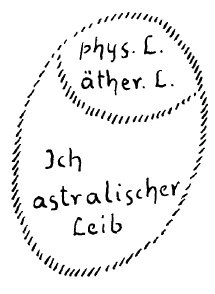
[ 26 ] So daß man wirklich sagen kann: Sehen wir uns den Kopf eines Menschen an, so ist das Hervorstechendste, das Wichtigste das, was herausgepreßt ist in den physischen Leib und in den Ätherleib. Sehen wir uns den übrigen Leib an, so ist das wichtigste das, was in ihm pulsiert und ihn erkraftet, das, was vom Ich kommt und vom astralischen Leib. Also, wenn Sie diesen Gegensatz nehmen, einerseits den Kopf und andererseits den übrigen Leib, so würden wir im Kopf hervorstechend haben: physischen Leib und AÄtherleib, und relativ selbständig, das durchflutend, astralischen Leib und Ich. Im übrigen Leib würden wir Ich und astralischen Leib haben, die geradezu in den physischen Vorgängen drinnen wirken; und das übrige liegt eigentlich als unsichtbares Gerüst, als physisches und ätherisches Gerüst, das gewöhnlich gar nicht beachtet wird, zugrunde. Es ist wirklich das Ich physisch in unserer Blutzirkulation.
[ 26 ] So one can truly say: When we look at a person’s head, the most striking and important feature is what is projected into the physical body and the etheric body. If we look at the rest of the body, the most important thing is what pulsates within it and gives it strength—that which comes from the “I” and the astral body. So, if you take this contrast—the head on the one hand and the rest of the body on the other—we would have, prominently in the head: the physical body and the etheric body, and, relatively independent and permeating them, the astral body and the “I.” In the rest of the body, we would have the “I” and the astral body, which are actively at work within the physical processes; and the rest actually lies at the foundation as an invisible framework—a physical and etheric framework—that is usually not noticed at all. The “I” is truly physically present in our blood circulation.
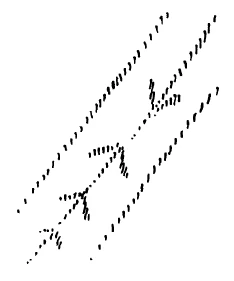
[ 27 ] Dasjenige nun, was wir gewissermaßen die moralisch-ätherische Aura nennen, wie wirkt denn die auf uns? Sie wirkt zunächst auf den ganzen Menschen. Aber sie wirkt auf das Ich, und das Ich wirkt eigentlich im ganzen übrigen Leib, sagen wir zum Beispiel im Blut. Nicht wahr, es ist ja das Ich das Hauptsächlichste im Blute. Die Moralität wirkt auf das Blut. Sie müssen nicht so sehr das physische Blut ins Auge fassen, das eigentlich nur da ist, ich möchte sagen, um die Stelle im Raum auszufüllen, wo die Ich-Kräfte wirken, sondern das Blut im Sinne dessen auffassen, was ich gesagt habe. Also die Moralität wirkt auf das Ich. Es begegnet sich gleichsam dasjenige, was in unserem Blute wirkt als Ich-Kräfte, mit den Kräften der Moralität. Wenn der Mensch hier in der physischen Welt steht, so ist es schon so: was in seinem Blute pulsiert, begegnet sich geistig mit den Kräften, die aus der moralischen Sphäre hereinspielen, und zwar so, daß der eigentlich moralische Impuls dasjenige, was gewissermaßen aufsteigt aus dem Blute, heraustreibt. Also stellen Sie sich vor, wir hätten hier einen Blutstrom, und da strömt das Ich und wirkt die Moralität (siehe Zeichnung $.69). Dann muß die Moralität entgegenwirken dem zunächst strömenden Ich, muß die Gegenkraft zu diesem strömenden Ich sein. Das ist auch der Fall. Wenn jemand unter einem starken moralischen Impuls steht, so ist eine unmittelbare Wirkung des moralischen Impulses auf das Blut vorhanden. Die geht voran selbst der Wahrnehmung des moralischen Vorganges, des moralischen Prozesses durch den Kopf. Daher hat Aristoteles, der diese Dinge immer noch genauer gesehen hat, nicht nur die physischen, sondern auch die moralischen Dinge, ein wunderbares Wort gesagt: daß die Moralität auf einer Fertigkeit beruht, das heißt entbunden ist in bezug auf ihre eigentliche Tätigkeit, entbunden ist dem intellektuellen Urteil.
[ 27 ] Now, what we might call the moral-etheric aura—how does it affect us? First of all, it affects the whole human being. But it affects the “I,” and the “I” actually acts throughout the rest of the body—in the blood, for example. Isn’t it true that the “I” is the most essential element in the blood? Morality acts upon the blood. You need not focus so much on the physical blood, which is really only there—I would say—to fill the space where the “I” forces are at work, but rather understand the blood in the sense of what I have said. So morality acts upon the “I.” What acts in our blood as “I”-forces, so to speak, encounters the forces of morality. When a human being stands here in the physical world, it is indeed the case that what pulses in their blood encounters, spiritually speaking, the forces that flow in from the moral sphere—and this occurs in such a way that the truly moral impulse drives out that which, so to speak, rises up from the blood. So imagine we have a stream of blood here, and within it the “I” flows and morality takes effect (see drawing $.69). Then morality must counteract the “I” that is initially flowing; it must be the counterforce to this flowing “I.” This is indeed the case. When someone is under a strong moral impulse, there is a direct effect of the moral impulse on the blood. This precedes even the perception of the moral event, the moral process taking place in the mind. That is why Aristotle, who saw these things—not only the physical but also the moral—with even greater precision, uttered a wonderful statement: that morality is based on a faculty, that is, it is independent in terms of its actual activity, independent of intellectual judgment.
[ 28 ] Der Kopf schaut zu, radikal gesprochen. Also wir haben, indem wir hier auf dem physischen Plan herumgehen, eine Wechselwirkung zwischen gewissen Kräften, die als Ich zugrunde liegen unserer Blutpulsation, und den moralischen Impulsen, die aus einer geistigen Welt in uns hereindringen. Diese Wechselwirkung beruht im wesentlichen darauf, daß wir mit unserem ganzen Leib im Wachbewußtsein sind; das gehört schon dazu, daß wir im Wachbewußtsein sind. Es muß das Ich wirklich pulsieren als bewußtes Ich im Blute. Sie werden vielleicht sagen das will ich gewissermaßen in Parenthese einschalten —: Ja, aber im Schlafe, da ist doch das Ich und der astralische Leib heraußen, die sind heraußen aus dem physischen Leib und Ätherleib. Wenn hier hauptsächlich das Ich und der astralische Leib wirksam sind, dann ist Ja nichts mehr drinnen von dem Ich und dem astralischen Leib im Schlafe. Aber die Formen und Bewegungen bleiben doch! — Gewiß ist das Wesentliche draußen, aber eigentlich — ich habe es öfters betont —: das Heraussein bezieht sich wesentlich auf den Kopfteil. Ich habe ausdrücklich gesagt, die Wechselwirkung zwischen dem Ich und dem astralischen Leib, wenn sie nicht auf den Kopf wirkt, ist um so intensiver in bezug auf den übrigen Organismus. Das ist oftmals hier gesagt worden. Beim übrigen Organismus ist das Ich und der astralische Leib nicht so getrennt.
[ 28 ] The head observes, to put it bluntly. So, as we go about our lives here on the physical plane, there is an interaction between certain forces—which, as the “I,” underlie the pulsation of our blood—and the moral impulses that flow into us from a spiritual world. This interaction essentially rests on the fact that we are in waking consciousness with our entire body; that is already part of being in waking consciousness. The “I” must truly pulsate as a conscious “I” in the blood. You might say—and I’d like to interject this, so to speak—: “Yes, but during sleep, the ‘I’ and the astral body are outside; they are outside the physical body and the etheric body.” If it is mainly the “I” and the astral body that are active here, then there is indeed nothing left of the “I” and the astral body inside during sleep. But the forms and movements remain, don’t they! — Certainly, the essential part is outside, but actually—as I have often emphasized—this “being outside” essentially refers to the head region. I have explicitly stated that the interaction between the “I” and the astral body, when it does not act upon the head, is all the more intense in relation to the rest of the organism. This has often been said here. In the rest of the organism, the “I” and the astral body are not so separated.
[ 29 ] Aber wenn nun auch die Moralität sich in unserer Blutsphäre mit den Ich-Kräften begegnet, so strömt sie doch so ein, daß sie durch den Kopf geht. Deshalb habe ich früher auch gesagt: Hier gehört der dazu, zum ganzen Leib dazu. Sie muß durch den Kopf gehen, sie darf nicht direkt in den Leib einströmen. Das heißt, der Mensch muß wach sein. Denn würde der Mensch schlafen und das Ich und der astralische Leib aus dem Kopf heraußen sein, so könnte die Moralität nicht durch das Geistige, sondern müßte durch das Physische und Ätherische, womit sie gar nichts zu tun hat, in den Kopf, in den physischen Leib einströmen. Das würde unmöglich sein.
[ 29 ] But even when morality encounters the “I” forces within our blood sphere, it still flows in in such a way that it passes through the head. That is why I have said before: It belongs here—it belongs to the whole body. It must pass through the head; it must not flow directly into the body. This means that the human being must be awake. For if the human being were asleep and the ego and the astral body were outside the head, morality could not flow through the spiritual realm but would have to flow through the physical and etheric realms—with which it has absolutely nothing to do—into the head and into the physical body. That would be impossible.
[ 30 ] Sie können sich von dem, was ich jetzt sage, wenn Sie ganz ehrlich sind gegen sich, durch etwas sehr Einfaches überzeugen. Fragen Sie sich einmal, ob Sie im Schlafe oder im Traum so durchaus moralisch sind — wenn die Moralität nicht eine Reminiszenz aus dem physischen Leben ist! Mit der Moralität im Traum, mit dem, was man Moralität nennt, steht es zuweilen recht schlimm, nicht wahr? Es kann ja etwas amoralisch sein, das heißt, daß der Maßstab des Moralischen gar nicht anwendbar ist, wie es bei der Pflanzenwelt der Fall ist. Aber der moralische Impuls als solcher kann nur für das Wachbewußtsein gelten. So sehen Sie, wie wir in der Moralität eine Wirkung unserer geistigen Umwelt haben unmittelbar auf diejenigen Kräfte, die in uns Ich-Strahlung sind.
[ 30 ] If you are completely honest with yourself, you can convince yourself of what I am about to say through something very simple. Just ask yourself whether you are quite so moral while asleep or in a dream—if morality is not simply a reminiscence of physical life! Morality in dreams—or what we call morality—is sometimes in a pretty bad state, isn’t it? It can, of course, be somewhat amoral—that is, the standard of morality may not apply at all, as is the case with the plant kingdom. But the moral impulse as such can only apply to waking consciousness. So you see how, in morality, we have an effect from our spiritual environment that acts directly upon those forces within us that constitute the “I-radiation.”
[ 31 ] Gehen wir jetzt zur Schönheit, zu dem, was ästhetisch wirkt. Wir wissen schon: es beruht auf einer Wechselwirkung des Kopfteiles und des übrigen Leibes. Es ist so, daß der Kopf träumt von dem übrigen Leib, und der übrige Leib träumt von dem Kopf. Untersucht man das, was zugrunde liegt, so findet man, daß alles Ästhetische auch aus gewissen Impulsen der geistigen Umwelt kommt, welche diese Wechselwirkung in uns anregt. Diejenigen, von welchen ich vorhin gesagt habe, daß sie das botokudische Element darstellen, die sind für diese Impulse wenig empfänglich; die lassen sich nicht anregen durch dasjenige, was im Innern diese Wechselwirkung hervorruft. Aber diese Impulse wirken nun nicht auf das Ich, sondern sie wirken unmittelbar auf den astralischen Leib, während die moralischen Impulse unmittelbar auf das Ich wirken. Und jenes Unbewußte, welches im Moralischen liegt, das den Charakter des unbewußten, halb unterbewußten Gewissens ausmacht, das beruht eben darauf, daß das Moralische durch den Kopf durchgeht, und — da das Ich nicht so intensiv mit dem Kopf verbunden ist — in das mehr Unterbewußte des Leibes eintritt, den ganzen Menschen ergreift. Dasjenige, was aus einer ästhetischen Sphäre kommt, wirkt nun unmittelbar auf den astralischen Leib. Und es wirkt so, daß eben jenes eigentümliche Spiel entsteht zwischen dem astralischen Leib, der intensiv verbunden ist mit aller Regsamkeit, sei es Nerven-, sei es Muskelregsamkeit des Leibes, und dem astralischen Leib, der weniger intensiv mit der Muskel- und Nervenregsamkeit des Kopfes verbunden ist. Der astralische Leib steht eben in einem andern Verhältnis zum Kopfe als zum übrigen Leib. Dadurch hat der Mensch diese zwei Astralitäten: eine gewissermaßen freiere Astralität im Kopfteil, und eine an die physischen Vorgänge gebundene Astralität im übrigen Leib. Und diese gebundene und freie Astralität, die spielen ineinander durch die ästhetischen Impulse. Das ist ein Durcheinanderwogen und Durcheinanderweben.
[ 31 ] Let us now turn to beauty, to that which has an aesthetic effect. We already know that it is based on an interaction between the head and the rest of the body. It is as if the head dreams of the rest of the body, and the rest of the body dreams of the head. If we examine what underlies this, we find that everything aesthetic also stems from certain impulses in the spiritual environment, which stimulate this interaction within us. Those whom I mentioned earlier as representing the Botokudian element are not very receptive to these impulses; they are not stirred by what internally evokes this interaction. But these impulses do not act upon the ego; rather, they act directly upon the astral body, whereas moral impulses act directly upon the ego. And that unconscious aspect which lies within the moral realm—which constitutes the character of the unconscious, semi-subconscious conscience—is based precisely on the fact that the moral passes through the head and—since the “I” is not so intensely connected to the head—enters the more subconscious realm of the body, taking hold of the whole human being. That which comes from the aesthetic sphere now acts directly upon the astral body. And it acts in such a way that precisely this peculiar interplay arises between the astral body—which is intensely connected to all activity, whether nervous or muscular activity of the body—and the astral body, which is less intensely connected to the muscular and nervous activity of the head. The astral body simply has a different relationship to the head than it does to the rest of the body. As a result, the human being possesses these two forms of astral nature: a somewhat freer astral nature in the head region, and an astral nature bound to physical processes in the rest of the body. And these bound and free forms of astral nature interact with one another through aesthetic impulses. It is a surging and interweaving of these forces.
[ 32 ] Und wenn wir ins Gebiet der Wahrheit kommen: Wahrheit ist auch etwas Übersinnliches, wirkt aber in den Kopf direkt hinein. Wahrheit als solche hat es unmittelbar mit den Tätigkeiten, mit den Prozessen des Kopfes zu tun. Aber das Eigentümliche alles dessen, was Wahrheit ist, das ist,daß es so wirkt auf den Menschen, und daher so erfaßt wird, daß es unmittelbar in den ätherischen Leib einströmt. Aus vielen Auseinandersetzungen, die gepflogen worden sind, können Sie das entnehmen. Indem die Wahrheit in Form der Gedanken im Menschen lebt, lebt sie im ätherischen Leib — das habe ich ja oft gesagt —, lebt mit den Gedanken im ätherischen Leib. Wahrheit erfaßt unmittelbar den Ätherteil des Kopfes und überträgt sich da natürlich als Wahrheit auf den physischen Teil des Kopfes.
[ 32 ] And when we come to the realm of truth: Truth is also something supernatural, but it acts directly upon the mind. Truth as such is directly connected to the activities and processes of the head. But the distinctive feature of everything that is truth is that it affects human beings—and is therefore perceived—in such a way that it flows directly into the etheric body. You can deduce this from many of the discussions that have taken place. Since truth lives within the human being in the form of thoughts, it lives in the etheric body—as I have often said—and lives there with the thoughts in the etheric body. Truth directly affects the etheric part of the head and is naturally transmitted from there as truth to the physical part of the head.
[ 33 ] Sehen Sie, so ist das Ergriffenwerden des Menschen von Wahrheit, Schönheit, Güte, von Erkenntnis, von Ästhetik, von Moralität. Erkenntnis, Wahrnehmung, Wahrheit erfaßt den Menschen so, daß die äußere Welt unmittelbar — durch das Ich und den astralischen Leib hindurchströmend, insofern die am Kopfteil teilnehmen — bis in den Ätherleib hinein von außen her wirkt. Da wird unmittelbar der Ätherleib ergriffen. Und weil der Mensch mit seinem Bewußtsein nicht so untertaucht in seinen Ätherleib, kommt ihm die Wahrheit als etwas Fertiges vor. Das ist gerade das Bestürzende, das Überraschende der Initiation, daß man beginnt, die Wahrheit, wie sie da hineinpulst in den Ätherleib, als etwas ebenso Freies zu empfinden, wie man sonst das Hereinpulsieren der Moralität empfindet oder der Schönheit in den astralischen Leib. Das ist dieses Bestürzende, Überraschende aus dem Grunde, weil es den Menschen, der irgendeine Initiation durchgemacht hat, in ein viel freieres Verhältnis zur Wahrheit bringt, und dadurch in ein viel verantwortungsvolleres Verhältnis zur Wahrheit. Tritt die Wahrheit ganz unbewußt in uns herein, dann ist sie fertig, und dann sagen wir einfach mit der gewöhnlichen Logik: das ist wahr, das ist unwahr. Dann hat man ein viel geringeres Verantwortlichkeitsgefühl gegenüber der Wahrheit, als wenn man weiß, daß die Wahrheit geradeso im Grunde abhängig ist von tiefliegenden Sympathie- und Antipathiegefühlen wie die Moralität und wie die Schönheit, so daß man ein gewisses freies Verhältnis zur Wahrheit hat.
[ 33 ] You see, this is how human beings are moved by truth, beauty, goodness, knowledge, aesthetics, and morality. Knowledge, perception, and truth affect a person in such a way that the external world acts directly from the outside—flowing through the “I” and the astral body, insofar as they participate in the head region—all the way into the etheric body. There, the etheric body is directly affected. And because a person does not immerse their consciousness so deeply into their etheric body, truth appears to them as something already complete. This is precisely what is so startling and surprising about initiation: that one begins to perceive truth—as it pulses into the etheric body—as something just as free as one otherwise perceives the pulsing of morality or beauty into the astral body. This is what is so startling and surprising, fundamentally because it brings a person who has undergone any kind of initiation into a much freer relationship with truth—and thereby into a much more responsible relationship with truth. If truth enters us entirely unconsciously, then it is a finished product, and we simply say, using ordinary logic: “This is true; this is false.” In that case, one has a much lesser sense of responsibility toward the truth than when one knows that the truth is, at its core, just as dependent on deep-seated feelings of sympathy and antipathy as morality and beauty are, so that one has a certain free relationship to the truth.
[ 34 ] Hier liegt wiederum ein Mysterium, und zwar jetzt ein bedeutsames subjektives Mysterium vor, das sich darin äußert, daß manche, die nicht in richtiger, würdiger Weise sich dem Erlebnis der Initiation nähern, an ihrem Wahrheitsgefühl nicht so gewinnen, daß sie ein größeres Verantwortlichkeitsgefühl entwickeln, sondern daß sie das Verantwortlichkeitsgefühl, das sie gegenüber der aufgezwungenen Wahrheit haben, verlieren und in ein gewisses unwahres Element hineinkommen. Oh, hier liegen sehr viele bedeutungsvolle Dinge in der menschlichen Entwickelung zur spirituellen Wahrheit, die dann in ihrer höchsten Läuterung Weisheit ist. Indem sie gewissermaßen durchströmt durch das Ich und den astralischen Leib, wirkt sie unmittelbar in das Ätherische, in den Ätherleib des Menschen. Das Schöne wirkt in den astralischen Leib des Menschen herein; das Ich durchdringt das Moralische; der moralische Impuls wirkt in das Ich herein. Das Wahre hat also nur noch, indem es aus dem Kosmos, aus dem Universum in uns einströmt, auf den physischen Leib zu wirken, hat sich nur noch im physischen Leib abzudrücken, das heißt im physischen Gehirn; es wird im Physischen Wahrnehmung. Das Schöne muß, indem es von außen, vom Universum in unser Astralisches einströmt, noch in den Ätherleib hineinwirken, und dann in den physischen Leib. Das Gute, der Impuls des Guten wirkt auf das Ich, und muß so stark auf das Ich wirken, daß das wieder weitervibriert in den astralischen Leib, Ätherleib und physischen Leib hinein, wo es dann erst wirksam werden kann in dem physischen Leib.
[ 34 ] Here, once again, lies a mystery, namely a significant subjective mystery, which manifests itself in the fact that some who do not approach the experience of initiation in a proper, dignified manner do not gain from their sense of truth in such a way that they develop a greater sense of responsibility; rather, they lose the sense of responsibility they have toward the truth that has been imposed upon them and slip into a certain element of untruth. Oh, there are so many significant aspects here in human development toward spiritual truth, which, in its highest purification, is wisdom. As it flows, so to speak, through the ego and the astral body, it acts directly upon the etheric, upon the human etheric body. Beauty acts upon the human astral body; the ego permeates the moral realm; the moral impulse acts upon the ego. Truth, therefore, having flowed into us from the cosmos, from the universe, has only to act upon the physical body; it must only be imprinted in the physical body—that is, in the physical brain; it becomes perception in the physical realm. Beauty, as it flows in from outside—from the universe—into our astral body, must still act upon the etheric body, and then upon the physical body. The Good—the impulse of the Good—acts upon the “I,” and must act so strongly upon the “I” that it in turn radiates further into the astral body, the etheric body, and the physical body, where it can then become effective in the physical body.
[ 35 ] So steht der Mensch zum Wahren, Schönen, Guten. Im Wahren öffnet er seinen Ätherleib, zunächst den Ätherteil des Kopfes, unmittelbar dem Kosmos. Im Schönen öffnet er seinen astralischen Leib unmittelbar dem Kosmos. In der Moralität öffnet er unmittelbar sein Ich dem Kosmos. Im Wahren — wir werden diese Dinge morgen weiter ausführen und dann auch die Gesetze des Lebens zwischen Geburt und Tod und auch zwischen dem Tod und einer neuen Geburt anführen —, im Wahren haben wir etwas, was am längsten schon vorbereitet ist für den Menschen. Im Schönen haben wir etwas, was verhältnismäßig kürzer vorbereitet ist; und im Moralischen haben wir etwas, was erst jetzt auf der Erde seinen Anfang nimmt. Was in der Wahrheit lebt, die sich zur Weisheit läutert, nimmt eigentlich schon während der Sonnenentwickelung seinen ersten Anfang, hat dann in einer gewissen Weise seinen Höhepunkt in der Mondenentwickelung, lebt sich weiter ein in der Erdenentwickelung, und wird im wesentlichen schon vollendet sein bei dem, was wir als die Jupiterentwickelung kennen. Da wird das menschliche Wesen mit Bezug auf den Inhalt der Weisheit einen gewissen vollen Abschluß erlangt haben. Schönheit — was eine sehr innerliche Sache für den Menschen ist — nimmt ihren Anfang während der Mondenentwickelung, setzt sich während der Erdenentwickelung fort, wird den Abschluß erlangen während der Venusentwickelung, was wir die Venusentwickelung nennen. Diese Dinge sind alle so, daß da, wo aus dem Okkulten heraus Namen gewählt werden, sie schon ihre gute Bedeutung haben. Ich nenne nicht umsonst diese Entwickelung «Venusentwickelung»; sie wird eben mit Bezug auf die maßgeblichen Prozesse schon so genannt.
[ 35 ] This is how human beings relate to the True, the Beautiful, and the Good. In the True, they open their etheric body—first the etheric part of the head—directly to the cosmos. In the Beautiful, they open their astral body directly to the cosmos. In morality, they open their “I” directly to the cosmos. In Truth—we will elaborate on these matters further tomorrow and then also discuss the laws of life between birth and death, as well as between death and a new birth—in Truth we have something that has long been prepared for human beings. In Beauty we have something that has been prepared for a relatively shorter time; and in Morality we have something that is only now beginning on Earth. That which lives in Truth—which is purified into wisdom—actually begins its first stages during the Solar Evolution, then reaches its peak in a certain sense during the Lunar Evolution, continues to unfold during the Earth Evolution, and will essentially already be completed by the time of what we know as the Jovian Evolution. By then, the human being will have attained a certain full completion with regard to the content of wisdom. Beauty—which is a very inner matter for human beings—begins during the Lunar evolution, continues during the Earth evolution, and will reach its completion during the Venus evolution, which we call the Venus evolution. These things are all such that, where names are chosen from the occult, they already have their proper meaning. It is not without reason that I call this evolution the “Venus evolution”; it is already called that in reference to the relevant processes.
[ 36 ] Von Moralität konnte man während der Mondenentwickelung noch nicht sprechen, denn da war der Mensch in bezug auf das, was er tat, noch in eine Notwendigkeit, fast in eine Naturnotwendigkeit eingeschalter. Moralität beginnt erst auf der Erde. Und die Vollendung wird sie erreichen in der Vulkanentwickelung, wenn alles das, was in den Feuerprozessen des Blutes pulsiert, geläutertes Ich sein wird, von der Moralität geläutertes Ich, von der Moralität ganz ergriffenes Ich: wenn Ich-Kräfte des Menschen und Moralkräfte eines und dasselbe sein werden, und sein Blut, das heißt seine Blutwärme - denn das Materielle ist ja nur das äußere Zeichen -, wenn seine Blutwärme das heilige Feuer des Vulkans sein wird. Über diese Dinge wollen wir morgen weitersprechen.
[ 36 ] During the lunar evolution, one could not yet speak of morality, for at that time human beings were still bound by necessity—almost a natural necessity—in regard to their actions. Morality begins only on Earth. And it will reach its fulfillment in the volcanic stage of development, when everything that pulsates in the fiery processes of the blood will be a purified “I”—an “I” purified by morality, an “I” completely embraced by morality: when the human “I” forces and the moral forces will be one and the same, and his blood—that is, his blood warmth (for the material is, after all, only the outward sign)—when his blood warmth will be the sacred fire of the volcano. We will continue discussing these matters tomorrow.