

How Individual Spirit Beings Work in the Human Soul
GA 178
19 November 1917, Dornach
Translated by Steiner Online Library
8. Individual Spiritual Beings and the Unified Foundation of the Universe II
[ 1 ] First of all, with regard to the reflections we are now engaging in—which I have linked to the dawning of a quest for knowledge using inadequate means of knowledge, yet which have led us to broad historical perspectives— please bear in mind, first of all, that both in these matters and in what I said during my previous visit here—which arose from the same intention and the same impulse—these are accounts of actual events, not some theory, not some systematic set of ideas, but accounts of facts. So this is precisely the point we must take into account, because otherwise understanding these matters may present difficulties for us. It is not a matter of my presenting historical laws or historical ideas to you, but rather facts connected with the intentions and purposes of certain individuals who are united in brotherhoods, as well as other beings who influence such brotherhoods—beings whose influence is also sought by these brotherhoods—but who, as they are, do not belong to human beings incarnated in the flesh, but are beings who incarnate in the spiritual world. This is particularly important to bear in mind in the case of a communication such as the one I gave yesterday. For with these brotherhoods, as you were already able to recognize from last year’s discussions, we are, so to speak, dealing with various factions. I pointed out to you at the time that within such brotherhoods we are dealing with one faction that, of its own accord, advocates absolute secrecy regarding certain higher truths; in addition, alongside other shades of opinion, we are dealing with members of such brotherhoods who, particularly since the mid-19th century, have advocated that certain truths—even if, for the time being, only those truths for which there is an immediate necessity to disclose them—be revealed to humanity cautiously and in an appropriate manner. In addition to these main factions, there are other nuances. From this, however, you can see that what is intended—what is being introduced into the development of humanity as an impulse, specifically from such brotherhoods—will very often be a matter of compromise.
[ 2 ] Now, just as the brotherhoods familiar with the spiritual impulses driving human evolution were approaching, they witnessed the significant event of the early 1840s: the struggle between certain spirits and higher spirits, which was then concluded in 1879 with the defeat of certain spirits of angelic nature, spirits of darkness, succumbed to the event symbolized by Michael’s victory over the dragon. So when, in the mid-19th century—in the early 1840s—these brotherhoods sensed that event approaching, they had to take a stand and ask themselves: What is to be done?
[ 3 ] Those members of these brotherhoods who, above all else, sought to respond to the demands of the times were, to a certain extent, motivated by the best of intentions, and it was they who were driven by the mistaken impulse to accommodate the materialism of the times; it was they who were primarily concerned with teaching people—who really only wanted to know something through physical means—something about the spiritual world in a materialistic way, precisely through these physical means. It was therefore well-intentioned when, in the 1840s, spiritualism was introduced into the world from this quarter.
[ 4 ] During this struggle—a time in which, as I have indicated, the critical spirit, the intellect directed solely toward the external world, was to prevail on Earth—it was necessary to instill in people at least a sense, a feeling, that there is a spiritual world surrounding them. And now, just as compromises come about, so too did this compromise come about. Those members of such brotherhoods who were thoroughly opposed to the disclosure of certain spiritual truths to humanity found themselves, I might say, outvoted and had to bring themselves to agree to the matter. It was not their own intention to bring these things—which were connected with spiritualism—into the world. Where organizations are involved and the will of the organizations prevails, one is dealing with compromises. But of course, as is the case in everyday life: when a decision is made in any organization, it is not only those who, out of their own intentions, brought the matter to the fore who expect something from the decision, but also those who were originally opposed to it expect one thing or another from it once it has been decided.
[ 5 ] Thus, well-meaning spiritual members of the brotherhoods held the mistaken view that by using the media, people would be convinced of the existence of a spiritual world around them; then, based on this conviction, they could be taught further, higher truths. That would have been possible if what these well-meaning members of the brotherhoods had assumed had come to pass: if what came to light through such mediums had been interpreted to mean that we are dealing with a spiritual world all around us. Something entirely different occurred—as I also hinted at yesterday. What came to light through the mediums was interpreted by the people participating as coming from the dead. Consequently, what came to light through spiritualism was actually a disappointment for everyone. For those who allowed themselves to be swayed were, of course, deeply saddened that in the spiritualist séances—sometimes rightly so—one could speak of manifestations of the spirits of the deceased. The well-meaning, progressive initiates did not expect at all that the dead would be spoken of, but rather that a general elemental world would be discussed; so they, too, were disappointed. Above all, however, such matters concern those who are initiated in a certain way. And now we have—in addition to the members of brotherhoods already mentioned—members of other brotherhoods, or in some cases of the same ones, within which minorities, and sometimes even majorities, may form; we must also take into account other initiates: those who are called within the brotherhoods “the Brothers of the Left,” that is, those who, above all, exploit everything that is incorporated as an impulse for human development in the sense of a power struggle. And of course, these Brothers of the Left, for their part, now also expected all manner of things from what came to light through Spiritism. I noted yesterday that it was above all these Brothers of the Left who conducted the séances with the souls of the dead. For them, what was most interesting was what would emerge from the Spiritist séances. They gradually took control of the entire field. The well-meaning initiates gradually lost all interest in spiritualism; they even felt, in a certain sense, ashamed, because those who had opposed spiritualism from the very beginning told them that it could have been known from the start that nothing of substance could come of spiritualism now. But this is precisely what brought spiritualism into the sphere of influence—I might say—of the brothers of the Left. Well, yesterday I spoke of such brothers on the Left who felt particularly disappointed because they saw that this now-staged spiritualism could reveal precisely what they had actually instigated, yet which they wanted above all else to keep hidden: it was precisely in spiritualist séances—because the participants believed themselves to be influenced by the dead—that, through communications from the dead, what certain brothers of the Left were doing with the souls of the deceased might be revealed. It was precisely those souls that were, in a sense, being misused by the brothers of the Left who were able to manifest themselves in the spiritualist séances.
[ 6 ] You really must take into account that these messages are not theories, but rather accounts of facts that can be traced back to individualities. And if these individualities are in turn united in brotherhoods, then one individuality may expect one thing from a given situation, while another may expect something else. When speaking of the realities of the spiritual world, it is simply not possible to look for anything other than an effect arising from the impulses of individualities. After all, what one person does and what another does are often contradictory in life as well. When speaking of theories, the law of non-contradiction must not be violated. But when speaking of facts—precisely because we are speaking of facts—it will very often become apparent that these facts in the spiritual world are just as inconsistent with one another as the actions of human beings here on the physical plane. So I ask you to always bear this in mind. After all, when speaking of these things, one cannot speak of realities unless one is speaking of individual facts. That is what this is all about. So the individual currents must be distinguished from one another, separated out.
[ 7 ] However, this is connected to a very significant matter that one must, above all else, bring to one’s consciousness if one wishes to arrive at a reasonably satisfactory worldview in the present. What I am about to say is a matter of fundamental principle and great significance, even though it is somewhat abstract; but we must take this fact to heart.
[ 8 ] When a person seeks to form a worldview, he rightly strives to ensure that the individual parts of that worldview are consistent with one another. They do this out of a certain habit—a habit that is as justified as can be, for it is connected to all that has been humanity’s most cherished spiritual and intellectual heritage throughout many centuries: monotheism. One wishes to trace back what one encounters in the world as experience to a unified foundation of the world. This has its good justification, but not in the sense in which people usually believe it to be justified, but in a completely different sense, which we will discuss next time. Today I would like only to bring the fundamentally important points to your attention.
[ 9 ] Anyone who approaches the world with the assumption that everything must be explainable without contradiction, as if it were derived from a unified divine source, will experience many disappointments—especially when he approaches the world and its experiences with an open mind. It has long been the case that people treat everything they perceive in the world according to a pastoral worldview: everything leads back to the unified divine source; since everything originates from God, it must therefore be explainable in a unified manner.
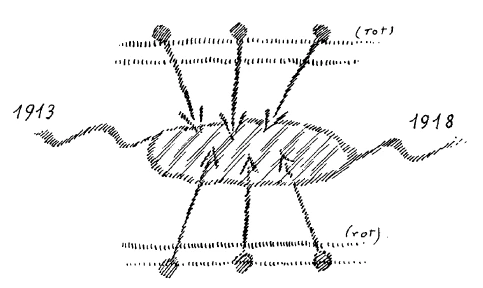
[ 10 ] But that is not the case. It is not so; the experiences that surround us in the world do not originate from a single, unified source, but rather from spiritual individualities that are distinct from one another. Various individualities work together to create what surrounds us in the world as experiences. That is how it is, for now. We will discuss other factors that justify monotheism next time. But that is how it is, to begin with. We must conceive of individualities that are, to a certain degree—indeed, to a high degree—independent of one another as soon as we cross the threshold of the spiritual world. But then one cannot demand that what occurs be explained on the basis of a single, unified principle. For consider, schematically represented (see diagram on p. 200), that this were some kind of experience—for the sake of argument, let these be the experiences, say, from the year 1913 to the year 1918. People’s experiences, of course, extend in both directions. Indeed, the historian will always be tempted to assume a unified principle underlying this entire course of events. But that is not the case; rather, as soon as one crosses the threshold into the spiritual world—which can be crossed both downward and upward (see diagram, red)—it is one and the same—various individualities, which are relatively independent of one another, interact within these events (see diagram, arrows). And if you do not take this into account, if you assume a uniform underlying principle of the world everywhere, you will never understand these events. Only when you consider, within what is, so to speak, the ebb and flow of events, the most diverse individualities working against or with one another, will you understand things correctly.
[ 11 ] This matter is, after all, connected to the deepest mysteries of human existence itself. And only the monotheistic sentiment has veiled this fact for centuries or millennia; but it must be taken into account. Therefore, if one wishes to make progress today in matters of worldview, one must above all avoid confusing logic with abstract consistency. Abstract consistency cannot exist in a world where independent individuals interact; therefore, whenever abstract consistency is sought, it will lead to an impoverishment of concepts; concepts will no longer be able to encompass the full reality. Concepts can encompass the full reality only if they are capable of embracing within themselves that contradictory world which is, in fact, reality.
[ 12 ] What humanity has before it as the natural world comes about in a very remarkable way. Various individualities are also at work in nature—in everything that humanity calls “nature” and encompasses, on the one hand, through the natural sciences, and on the other, through service to nature, the aesthetics of nature, and so on. But in humanity’s current cycle of development, a very beneficial arrangement for human beings has been established through the wise guidance of the worlds. Namely, human beings can comprehend nature using concepts that refer to a unified guidance, because only that aspect of nature which depends on this unified guidance reaches human beings as an experience through sensory perception. Behind the veil of nature lies something else, which is influenced from an entirely different direction. But this is filtered out when human beings perceive nature. Thus, what human beings call nature is a unified system, but only because it has been filtered. As we perceive through our senses, nature is, as it were, filtered for us. Everything contradictory within it is filtered out, and nature is thus presented to us as a unified system. But the moment one crosses the threshold and draws upon that which belongs to reality—the elemental spirits or the influences of human souls, which can also be directed toward nature— at that very moment one is no longer in a position to speak of a unified system even in nature; rather, one must then once again realize that one is dealing with the interplay of individualities that either conflict with one another or support and reinforce one another.
[ 13 ] In the elemental world, we find spirits of the earth, gnome-like beings; spirits of water, undine-like beings; spirits of air, sylph-like beings; spirits of fire, salamander-like beings. They are all there. Yes, it is not as though they all form a unified hierarchy. That is not the case. Rather, these different realms—gnomes, undines, sylphs, salamanders—are, in a certain sense, independent; they do not merely work in lockstep as part of a single system, but they also fight one another. Their intentions have nothing to do with one another from the outset; rather, what arises comes about through the most diverse interplay of these intentions. If one knows these intentions, then one can see in what appears before one that, for my sake, fire spirits and undines are working together. But one must never believe that behind them there is someone who gives them specific orders. That is not the case. This mindset is very widespread today, and philosophers such as Wand—of whom Fritz Mauthner not without reason said: “an authority by the grace of his publisher”—though he was, in fact, an authority to nearly the entire world before the war—seek to unify everything that lives within the human soul—the life of the imagination, the life of feeling, and the life of the will—into a single entity, because they say: The soul is a unity, so all of this must belong to a single unity, to a common system. — But that is precisely not the case, and those strong, significant discrepancies in human life—which analytical psychology specifically addresses—would not come to light if our life of imagination did not lead us beyond the threshold into entirely different realms, where different individualities influence our life of imagination, our emotional life, and, in turn, our life of the will.
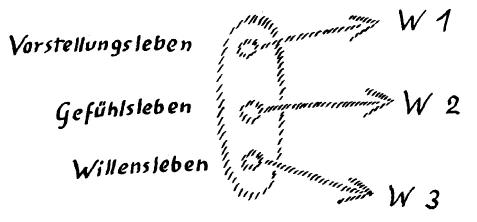
[ 14 ] It’s so strange! You see, if this is the human being (see drawing, oval) and we have within the human being a life of imagination, a life of feeling, and a life of will (three circles), then a systematic thinker like Wundt can imagine nothing other than that all of this is a system.
[ 15 ] However, it leads the life of the imagination into another world (W 1), it leads the life of feeling into another world (W 2), and, in turn, the life of the will into another world (W 3). This is precisely why the human soul exists: to form a unity out of that which is a trinity in the prehuman—that is, the currently prehuman—world.
[ 16 ] Well, all these factors must be taken into account as soon as the impulses that will eventually become part of humanity’s historical development come into play.
[ 17 ] In the course of these reflections, I have said that each period of the post-Atlantean era has its own specific task. I have generally characterized the task of the fifth post-Atlantean epoch by suggesting that one of humanity’s tasks during this epoch is to grapple with evil as an impulse in the development of the world. We have discussed what this means on various occasions. There is no other way but for the forces—which, when they arise in the wrong place, manifest as evil—to be conquered for humanity through human efforts during the fifth post-Atlantean epoch, so that humanity is able to use these forces of evil to bring about something beneficial for the future of the entire development of the world. This makes the task of this fifth post-Atlantean epoch a particularly difficult one. For, you see, a great number of temptations lie ahead for humanity. And as the forces of evil gradually emerge, human beings may well be much more inclined to surrender to this evil in all areas than to take up the struggle to place what appears to them as evil in the service of positive world development. And yet, this must happen; evil must, to a certain degree, be placed in the service of the positive development of the world. Without this, it would not be possible to enter the sixth post-Atlantean epoch, which will then have an entirely different task—namely, to allow humanity to live, even though it is still connected to the Earth, above all through a continuous perception of the spiritual world and through spiritual impulses. It is precisely in connection with this task of confronting evil in the fifth post-Atlantean epoch that a certain kind of personal darkening can occur for human beings.
[ 18 ] We now know that since the year 1879, the spirits of darkness closest to human beings—who belong to the realm of the Angeloi—have been walking among humanity itself, because they have been cast down from the spiritual world into the human realm and are now present within human impulses, working through them. I said that precisely because these beings, who are so close to human beings, work invisibly among them, and because human beings are prevented by the forces of evil at work within them from recognizing the spiritual through reason—for this, in turn, is the related task of the fifth post-Atlantean epoch— precisely this is what gives this fifth post-Atlantean epoch many opportunities to succumb to dark errors and the like. Human beings must, so to speak, bring themselves to grasp the spiritual through their reason in this fifth post-Atlantean epoch. It is already being revealed; because the spirits of darkness were defeated in 1879, spiritual wisdom will be able to flow down more and more from the spiritual worlds. Only if the spirits of darkness had remained above in the spiritual realms could they have been an obstacle to this flow. From now on, they cannot prevent the flow of spiritual wisdom; but they can still sow confusion and darken souls. And we have already described, in part, the opportunities they seize to bring about this darkening. We have also outlined the measures taken to prevent people from embracing the spiritual life.
[ 19 ] Of course, none of this should give rise to complaining or anything of the sort, but rather to a strengthening of the human soul’s power and energy toward the spiritual. For if, in this fifth post-Atlantean epoch, human beings achieve what can be achieved through the incorporation of the forces of evil in the good sense, then something immense will be achieved at the same time: this fifth post-Atlantean epoch will then contribute to the development of humanity with concepts of a greater magnitude than any other post-Atlantean epoch, indeed than any earlier epoch of Earth’s development. For example, Christ appeared in the fourth post-Atlantean epoch through the Mystery of Golgotha; it is only the fifth post-Atlantean epoch that can truly make him accessible to human reason. In the fourth post-Atlantean epoch, human beings were able to grasp that in the Christ impulse they have something that leads them beyond death as souls; this has indeed become sufficiently clear through Pauline Christianity. But something even more significant will occur for the development of the fifth post-Atlantean epoch, in which human souls will recognize that in Christ they have a helper to transform the forces of evil into good. But one thing is connected with this distinctive feature of the fifth post-Atlantean epoch—something that one should inscribe anew in one’s soul every day, something that one must not forget, even though human beings are particularly prone to forgetting this very thing: in this fifth post-Atlantean epoch, human beings must be fighters for the spiritual; he must experience that his powers will flag if he does not continually keep them in check for the conquest of the spiritual world. Human beings are entrusted with their freedom to the highest degree in this fifth post-Atlantean epoch! This is what they must go through. And, in a sense, everything that befalls human beings in this fifth post-Atlantean epoch must be measured against the idea of human freedom. For if human powers were to wane, everything could, in a sense, turn out for the worse. Human beings are not in a position to be guided like children in this fifth post-Atlantean epoch. If there are certain brotherhoods that, in a sense, hold up the ideal of guiding people like children—as they were still guided in the third and fourth post-Atlantean epochs—then these brotherhoods are not doing the right thing at all; they are not doing what is actually necessary for the development of humanity. To point people toward the spiritual world in such a way that acceptance or rejection of the spiritual world is left to their own free will—this is what anyone who speaks of this spiritual world in this fifth post-Atlantean epoch must keep bearing in mind time and again. Therefore, certain things can only be said in this fifth post-Atlantean epoch; but saying them is just as important now as anything else was important in other epochs. I will give you an example of this.
[ 20 ] In our time, the communication of truths—if I may put it simply—the presentation of truths, is the most important thing of all. People should orient themselves toward this out of their own free will. One should not actually go any further than the presentation, the communication of truths; the rest should follow from this through free decision—just as things follow that are taken as decisions arising from impulses of the physical plane. This also applies to those things that, in a sense, can only be self-directed and guided from the spiritual world.
[ 21 ] We will understand each other better in a moment if we go into details. Even in the fourth post-Atlantean epoch, factors other than the mere word, the mere message, were taken into account. What was taken into account? Well, let’s take a specific case: the island of Ireland, as we call it today, has very special characteristics. This island of Ireland differs from the rest of the Earth in certain respects. Every region of the Earth differs from the others in certain respects; so that is nothing unusual; I simply wish to emphasize today the relatively marked difference that exists when comparing Ireland with other regions of the Earth. In the evolution of the Earth, one can—as you have already seen in my *Outline of Esoteric Science*—trace back and identify various influences and events based on what can be gleaned as facts from the spiritual world. You know from *The Outline of Esoteric Science* how things stand when one goes back to what is called the Lemurian period, what has happened there since the Lemurian period, and how various things have developed. Yesterday I drew your attention to the fact that the entire Earth is actually to be regarded as an organism, that it radiates different influences from within itself to the inhabitants of different territories. This radiation has a very special influence on the double, which I drew your attention to at the end of yesterday’s lecture. In the case of Ireland, it is so that in earlier times, the people who knew Ireland expressed the very special character of Ireland in the form of fairy tales and legends. I would say that an esoteric legend was known to express the essence of Ireland within the Earth organism. It was said: Humanity was once driven out of Paradise because Lucifer had tempted humanity there; and humanity was then scattered throughout the rest of the world. But this “rest of the world” already existed at the time humanity was driven out of Paradise. Thus, a distinction is made—so it was said in this fairy-tale-like, legendary account— a distinction is made between Paradise—with Lucifer within it—and the rest of the Earth, into which humanity was cast out. But this is not the case with Ireland; it does not belong to the rest of the Earth in the same sense, because, before Lucifer entered Paradise, an image of Paradise had formed on Earth, and this image became Ireland.
[ 22 ] Understand this well: Ireland is thus that piece of earth that has no part in Lucifer, to which Lucifer has no connection. That which had to be separated from Paradise so that its earthly reflection might come into being—that would have prevented Lucifer from entering Paradise. Thus, according to this legend, Ireland was understood to have been, first and foremost, a separation of that part of Paradise which would have prevented Lucifer from entering Paradise. Only after Ireland had been separated from Paradise could Lucifer enter Paradise.
[ 23 ] This esoteric legend, which I have described to you in a very incomplete way, is something truly beautiful. For many people, it served as an explanation for Ireland’s very peculiar role throughout the centuries. In the first Mystery Play I wrote, you will already find what is so often recounted: how the Christianization of Europe originated with Irish monks. When Patrick had introduced Christianity to Ireland, the situation was such that Christianity there led to the highest piety. Reinterpreting the legend just discussed, one even called Ireland—which the Greeks had called “Ierne,” and the Romans “Ivernia”—in those times when the forces of European Christianity, in their very best impulses, emanated from Ireland, from Irish people lovingly initiated into Christianity—was called, because of the piety that reigned there in the Christian monasteries: the Island of the Saints. This is connected to the fact that, indeed, the forces I have spoken of—these territorial forces that rise from the earth and encompass the human double—are the very best for the island of Ireland.
[ 24 ] You might say: then Ireland must be home to the very best people. Yes, but that’s not how the world works. People from different places migrate into every region, have children, and so on. So, it is simply not the case that a person is merely the product of the piece of earth on which they stand. It is quite possible for people’s character to contradict what arises from the earth. One must not cite what truly develops within people as a characteristic of the earth organism with reference to a specific territory. To do so would simply be to abandon oneself once again to the world of illusions.
[ 25 ] But something like what I have just hinted at—that Ireland is a very special place—is something we can say today. And such a statement should give rise to one factor among the many factors that can fruitfully lead to social-political ideas today. One would have to take such factors into account. What I have just said about Ireland is one such factor; we must take such factors into account. We must bring all of this together. This must be the science of shaping human relationships on Earth. Until that happens, there will be no true salvation with regard to the organization of public affairs. What can be said from the spiritual world must be incorporated into the measures we take. That is why I have now said in public lectures that it is important for everyone involved in public affairs—statesmen and so on—to familiarize themselves with this; for only in this way would they master reality. They simply do not do it; above all, they have not done it until now. But it is nonetheless a necessity.
[ 26 ] Today, in accordance with the tasks of the fifth post-Atlantean epoch, what matters is speaking, is communicating; for before what is said is to be put into action, decisions must be made in the same way as they are made based on the impulse of the physical plane. That was different in earlier times; back then, one could still do other things.
[ 27 ] At a certain point in the third post-Atlantean epoch, a certain brotherhood undertook to send a large number of colonists from Asia Minor to the island of Ireland. At that time, colonists from the same region of Asia—from which the philosopher Thales later hailed—were settled there. Read more about the philosophy of Thales in my book *The Riddles of Philosophy*. Thales came from the same region, albeit later; after all, he was not born until the fourth post-Atlantean epoch. But even earlier, drawing from that milieu, from the entire spiritual substance from which the philosopher Thales later emerged, the initiates had sent colonists to Ireland. Why? Because they understood the unique nature of a region of the Earth such as Ireland. They knew what was hinted at by the esoteric legend I have spoken to you about. They knew that the forces rising from the earth through the soil of the Irish island affect people in such a way that they are influenced only slightly in the direction of intellectuality, only slightly in the direction of egoism, and only slightly in the direction of decisiveness. The initiates who sent those colonists there knew this very well, and they selected people who, due to their particular karmic predispositions, seemed suited to be exposed precisely to the influences of the island of Ireland. Even today, there are still descendants in Ireland of that ancient population that was transplanted there from Asia Minor at that time, and who were to develop in such a way that not the slightest intellectuality, not the slightest intelligence, not the slightest decisiveness would develop, but rather certain special qualities of the soul would develop prominently.
[ 28 ] This laid the groundwork long in advance for what later took place as the peaceful spread of Christianity in Ireland and for that glorious development of Christianity in Ireland, from which the Christianization of Europe then radiated. This had been prepared long in advance. The compatriots of the future Thales sent people there who then proved suitable to become monks capable of working in the manner I have indicated. Many such things were done in earlier times, and when you read in the outer, exoteric history today—written by uninformed historians (who may, of course, possess great intellect, for intellect is, after all, to be found on every street corner today)—when you read accounts by such historians of the colonizations carried out by the ancients, you must always be clear about this: there was a profound wisdom underlying such colonizations; they were guided and directed by taking into account everywhere what was to take place in the future, by factoring in the peculiarities of Earth’s development at that time.
[ 29 ] That was a different way of bringing spiritual wisdom into the world. Today, someone who walks the right path should not do this in that way; he should not simply dictate to people against their will how to organize the world, but rather he must act in such a way that he tells people the truths, and they should guide themselves accordingly.
[ 30 ] You can thus see, as indicated here, a significant progression from the third and fourth to the fifth post-Atlantean epoch. One must take such a matter very seriously. And one must recognize how this impulse of freedom must run through everything that characterizes the fifth post-Atlantean epoch. For it is precisely against this freedom of the human soul that the adversary—of whom I have told you that he accompanies the human being like a double from some time before birth until death, but must leave the human being at death, or rather before death—rebels. When one is under this influence, which works in direct connection with the double, all sorts of things emerge that can indeed come to light in this fifth post-Atlantean epoch, but are not sufficiently suited to this epoch to enable it to fulfill its task in such a way that, in the struggle against evil, the transformation of evil into good is accomplished to a certain degree.
[ 31 ] Consider, then, what actually lies behind all the circumstances in which human beings of the fifth post-Atlantean epoch find themselves. The individual facts must be examined in the proper light; they must be understood. For wherever the “double” I spoke of yesterday is strongly at work, there one is also working against the actual tendency of the fifth post-Atlantean epoch. It is only in this fifth post-Atlantean epoch that humanity is not yet ready to assess the facts correctly; especially since these last three sad years, humanity has been entirely incapable of assessing the facts in any way that is correct.
[ 32 ] But let’s take a “fact” that seems very far removed from what I have discussed today. The fact I want to present to you is this: At a large ironworks, tens of thousands of metric tons of cast iron were to be loaded onto railroad cars. Naturally, a certain number of workers were hired for this purpose. Seventy-five men were to be put to work, and it turned out that each one could load twelve and a half metric tons per day; that is, seventy-five men loading twelve and a half metric tons each per day.
[ 33 ] Taylor is a man who placed more importance on the doppelgänger than on what, in the interest of human progress, must be achieved for the human mind in the fifth post-Atlantean epoch. This man first asked the factory owners whether they did not believe that a single man could load much more than twelve and a half metric tons a day. The factory owners said that a worker could load at most eighteen metric tons. Then Taylor said: “Then let’s conduct experiments; let’s try it out.”
[ 34 ] Taylor set out to experiment on people. This transfers the mechanical aspect into human social life. The plan was to experiment on people! He tested whether it was really true, as the most practical factory owners claimed, that a man could load no more than eighteen metric tons a day. He scheduled breaks, which he calculated based on physiology so that during these breaks, people would regain exactly as much strength as they had expended beforehand. Of course, it turned out that under certain circumstances, this was true for some and not for others. So he took—you know, in a machine, that doesn’t matter; there you take the arithmetic mean, but with people you can’t take the arithmetic mean because every person has a right to exist—but Taylor took arithmetic means; that is, he selected those workers who, taken as a group, yielded rational breaks, and he allowed them those rational breaks. The others, who could not regain their strength during these breaks, were simply dismissed. It then turned out, when experimenting with people in this way, that the selected ones—those chosen through selection—could each load forty-seven and a half metric tons if they fully recovered during the breaks.
[ 35 ] They applied the mechanism of Darwin’s theory to the lives of the workers: the unfit were weeded out, and the fit were selected through natural selection. The fit are those who, by making appropriate use of their breaks, can load not, as was previously assumed, a maximum of eighteen metric tons, but forty-seven and a half metric tons. This also satisfies the workers, however, because it results in enormous savings, allowing their wages to be increased by sixty percent. Thus, the chosen ones—those best suited to the struggle for existence, selected in this way—are also made very satisfied people. But—let the unfit starve!
[ 36 ] This is the beginning of a principle! People pay little attention to such things because they do not examine them from a broader perspective. But they must be examined from a broader perspective. Today, it is still merely a matter of applying erroneous scientific concepts to human life. The impulse remains. And then this impulse will be applied to those things that will emerge as occult truths in the course of the fifth post-Atlantean epoch. Darwinism contains no occult truths; yet its application would already lead to great atrocities: the application of the Darwinian view to direct experimentation on human beings. But if occult truths do indeed emerge in this context—as they must be revealed in the course of the fifth post-Atlantean epoch—then one would gain immense power over human beings in this way, albeit only by always selecting the fittest. But one would not only select the most suitable; rather, by striving toward a certain occult invention to make the suitable ones ever more suitable—this would lead to a monstrous abuse of power that would have an effect directly opposed to the positive trend of the fifth post-Atlantean epoch.
[ 37 ] I wanted to mention such connections, as I have just presented them to you, only to show you what the beginnings of far-reaching intentions look like and how these things must be examined from certain higher perspectives. Our next task will be to point out, in our next session, the three or four great truths that the fifth post-Atlantean epoch must arrive at. We will demonstrate how these truths can be misused if they are not applied in accordance with the proper, positive trend of the fifth post-Atlantean epoch, but rather if the conditions of the Doppelgänger—as advocated by those brotherhoods that wish to replace Christ with another being—are prioritized.