

Correspondences Between the Microcosm and the Macrocosm
Man — A Hieroglyph of the Universe
GA 201
23 April 1920, Dornach
Translated by Steiner Online Library
Seventh Lecture
[ 1 ] The previous reflections here were devoted to a path that, when followed appropriately, leads to gaining an understanding of our universe and its organization. You have seen that this path requires us to continually seek harmony between what takes place within human beings themselves and what takes place in the vast universe. I will have to structure the following reflections tomorrow and the day after tomorrow in such a way that our friends who have come from out of town for the General Assembly will also be able to grasp some of these things. Therefore, tomorrow I will have to briefly repeat some of what has been said—the essentials—in order to then build on them. Today, however, I would like to insert into the course of our reflections something that may be particularly suitable for pointing more specifically toward the true path to understanding the universe.
[ 2 ] If you go through my *Secret Science*, you will see that in this sketchy account of the evolution of the universe as we know it—as presented in *Secret Science*—the connection to human beings is emphasized throughout. If you start with the Saturn evolution and then proceed through the Sun and Moon evolutions to our Earth evolution, you know that this Saturn evolution is characterized—or rather, co-characterized—by the fact that it laid the first foundation for human sensibility. And so it continues. Throughout this process, the states of the universe are traced in such a way that the development of the human being is simultaneously revealed. Thus, human beings are not conceived of as standing apart in the universe, as is the case in modern natural science, where the universe is viewed on one side and human beings on the other—as two entities that do not truly belong together—but rather both are conceived of as intertwined, and their development is traced in tandem. This must also be taken fully into account when speaking of what currently constitute the properties, forces, movements, and so on of the universe. One cannot, on the one hand, view the universe in a purely spatial and abstract sense—in the Copernican-Galilean sense—and then, as it were, consider humanity separately; rather, one must allow both to flow into one another during the examination.
[ 3 ] But this is only possible once one has first gained a proper understanding of human beings themselves. I have already pointed out to you how little the current scientific worldview is actually suited to providing insights into human beings themselves. What, in fact, does this natural science do precisely in the area where it is at its greatest, based on its current premises? Just consider it. It magnificently illustrates how human beings have gradually developed physically from other forms. It traces how, during the embryonic period, these forms are then passed through once more, as in a brief recapitulation. In other words, it regards human beings as the highest of the animals. It examines the animal realm, and then constructs human beings from everything it has found in that realm. In other words, it examines everything non-human in order to then, so to speak, say: “Here is the final point; this is where the non-human ends, and this is where humanity begins.” — It does not consider the human being as such. This is precisely what modern natural science is entirely unwilling to do—to consider the human being as such—and therefore it gains no insight whatsoever into human reality.
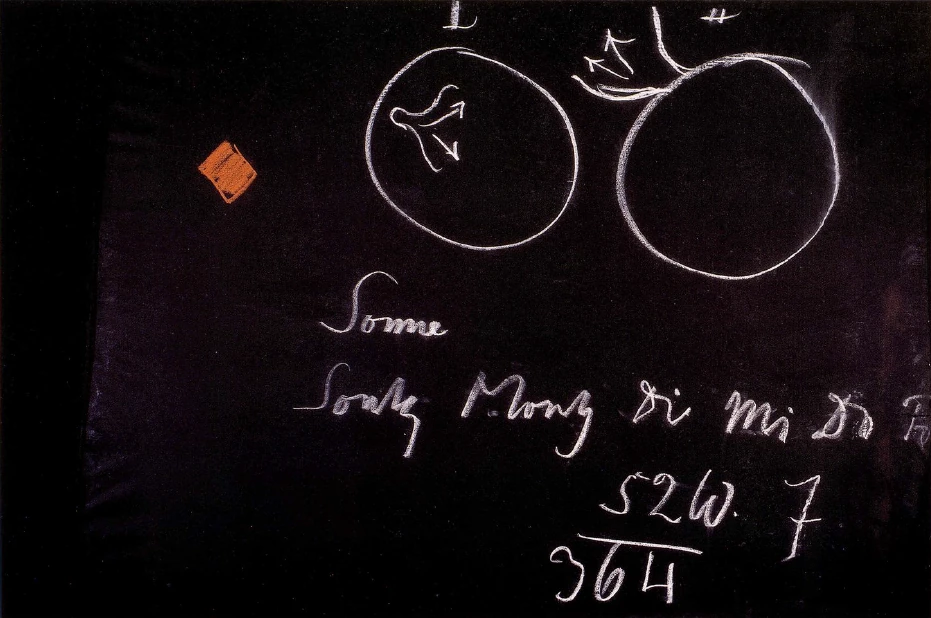
[ 4 ] You see, I would like to start here with something I discussed yesterday in a completely different place and context, before a different audience, but which can also serve to clarify our current discussion. It would really be very necessary today for people who wish to be experts in this field to turn, at least to some extent, to Goethe’s scientific approach—in particular, to his theory of colors. This theory of colors actually employs a method of scientific inquiry quite different from what we are accustomed to today. Right from the start, it discusses so-called subjective colors and physiological colors, and it examines very carefully how the human eye—as a living entity—experiences its surroundings, how these experiences do not simply last as long as the eye is exposed to the external world, but rather how an aftereffect persists. You are all familiar with the simplest phenomenon in this area: You look at a limited area—let’s say, for example, a red surface (Plate 13, left rhombus, peach blossom)—then quickly turn your gaze away and look at a white surface: You see the red as a green afterimage. This means that, in a certain sense, the eye is still under the impression of what it has experienced. Now, we do not wish to investigate the reasons why a green afterimage appears in particular; rather, we simply want to note the more general fact that the eye allows the experience to linger afterward.
[ 5 ] Here we are dealing with an experience at the periphery of our human body. The eye is located at the periphery of the human body. When we look at the experience of the eye, we find that for a certain limited time, the eye allows this experience to fade away. Then the experience has completely faded. Then the eye, uninfluenced by what it has experienced, can turn to other experiences. Let us first consider, purely intuitively, a phenomenon that is not bound to a single localized organ of our organism, but rather to the whole human being; and if we engage in unbiased observation, we will not fail to recognize how, even before this observation, this experience is related to the experience of the localized eye. You expose yourself to a phenomenon, to an experience; you expose yourself as a whole person to this experience. By exposing yourself as a whole person to this experience, you take it in, just as the eye takes in the experience of color to which it is exposed. And now you can experience that even months or years later, the aftereffect, the afterimage, emerges from within you in the form of a memory image. The entire phenomenon is somewhat different, but you will not fail to recognize the similarity between the memory image and the afterimage of the experience that the eye has for a brief, limited time.
[ 6 ] Thus, questions are presented to people in a correct manner, and people can only learn about the world by learning to ask questions in the right way. Let us ask ourselves: How are these two phenomena connected—the afterimage of the eye and the memory of a specific experience that arises within us—let us leave its origin entirely undefined?—You see, when one raises such questions and seeks an appropriate answer, the entire method of contemporary scientific inquiry immediately fails. It fails for the reason that this approach does not know one thing: it does not know the universal significance of metamorphosis. Contemporary natural science does not know the full universal significance of metamorphosis. This metamorphosis is something that is not completed in a single human life, but is only brought to completion in successive earthly lives.
[ 7 ] As you know, in order to gain an understanding of the whole human being—if we set aside the threefold nature and focus only on two aspects, combining the second and third—we first distinguish between the human head organization and the rest of the human being. If we want to study the human head organization, we must be able to understand how this head organization is connected to the entire development of the human being. It is a later metamorphosis; it is the transformation of the rest of the human being with regard to its powers. What you are—when you think of yourself as headless, naturally including everything that belongs from the head into the rest of the organism and actually belongs to the head—what you are in the rest of the human being, you naturally conceive of as substantial at first. But this substantial aspect is not what matters; rather, the interplay of forces within this substance undergoes a metamorphosis in the cosmos between death and a new birth, and becomes the head organization in the next earthly life. This means that what you now carry within the part of your being outside the head is an earlier metamorphosis of the later head organization. But if you want to understand how this metamorphosis works, then you must consider the following:
[ 8 ] Take any organ—the liver or a kidney—from the rest of your human body and compare it with the organization of your head; you will find a significant, fundamental difference. Namely, you will find that the entire activity of the organs in the part of your body outside the head is directed inward. If, for example, you take the kidney, its entire activity is directed toward the interior of the body cavity. That is where the activity of the renal system is directed. And this activity is even geared toward excretion. If you compare this organ with any organ that is characteristic of the head, you can take the eye, for instance. It is constructed exactly the opposite way; it is directed entirely outward. And whatever interaction it has with the outside world, it transmits inward to the human being—to understanding, to the mind. In one organ of the head, you have the complete polar opposite of an organ of the rest of the human body. The rest of the human body has its organs directed entirely toward the interior of the organism’s structure. The head has its essential organs open to the outside. Therefore, I can sketch the following schematically (Plate 13, top):
[ 9 ] Let us assume that this is one metamorphosis and that is the other metamorphosis under consideration here; then you must imagine it this way: first life, second life; in between lies the life between death and a new birth. We have an internal organ. This internal organ opens inward. As the metamorphosis takes effect between death and a new birth, the entire orientation—and everything connected to this organ—is reversed. The organ then opens outward. It is, in other words, as if that which carries out its activity inwardly in this life were to carry it out outwardly in the next incarnation. So you must imagine that something has taken place between the two incarnations that can only be compared to this: imagine you have a glove here, which you put on; and now you take it and turn it inside out, so that what was against the hand comes to the outside, and what was previously on the outside, facing the air, comes to the inside. So the metamorphosis did not merely take place in such a way that the other organs were simply transformed; no, they were also turned inside out. What was inside—what was turned inward—has become the outside, the part turned outward. So we can say: The organs—I will now speak of the body and the head as opposites—the organs of the body undergo metamorphosis by turning inside out. So our eyes would have been something in our abdomen in our previous incarnation, if I may use that expression. That has turned itself inside out in its powers and has now become eyes, and they have acquired the ability to produce afterimages. This ability to produce afterimages of the external world must also come from somewhere. Where does this ability to produce afterimages come from?
[ 10 ] Well, let’s take a look at the eyes, at the function of the eye’s vital activity—let’s examine this completely objectively. Afterimages merely prove to us that the eye is a living thing; afterimages merely prove to us that the eye retains the activity for a short while. Why does the eye retain the activity for a moment? Let’s start with something simpler. Suppose you touch silk. When I touch silk, a residual sensation of its smoothness remains in my sensory organ. When I touch the silk again, I recognize it by the effect it has produced within me. It is the same with the eye. The afterimage has something to do with recognition. The inner vitality that comes into play so that the afterimage arises has something to do with recognition. But out there, when it comes to recognition, things remain where they are. They remain outside. If I see one of you now and meet you again tomorrow and recognize you, there you stand in the flesh.
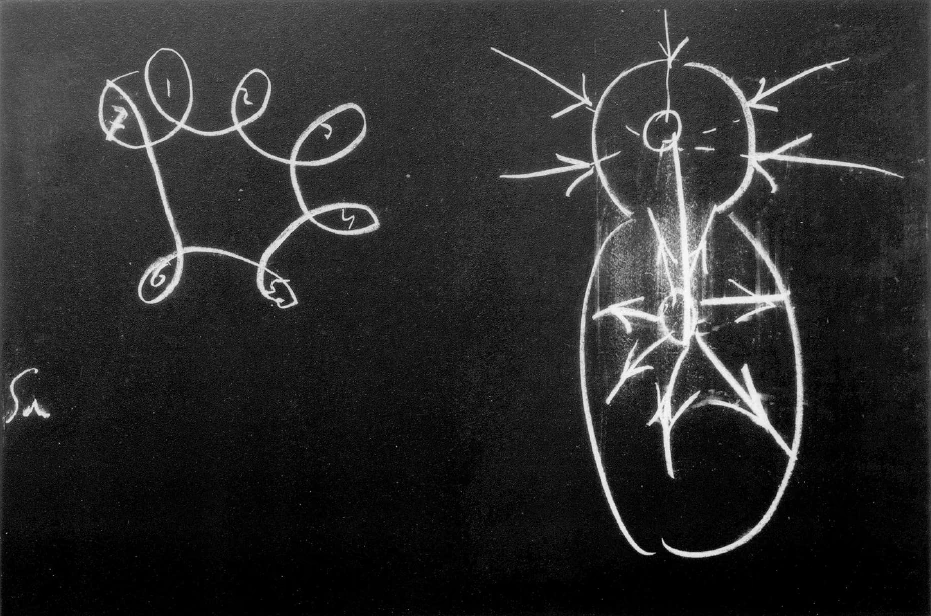
[ 11 ] Let us now compare this with the process through which the eye developed as a metamorphosis in terms of its function. Let us look at the organ within our inner organism from which the eye developed. What appears as the ability to form afterimages—the liveliness of the eye—must be present there in a certain way, though it must be turned inward. This must also have something to do with recognition. But to recognize an experience means to remember it. So if you seek the original metamorphosis for the activity of the eye in a previous life, you must inquire into the activity of the organ that works for memory. Of course, these things cannot be explained as conveniently and simply as people like to have them today; but they can be hinted at along this path. And if you follow this path, you will find: all our sense organs, which are directed outward, have their counterparts in our internal organs. And these internal organs are, at the same time, the organs of memory. With the eye, you see what recurs in external life; with that part of your body cavity corresponding to the eye’s earlier metamorphosis, you recall the images conveyed to you by the eye. With the ear, you hear sounds; with that part of your abdominal cavity that corresponds to the ear, you recall the sounds. And so the whole human being, by opening its organs inward, becomes an organ of memory. The whole human being is an organ of memory. And we face external life; we take in this external life. Materialistic natural science says, for example, that we take in visual images; their effects are transmitted to the optic nerve. But that is all. The rest of the organism is, for the process of cognition, the fifth wheel on the wagon. But that is not true. What we perceive passes into the rest of the organism, and the nerves have absolutely nothing to do with memory directly; rather, it is the other organs—the organs that open their activity inward—that are involved. The whole human being is an instrument of memory, merely specialized according to the various organs. Materialism faces the terrible tragedy—as I have already pointed out—that it is precisely unable to recognize the material, for it remains stuck in abstractions. And materialism becomes ever more abstract—that is, more filtered, more spiritual—and it cannot penetrate the essence of material phenomena. It fails to grasp the spiritual nature of material phenomena. For example, it fails to grasp that our inner bodily organs have far more to do with our memory than the brain, which merely prepares the mental images so that they can be received by the other bodily organs. In this respect, our science—what is it, really?—is continued asceticism, continued one-sided asceticism. What does this one-sided asceticism consist of? It consists in not wanting to comprehend the material world in its spirituality, but rather in wanting to despise it, to overcome it, and to have nothing to do with it. Our science has already learned from asceticism that it no longer comprehends anything at all about the world; that it imagines the eyes and the other sense organs take in perceptions, transmit them to the nervous system, and then to something that is left undefined. No, then this passes into the rest of the organism. There, memories arise first through the reverberation of the organs.
[ 12 ] People were well aware of this in times when a false asceticism had not yet imposed itself on their views of humanity. That is why the ancients, when they spoke of “hypochondria,” for example, did not speak of it as modern people—or even psychoanalysts—often do, as if hypochondria were merely a psychological condition rooted in the soul. No, hypochondria literally means “abdominal cartilaginousness.” The ancients knew quite well that what constitutes hypochondria has its root in a stiffening, a hardening of the abdominal system. And the English language—which is still at a stage that represents a less advanced level compared to the other European languages—still retains within itself a memory of this harmony between the material and the spiritual. I’ll mention just one example. In English, something emotional is called “spleen,” but it’s not merely emotional. The spleen is also called “spleen.” And “spleen” has a great deal to do with the spleen itself. For this is not something that can be explained solely in terms of the nervous system, but rather in terms of the spleen. And so many more examples could be found. The genius of language has indeed preserved a great deal, and even if the words have been somewhat adapted for psychological use, they still point to what has functioned well as a primordial insight of humanity.
[ 13 ] So you look at the world, perceive it as a whole person, and as you perceive it as a whole person, it affects your organs. These organs adapt to the experiences and the nature of those experiences. In the clinic, when you’re studying anatomy, a liver is a liver; the liver of a fifty-year-old, the liver of a twenty-five-year-old, the liver of a musician—it’s all a liver; the liver of someone who understands as much about music as an ox on Sunday after eating nothing but grass all week—that’s also a liver. But the significant point is that there is a crucial difference between the liver of a musician and that of a non-musician, because the liver has a great, great deal to do with what resonates within a person from musical experiences. Yes, it does no good to regard the liver as an insignificant organ out of ascetic conviction. This liver, which appears to be such a minor organ, is the seat of everything that lives in the beautiful sequence of melodies, and the liver has a great deal to do with listening to a symphony. Of course, one must be clear that this liver also has an etheric organ and that this is primarily what it has to do with. But the outer physical liver is, so to speak, the exudate of the etheric liver and is shaped just as this etheric liver is shaped. Yes, this is where you prepare your organs, and if you were now entirely left to your own devices—and to the extent that you are left to your own devices—your sensory apparatus in the next incarnation would be an exact reflection of your experiences in relation to the environment. It is so in a certain sense, but not exclusively, for in the life between death and rebirth, beings from the higher hierarchies come to our aid, ensuring that not all the mistreatment we inflict upon our organs must necessarily be borne by us as a matter of fate. We are helped between death and rebirth. With regard to this part of our organization, we are not left to our own devices.
[ 14 ] But you can see from this that such a connection exists between the rest of the human being and his organs and the structure of his head. The body becomes the head, and with death we lose the head in terms of its development of powers. That is why it is essentially bony in form and persists longer than the rest of the organism here on Earth. This is merely the outward sign that we lose it for our next incarnation, for everything we must go through between death and a new birth.
[ 15 ] These things were intuitively sensed by ancient, atavistic wisdom, and they were also sensed when people sought that great connection between human beings and the macrocosm, which found expression in the ancient descriptions of the movements of the heavens. The genius of language has also preserved much in this regard. You see, human beings—as I explained to you last time—internally follow the daily cycle. You expect to have breakfast every day, not just on Sunday. You expect to have lunch and dinner every day, not just breakfast on Sunday, lunch on Wednesday, and dinner on Saturday; you don’t do that. With regard to what constitutes metabolism in relation to the outside world, you are subject to the daily cycle. Human beings participate in this cycle internally. This inner daily cycle corresponds in human beings to the Earth’s daily rotation on its axis. Such things were vividly felt in ancient wisdom. Back then, people knew they were not separate from the Earth; they participated in what the Earth does. And they also knew how to point to what they were participating in. Anyone with an appreciation for ancient works of art—even though the surviving artworks offer us very few opportunities to observe these things for ourselves—can still sense, even from these ancient works, the vivid perception the ancients had of the connection between the microcosm (the human being) and the macrocosm, as revealed in the positioning of certain figures, the initial movements of certain figures, and so on; in which cosmic movements are mostly imitated. But there is even more to it than that.
[ 16 ] You see, among all or most peoples, the day is contrasted with the week. On the one hand, if I may put it that way, there is the cycle of metabolism, which is expressed in the fact that you must eat at the same mealtimes every day. But human beings have never been the kind to organize their lives solely according to this metabolic cycle. They have added the weekly cycle to the daily cycle. First, they distinguished between the sun’s rising and setting, corresponding to the daily cycle; but they added: Sunday, Monday, Tuesday, Wednesday, Thursday, Friday, Saturday—a period seven times as long. Then they returned once more to Sunday. In a sense, we return again after seven cycles (Plate 14, left). This is sensed in the contrast between the day and the week. But with this contrast between the day and the week, human beings wanted to express much more. They wanted to express that the daily cycle is connected to the sun, to the sun’s course. We call it “apparent” today; that is of no concern to us at the moment.
[ 17 ] Now we have a period seven times as long, which in turn returns to the Sun, but which encompasses all the planets: the Sun, the Moon, Mars, Mercury, Jupiter, Venus, and Saturn. The weekly cycle encompasses all the planets. This is meant to convey: We have a cycle corresponding to the day, and another cycle corresponding to a period seven times as long, which encompasses the planets. The point being made is this: It is not merely that the Earth rotates on its axis, or that the Sun moves in its orbit, but that the entire system also has an internal motion. This motion can be observed in many other ways as well. Take, for example, the annual cycle: as you know, there are 52 weeks in a year. This is approximately one-seventh of the number of days in the annual cycle. In other words, when considering the weeks from the beginning to the end of the year, one must conclude that the events of the weeks occur at a different pace than those of the daily cycle.
[ 18 ] Where, then, did this feeling come from—the feeling of sometimes basing calculations on a daily cycle and other times on a weekly cycle? Where did this feeling come from? It stemmed from the perception of the contrast between the development of the human head and the development of the rest of the human being. The development of the human head—we see it represented in something I have already drawn your attention to—we see it represented in what takes shape in the head over the course of roughly one year: in tooth formation, the first tooth formation, the formation of the baby teeth.
[ 19 ] If you consider the process of tooth replacement, it occurs after a period seven times as long, around the age of 7. One could say: just as the individual annual cycle relates to tooth formation in the same way that the cycle of human development—which continues until the change of teeth—relates to it, so does the day relate to the week. This was intuitively understood. And it was understood because people correctly perceived the other aspect: tooth formation, insofar as baby teeth develop, is primarily a result of heredity. You need only look at the embryo, how it actually develops from the formation of the head and then integrates the rest of the body, and you will also understand that the intuition of the ancients was correct: to associate the formation of baby teeth more with the head, and the formation of permanent teeth more with the entire human organism. This is a conclusion that, however, is also being reached again today when we examine the matter properly. The baby teeth are linked to the forces of the human head. The other teeth are linked to the forces that surge into the head from the rest of the organism.
[ 20 ] But in doing so, you have used a specific example to illustrate an important contrast between the head and the rest of the human organism. This contrast is, first and foremost, a temporal one. What takes place in the human head occurs seven times as fast as what takes place in the rest of the human organism. Let’s translate that into plain language—we just expressed it in concrete terms—now let’s translate it into plain language. Imagine this: you’re eating today; you’ve eaten the appropriate meals today, as you should. But what you’ve eaten—your body demands that you repeat it tomorrow. But your head operates at a different pace. The head must wait seven days until what was absorbed today by the rest of your body is ready to be processed by the head. If tomorrow is Sunday and you eat, then your head must wait until the following Sunday to reap the benefits of that meal. After a seven-day period, there is a repetition of what you accomplished in your organism seven days earlier. People sensed this and expressed it, as it were, by saying: “It takes a week for the physical to become spiritual and soulful.”
[ 21 ] You see, the metamorphosis also consists in the fact that what takes seven times as long is repeated in simple time when the next life follows this one. We are thus dealing with a spatial metamorphosis in that the rest of our organism—our body—is not merely transformed but turned inside out; and we are dealing with a temporal metamorphosis in that our head organization has been set back by 7.
[ 22 ] In fact, this human organization is not as simple as one might like it to be, in the sense of today’s convenient science. One must be willing to consider this organization of humanity in more complex terms. And if one does not study human beings, one cannot study the movements of the universe in which human beings participate. That is why the movements of the universe described since the beginning of the modern era are merely abstractions, described without any knowledge of human nature.
[ 23 ] This is the reform that astronomy, above all, faces: that humans must once again be included in the study of the movements of the universe. Of course, this makes the studies somewhat more difficult than they would otherwise be.
[ 24 ] You see, driven by a remarkable intuition, Goethe sensed within himself the metamorphosis of the human skull from the spine—from the vertebrae of the spine—when he once found a sheep skull that had been neatly split open at the Jewish cemetery in Venice. It had fallen apart so beautifully into its individual pieces that Goethe was able to study the transformation of the human spinal vertebrae into skull bones using this sheep skull. Goethe then investigated this in detail. Science has also, in a certain way, taken up this subject. You will find interesting observations made on this subject by the comparative anatomist Gar Gegenbaur, as well as hypotheses he formulated—very beautiful insights; but in reality, Gegenbaur could only complicate Goethe’s intuition. He does not believe that one can establish a precise parallelism between the vertebrae of the spine and the individual structures of the skull.
[ 25 ] Yes, you see, why is that? Because people don’t think of an inversion; because one must not merely think of a transformation, but of an inversion; therefore, only a rough approximation of a cluster of skull bones can resemble the vertebrae of the spine. For in reality, the bones of the skull are formed as the result of those forces acting upon the human being between death and a new birth, and must therefore look fundamentally different from merely transformed other bones. They are turned inside out. This turning inside out is what matters. And now you will understand one thing above all else.
[ 26 ] Suppose, for the sake of simplicity, that this were, in a sense, the “upper human being,” the “head-human.” All effects move from the outside to the inside. That would be the rest of the human being (Plate 14, right). All influences move from the inside out, but they remain within the human being’s organic interior. So we can say: Through the head, the human being relates to the external world; through the rest of the organism, to what is taking place within the human being itself. The abstract mystic says: Look within yourself, and you will find the essence of the external world. — But this is only a very abstract way of thinking, for it is not true. We do not find the essence of the external world by contemplating inwardly everything that affects us from the outside, but only when we go deeper—when we first regard ourselves as a duality and allow the world to emerge anew from a completely different part of our being. This is why abstract mysticism yields so little, and why it is necessary to consider an inner process here as well, rather than merely an abstract transformation of external perception.
[ 27 ] Look, I certainly don’t want to expect any of you to leave your lunch untouched and be satisfied simply by the beautiful sight of it. That’s not possible, is it? Life wouldn’t be sustainable that way. We must bring about the process that initially takes 24 hours to complete, and—if we consider the whole person, including the head—takes 7 days to complete. But what is taken in spiritually must be assimilated just as truly; it cannot merely be observed—it must be processed internally and also requires a period seven times as long. Therefore, it is necessary to first process what is taken in intellectually. But for it to be reborn, we must allow seven years to pass. Only then does it resurface. Only then does it become what it is meant to be. That was, after all, the reason why, after the Anthroposophical Society was founded around 1901, we patiently waited seven years—and then even fourteen years—for what would emerge from it.
[ 28 ] Well, I think I'll wrap things up here for today! We'll talk more about this tomorrow.