

Correspondences Between the Microcosm and the Macrocosm
Man — A Hieroglyph of the Universe
GA 201
24 April 1920, Dornach
Translated by Steiner Online Library
Eighth Lecture
[ 1 ] I would like to begin by revisiting today, in a certain way, some remarks that have come up in the course of our recent reflections. As you know, older schools of thought viewed humanity’s connection to the entire universe as much more immediate than we do today. If we were to go back even to the Egyptian-Chaldean cultural period, we would find that in that period—that is, even as late as the second millennium B.C.—human beings did not feel themselves to be separate beings wandering here on Earth, but rather beings who belonged to the entire visible world. Human beings knew that, in a certain sense, they were indeed dependent on the earth. This is, after all, easy to perceive. It is something that even the age of materialism does not deny, for the age of materialism also admits that, in terms of their physical metabolism, human beings are dependent on the products of the earth that they take into their bodies. But the human being of ancient times knew—albeit with an atavistic awareness—that, in regard to his soul life, he was dependent on the one hand on the elements of fire, water, and air, and on the other hand on the movements of the planets. He related this to his soul life just as he related the products of the earth to his physical metabolism. And they related what is in the starry sky beyond the immediate planetary system to their spirit.
[ 2 ] Thus, in ages when materialism was unthinkable, humankind knew itself to be in the bosom of the entire universe. You may now ask: Well, how is it that back then, humanity was so profoundly mistaken regarding the movements of the celestial bodies, whereas today, in the materialistic age, it has made such remarkable progress in knowing the truth precisely about these external processes of the universe? Well, we have been speaking about these things for some time now and have pointed out that people today believe in the movements of the starry world—as prescribed to them by so-called science—solely out of certain prejudices. We will speak more about this tomorrow. But for now, let us first and foremost consider how people today have completely lost any awareness that what belongs to the whole human being cannot be found in the earthly world any more than in the visible world of the stars. After all, it is not possible to gain a true understanding even of the visible world of the stars unless one adds to the consideration of outward, physical life the supersensible realm that human beings must pass through between death and a new birth. We pointed this out again yesterday, noting how the entire metamorphosis of the human being is embedded in this transition between earthly life and the super-earthly life; how those organs that we today regard as belonging to the lower human being—the organs of which we said yesterday that they open inward—how these are transformed in terms of their powers—not, of course, in terms of their substance—during the time between death and a new birth, and become the so-called nobler organ, the head organ. Our physical head is, in fact, nothing more—in terms of its structure of forces—than the transformation of the so-called lower human being from the previous earthly life.
[ 3 ] If we truly bring this to mind, we can first consider in our minds how, between death and a new birth, a human being has a certain content to their experience, just as they have a content here between birth and death. But these contents of their experience are fundamentally different. If we want to clarify schematically what the difference consists of, we can say: When a human being is here (Plate 15, center top) between birth and death, the scope of their experiences includes the spatial surroundings and that which unfolds over time; this is the scope of their experiences. You know, of course, that only to a very small extent does a human being here on Earth actually experience his or her own inner life. The inner processes of the organism are not actually experienced. You are aware of what is around you. As for what lies beneath the skin, human beings have no direct knowledge of it, for the knowledge provided by anatomy and physiology cannot be counted as true knowledge, since it is by no means such that we actually look into the true inner being through the corresponding examinations. Only an illusion can lead one to believe that one is truly looking into the inner world. And only spiritual science can gradually reveal this inner world in its true form.
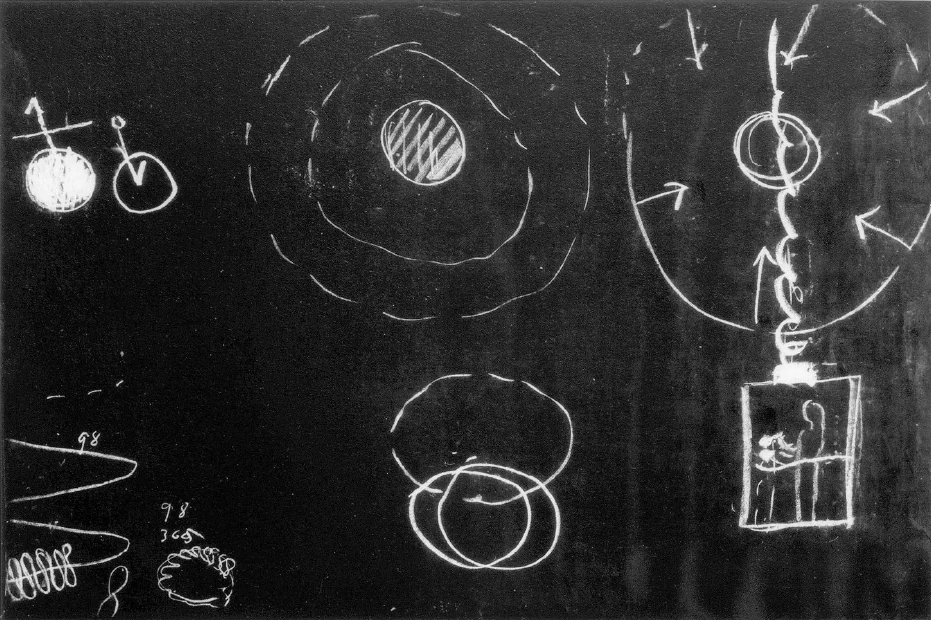
[ 4 ] But what is it like in the time between death and a new birth? We must tell ourselves that, in a certain sense, we are looking from the periphery toward the center (Plate 15, top right). We know as little about the periphery as we do about the center—our inner self—during the life between birth and death. Instead, during this time, we behold the secrets, the mysteries of the human being itself. That which is hidden within us, beneath our skin—that is what we experience between death and a new birth.
[ 5 ] You might say, then, that this world we see—between death and a new birth—is a terribly small one. But it is not the spatial size that matters. What matters is the richness or poverty of its content, not its spatial size. We must constantly remind ourselves that it is the richness or poverty of its content that matters. If you take everything you perceive here on Earth—in the mineral, plant, and animal kingdoms; in the realm of forests and mountains; and in the realm of the stars—it still cannot be compared in richness to the mysteries that human beings themselves contain within.
[ 6 ] What actually happens is that we lose the structural forces of the head when we pass through death. They have served their purpose. In contrast, the spiritual world absorbs those structural forces that are, in fact, the structural forces of the rest of the organism. And they are transformed from the inner experiences—which are now peripheral experiences—in such a way that, when the time is ripe, the human head is determined from the spiritual world and formed within the mother’s body.
[ 7 ] You must be fully aware that what takes place in the mother’s womb as the very beginning of the process of becoming human is a result of the entire cosmos. Conception merely provides the impetus for a certain effect from the cosmos to enter a human body. And what first arises in the formation of the human being is indeed a reflection of the entire cosmos. Anyone who wishes to study the embryo from its earliest stages must study it as a reflection of the entire cosmos. These are the things that are almost entirely overlooked today.
[ 8 ] What do people actually focus on today when they speak of human development in the physical sense? They focus on the hereditary line. We see how the child’s organism forms within the parent’s organism, yet we are unaware that at work within the parent’s organism are the cosmic forces that exist outside of us in our surroundings, reaching far out into the universe—that the entire macrocosm bestows its forces upon the human being so that a new human being may come into being.
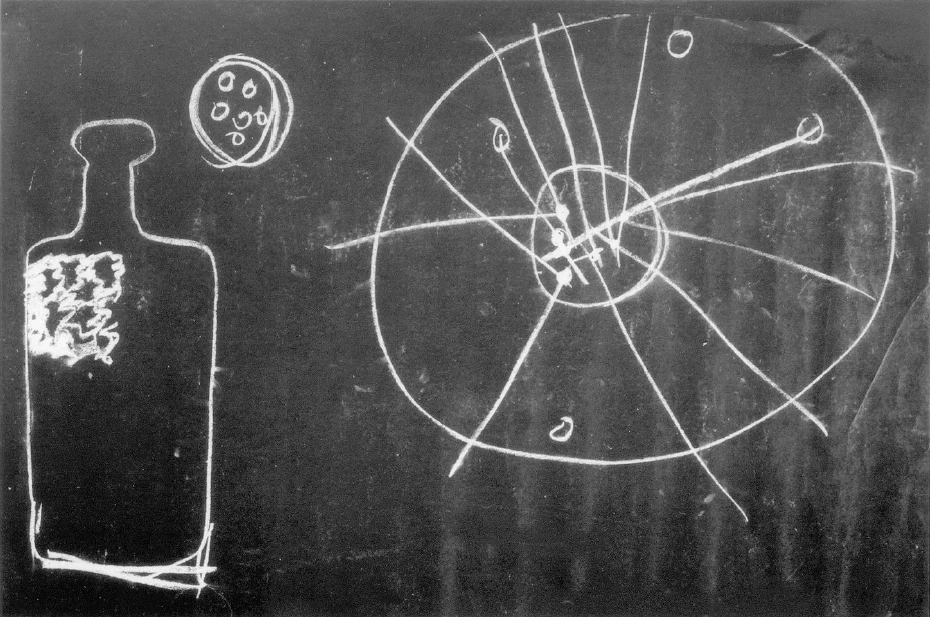
[ 9 ] That is, in fact, the fundamental flaw in our modern view of the world: that we never look toward the macrocosm, that we never become aware of the nature of the forces we observe. You see, I must return to this point once more: Today’s physicist or chemist says there are molecules; molecules consist of atoms (Plate 16, top left). Atoms possess forces through which they interact with one another. This is a conception that actually does not correspond to reality at all. In truth, even the smallest molecule is influenced by the entire starry sky. Let’s assume there is a planet here, a planet there, and so on (the small circles in the drawing on the right), and then the fixed stars. The fixed stars send forces into it. These forces that are sent in intersect in the most varied ways, forming points of intersection. The planets also send their forces into it, and these forces intersect, so that everywhere within this molecule there is nothing other than the synthesis of the forces of the macrocosm. It is the aspiration of modern science to finally advance microscopy to the point where one can observe the atoms within a molecule. This approach must cease. Instead of seeking to examine the structure of the molecule microscopically, one should look at it out there in the starry sky, in the constellations of the starry sky; copper in one constellation, tin in another. Let us look at the structure of molecules, which is merely reflected in the molecule, out there in the macrocosm. Instead of peering into the smallest details of everything, we should turn our gaze outward toward the greatest, for it is there that we must seek what lives within the smallest things.
[ 10 ] And this is how the materialistic way of thinking also manifests itself in other areas. You see, today you will hear some people—who now believe they can speak with authority about the progress of knowledge—say: “Oh, 19th-century materialism has been overcome.” — No, it has not been overcome as long as people think atomistically, as long as they do not seek the structure, the configuration of the smallest within the greatest. Thus, materialism—when considered in relation to humanity—has not been overcome either, unless one knows how to engage with humanity’s relationship to the greatest, to the entire universe.
[ 11 ] But here we immediately encounter a new—I would say outrageous—trace of materialism, which I have pointed out on numerous occasions. And we encounter this trace particularly often in certain branches of so-called theosophy. There is physical matter, then the ether—only thinner, but otherwise similar to physical matter, just thinner; the astral realm is even thinner; then come all sorts of other beautiful things, getting thinner and thinner and thinner. This—whether one calls it the astral world, Kama-Manas, or whatever—is not spiritual; it remains materialistic. If one truly wishes to understand the world, one must stop at the ether when considering the denser material realm. Then one must be clear that the ether is no longer the kind of matter we speak of as filling space. When we speak of matter that fills space, we imagine—to put it schematically—space filled with matter. But when we speak of ether, we must not imagine space filled with matter; rather, we must imagine space emptied of matter. When ordinary matter comes into contact with something, it pushes against it and drives it further along. When ether approaches it, it draws it toward itself and pulls it into itself (Plate 15, top left). This is the exact opposite effect of that of ordinary matter. Ether exerts suction forces. If ether did not exert suction forces, then your back would look just like your front, for the very difference between the front and back of the human body is the result, on the one hand, of the pushing effect of gravitational matter and, on the other, of the suction effect of etheric matter or ether. Your nose is pushed outward from your body by heavy matter, while your eye sockets are drawn inward by the suction force of the ether. And so, because your back is different from your front and your front is different from your back, both compressive and suction forces are at work within you.
[ 12 ] You see, people don’t really pay attention to such things; in this materialistic age, they don’t even think about them. When speaking further of the astral realm, one can think neither of the three-dimensionally extended physical matter nor of the absorbing ether; rather, one must think of a third entity that mediates between the two. And if one now thinks of that which one must imagine as the “I”-being, one must think of a fourth entity that, in turn, mediates on the one hand the suction-and-pressure effect of ether and physical matter, and on the other hand the astral substantiality. These are the things that must be taken into account (Plate 15, center bottom).
[ 13 ] You cannot say: “Well, if the ether has only a suction effect, how is it that the ether is perceptible?” It is simply that the ether behaves toward dense matter in the same way that—to use an analogy, as it were, on a different level—what I have here in a bottle of Seltzer water behaves (Plate 16, left). I have water in there, and pearls inside it. You see, I don’t see the water, but I do see the pearls, even though the pearls are thinner. And so it is that, in certain cases, the ether—which is, after all, a void in physical matter, the opposite of physical matter—can also be perceived.
[ 14 ] Now you will see from what has just been described that, indeed, when we speak of the life between death and a new birth, we must actually conceive of this life as being lived outside of space—outside the ordinary space that we perceive here—and our effort should be directed toward gaining a conception of this “outside-of-space.” You will gain this understanding if you first try to imagine a space that is filled. You can imagine that. You need only imagine a table; it fills the space. Then move from the filled space to the empty space. Now you will say: Empty space—that cannot be surpassed. —I have told you, that is just as sensible as if someone were to say: “My wallet is full of money, so I keep taking it out until I have nothing left; that nothingness can’t be surpassed.” It can be surpassed. I go into debt, and then I have less than nothing in my wallet. And so the empty space can also be surpassed. If it is filled with ether, it is less than empty; it is a negative entity.
[ 15 ] And that which serves as the mediator—which also serves as the mediator within you, as the astral body, between the suction and the pressure—is precisely the astral. You see, there would be no relationship between your front and back—which are not the same but different—because of the suction and pressure forces within you, if the astral nature, which acts as the mediator, were not at work within you. You will say: “I don’t notice this mediation.” — Yes, please, observe the digestive process, and you will see that this mediating force is present, that it expresses itself very precisely. The astral is at work there. And the activity of the astral is based precisely on the contrast between the front and back aspects of the human being, just as the mediation through the astral between the upper and lower human beings is based on the “I” entity. So the point is to grasp this human being, as he stands before us, concretely—truly concretely—and to be clear about the fact that, as the human being lives here between birth and death, he imprints his astral body and his “I” in the forces of suction and pressure, and that he carries his being back into that which, here on this Earth, merely forms the mediation between front and back and above and below.
[ 16 ] Yes, this mediation between front and back, up and down—what exactly is that? You see, that is what we experience within ourselves as we experience our balance. We don’t jerk our heads forward or backward; we can also sit up straight. We adjust ourselves to a state of balance. We don’t see this—we experience it. We first become attuned to this—something we don’t take into account in our life here—we first become attuned to it when we pass through the gate of death. If we had only eyes, it would be dark around us; if we had only ears, it would be silent around us. But we also have a sense of balance and a sense of movement. That is where it becomes an experience within us. We participate in what balance and movement mean in the world. We find our place within the movements of the outside world.
[ 17 ] You see, here in this life between birth and death, we actually experience only the effect of the Earth’s rotation on its axis in our daily metabolism. We must eat breakfast every day, have lunch every day, and what happens there takes place over 24 hours and runs parallel to the Earth’s rotation on its axis. These two things belong together. One is proof of the other. That is how they belong together. When we die, this movement of the Earth becomes something very real, just like the visible things here. Then we live with this movement of the Earth. Then we begin, first of all, by experiencing this movement of the Earth.
[ 18 ] And so we witness other movements of the starry sky as well. We experience them, and in fact, this experience is already contained within this drawing (Plate 15, top right), for you do not expand out into the cosmos like a jellyfish, but rather you participate in the life of this cosmos, and as a being that participates in the life of the cosmos, you experience the inner being of the human being. Here, between birth and death, you say: My heart is in my chest; the circulatory movements of the blood converge in the heart; at a certain stage of maturity between death and a new birth, you say: There is a sun within me—and you mean the real sun, which physicists imagine to be a ball of gas, but which is something entirely different. You experience the real sun. You experience the sun between death and a new birth just as you experience your heart here. And just as the sun is visible to your eye here, so too, between death and a new birth, the heart—in its development on the path to the pineal gland—undergoes a wondrous metamorphic transformation that is the source of magnificent experiences between death and a new birth. You experience your entire circulatory system in a state of transformation—of course, not the substance itself, but the forces in motion. Here, you have your circulatory system within you. As you continue to live between death and a new birth, these forces within the circulatory system are constantly changing. And when you arrive here again in a new earthly life, these forces have become the forces of the new nervous system. Look at the images of the nerve tracts and blood circulation in today’s anatomy or physiology charts; look at the blood circulation: an incarnation. From this arises the nervous life in the next incarnation. And when I say: head system, chest system, limb system—you must not simply juxtapose these in a schematic way, for these elements merge into one another. Look at the marvelous structure of the human eye: blood vessels, choroid, retina. The latter two are metamorphoses of one another. What is now the retina was the choroid in the previous incarnation, and what is now the choroid of your eye will be the retina in the next incarnation—though not exactly so immediately. But what I have said is nevertheless true. You see, one cannot gain a true understanding of the human being standing before us by considering them solely in terms of how they develop between birth and death, or at most through the forces of physical heredity. For through all of that, we understand things at most up to, let’s say, the movement of the vital fluids. But this movement of the vital fluids is, after all, the very limit of our understanding. The nervous system of a present life is the result of a previous life and cannot be understood at all from the present life.
[ 19 ] I ask you now not to object by saying: “Yes, animals do have nerves, too, and they have no past lives.” — To judge the world in this way is simply to judge it very short-sightedly. If the human nervous system, in terms of its functions, is the transformation of the circulatory system from a previous life, then the same need not apply to the nervous system of animals. Otherwise, if you were to apply such logic—which, admittedly, is widely used today—it would mean exactly the same thing as if you were to walk into a barber’s shop, find a number of razors there, and say: “Please, let’s buy these as cutlery for our lunch table, because knives are for eating!” — but razors are not for that; they belong to something else! No object carries its immediate purpose within itself in this way, nor does any organ. The organ in humans is something entirely different from the organ in animals. It depends on what the organ is used for. One should not compare one nervous system with another—namely, human nerves with animal nerves—but rather one should recognize that, compared to the animal nerve, the human nerve has become something similar to what the straight razor is to the table knife, so that one cannot arrive at any conclusions using the usual methods of materialistic investigation. Yet this is the approach that is primarily taken today.
[ 20 ] And this path prevents us from truly considering what makes human beings, as products of the spiritual world, understandable. For you see, our religious creeds, as they have gradually developed, have also—as I have said many times before—indulged in and served selfishness to a great extent. They are aimed almost exclusively at proving to human beings that they will continue to live after death, simply because their egoism demands it. But it is just as important to prove to human beings the continuation of their pre-birth life, so that they may understand: here on this earth, I am to be a continuation of what I was between death and my present birth. I have a spiritual life to continue here. This, of course, indulges selfishness less, but at the same time it is something that must in turn flow into culture, so that our culture may free people from antisocial instincts. Just think for a moment what it will mean when one looks at a human face and says: “This is not of this world; the spiritual world has been at work on it between the last death and this birth”—what it will mean when one will already be able to see in the material world the image of the spiritual work between death and a new birth. It will indeed be a different kind of education that will then exist among people, and this different kind of education will bring about a different mindset. And this mindset will not allow us to gaze at the starry sky and see there merely a vast machinery of stars attracting one another in a Newtonian manner. This is true even if one disregards the fact that abstraction has reached its highest peak today.
[ 21 ] You see, abstraction is already very much present in our ordinary solar and planetary system. But today, abstraction is taking some very curious forms. For example, if you look through much of today’s popular literature, you’ll see the glorification of a certain idea—one that Einstein, for instance, had. It is said that this idea has shaken the very foundations of gravity. For imagine (Figure 15, bottom right): far away from all celestial bodies, so that no gravitational field is at work, there is a box. Inside this box is a person holding a stone and a down feather in both hands. He is somewhere where there are no celestial bodies, inside a box, holding a stone and a down feather. Now he lets them go, and lo and behold, they begin to fall. They fall down to the floor. Yes, says Einstein, the person might say: The stone and the downy feather fall to the floor. But it doesn’t have to be that way; instead, there could be a rope attached up there, hanging there (drawing)—where, I don’t know!—and instead of the stone and the downy feather falling down, the entire box is pulled up. The stone and the down feather—since there’s no celestial body nearby—don’t fall; instead, they stay there. But the box is lifted upward, and the stone and the down feather remain in the same spot. As the box arrives there with its bottom, it takes them along with it.
[ 22 ] Today, you can find this discussion of an extreme abstraction described as Albert Einstein’s modern theory of relativity. Just think how far humanity has strayed from thinking about reality! People talk about relativity. Fine, they can do that. But just imagine what would happen if this whole idea were taken seriously: a box out there, far away from all celestial bodies, with no celestial body nearby that could attract the stone and the down feather, and a person inside it! Air exists only near celestial bodies, but he’s quite content in there with his stone and his down feather; of course, they don’t need to breathe. And besides, the box is suspended—it’s been hoisted up there.
[ 23 ] This is yet another intensification of that Newtonian impulse imparted to the celestial body at the tangent, so that it may continue to fly away under the combined effect of centrifugal and centripetal forces. But such things are in fact the subject of scientific debate today, and they are regarded as great achievements, whereas they are nothing more than evidence of how far we have gone in our extreme abstraction and how materialism has brought us to the point where people no longer know anything about matter, where people can live in mental constructs that are far removed from all reality.
[ 24 ] But these things are being ignored today; instead, all the newspapers are reporting that a great discovery has been made: the theory of gravity has been replaced by the theory of inertia alone. The stone and the down feather are not attracted to each other, but they remain in place—perhaps only because one can imagine them remaining there while the box is being pulled up. One can truly say that there is as much nonsense circulating today as there is genius, to the point that it is grotesque to realize just how much nonsense passes for genius. How can one be surprised, then, that in this era, even in other fields, thoughts have been running haphazardly—straight and crooked—and have ultimately brought about what people have experienced over the past five to six years.
[ 25 ] This is something we must keep reminding ourselves of. I had to remind everyone of this today, and tomorrow I will add a few more thoughts on the structure of the world—based on these premises—for our friends who have come to the General Assembly as well.