

Correspondences Between the Microcosm and the Macrocosm
Man — A Hieroglyph of the Universe
GA 201
25 April 1920, Dornach
Translated by Steiner Online Library
Ninth Lecture
[ 1 ] The theme underlying these present reflections, in the broadest sense, is getting to know the universe through humanity’s relationship to it. I certainly do not wish to give those who have already gained some insight into the universe itself during these evenings the impression that the superficial manner in which our conventional astronomy discusses celestial movements is sufficient to arrive at the truth of the matter. But I also want those friends who have now gathered here for the General Assembly not merely to hear something that is part of an ongoing series, but I want them, too, to have a complete picture from these lectures held on the occasion of the General Assembly. Therefore, today I would like to continue yesterday’s reflections in a certain sense and merely point out how one arrives at the concept of the universe—its nature and its motion—by starting from the concept of the human being. Of course, this is such a vast topic that I cannot cover it exhaustively for the friends who are here right now. What I have to say today—and what I have already said in the previous lectures—will be continued next Saturday. But today I would like to present at least something—which in part already emerges from what we have already considered—for our friends from out of town.
[ 2 ] As you know from the various perspectives that have been discussed on this subject, there is a relationship in human life between the daily rhythm of waking and sleeping. You know that we usually describe this relationship in abstract terms by saying: In the waking state, the physical body, the etheric body, the astral body, and the I-being are connected in a certain inner relationship. In the sleeping state, on the one hand, the physical body and the etheric body are connected to one another, and, in a sense, separated—at least in relation to the daily context, to the waking state—from the I-being and the astral body. But you also know that this is, at first, only an abstract observation, for I have often enough emphasized that, with regard to everything that belongs to the human being’s limb nature—which, in a sense, by extending into the interior of the organism, is also the actual carrier of metabolism and is at the same time connected to the will—the human being is, in essence, continually in a state of sleep. We must be absolutely clear that everything connected with our will is in a continuous state of sleep, even when we are awake. So we can say: the limb-human, as the bearer of the will-human, is in a continuous state of sleep. That which lies between the actual head organization and this limb organization—which, however, continues inward—that is, what lies in between, what belongs to the circulatory human, the rhythmic human—is in a continuous state of dreaming. This is, at the same time, the outer instrument of the world of feeling. The world of feeling is rooted entirely in the rhythmic human being. And while the metabolic human being, with its extension—the limbs—is at the same time the bearer of the will, the rhythmic human being is the bearer of the life of feeling, and this relates to our consciousness in exactly the same way that the dream state relates to our waking consciousness. We are truly awake only in our life of imagination, from the moment we wake up until we fall asleep.
[ 3 ] So you have, in fact, established this fact: that in the course of a person’s life between birth and death, they are alternately in a waking state with regard to their imaginative life; that with regard to their emotional life—which is carried by the rhythmic human being—they are in a dream state; but that they are in a continuous state of sleep with regard to the nature of their limbs and their metabolism. For you must simply be clear about this: human nature, taken in a way that allows it to be understood, presupposes that one considers the continuation of the nature of the limbs inward. Everything that ultimately has to do with the lower abdomen, everything that has to do with metabolism—for example, with the secretion of breast milk—is, after all, an inward-directed continuation of the limb-human, so that when we speak of the nature of the will or the nature of metabolism, we naturally do not mean merely the external limbs in a schematic sense. It is primarily the external limbs, but what constitutes limb activity continues inward. With regard to this—which is at the same time directly connected to the human nature of the will—the human being is constantly asleep. This complicates the initially abstract concept of the “out-stepping” of the “I” and the astral body. But it makes it necessary for us to gain a corresponding understanding of yet another matter.
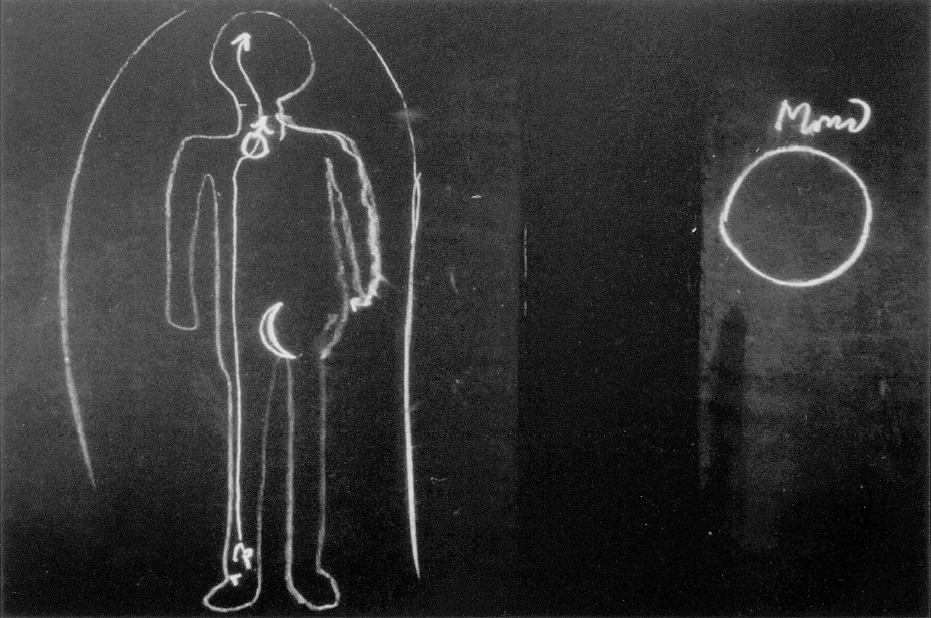
[ 4 ] You see, when today’s materialistically minded physiologist speaks of the will as manifested, for example, in a movement of a human limb, he thinks that some kind of telegraphic signal is sent from the central organ—the brain—travels through the so-called motor nerve, and then moves, say, the right leg. But this is, as such, truly a completely unfounded hypothesis, and it is also an incorrect hypothesis. For spiritual observation reveals the following. If we consider the human being schematically (Plate 17), it is as follows: When the right leg is lifted by the will, a direct influence is exerted on the leg by the human being’s “I”-essence—the true “I”-essence—and the leg is lifted directly by the “I”-essence. Only, all of this takes place in the same way as the activity of sleeping. Consciousness is unaware of this. The fact that nerves are involved here, which then lead to the central organ, merely informs us that we have a leg; it merely continually informs us of the presence of this leg. This nerve, as such, has nothing to do with the effect of the “I” on the leg. There is a direct correspondence between the leg and the will, which in humans is linked to the “I”-being, and in animals is linked to the astral body. Everything that physiology has to say—for example, regarding the speed of transmission of the so-called will—would have to be rethought in such a way that one is dealing with the speed of transmission that relates to the perception of the limb in question. Of course, those who are trained in modern physiology may come up with a dozen objections. I am very familiar with these objections; but one need only try to reason logically, and one will find that what I am saying here is in accordance with the facts of observation—not, however, with what you find in today’s physiology textbooks.
[ 5 ] Sometimes, I would say, people point to such things. For example, at an Italian nature researchers’ conference—I believe in the 1880s—a very interesting discussion took place regarding the contradictions that arise between the conventional theory of the motor nerve and limb movement. But since there is no inclination within contemporary physiology to address the spiritual aspect of the human being, such a discussion could naturally not yield much more than a mere acknowledgment of contradictions with what had been found as a hypothetical explanation for the phenomenon. It would be interesting, in fact, if our learned friends—and we do have such people among us—were to undertake an examination of the physiological and biological literature of the last forty years. They would make extraordinarily interesting discoveries; they need only seek out the relevant material. You will see that the facts are readily available everywhere; one need only grasp them in the right way to arrive at a confirmation of what spiritual science offers. It would be one of the most interesting tasks for the research institutes that are now to be established if the following were done: First of all, one would have to carefully review the international literature—one must consult the international literature, because the most remarkable indications are found, for example, in English and, in particular, in American literature. The Americans have documented the most interesting facts, but they simply don’t know what to do with them. If you were to address these matters, truly take a close look at what is there, and then recognize that—precisely because you have the right perspective on where this is heading—all that is needed is a single step to continue the experimental setup, you could truly accomplish something truly magnificent today. One would only need to reach the point where one has a research institute and the experimental setup—that is, the necessary equipment and materials—and everywhere things are, I would say, just waiting. People today don’t even realize how everything is pushing in that direction—the series of experiments that have been started and are always interrupted precisely at the decisive points because people don’t know the direction—how everything is pushing toward research institutes like the ones we have in mind here. And these research institutes would truly provide significant foundations for practical applications as well. People today can’t even begin to imagine what kind of technology would emerge from this if these things were actually carried out—first as experiments, and then expanded upon. The only thing missing is the opportunity to work on them in practice. Well, that’s just an aside.
[ 6 ] So you see, we are dealing with a part of the human being that sleeps even when we are awake. Now I would like to draw your attention to a fact that has played a major role in the entire older, shall we say, understanding of the world. This older understanding of the world, for example, made the following association. It stated: The starting point for the lower limbs is associated with the Moon. The convergence point for the upper limbs—located in the larynx region, so to speak—is associated with Mars (the Moon and Mars are shown in Figure 17). People today, who are so deeply immersed in the current worldview, naturally cannot make sense of such things; and one really should not attach any particular value to the nonsense that obscure mystics and obscure theosophists say about these matters today. For these things are far deeper than what is always being said today, especially in the realm of materialistic theosophy: coarse, physical matter; ether, somewhat finer; the astral, even finer, and so on—things that are presented as theosophy but are in fact not a spiritual teaching, but merely a spiritual lie, because they are nothing but a continuation of materialism itself. But the things that are remnants of an ancient human wisdom actually lead us to the point where, when we begin to understand them, they evoke in us a profound reverence and deep humility toward humanity’s primordial knowledge; for these hints have been preserved not only well into the Middle Ages but even into the 18th century. One can still find it in the literature of the 18th, and perhaps even the 19th century, but there it is already a copy; it no longer springs from an original consciousness. And when today’s mystical writers reintroduce it into literature, it is all the more a mere copy. But right up into the 18th century, one still finds a certain awareness of these things, and in particular, the nature of the Moon is conceived in connection with this part of the organism.
[ 7 ] You see, what I just said—that, in terms of the nature of their will-metabolism, human beings are sleeping, constantly sleeping beings—is most intensely expressed in the lower limbs. One could actually say: Through that metamorphic transformation that the arms and hands have undergone in human beings, human beings defy the unconsciousness that is, in fact, the sleeping nature of the limb-being. You will also be able to perceive—if you sharpen your inner experience of such things a little—that there is, after all, a considerable difference between the movements of the legs and the movements of the arms. The movements of the arms are free; in a certain sense, they follow sensations. The movements of the legs are not as free—I am referring here to the laws by which we set the legs in motion. Admittedly, this is something that is not always noticed or properly appreciated, for you see, a large portion of the audience attending eurythmy performances is, of course, accustomed to engaging with the performances more passively; they then perceive, in our eurythmy, the less articulated leg movements in contrast to the more articulated arm and hand movements. But this is simply because, in order to understand the arm movements, a certain degree of active participation on the part of the soul is already required from the viewer. And that—that active participation—is precisely what people don’t want today, in the age of cinema. When you watch a dance movement where only the legs are dancing and the arms make at most a few arbitrary gestures, you don’t need to think or feel much along with it. Well, that’s just an aside.
[ 8 ] So what is most intensely unconscious is that which relates to the movement of the lower limbs. In a certain sense, a person is completely asleep there. How the will acts upon the legs, how the will is already at work in the lower abdomen—these are things that are completely overshadowed by sleep. In a sense, the person is always turned away from their conscious nature in this regard. Here, their own nature sends back to them only what is a reflection. Of course, you also follow the movement of your legs, but you do so through your nervous system, through perception; you do not follow how the will intervenes—you only receive it into your perception as a reflection. The lower nature, so to speak, always turns one side away from you and always turns only one side toward you, depending on how you illuminate it from your higher self. But this is exactly the same as what the moon does (Plate 17, right). As you know, the moon orbits the Earth. It is a courteous gentleman; it always turns only one side toward the Earth. As it orbits the Earth, it does not rotate in such a way that it shows its front side one moment and its back side the next; rather, it never turns its back side toward the Earth. At the same time, however, we never receive anything of the Moon’s own, but always the light it reflects back to us. There is indeed an inner parallelism between the nature of the Moon and the entire inner human being. When you look up at the Moon—even if you understand it only in terms of this outer, formal aspect—you must sense in it the inner kinship with the lower organization of the human being. And the more one delves into these matters, the more this is the case. It was indeed the naive, instinctively naive perception of the ancients that grasped this inner relationship between human nature and the celestial body, whereas today’s materialistic philistine says: Well, the Moon—silvery light. Because of the similarity to silver in the light, the same symbol has been used for both. — All of this is nothing other than a result of ignorance toward that magnificent knowledge, which was not attained by the ancients in the way that we must regain spiritual knowledge, but which was attained by them in a different way.
[ 9 ] And let us now consider the other fact—the fact that the arms, in their connection with the upper part of the middle human being, awaken in a certain way, I would say, within the human being itself, so that arm movement becomes, at least in a dreamlike sense, something that we feel has more of a connection to human consciousness than leg movement does. The person with elemental perception will therefore very often, quite naturally, make use of their arms to some extent when it comes to speech, which, after all, has a great deal to do with the middle human being. Supporting speech with the arms will come naturally to us. But I do not believe there are very many speakers who simultaneously support their speech with leg gestures, nor many listeners who would take pleasure in these leg gestures. So you need only to sense this human need in the right way, and then you will perceive the connection that truly exists between the arms and hands—which, after all, belong to the limb-human—this higher part of the limb-human and the middle human, the rhythmic human, whose soul counterpart is the emotional aspect of the human being. Preferably, we try to support speech—which very easily becomes abstract—through arm and hand gestures. We seek to bring the emotional aspect into speech through this support. In some circles today—I won’t say which ones—it is considered a sign of a serene nature to support one’s speech with as few gestures as possible. One could also, if one considers the matter from a different perspective, say: Well, if someone, in order to avoid supporting speech with gestures, gets into the habit of always keeping their hands in their pants pockets while speaking, then they are perhaps not merely serene, but perhaps also somewhat blasé. And that is the other side of the matter. I do not wish to advocate for either view at this moment, but you can see at the same time that the entire nature of the arms—in addition to belonging to the metabolic-limb human—also points to the middle human, the circulatory human. This, in turn, was sensed by establishing a certain connection between speech and arm movement, collectively, and Mars. Mars, after all, is not as intimately connected to the Earth as the Moon is, and that which underlies the speech organism and the arm organism is also not as intimately connected to the earthly human being as that which underlies the leg organism and the abdominal organism. We can say: In a certain sense, what corresponds to the activities of the lower limbs has a very strong effect on the unconscious human being; but what corresponds to the arms and hands has an immensely strong effect on the semi-conscious human being. And it is indeed the case that someone who has very clumsy hands—who, for example, cannot perform dexterous movements with their fingers at all—will not be a very subtle thinker either. In a certain sense, they will seek out coarse patterns of thought rather than fine threads of thought. If they have clumsy, rough hands, they will be much more suited to materialism than if they have dexterous hand movements. This has nothing to do with an abstract worldview, but rather with a genuine inclination toward a spiritual worldview, which always demands that it be grasped through finely woven thoughts.
[ 10 ] All of these things are certainly taken into account by a comprehensive educational approach. You would probably be delighted if, upon entering our Waldorf school, you happened to walk into the room where, shortly after 10 a.m., our friend, Mrs. Mo/r, along with several other ladies, is teaching the handicrafts class, and you were to see the boys knitting and the boys crocheting sitting right next to one another, working diligently and devotedly, just like the girls. All of these things stem directly from the very essence of the Waldorf school spirit, for it is truly not a matter of writing this or that in a few abstract programmatic sentences, but rather of taking seriously the fact that all teaching should be based on an understanding of the human being; that as a teacher, one should know what significance it holds if I know how to move my fingers skillfully—if, under certain circumstances, I am even able to neatly place my middle finger over my index finger, like a caduceus, or if I am absolutely unable to do so—and what a huge difference that makes for thinking. Our finger movements are, to a great extent, teachers of the flexibility of our thinking. But these things can also be explored further through insight. You will acquire the skill relatively easily of flexibly placing the middle finger over the index finger, so that you can form a snake around the Mercury staff, but you will find it less easy to do this with the middle toe in relation to the second toe. From this you can see the difference in the entire organization. It is very important to bear this in mind, for the structure of the foot is intimately connected with our entire human, earthly nature. Through the organization of our hands, we rise above our earthly nature. We rise to become extraterrestrial beings. This rising to become extraterrestrial within the human being was sensed by ancient wisdom, which said: The lower human is assigned to the Moon; the human who rises above earthly nature is assigned to Mars. — Thus, this ancient wisdom sensed the organization within the entire universe just as we sense the organization within the human being. But materialism has, in fact, led precisely to a situation where it no longer understands anything about the human being. This is—I must emphasize it again and again—the tragedy of materialism: that it directs its gaze toward matter but no longer understands anything about matter, and instead loses precisely its connection to material existence. Consequently, this materialism can only wreak havoc socially as well. For it is precisely the socialist materialists, the Marxists, who are mere windbags when it comes to reality. They have learned this from the bourgeoisie, who have been spouting materialistic drivel for centuries but have failed to apply it to social institutions and have remained stuck in half-measures. A spiritual worldview, on the other hand, will reveal to us the nature of the human being—not by revealing some abstract spiritual-psychic realm, but rather a concrete spiritual-psychic realm capable of working its way into every single part of the human organism.
[ 11 ] Of course, one cannot make progress in these matters without also constantly turning to the other side of life for refuge. For this development—as I already said yesterday—that our organism exhibits is, in a sense, ambivalent, in that everything belonging to the higher human being is a metamorphosis of the lower human being from the previous earthly life. There is a moment between death and a new birth when a complete reversal takes place, when the inner is turned outward, when what appears in our lower human being as the connection between the liver and spleen systems is transformed in its entire structural power into what exists within us as the auditory system when we are reborn. The entire lower self appears transformed. Today, we carry within our lower self a certain connection between the spleen and the liver. They slip, so to speak, into one another. What is today the spleen slips through the liver, reaches, in a certain sense, the other side, and reappears in the auditory system. And so it is with the other organs. You see, people today talk about the need to find evidence for repeated earthly lives. Yes, but one must first acquire the method by which this evidence can be found. Anyone who is able to observe the human head in the right way, anyone who has a sense for observing the human head, will come to understand this transformation of the lower human being into the human head; but they cannot understand it without taking into account the intermediate stage of experience between death and a new birth.
[ 12 ] You see, in this regard, one experiences some very strange things. Perhaps you will be a little surprised when I say the following. An artist who has become well-known for his views on our philosophy said: “Yes, everything that anthroposophy says is very nice, but it doesn’t provide any proof.” But de Rochas, for example, has provided evidence, for he has shown how, in certain states of hypnosis and the like, recollections of past earthly lives can arise in human beings. — I must say, coming from an artist in particular, I found it highly peculiar that he would say such a thing, for I’d like to tell him: Just imagine, it’s exactly as if I were to say to you: ‘Yes, my dear friend, your paintings mean nothing to me; show me the originals of these paintings first, and then I’ll believe that these paintings are good’—or something like that. That would be nonsense, wouldn’t it? But as soon as he steps outside his own field, he fails to grasp that one can deduce, from what is before us—from the actual form of the human head—what is expressed within that human head. The picture must speak for itself, not through mere comparison with the original. The human head speaks for itself. It speaks the truth; it is the transformed lower human being and points us back to our former earthly life. But one must first create the possibility of understanding what is there in the right way.
[ 13 ] Thus, we are reminded that what exists physically is a direct expression of the spiritual. We can understand the physical human being standing before us as an expression of the spiritual realm that is lived through between death and a new birth. The physical world can be explained in and of itself, and it incorporates the spiritual world into this explanation. But one must first come to realize that natural phenomena are only half the story if we regard them as mere sensory phenomena. One must first come to this realization; only then can one find the transition to the understanding that the event which actually gives the Earth its true meaning—the event of Golgotha—is, on the one hand, a purely spiritual event, yet at the same time intervenes in physical life. If one is not prepared to see the relationships between the spiritual and the physical in the right way, one will never be able to comprehend that the event of Golgotha is a spiritual event and, at the same time, an event of the physical plane. When the Spirit was abolished at the Eighth Ecumenical Council in 869, the impossibility of comprehending the event of Golgotha was simultaneously inaugurated. What is interesting is that, although the Western creeds originated from Christianity, they have, strangely enough, ensured that the essence of Christianity cannot be grasped within these creeds. The essence of this Christianity must be grasped through the Spirit. And the Western creeds have resisted the Spirit; one of the main reasons why anthroposophy is frowned upon even by the Catholic side is that it moves away from the erroneous view that human beings consist of body and soul, and returns to the truth: human beings consist of body, soul, and Spirit. This points precisely to the interest on that side in ensuring that people under no circumstances come to a knowledge of the spirit and under no circumstances come to understand what the event of Golgotha actually is. And so, for the time being, this entire body of knowledge—which, as you can see, has such an enlightening effect on our understanding of the human being—has been lost. How, then, are we to develop a pedagogy for humanity today, given that humanity today has lost sight of the essence of the human being?
[ 14 ] To be an educator is to solve that magnificent riddle posed to us by the child, who gradually reveals what was instilled within them between death and a new birth. But the confessions initially reckoned only with the post-mortem life—the life after death—in order to indulge human egoism, while they did not consider human life here on earth as a continuation of heavenly life. To demand of a human being that they prove themselves worthy of what was required of them before they entered this earthly life through birth requires a certain selflessness of perspective, whereas the Confessions have, for the most part, relied on a self-centered perspective. Here, what is characteristic of the confessions takes on—I would say—in a certain sense, a moral hue. Here, purely theoretical knowledge flows into a higher moral attitude and a moral worldview. And this should also be recognized by friends of anthroposophy: that, in a certain sense, a moral inclination toward the spiritual is the prerequisite for recognizing the spiritual essence. In these difficult times of ours, it is especially necessary to turn one’s attention to this moral aspect of the worldview as well. When you look at what is happening in the outer world, you will have to admit to yourselves: empty rhetoric—which is the sister of lies—and which, especially in our time, is swelling into lies in such a terrible way—this is what materialism has brought about, even for humanity’s moral experience. It would grow ever stronger and stronger were it not for humanity being aided by knowledge that reaches toward the spirit and that must be connected with an elevation of the human being’s inner moral sense. We should also learn to feel how a spiritual-scientific worldview relates to the tasks and to the very dignity of the human being, and we should take this feeling as the starting point for our understanding. This is all too necessary for humanity at the present time, and one would like to find ever new ways and new forms of expression to characterize precisely this aspect of the tasks of spiritual science.