

Correspondences Between the Microcosm and the Macrocosm
Man — A Hieroglyph of the Universe
GA 201
1 May 1920, Dornach
Translated by Steiner Online Library
Tenth Lecture
[ 1 ] It is impossible to understand the world without understanding human beings. This is the conclusion that will likely emerge for you from the reflections we have engaged in here. For this reason, I would like to contribute a few more thoughts today specifically toward understanding human beings as such. Let us begin with the diversity of the human head organization and the organization of the rest of the body—namely, the limbs—which has already been brought to our attention many times and sufficiently. Above all, I would like to remind you once again that the organization of the head, as it appears to us in the life between birth and death, is the result of all those formative processes that have taken place from the last death up to the earthly incarnation in this life. From this, however, you must conclude that everything connected to the human head organization does not, so to speak, follow in its regularity the same rules and forces to which we, as earthly human beings, are adapted. We are adapted to earthly life through the physical organization that we have received only in this incarnation. We have, after all, already spoken of how we are adapted to earthly life through this physical constitution. We complete a cycle of food intake and digestion within 24 hours. In this respect, we are adapted to the Earth’s rotation over a 24-hour period. In a sense, a process takes place within us that is similar to the processes occurring on Earth within the universe. However, the organization of the head is essentially brought with us at birth. Therefore, the head is initially not adapted to earthly conditions, but to conditions that are, in fact, extraterrestrial. This places the head in a very special situation. I would like to use a comparison to clarify for you the situation in which the human head finds itself, particularly during the first epoch of life.
[ 2 ] Imagine for a moment that you are on a ship. The ship moves in all sorts of ways, in every direction. If you have a compass on the ship—a magnetic needle—the position of the magnetic needle does not follow the ship’s movements, but always points toward the magnetic North Pole. It remains entirely unaffected by the ship’s movements. In fact, one can even regulate the ship’s movements based on the constant position of the magnetic needle. Now, however, the human head is similar in a certain respect. Human beings perform a wide variety of activities with the rest of their organism here in the physical world. In a certain sense, the head does not participate in what human beings do in earthly life. It is always organized, first and foremost, with its innate powers toward the non-earthly. It is very important that we actually have something in the organization of the human head that is organized toward the non-earthly. Nevertheless, there is always an interaction between the organization of the head and the organization of the rest of the human being. This interaction, however, takes place over the course of time that elapses between birth and death. Our head is initially organized for the life of imagination, just as we receive it from the supersensible worlds through birth into this world. It is, so to speak, formed entirely so that the life of imagination can make use of this head as its instrument. If the head were to develop solely on the basis of the forces it receives from the supersensible worlds, it would form itself solely as an organ of imagination. Then we would gradually lose all connection with the world through the organization of our head. We would, so to speak, go through earthly existence with the awareness that through our head we develop only ideas—that is, only images—of earthly life. We would become increasingly aware that we, in a sense, stand apart from our physical organization—which is connected to our earthly being—that we stand apart with our head from this earthly organization, as if, through this head, we were beings foreign to the earth, who develop only in images that which is connected to earthly life.
[ 3 ] That is not the case. It is not the case because the rest of the organism directs its forces into the head. And if we ask about the nature of the forces that, from childhood onward, are channeled more and more from the rest of the organism into the head, then—in characterizing these forces from a psychological perspective—we must look for them specifically in the forces of the will. The rest of the organism continually imbues the imaginative faculties of our head with the forces of the will. So that we can say, schematically: We receive the head as the result of our previous incarnation, as the bearer of imagination (Plate 18, left); but the forces of the will are sent into it from the rest of the organism. What I have told you here does not take place solely in the life of the soul, but also manifests its effects in physical life. As beings of the head, we are born into this earthly world as beings of imagination. When we are born into earthly life, our powers of imagination are still very powerful. They radiate from the head out to the rest of our organism. And it is these powers of imagination that, during the first seven years of life, gradually cause the forces to act from the rest of our organism—forces that manifest themselves during the second set of teeth; the very same forces that actually consolidate our imaginative life—which is not yet consolidated before we begin to grow our second set of teeth—are the very same forces that also bring about the growth of our teeth. So that once we have our teeth, these forces are set free. Then they can assert themselves in our imaginative life; then they can shape our ideas, they can develop our memory in the appropriate way, and sharply defined ideas can take root within us. As long as we need these same forces to develop our teeth, they cannot assert themselves as true forces that consolidate our imaginative life.
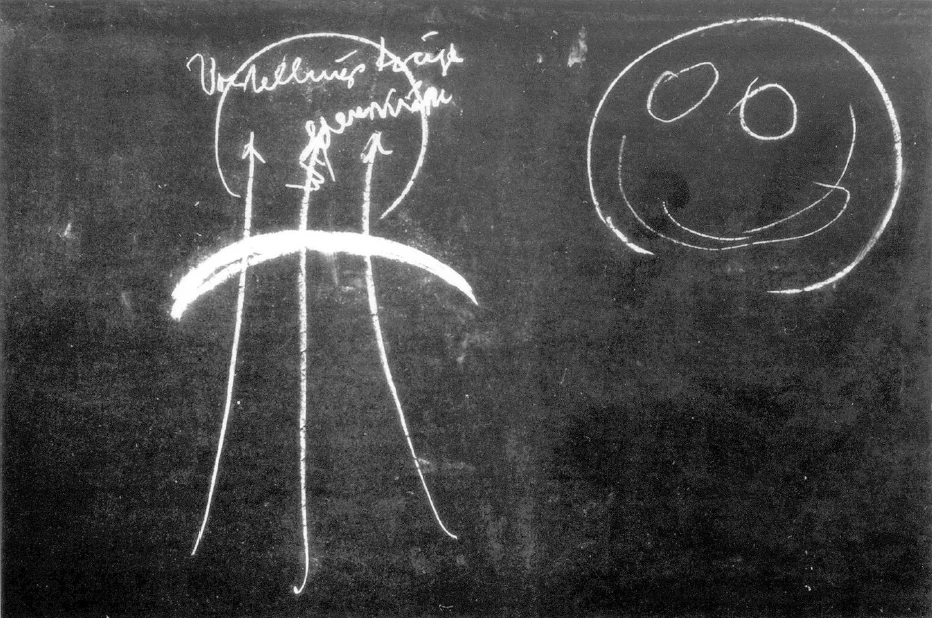
[ 4 ] Now, as we grow beyond the seventh or eighth year of life, we would begin to see—or it would become particularly evident—how the will, which is essentially bound to other human beings and not to the head, would surge into the head. But this would not happen automatically. For our head, which is actually organized for the extraterrestrial, would not be able to readily absorb those strong forces that, originating from our metabolism, seek to surge into the head as bearers of the will. These forces must first accumulate (the lower arc is drawn). These forces must first come to a halt before they are sufficiently filtered, sufficiently diluted, and imbued with soul to be able to assert themselves in the head. And these forces go through this stage at the end of the second seven-year period of life, when the forces of the will accumulate in the laryngeal organization, when they surge up within the human being in such a way that they even make themselves felt in the male organism—in the female organism this manifests somewhat differently—in the change of voice. These are the forces of will that, before they surge upward toward the head, come to a halt, so that we say: at the end of our second seven-year life cycle, the forces of will accumulate in our speech apparatus. Then they are sufficiently filtered and sufficiently imbued with soul to be able to assert themselves in our head organization. Then we are ready—once we have reached sexual maturity and also possess what goes hand in hand with sexual maturity, namely the transformation of speech—then we are ready for imagination and will to interact through our head within our earthly human being.
[ 5 ] You see, here is an example of how we use our science of the spirit to point specifically to events. Take the abstract philosophies that have gained prominence in modern times, for example Schopenhauer’s *The World as Will and Representation*—they have remained stuck in the abstract. Schopenhauer endeavors, on the one hand, to characterize the world in terms of its representational nature, and on the other hand, in terms of its volitional nature; yet he remains stuck in the abstract, as does Eduard von Hartmann. People all remain stuck in the abstract. What is concrete is that we come to understand how, within this world system of the human head, through these two stages—the first seven years of life and the second seven years of life—representation and will come together in a very specific, differentiated way. The essential point is that one can point to the spiritual-soul aspect as it manifests and reveals itself in the outer physical world. And so you can also see how the forces of the head, which extend toward the body and manifest in the body through tooth formation, interact with the forces of the body, which extend toward the head and prepare to become true soul-will by first pausing at the stage of speech development and only then extending toward the head.
[ 6 ] This is how one must understand human beings in their process of development. This is how one must be able to observe what is actually taking place within a human being. I said that the human head is not at all organized toward that which in human beings is adapted to earthly conditions. Just as the compass needle is not organized to respond to the movements of the ship—but rather excludes itself from them—so too does the human head exclude itself from adaptation to earthly conditions. Here you have what gradually leads to a physiological understanding of freedom. Here you have the physiological basis for what I expounded in my *Philosophy of Freedom*: that freedom can only be understood when it is grasped through thinking free from the senses—that is, in the processes that take place within a human being when he directs pure thinking through his will and orients it in specific directions.
[ 7 ] You can see how one can gradually come to truly study the interrelationship between the spiritual-soul and the physical-bodily, and how something like the process of language formation can actually only be understood if one conceives of it as the result of these two sources from which the human being is nourished—those sources that lie in the “head-human” on the one hand and in the “limb-human” on the other.
[ 8 ] And now you will gain an even deeper understanding of how impossible it is to speak of any volitional impulses being transmitted from the brain via motor nerves. After all, the brain only derives its full powers of will from the rest of the organism. Of course, you must not imagine this in schematic terms, for the process—which manifests itself particularly in the formation of speech as a kind of accumulation—naturally begins much earlier; it is something that runs through one’s entire life, revealing itself only in its most characteristic features during specific transitional periods. Thus, we must gain a clear understanding of how human beings are in fact adapted to both earthly life and extraterrestrial life.
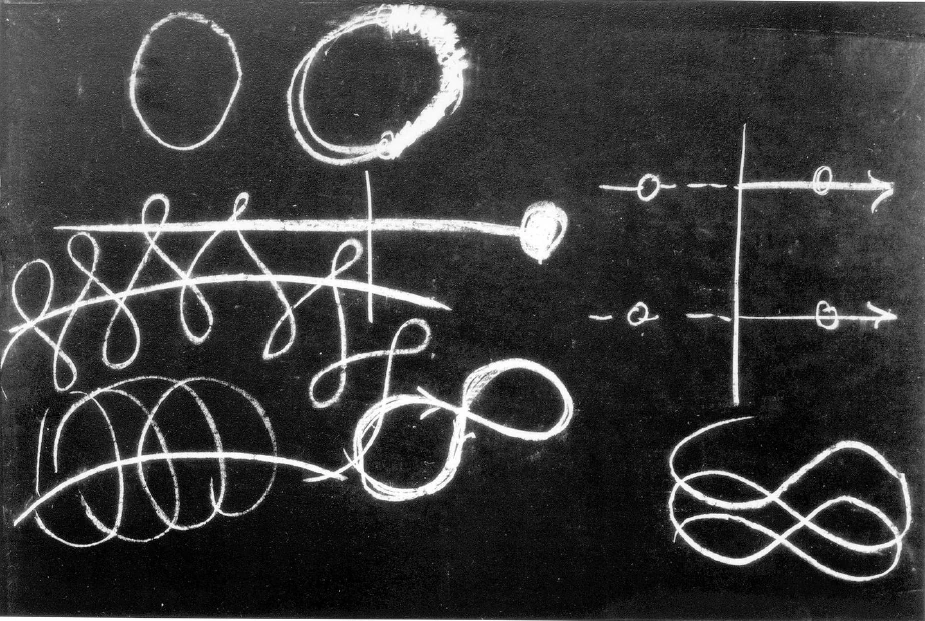
[ 9 ] He is so adapted to earthly life that certain processes which the animal carries through to completion, he does not carry through to completion in his purely natural constitution. The animal is, so to speak, born ready for all its functions. Human beings must first acquire these functions through their upbringing and so on. What takes place in human beings is, in essence, merely an outward expression of something that also occurs organically within them. If one studies the animal’s metabolism correctly from a spiritual-scientific perspective, one sees that this metabolism is more advanced than that of human beings. Human metabolism must, after all, be halted at an earlier stage than that of the animal. What in the animal—if I were to depict it schematically (Plate 19, top left, the thick horizontal line with the rounded end)—is carried forward to a certain level must come to a halt at an earlier stage in humans. To put it simply, humans must not digest as far as animals do. Humans must stop the digestive process earlier than animals do. Through this halted digestion, they receive the forces that then become the physical vehicles for what they send up into the head through the will.
[ 10 ] You see, human nature is complicated. And if we are unwilling to endure the inconvenience of truly studying the complexities of human nature, we end up with a natural science of the human being such as we have today in conventional science. We do not arrive at what truly constitutes the essence of the human being. This essence of the human being can only be revealed if spiritual science is allowed to shed light on natural science. But if this is how it is within the human being, as I have just told you—if that relationship exists between the human being and the non-human world to which we have alluded in these reflections—then you will also realize that this non-human world can only exist for the human being if it bears a certain resemblance to him and to his organization. In other words: As beings with limbs, we are adapted to earthly conditions; just as a ship’s compass rises above the ship, we rise above earthly conditions through the organization of our heads. Something similar must also take place in the non-human world. For example, there must also be something in the movements of the planets that corresponds to the adaptation of human limb-based nature to earthly conditions. And something must stand out; something must not belong to it.
[ 11 ] How does modern science view human beings? It views them as if they had no head. Of course, it also studies the head; but how does it study the head? As if it were merely a kind of appendage to the rest of the body. Everything that modern science brings to bear in order to understand human beings is, in fact, only suited to understanding the non-mental aspects of human beings, but not the human head itself. That must be understood from within the spiritual world.
[ 12 ] I could also have used the following analogy. I could also have said—and I have already pointed this out in recent days—that the human head sits atop the rest of the organism, just as you sit inside a train. On its own, it does not participate in the train’s movements. It remains at rest, allowing the train to move it. Thus, the human head is the lazy one. It regards the rest of the organism, which adapts to the outside world, as its carriage. It lets itself be carried by it. The head itself is organized for an entirely different world. But it must be the same in the external world as well. So when we construct a natural history of humankind, as we have today, this natural history of humankind actually speaks only of the human being outside the head. Therefore, it does not grasp the true essence of humankind. But if we construct an astronomy based on the same principles, then this astronomy also does not correspond to the entire non-human world, but only to a certain part; the other part, which eludes this principle, is not considered in the process. This has indeed been the particular strength of natural science over the last three to four centuries: that it has developed models of the movements of the universe that disregard a certain aspect of that universe, just as the rest of natural science disregards the human mind. Consequently, this astronomy arrives at forms of motion such as these: The Earth revolves in an ellipse around the Sun and the like—which are just as accurate for the world as natural science is today for the entire being of the human being. They do not correspond to what is now the reality of the world. That is why we have had to point out so often that even the Copernican view must be enriched by spiritual science. Many of today’s mystics, anthroposophists, and so on preach ad nauseam: The sensory world around us is Maya. But they by no means draw the ultimate conclusions; otherwise, they would have to say: Even the world of the Copernican system—this movement of the Earth around the Sun and so on—is in truth a Maya, an illusion, and it must be corrected. It must be viewed in such a way that we become aware: there is something at work here that can no more be understood on the basis of the premises applied by Copernicus, Galileo, or even Kepler than the total being of the human being can be understood through today’s scientific principles.
[ 13 ] Now, you see, when we broach such a topic, we must at the same time point out something that has just taken place in the course of human development. If we recall what we have often said—that in ancient times there existed a kind of primordial wisdom, something that people knew, albeit in a dreamlike, atavistic form, yet whose content went far beyond what we have regained today—if we remember all of this, it will not be difficult for us to truly recall that the worldview that existed in ancient times was, after all, quite different from the worldview we have today. What, then, was actually the worldview of our ancestors—that is, of ourselves in our earlier earthly lives? Much more than is the case today, the worldview they possessed was what they brought with them through birth into physical existence. Today, at most, something like a picture of the world in which a person lived before descending into physical existence is still present in children—if we know how to examine them properly. But in later life—and indeed very early on—this worldview disappears. In earlier human history, this worldview was present. And what existed in earlier epochs of spiritual development as an astronomical image—a description of the solar system or planetary system and its connection to human beings—was something that people experienced directly within themselves, even if only in a dreamlike state. Certainly, we look down today with a certain arrogance upon these ancestral times of humanity. But those ancient times of humanity were such that people truly knew that something within us was connected to Mars, to Mercury, and so on. This was something that was an inner component of human consciousness. It was what dawned on human beings as they developed. Primitive man did not merely see the external constellation. He sensed within himself an inner constellation, an inner world system. He sensed the world system not only outside, but also within his head—which we today regard as the seat of what I might call an undifferentiated life of imagination. There, within, the sun shone; there, within, the planets orbited. Human beings carried this world picture within their heads. (Plate 18, right). And what he carried there in his head possessed forces that acted upon the rest of his organism, which in turn influenced that which one receives from the earthly forces only after birth or, respectively, after conception; so that this, too, was influenced by the organization of the head, so that, in a sense, the rest of the human being was also drawn into the adaptation to the planetary forces. And here it becomes clear to you: the human being is born into this world. As an inheritance, let us say for now, he receives the tendency to develop his first teeth, the baby teeth. They complete their development roughly within the course of a year. The permanent teeth—those produced by the human organism itself—take seven times as long to develop. This is something that points to us, in the deepest sense, how a certain rhythm—which we bring with us at birth and which relates to the annual cycle—is slowed down sevenfold in our earthly life. The annual cycle is slowed down sevenfold. This is something that has also been expressed by incorporating the ratio of 1 to 7—the day and the week—into the division of time. The week is seven times longer than the day. This week, which is seven times longer than the day, expresses that something proceeds within the human being that moves seven times more slowly than what we bring into physical existence at birth. One will not truly understand the actual process of human existence until one properly realizes how something within the human being—which is, so to speak, brought in from extraterrestrial conditions—must slow down sevenfold during the earthly life.
[ 14 ] You see, the ancient Hebrew esoteric teachings spoke at length precisely about these facts. And if I were to express in our language what the ancient Hebrew esoteric teachings—drawing on atavistic knowledge—said about this matter, I would have to say: These ancient Hebrew esoteric teachers made it clear to their students that Yahweh—who is the true god of the Earth, the one who added the Earth organization to the Saturn, Sun, and Moon organizations—has a tendency to slow down sevenfold whatever comes from the Moon organization. Accelerated in relation to the Earth’s orbit, something seeks to manifest itself within the human being. I could also say that the ancient Hebrew secret teacher told his students: “Lucifer moves seven times faster than Yahweh.” This points to two movements, two currents within human nature. These two currents are also present in non-human nature. However, they exist in a somewhat different form in non-human nature than in human nature.
[ 15 ] But this very idea we are approaching is not all that easy to grasp. If we want to understand it, perhaps the best way to do so is to start with more social conditions and then turn our attention back to the cosmic-terrestrial conditions.
[ 16 ] I have mentioned something on several occasions in public lectures that I would also like to address here. When we survey the misery of the present age, we find the peculiar fact that the entire intellectual class of modern humanity has developed in a way that is out of touch with reality. It is, after all, a peculiarity that, especially in practical life today, one finds more and more incompetent people rather than competent ones. And on a larger scale, this is evident in a matter such as the one I have now mentioned in several public lectures—for example, that in the 19th century there was much discussion about the effect of the gold standard on international economic relations. You can go through the parliamentary reports of the 19th century. Try to get a sense from them of what people thought would be the consequence of the gold standard’s monometallism. They viewed the gold standard as the very thing that would make free trade—free trade unhindered by any tariff barriers—possible beyond the unified global economic area. This was predicted everywhere where the gold standard was extolled. And what actually happened? Tariff barriers. Gradually, the actual circumstances developed in such a way that tariff barriers were erected everywhere. That is what reality has shown.
[ 17 ] Now, if you were to judge superficially, you might say: Yes, but those people must have actually been too stupid. But they weren’t even stupid; among those who expected the gold standard to promote free trade were some very astute, very intelligent people. But they lacked a sense of reality; they relied solely on logic, not on conformity to reality. They were unable to immerse themselves in actual conditions, just as our natural scientists today are unable to immerse themselves in the organization of the heart, the liver, the spleen, and so on. They abstract and, despite becoming materialists, remain stuck in the abstract with their theories. That is why something like this can happen, as recounted in an anecdote based on actual events that sheds light on many things: At an academy of sciences, a learned member—a physiologist—had developed a theory about how long birds, in particular, could go without food. He had produced a fine table. The physiologist in question had set up large birdcages all along his hallway and had starved these birds to determine how long they could go without food. He then recorded the results. The figures he obtained were impressively large. He then incorporated these figures into a paper and read his paper aloud at a meeting of the academy. However, another physiologist lived in the same building who did not use such methods. He lived one flight of stairs higher. He stood up after this scholarly paper had been read and said: “I’m afraid I must object that the figures cannot be entirely correct, for I felt very sorry for the poor creatures, and I fed them as I passed by.”
[ 18 ] Well, it doesn’t always have to happen the same way; it’s an anecdote, but one based on truth, because in fact a great deal of the material underlying our exact sciences has also come about in this way—with someone in the background “feeding the birds” instead of letting them go hungry for as long as the table indicates. If one has a sense of reality, one cannot make much of such statistical methods at all. One cannot expect much from such methods. And this sense of reality has indeed been lacking in modern humanity. Why has it been lacking in modern humanity? The blame lies with a certain necessity of human development. We can understand the matter this way:
[ 19 ] Suppose that in ancient times, human beings—when that was the limit of their senses in relation to the outside world (Plate 19, top right)—looked out into the external world. Through everything they carried within themselves, they surveyed the conditions of the external world. They also helped shape their theories of the stars based on their inner star system. They possessed a sense of reality. This sense of reality was rooted in their senses (the two circles on the right are depicted); it has disappeared in the course of human evolution. It must be developed again within, to the very same extent that it was previously developed in the external world. We must truly come to cultivate a sense of reality within ourselves through the education we receive from spiritual science; only then can we once again develop a sense of reality in the external world. It is indeed the case that if people were to continue in a straight line along the path on which they have developed with modern intellectualism, they would no longer be able to see what lies outside, and things would turn out everywhere just as they did with the gold standard: while they predicted that free trade would emerge, tariff barriers were erected. This, after all, happens constantly in the most diverse areas of so-called practical life. What happened on a large scale back then is happening everywhere today on a small scale. Practitioners predict this or that—the opposite occurs. It might be interesting to note what the practitioners predicted during the last years of the war as things that would most certainly happen. In fact, the opposite has always come to pass, especially in recent years, precisely because people no longer possessed any sense of reality. But this sense of reality can only be attained by a person cultivating themselves through spiritual science in such a way that this sense of reality is first developed within. No one in the future will be a practical person or a realistic thinker who disdains to cultivate this sense of reality within themselves through spiritual science—a sense that cannot be cultivated through the external world today. We must also bring into the outer world what we develop within ourselves. That is why spiritual science is so necessary: people will not come to understand how the heart relates to the liver unless they first acquire the method for doing so through training in spiritual science. What used to exist, when one could say: ‘The heart relates to the liver in the inner world just as the Sun relates to Mercury in the outer world’—and where one knew something because one brought the relationship between the Sun and Mercury from the supersensible world into the sensory world—this is no longer understood, nor can it be understood in its original sense, unless people acquire the foundation, the fundamental impulse for this understanding from within. One does not acquire it merely through clairvoyance—clairvoyance is used to investigate the facts of spiritual science—but rather one acquires this insight by truly thinking through and feeling deeply what has been established through the clairvoyant method, and by organizing one’s life accordingly. That is what matters. What matters above all is to study the findings of spiritual science, not to satisfy the curiosity of clairvoyance. This must be emphasized again and again, for in the general cultural process of humanity, this application of the spiritual scientific method to external life—and also to the understanding of the greater world, the non-human world—is of particular importance.
[ 20 ] That which we must regard as the original primary organization is, in the course of our lives, gradually permeated by everything in our organization that serves to adapt us to the external world. So we must learn to understand the world outside of humanity by starting from the human organism, from the organization of the limbs. And in this, we can only be helped by things such as those I have already pointed out. I have pointed out to you the contrast between the state in which a person is awake and the state in which a person is asleep. On the one hand, we consider waking; on the other, sleeping. These are states that are opposed to one another. And as one transitions into the other—in waking up and falling asleep—we pass, so to speak, through a kind of zero point of our existence. The moment of waking up and the moment of falling asleep must be related to one another.
[ 21 ] This suggests that if we want to express the human daily cycle in a geometric form, we cannot use either a circle or an ellipse. For if we were to assign the state of sleep to one part of the ellipse, the states of waking up and falling asleep would diverge (Plate 19, at the very top). But they cannot diverge—we will yet see how they also represent a unity in their outward manifestations. We therefore cannot draw the geometric figure intended to correspond to the human daily cycle in the form of a circle or an ellipse. We can only draw it as a looped line, a lemniscate (the same plate, bottom center). Only in this way do we have the possibility, when we say that a person moves from the waking state into the sleeping state, to state that they emerge from it again through the same state upon waking. And with that, we have a curve, a line that corresponds to the daily course of human life. You will find no other line representing the daily cycle than this lemniscate, for with any other line, waking would not follow the same path as falling asleep.
[ 22 ] But there is something else as well. If we pay attention to the process of human development, particularly in childhood, we must say that, essentially, we wake up much as we fell asleep. But if one can observe life correctly, one cannot exclude the state of sleep from the whole of human life. We teach children during the day. We should always be mindful of what, out of what we present to the children, does not take effect immediately, but only becomes effective the next day, once the ego and the astral body have passed through the night state. It is only then that the child truly makes sense of what we teach them during the day. We must structure our pedagogy and didactics accordingly. So that we can say, with regard to the alternating states of day and night: We sleep, and upon waking we return to the same place where we fell asleep, but in terms of human development, we advance a little. We advance in a different direction.
[ 23 ] Therefore, we must not draw the line exactly as in the lemniscate, but rather in such a way that, while we emerge here again, we do so a little further along, so that we obtain progressive lemniscates (bottom right). So if we examine, on the one hand, the alternating state between waking and sleeping and, on the other hand, ongoing development, we arrive at a helical line as the geometric form for what is taking place within the human being. This helical line is intimately connected with our development, and our development, in turn, is connected with the entire world system. Therefore, we must seek this very same line as the foundation for the movements of the worlds. And if, instead of merely applying abstract geometry to the celestial sphere, one had applied the concrete geometry that follows from the whole human being, one would have arrived at a different conclusion. For you see, in ancient wisdom, this line was already recognized. There, one did not speak of, say, Mars moving in any way other than by progressing along such a line (left, center). But this was gradually forgotten. People began to construct models instead of relying on knowledge. What came of it? This line, which proceeds in this way (pointing to the line just drawn), could not be taken any further. And so they took this line (bottom left, the large arc), superimposed circles upon it, and arrived at the epicyclic theory. Even the Ptolemaic theory is the last remnant of ancient primordial wisdom, and on the basis of this, Copernicus in turn made a simplification. And modern astronomy is still theorizing about it. It still theorizes in such a way that it prefers to consider ellipses and circles and all manner of things rather than that intrinsically dynamic line, which represents a progressive helical curve. And then people are surprised that the observations do not match what is calculated, that they are constantly forced to make new corrections.
[ 24 ] Take a look at how the theory of relativity is based on an error in Mercury’s orbital periods. People only seek to make the correction in a way other than how it should be done—namely, by returning to the relationship between human beings and the entire environment. — But more on that tomorrow.