

Correspondences Between the Microcosm and the Macrocosm
Man — A Hieroglyph of the Universe
GA 201
2 May 1920, Dornach
Translated by Steiner Online Library
Eleventh Lecture
[ 1 ] Yesterday I drew attention to how what exists within the human being points to something that exists correspondingly in the non-human universe, insofar as a certain relationship exists between the human being and the non-human universe. What we must now particularly point out as existing within the human being is the orientation of the human head toward an extraterrestrial world—a world that lies outside the one on which the rest of the human organism depends. Our head still points clearly toward the world we passed through between death and a new birth. The entire structure of our head is formed in such a way that it constitutes a clear echo of our sojourn in the spiritual worlds. Now we must seek the corresponding phenomenon in the cosmos.
[ 2 ] You need only compare the behavior of, say, Saturn—which lies far out in the vastness of space—with that of the Earth itself, and you will notice a certain difference. This difference has become significant in astronomy in that it is said that Saturn orbits the Sun in 30 years, while the Earth does so in one year. Let’s not concern ourselves for now with whether these statements are right or wrong, or whether they represent a one-sided view or not; we simply want to point out that the observations one can make by tracking Saturn through space and comparing the speed of its motion with the speed attributed to Earth—assuming the Copernican -Keplerian model, leads to the conclusion that Saturn takes 30 years to orbit the Sun, while the Earth takes one year. And when we look at Jupiter, it is said to have an orbital period of 12 years. Mars’s orbital period is much shorter. But now, when we consider the other planets—Venus and Mercury—we find orbital periods that are shorter than Earth’s, or rather, that are said to be shorter than Earth’s orbital period. All these things are, of course, theoretical constructs, derived from observations made in one way or another.
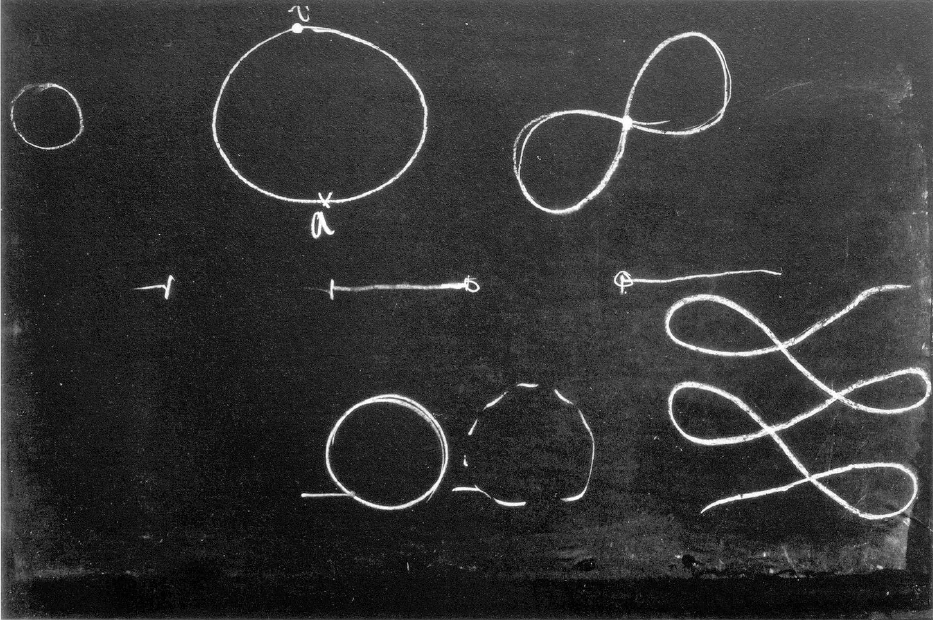
[ 3 ] Now, I have pointed out that we can only truly gain insight into these matters if we, so to speak, compare what is happening out there in the vastness of space with what is happening, in a corresponding way, within the confines of our own bodies, within our own organisms. Consider for a moment that there is indeed a counterpart to what is called the Earth’s orbital period around the Sun. We pointed out yesterday that, even for the daily sequence of events, there is a certain curve, a certain line that intersects with itself. In a similar way, we can also conceive of the curve—the curved line—that corresponds to the Earth’s annual motion, regardless of whether one holds the view that this motion of the Earth is simultaneously a motion around the Sun or not. For what do we actually have before us here? Consider this: We have our own daily cycle, which we do not wish to consider here as it corresponds to the cosmos, but rather as it occurs within the human being—so that we can also include those whose sleeping and waking hours do not coincide with the alternation of day and night; in other words, we can also take into account the late sleepers and those who live irregular lives. We want to consider this daily cycle in human beings in such a way that, for the reason we already mentioned yesterday, we imagine it represented by a line like this (Plate 20, top right), with the points of falling asleep and waking up coinciding. I already noted yesterday that one must conceive of these points of falling asleep and waking up as coinciding. There are many reasons, but one reason suffices for an unbiased judgment to recognize that we must place the point of waking above the point of falling asleep. For consider the most striking fact: When you look back on your life, it appears to you as a continuous flow. You are not led to imagine this life in this way (the broken line at mid-height, from right to left): Today I lived and was aware of my surroundings until I woke up; then comes darkness; then yesterday, when I fell asleep, and again I lived until I woke up; followed once more by darkness. That is not how you imagine the flow of memory; rather, you imagine the flow of memory in such a way that, in fact, the moment of waking and the moment of falling asleep truly coincide in your remembering consciousness. That is a simple fact. This fact can only be illustrated by drawing the curve representing the course of a human day as a looping line, where the point of waking up falls above the point of falling asleep. If a curve in the form of an ellipse or a circle were correct, then falling asleep and waking up would have to be clearly separated from one another; waking up could not immediately follow falling asleep. This, then, is how we must imagine the course of a person’s day.
[ 4 ] Try to get a clear understanding of what a human being actually is: You live while awake, from the moment you wake up until you fall asleep. As a physical human being, you are at the same time the whole human being; within you are your physical body, your etheric body, your astral body, and your “I.” Now consider the physical human being from the moment of falling asleep until waking up. There you have only the physical body and the etheric body. As a physical human being, you are not a human being, but rather you possess the physical body and the etheric body; that is what lies in bed. Strictly speaking, that should not be the case at all. It exists, strictly speaking, unjustly, for it should be a plant. This is merely the remnant of the complete human being that has been left behind; the “I” and the astral body have departed, and it is only under the influence of the fact that the “I” and the astral body can return before the physical body and the etheric body can pursue their plant-like destiny—only this fact prevents us from dying every night.
[ 5 ] Now let’s look at what is actually lying there in the bed. What is it, this thing lying there in the bed? It suddenly becomes part of the nature of the plant kingdom. You must see this as similar to what happens on Earth from the moment plants sprout in the spring until the fall, when the plants wither away again. In the human being, the plant nature flourishes, one might say, from falling asleep until waking up. Then he becomes like the earth is in summertime. And when the ego and the astral body return, when the person wakes up, they become like the earth in winter. So we can say: a person’s waking state—the time from waking to falling asleep—is their personal winter; the time from falling asleep to waking is their personal summer. For the cosmos—insofar as the Earth is also part of this cosmos—the year is the corresponding phenomenon. The Earth is awake during winter and sleeps during summer. Summer is the Earth’s time of sleep; winter is the Earth’s time of wakefulness. Externally speaking, of course, this is a false analogy; one might believe that summer is the Earth’s waking time and winter is its sleeping time. The opposite is true; for during our sleep we become like the blossoming, sprouting plant life—we thus become like the Earth during the summer. And when our ego and our astral body enter our physical body and our etheric body, it is as if, for the Earth that bears plants, the summer sun were to withdraw and the winter sun were to take effect. Yet each season applies to a specific part of the Earth’s surface. So it is different for the Earth than for the individual human being—though only seemingly, incidentally; for the Earth, insofar as we inhabit any part of it, the annual cycle corresponds to the human daily cycle. An annual cycle in the cosmos corresponds to the human daily cycle.
[ 6 ] Now, this immediately leads to the fact that when you look at the cosmos, you must say to yourself: a year—for the cosmos, that is sleeping and waking. And if our Earth is simply the head of the cosmos, then winter expresses the cosmos’s waking, and summer its sleeping. Let us now consider this cosmos, which indeed gives rise to waking and sleeping—for the vegetation covering the Earth is, after all, the result of the cosmos—let us now consider this cosmos, and we must also view it as a great organism. We must conceive of what takes place within its parts as organically integrated into the entire cosmos, just as we must conceive of what takes place within one of our organs as organically integrated into our organism. This brings us to the significance of those differences that, in astronomy, are otherwise expressed in the shorter orbital periods of Venus and Mercury compared to the longer orbital periods—namely, those of Mars, Jupiter, and Saturn, which are longer than Earth’s so-called orbital period. If we consider the so-called outer planets—Saturn, Jupiter, and Mars—they appear to have a long orbital period that extends beyond a year, thus transcending mere wakefulness. Take Saturn, for example, with its 30 years, which is, after all, its apparent orbital period around the Sun (Plate 20, top left); its 30 years—how can we express them, if we speak the proper language of the cosmos, in terms of a year being its daily cycle? If a year is the daily cycle of the cosmos, then Saturn’s so-called orbital period is approximately 30 days—a cosmic month, or 4 cosmic weeks. So you can say to yourself: If one considers Saturn—the other two planets, Uranus and Neptune, which are now regarded as equals, are, after all, latecomers—if one considers Saturn to be the outermost planet, then one must say: Saturn marks the boundary of our cosmos, and in Saturn’s apparent slowness—in its lagging behind the Earth—the life of the cosmos unfolds over four weeks, over a month, in contrast to the life the cosmos displays over the course of a year, which for it is a falling asleep and waking up.
[ 7 ] From this, however, you can see that Saturn—if we, so to speak, regard its apparent orbit as the outermost boundary of our planetary system—behaves differently within this planetary system than, for example, Mercury. Mercury, which takes less than 100 days to complete a so-called apparent orbit, moves quickly; it is active there in the inner regions and has a certain speed, whereas Saturn moves slowly.
[ 8 ] Who does this actually correspond to? If you consider Saturn’s movement, it is relatively slow; Mercury’s movement, in contrast to Saturn’s, is very fast—an inner vitality of the cosmic organism, something that moves the cosmos from within. It is as if you were to imagine, for my sake, a kind of living slime organism (Plate 21, left) that rotates as such, and within it an organ that in turn rotates more rapidly around itself. In its movement, this Mercury, through its faster rotation, distinguishes itself from the overall rotation, from the entire movement. It is like an enclosed member; likewise, the movement of Venus is like an enclosed member. Here you have something that, in the human being, corresponds to the relationship of the head to the rest of the organism. The head is separate from the movements of the rest of the organism. Venus and Mercury emancipate themselves from the movement dictated by Saturn. They go their own way. They tremble within the entire system. What does that mean? They have something extra within the entire system. Their faster activity indicates that they have something extra inside. What, then, is the counterpart of this “something extra”? Well, in our head, what the head has in addition is its connection to the supersensible world; only—our head remains still within our organism, just as we remain still inside a carriage or a train, even though the train continues on its way. Venus and Mercury do it differently; they do the opposite with regard to their emancipation. While our head remains still—as if we were sitting quite calmly in the carriage or on the train and were at rest inside it—Venus and Mercury emancipate themselves from the entire planetary system in the opposite manner. It is as if, by sitting in the train car, we were stimulated by something and, as an extra force within it, were moving constantly faster than the train itself.
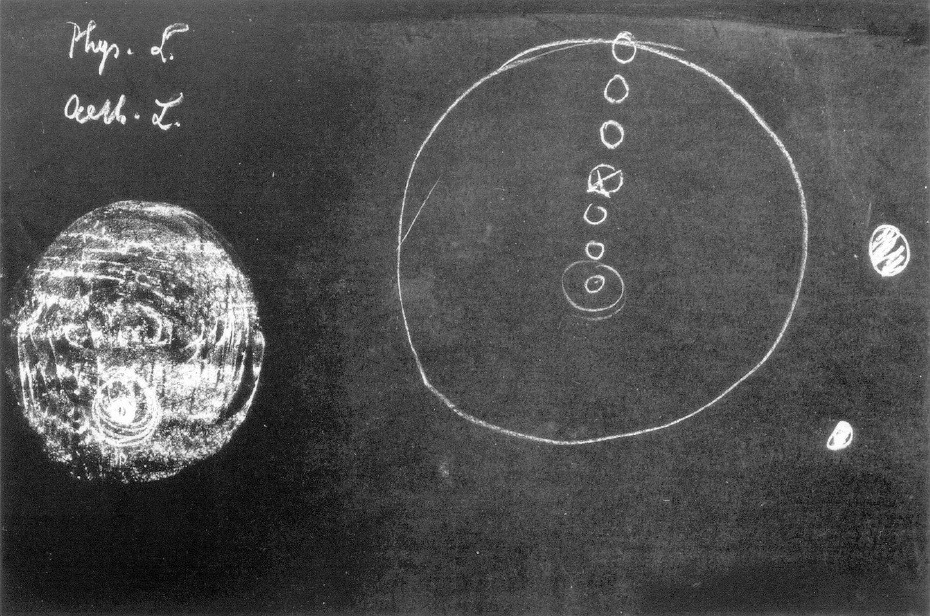
[ 9 ] You see, this stems from the fact that Venus and Mercury—which exhibit the faster apparent motion—do not merely have a relationship to outer space, to the spatial realm, but also have relationships of their own to that with which our head has relationships. It’s just that they enter into these relationships in opposite ways: our Earth by becoming calm, Venus and Mercury by becoming active. But Venus and Mercury are the planets through which our planetary system has a relationship to the supersensible world. Venus and Mercury integrate our planetary system into the cosmos in a different way than Saturn and Jupiter do. Our planetary system is spiritualized through Venus and Mercury—spiritualized and connected to the spiritual powers in a more intimate way than is the case, for example, with Jupiter and Saturn.
[ 10 ] Things that truly exist often appear quite different when studied as they really are than when understood according to our initial, obvious judgments. Just as a person, judging by outward appearances, calls winter the Earth’s “sleep” and summer its “waking” season—even though the opposite is true—so too, judging by outward appearances, one might be tempted to regard Saturn and Jupiter as more spiritual than Venus and Mercury. But this is not the case; rather, Venus and Mercury stand in a more intimate relationship to something that lies beyond the entire cosmos than do Jupiter and Saturn. So that we can say: In Venus and Mercury we have something that, outwardly—insofar as we are a part of our planetary system—connects us to a supersensible world. By living here, we are connected to a supersensible world through Mercury and Venus. One could say: As we incarnate in the physical world through birth, we are brought into this physical world by Saturn and Jupiter; as we live from birth to death, Venus and Mercury work within us and prepare us to carry our supersensible being back out into the supersensible world through death. In fact, Mercury and Venus play just as much a part in our immortality after death as Jupiter and Saturn do in our immortality before death. But the fact is that we must also see something in the cosmos that corresponds to the relatively more spiritual organization of the head in comparison to the organization of the rest of the human organism.
[ 11 ] Now, if we imagine that Saturn, for its part, also moves along such a curve (a lemniscate, Plate 20)—which, of course, is traced differently in outer space than the curve of the Earth, caused by a movement 30 times faster—if we imagine this curve for both Saturn and the Earth, then we must conclude that every celestial body orbiting in such a path is, of course, moved along this path by forces, but it is moved by forces of different kinds. And this brings us to a concept that is extraordinarily significant and which, once you truly grasp it, will likely immediately strike you as valid. The only reason it does not strike people as valid is that, under the influence of the materialism of the past centuries, they are simply not accustomed to connecting such things with the facts of the universe.
[ 12 ] From the perspective of today’s materialistic worldview, Saturn—which is found out there in space—is merely a body drifting around in space, and so are the other planets. But that is not the case; rather, if we take this outermost planet of our solar system, Saturn, then we must imagine it—and I will now have to state something, in a sense, by way of a preview of what we will explain later—we must imagine it as the guide of our solar system through outer space. It pulls our planetary system through outer space. It is the body embodying the outermost force that guides us along the lemniscate through outer space. It both steers and pulls. It is thus the force at the outermost periphery. If it were the only force at work, we would move along the lemniscate. But now, within our planetary system, there are precisely these other forces that represent a more intimate connection to the spiritual world, which we find in Mercury and Venus. These forces are constantly raising the orbit. So that when we look at this orbit from above, we see this lemniscate (the previous curve); but when we look at it from the side, we see lines that are constantly rising and progressing (Plate 20, bottom right). This progression corresponds, in human beings, to the fact that while we sleep, we process what we have taken in; even if it does not immediately enter our consciousness, we process it. We process what we take in through our upbringing and our life—in fact, mainly while we sleep. And during sleep, Mercury and Venus act as our mediators. They are our most important night planets, while Jupiter and Saturn are our most important day planets. Therefore, an ancient, instinctive, atavistic wisdom quite rightly associated Jupiter and Saturn with the formation of the human head, and Mercury and Venus with the formation of the human torso—that is, with the rest of the organism. These insights arose from an intimate understanding of the relationship between the human being and the universe.
[ 13 ] Now, however, I ask you to consider the following. First of all, for internal reasons, we must conceive of the Earth’s motion as lemniscatic; furthermore, the forces of Venus and Mercury act upon the Earth’s motion, and these forces in turn carry the lemniscate forward, so that the lemniscate actually progresses and its axis itself then becomes a lemniscate. We have an extraordinarily complex motion for the Earth itself. And now comes the point I actually want to draw your attention to. Astronomy strives to map out these movements. People want to have a planetary system. They want to map out the solar system and explain it mathematically. But planets such as Venus and Mercury also have connections to the extra-spatial, to the supersensible, to the spiritual—to that which does not belong in space at all. So if you want to map the orbits of Saturn, Jupiter, and Mars, and also plot the orbits of Venus and Mercury within the same space, you will at most obtain a projection of the Venus and Mercury orbits, but by no means the Venus and Mercury orbits themselves. If you use three-dimensional space to plot the orbits of Jupiter, Saturn, and Mars, you will at most reach a limit; there you will get something like the orbit of the Sun. But if you now want to draw the other things that come into play, you can no longer draw them within that three-dimensional space; instead, you can only capture silhouettes of these other movements within that three-dimensional space. You cannot draw both the orbit of Venus and the orbit of Saturn within the same space. From this you can see that any depiction of the solar system—in which the same space is used for Saturn as for Venus—is merely an approximation; it is simply impossible to draw a solar system. This is just as impossible as explaining a human being in their entirety through purely natural forces alone. And now you will understand why no solar system is sufficient. It was easy for a non-astronomer like Johannes Schlaf to show people who are staunch astronomers the impossibility of their model of the solar system using very simple facts—for example, by simply pointing out that if the Sun and Earth were arranged such that the Earth orbited the Sun, sunspots would not appear the way they actually do, because one moment you’re behind, then you’re in front, and then you’re going around. But none of that is the case. Nothing that is drawn into a space defined by the usual three abstract dimensions of our solar system is true. One must be absolutely clear that, just as with human beings, one must say to oneself: If one wants to understand the human being as a whole, one must move from the physical forces to the supersensible forces. Likewise, if one wants to understand a solar system, one must go beyond the three dimensions into other dimensionality. That is to say, one cannot draw an ordinary solar system in three-dimensional space (Plate 21, center). All these planiglobes and so on—we must understand them in such a way that we say: Where Saturn is located in such a planiglobe, there—if, according to our ordinary schematic solar system, we have Mercury somewhere—is not the real Mercury, but its shadow, its mere projection.
[ 14 ] These are the kinds of things that must first be brought to light again by spiritual science. After all, they have disappeared. About six or seven centuries before the Christian era, ancient wisdom began to disappear. Then it gradually declined until it was replaced by philosophy starting in the mid-15th century. But people like Pythagoras, for example, still knew so much of the ancient primordial wisdom that they—or at least Pythagoras’s contemporaries—could say: Yes, we live on Earth; through this Earth, we belong to a world system that includes Saturn and Jupiter; but if we remain within this dimensionality, we do not find within it an equivalent connection to Venus and Mercury. And if we want to belong to Venus and Mercury, we cannot belong to them as directly as we belong to Saturn and Jupiter; rather, if our Earth is in a shared space with Saturn and Jupiter (Plate 20, bottom center), then there is a counter-Earth, which is in the other shared space with Mercury and Venus. — That is why these ancient astronomers speak of the Earth and the counter-Earth. Of course, the modern materialist now comes along and says: Counter-Earth? I see no sign of it. He is like someone who weighs a person whom he has first commanded not to think anything, and then weighs him after commanding him to think a particularly clever thought, and then says: I have weighed him, but I have not found the weight of his thoughts. — Isn’t it true that materialism rejects everything that isn’t heavy or that cannot be seen? But strange things shine forth from primordial wisdom, from the atavistic primordial wisdom of humankind, to which we in turn arrive through inner vision, through inner contemplation derived from spiritual science. And this working one’s way back toward something absolutely new—which, however, was actually already present on Earth once before and is now to be attained out of the fullness of human consciousness—is precisely what humanity urgently needs at this time, for if not, people will lose the very capacity to think.
[ 15 ] I pointed out to you yesterday that, from a social perspective, people strive for mono-metallism because of free trade—and yet protective tariffs are being introduced. Based on what is being strived for—based on the way humanity thinks today—a true social order will never emerge on Earth—solely from that way of thinking which is trained in a science that does not draw planispheres in which Saturn and Venus occupy the same space. For this anthroposophical view of the world does not merely mean that we hold certain ideas in mind, but it also means that we learn to think in a certain way. What, then, actually happens when we learn to think the way we do today? Well, remember what I said. As our physical organism undergoes a metamorphic transformation toward the next incarnation, it does not merely undergo a transformation but a complete reversal. Just as when I turn a glove from my left hand to my right hand so that the inside faces out, so too does that which is now on the inside—the liver, heart, kidneys, and so on—turn outward in the next incarnation, becoming the sensory organs: the eye, the ear, and so on. It turns inside out. This inversion within the human being corresponds to this other inversion: Saturn on one side, then, completely outside this space, Venus and Mercury. An inversion within itself. If we do not take this into account, what are we doing then? We are doing exactly the same thing as if we were to ignore the inversion in the human head. If we do not view the world at all in light of this law of inversion, we are doing something very peculiar. For then we are not thinking with our heads at all. And this is precisely where the fifth post-Atlantean epoch—insofar as it moves downward and does not seek an ascent through spiritual science—is tending. People want to get rid of their heads and think solely with the rest of their organism. Abstraction is thinking with the rest of the organism. They want to get rid of their head. They do not want to lay claim to what has come to them from their previous incarnation. They want to reckon only with their present incarnation. People do not merely wish to deny successive earthly lives in theory; rather, they carry their head—if I may put it that way—with outward dignity, because the Lord sits upon the rest of their organism, just as a person sits in a carriage. And they do not take the “in-body dweller” seriously. They carry him around with them, but make no real claim to his own abilities. Nor do they make any practical use of their repeated earthly lives.
[ 16 ] This is the trend that has essentially been developing since the beginning of the fifth post-Atlantean epoch, and it can only be countered by actually turning to spiritual science. One could also define spiritual science by saying that it leads people to take their minds seriously again. From a certain perspective, this is actually the essence of spiritual science: that the human mind is taken seriously again, rather than being regarded as a mere appendage to the rest of the organism. Europe, in particular, as it rapidly descends into barbarism, would like to rid itself of human minds. Spiritual science must disrupt this slumber. It must appeal to humanity: Use your minds! This can only be achieved by taking repeated earthly lives seriously.
[ 17 ] You see, one cannot speak of spiritual science in the usual way if one takes this spiritual science seriously. One must speak of what is. And part of what is includes something that seems like madness to people; part of what is includes the fact that people deny their own minds. People are reluctant to believe this. Naturally, they prefer to regard such a truth as madness. But after all, it has always been this way. Things had to enter human development in such a way that people are, so to speak, taken by surprise by the new. So, naturally, people must also be taken by surprise by the necessity of being urged to use their heads. Lenin and Trotsky say: Don’t make any use of your heads; just proceed from the rest of the organism. That is the bearer of instincts. — One is supposed to rely solely on instincts. You see, that is the practice. The practice is, after all, that nothing arising from the human mind is to be incorporated into modern Marxist theory. These are very serious matters, and it must be emphasized again and again just how serious they are.