

Correspondences Between the Microcosm and the Macrocosm
Man — A Hieroglyph of the Universe
GA 201
8 May 1920, Dornach
Translated by Steiner Online Library
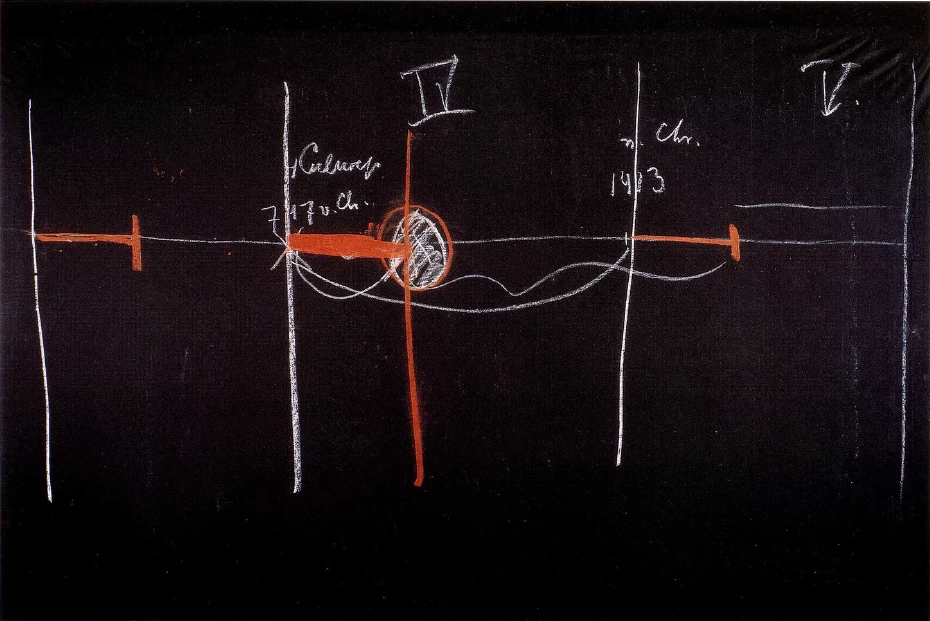
Twelfth Lecture
[ 1 ] You will recall that one of the most common criticisms—I have already cited the details—is that the Christ event, the appearance of Christ on Earth, is linked to cosmic events, to the course of the sun, to the relationship between the sun and the Earth, and so on. This matter can only be understood if we delve a little deeper into all the observations we have attempted so far regarding the movements within the solar system. And we will make a start on that today, for you will see that, ultimately, astronomy cannot be properly considered at all without addressing the entire nature of the human being. I have already mentioned this, but we will see how deeply rooted this assertion is in the very nature of the world, and one actually understands neither the nature of the world nor the nature of the human being if one considers the two so separately from one another, as is the case today.
[ 2 ] You will notice a striking fact related to what has just been mentioned. This striking fact is that actual materialism—provided it is not explicitly acknowledged—is preferred to spiritual science by the creeds as they have developed up to the present day. That is to say, both Protestant and Catholic creeds prefer that the external world, in its various realms, be viewed in a materialistic sense rather than that attention be given to how the spiritual works in the world and how the spiritual manifests itself in material phenomena. To see this confirmed, you need only take a look at the Jesuits’ scientific treatises—you will see that these Jesuit scientific treatises are materialistic in the strictest sense, and that from that perspective, there is complete agreement with a materialistic interpretation of the external world, of the cosmos. For it is precisely through this that they seek to protect a certain form of religious creed—one they have developed since the Council of Constantinople in 869—by maintaining external science at the level of materialism. Admittedly, in a certain sense, an illusion is being spread about this matter in the widest circles by seemingly combating materialism even in the scientific realm. But this is only apparent, for what matters is not whether one says that spirit exists in some way, but whether one outright denies this spirit by failing to explain the material world itself in spiritual terms.
[ 3 ] You may know that one of the highlights of the more recent scientific explanation of the external world is astrophysics, the discipline that seeks to examine the material nature of the stellar world and to subject the material unity of the world accessible to our senses to scrutiny. Now, one of the greatest astrophysicists is Father Secchi, a Roman Jesuit. It is by no means an obstacle to hold the standpoint of today’s materialistic natural science and, at the same time, to embrace this nuance of religious belief. In fact, a materialistic view of the heavens is today closer to religious beliefs—particularly according to their own view—than to that of the spiritual scientists. For, above all, these religious beliefs are concerned not with enlightening the world about the relationship between the spiritual and the material. The spiritual is to be the content of an independent creed, into which the scientific view of the world does not intrude, and the scientific view of the world is to remain materialistic; for the moment it ceases to be materialistic, it must intrude upon that which concerns the spiritual, for it must speak of the spirit.
[ 4 ] Now I ask you to take what I have just said with the utmost seriousness, for otherwise you will overlook the significant fact that, for example, the Jesuit natural scientists are the most extreme materialists in the field of natural science. Not only do they continually demonstrate that natural science cannot approach the spiritual, but they also strive to keep the spiritual as far away from natural science as possible. You can trace this all the way back to Father Wasmann’s research on ants.
[ 5 ] Now that I have made this preliminary remark, I ask you to recall a significant fact that appears to unfold entirely within the currents of the spiritual world, but which—as we now examine it more closely at this point in our discussion—will reveal to us a parallel phenomenon between spiritual life and the life of the outer stellar world. As you know, we divide the so-called post-Atlantean era into cultural epochs. We speak of a first cultural epoch—the ancient Indian cultural epoch—a second, the primordial Persian; a third, the Chaldean-Babylonian-Egyptian; a fourth, the Greek-Latin; and a fifth, which began in the mid-15th century and in which we now live. A sixth will follow, and so on. You also know that we have often considered how, within this continuous flow of the post-Atlantean era, the fourth cultural epoch begins and ends—I always say approximately around the middle of the 15th century—but ends precisely around the year 1413 A.D. (Plate 22); that is the fourth, and we are now in the fifth.
[ 6 ] If we look at the succession of cultures in this way—we can describe the content of these cultural epochs; we need only recall what is written in my *Secret Science* as a description of these cultural epochs—we can say: The ancient Indian cultural epoch was of such and such a nature, and so on. We then describe the Greco-Latin cultural epoch, into which the event of Golgotha falls, but we describe it by linking it to the preceding ones, and in a sense, when we link it to the preceding ones in this way, we do not need to invoke the event of Golgotha at all at first. We can describe the successive cultural epochs in terms of their fundamental character and, as you can see, we have a period from 747 B.C. to 1413 A.D. that unfolds in such a way that nothing indicates that a significant event occurs anywhere within it. We can even see this in history. Just consider for a moment what it was like when the event at Golgotha took place. Recall what you know from the time of that event about the cultures of the most advanced peoples of that era—the culture of the Greeks, the culture of the Romans, and the culture of the Latins. Consider that, for these people, the event at Golgotha was initially an unknown occurrence. The event at Golgotha took place in some small corner of the world, and the Roman writer Tacitus did not record traces of its impact until nearly a century later. Thus, this event at Golgotha was, so to speak, not really noticed by contemporaries—especially the most educated among them.
[ 7 ] This is also clearly expressed in the historical flow of becoming—just as in the regular, continuous progression of human development from the first, second, and third cultural epochs into the fourth—there is no immediate necessity for the event of Golgotha to occur. This is something we should examine with the utmost attention. And indeed, 747 years after the beginning of the fourth post-Atlantean cultural epoch, this event at Golgotha takes place. And when we speak of this—as we seek to understand the event at Golgotha—we speak of the fact that this event at Golgotha gives earthly life its true meaning; we speak of the fact that earthly life would lack this meaning if development were to continue simply as it had been, building upon everything that came from the first, second, and third post-Atlantean cultural epochs. What comes with this event at Golgotha is like an impact falling in from foreign worlds. This is something that is not given sufficient consideration. In more recent times, individual historians have attempted to point out this fact—I have also mentioned it before. But they have not been able to make sense of this fact. Essentially, all historians tell the story in such a way that they omit the event of Golgotha from actual history. At most, they describe the effects of Christianity in the successive post-Christian centuries. But they do not describe the actual impact of the Mystery of Golgotha within the ordinary course of history. It would indeed be difficult to describe it while adhering to the conventional historical method.
[ 8 ] There have indeed been some strange people—curiously enough, even pastors—who have tried to explain the events at Golgotha in causal terms. One such peculiar person, for example, is Pastor Kalthoff, but there are many others as well. This Pastor Kalthoff attempted to explain Christianity based on the consciousness and economic conditions that existed in the world during the centuries leading up to the emergence of Christianity. But what actually came of this explanation? Essentially, it boiled down to him saying: Yes, people lived under certain economic conditions, and that’s when the idea of Christ—the dream, as it were, of Christ, the ideology of Christ—came to them, and that is how Christology arose. So it actually arose only as an idea within people. And people like Paul and a few others described what had arisen as an idea among the people as if it corresponded to a fact in some remote corner of the world. — Such an explanation of Christianity amounts to decreeing Christianity away. And it is, after all, a remarkable phenomenon of the nineteenth century and the early twentieth century that Christian pastors had already set themselves the task of saving Christianity by decreeing Christ away. People were positively ashamed to admit the facts surrounding the origins of Christianity. They therefore found it more expedient to explain the emergence of the idea of Christology precisely as that of a mere idea. After all, today we have become embroiled in all sorts of trends in this very field, and what is known as scientific specialization has certainly made itself felt abundantly in this area as well. For you see, for example, the materialist cultural movement has emerged, which then reached its peak in Marxism. Kalthoff is a sort of Marxist pastor who attempted to explain Christology in the vein of a more devout form of Marxism. Others have used their own specific areas of expertise to explain the phenomenon of Christianity. Why shouldn’t everyone use their own area of expertise to explain the phenomenon of Christianity or of Christ Jesus? A man who was or is a psychiatrist has now turned to psychiatry and has simply explained the kind of psychiatric condition that enabled Christ Jesus to appear in such a powerful way during his time; how this can be explained from the perspective of abnormal consciousness according to current psychiatric understanding. In fact, this is not an isolated case; others have also attempted to explain that particular form of madness—which entered the world through Christianity—from the standpoint of contemporary psychiatry.
[ 9 ] Yes, all of these are simply signs of the times that must not be overlooked. For if one chooses not to look at such phenomena, one fails to see what is actually happening in the present, since they are symptoms of the whole of present-day life. We must therefore be clear that what actually gives meaning to the Earth is like an impact from another world striking this Earth. And we should actually say that we must distinguish between two currents in human development, which, although they run parallel today, only came together at the beginning of our calendar. It is only what we must call the Christian current that has been added to what was a continuous current from ancient times. Natural science, for example, has not yet incorporated the event of Golgotha; it continues to work within the continuous current as if the event of Golgotha had never taken place. And spiritual science must strive precisely to present these two things in harmony with one another: scientific observation and Christology. For where would Christology have a place if one were to follow the Kant-Laplace theory—that is, if one were to go back to a primordial nebula and simply allow everything to emerge from that primordial nebula? After all, where would Christology have any real significance for people on Earth if one were to view the starry sky the way Father Secchi did? One might say: We view the starry sky materialistically; we view it as if the event of Golgotha had never at all emerged from this starry sky. And that is the best foundation for leaving everything that is to be said about the event of Golgotha to other powers. For if one is not allowed to derive anything about the event of Golgotha from our understanding of the world, then another authority must be established to tell people what they are to think about the event of Golgotha. And it then stands to reason that one is that authority oneself—that is, that Rome is the authority in question. All these things are so consistent and, in a certain sense, even so grandly conceived that one really cannot afford to harbor any illusions about them in today’s fateful times.
[ 10 ] And these 747 years fit into the course of world history as a period that speaks with profound significance (Plate 22; red; likewise the two identical time spans to the left and right, and the circle and vertical line relative to the birth of Christ). They tell us everything related to the ancient course of world history, presenting it in a way that takes these ancient time periods into account. The new beginning, which starts after this period—747 years after the founding of Rome, which in truth was in the year 747, not the date given in ordinary history books.
[ 11 ] So here we have a new beginning. And if we were to go back now and examine the time periods, we would have to add corresponding dates to all the correctly specified points in time. A completely new division of the flow of time is brought about by the fact that the event of Golgotha falls within this point in time, as if inserted from the outside into the development of humanity. We must be clear that these two currents exist in the development of the world, insofar as humanity is involved in this development. Let us keep this in mind, and now let us look at something else.
[ 12 ] You know, the Moon moves—we can, I would say, maintain the perspective of conventional astronomy and say it moves around the Earth. In reality, it does not do so in the way it is usually described. It, too, traces a lemniscate. But let’s set that aside for now. The Moon moves around the Earth. At the same time, while it moves around the Earth, it rotates on its own axis. I have already mentioned this. It is a polite gentleman; it always faces us with the same side. Its far side is always turned away from the Earth—not quite exactly; one can really only say that, for the most part, one side of the Moon is always facing the Earth. Namely, one-seventh of the Moon does, however, move around the edges (Plate 23, top; the crescent in red); so that one can say: It is actually the case that this front side is not always facing the Earth, but after some time, one-seventh of the far side has come into view and, in turn, one-seventh has moved away. This then balances itself out again through the further movements. That one-seventh doesn’t go all the way over there, but rather returns, and the Moon essentially wobbles as it moves around the Earth. However, this is something we merely wish to mention here, for you can look up the details in any introductory astronomy textbook.
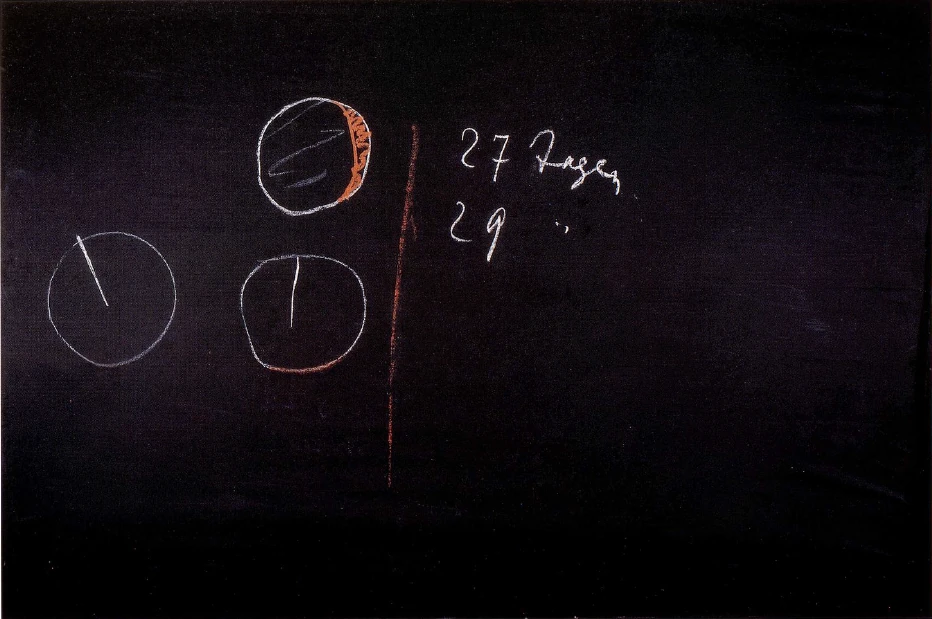
[ 13 ] If one were to transport oneself to a point in outer space that, according to astronomical calculations, would be a distant star, this single rotation of the Moon around its axis would take a little more than 27 days. However, if you were to place yourself at the Sun, you would see—since the Sun and the Moon are not moving in a uniform manner but are moving toward each other at different speeds—that the rotation, as viewed from the Sun, is not the same as when viewed from a distant star; rather, from the Sun’s perspective, it takes approximately a little more than 29 days. Thus, one can say: the lunar sidereal day is 27 days, and the lunar solar day is 29 days.
[ 14 ] This is, of course, related to all the shifts that take place throughout the universe. As you know, the sun rises at a different vernal point every spring, and the vernal point completes a full circuit around the entire ecliptic—around the entire zodiac—in 25,920 years. These relative movements cause the lunar sidereal day to be significantly shorter than the lunar solar day.
[ 15 ] Well, you see, if you consider this, you’ll realize that there’s a curious difference there, too. Every time we observe the transition from one full moon to the next, we notice a difference of nearly two days in the way the moon and sun appear. But this actually indicates that we are dealing here as well with two movements in the universe that, while they occur together, do not trace back to the same origin. And what I have now explained in cosmic terms can be compared to what I previously explained in moral-spiritual terms. There is an interim period between the beginnings of the individual cultural epochs—which follow a particular current—and those beginnings that are, so to speak, oriented toward the Christ event. There is always a necessity, once the full moon has occurred in relation to the stellar time, to wait if one wishes to observe the solar time. This takes longer. Here, too, there is an interim period. Out there in the cosmos, you have two currents: a current of movement in which the sun participates, and a current of movement in which the moon participates, which are precisely such that one can say: If we start from the lunar current, then the solar current is something that falls into this lunar current like an external impact, just as the Christ event falls into the ongoing cultural current as if from a foreign world. For the lunar world, the solar world is a foreign world. From a certain point of view, for the pagan world, the Christ world is a foreign world.
[ 16 ] Now let’s look at the same thing from a third perspective. We can do that, after all. If you try to recall exactly how human memory actually works—especially if you include your dreams in this recollection—you will find that, for example, dreams essentially incorporate what has actually happened shortly before; not in the inner process of dreaming, but in the imagery of the dream, what has happened recently plays a role. Do not misunderstand me. Of course, you may dream of something that happened to you many years ago; but you will not dream of what happened to you many years ago unless something has occurred in the very last few days that is connected, in some way of thought or feeling, to what was there years ago. The very nature of dreaming has something to do with what has happened in the immediate past. Observing this, of course, presupposes that one is open to such subtleties of human life. If one is open to them, observation yields results as precise as any exact natural science can provide.
[ 17 ] Where does this come from? It comes from the fact that a certain amount of time is needed for what we experience psychologically to be imprinted from the astral body into our etheric body. After about two and a half to three days—sometimes even after just one and a half days, or two days—but not without having slept on it—what we experience in our interaction with the world is imprinted from our astral body into our etheric body. It always takes some time for it to become firmly established there. And when we compare this fact with the other—that in ordinary life we alternately separate the physical body and the etheric body, and reunite the astral body and the I during sleep and wakefulness—we must conclude that there is a somewhat looser connection between the physical body and the etheric body on the one hand, and the I and the astral body on the other. The etheric body and the physical body always remain together between birth and death, and the “I” and the astral body also remain together. But the astral body and the etheric body do not remain together. They separate every night. There is a looser connection between the astral body and the etheric body than between the etheric body and the physical body. This looser connection is expressed by the fact that there must first, so to speak, be a separation between the astral body and the etheric body before what we experience through our astral body is imprinted upon the etheric body. And we can say that when any event affects us, it does so while we are awake. Just consider this: when you encounter an event while fully awake, that event affects your physical body, etheric body, astral body, and your “I.” Yet there is still a difference in terms of how these are received. The astral body takes in the event immediately. The etheric body needs a certain amount of time to allow the event to become firmly established within it, so that there is now complete harmony between the etheric body and the astral body. Doesn’t this clearly and unambiguously indicate to you that, even though you face the event with all four members of your human being, there are two currents that do not proceed at the same pace in their relationship to the external world, one of which takes longer than the other? Here you have the same thing you find in history, the same thing you find in the cosmos—the moon and the sun, paganism and Christianity—here you have the same thing: etheric nature, astral nature—the difference being a period of time. This interplay of two currents—which converge and produce shared results for life, but which must not simply be understood as the causes and effects of one current overlapping with those of the other—thus extends into our everyday life.
[ 18 ] You see, these are matters of fundamental importance for our view of the world and our view of life—matters we simply cannot do without if we wish to understand the world. And at the same time, they are facts that are not mentioned anywhere today, that are completely overlooked. And what do these facts reveal? They show that a certain harmony exists between cosmic life, historical life, and the life of the individual human being—but not a harmony constructed in the way it is usually presented today, when people try to force everything to conform to the materialistic biogenetic law. It follows from this that we cannot have just one kind of astronomy, but rather that we need different kinds of astronomy: lunar astronomy and solar astronomy. You see, if you have two clocks (Plate 23, bottom), one of which always runs a little slow compared to the other, the other will always be ahead, and the one will always be behind; but you can never assume that what happens on one clock is caused by the other clock. You cannot do that, even though a certain regularity exists, of course, in that one clock is always behind by the same amount. But the two have absolutely nothing to do with each other; they interact only when I look at them together. Nor does solar astronomy have anything to do with lunar astronomy. It is only in our universe that the two act together.
[ 19 ] That is the important thing—you see, to keep that in mind. And just as one must distinguish between solar astronomy and lunar astronomy—that is, between the regulation of the Sun’s motion and that of the Moon’s—so too must one distinguish in history between what takes place within us as a result of the course of events as we describe them in the cultural periods, and what happens within us as a result of our designation of those historical epochs that have their focal point in the event at Golgotha. These two things initially interact in the world. But if we are to come to grips with them, we must distinguish them from one another. We see the archetype of the historical in the cosmic, and we see the ultimate expression—I do not say the effect — of the same universal fact in our own lives in the two or three days that must pass before our thoughts have become sufficiently consolidated that they are no longer so high up in our astral body as to appear effortlessly as a dream, but are instead down in our etheric body and must be brought up through active recollection or through something that resonates with them. Within us, then, one current flows into another. Just as we must imagine that there is a lunar current that generates, so to speak, independent structures of movement, and alongside it the solar current, which in turn has its own independent structures of movement, so must we imagine that, through our physical body and etheric body, our own human being is more closely connected to something extra-human, and, on the other hand, are more closely connected to something else beyond the human realm through our astral body and our “I.”
[ 20 ] The current way of looking at these things casts a veil of obscurity over them, throwing everything into confusion; it assumes a cosmic nebula and allows this nebula to condense. From it emerge suns, planets, and moons. But that is not how it is. Suns and moons do not arise from the same origins; rather, these are two parallel currents. Nor can one find the same origin in what constitutes the “I” and the astral body in the human being, and what constitutes the physical and etheric bodies. These are two different currents. And if you read my *Secret Science*, you will see how you must trace these two distinct currents back to the Solar Age. Then, however, when we go back from the Sun to Saturn, a certain kind of unity is present. But that, of course, lies very far back in time. But from that point on—as you know—I had to describe it in such a way that there is, in fact, a continuous tendency for these two currents to run parallel to one another.
[ 21 ] Today I simply wanted to explain to you how necessary it is to shed light on the parallels between cosmic existence, historical existence, and human existence in order to form any judgment at all about how one should relate to the movements of the world. You have seen that, when one takes the right stance, not one astronomy follows, but two: solar astronomy and lunar astronomy. And in the same way, there is a becoming-human of a pagan nature—natural science is still pagan—and a becoming-human of a Christian nature. And in our time, many people have a tendency not to allow these two currents, which have now truly met on Earth to work together, to come together.
[ 22 ] Just look at how the whole point—the rest is nonsense anyway—how the whole point of a pamphlet like Traub’s lies in the fact that it actually says: Yes, Steiner would like the two currents, the pagan and the Christian, to come together. We do not want to allow that; we want natural science to remain pagan forever, so that we do not have to allow anything to happen to Christianity that would bring it together with natural science. — Of course, if one leaves natural science pagan, Christianity cannot come together with natural science. Then one might say: Natural science is pursued in an outwardly materialistic way, while Christianity is founded on faith. The two must not be brought together. — But Christ truly did not appear in the world so that, alongside his impulses, pagan impulses might become ever more powerful; rather, he appeared to permeate those pagan impulses. And the task of the present age is to unite what people would like to keep separate—knowledge and faith. And this must happen. That is why attention must also be drawn to such matters, as I have indeed done in one of my recent public lectures. On the one hand, the creed has come to the point of refusing to allow cosmology to be introduced into Christology; on the other hand, cosmology has arrived at the principle of the indestructibility of matter and force. If one regards matter and force as indestructible and eternal, this entails the trampling underfoot of all ideals. But then Christianity, too, is meaningless. Only and exclusively if what we now call matter and the laws of matter is a temporary phenomenon, and if what we are now experiencing in connection with Christology—with the Christ impulse—is a seed for what will endure when matter and force, as they now operate according to the laws, no longer exist but will have perished, only then—and only then—do Christianity, moral ideals, and human dignity have true meaning. There are two great opposites. One stems from the ultimate consequence of paganism and states: Matter and force are imperishable; the other stems from Christianity and states: Heaven and earth will pass away, but my words will not pass away.
[ 23 ] These are the two greatest opposites that can be articulated in a worldview. And our time has every reason not to brush aside such matters in a confused manner, but to look at them seriously and with an alert spirit to determine what must be achieved as a worldview, so that moral human dignity and the Christian impulse are not lost in the course of world development amid the illusion of indestructible matter and indestructible force. More on this tomorrow.