Perspectives on Human Evolution
The Materialistic Impulse toward Knowledge
and the Task of Anthroposophy
GA 204
2 April 1921, Dornach
Translated by Steiner Online Library
First Lecture
[ 1 ] The period of materialist development lies primarily in the middle and second half of the 19th century. Today, we may initially be more interested in the theoretical side of this materialist development. However, much of what I will say today about this theoretical aspect can also be said in roughly the same way about the more practical, everyday aspect of materialism. But, as I said, we will set that aside for today; we want to focus more on what emerged throughout the civilized world in the middle and second half of the 19th century as the materialist worldview.
[ 2 ] Such a matter actually involves two aspects. First, we must be clear about the extent to which something like the materialist worldview must be combated; we must, so to speak, carry within ourselves all those concepts and ideas that equip us to reject the materialist worldview as such. However, in addition to being equipped with the necessary conceptual framework, we need something else, particularly from the perspective of spiritual science. We need to understand this materialistic way of thinking—first, in terms of its content, and second, to understand to what extent this extreme materialistic worldview could have arisen in the course of human development.
[ 3 ] It might seem like a contradiction that, on the one hand, it is argued here that one must be able to combat the materialist worldview, and on the other hand, that one must be able to understand it. For those who stand on the ground of spiritual science, this is not really a contradiction, but only an apparent one. The situation is rather as follows: In the course of human development, moments must arise that initially pull humanity down in a certain way—that bring humanity below a certain level—so that it can then raise itself up again through its own efforts. And it would be of no help to humanity if it could be spared, through some divine decree or the like, from having to pass through the depths of existence. It is absolutely necessary for humanity—so that it may come to the full use of its powers of freedom—to descend into the depths of both its worldview and its life. And the danger does not actually lie in the fact that such a thing occurs at the right time—which, for theoretical materialism, was actually the mid-19th century—but rather in the fact that, once such a thing has arisen in the course of normal development, it is clung to, so that what was necessary for a certain point in time is carried over into future times. And while it can be said that, in a certain sense, materialism was a trial that humanity had to undergo in the mid-19th century, it is also true, on the other hand, that clinging to materialism now is bound to cause terrible harm, and that the terrible global and human catastrophes we are experiencing are precisely due to the fact that humanity, in large circles, wishes to cling to this materialism.
[ 4 ] What does theoretical materialism actually mean? It refers to the view that human beings are, first and foremost, the sum of the material processes that constitute their physical bodies. Theoretical materialism has studied the physical and sensory processes of the physical body, and even though what it has achieved in this study is, for the time being, more or less in its infancy, it has already drawn the ultimate conclusions regarding worldviews. It has, so to speak, explained human beings as the convergence of these physical forces, and it has explained their mental life as something that is merely brought about by the interaction of these physical forces. But he has also initiated the investigation of the physical nature of the human being. This latter endeavor—the further investigation of the physical nature of the human being—is what must endure. What the 19th century drew as a consequence from this physical investigation is what must remain a temporary phenomenon in human development. But let us first understand it as such a temporary phenomenon.
[ 5 ] What exactly are we dealing with here? Well, if we look back at human evolution—and, based on what I have outlined in An Outline of Esoteric Science, look back quite far—then we must say: This human being has gone through the most diverse stages. — We need only limit ourselves to what the human being has undergone in the course of Earth’s evolution, and we will have to conclude: In the course of Earth’s evolution, this human being began with a form of development that was indeed primitive in relation to its present form, then transformed this form of development, and came closer and closer to the form that human beings have today. As long as one remains within the broad outlines of human form, one will not find the differences to be exceptionally great when tracing the historical existence of humankind. For example, anyone who, using the sources available for external history, wishes to compare the form of an ancient Egyptian or even an ancient Indian with that of a person from today’s European civilization will find only relatively minor differences if they remain strictly within the broader scope of observation. In terms of this broader perspective, the major differences compared to the primitive forms of development that early humans possessed only become apparent in times that lie far beyond the historical record. But when we delve into finer details—when we examine what is indeed hidden from outward view—then what I have just said no longer applies; then one must certainly say: There is a great, significant difference between the organism of a modern civilized human being and that of an ancient Egyptian or even an ancient Greek or Roman. And even though this transformation took place in a much more subtle way during historical times, it did indeed occur with regard to all the finer aspects of the human organism. And what took place there reached a certain culmination, a certain peak, in the middle of the 19th century. As paradoxical as it may sound, it is indeed the case that, in terms of its inner formation—in terms of what the human organism is capable of becoming—human beings were at their most perfect around the middle of the 19th century, and that precisely since that time a kind of decadence has set in once again, with the human organism undergoing a process of regression. Consequently, it was also the case in the mid-19th century that those organs which serve as the physical organs of intellectual activity were the most fully developed.
[ 6 ] What we call the human mind, the human intellect, requires physical organs. In earlier times, these physical organs were far less developed than they were in the mid-19th century. It is certainly true that what we admire, for example, in the Greeks—even in such consummate Greeks as Plato or Aristotle—is based on the fact that these Greeks did not possess thinking organs as perfect in the purely physical sense as those of the people of the 19th century. Depending on one’s inclination, one might say: Thank God that the people of the Greek era did not have such perfect cognitive faculties as the people of the 19th century! — But if one is a sober-minded person of the 19th century oneself and wishes to maintain this sobriety, then one might say: The Greeks were, after all, children; they did not yet possess those perfect organs of thought that people of the nineteenth century have, and one must therefore look down upon what Plato and Aristotle brought to light with a certain degree of indulgence. — High school teachers often do this by feeling immensely superior when criticizing Plato and Aristotle. But one will only fully understand what I have just hinted at if one has become acquainted with people—and such people do exist—who, to a certain degree, possess a kind of insight, that which, in the best sense of the word, can be called a kind of clairvoyant consciousness.
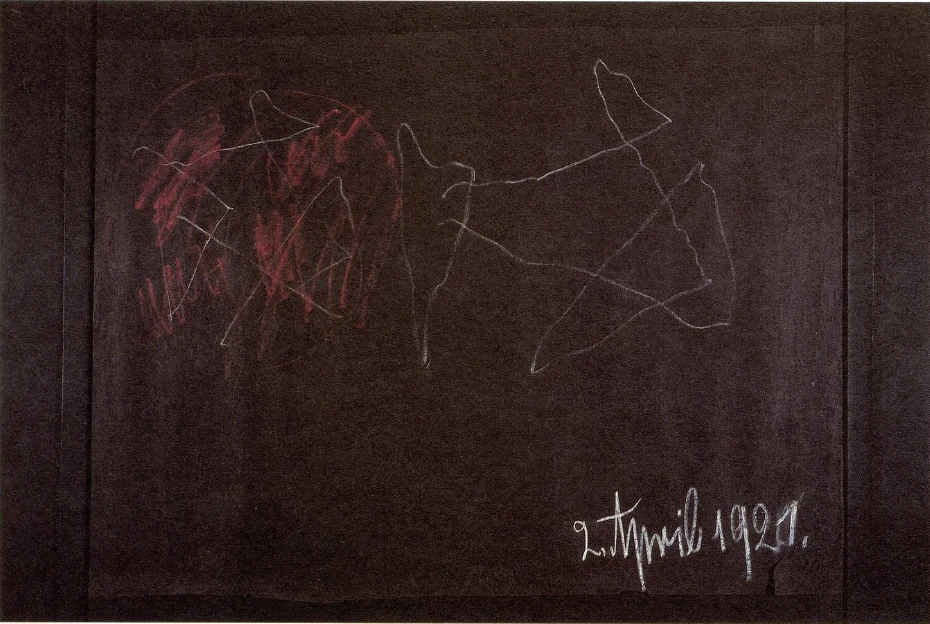
[ 7 ] For people who possess such clairvoyant consciousness today—and I ask those in this auditorium who might have such clairvoyant consciousness to forgive me for stating this truth—the existence of this clairvoyant consciousness may be due precisely to the inadequate development of their intellectual faculties. It is indeed a quite common phenomenon that, within our present-day world, we can encounter people with a certain clairvoyant consciousness who actually possess very little of what is today called the scientific intellect. And as true as this is, it is equally true that such clairvoyant people may come to record or recount certain things that they themselves bring forth through their insight, and that in these accounts, in these records, there live thoughts that are far more intelligent than the thoughts of those people who, without developing clairvoyance, work with the very best tools of the intellect. It can happen that, from the standpoint of modern science, “stupid”—pardon the expression—“stupid” clairvoyant individuals produce thoughts that, while not making them any smarter, are nonetheless more intelligent than the thoughts of today’s most authoritative scientists. This fact is already very much a reality. And on what does it rest? It is based on the fact that such clairvoyant individuals do not need to exert their thinking faculties at all to arrive at these thoughts. They create the relevant images from within the spiritual world, and the thoughts are already there—they are already complete—while other people, who are not clairvoyant and can only think, must train their thinking faculties to form their thoughts. Schematically drawn, it would look like this. Let’s assume that such clairvoyant individuals bring forth all sorts of images from the spiritual world; let this (see drawing, red) be an example of something that comes out of the spiritual world through such individuals. But inside there are thoughts; there is a network of thoughts inside. The individuals in question do not think these thoughts; rather, they see them and bring them back from the spiritual world; they do not need to exert their thinking faculties.
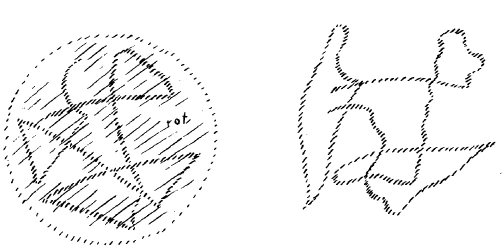
[ 8 ] Let’s consider someone else who does not possess clairvoyant abilities but is capable of thinking; as for the red element, there is nothing of it within him—he cannot bring it forth; nor can he bring forth this skeletal framework of thought (see drawing on the left) from the spiritual world; but he strains his thinking faculties and then, through his thinking faculties, brings this skeletal framework of thought into being (see drawing on the right).
[ 9 ] If one observes people today, one can see the gradations between these two extremes everywhere. For those who have not trained their powers of perception, however, it is extremely difficult to distinguish whether another person is truly intelligent in the sense that they think through their intellectual faculties, or whether they do not think through their intellectual faculties at all, but rather somehow brings something into their consciousness, and that only what is pictorial, what is imaginative, develops within them—though so weakly that they themselves do not notice it. And so there are all kinds of people today who produce very intelligent thoughts but need not be intelligent at all because of this, while others think very intelligent thoughts but are in no special way connected to any spiritual world. Training oneself to make this distinction is one of the significant psychological tasks of our time, and it provides the foundation for an important understanding of human nature in the present. If you take this as an explanation, it will no longer be so incomprehensible to you that empirical supersensible observation reveals that, in the mid-19th century, the human organism possessed the most perfect thinking organs in the vast majority of people. Never has there been such an exclusive focus on thinking as there was around the mid-19th century, and never has thinking been as unwise as it was at that time.
[ 10 ] Just go back—which is something people don’t do today—to the 1820s or earlier in the 19th century, and read through what was produced scientifically at that time, and you will see: it has a completely different tone; it is by no means characterized by that entirely abstract way of thinking—reliant on the human physical organs of thought—as it was later, not to mention the kind of ideas produced by figures such as Herder, Goethe, and Schiller. There are still magnificent insights alive within them. The fact that people do not believe this, and that commentaries today speak as if that were not the case, is irrelevant. For those who write these commentaries and who believe they understand Goethe, Schiller, and Herder—they simply do not understand them; they fail to see what is most important about them.
[ 11 ] It is an important fact that, around the middle of the 19th century, the human organism had, in terms of its physical form, reached a kind of culmination, a peak, and that since then it has been in decline—and, in a certain sense relevant to our rational understanding of the world, it has been declining rapidly.
[ 12 ] The emergence of materialism in the mid-19th century, however, is closely linked to this fact. For what, exactly, is this human organism? — This human organism is, after all, a faithful reflection of the human spirit and soul. It is hardly surprising that, to those who are unable to grasp the spiritual and soul aspects, the structure of this human organism already appears to be an explanation of the whole human being. This becomes particularly evident when one considers the organization of the head and, within the head, the nervous system in particular.
[ 13 ] I recently mentioned an experience during my lectures in Stuttgart that really sheds light on this matter. I said: It happened at the beginning of the 20th century at a meeting of the Berlin Giordano Bruno Society, where a man—whom I would call a staunch materialist—spoke first; he was a very knowledgeable materialist who understood the structure of the brain just as well as anyone who has studied it conscientiously truly understands it today; and he was one of those people who actually see the entire science of the soul in the analysis of brain structure—who say: One need only understand how the brain works, and then one has the soul; then one can describe the soul. — Well, it was interesting; he sketched these various parts of the brain on the blackboard—the connecting pathways and so on—and presented precisely that marvelous picture one obtains when one traces the structure of the human brain. And he truly believed that by describing this structure of the brain, he had provided something that constitutes the study of the soul. After he had presented his arguments, a staunch philosopher, a Herbartian, rose to his feet. This Herbartian said: “I must, of course, firmly oppose the views this man has put forward—namely, that one already possesses the study of the soul simply by explaining the structure of the brain; but I need not object at all to the diagram he drew; this diagram agrees quite well with my Herbartian view that ideas associate with one another, that certain connecting threads of a purely psychological nature run from one idea to another.” And he added that, as a Herbartian, he could very well draw the same diagram; it’s just that, for him, the individual circles and so on would not represent parts of the brain, but rather complexes of ideas. But the diagram would remain exactly the same!
[ 14 ] Very interesting, you see! When it comes to placing the matter within reality, people hold completely opposing views; when they draw pictures of the same thing, they should actually produce the same drawings, and one is a die-hard Herbartian philosopher, while the other is a staunch materialist physiologist.
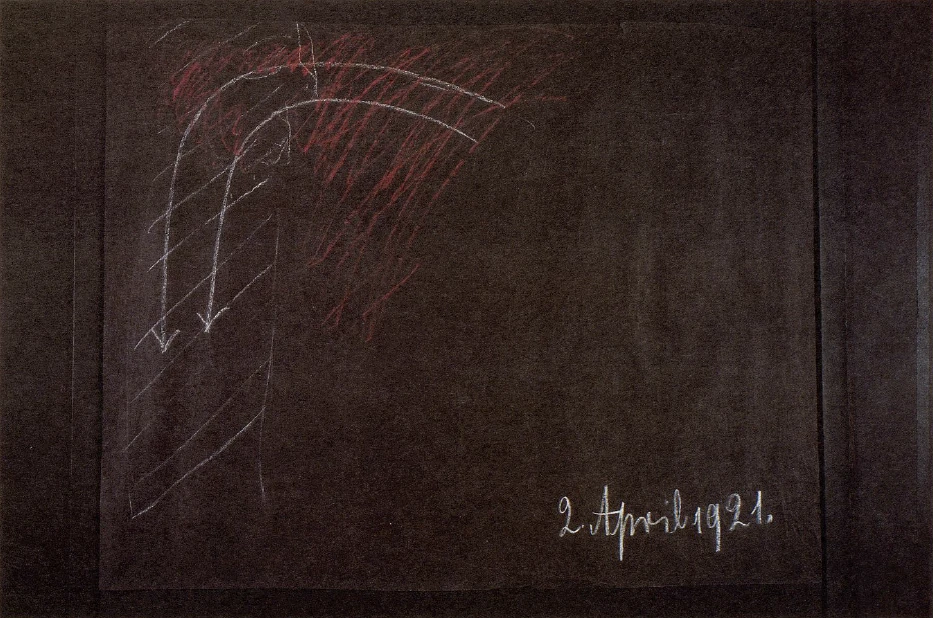
[ 15 ] What is the basis for this? It is based on the fact that this is indeed the case: We possess the spiritual-soul nature of the human being; we carry it within us. And this spiritual-soul nature is the creator of the entire form of our organism. And we need not be surprised that where the organism has its most perfect part—in the nervous system of the brain—the image that the spiritual-soul being projects there looks perfectly similar to this spiritual-soul being. It is indeed the case that where the human being is most—if I may put it this way— human—in his nervous structure—he is a faithful image of the spiritual-soul aspect, so that the person who is content with the image, who above all wants to have something sensory before him and is content with the image, in fact sees in the image the very same thing that one initially sees in the spiritual-soul aspect of the human being. And since they have no desire for the spiritual-psychic realm—since, in a sense, they want only the image—they cling to the structure of the brain. And because this structure of the brain appeared to the observer around the middle of the 19th century as particularly perfected, it was, given the disposition of humanity at that time, incredibly natural to develop theoretical materialism. For what is actually present in the human being? If we consider the human being as such—I will sketch him schematically here—and then examine the structure of the brain, we see that, first of all, the human being is a threefold being, as we know: the human being of the limbs, the human being of rhythm, and the human being of nerves and senses. When we look at the nervous-sensory human being, we have before us the most perfect part of the human being, so to speak, the most human part. In this most human part, the external world is reflected (see diagram, red). I will illustrate this reflection by referring, for example, to perceptions through the eye. I could also draw perceptions through the ear, and so on. The external world, then, is reflected in the human being, so that we have before us the structure of the human being and the reflection of the external world within this human being. As long as we view the human being in this way—even if we go beyond the sometimes rather crude notions of materialism—we cannot help but interpret the human being in materialistic terms. For on the one hand, we have the structure of the human being. We can trace this structure in all its finer tissue structures and, the further we move upward toward the organization of the head, the more we obtain a faithful reflection of the spiritual-soul aspect. And we can then continue to trace what is reflected in the human being from the external world. But that is merely an image. We have the reality of the human being, which we can trace down into its finer structures, and we have the image of the world.
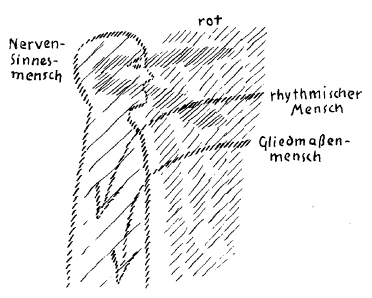
[ 16 ] Let us keep this clearly in mind: we have the reality of the human being in the structure of his organs, and we have that which is reflected within the human being. That is, in fact, all that is initially present to external sensory observation. In this external sensory observation, the following is essentially the case: this entire structure of the human being disintegrates when the person dies—it disintegrates as a corpse. Furthermore, the images of the external world are present in this structure. If you break a mirror, nothing can be reflected anymore; thus, the images also vanish when a person passes through death. Is it not, then, natural that external sensory-physical observation reveals nothing other than what I have just described, that one must say: With death, the physical structure of the human being disintegrates? — It used to reflect the external world. What the human being carries within the soul is a reflection; but that passes away. This fact was simply posited by nineteenth-century materialism. It had to present it that way because, after all, it knew nothing else. Now, however, the matter takes on a different aspect when one delves a little into human spiritual and soul life itself. But there we are already entering a realm where physical-sensory observation cannot penetrate.
[ 17 ] Let us take a straightforward sequence of facts concerning the soul—the simple sequence of facts that arises from our observing the external world. We observe things, we perceive them, and then hold them within us as images. But we also have a memory, a capacity to recall. What we experience in the external world, we can in turn bring to the surface in images from the depths of our being. We know what significance this memory has for human beings. Let us first pause at this sequence of facts. Consider these two inner experiences: You look at the external world through your eyes, or hear it with your ears, or perceive it in some other way through your senses. There you are engaged in a present moment of soul activity. This flows into your imaginative life. What you have experienced today, you can bring back in a few days as images from the depths of your soul. Something enters you in some way, and you bring it back out of yourself. It is not difficult to see that what enters the soul must originate from the external world. I do not wish to delve into anything other than the plain fact—which is, after all, plain to see—that what is recalled in this way must come from the outside world. For if you have seen any red object, you recall that red object, and what has taken place within you is merely the image of the red object that resurfaces within you. So it is something that the external world has imprinted upon you, imprinted more deeply than when you are merely engaged in the external world through immediate imagination. But now imagine this: you approach something, observe it—you are thus engaged in a present activity of the soul in relation to what you are observing. You leave it; after a few days, you have reason to bring the images of what you observed back up from the depths of your being—there they are again; they are paler, certainly, but they are there; they are present within the person. But what happened in the meantime?
[ 18 ] Now I ask you to keep in mind what I have told you and to compare this peculiar interplay of present perceptions and memories with what you know well as the image of a dream. You will easily be able to see how dreaming is connected to memory. After all, the images in a dream need not be very confused; then you will see how they tie in with the images of memory—that is, how there is a connection between dreaming and that which passes from living images into memory.
[ 19 ] But now consider something else. A person must be in perfect physical health if they are to, so to speak, handle dreaming properly. Part of dreaming is having complete control over one’s body, so that the moment can always arise again when one realizes: “That was a dream.” — Something must be wrong if someone cannot reach the moment when they fully realize: “That was a dream.” After all, we have all met people who have dreamed that they were beheaded. Now imagine if these people, afterward, could not distinguish between this dream of being beheaded and the actual beheading, and believed that they had indeed been beheaded yet still had to go on living—just consider for a moment how little such people could reconcile the facts through this distinction without becoming confused. They would have to constantly experience: “I’ve just come from being beheaded.” — And if they were forced to assume that they had to believe that, then one can roughly imagine what words would escape their lips. So, the point is that a person always has the ability to maintain enough self-control to distinguish dreams from being immersed in reality through their imagination. But there are also people who cannot do that. There are people who experience all sorts of hallucinations, visions, and the like, and take them for reality. They cannot distinguish between the two; they do not have such strong self-control. What does this mean? It means that, for these people, what lives in their dreams influences their mental constitution, that their mental constitution is adapted to their dream imagery. Somewhere in their nervous system, they have not fully developed something that should be fully developed; therefore, the dream is active within them; it exerts its influence on them.
[ 20 ] So if anyone is unable to distinguish their dream images from the realities they have experienced, this means that the power of dreams is having an organizing effect within them. As soon as the power of dreams took hold of our entire brain, we would perceive the whole world as a dream. Anyone who can contemplate such a fact in its full significance will gradually arrive at insights that our conventional science today is unwilling to embrace—because it lacks the courage to do so; they will come to realize that what is at work in the life of dreams is the very same force that constitutes our power of organization, our power of growth and vitality. It is only because our organism is, so to speak, so consolidated within itself—possessing such firm structures that it resists ordinary dreaming—that the power of ordinary dreams lacks the strength to tear its structure apart, and the human being is able to distinguish the dream experience from the experience of reality.
[ 21 ] But when a child is small and growing up—that is, as it gets bigger and bigger—there is a power within it. This is the same power that exists in dreams, except that in dreams we can see it. And when—instead of seeing it—this force, which is otherwise present in dreams, is at work within the body, then one grows through it. And one doesn’t even need to go so far as to observe the process of growth. Even when you eat every day, for example, and digest what you’ve eaten, distributing it throughout your entire organism, this happens through the force that lives in dreams. Therefore, if something in the organism is not right, it is also connected to incorrect dreaming. It is the same force that is visibly at work in the life of dreams, and that works within you, even down to your digestive functions.
[ 22 ] Thus we can say: If we only look properly at a person’s life, we become aware of the active force of trauma within their organism. And in describing this active force of trauma, I am actually following the same path in this description that I must follow when describing the human etheric body.
[ 23 ] Just imagine if someone could see through everything that develops within a human being from childhood onward—what causes digestion in a human being, what works within a human being to maintain the entire organism in its activity; imagine if I could take this entire system of forces, remove it from the human being, and place it before people—then I would have placed the etheric body before them. This etheric body—this body, in other words, that reveals itself only in irregularities during dreams—was much more fully developed prior to the point in the 19th century that I mentioned. Its structure grew weaker and weaker. In contrast, the physical body’s structure grew stronger and stronger. The etheric body can form images; it can have dreamlike imaginings, but it cannot think. And as soon as this etheric body begins to be particularly active in any person today, then what I said earlier happens: the person becomes somewhat clairvoyant; but they are then less able to think, for thinking requires precisely the physical body.
[ 24 ] It is therefore not surprising that when people in the 19th century felt they were particularly capable of thinking, they were in fact driven toward materialism. To put it another way, what helped them most in this way of thinking was this physical body. But it is precisely this way of thinking—this physical thinking—that is linked to the particular kind of memory that developed in the 19th century; it is a memory that is perhaps not very vivid, perhaps tending toward abstractions.
[ 25 ] This is an interesting phenomenon. I have often cited the criminal anthropologist Moriz Benedikt; today I would also like to mention an interesting experience that he himself recounts in his Memoirs. He was scheduled to give a speech at a meeting of naturalists, and he recounts that he prepared for this speech by staying awake day and night for twenty-two nights. He spent twenty-two nights preparing the speech, and on the last day before he was to deliver it, a journalist came to see him to publish the speech. He dictated it to the journalist. He hadn’t written the speech down, he says; he had merely committed it to memory. He dictated it to the journalist—in his little study, to be precise—and then he delivered the speech at the naturalists’ conference. What the journalist printed after the dictation matched exactly, word for word, what Benedikt then presented to the naturalists’ conference. — I must say, I admire something like that immensely! For one always admires what one would never be capable of accomplishing oneself. So this is a very interesting phenomenon. The man worked on it for twenty-two nights, incorporating what he had prepared, word for word, into his own system, so that he could never have phrased any sentence differently in the sequence of words than it was embedded in his system—so firmly was it embedded there.
[ 26 ] Something like this is only possible if one can imprint the entire speech—in its gradually taking shape—upon the physical organism. It is indeed true that what one conceives there is imprinted upon the physical organism just as firmly as the forces of nature firmly build up the skeletal system. Then this entire speech rests within the physical organism like a skeleton. Memory is usually bound to the etheric body, but here the etheric body has been fully imprinted upon the physical organism. The entire physical organism contains within itself—just as it contains its bones—something that stands as a skeleton for this speech. Then one can also do something like what Professor Benedikt did. And something like this is only possible if the nervous structure of this physical organism is developed in such a way that it incorporates—without resistance—into its plasticity whatever is brought into it; though this must be worked in gradually, over the course of twenty-two days or, rather, twenty-two nights.
[ 27 ] It is no wonder that someone who relies so heavily on his physical body comes to feel that this physical body is the only active force within a human being. — And human life had gradually come to be such that it became entirely absorbed in the physical body, leading people to believe that the physical body is everything in the human organism. I do not believe that any other era than the one that places such great value on the physical body could have come up with such a grotesque invention—forgive me for using that expression—as shorthand. For when shorthand did not yet exist, people did not place such importance on recording words and word sequences so absolutely, nor on imprinting the words as firmly as they are intended to be recorded in shorthand. Only the imprint in the physical body can fix them so firmly. Thus, it is precisely this particular preference for imprinting in the physical body that also gives rise to the other preference: to preserve this imprinted word—and indeed, not just to preserve anything, but something elevated to a higher level. For shorthand would have no place there if one were to record the forms that are imprinted in the etheric body. It took a materialistic tendency to invent something as grotesque as shorthand.
[ 28 ] Well, this should just be added by way of explanation to what I would like to contribute to the issue: understanding the emergence of materialism in the 19th century. Humanity had reached a certain state that tended toward the imprinting of the spiritual-soul aspects onto the physical organism. You must take what I have said as an interpretation, not as a criticism of shorthand. I do not want shorthand to be abolished right away. That is never the intention underlying such characterizations. For one must be quite clear about this: just because one understands something does not mean one necessarily wants to abolish it right away! There are many things in the world that are necessary for life, but which cannot serve every purpose—I do not wish to elaborate further on this topic—and which one must nevertheless understand in terms of their necessity. But we live—and I must emphasize this again and again—in an age in which it is absolutely necessary to delve a little more deeply into both the development of nature and the development of culture, to be able to ask ourselves: Where does this or that phenomenon come from? — For mere snide condemnation and criticism are not enough; one must truly understand all things in the world.
[ 29 ] So I would like to summarize what I have discussed today by saying that the development of humanity shows us that, in a sense, the structural perfection of the physical body reached a peak in the middle of the 19th century, that decadence is now setting in once again, and that the rise of the theoretical materialist worldview is connected with this perfection of the physical body. I will, of course, have more to say about these matters in the coming days from one perspective or another. Today, I simply wanted to present to you what I have just summarized.