Perspectives on Human Evolution
The Materialistic Impulse toward Knowledge
and the Task of Anthroposophy
GA 204
5 May 1921, Dornach
Translated by Steiner Online Library
Thirteenth Lecture
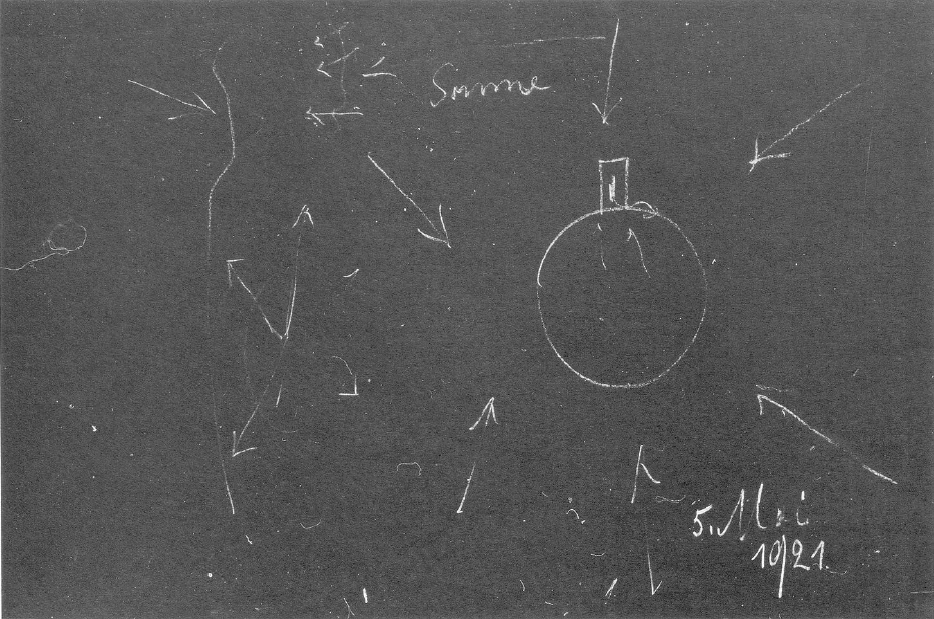
[ 1 ] The fourth post-Atlantean epoch, during which humanity’s intellectual development took place, was guided by the Greek mysteries. It was the mysteries that first imparted to the general population of the Near East and southern Europe the foundations of this intellectual or spiritual culture. In these mysteries, the secret of humanity’s coexistence with the sun played a major role. We know, of course, from the descriptions I have given in my Theosophy, how the “I” shines forth within the human intellectual or emotional soul, and how it is then to attain, so to speak, its full inner power through the soul of consciousness. Insofar as the human “I” was, so to speak, to be awakened during the era of intellectual culture, the mysteries of that time had to deal with the secrets of the life of the Sun and its connections to what the human “I” actually is. You are also familiar, from my exposition of The Riddles of Philosophy, with how the Greeks still perceived their ideas and concepts in the external world in the same way that we today perceive colors, sounds, and so on. What lived in their ideas was by no means, for the Greeks, merely something created inwardly in the soul; rather, it was something they perceived in things themselves. In this respect, Goethe certainly had something Greek about him, which he demonstrated when, upon hearing Schiller’s words in their famous conversation—that his ideas, that is, something conceptual and ideal, were not perceptions but an idea—he replied that he then saw his ideas before him just as he saw external perceptions.
[ 2 ] This Greek way of relating to ideas was closely linked to a very specific sensation the Greeks experienced when they turned their gaze toward the external world. In everything that shone before them as the content of their imagination, they saw, in essence, the creation of solar life. They sensed that, as the sun rose in the morning, the life of the imagination also arose in space, and when the sun set, they sensed the world of the imagination sinking back into the night. One cannot understand the development of peoples unless one fully takes this change in the life of the soul into account.
[ 3 ] This, my dear friends, is something that has actually been lost to human beings in their inner life: the ability to sense the spirituality of their entire surroundings. Today, when a person sees the sun rising, they are aware only of the colorful and luminous phenomenon in the air that meets their gaze. And it is the same when they see the sun disappear into the evening twilight. The Greeks had the sense that in the morning the world that brings them their concepts rises, and that in the evening it sets—that in the evening the world comes that withdraws this world of concepts from them. They therefore felt as though they were left without concepts in the darkness of the night. And when he looked out into the sky—which we see as blue, but for which he used the same term as for darkness—he actually felt the world bounded by that which lay outside the realm of imagination. For him, the life of imagination, as it is bestowed upon human beings, ceased where he perceived the limits of outer space. Beyond this universe lay, for him, other worlds of thought—the worlds of thought of the gods. And he saw them as closely bound to what he called light. They revealed themselves to him, as it were, concentrated in the life of the sun, while otherwise they eluded him in the vastness of the dark celestial firmament. One must look into this entirely different world of perception if one wishes to understand how, after this way of viewing the world—with all its inner vitality—had been at work for a time in the development of humanity, humanity’s most advanced representatives came to feel that they could no longer perceive the life of the sun in the cosmos as something that spiritually radiated back to them, and how, in the earliest times—and this was particularly the case among humanity’s most advanced representatives, those who had still received their education in the Greek mysteries—how they perceived the Mystery of Golgotha as a redemption, insofar as it gave them the possibility of now kindling the light within themselves. The light that he had previously truly experienced as divine, he now wished to experience by taking part, with his soul and spirit, in the events of the Mystery of Golgotha. One cannot truly understand what has actually taken place within humanity over the course of millennia by merely looking at these things with the intellect. One must take into account the transformation of the human mind and of the human soul life in its entirety. And we, who have been living in the age of the development of the conscious soul since the beginning of the 15th century, have, after all, retained only the shadow of our inner intellectual activity from that intellectual spirituality that existed in the times of the fourth post-Atlantean period. I have, after all, elaborated on this here in recent weeks. But we must once again bring ourselves to recognize what this intellectual being—this shadowy intellectual being—can be permeated by through a living vision of the universe. It is precisely through modern intellectual shadow culture that human beings have, so to speak, been bound to the Earth. Today, especially when they allow themselves to be influenced by the ever-spreading, purely scientific culture, they consider only what the Earth actually provides them. He has no idea that, with his entire being, he does not merely belong to the Earth, but that, with his entire being, he belongs to the outer universe. And this is what human beings must regain: this awareness of their connection to the outer universe.
[ 4 ] Today, we simply form our concepts and ideas by taking earthly life as our starting point and constructing the entire universe based on this earthly life. But the worldview that results from this is not much different from a projection of earthly conditions onto extraterrestrial ones. And so it has come to pass that, based on the magnificent achievements of modern natural science—spectral analysis and other findings—a conception of the Sun has been formed that is actually modeled entirely on earthly conditions. We imagine what a luminous gaseous body looks like. And now this view of a luminous gaseous body is transferred to what appears to us as the Sun in the vastness of the cosmos. We must learn once again to apply spiritual-scientific principles in order to arrive at a conception of the Sun. This Sun, which the physicist believes would present itself to him as a luminous gaseous sphere if he were to venture out into outer space; this Sun, even though it reflects the light of the universe back to us in its own way, just as it receives it, is a thoroughly spiritual being, and we are not dealing with a physical being floating around somewhere up there in outer space, but with a thoroughly spiritual being. And the Greek still perceived correctly when he regarded what radiated toward him from the sun as that which must be connected with the development of his “I,” insofar as this development of the “I” is bound up with the imaginative faculty of the intellect. In the sunbeam, the Greeks saw that which kindles the “I” within them. So one must say: The Greeks still had this sense of the spiritual nature of the cosmos. They saw in the sun a substantial being akin to the “I.” That which a person becomes aware of when he says “I” to himself—the force that works within him so that he can say “I” to himself—the Greek looked upon this, and he felt compelled to say the same thing to the sun as he did to his “I,” to direct toward the sun the same feeling that he directed toward his “I.”
[ 5 ] The sun and I behave like the inner and the outer. What circles through outer space as the sun is the cosmic “I.” What lives within me is the human “I.” One might say: This sensation can still just barely be grasped by those people who feel a deeper connection with the entire universe of nature. What actually underlies this has already faded greatly, but even today there is still that life within the human being which, so to speak, senses the sun rising in spring, which can still experience the sunbeam as something spiritual, and which feels the “I” come alive as the sunbeam illuminates the earth with greater intensity. But it is, I would say, a final sensation that is now also fading away in this outward form within humanity, a sensation that is in danger of perishing within the abstract culture of intellectual shadows that has gradually taken hold of our entire civilized life. Yet we must once again penetrate to the core in order to recognize something of humanity’s connection with extraterrestrial existence. And in this regard, I would like to point out a few things today.
[ 6 ] By bringing together all that you will find scattered throughout our spiritual science literature, we will first be able to grasp once again the connection between the Sun and the “I,” and we will be able to recognize the significant contrast that exists between the forces radiating from the Sun to the Earth and those forces that act upon the Earth through what we call the Moon. The Sun and the Moon are, in a certain sense, complete opposites of one another. They are polar opposites. When we study the Sun through the methods of spiritual science, the Sun radiates to us everything that shapes us into a vessel for our “I.” We owe to the Sun’s radiation that which actually gives us our human form—that which makes us, in our human form, an image of the “I.” Everything that acts upon the human being from the outside—that which determines its form from the outside, that which determines its form even during its embryonic stage—is the effect of the Sun. When the human embryo forms in the womb, it is by no means merely the case—as modern science imagines—that forces emanating from the fertilized mother shape the human being; no, the human embryo merely rests in the mother’s womb. What gives it its form there are the forces of the sun. However, we must consider these solar forces in relation to the lunar forces that act in opposition to them. The lunar forces are, first and foremost, what manifests as the inner life for the lower, metabolic human being. So that we can say, if we draw a schematic diagram: the solar forces are what shape the human being from the outside. What takes shape from within in the human being’s metabolism are the centrally radiating lunar forces that become established within him.
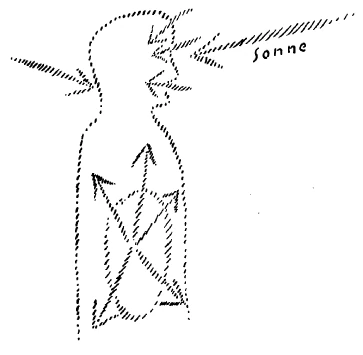
[ 7 ] This does not contradict the fact that these lunar forces, for example, help shape the human face. They do, in fact, shape the human face because what acts from the center in the lower, metabolic human being exerts, so to speak, an attractive influence from the outside on the formation of the human face; the lunar forces act to differentiate the formation of the human face, but they do so by combining with the solar forces, while at the same time counteracting the solar forces from within the human being. Therefore, human reproduction as an organism also depends on the lunar forces, which give form. But what is reproduced depends on the solar forces. The human being, with his entire being, is caught between the lunar forces and the solar forces.
[ 8 ] However, when we look for the lunar forces within the human being—within human metabolism—we must distinguish these lunar forces in metabolism from the forces that actually originate within metabolism itself. The lunar forces do play a role in metabolism, but metabolism has its own forces. And these inherent forces are the Earth forces. So we can say that when the forces inherent in the substances of a person’s food—the forces found, for example, in vegetables or other foods—are at work within the person, these forces act within him of their own accord. They act there as Earth forces. Metabolism is, first and foremost, a result of the Earth forces; but the lunar forces act upon these Earth forces. If a human being had only metabolism with its own forces within them—if, so to speak, the substances in their food were to continue only their own forces within their body after being ingested—then the human being would be a chaos of all manner of forces. The fact that these forces are constantly at work to renew the human being from within does not depend on the Earth at all; it depends on the Moon, which is associated with the Earth. From within, the human being is shaped by the Moon; from without, the human being is shaped by the Sun. And as the sun’s rays are taken up again by the eye into the human head organism, they also have an inner effect; yet they still act from the outside in.
[ 9 ] Thus we find that, on the one hand, human beings, in the full development of their “I,” depend on the influence of the sun—for they could not have an “I” firmly rooted on Earth without the sun; and that there would be no human race, no procreation, if the moon were not the Earth’s companion. One might say: the sun is what firmly anchors the human being as a personality, as a single individual, to the Earth. The moon is what draws the human being—in all its diversity and in its entire development—to the Earth. The human race, as a physical succession of generations, is the result of the lunar forces that stimulate it. The human being as a single being, as an individuality, is the result of the solar forces. And so, if we wish to study human beings and the human race, we cannot limit ourselves to studying the conditions of the Earth. Geologists search in vain to fathom the conditions of the Earth and thereby understand human beings; they investigate the other forces of the Earth in vain in an attempt to understand human beings. Human beings are not, in the first place, formed on Earth. Human beings are formed from within the cosmos; they are a product of the world of the stars, primarily of the Sun and the Moon. Only those forces that are inherent in matter itself originate from the Earth, and these are effective outside of human beings, continuing their effect once they have entered the human being through eating and drinking; but there they are received by the non-earthly.
[ 10 ] What takes place within a human being is by no means merely an earthly occurrence; it is, in fact, something that is brought about from the world of the stars. Human beings must once again bring themselves to recognize this. And if we consider the human being further, we can take the following into account: First and foremost, he is a physical body. This physical body, after all, takes in external nourishment. In this physical body, these forces continue to act. But the physical body is influenced by the astral body, and within the astral body the lunar influence is at work, just as I have described to you. And the solar influence acts upon this astral body. The Sun and the Moon permeate the astral body with their forces, and the astral body manifests itself in the way I have just described. The etheric body stands in the middle between the physical body and the astral body.
[ 11 ] When one studies the forces that emanate from food, they first become active in the physical body, and they are absorbed by the astral body—which contains within itself the influences of the sun and moon—in the manner I have just described. But in between lies the other force—that which is active in the etheric body. This, too, does not come from the Earth; it comes from the expanse of the entire universe. When we consider the Earth in relation to the human being—with its products, with those substances that manifest as solid, liquid, and gaseous components—these are taken in by the human being and processed within the human body in accordance with the forces of the Sun and the Moon. But forces also act within the human being that now radiate toward him from all sides of the cosmos. The forces that act in food come from the Earth. But forces radiate toward the human being from all sides of the universe: these are the etheric forces. These etheric forces also take hold of the food—though in a much more uniform way—and transform it so that they make something viable out of it, something that can also experience the etheric as such—light and warmth—internally. So we can say: Through his physical body, the human being is connected to the Earth; through his etheric body, to the entire universe; and through his astral body, he is initially connected to the Moon and the Sun in their effects. But these influences, which are contained in the astral body as solar and lunar influences, are in turn modified—modified in such a way that there is a tremendous difference between the influences exerted on the upper human being and those exerted on the lower human being.
[ 12 ] Let us call the “upper human being” that part of the human being that is, so to speak, permeated by the flow of blood moving upward toward the head; let us call the “lower human being” that which lies below the heart. When we view the human being in this way, we first see the upper part, which encompasses the head, and that which, in a sense, belongs organically to the head. This is primarily dependent on the effects of the sun in its formation. Indeed, it develops primarily in the embryonic stage. Even in the embryo, the effects of the sun act upon this organism in a very special way, but these effects continue after the human being is born, when the human being is physically present in life between birth and death. And there, what lies in this region of the human being—I would say, what lies above the heart; more precisely, one would have to describe it in terms of the blood circulation—what lies above the heart is modified, in relation to astral influences, by Saturn, Jupiter, and Mars (see illustration on p. 233).
[ 13 ] Saturn possesses forces which—if we consider it from the Copernican worldview—it develops in its orbit around the Sun and sends to Earth; it possesses those forces that are actually at work throughout the entire astral body, particularly in that part belonging to this higher human being. Saturn possesses the forces that radiate into this astral body. And as they permeate and enliven the astral body, they act upon it in such a way that the extent to which the astral body establishes a proper relationship with the human physical body actually depends on them in a very essential way. If, for example, a person cannot sleep properly—that is, if their astral body does not want to separate properly from the etheric body and the physical body, if it does not want to re-enter them properly upon awakening, or if it otherwise fails to integrate properly with the physical body in any way—this is an effect, an irregular effect, of the forces of Saturn. Saturn is essentially the celestial body that, indirectly through the human head, establishes a proper relationship between the astral body and the human physical body and etheric body. Through this, the forces of Saturn in turn provide the relationship of the astral body to the “I,” since Saturn is related to the influence of the Sun. It stands in such a relationship to the influence of the Sun that this is expressed in terms of space and time by the fact that, as you know, Saturn completes its orbit around the Sun in approximately thirty years.
[ 14 ] This relationship between Saturn and the Sun is expressed in the human being, first, by the ego entering into a corresponding relationship with the astral body, but especially by the astral body integrating itself properly into the entire human organism. So we can say that Saturn has a relationship to the upper part of the entire astral body. This relationship was absolutely decisive for people of earlier times. And even in the Egyptian-Chaldean era—if we were to go back to the 3rd or 4th millennium before the Mystery of Golgotha—we would find that among the teachers and sages of the Mysteries, every person was judged according to how their relationship to Saturn was determined by their date of birth; for it was known quite precisely that if a person was born under this or that constellation of Saturn, they were someone who could use their astral body within the physical body correctly—or less correctly. The knowledge of such things played a major role in ancient times. But the very progress of human development in our age—which began at the start of the 15th century—is based on our freeing ourselves from what is at work within us.
[ 15 ] My dear friends, please do not misunderstand this. This does not mean that Saturn is not at work within us today. It is at work within us just as it was in ancient times; we simply have to free ourselves from its influence. And do you know what this “freeing ourselves in the right way” from Saturn’s influence consists of? The worst way to free oneself from the influence of Saturn is to follow the shadowy intellect of our age. In doing so, one literally lets the influences of Saturn rage within oneself; they shoot back and forth, turning one into precisely what is called a “nervous person” in our age. The nervous person is essentially someone whose astral body is not properly integrated into their entire physical being. This is the basis of the nervousness of our age. And what a person must be led toward is the striving for true intuition, the striving for imagination. If a person remains stuck in abstract thinking, they will become more and more nervous, because they are actually outgrowing Saturn’s activity, yet this activity is still within them, shooting back and forth within them, and dragging the astral body out of their nerves—and thus making them nervous. The nervousness of our age must be understood cosmologically as a Saturnian influence.
[ 16 ] Just as Saturn is associated with the upper part of the entire astral body—insofar as this astral body is connected to the entire organism through the nervous system—Jupiter is primarily associated with human thought (see illustration on p. 233).
[ 17 ] This human thinking is, in a certain sense, also based on a partial activity of the astral body. I would say that a smaller part of the astral body is active in thinking than in providing for the whole human being through the astral body. What is at work in our astral body—and what, first and foremost, strengthens our thinking—is the influence of Jupiter. The influence of Jupiter is primarily concerned with the astral organization of the human brain.
[ 18 ] You see, the effects of Saturn actually extend throughout the entire human life, and this entire human life has, after all, begun during our first three decades. How we develop in our astral body—as long as we are in the growth periods, which actually do not fully end until after the age of thirty—is what our entire life and our health depend on. That is why Saturn takes thirty years to orbit the Sun. This is perfectly tailored to human beings.
[ 19 ] What develops within us as thinking is connected to the first twelve years of life. What revolves out there is not unrelated to human beings.
[ 20 ] Just as Jupiter is associated with thought, Mars is associated with what language is. Mars is associated with language.
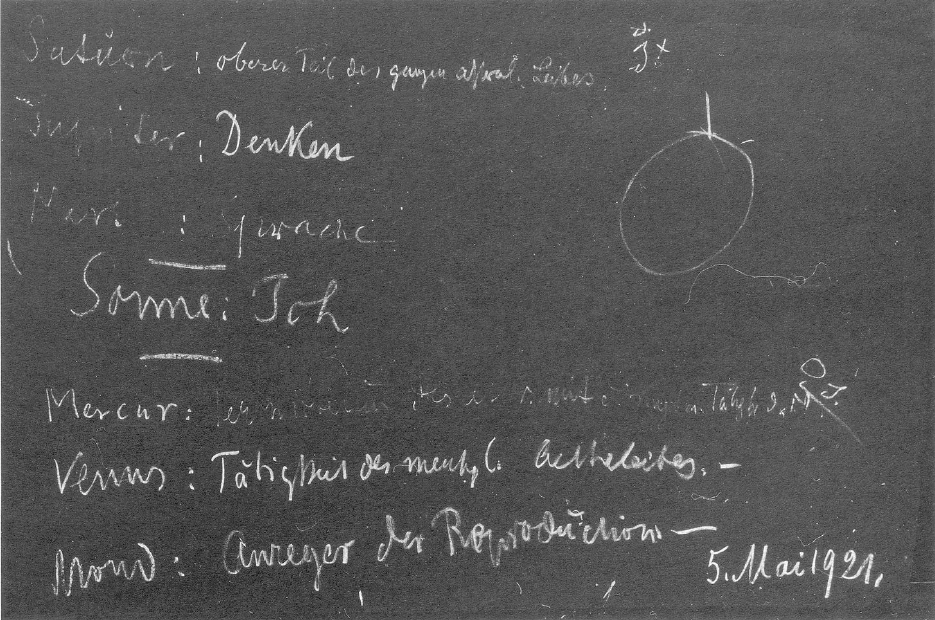
Saturn = the upper part of the entire astral body
Jupiter = thinking
Mars = speech
[ 21 ] Mars, you see, in a sense draws out of the astral body a smaller part—than the one involved in thinking—from its overall organization within the rest of the human being. And it is the effects of Mars within us that enable the unfolding of the forces that then pour into speech. Mars’s short orbital period is, after all, also decisive in this regard. After all, a human being learns the first sounds of speech within a period of time that roughly corresponds to half of Mars’s orbital period.
[ 22 ] Ascending and descending development! We see that this entire development, insofar as it is connected to the region of the human head, is linked to the forces of Saturn, Jupiter, and Mars.
[ 23 ] We have thus described the outer planets and their continuing influence within the human astral body. While the Sun is more closely connected to the “I,” these three celestial bodies—Saturn, Jupiter, and Mars—are involved in the development of those aspects that are bound to the astral body: speech, thought, and the entire behavior of the human soul within the human organism. Then we have the Sun, which is connected to the “I” itself. And then we have those planets that we also call the inner planets—those planets that are, so to speak, closer to Earth than the Sun, that is, those planets located between Earth and the Sun, whereas the other planets—Saturn, Jupiter, and Mars—are turned away from Earth toward the Sun. When we consider these inner planets, we also come to consider the relationships of their forces to human beings. Let us first consider Mercury.
[ 24 ] Mercury—I would say that, like the Moon, its points of influence lie more within the human being; yet, in contrast to the Moon, it acts from the outside upon the human face; but it already acts within that part of the human being that lies below the heart region. There he exerts his forces by taking hold of the human organism from within and radiating his forces outward from there. And there he acts in such a way that it is primarily he who mediates the activity of the astral body in all of the human being’s respiratory and circulatory processes. He is the mediator between the astral body and the rhythmic processes within the human being. Thus we can say: its forces mediate the connection between the astral body and the rhythmic activity of the human being (see illustration on p. 233). In this way, the Mercury forces—similar to the lunar forces—also intervene in the entire metabolism of the human being, but only to the extent that metabolism is subject to rhythm and interacts with rhythmic activity.
[ 25 ] Then we have Venus. Venus is the force that is primarily active in the human etheric body—that is, the force that acts from the cosmos within the human etheric body: the activity of the human etheric body.
[ 26 ] And then there is the Moon. We have already spoken about it. It is that aspect within the human being which is the polar opposite of the solar forces, and which, from within, transforms matter into life and is thus also connected with reproduction. The Moon is thus, in the broadest sense, the stimulus for both inner reproduction and procreative reproduction.
[ 27 ] Now consider that what is actually taking place within a human being appears to you as dependent on the surrounding cosmos. On the one hand, the human being is bound to earthly forces through his physical body, and through his etheric body
Saturn = upper part of the entire astral body
Jupiter = thinking
Mars = speech
Sun = Self
Mercury = Mediates between the astral body and the rhythmic activity of the human being
Venus = Activity of the human etheric body
Moon = Stimulator of reproduction
[ 28 ] The body is bound to the entire cosmic sphere. Within it, however, differentiation occurs in the manner I have described here, and since this differentiation originates primarily from the astral body, the forces of Saturn, Jupiter, Mars, Mercury, Venus, and the Moon are integrated into this astral body. The Sun then acts within the human being indirectly through the “I.” Consider that, because the human being is thus integrated into the cosmos, it makes a difference whether the human being stands at a point on Earth and, say, Jupiter shines from the sky, or whether the human being stands here on Earth and Jupiter is obscured from view by the Earth. In the first case, the effects on the human being are direct; in the second case, the Earth interposes itself between the human being and the planet. This makes a significant difference. Jupiter, as we have said, is related to thinking. Let us assume that where the human physical organ of thought is at its peak of development—that is, shortly after birth, from the moment of birth—a person experiences Jupiter’s influence shining upon them. The person receives the direct influence of Jupiter. Their brain is restructured in a very special way into an organ of thought; they acquire a certain predisposition for thinking. Let us suppose that a person spends these years in such a way that Jupiter is on the other side—that is, the effects of Jupiter are hindered by the Earth: their brain is scarcely transformed into an organ of thought. If, on the other hand, the Earth acts within them with its substances and forces, and everything that emanates from the Earth’s substances is perhaps transformed—let us say—by the influences of the Moon, which are always present in a certain way, then the human being becomes merely a dull dreamer, a being with only a dull consciousness; thinking recedes into the background. In between lie all possible degrees. Suppose a human being possesses within himself, from a previous incarnation, such forces that predestine his thinking to be particularly developed in the earthly life he is now about to embark upon; then he sets out to descend to Earth. Since Jupiter has its specific orbital period, the person chooses the time of his appearance on Earth—the time at which he is to be born—so that Jupiter’s rays are directed toward him.
[ 29 ] In this way, the constellation determines the environment into which a person is born, based on the conditions of their previous earthly lives.
[ 30 ] Indeed, in today’s age of consciousness, human beings must increasingly free themselves from what is revealed to them in this way. But the point is that they must free themselves from it in the right way—that is, by actually doing what I have indicated with regard to the Saturn influences: by attempting to move from mere shadowy intellectual development back to an imaginative, pictorial form of development. What we develop in this way through spiritual science, as I have described in How Does One Attain Knowledge of the Higher Worlds?, is at the same time a guide for how human beings can become truly independent of the cosmic forces that nevertheless continue to work within them.
[ 31 ] By allowing himself to be born, a human being becomes rooted in the Earth, depending on the constellation of the stars. But he must equip himself with powers that will make him independent of this constellation in the right way.
[ 32 ] You see, our civilization must return to such insights into the connection between human beings and the extraterrestrial cosmos. Human beings must once again come to realize that the forces at work within their own organism are not limited to the ordinary hereditary forces recognized by modern science. In light of the actual facts, for example, it is sheer nonsense to believe that within the structure of the female organism there are forces that are then inherited—this concept of inheritance is such a dark, mystical notion—and that they are inherited in such a way that they form a heart, a liver, and so on. There would be no heart in the human organism if the Sun had not integrated this very heart—starting from the head—and there would be no liver in the human organism if Venus had not integrated this liver into it. And so it is with the individual organs of the human being. They are entirely connected to what is extraterrestrial. The forces of Jupiter are at work in the human brain. Throughout the entire human constitution—insofar as the human being has integrated his astral body, whether healthy or diseased, into his physical organization—the forces of Saturn are at work. The human being learns to speak through the action of the forces of Mars within him, and these forces of Mars manifest themselves in speech.
[ 33 ] These are things that humanity must, in turn, come to understand. Human beings must also realize that a science limited to the earthly realm cannot possibly explain their very nature. Then they will also come to understand humanity’s connection to the Earth. For the other beings that live around human beings are not merely earthly beings either. Earthly beings are, at first, merely the minerals. But even the minerals have undergone changes that, in turn, were dependent on the forces in the Earth’s environment. Thus, all our metals—insofar as they crystallize—exist in their present forms precisely because they are, in a certain sense, dependent on extraterrestrial forces; they were formed at a time when the Earth had not yet intensively developed its own forces, but when extraterrestrial forces were still active within the Earth. Healing powers, which are found specifically in minerals and metals, are related to how these metals were formed within the Earth through extraterrestrial forces.
[ 34 ] If we look back at post-Atlantean development, we see how, in the early days when the ancient Indian culture flourished, human beings were truly beings who felt at home in the entire universe—citizens of the entire universe. Although he had not yet developed those powers of which humanity is so proud today, he was, in the true sense of the word, human. Then humanity became more or less distracted by extraterrestrial forces. But we can still see throughout the entire Chaldean period and the early Greek period how human beings at least looked up to the sun. They were still, in a certain sense, a kind of amphibian that rejoiced when it received the sun’s rays and when it no longer needed to burrow in the earth’s gloom. Human beings had become amphibians. Now, in believing that he is actually connected only to earthly forces—one cannot even call him a mole; he is actually an earthworm—he perceives, at most, only when that which was first sent out from the earth into outer space—rainwater—returns to him. That is the only thing humanity still perceives of extraterrestrial forces. But earthworms perceive that too—you could have seen it this morning if you walked along the streets! In his materialism, man has essentially become an earthworm today. He must once again overcome this earthworm-like nature. But he can only do so if he develops to the point of recognizing his connection with the extraterrestrial cosmos.
[ 35 ] So, my dear friends, the point is that in our time we must manage to “weed out” the old ways from our civilization and move toward a new spiritualism.