

Human-Becoming, World-Soul and World-Spirit I
Human Beings as Physical and Spiritual Entities
in Their Relationship to the World
GA 206
13 August 1921, Dornach
Translated by Steiner Online Library
Twenty-first Lecture
Yesterday we examined how the human being functions through his various members—the physical body, the etheric body, the astral body, and the I-bearer—while taking into account what actually takes place within these members, emanating from the human soul. You have seen that, in doing so, we had to place particular emphasis, on the one hand, on the consideration of sensory perception and how the human being lives in this sensory perception in accordance with his or her I, and, on the other hand, memory has led us deeper into the innermost being of the human being. There is something here that must be examined closely, and I must ask you already today to follow me into areas that may be more difficult to grasp, because only through such understanding is a serious comprehension possible of what is actually connected with the essence of the human being. Let us once again bring to mind some of what was said yesterday.
[ 1 ] For ordinary consciousness, the “I” exists within sensory perception. As far as our sensory perceptions extend, so far does this ordinary “I”-consciousness extend at first. I am not saying “the I”; I am saying “I-consciousness.” And we connect to what we experience as the “I” and sensory perception—our imaginative experiences. With these imaginative experiences, we live in our astral body.
[ 2 ] Let us once again visualize the process schematically. In the realm of ego-consciousness, we have sensory perception; we have thus engaged our ego in this sensory perception, then, in a sense, extended this activity through our astral body, and there we experience our mental images. We have then seen that memories arise through the activity of our etheric body. And in the physical body—as I said yesterday—all images take shape. Now the point is that we try to bring something into consciousness that can already be brought into consciousness through subtle inner contemplation. If you, so to speak, cast your spiritual gaze upon the realm of sensory perceptions and allow yourself to be permeated by how the “I”-consciousness unfolds within it, then you will say to yourself: For sensory perceptions, we are stimulated from the outside. — So if I want to schematically depict the relationship between a human being and their sensory perceptions, I must actually draw it in such a way that I say: If there is an external world here, then sensory perceptions are stimulated by the external world (see diagram, blue), but within these sensory perceptions that are being stimulated, the “I” lives (orange). It is therefore already clear that we should not actually say: Our “I,” insofar as we become conscious of it, is inside us—but rather: We experience it coming in from the outside. — Just as we experience sensory experiences coming in from the outside, so we experience our “I” itself coming in from the outside. It is therefore actually an illusion to speak of our “I” as being inside us. We breathe in, so to speak—if I may put it that way—the “I” along with the sensory perceptions, if we conceive of the apprehension of sensory perceptions as a more subtle form of breathing. So we must conclude: This “I,” which actually lives in the external world and fills us through sensory perceptions, continues to fill us as the ideas (yellow) now attach themselves to the sensory perceptions (orange), penetrating all the way to the astral body.
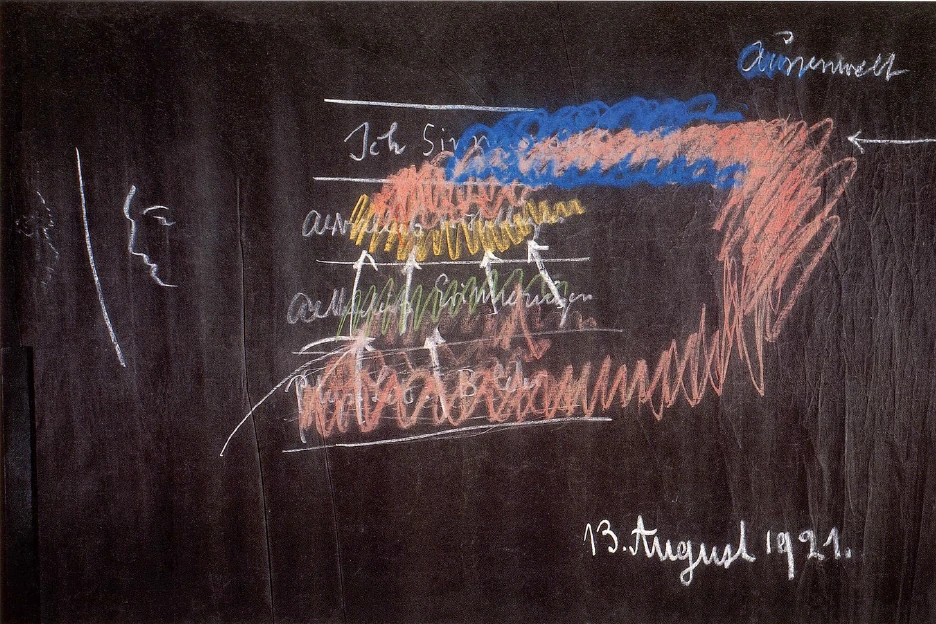
[ 3 ] So you see: If you want to imagine this relationship of the “I” to what is commonly called a human being—and which is thought of as confined within the skin—in the correct way, then you must actually—if I first sketch the eye here as a representative of sensory perceptions—imagine that the “I” is not inside, but rather that the “I” lives here on the outside and penetrates inward through the senses. We usually succumb to the illusion that our “I” lies within what we call our physical organism. But the “I” is actually situated in the outer world in relation to this physical organism and, so to speak, extends its tentacles toward our inner being—initially in the imagination, toward the astral body or as far as the astral body.
[ 4 ] Let us now take a closer look at the world of memories. Memories are brought to the surface by what we call our inner self. As they are brought to the surface, they initially constitute an activity in the etheric body, and this in turn stimulates images in the astral body; but now the flow is reversed (see diagram on page 135, arrows). Ultimately, however, they must originate from what are the images in the physical body.
Translate text Select source language. Currently selected: English (detected) Select target language. Currently selected: German Toolbar Source text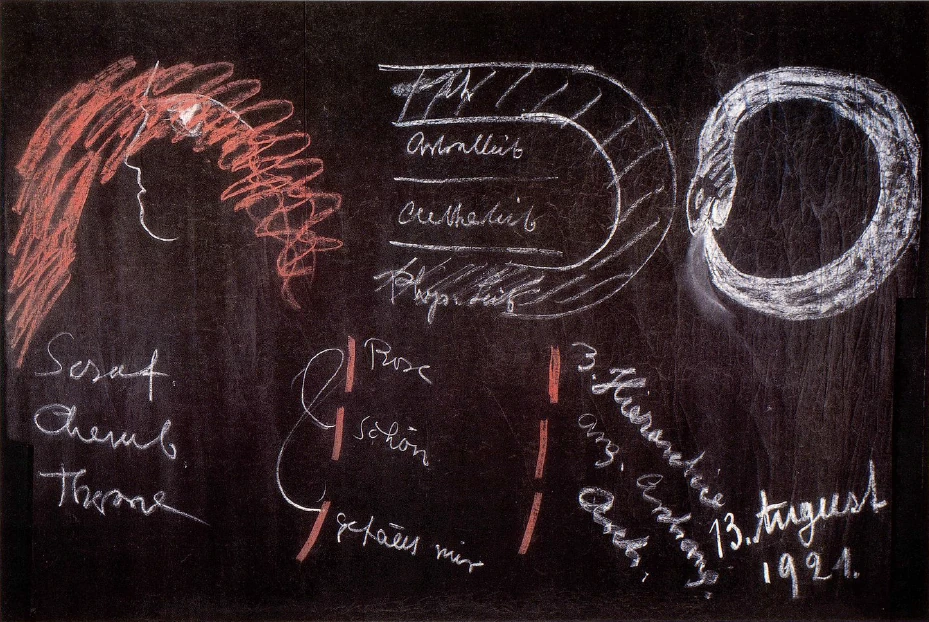
[ 5 ] So you see that, starting from the physical body, the impulse that underlies memory flows into the etheric body, and since the “I” is within it, the “I” is also here. I must therefore illustrate this in such a way that, schematically, I do not merely conceive of the “I” as being here on the outside, but rather that the “I” is indeed also in the physical body (reddish) and, from the physical body, stimulates the memories (green), which then become mental images (yellow).
[ 6 ] So you see, I actually can’t make do with the diagram I’ve drawn there. I would have to draw it differently. I would have to say: I, astral body, etheric body, physical body. But when I consider memory, I would also have to place what is there above as “I” into the physical body as well. It is at once separate in itself, and at the same time it also fills the physical body. You see, through careful understanding of what goes on within the human being, it is possible to form a conception of the integration of this “I,” as it is, on the one hand, in the outer world, and on the other hand, within the inner being.
[ 7 ] And now consider the following process. Imagine you meet a person on the street; you have your sensory perception of that person. Your “I” is present in that experience, but at the same time, a memory arises from within: you recognize the person. The memory comes from within, and the sensory perceptions come from without. They intertwine. This phenomenon of intertwining was already known to the early, instinctively gifted researchers of the spirit. We are once again drawing it out from the body of facts. It is this—which I am now once again drawing from the body of facts—that was known to the ancient spiritual researchers, and they were accustomed to depicting such things in images; they depicted what I have just described to you—this presence of the “I,” this convergence with what comes from the outside—as the serpent biting its own tail. The way the human being relates to the external world was thus depicted as the serpent biting its own tail. When one looks at older depictions that arose from instinctive visions, one can often recognize how profound insights are hidden within such visions. Then the abstract thinkers come along and interpret all sorts of things. In this way, something terribly profound sometimes comes into being; but it has no value if one symbolizes and interprets it, because one cannot grasp the facts through intellectual analysis anyway—rather, one can actually only discover what is there by penetrating back to the sources themselves.
[ 8 ] But let us also use another image to bring to mind what is actually at stake here. Let us think of this human “I” as it exists in sensory perception and in the imagination linked to it. The fact is that we truly live in an illusion that has come about in the following way. Imagine for a moment that you have a mirror and you see yourself in it, and—let me assume this hypothetically—you have never had the opportunity to acquire any knowledge other than that in which you have always seen yourself in the mirror, and this has led you—just imagine how this could be possible—to confuse yourself with the mirror image. The mirror image moves back and forth. Now, let’s say you don’t feel yourself inside your own skin, but you see the mirror image moving back and forth, and so you think: That is me—and you always say: That is me. —You are actually looking at your mirror image, but you confuse it with yourself. That is, in fact, what human beings do. In reality, the “I” is like a stream that carries sensory stimuli to the body. The body reflects it back—first that part in which the true “I” itself resides. The “I” is right here, but it is also in the external world. And it is even in the physical body, but it is reflected back to you. Human beings do not perceive their true “I,” but rather the reflection. They already perceive the reflection through their sensory perception. These are mirror images.
[ 9 ] I have elaborated on this in more detail in my book On the Mysteries of the Soul. Imaginations, too, are now mirror images—they are the reflections of experiences in the external world. The “I” actually lives in the external world and experiences itself in consciousness when that which it stirs into the body as the unconscious “I” is reflected back to it. This is the case when we take sensory perceptions and imagination into account.
[ 10 ] The situation is different, however, when a memory comes to mind. Then we are truly here, down in the images that have come into being, with our “I” within them. Yet the unconscious is at work to a great extent. Just consider how difficult it is for you to bring up memories, how little you can do with your full conscious mind. The unconscious is at work there. There is, in fact—and you can feel this—a reality at work. It is different there. There, however, you no longer confuse what you see with your “I,” for you feel yourself present within this activity. But it also remains very obscure; this “I,” as I have often mentioned, remains in an inner activity like a dream or even like something asleep, for the will is at work within it. And in the act of remembering, it is essentially the will that is at work. A will that is strangely fluctuating and changeable is at work there. And if we want to use an image, we can say: Let’s imagine that we look at it spiritually with our “I.” When we have this perception and imagination, we look at it this way. When we form memories and everything that belongs to them, then we turn around, so to speak, in our soul. Indeed, as we progress from sensory perception to memory, this concept of a “turning of the soul” is an important one: a turning of the soul. For when you imagine such a turning of the soul, you gain an inner sense of mobility.
[ 11 ] The ego, the astral body, the etheric body, and the physical body can no longer coexist so easily side by side. This is convenient when presenting anthroposophy to groups of anthroposophists who want to receive rather calm, gentle ideas—the kind that are easy to take in while sitting comfortably in armchairs. But that is not how it is in reality. In reality, the point is that when we approach the human being with the aim of grasping the life of the soul, we must take into account a constant turning and shifting of the entire inner human being—that is, the true human being. The “I” is like this, and because it is like this, it shines in through the sensory perceptions; because it is like this (turned inside out), it shines up from the physical body. The concepts must be set in motion.
[ 12 ] This is something that shows you, however, how we must move toward flexibility and toward concepts that are alive within us if we want to understand human beings. For just consider what our ordinary inner life is like! You need only think of a very small fragment of everyday soul life, and you see this, that person sees that in the external world. That is all the sensory world. It penetrates as a world of imagination. In the process, all kinds of memories surface. And you can only imagine that, while sensory perceptions are present, you are, so to speak, looking from one side with your soul, and when memories arise, you are looking from the other side. But since these are constantly intermingling, you must constantly conceive of the soul as being in a state of inner, swirling motion.
[ 13 ] And that is also what should be conceived as an image: the soul in a state of inner, swirling motion. That is also what presents itself to the beholder. That is why I have hinted at this in my books and have emphasized it again and again: Anyone who wants to make drawings that adequately represent what actually exists as the higher aspects of human nature is in the same situation as a painter who wants to paint a flash of lightning. Just as a flash of lightning cannot be painted in reality, so too can the higher structure not be painted. Even the etheric body cannot be painted as it really is. One can depict it schematically, but one cannot paint it as it really is, for in reality, a static form of it does not actually exist.
[ 14 ] Memories and impressions of the external world—they meet, as I said. We are dealing here with something that really ought to be understood very precisely. If you consider the human physical body as such, the “I” within it is responsible for memory. But the “I” is also in the external world. So in everything that underlies sensory perceptions, the “I” is actually present. But it is also in the human physical body. If you examine all kinds of modern philosophies—and this “modern era” has been going on for a long time—you will find much discussion of the subjective and the objective. One can think of it this way as long as one remains at the level of imagination, for one can indeed distinguish between what lives within one and what lives outside of one. But when one delves deeper into the matter, these concepts lose their meaning. For by what means is that which lies behind sensory perceptions—and from which the “I” brings in these perceptions—by what means is it objective? It is objective precisely by the same thing that makes the physical body objective here. There is no difference between the subjective and the objective. The “I” lives just as much in the external world as it does in its own physical body. That is where the distinction between the subjective and the objective ceases entirely.
[ 15 ] This distinction between the subjective and the objective arises only when we are engaged in imagination up here. And why does it arise here? Not for the reason one usually imagines, but rather because, up here, we are dealing only with images. Up here, we experience only images. But images are not real in and of themselves. We sense this as we experience them. We therefore speak of images as something subjective, and of the processes underlying the images as something objective. But we cannot do this with impressions of the external world, for the processes in which the “I” lives are, of course, objective here, just as are the processes through which the “I” acts by transmitting the images of memory through the physical body. All of this is objective, and if you will, all of it is subjective. Here, the subjective and the objective become completely intertwined and merge into one another, becoming indistinguishable. And that is the important point, for this concept of the subjective and the objective—which preoccupies people—is what some philosophies juggle with.
[ 16 ] However, there is, in fact, something even deeper underlying all this. Human beings live, first and foremost, in their everyday experiences. There they develop a spiritual life of the kind that is, as is well known, found everywhere. But behind all of this, of course, lies an entirely different world. I have described in How Does One Attain Knowledge of the Higher Worlds? and in my Outline of Esoteric Science how one can penetrate into this world. But that which spiritual research penetrates is, of course, a reality for every human being. It is always there, whether one is aware of it or not. So when one speaks of reality, one must take this into account. When one develops those insights that arise through imagination, inspiration, and intuition, one arrives at what is present in every human being—what every person constantly carries within themselves. If one ascends, as I have described, to the level of imagination, one first encounters a different world of the soul than the one present in everyday life. Through imagination, one receives images instead of the usual abstract concepts—which is why the term “imagination,” or “imaginative conception,” was chosen—images that are clearly recognized as images. One is fully aware, when dealing with imaginations, that one is dealing with images. That is precisely the difference between what the spiritual researcher actually experiences and what occurs in dreams or hallucinations: Those who live in dreams or hallucinations take their images for reality. The spiritual researcher never does this. Only those who wish to write foolish refutations claim that what the spiritual researcher experiences could also be a hallucination or a dream. The spiritual researcher never confuses what appears to him in images with reality. Yet he is also clearly aware, from the very nature of these images, that they are not invented images, not images conjured up by the imagination, but rather images that point to spiritual reality.
[ 17 ] First of all, he never confuses his images with reality; rather, he is fully aware that these images point to spiritual realities. There are many things that can lead a person to become fully aware of this imagery on the one hand, and of the way these images point to a spiritual world on the other. If you are a fully thoughtful person, you have a clear awareness that you yourself link and separate your ideas. You need only reflect carefully on this for a moment. Just imagine how different your inner life would be if you could not arbitrarily connect the ideas you have, but instead these ideas were forced to connect with one another: you would be like an automaton. This inner ability to connect and separate ideas does, however, cease in a certain sense when one enters the world of imagination. And one must know that it ceases, for this gives one a clear awareness that freedom, as human beings value it, can actually only be experienced and attained in this physical world between birth and death. Then one also gains a clear sense that we do not descend from spiritual worlds into this physical world unnecessarily. If we lived only in the spiritual worlds that are otherwise accessible to us between death and a new birth, we would never be able to attain that freedom there. We attain this freedom within the physical world. Only people who care nothing for freedom, who hate or hold in low esteem this world that human beings live through between birth and death.
[ 18 ] We particularly appreciate this freedom when we develop it as a force—let us say, like a memory—namely, after death. Only by feeling our way back into earthly life do we partake of freedom between death and a new birth. We must remain connected to earthly life so that we may share in this freedom even between death and a new birth. The spiritual researcher can truly sense this when he immerses himself in the world of imagination. If, before immersing himself in the world of imagination, he were not firmly grounded on the same ground on which we stand within physical reality, he would not be able to enter the spiritual world in a healthy state. That is why it is emphasized time and again: One must have prepared oneself well in the physical world if one wishes to enter the spiritual world. One must truly have attained everything that can in principle be attained in the physical world—namely, not being at the mercy of one’s instincts, which means a lack of freedom; not being at the mercy of any automatic rules of habit, to which human beings are so eager to submit. One must truly have attained an awareness of one’s freedom before one can enter the spiritual world. Ideas such as those I have developed in my Philosophy of Freedom should already have been brought to life within oneself if one truly wishes to achieve one’s ascent into the spiritual world. This has also been emphasized in How Does One Attain Knowledge of the Higher Worlds?
[ 19 ] Since we are speaking here specifically of the imagination of images, these must certainly be understood as something entirely subjective. I would say that the degree of subjective experience is even stronger in the imaginative life than in ordinary, everyday mental life. Mental life is richer in imaginations, but it is an experience of images. One knows that true reality lies behind this experience of images; but initially, one has the experience of the image.
[ 20 ] But there is something alive in these images that prevents them from appearing to us as freely as they might. We cannot combine and separate them in this way; nor would we be able to penetrate to reality if we could combine and separate these images of imaginative cognition in the same way that we combine and separate what we experience as ordinary concepts. We experience ordinary concepts in this way: Here is one concept, here is a second, here is a third. We experience them and form connections. We have the concept “rose,” we have the concept “beautiful,” and the concept “I like it.” I form the connection: I like the beautiful rose. — What I form here as a connection is entirely an inner activity; it depends on me; in this I am free. In this way, one is not free in the imaginative world. When you have the images of the imaginative world, it is not the case that you now feel an inner activity through which you connect and separate these images. Just think about it for a moment—that simply cannot be the case—because although you feel free in the physical world and can connect and separate things, you do so in the physical world precisely as the external, physical-sensory world demands. You therefore have a regulatory principle governing your connecting and separating. You must also have such a regulatory principle in the world of imagination. You simply must not carry over into this imaginative world what the physical world has dictated to you. That is what those who are nebulists, fantasists, or perhaps—in the best sense—imaginative people do. They take various elements from the physical-sensory world and connect and separate them according to some arbitrary judgment of taste. That may be very beautiful, but it cannot happen in imaginative insight. There must be something there that prompts one to link one element to another, to establish connections.
[ 21 ] If you now take this idea, you will see: You arrive at something that lives in the world of the imagination, something that functions in the world of the imagination just as our own intellect otherwise functions—by connecting and separating the ideas of the ordinary world. There you step out into the objective realm. One goes beyond the worlds that are given as sensory perceptions; but one enters into something that connects and separates them.
[ 22 ] What is this, then? I would say that it is experienced in such a way that the imaginations begin to develop a life of their own. Let me use an analogy here: If you look at a human embryo at a very early stage, its head is already highly developed, while the other organs are only vaguely attached to it; but they then take on their form. In the same way, what lives in the imaginative world grows inwardly. One cannot simply impose ideas there at will. It arises of its own accord. So there is something living within it that arises of its own accord. And this is gradually recognized as the world we call the world of the third hierarchy: Angeloi, Archangeloi, Archai.
[ 23 ] It is a very real process of human experience into which one immerses oneself. I have just described it to you as a process of cognition. However, it is not merely a process of cognition, for what is at work here is that which lives in the “I” and the astral body.
[ 24 ] Now consider this: We are children; we are growing up. First, up to the age of seven, we develop an inner world based on imitation; then, up to the age of fourteen or fifteen, we accept the world on the basis of authority, and so on. If we can observe life, we will discover how much—not everything, of course—of what we take in in this way, through sensory impressions being brought to us and our processing of those sensory impressions and ideas, becomes part of us—and is what we later read in a person’s face. Compare the dull, expressionless face of a person who was unable to take anything in, who could not process any sensory impressions in their life of imagination, with the expressive face, the expressive physiognomy of someone who, as a child, was introduced in the right way to the sensory world and to its processing in the imagination. This is, after all, something that lives within us from the soul-spiritual realm. We are, after all, shaped by this. It is, I would say, the most subtle force at work within us, one that extends its influence—albeit in a very subtle way—into the entire physical life of the human being.
[ 25 ] Anyone who can observe people can tell, even in later life, by the way they walk whether they had a happy childhood or one such as is sometimes the case among today’s teachers. This is not some unreal quality that works its way from the “I” and the astral body into the whole person. The spiritual researcher merely looks into what is actually alive in the “I” and the astral body, and he discovers it through his imaginative world. There he discovers the world of angels, archangels, and archai. But this world is contained within what develops in the human being as the spiritual-soul aspect shapes him—shapes him in such a way that, at first, his development is an individual one. We can observe this in the way I have just described. But this development is also such that it belongs to a group of people, to a nation. We do, after all, distinguish what grows within the human being insofar as he or she belongs to a group of people, to a nation; and in turn, we distinguish a modern human being from an ancient Greek. In short, we distinguish between the individual development of the human being, which depends on the hierarchy of the Angeloi; the development of a people, the development within the various ethnic groups, brought about by the hierarchy of the Archangeloi; and we distinguish between human beings in different historical epochs, brought about by the hierarchy of the Archai.
[ 26 ] What is discovered there by the science of the spirit are precisely realities that are active—active in the spirits of the age, active in the spirits of the people, active in those spirits that carry the life of the individual human being from consciousness into constitutional, into organic life. After all, we do not create our own physiognomy ourselves, just as a watchmaker makes a watch, simply because we may have been raised in our youth to see the world joyfully and have acquired a friendly physiognomy; something else must be at work here. The being from the hierarchy of the Angeloi helps in this. And we certainly do not simply insert ourselves into a people and fashion the various national physiognomies, just as a watchmaker makes a watch.
[ 27 ] You see, we are dealing here with realities that are merely revealed through insight, but which are active within the human being. We have here, so to speak, the human being from one side—to use the language of the ancient clairvoyants—from the side of the serpent’s head. Let us now approach the matter from the other side. We arrive at that other side—the tail of the serpent—by turning to the world of memories that emerge from below, from that place where the human being also perceives this world in which the subjective and the objective lose their meaning.
[ 28 ] Yes, what emerges there as the power of memory is indeed grasped by the “I,” but it rises from the very deepest depths of the human being. We know—or at least can know—how intimately connected we are to our human nature when we unfold this power of memory. This points us even further down into such depths that we cannot reach in ordinary life through our soul experiences. It points us down into something that we are, but in the same way that external nature is. There is something within us that is exactly as external nature is. We do not stand in that same intimate connection with it as we do with the world we understand under the hierarchy of the Angeloi, Archangeloi, and Archai. There reigns something that is by no means so close to our present consciousness. I would say that there is, after all, only a thin veil between our present consciousness and the Angeloi, Archangeloi, and Archai. But we plunge into a world that is deeply hidden from ordinary consciousness when we descend into that innermost part of the human being from which only the power of memory shines up—a power that we can still, I would say, just barely catch. Yet what we catch there is connected to contents that lie beyond ordinary consciousness.
[ 29 ] Yet—just as we can reach the world I have just described, from which we are separated in our imagination as if by a thin membrane—we can now, as we advance in spiritual science, also perceive the world to which we are pointed on the other side: the side we reach when we turn around, or rather, when we turn toward the other side of the serpent. But we reach this world only when we rise to the third stage of spiritual knowledge: intuition. And there we then encounter those beings described in my books as Seraphim, Cherubim, and Thrones. This is the world of the Cherubim, Seraphim, and Thrones, which lies just as much behind what shines up into our lives as activity in memory as the world of the Angeloi, Archangeloi, and Archai lies behind our sensory perceptions and ideas.
[ 30 ] Tomorrow we will discuss these connections between the human world, which lives within memories, and these hierarchies, as well as what lies between them—Kyriotetes, Dynamis, Exusiai—these things.