

Old and New Initiation Methods
Drama and Poetry in the Shift
of Consciousness in the Modern Era
GA 210
24 February 1922, Dornach
Translated by Steiner Online Library
9. Shakespeare, Goethe, and Schiller in Light of the Intellectual Upheaval of the 15th Century
[ 1 ] The turning point between the fourth and fifth post-Atlantean epochs—which falls within the 15th century and which I have often referred to as such—truly has far greater significance for the development of humanity than what is still commonly recorded in external history today. People are unaware of what a tremendous upheaval took place in the very innermost being of human beings at that time. One might say that the traces of what took place for humanity at that time are deeply engraved in the consciousness of the finest minds in particular. They have remained there for a long time and still do today. The very emergence of Christianity itself provides an example of how something so significant can take place without being immediately and strongly noticed from the outside.
[ 2 ] Just consider that this Christianity, which has had such a transformative effect on the civilized world over the course of nearly two millennia, had not yet really been taken into account—even by the most eminent minds of the Roman culture that dominated at the time—a century after the Mystery of Golgotha. After all, it was regarded at the time as a small, insignificant event over there, on the borders of the empire, in Asia. And it is fair to say that what took place around the first third of the 15th century was no more noticed by the civilized world than what has been recorded in external, documentary historical sources. But it has certainly left its mark on human endeavor and human struggle.
[ 3 ] We have already noted some of this again in recent times, for example, the way it played out in Calderón’s poem Magus Cyprianus, showing how this spiritual transformation in humanity was perceived, particularly in Spain. Now, however, we can see how, at various stages of human development—even if the matter is not expressed exactly as it must be today from the perspective of anthroposophy—there is nevertheless a more intense sense that one must, so to speak, gain inner spiritual clarity about this transformation that has taken place. And I have already pointed out that one of the attempts, born of human struggle, to come to terms with this transformation is Goethe’s Faust. But perhaps even more light will be shed on Goethe’s Faust if we place it within a broader cosmic context. Just as Faust appears before us in Goethe’s poetry as a spiritual phenomenon that is initially isolated, we can characterize him in roughly the following way:
[ 4 ] Goethe, in his youthful aspirations—which were naturally inspired by the intellectual climate of Europe—was led to dramatize the human struggle within the emerging intellectualism. Based on his familiarity with the medieval Faust figure—gained from folk plays or similar sources—the personality of Faust presents itself to his mind as a representative of those struggling figures who lived in that era. Faust, of course, belongs to the 16th century, not the 15th, but one could say that this transformation did not take place in a single year, nor even in a single century, but is spread out over the centuries. Thus, Goethe encountered the figure of Faust as a personality who lives within this entire struggle, emerging from an earlier time into a later one. And one can actually see how clear Goethe’s understanding of the particular nature of this struggle from the fourth to the fifth post-Atlantean epoch is. We see how he initially presents his Faust as the scholar who is familiar with all four faculties, who has allowed them to take effect upon him—who has thus absorbed into his soul the impulses arising from intellectualism and intellectual scientific inquiry—and who also senses the human dissatisfaction of remaining stuck in one-sided intellectualism. Faust turns away from this intellectualism, as you know, and turns, in his own way, toward magic. One must simply realize what that actually means in this case. What Faust went through “in philosophy, law, medicine, and, unfortunately, theology as well” is what one can go through in the face of intellectualized scientific rigor. At first, this leaves one unsatisfied. It leaves one unsatisfied for the reason that this form of abstraction, through which this scientific approach speaks, engages only a part of the human being—the head, so to speak—and essentially disregards the rest of the person.
[ 5 ] One need only compare how different things were in an earlier time. It is usually overlooked that things were indeed quite different in an earlier time. Back then, those who sought to gain insight into life and the world did not turn to intellectual concepts, but rather all sought to look beyond the sensory phenomena of their surroundings to perceive spiritual realities and spiritual essences. This is precisely what is so difficult to understand: that individuals striving for knowledge in, say, the 10th, 11th, and 12th centuries were by no means seeking mere conceptual connections, but rather spiritual, essential reality—that which could be perceived behind sensory phenomena, not that which can merely be thought within them.
[ 6 ] But this very transition is based on the fact that, in a sense, what people had previously sought was relegated to the realm of superstition; that they lost the inclination to search for such real spiritual entities; and that they came to regard intellectualistic connections as the only possible, truly scientific approach. But as much as one might logically tell oneself on the one hand: “The only concepts and ideas that are not superstitious are those that the intellect derives from sensory reality”—the whole human being, and above all the human soul, could find no satisfaction in what ultimately remained of these concepts and ideas. And so Goethe’s Faust finds himself in the position of being dissatisfied with the intellectual and turning back to what he still knows of magic.
[ 7 ] This state of mind was indeed one that was genuine and sincere in Goethe. Goethe, too, had dabbled in a wide variety of academic disciplines at the University of Leipzig. And before he found a certain contemplative depth in Strasbourg with Herder, he attempted—in fact, as a departure from the intellectualism he had encountered in Leipzig—to explore, for example through his association with Susanne von Klettenberg and by studying relevant works, the realm that he later called “magic” in Faust. It was very much Goethe’s own path. It was only when Goethe, during his further studies in Strasbourg, encountered Herder that he found before him a spirit who was himself averse to intellectualism. Herder was by no means an intellectual—hence his anti-Kantianism—and he then guided Goethe, in a certain sense and without resorting to magic, beyond what Goethe had previously attempted to achieve out of a truly Faustian mood, drawing on ancient magic.
[ 8 ] Goethe thus actually looked upon this Faust of the 16th century—one might just as well say: upon the scholar of the 15th century who is emerging from magic but is still half immersed in it—in that he, Goethe, sought to portray his own deepest inner struggle as it presented itself to him, because the traces of the transition from the fourth to the fifth post-Atlantean epoch were still very much at work within him.
[ 9 ] One of the most interesting aspects of recent intellectual development is that Goethe, in seeking to express his own youthful struggles, turned to the professor of the 15th and 16th centuries in order to dramatically characterize his own inner spiritual life and spiritual experiences through this figure. Of course, one completely misunderstands both what lived within Goethe and what constituted the great upheaval of the 15th and 16th centuries if one agrees with Du Bois-Reymond that Goethe made a grave mistake by portraying his “Faust” the way he did; he should have made it entirely differently. Faust might indeed have had to remain unsatisfied with what tradition could have offered him. However, if Goethe had been able to portray Faust properly, then Faust—after getting through the first few scenes—would have made Gretchen his lawful wife, married her, and become a well-established professor who would have invented the electrostatic machine and the air pump. — That is Du Bois-Reymond’s view of what Faust should actually have become.
[ 10 ] Well, Goethe didn’t write Faust that way, and I don’t know if it would have been much more interesting if it had come into the world shaped the way Du Bois-Reymond wanted it to be. But in any case, as Goethe’s Faust stands, it is one of the most interesting phenomena in recent intellectual history precisely because Goethe felt compelled to portray the professor of the 15th and 16th centuries as the representative of what still resonated within him—within Goethe himself—from that transition from the fourth to the fifth post-Atlantic period.
[ 11 ] We know, of course, that the 16th-century Faust—who was thus portrayed as a mythical figure, not as the man who invented the electrostatic machine and the air pump—that he, too, turns to magic, but truly perishes, succumbs to the Devil—that this 16th-century Faust could not be recognized, even by Lessing and Goethe, as the Faust of the 18th century. Rather, the aim had to be to show how, even as one strives once again toward the spiritual, human beings are nevertheless to find their way—if one may use the word—toward redemption. |
[ 12 ] So, at first, Faust appears as a professor of the 15th or 16th century, whom Goethe actually portrays quite well, because that is exactly what such figures were like at the universities back then. Of course, the Faust of legend doesn’t even come into the picture here; the Faust of legend was, of course, never this professor, but rather a wandering Gypsy; but Goethe isn’t portraying this Faust of legend either—rather, he is characterizing a professor-like figure. And it is certainly true that we can say: Just as Goethe characterized his Faust—in the depth of his soul’s feelings, he is, of course, a unique figure, an exception—just as he placed him within the intellectual sphere, if I may use that expression: on the one hand engaged in the intellectual sciences, yet not unfamiliar with a certain inclination toward spiritual matters—which, even in Goethe’s time, were of course regarded as superstition—this Faust is very much the archetype of, say, a philosophy professor or perhaps even a medical professor of the 14th or 15th century.
[ 13 ] Now, however, we can also place Goethe’s Faust within a broader global context. Goethe himself introduces us to Faust’s assistant, and we see there the relationship between the professor and his assistant. We also see a student, but we cannot really believe that this student was particularly deeply influenced by his professor Faust; this is evident from the way he develops later on. So in Goethe’s Faust itself, we actually see little of the impact of Faust—that is, of the spiritually profound professor of the 14th and 15th centuries, as he might have taught in Wittenberg, for example. But one could still say that there is a student of this Faust who can lead us deeper into this “entire context of the world.” There is a student of Faust who now occupies almost the same significance in the intellectual history of humanity as Professor Faust himself—I am, of course, always referring to Goethe’s Faust. And this student is none other than Hamlet.
[ 14 ] Hamlet can indeed be regarded as a true disciple of Faust. The historical aspect is irrelevant here; I am always referring to what Goethe portrayed as Faust. The entire course of Faust’s story attests to the fact that, while we are indeed dealing with the 18th-century view of humanity, Goethe nevertheless strives to set his Faust in an earlier time. In a certain sense, we can certainly say: Hamlet, who studied in Wittenberg and brought home a certain state of mind from those studies—Hamlet, as Shakespeare portrayed him—can be regarded, in a certain way, albeit in terms of the history of world thought, as a disciple of Faust. In him we may even find something that we can call, in a much truer sense, a discipleship of Faust than what we encounter as such a discipleship of Faust in Goethe’s own poetry.
[ 15 ] Consider Hamlet’s entire character and combine it with the fact that he studied in Wittenberg, where he could very well have had a figure like Faust as a professor, and then consider the way in which Hamlet comes to his mission: his father’s ghost appears to him. So he has a connection to the real spiritual world. He is, from the outset, placed within the real spiritual world. But he studied in Wittenberg—he studied so well there that he regards the human brain as a book. Remember Hamlet’s line where he speaks of the “book of the brain.” He has studied human knowledge so thoroughly that he speaks of the “book of the brain,” even jotting down on his writing tablet what he wishes to retain in his memory—almost as if he had in mind the line from the later Faust poem: “What one possesses in black and white, one can confidently carry home.” ” So Hamlet is, on the one hand, a most exemplary student of intellectualism, as it was taught to him in Wittenberg, but on the other hand, he stands within an spiritual context, and both impulses are at work in his soul. And the entire Hamlet drama is, in fact, under the influence of these two impulses. Hamlet, both as a work of fiction and as a character, is shaped by these impulses, for, when it comes down to it, the author of Hamlet does not really know how to reconcile the spiritual world with the intellectual disposition of the soul. Works of fiction that possess such characteristics—which are truly deeply rooted in life—provide commentators with ample opportunity for debate. That is why so many books are written about such works, though they do not really make one any wiser, for the simple reason that it is not at all necessary to become wiser about them. One can constantly observe how commentators treat the following as major problems: Are the ghosts in Hamlet merely a metaphor, or do they have an objective meaning? How should one interpret the fact that only Hamlet sees the ghost, while the other characters—who are on stage at the same time—do not?
[ 16 ] Just imagine all the extraordinarily insightful and interesting things that have been written on this subject! Of course, this does not at all address what is relevant to the poet of Hamlet, for what is precisely relevant to him—who belonged to the 16th and 17th centuries—is that, because he had to write with such vitality, he was compelled to address this problem in such a way that his conception of the matter cannot be encapsulated in abstract terms at all. It would be better to refrain from such approaches, as the commentators do; that is why I consider it unnecessary. For this concerned precisely that transition leading from a time when it was still clear to people that spiritual beings are realities just like a table or a chair, or like a dog or a cat—for that was indeed the case. And Calderón, who still held the old viewpoint—even though he belonged to a somewhat later era than Shakespeare—it would never have occurred to Calderón to even hint in any way that what he presents as spiritual beings could in any way have merely a subjective character. Because he is immersed in this view with his whole soul, he portrays everything spiritual as tangibly as dogs and cats.
[ 17 ] Of course, in Shakespeare’s case, it is quite possible that his state of mind places him squarely in the midst of a transitional period, and therefore he cannot feel compelled, as a poet, to treat this question any differently than: It may be this way, and it may be that way. — The boundary between whether spirits are subjective or objective is not entirely clear. This is, after all, a question that ceases to matter for a higher worldview, just as the clear boundaries between day and night—which are defined for life, not for astronomy—cease to matter. This question of whether one is subjective and the other objective ceases when one recognizes the objectivity of the human inner world and the subjectivity of the outer world. But it is precisely in this vibrant limbo that Shakespeare captures what he portrays in Hamlet and also, for example, in Macbeth. We see, then, that Shakespeare’s plays are thoroughly rooted in the transition from the fourth to the fifth post-Atlantean epoch.
[ 18 ] In Hamlet, however, this is expressed most significantly. Hamlet may well have spent those semesters in Wittenberg—if I may put it this way, somewhat, let’s say, unhistorically, but perhaps no less truthfully for that—where Faust—you know, given the context, what I mean by that—read less about magic and more about intellectual sciences. So he may have been in Wittenberg before Faust himself came to the admission that he had been leading his students by the nose for ten years, in every direction—straight and crooked. Hamlet may well have been among those who were led by the nose; so his studies may have fallen precisely within those ten years. And now, when he returns once more and has taken it all in from a soul that was itself uncertain—for one can, of course, be quite certain that Faust was uncertain during those ten years when he led his students by the nose in every possible way— now he is confronted, on the one hand, with the experience of the spiritual world—that is, with what has remained from earlier times and what is still present for him—and, on the other hand, with that human outlook that simply drives away the spiritual. For just as spirits flee from the light, so does the spiritual outlook flee from intellectualism. Spiritual perception cannot tolerate intellectualism, and this gives rise to a state of mind about which one might say: The human being is completely torn away inwardly from the spiritual context. He is inwardly afflicted by the pallor of thought. This gives rise to precisely the kind of mood that actually characterized the entire period from the 11th to the 15th century—and even into the centuries that followed—as a mood of the soul. And Goethe, because he was receptive to everything, extended into this period with his own state of mind as well. One must simply be clear about this.
[ 19 ] Take, for example, Greek drama. Greek drama is, after all, inconceivable without the spiritual forces behind it. These forces determine human destinies. Human beings are entangled in what the spiritual forces weave as destinies. What a person could actually experience only if they were consciously aware of their states of sleep is brought into ordinary life. What is brought into ordinary life is what enters the will—the very things that are otherwise slept through even while awake. Greek fate is a glimpse into what is otherwise slept through. The Greek is aware that when he unfolds his will, when he moves into action, it is not only waking life that is at work with its pale thoughts, but that—because the whole human being is at work—what pulsates within the human being while he sleeps is also at work. From such a feeling arises a very specific attitude toward the question of death and the question of immortality.
[ 20 ] Now comes the period I just described, during which a person is no longer aware that, while sleeping, a spiritual force is at work within them that also influences their will. There comes a period when a person accepts sleep as their own, so to speak, yet through ancient tradition retains an awareness that they are connected to the spiritual world. Already, the very abstract concepts of “philosophy, law, medicine, and, unfortunately, theology” in their modern forms are beginning to dawn. These concepts are dawning, but the earlier way of perceiving things still plays a role. This creates a twilight state. People have, in fact, lived in this twilight state, and fundamentally, figures such as Faust are born out of a twilight state—out of a glimpse into the spiritual world that is like looking around in a dream. And consider the mood that lies behind words such as “sleep” and “dream” in Hamlet. One might say that when Hamlet delivers his monologues, he is simply expressing the mysteries of his age in a way that is intuitive—not theoretical, of course, but intuitive.
[ 21 ] And so we see how, over the centuries—but within the context of the spirits—Shakespeare is portrayed as the student and Goethe as the professor, for the simple reason that, of course, several centuries had passed, and in Goethe’s time it was necessary to go back further to the source of what was at stake there. But we are led into a context that truly shows us how something lives in people’s consciousness—something of the nature that such outstanding spirits say to themselves: I must give expression to what actually exists there as a transitional state in the development of humanity.
[ 22 ] Now, what is extraordinarily interesting is to expand on this worldview, I would say, because a vast number of all-encompassing questions and mysteries of life and the world arise. It is interesting, for example, to see how, among Shakespeare’s works, Hamlet stands out as the purest portrayal of a personality that expresses the entire twilight state of transition, particularly in the monologues. One might say that if one had understood Hamlet from the 17th to the 18th century, one could have asked: “Yes, where in Hamlet’s soul was this inspired?”—One is directed to Wittenberg. One is directed to the source of Faust. One arrives at very similar questions when considering Macbeth; but by the time one considers Lear, it has already drawn into the human realm. There, the question is no longer brought so close to the earthly realm in relation to the spiritual; rather, it is pressed into the human being, becoming a subjective state—and, consequently, madness.
[ 23 ] And then one might consider Shakespeare’s other plays and say: What the poet of these plays was able to learn from the characters—where he brings the human aspect up to the spiritual—lives on in the royal plays, even though he does not pursue the same theme in the same way there; but the indefinable forces continue to work. Except that, when one traces Shakespeare’s plays as a whole, one actually always has the feeling that they culminate in the age of Queen Elizabeth. Shakespeare sought to portray what emerges from subconscious, seething national forces to lead to the intellectual clarity that, since the Elizabethan era, has emanated in a particularly distinctive way from this corner of the civilized world. From this perspective, the entire world of Shakespeare’s dramas appears as a kind of—I won’t say comedy—that ends satisfactorily, but at least as a drama that has a certain satisfying conclusion. That is to say, it leads to a world that continues to develop; a world that—after the upheaval has been present for a time (for Shakespeare does, after all, extend his dramatic world right up to his own present)—leaves behind the perspective of the immediate present and goes beyond a world with which one simply comes to terms. That is, after all, the remarkable thing: that Shakespeare’s dramatic world leads all the way to Shakespeare’s own present, with which one then comes to terms, because from there the story simply continues with a satisfying course, flowing into intellectualism. Intellectualism springs from that very perspective from which Shakespeare composed what he depicted, having led it to this conclusion.
[ 24 ] The questions I’m referring to become clear when one traces the lines from the student Hamlet to the professor Faust and then asks what Goethe’s situation was like during the time when, through his own struggles, he arrived at the character of Faust. Yes, you see, that was also when Goethe wrote Götz von Berlichingen. In Götz von Berlichingen—which, again, draws on folk traditions—we find, on the one hand, thoroughly ancient powers from the pre-intellectualist era: the old German Empire—which, of course, must by no means be compared to what the German Empire later became—the knights, the peasants—in other words, that which, emerging from a pre-intellectual era, is by no means afflicted by the pallor of thought—which is not only so little confined to the head that it also requires the hands, but even requires an iron hand. There is a return to something that once existed in modern civilization, but which, in a sense, is still rooted in its very essence in the fourth post-Atlantean epoch. And set against this, on the other hand—as embodied, for example, in the figure of Weislingen—is now the other force that is emerging: the intellectualist era, which is intimately connected with the German principality that subsequently brought about the later conditions in Central Europe, right up to the catastrophe of today.
[ 25 ] One can see how Goethe, in Götz von Berlichingen, actually rails against this principality, how he looks back on the times when intellectualism had not yet emerged, how he takes the side of the old ways, and how he rebels against what has just taken the place of those old ways in Central Europe. One might say: It is as if Goethe, in Götz von Berlichingen, wanted to say that intellectualism has also taken hold in Central Europe. But here it does not appear as something without any legitimate basis. It would never have occurred to Goethe to negate Shakespeare. We know how Goethe viewed Shakespeare in a positive light. It would never have occurred to him to criticize Shakespeare, for example, simply because he ultimately arrived at a conclusion that could endure. On the contrary, Goethe found that exceptionally appealing.
[ 26 ] But then again: The way in which intellectualism developed, particularly in Goethe’s circle, led Goethe to portray this existing, prevailing state of affairs as something unjustified, and to grasp intellectually what had found expression in the French Revolution as the “political.” In Götz von Berlichingen, Goethe is the spiritual revolutionary who negates the spiritual, just as the French Revolution negated the political. But now, in a certain sense, Goethe turns back to what was there—which he certainly cannot wish to see renewed in its old form. Yet he wants it to take a different course of development. It is extraordinarily interesting to observe this mood in Goethe, as he truly rebels against what has taken the place of the “Götz” world.
[ 27 ] It is therefore extraordinarily interesting that Shakespeare was so deeply understood by Lessing and Goethe that they sought, precisely by drawing on Shakespeare, what they wanted to find in accordance with their intellectual-revolutionary spirit, whereas in cases where intellectualism has taken particularly deep root due to the prevailing conditions, for example in Voltaire, this intellectualism lashes out at Shakespeare in the most savage manner. As is well known, Voltaire called Shakespeare a drunken savage. All these things must certainly be taken into account.
[ 28 ] Now, in order to understand the major question that arises here—one that is of such great significance, particularly in characterizing the transition from the fourth to the fifth post-Atlantic period—consider something else as well. Consider how uniquely Schiller intervened in this spiritual revolution, which finds expression in Goethe’s Götz von Berlichingen in Goethe’s own way. Schiller first became acquainted, within a very narrow circle, with what he had to rebel against, emerging from the most one-sided, pathological intellectualism. Since there was no Waldorf School at that time that also rebelled against one-sided intellectualism, and since Schiller could not be sent to the Waldorf School in Württemberg, he was sent to the Karlsschule. And everything that Schiller developed in his youth as a form of protest was, in essence, born out of his protest against the educational philosophy of the Karlsschule. There was, in essence, no truly productive work against this educational philosophy—which today constitutes the global educational system—despite the fact that Schiller wrote his The Robbers in opposition to it; there was no truly positive work against it until the founding of the Waldorf School.
[ 29 ] Well, how does Schiller—who was later placed alongside Goethe—fit into this whole context? He writes his The Robbers. In Spiegelberg and the other characters, we can clearly see—if we only know how to judge such things—that he has portrayed his classmates. Of course, he could not exactly draw Karl Moor from among his classmates, but in Karl Moor he portrayed the classmate in such a way that he actually embodied in Karl Moor, in an Ahrimanic form, everything that now emerges from the genius’s grasp of the modern age. And anyone capable of judging these things will see everywhere how Schiller, while no longer depicting spiritual beings externally as they still appear in Hamlet and Macbeth, instead allows the Ahrimanic principle to be at work in Karl Moor. And set against this is the Luciferic principle in Franz Moor. And in Franz Moor we see simply a representative of that against which Schiller now rebelled. Once again, it is the same world against which Goethe rebels in Götz von Berlichingen, only Schiller does so in a different way. This is what Kabale und Liebe later teaches.
[ 30 ] So we see that here, in Central Europe, these figures—Goethe and Schiller—do not portray things in the same way as Shakespeare. They do not allow events to culminate in something that can then endure; rather, they depict something that existed but, in their view, should have taken a completely different course. So what they actually want is not there, and they initially rebel against what exists on the physical plane in a spiritual revolution. Thus, we have here a remarkable interplay between what exists on the physical plane and what lives within these spirits.
[ 31 ] If I were to illustrate what is actually happening there using a somewhat bold image, I would draw it like this: In Shakespeare’s work, we have a picture in which events continue in a thoroughly earthly manner (see drawing, blue), in which what he draws from an earlier time—when the spiritual was still at work—continues to have an effect (red), and in which it spills over into a present that then constitutes the very fact of the course of world history.
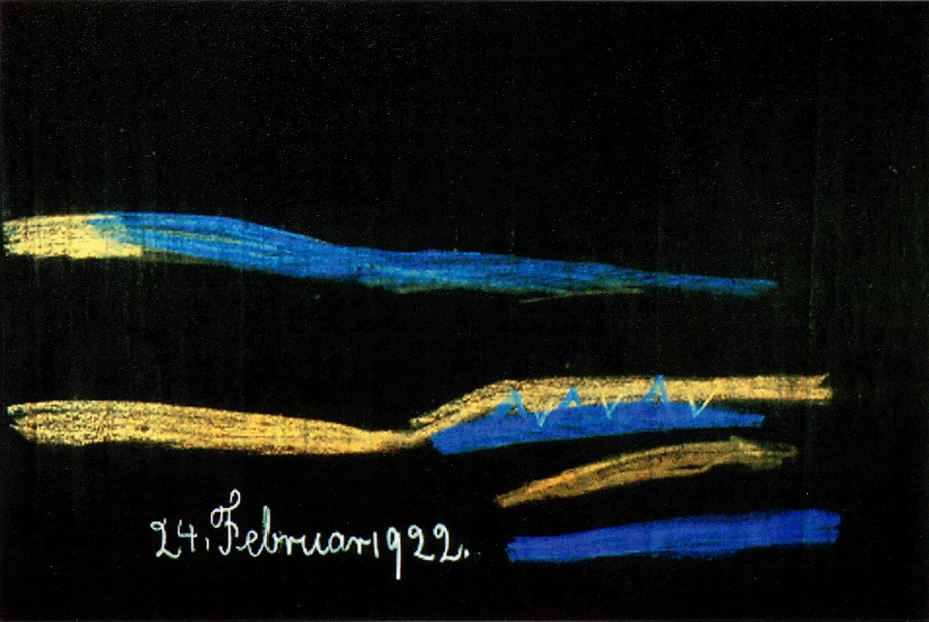
[ 32 ] We can see, when we consider Goethe and Schiller, the insights they had into an ancient time [see illustration on p. 162] (red)—a time when the spiritual world was still powerful, in the fourth post-Atlantean epoch—that they bring this forth solely in their intentions, in their spirituality, while they perceive what takes place on Earth (blue) as a struggle against it. I would say that here we see one interplaying with the other, indirectly through the struggle of the human spirit. And that is precisely the reason why the transition to the purely human problem was found here in Central Europe. So that—and I will be able to elaborate on this further in the following reflections—in the specific conception of the human being as a being situated within a social context, a powerful shift takes place during the Goethe-Schiller era.
[ 33 ] Let us now look toward the East, toward Eastern Europe. Yes, you cannot look toward the East in that way at all. Anyone who merely describes the external facts and has no understanding of what lived in the souls of Goethe, Schiller, and, of course, many others will indeed describe the external facts, but not what is at play there from a spiritual world that does exist, after all—though it exists only in people’s minds. In France, the revolutionary struggle takes place on the political ground, on the physical plane. In Germany, it does not descend to the physical plane, but it still passes through human souls; it trembles within them. But this entire perspective cannot be extended to the East, for in the East the situation is different. For if one wishes to pursue this further, one can only approach the matter through anthroposophy; for what swirls in the souls of Goethe and Schiller—that is, already on Earth, albeit through earthly souls—exists only in the higher world and finds no expression whatsoever down here on Earth.
[ 34 ] If you want to trace what is taking place between Goethe’s and Schiller’s spirits in the physical world all the way to Russia, then you must describe it in much the same way as battles were described in the time of Attila, when something was happening above people’s heads in the air, where the spirits were waging their battles against one another.
[ 35 ] What you find expressed in Central Europe by Goethe and Schiller—in Schiller’s The Robbers and in Goethe’s Götz von Berlichingen—you will find in the East as a spiritual reality, unfolding in the spiritual world above the physical plane. If you wish to seek the parallel events for the writing of The Robbers and Götz, then you must look for them among the spirits in the supersensible world; you cannot find them on the physical plane. So one could describe it this way for the East: Like clouds unfolding above the physical plane, we have what makes the matter understandable in the first place, and below, completely untouched by it, what can be recorded externally on the physical plane.
[ 36 ] And one might say: We know, then, how a Westerner who had become a disciple of Faust behaved—or could have behaved—because we have Hamlet. We could not have a Russian Faust. Or perhaps—? Yes, one could have him in one’s mind’s eye if one were to imagine: While Faust is teaching in Wittenberg and Hamlet is listening to him—writing everything down, even what the spirit tells him, and that there are scoundrels in Denmark and so on, that is, everything the book of the mind needs—an angelic being would also be listening to him. — I’m always referring to Goethe’s Faust, not historical facts, but that which is truer than the historical account. Consider what Shakespeare made of the character he took from Saxo Grammaticus, where the situation is entirely different, and where there is also no clue as to how Shakespeare actually portrayed Faust’s student. — So: While Hamlet sat at his desk, Faust stood at the lectern; an angel would have been listening from the back of the room and would then have flown eastward. There, this angel would in turn have developed what could have unfolded in the West in parallel with Hamlet’s deeds. I do not believe that one can arrive at a truly penetrating understanding by merely considering the external facts and not the profound impressions these external facts made on the most significant figures of the time—especially when dealing with something as momentous as the transition from the fourth to the fifth post-Atlantic period. We’ll talk about that tomorrow.