

Old and New Initiation Methods
Drama and Poetry in the Shift
of Consciousness in the Modern Era
GA 210
19 February 1922, Dornach
Translated by Steiner Online Library
8. Man's Connection to the Cosmos
[ 1 ] In these reflections, we have once again pointed out how, in the most recent cultural epoch recorded in human development—the fifth post-Atlantean epoch—the primary force governing human soul life is the intellectual force, the power of reason that lives in thought. And we have now had to add that the power of thought actually represents the corpse of the spiritual-soul life as it was before birth. In a certain sense, this power of thought has emancipated itself more and more from the other powers of the human being in recent times, and this was keenly felt by those spirits who sought to arrive at a full understanding of the Christian impulse.
[ 2 ] I tried to illustrate this yesterday using the example of Calderón’s Cyprianus. On the one hand, we see the struggle arising from the old notions of a nature imbued with spirit, but at the same time a strong sense of the powerlessness into which a person actually falls when he moves away from the old worldview and is now forced to seek refuge in mere thoughts. In Cyprianus in particular, we see how, in order to take possession of Justina—whose significance I tried to explain yesterday—he seeks refuge with Satan, yet precisely because of the most fundamental modern principle of the soul, he can obtain from this Satan only the phantom of Justina.
[ 3 ] All these things point strongly to what the feelings of people striving for the spiritual were like in this most recent period of human development, how they felt the lifelessness of mere intellectual life, and how they felt at the same time that this mere intellectual life could not penetrate the vitality of the Christ conception. Now, I already pointed out yesterday that, in a sense, a further phase of the same problem that confronts us in Calderón’s Cyprianus then presents itself to us in Goethe’s Faust. In Goethe, one must indeed see a human personality who is situated within the cultural life of the 18th century—which, fundamentally speaking, was far more international than any subsequent cultural life—and who feels strongly, truly very strongly, the intellectual, the rational. One can certainly say that in his youth, Goethe immersed himself in the most diverse sciences, just as he depicts in his Faust. For Goethe did not seek in the life that presented itself to him as intellectual—what most people seek out of a certain human habit—but rather he sought a genuine connection with the world to which human beings, with their eternal nature, belong. One could say that Goethe sought true knowledge. He simply could not find this through the individual sciences that were available to him. Goethe may initially have approached the figure of Faust in a superficial way. But in any case, through his special disposition, he sensed in this figure of Faust what represents that struggling human being we spoke of yesterday. And in a certain sense, he identified with this struggling human being.
[ 4 ] Goethe’s work on Faust seems to unfold in three stages. The first stage takes us back to Goethe’s early youth, when he had just come to fully realize the unsatisfactory nature of his university studies, from which he sought to break free in order to achieve a genuine connection of the soul with the fullness of intellectual life. There he portrayed the figure of Faust—who had appeared to him in the “puppet play,” from which one can still very clearly discern the struggling human being—precisely as the striving human being who wants to break free from the purely intellectual realm and attain a fully human understanding of humanity’s cosmic origin. And so, in the first form Goethe gave to his “Faust,” Faust stands alongside the other individual characters simply as the striving human being. Goethe then passed through those stages of development in his life that he initially experienced by immersing himself in the art still extant in the South, in which he saw, as it were, a higher expression of the essence of nature. Goethe progressively sought the spirit within nature. He could not find it in the spiritual life that had initially presented itself to him. A deep longing led him to what he regarded as the remnants of Greek art in the South. There, in the way in which the mysteries of nature had been explored in artistic forms based on the Greek worldview, he believed he recognized the spirituality of nature.
[ 5 ] Then, I would say, everything he had experienced in Italy underwent a transformation within his own soul. We see this transformation playing out in the intimate form he gave to “The Fairy Tale of the Green Snake and the Beautiful Lily,” where he shaped his temple with the four kings out of certain traditional concepts of beauty, wisdom, virtue, and strength.
[ 6 ] We see how, drawing on this imaginative world and spurred on by Schiller, Goethe returned to his Faust at the end of the 18th century. And this second stage of his work on Faust is expressed in particular by his inclusion of the “Prologue in Heaven,” that beautiful poem that begins with the words: “The sun resounds, as in times of old, in a contest of song among the spheres of brotherhood.” There, in the way Goethe now seeks to encompass the Faust poem, Faust no longer appears as a single individual concerned only with himself; there stands, so to speak, the cosmos with its ascending and descending cosmic forces, and set within this cosmos is the human being, around whom the forces of good and evil struggle. There, Faust is placed within the entire cosmos. Goethe has, in a sense, expanded the problem—which for him was initially merely a human problem—into a universal problem.
[ 7 ] And a third phase then begins when Goethe sets out to complete Faust in the 1820s. By then, his soul was filled with entirely different forms of thought than at the end of the 18th century, when he composed the “Prologue in Heaven” and had drawn upon ancient conceptions of nature—spiritualized conceptions of nature—to transform the Faust problem into a cosmic one. In the 1820s, as he was finishing the second part of Faust, Goethe then sought once again to draw everything from the human soul—in a sense, to expand the soul-being back into the cosmic being.
[ 8 ] We see how he dramatically—of course, he can only do this through external forms—depicts the inner paths of the soul in the classic Walpurgis Night, in the revival of the Helena scene, which, admittedly, had already been created earlier, though only as an episode, and how he then attempts to bring this inner experience—which, when it becomes spiritual, is at the same time a cosmic experience within the soul—to its conclusion in the great final tableau of Faust. There, however, Faust flows into the Christian element. However, as I already said yesterday, this Christian element does not develop from within Faust’s soul; rather, it is, so to speak, pasted on. Goethe immersed himself in the form of Catholic worship and affixed this Christianizing element to Faust, so that there is, after all, only an external connection between Faust’s struggle and this convergence into the thoroughly Christianized world tableau. Of course, this does not diminish Faust, but it is nevertheless true that one must say: Goethe, who struggled in the deepest sense of the word to portray how spirituality should be found in earthly life itself, did not actually succeed in portraying this finding of spirituality in earthly life in any way. He would have had to come to a full understanding of the Mystery of Golgotha—to grasp how the Christ Being truly descended from cosmic expanses into Jesus of Nazareth and united with the Earth, so that whenever one seeks the Earth Spirit, which surges up and down in the storm of deeds, one must actually find the Christ impulse within the fabric of the Earth.
[ 9 ] One might say that Goethe was never able to connect the Earth Spirit—which surges up and down in the storm of deeds and the ebb and flow of time—with the Christ impulse. In a certain sense, this is something we perceive as a kind of paradox, but it is, of course, due to the fact that during that period of human development in which Goethe lived, the conditions simply were not yet in place to perceive the Mystery of Golgotha in its fullest sense. And this Mystery of Golgotha can actually only be experienced in its full meaning when people learn to breathe new life into what they have as “dead thoughts” in the fifth post-Atlantean epoch. Today, there is still a great deal of prejudice, preconception, and even deliberate resistance to bringing the world of thought to life. But humanity must solve this problem: to revive the world of thought—which, when a human being is conceived or born, enters human nature as the corpse of the spiritual-soul—and to transform this corpse of thoughts and ideas into something living. But this can only happen if thoughts are first transformed into imaginations, and if these imaginations are then elevated to inspirations and intuitions. For what is needed is full human understanding. Only then will what I presented to you yesterday be fully understood: that the world as it surrounds us is a great question, and that human beings themselves are the answer—which, in the deepest sense, is precisely what was to be given through the Mystery of Golgotha. Only then will this be understood, when human beings themselves can once again be understood.
[ 10 ] Let us once again picture, in a schematic way, this threefold human being: the head human, or the nervous-sensory human, in the sense discussed again yesterday; the rhythmic human, the chest human, and the metabolic-limb human.
[ 11 ] When we look at a person today, we perceive them as they appear to us in their outward form. Anyone who places a human being on the dissection table in the dissection room today does not have a deep sense—for example, when examining the human head—that they are dealing with something entirely different than when, say, examining a finger. The muscle of the finger is assessed in the same way as the muscle of the head. But one must realize that the human head is essentially a metamorphic transformation of the limb-metabolic organism from the previous incarnation; that is, in terms of its development, the head is something entirely different from the limb-based human of today.
[ 12 ] Well, once one has brought oneself to an inner understanding of the threefold human being, one will also be able to gain an understanding of what, from the cosmos, is connected to this threefold human being. As outer human beings, we are actually incorporated into the solid or earthly realm only through our head organization. We would never be beings that could be described as solid or earthly if we did not have our head organization—which, however, is an echo of the limb organization from our previous incarnation. The fact that we also have solid components in our limbs, in our hands, and in our feet, is a radiating effect of the head. The head is what makes us solid. Everything that is solid within us, everything that is earthly, derives its power from the head.
[ 13 ] We can say: The head contains the solid, the earth, within us (see drawing $130). And everything else that is solid within us radiates out from the head throughout the human being. The head is primarily the source of the bones, of solid bone formation. But in this head we also see the transition to the fluid. All the solid components of the brain are embedded in cerebrospinal fluid, and within the head there is a continuous intermingling and vibration of the solid brain components with the cerebrospinal fluid, which is then connected to the rest of the body through the spinal canal. So we can say: When we consider the nerve-sense human, there is a transition from the earthy (blue) to the watery, to the fluid. We may therefore say that the nerve-sense human lives in the earthy-watery element. And in fact, our brain, in terms of its organism, consists of this interplay between the solid and the fluid.
[ 14 ] If we then turn to the breast organism, the rhythmic organism, this rhythmic organism lives in a Table 11.
[ 15 ] The interplay between the liquid and the airy (yellow). You therefore see the liquid coming into contact with the airy through the lungs. You see rhythmic life as an interwoven interplay of the liquid with the airy, of water with air. So that I can say: The rhythmic human being lives in the watery-airy element.
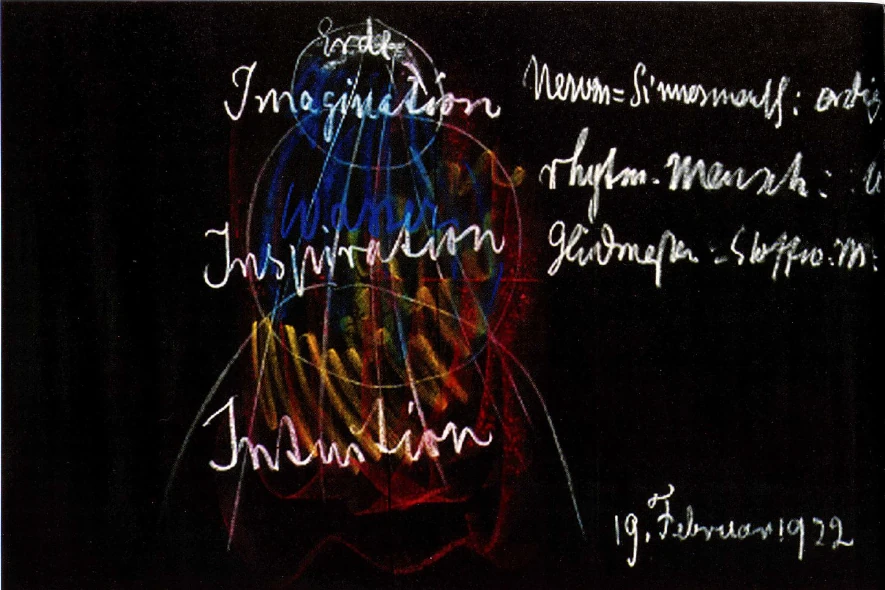
[ 16 ] And the metabolic-limb human then lives at the transition from the airy element to the warm element, to the fiery element (red). He is a continuous dissolution of the airy element into the element of warmth, into the fiery element, which then permeates the entire human being as his body heat. In truth, what happens in metabolism and through our movements is an organization of the airy element—the gaseous element—into the element of warmth, into the fiery element. As we walk about, we are constantly burning the elements of our food that have become air-like, and even when we are not walking about in ordinary human life, it happens continuously that, as the foodstuffs are driven down to the air-like state, they burn and pass into the heat element. So I can say that the human being of limb metabolism lives in the air-like and fiery elements.
Nerve-Sensation Type: Earthy-Watery Element
Rhythmic Type: Watery-Airy
Limbs-Metabolism Type: Airy-Fiery.
[ 17 ] Then it ascends into the ethereal, into the light-form, into the etheric components of the human being, into the etheric body. Once the human being has transformed everything into warmth through its metabolic-limb organism, it ascends into the etheric body. There the human being unites with the ether that fills the entire world; there he becomes part of the cosmos.
[ 18 ] Such ideas, as I am outlining them here schematically, can certainly be transformed into something artistic and poetic if a person possesses an inner sense of plasticity and musicality. And in a work of poetry such as Faust, one could certainly give artistic expression to what one knows—just as certain cosmic mysteries have been depicted, for example, in the seventh scene of my first mystery play. This opens up the possibility of viewing human beings once again in connection with the cosmos. But then one must not apply to human beings what the intellect provides about external nature. Then one must be clear: If you study external nature and then the human head in exactly the same way as external nature, you are studying something that does not belong at all to this present external nature, but rather comes from the previous incarnation. You study it as if it had arisen from the present moment, but it did not arise from the present moment. Nor could it ever arise from a present moment, for a human head could never arise from the natural forces that exist. Therefore, the human head must not be studied through objective knowledge, as provided by the intellect, but through imaginative knowledge. Thus, one will not come to know the human head until one studies it through imaginative knowledge.
[ 19 ] In the rhythmic human being, everything is already integrated into movement. There you are dealing with the liquid and the airy elements. The rhythmic human being is a transition between the watery and the airy elements. Everything surges there. And the outer, solid components in our chest are merely what the head radiates into this undulation. So if we wish to study the rhythmic human being, we must say that within this rhythmic human being, the watery element and the airy element undulate within one another (see drawing, green, yellow). And into this, the head then sends the potential for solid components—such as those found in the lungs and so on—to be present there (white). This undulation, which is the true form of the rhythmic human being, can only be studied through inspiration. Thus, the rhythmic human being can only be studied through inspiration.
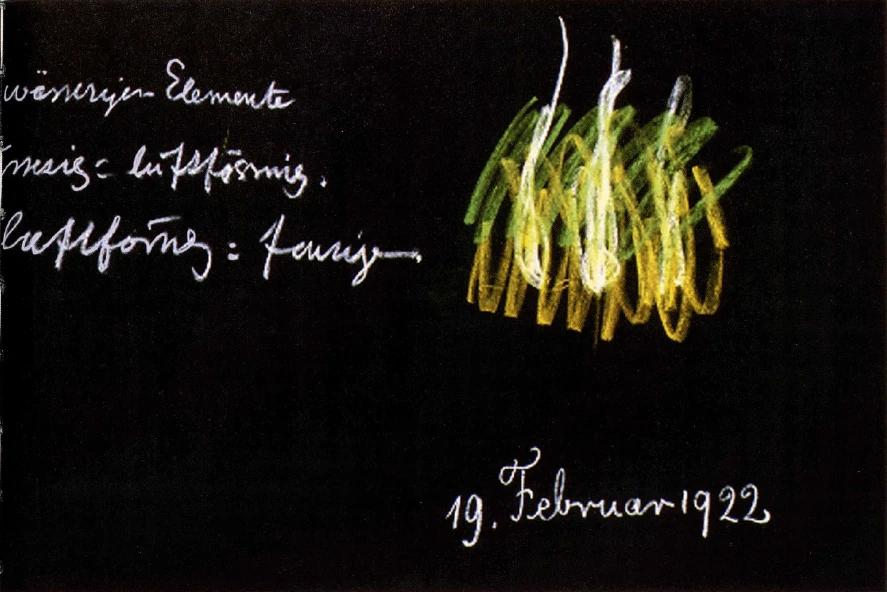
[ 20 ] And the human being as a metabolic entity—that is the ceaseless burning of the air within us. You stand within it; you feel yourself as a human being in its warmth, but this is a very obscure concept. In all seriousness, one can study this only through intuition, where the soul is present within the object. Only intuition can lead to the metabolic-limb human.
[ 21 ] Human beings will always remain a mystery unless they are studied with imagination, inspiration, and intuition. They will always appear to people as that external form they represent in today’s popular and scientific conception. This must not be allowed to continue. Human beings must be recognized anew. If you study human beings solely in terms of their solid components, if you rely only on the illustrations found in today’s anatomy textbooks, then you are not studying them correctly anyway, because you should be studying them imaginatively; for all these illustrations of the solid components of the human organism should be understood as images from a previous earthly life. That alone is the first step. But what then lives in the finer aspects of the human being—in the fluid components—can only be studied through inspiration, and the other aspect—that which is air- and heat-like—can only be studied through intuition. These are the things that must enter European consciousness, that must enter modern civilization as a whole. Unless we bring this into the whole of modern civilization, we will certainly not achieve any construction with this civilization, but only its decline.
[ 22 ] Anyone who understands Goethe, anyone who understands what he was aiming for in his Faust, can already sense that he was actually—I would say—trying to pass through a certain gate. Throughout the work, he grapples with the question: What is the true nature of this human being? — As a very young man, Goethe began to study the human form. Read his treatise on the intervertebral bone and also what I have written about it in my editions of Goethe’s Scientific Writings; everywhere he seeks to approach the human being. He first attempts this from an anatomical and physiological perspective; then, in the 1890s, he approaches it from a more moral perspective through ideas that we later find in the “Fairy Tale of the Green Snake and the Beautiful Lily.” And then, in Faust, he seeks to portray human beings as they exist within the world. He wants to pass through a gate to see how these human beings exist within the world. But he lacks the means to do so; he cannot.
[ 23 ] When Calderón wrote his Cyprianus, the struggle was still at an earlier stage. There we see how Justina breaks free from Satan, how Cyprianus then goes mad, how they find each other in death, and how, at the very moment they meet their end on the scaffold, their redemption takes place: Above, the serpent appears with the demon riding upon it, who himself must proclaim that they are redeemed.
[ 24 ] Here we see how, at the time Calderón wrote his Cyprianus, it was meant to be clearly stated: Here in earthly life, you will not find the divine-spiritual. You must first die; you must first pass through death; only then will you find the divine-spiritual, that salvation which you can find through Christ. People are still far from understanding the Mystery of Golgotha, through which Christ descended to Earth; that is where He should therefore also be found. There is still too much paganism, too much Judaism in Calderón’s ideas for his Christian sensibility to be fully developed.
[ 25 ] Then, of course, some time passed before Goethe began working on his Faust. Goethe already sensed the necessity: Faust must be able to find his redemption here on earth. Goethe should have posed the question this way: How does Faust find the fulfillment of Paul’s words: “Not I, but Christ in me”? Goethe should have gone so far as to have his Faust say not only, “To stand on free ground with a free people,” but: “On free ground, with Christ in the soul, leading human beings to the spirit in their earthly life.” — That is roughly what Goethe should have had his Faust say. Goethe is, of course, honest; he does not say it because he has not yet fully grasped it. But Goethe strives toward this understanding. Goethe strives for something that can actually only be fulfilled when one says: Know the human being through imagination, inspiration, and intuition. — The fact that this is so gives those who approach Goethe the feeling that in Goethe’s struggles, in Goethe’s striving, there is actually much more than what was ultimately realized, than what was ultimately incorporated into modern civilization. Perhaps one can only understand Goethe by doing as I did in my early writings, where I attempted to portray what, in a sense, lived unconsciously within Goethe as a worldview. But the fact is that, in the present day, humanity shows little understanding for this quest.
[ 26 ] When I look at this whole situation within modern civilization, I am constantly reminded of my old teacher and friend Karl Julius Schröer. And in particular, how Schröer himself, when he was working on Faust and Goethe’s other dramas in the 1880s, provided commentaries and introductions—how he was actually not at all concerned with speaking about Goethe in strictly defined terms, but rather in general concepts; yet how he sought to make it clear that what lived as the deepest essence within Goethe must, after all, find its way into modern culture. In 1882, on the fiftieth anniversary of Goethe’s death, Schröer delivered a speech titled “The Coming Perspective on Goethe.” Schröer lived in the hope that the time had already come for Goethe to experience a kind of resurrection. He then wrote a short essay in the Neue freie Presse, which in turn was reprinted in the little book Goethe and Love, which has now been acquired by our Kommenden-Tag-Verlag along with other writings by Schröer, so that the remaining copies are available there and new editions will likely be published after some time. This essay, “Goethe After 50 Years,” is a brief excerpt from that lecture I heard back then. It contains much of what was alive in Schröer’s feelings at the time: that Goethe must be brought into contemporary civilization. And then, when Schröer wrote the little book Goethe and Love, he had tried to show in the notes how Goethe should be brought to life, for bringing Goethe to life means, in a certain sense, bringing the abstract world of thought itself to life. In the latest issue of Goetheanum, I pointed out a passage of this kind—one that is beautiful and appears in the little book Goethe and Love. There Schröer says: “Schiller recognized him [Goethe, that is]: If the intuitive spirit is genius-like and seeks the character of necessity in the empirical, it will indeed always produce only individuals, but with the character of the species. With his intuitive method—by which he sees the imperishable idea, the archetype, in the transitory individual—Goethe does not stand as isolated as one might perhaps assume.”
[ 27 ] I was with Schröer at the very time he wrote this passage, back in 1882; that is to say, while he was writing that little book, I visited him frequently, and at that time he was completely absorbed by an impression he had received. This impression stemmed from the fact that he had observed somewhere—it was one of those older physicians who were still practicing at the time, namely Oppolzer—that the Viennese clinician Oppolzer possessed a certain indefinable intuition when making a diagnosis. When Oppolzer approached a patient’s bedside, he did not perform the differential examinations as is usually done; rather, the patient’s type made a certain impression on him, and from the patient’s type he was then able to discern something of the type of the illness. This made a strong impression on Schröer, and based on this impression, he then wrote the passage that merely used this phenomenon in Oppolzer’s case for illustrative purposes. He wrote: “In the art of healing, great diagnosticians at the patient’s bedside are praised for the depth of insight with which they recognize the patient’s constitution, the individual type of the patient, and from that, the disease itself. It is not their chemical or anatomical knowledge that aids them in this, but their intuition regarding the living being as a whole. They are creative spirits who see the sun because their eye is sun-like. Others simply do not see it. If such a diagnostician unconsciously follows Goethe’s intuitive method, Goethe consciously introduced it into science. It led him to results that are no longer disputed; only the method itself has not yet been universally recognized.”
[ 28 ] Schröer wrote this based on this insight, drawing on Oppolzer’s intuition at the patient’s bedside, already suggesting at that time that the individual sciences—such as medicine—must be enriched by the method that, in turn, works with the mind.
[ 29 ] There is something tragic about looking back and realizing that Schröer was one of the last of those people who still felt something of the deepest essence of Goethe. For while Schröer believed back then, in the early 1880s, that a revival of Goethe was bound to take place, Goethe was subsequently laid to rest—and truly buried—once and for all. One could also say: Goethe’s true grave, for Central Europe, was the Goethe Society—which is called the Goethe Society in English, since it was also founded there as a branch. That was the resting place of the living Goethe. But there is still a need to bring this living element, which lived within Goethe, back into our civilization. Karl Julius Schröer’s impulse was a good one; it simply could not be fulfilled at that time because the era continued to worship the dead. “Whoever wishes to recognize and describe something living must first seek to drive out the spirit.”
[ 30 ] That is precisely what has become the motto, and today, in some very broad circles, this motto has gone so far as to breed hatred toward any expression of the spiritual—as you can see from the way many people have reacted to anthroposophy.
[ 31 ] The civilization from which you yourselves have all outgrown certainly needs this element of revitalization. And it is remarkable how much is said today—for example, about Goethe’s Faust —which, after all, represents only a new phase in that struggle for the spirit that we saw yesterday in Calderón’s Cyprianus—yet how little is recognized that it is the task of the present to bring to full vitality that which Goethe actually brought to life—vaguely hinted at, in terms of feeling and sensation, but not through intellectual insight—in his Faust, particularly in the second part. We must direct our attention to these phenomena in a very intense way, for we are truly dealing here not merely with a matter of worldview, but with a matter of civilization as a whole. There are many symptoms of this in the present. These symptoms merely need to be seen in the right light.
[ 32 ] A book has been published titled The Three Crises by Ruedorffer—a book that, when you read it, strikes a chord on every page, I would say. For the man who wrote it is a figure who himself played a role in European diplomatic and political life in very important positions, both before the war and during it. Now that he has come to know all the possible facets of this European life—precisely from vantage points from which one can understand it more closely than most people—he is now seeking to clarify for himself what it is actually all about. I need only read a few passages to you from the writings of a man who certainly wants to be a realist, not an idealist—a man who has acquired a certain dry perspective during his diplomatic career and about whom, despite having written passages such as those I am about to read to you, one can still say: He’s still stuck in the past. Nevertheless, he has remained what people particularly love today: the bourgeois philistine.
[ 33 ] In this essay, he discusses three things. First, he discusses how the states and peoples of Europe no longer have any relationship with one another. Second, he discusses how the individual ruling circles—the leaders within each nation—in turn have no connection to the people themselves. And third, he discusses how, in particular, those people who today seek to radically shape and establish a new era have even less connection to reality.
[ 34 ] So a person who, as I said, has contributed to the conditions that exist today writes something like this: “This disease of the state organism strips reason of its leadership and subjects the state’s decisions to a multitude of irrelevant external influences and considerations. It restricts freedom of action, fragments the will of the state, and, moreover, is usually accompanied by a dangerous instability of governments. The era of unrestrained nationalism before the war, the war itself, and the postwar situation in Europe have placed immense demands on the reason of states, their composure, and their freedom of action. The fact that capacity did not grow but rather diminished in the face of these challenges was the final blow dealt by the catastrophe. The crisis of the state and the crisis of the international order have, in constant interaction, fueled one another, each amplifying the destructive effects of the other.” These are not the words of just any idealist, nor of just any artist who merely stood by and watched, but of one who took part. He says, for example: “If democracy is to survive, it must be honest and courageous enough to tell it like it is, even if it seems to testify against itself. Europe is facing ruin.”
[ 35 ] That we are facing the downfall of Europe is a view held today not only by idealists with a touch of pessimism, but especially by those who have been on the inside and experienced it firsthand. Someone who, as I said, has been on the inside and played an active role writes today: “Europe is facing its downfall.” There is no time for anyone to conceal their mistakes for partisan reasons instead of correcting them. For this purpose alone—and not as a laudator temporis acti—I emphasize that democracy must and will destroy itself if it cannot free the state from this entanglement of extraneous influences and considerations. Pre-war Europe collapsed because all the continental states—the monarchies as well as the democracies, and most of all autocratic Russia—submitted to demagoguery, partly voluntarily and unconsciously, partly unwillingly and under duress, unable to recognize what was reasonable amid the self-inflicted confusion of minds, and to act freely and decisively upon whatever they might have recognized. The upper classes of Europe’s old political order—who, in the past century, were indeed the bearers of European culture and abounded in figures of statesmanlike spirit and worldly experience—would not have been so easily unseated and cast aside as rotten and spent if they, having grown alongside the problems and challenges of the changing times, had not lost their statesmanlike spirit and had preserved a tradition other than that of the most superficial diplomatic routine. If monarchs claim to be better and more objective at selecting statesmen than parliaments, then they and their courts must be the center and pinnacle of education, insight, and knowledge. But that was over long before the war. Yet the indictment of the monarchy’s failings does not absolve democracy from recognizing the causes of its own inadequacies and doing everything possible to remedy them. Before Europe can recover, before any attempt can be made to replace its hopeless disorganization with a more sustainable political structure, the individual countries must put their internal affairs in order in such a way that their governments are enabled to work objectively and freely in the long term. Otherwise, even the best will and the greatest talent, entangled a thousandfold, will wither away in the same fate that befalls all.” I would not read all this to you if it came from an idealist, if it did not come from someone who must believe he is fully grounded in reality, precisely because he has been a participant.
[ 36 ] “It is a spectacle of profound tragedy, as every attempt at a redemptive act, every word of repentance, becomes ensnared in the webs of this fate and, entangled a hundredfold, ultimately falls to the ground, having no effect; just as the European bourgeoisie, thoughtlessly clinging to the fallacy of humanity’s constant progress or lamenting as it plods on along its familiar path, neither sees nor wishes to see that it is living off the accumulated labor of past years and is scarcely capable of recognizing the ills of the current world order, let alone giving birth to a new one of its own accord; how, on the other hand, the working class—radicalizing in nearly every country, convinced of the unsustainability of the present state of affairs, and believing itself to be the savior of a new order—is, in reality, merely an unwitting instrument of destruction and ruin, including its own, through this very belief. The new parasites of economic disorganization—yesterday’s lamenting wealthy, the petty bourgeois sinking into proletarian status, the devout worker who imagines he is founding a new world—all of them seem to be ensnared by the same doom; all of them seem like the blind who are digging their own graves.” This is not written in the book of an idealist; it is written today in the book of a [person] who was actively involved! “But the entire nature of today’s political reality—the Entente’s recent peace treaties, the Polish advance into Ukraine, the Entente’s blindness or helplessness in the face of German-Austrian developments—all of this shows the politician, who must ultimately rely on reality, that while the ideal demand for a pan-European, constructive revision of the Paris Peace Treaties has indeed been made, and the most urgent warning has been shatteringly substantiated, both the demand and the warning can only fall on deaf ears, and events will inevitably continue to roll toward the abyss in the old way.”
[ 37 ] The entire book is written to prove that Europe is on the brink of the abyss, that we are in the process of digging the grave of European civilization. But I would like to say all this to you merely as an introduction to what I now actually consider necessary to say. For that is something else entirely. We have before us a man who has held key positions himself, who sees that Europe is on the brink of the abyss, and who simply says—as is evident from this entire work—that if nothing happens other than a continuation of the old impulses, then civilization will perish; it will perish without a doubt. Something new must come along.
[ 38 ] Well, I am now looking to see where in such a text the New is alluded to. Yes, I find it on page 67; there are three lines there: “Only a change of mindset in the world, a change of will among the major powers involved, can bring about a supreme council of European reason.”
[ 39 ] Yes, you see, this is the choice people face. They point out that only if there is a change of heart everywhere, if something entirely new emerges, will there still be salvation. The entire book was written for the purpose of showing that there is no other salvation. There is much truth in that. The truth is, in fact, that for a civilization in collapse, there is no salvation other than through spiritual life drawn from genuine spiritual sources. There is no other salvation; otherwise, modern civilization—insofar as it was established from Europe all the way to America—is headed for its downfall. What is decaying must be seen as the most significant phenomenon of our time. And it does no good to make compromises with what is decaying; rather, the only thing that helps is to look to that which can flourish even over the grave, precisely because it is stronger than death. That is spiritual life. But as for what is necessary here, such people initially have only a very abstract suggestion: a general international change of heart must take place. — If they hear anywhere of a genuine blossoming of spiritual life, they dismiss it as “useless mysticism.” Then they come and say: Yes, in such declining times of ruin, all manner of occultism and mysticism assert themselves, and one must guard against them.
[ 40 ] And so those who are digging the grave of today’s civilization are, for the most part, the very ones who even realize that this digging is taking place. There is no other way to take a stand on these matters than by recognizing them with the utmost seriousness, by truly immersing oneself with the utmost seriousness in the truth that a new spiritual life is necessary and that this new spiritual life must truly be sought, so that at last the possibility may be found to find Christ within earthly life—to find him as he has been since the Mystery of Golgotha. For He has descended to connect Himself with earthly conditions.
[ 41 ] The fiercest opposition to this essentially Christian truth is being waged today, for example, by a certain kind of theology that rebels precisely when one speaks of the cosmic Christ. So it must be pointed out again and again that even in the days when, for example, Schröer referred to Goethe for the revival of civilization, the book by the Basel professor—a friend of Nietzsche’s—had already been published on the Christian character of modern theology—he meant Christian theology. And Overbeck argued at the time that theology, of all things, is the most unchristian, and sought to prove this as a historian of theology. At that time, therefore, the chair of historical theology in Basel was held by a professor who demonstrated: Theology is unchristian!
[ 42 ] Humanity has been driven into catastrophe because it failed to heed the individual calls that were made—calls that, admittedly, were still very unclear. Today, humanity no longer has time to wait. Today, humanity must realize that accounts such as Ruedorffer’s are entirely true, and that it is absolutely necessary to understand how everything is collapsing as a result of the persistence of the old impulses. Then there is only one thing to do: to turn to that which can grow even from graves—namely, the spiritual and living.
[ 43 ] And that is what we must keep bringing to your attention, time and again, especially in our context, my dear friends. We’ll continue discussing this next Friday at 8 o’clock.