

Old and New Initiation Methods
Drama and Poetry in the Shift
of Consciousness in the Modern Era
GA 210
18 February 1922, Dornach
Translated by Steiner Online Library
7. The Human Organism in Its Threefold Nature and Repeated Earthly Lives
[ 1 ] If we recall what was said yesterday, what emerges as the essential point is that, from the spiritual-soul realms, through conception and birth, there descends, as it were, into the physical-sensory world, on the one hand, that which still possesses an inner, living spiritual world—which is then shadowed and subdued into the world of thought that the human being carries within; and, on the other hand, that which pervades the soul-spiritual realm—and which I have essentially characterized as a state of fear. I then explained how the spiritual element that is still alive in itself is transformed into the realm of thought, yet—as it were—sends into this earthly life, like a living remnant of prenatal life, something that lives in human compassion, so that in human compassion we actually have something that contains within itself the vitality of the prenatal in our soul.
[ 2 ] What then pervades this soul as a feeling of fear before its descent into the physical world is transformed, on the one hand, into a sense of self here in earthly life, and then into will. What thus lives as thought in the human soul is, in comparison to the living reality in the spiritual world before birth, essentially spiritually and soulfully dead. In our thoughts—or at least in the force that permeates our thinking—we actually experience, as it were, the corpse of our spiritual-soul existence, as we have it between death and a new birth. But this present-day experience of the soul—which is, so to speak, dead—during physical earthly life was not always present to the same degree. The further back we go in human evolution, the more what I described yesterday as compassion—compassion not only for human beings but also, for example, for the whole of nature—still plays a certain role here in earthly life. Such abstract insight, as is sought today—and rightly so, at least with a certain relative justification—was not always present in human evolution. Such abstract inner consciousness, in the fullest and most extreme sense, did not really emerge until the 15th century—that is, with the beginning of the fifth post-Atlantean epoch. What people experience in their thoughts today was formerly permeated by living feeling. In the ancient bodies of knowledge—for example, those of the Greek world—the abstract concepts we have today did not exist at all. Back then, all concepts were imbued with living feeling. People sensed the world; they did not merely think it. This way of thinking about the world and the restriction of empathy to what is, in the strictest sense, ultimately only social existence—that only emerged with the beginning of the fifth post-Atlantean epoch.
[ 3 ] Well, if compassion is to remain active in earthly life—as it was, for example, so strongly present in ancient India toward all of nature, and as was sought for all beings in nature—then human beings still have within them a powerful experience of what takes place around them between death and a new birth. In thought, this life has died out. In our empathy with the world around us, there is certainly a reliving of our perceptions during the time between death and a new birth. In the lives of people in earlier times, when they looked out upon nature, this empathy played a major role, and as a result, these people saw everything in nature—every cloud, every tree, every plant—as imbued with spirit. If one lives solely in thought, then nature becomes devoid of spirit, because thought is, in fact, the corpse of the spiritual-soul. One then sees nature as a dead entity, because it can only be reflected in dead thoughts. Hence the disappearance of all elemental beings from the perception of nature as modern times dawned.
[ 4 ] So what is it, then, that human beings nevertheless still feel within themselves as a certain spirituality—a living spirituality—even though, in thinking, they should actually be experiencing only a dead spirituality? If one wants to answer this question, one must take into account what I have described with regard to the physical organization of humanity as the threefold human organism. There we have the nervous-sensory organism, which is essentially localized in the head. Let us visualize this schematically [here the drawing for Plate 10 begins]. We have located the rhythmic organism essentially in the upper chest organs, but of course both parts of the organism in turn permeate the entire organism. And we have the limb-metabolic organism, which is essentially located in the limbs and in the lower parts of the trunk.
[ 5 ] If we take this physical organization of the human being into account, we can first turn our attention to the head organization, which is thus primarily—though not exclusively—the bearer of the nervous-sensory life. This head organization can essentially be understood only if one grasps it visually, namely in such a way that one recognizes it as essentially the metamorphic transformation—not in substance, but in form—of the rest of the human being, namely the limb-metabolic organism, from the previous incarnation, from the previous earthly life.
[ 6 ] The limb-metabolic organism from the previous earthly life—not, of course, in its substance, but in its form—becomes the head organization in this, that is, the following earthly life. So one can say: Here in the head, we see, as it were, a vessel whose structure has been formed through a transformation of the limb-metabolic organism from the previous incarnation, and this head is primarily the dwelling place of abstract thoughts—that is, those thoughts that constitute the physical body of the soul-spiritual life prior to birth (see drawing, red).
[ 7 ] So, in a sense, we carry within our head the living memories of our previous earthly life, and this is what makes us feel, in this earthly life, as an “I”—as a living “I”—for this living “I” does not actually exist within us. Internally, there are dead thoughts. But these dead thoughts dwell in a shell that can only be understood in terms of its imagery, and in its imagery lies the metamorphic transformation of the limb-metabolic organism from the previous earthly life.
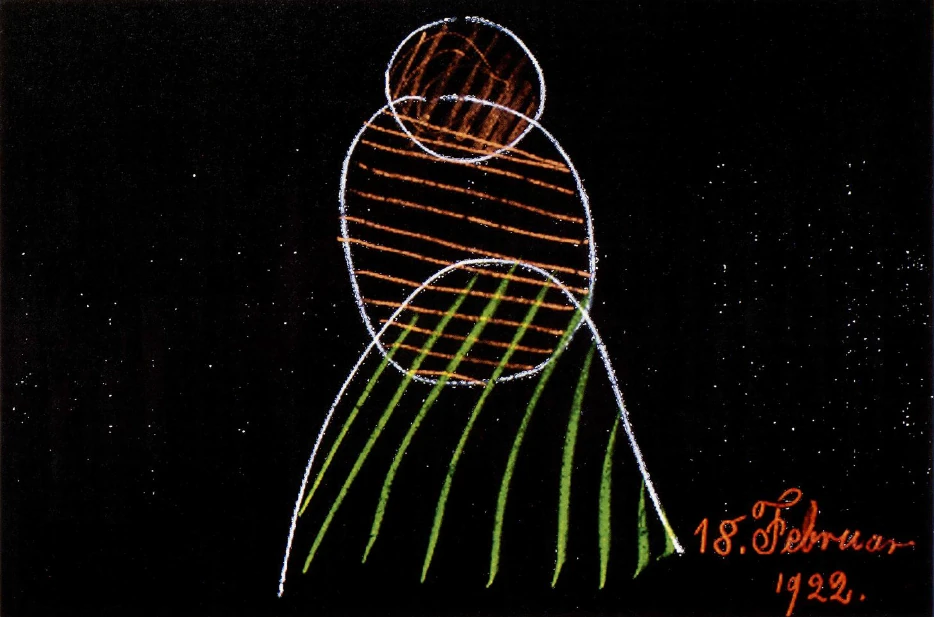
[ 8 ] That which now comes across as more vivid from the spiritual-soul life, when the soul descends into physical earthly life, does not immediately take up residence in the head, but rather in the rhythmic organism (red). In this rhythmic organism, we have within us everything that flows in from our surroundings—the environment we were surrounded by between death and a new birth. And while in their head a person has something that is merely an image of their previous earthly life with its dead thought organism, they have something much more alive in their rhythmic, upper chest organization. This is where the echoes of everything the soul experienced as it moved freely in the spiritual-soul realm between death and birth come into play. As we breathe, as our blood circulates, what were forces between death and birth vibrate into this breathing and this blood circulation. And what we possess as our spiritual-soul being for this earthly incarnation is found neither in the head nor in the chest, but—as strange as this may sound to people today—in the metabolic organization of the limbs. Our present earthly “I” is located in the metabolic organization of the limbs (green).
[ 9 ] You must, after all, think of these dead thoughts as living; these dead thoughts live—if I speak figuratively here, it is, of course, only meant as an approximation—within the convolutions of the brain, and the brain, in turn, is a transformation of the organism from the previous incarnation. This life, this dwelling of dead thoughts in the mind, is then perceived by the initiate as a real memory of the previous incarnation. It really is just like this with the memory of the previous incarnation: it’s as if you were in a dark room and had hung your various garments on a clothes rack, and by feeling them you can choose where, say, your velvet coat is, and in doing so you suddenly realize when you bought that velvet coat. That is how it is when the dead thoughts are bumping into things everywhere. What is sensed within the brain is all a memory of the previous earthly life.
[ 10 ] What is experienced in the chest organism is a memory of life between death and rebirth, and what is experienced in the limb-metabolic organism is the present earthly life. It is only because the metabolism of the limbs works its way up into the thoughts that a person has the experience of the “I” in their thoughts. But this is a deceptive experience. The “I” is not contained within the thoughts at all. It is no more contained within the thoughts than you are standing behind the mirror when you see your reflection in it. The “I” is not at all present within the life of thought. Because the life of thought is shaped by the head, it contains the memory of the previous earthly life. So, in your head, you actually have the person from your previous earthly life. In your chest you have the human being as he lived between death and a new birth, and in your limb-metabolic organism—and especially in the tips of your fingers and toes—you essentially have the human being as he is here on Earth. And it is only because you experience your fingertips and toes through your brain that you also have, through thought, an awareness of this “I” in your earthly life. That is how grotesque things really are compared to much of what people generally imagine today.
[ 11 ] To conceive of this with the mind, as we do today, actually did not become the norm until the beginning of the fifth post-Atlantean epoch, in the 15th century. But in a certain sense, all things proceed in an Ahrimanic way; they are anticipated. The Luciferic is that which occurs later than is justified by the course of development; the Ahrimanic occurs earlier. And so we have the opportunity to point to an event in history where, in a very decisive way, something occurs too early—something that, strictly speaking, should not have occurred until the 15th century. It did occur then, but it had already been anticipated at the time of the Mystery of Golgotha. And here we can point out how the Old Testament concepts, which I characterized for you somewhat yesterday, were transformed entirely into allegories by a contemporary of Christ Jesus, Philo of Alexandria.
[ 12 ] Philo of Alexandria interprets the entire Old Testament allegorically; that is, he seeks to transform the entire Old Testament—which is presented in the form of experiences—into mental images. This is very ingenious, and since it occurs for the first time in human development, one can indeed speak of this ingenuity. Today, it is less ingenious when, for example, theosophists interpret Hamlet by claiming that one character is Manas, another is Buddhi, and so on—that is, when the matter is dragged entirely into the realm of allegory. That is, of course, nonsense. But Philo of Alexandria, in a sense, transformed the entire Old Testament into mental images, into allegories. These allegories are nothing other than the inner revelation of the slain soul life—the soul life that has died and lies before us in the power of thought as a corpse. The Old Testament worldview, in its own way, still looked back to life before birth or before conception, and it was from this perspective that it constructed the Old Testament.
[ 13 ] When it was no longer possible to look back—and Philo of Alexandria could not look back—all of that became mere dead mental images. And so, in the historical development of humanity, we find these two significant phenomena side by side: the Old Testament development culminated in Philo of Alexandria at the time of the Mystery of Golgotha. The entire Old Testament, for Philo of Alexandria, becomes a world of straw-like allegories. And at the same time, the Mystery of Golgotha reveals that it is not a dead experience within the human being that can lead to the supersensible, but rather the whole human being who passes through the Mystery of Golgotha, with the divine being within them.
[ 14 ] These are the two great polar opposites: the abstract world, which is foreshadowed in an Ahrimanic way in Philo, and the world that is to enter human development with Christianity. One might say that, from this point of view, the whole world becomes a question. The abstract thinker—and Philo of Alexandria was perhaps the most brilliant of such thinkers, because he foreshadowed the later Ahrimanic abstractness—seeks to find the answer to the mystery of the world by formulating thoughts intended to solve the world’s enigma. In contrast, the Mystery of Golgotha is the all-encompassing, living protest. Thoughts never solve the riddle of the world; rather, this solution remains alive. Human beings themselves, in their totality, are the solution to the riddle of the world. Thus the suns, the stars, the clouds, the rivers, the mountains, and the individual beings of the various kingdoms of nature—as they reveal themselves from without—appear as one great question. And human beings stand there, and in their entire being, they are the answer.
[ 15 ] This is also a perspective from which the Mystery of Golgotha can be viewed. One does not seek to set thoughts, in their lifelessness, against the mystery of the world; rather, one sets the whole human being against that which can be experienced from within the whole human being.
[ 16 ] Humanity has been able to find the path to understanding this only very slowly and gradually. And even today, that path has not yet been found. Anthroposophy seeks to open up this path. But ever since abstraction has taken hold, people have, in a sense, even lost the awareness that this path must be sought. Up until then, there had been a struggle to do so, and this struggle is still most clearly evident at this turning point from the fourth into the fifth post-Atlantean epoch. As Christianity spreads as an external phenomenon, it is precisely the finest minds who are striving to understand this Christianity from within. At its core, it is a continuous struggle to grasp the meaning of Christianity that takes place among the finest minds. One sought, so to speak, to present the mystery of the world to humanity in a living way—that is, to truly understand humanity as such. They had simply taken up the two currents from ancient times: on the one hand, the pagan current, which was essentially a wisdom of nature that saw spiritual-elemental beings, demonic entities—precisely those demonic entities of which the Gospel speaks, pointing out that the demons rebelled when Christ came among humanity, because they now knew their dominion was over. People did not recognize Christ. The demons recognized him. They knew that he would now take possession of the hearts and souls of human beings; they would have to withdraw. But they continued to play a role in people’s minds and in their quest for knowledge for a long time afterward. The pagan consciousness, which sought the demonic-elemental-spiritual nature in all natural beings in the old way, continued to play a role for a long time. It was, in fact, a struggle over that kind of knowledge which was now to seek, everywhere in the earthly realm, that which—through the Mystery of Golgotha—had united with earthly life as the very substance of Christ Himself.
[ 17 ] That was one current—the pagan current—which was a “Nature-Sophia” that saw the spiritual everywhere in nature and could therefore also look back upon human beings, whom it regarded as natural beings, yet also as spiritual beings, precisely because it saw the spiritual in all natural beings. This is expressed most purely and beautifully in Greece, and in particular in Greek art, where we see how the spiritual, as destiny, interweaves human life, just as the laws of nature interweave natural phenomena. And even if we sometimes stand in awe before what is presented in Greek tragedy, we nevertheless have the feeling: The Greeks did not merely perceive the abstract laws of nature, as we do today, but they also perceived the workings of a divine-spiritual essence in all plants, in all stones, in all animals, and therefore also in human beings themselves, in whom the rigid necessity of the natural law took shape as fate, as can be found, for example, in the Oedipus drama. Here we see the intimate kinship between natural-spiritual existence and human-spiritual existence. Therefore, neither freedom nor human conscience yet reigns in these dramas. What reigns is an inner necessity, a fateful quality within the human being, in a manner similar to how the laws of nature reign in the natural world.
[ 18 ] This is one current that has emerged in more recent times. The other is the Old Testament-Jewish current. It has no wisdom about nature. With regard to nature, it has only a view of sensory-physical existence. However, this Old Testament perspective is directed upward toward the primordial sources of morality, which lie between death and a new birth—those primordial sources that do not, however, look toward the natural aspect of the human being. For the Old Testament, there is no natural science, but only the observance of divine commandments. In the sense of the Old Testament, things do not happen according to the laws of nature. Things happen because Yahweh wills it. And so we see that from the Old Testament it resounds without imagery, in a certain sense abstractly, but behind these abstractions—with the exception of Philo of Alexandria, who turns everything into allegories—stands the ruler Yahweh, who permeates these abstractions with a universal human nature idealized up into the supernatural, and who, like a human ruler, permeates everything that resounds down to earth from him as commandments. In this Old Testament worldview, there is a mere gazing upon the moral world—indeed, a shying away from viewing the world in its outward sensuality. While the pagans were intent on seeing divine-spiritual beings everywhere, the God of the Jews is simply the One. The Jew is a monotheist. His God, his Yahweh, is the One, because he can refer only to that which is unified within the human being: You shall believe in one God alone; and you shall not express this God through anything earthly, not through a sculpted image, not even through the word that only the initiate is permitted to utter on particularly festive occasions: You shall not take the name of your God in vain.
[ 19 ] And so everywhere there are references to the intangible, to that which cannot be expressed through nature, to that which can only be conceived. But in the Old Testament, one still imagines the living nature of Yahweh behind these ideas. This disappears in the allegories of Philo of Alexandria.
[ 20 ] The task now is to find, in the Christian struggle of the first centuries and continuing into the 15th, 16th, and 17th centuries, a harmony between what can be seen as the spiritual in external nature and what is experienced as the divine when we look at our own morality, at the soul within human beings. If one approaches this matter theoretically, it seems simple. In reality, the search for harmony between contemplating the spiritual in external nature and directing the soul upward toward the spiritual from which Christ Jesus descended was an immense struggle. And as Christianity spread from Asia and took hold of the Greek and Roman worlds, we see this struggle most intensely in the later centuries of the Middle Ages in those parts of Europe that had retained much of their original character. In Greece itself, the old pagan element—the perception of the spiritual in all things of nature—was still so strong that although Christianity passed through Hellenism and even adopted many linguistic forms from Greek, it could not take root within Hellenism. Only Gnosticism, the spiritual perception of Christianity, was able to take root in Greece.
[ 21 ] Then Christianity had to pass through the most prosaic phase in the development of the world: Roman culture, which, in its abstract nature, could in turn grasp only the abstract, thereby also foreshadowing the later Ahrimanic aspect of what is alive in Christianity. But we find a truly vibrant struggle in Spain, where the question arises—not theoretically, but as an intense question of life: How can a person, without losing sight of the spiritual in natural things and processes, find the whole human being who is set before the eyes of the soul through Christ Jesus? How can a human being become fully Christian? — This question arose most vividly in Spain, and we see in Calderón a poet who knew how to portray this struggle with particular intensity. In Calderón, if I may say so, this struggle for humanity to become fully Christian lives on dramatically.
[ 22 ] Here we turn to Calderón’s most characteristic drama, Cyprianus, who is a kind of miracle-working magician—that is, a person who, at first, lives among the things and processes of nature, seeking to explore their spiritual essence. If you take the image of such a person after his later metamorphosis—the Faustian metamorphosis—you do not have the full vitality with which, for example, Cyprianus appears in Calderón’s work. For this immersion in the spirit of nature in Cyprianus is still full of life. There is still a complete sense of naturalness there, whereas in Faust everything is already shrouded in doubt. While Faust, from the very beginning, no longer truly believes in finding the spiritual in nature, Calderón’s Cyprianus is still very much a medieval figure. Just as just as today’s physicist or chemist is surrounded in his laboratory by his instruments—the physicist by Geissler tubes and other apparatus, the chemist by his retorts, furnaces, and the like—so too is Cyprianus, in his state of mind, surrounded everywhere by that which, as the spiritual, shines forth and wells up from natural processes and natural entities.
[ 23 ] At this point—and this is characteristic—Justina enters the life of this Cyprianus. Here we have a reference to something that is portrayed in the drama quite humanly as a female being, but which we nevertheless fail to fully grasp if we view it merely as a female being. For these medieval poets are not properly understood if, as their more recent interpreters do, one always says: “Only the very crude, material, concrete must be taken into account”; for example, when it comes to Dante’s Beatrice, we must think of nothing other than a gentle, feminine being. — Or else the interpreters miss the mark by, in turn, allegorizing everything and elevating it into a spiritual sphere. Back then, the spiritual images and the real earthly beings were not yet as far apart as they are in the minds of modern interpreters. And so, when Justina appears in Calderón’s drama, we may once again think of the justice that pervades the world—which was by no means something as abstract as what even lawyers no longer possess today, but rather what stands on their bookshelves and what they take down in the form of individual volumes. Jurisprudence was, after all, perceived as something living.
[ 24 ] This is how Justina approaches Cyprianus. And now, of course, it becomes difficult once again for the modern scholarly interpreter, who is now supposed to understand the hymn that Cyprianus sings to Justina. Yes, modern lawyers do not do this in their jurisprudence, but someone like Cyprian perceived the justice that permeates and animates the world as something to which he could sing hymns. Spiritual life has simply changed; this must be emphasized again and again. But at the same time, Cyprian is also a magician who deals with the spirit beings of nature—that world of demons, which also includes the medieval figure of Satan. Now Cyprian feels unable to truly reach Justina. So he turns to Satan, the leader of these nature demons. He is to procure Justina for him.
[ 25 ] Therein lies the full, profound tragedy of the Christian conflict; namely, what draws Justina to Cyprian is the justice that is appropriate to Christian development. It is to be brought to Cyprian, the natural philosopher who is still half-pagan. That is the tragedy: He cannot find Christian justice within the necessity of nature, which has something rigid about it. But he can only turn to the leader of the demons, to Satan, to have him procure Justina for him.
[ 26 ] Satan sets about the task. It is difficult for people to understand—because, of course, Satan is a very clever being—that he repeatedly takes on tasks at which he has already failed so many times. But that is simply a fact. No matter how clever we may think we are, we cannot criticize a being as clever as Satan in this way. One would have to conclude that there must be something that repeatedly drives such an intelligent being to try his luck anew in order to corrupt people in this way. For, of course, the corruption of humanity would have occurred if Satan had succeeded in—if I may put it this way—outwitting Christian righteousness in order to bring it to Cyprian. So Satan sets out to do this, but he does not succeed. Justina’s entire disposition resists Satan; and she escapes from him, leaving him with only a phantom of her, a shadow image.
[ 27 ] You can see how, in Calderón’s work, certain motifs that you later find in Faust appear, but everything is, so to speak, steeped in this early Christian struggle. Satan leaves behind a shadow image, which he brings to Cyprianus. Cyprianus, of course, can’t really make sense of the phantom, of the shadow image. It has no life. It contains only a shadow image of justice. Oh, it is wonderfully expressed how what has become of the ancient wisdom of nature—and now appears as modern natural science—when it attempts to address something like social life or Justina, fails to provide the truly living, but only phantoms of thought. Just as now, because humanity has advanced into the dead world of thought with the fifth post-Atlantean epoch, it delivers only phantoms—the phantoms of justice, the phantoms of love, the phantoms of everything—I won’t say in life, but in theory.
[ 28 ] And on top of all this, Cyprianus goes mad. Justina—the real Justina—is taken into captivity along with her father. She is sentenced to death. Cyprianus hears this in his madness and demands death for himself as well. And there they find themselves on the scaffold. As they are about to die, the serpent appears, and riding upon it is the demon who had intended to lead Justina to Cyprianus; the demon declares that they are redeemed. They may ascend to the heavenly realms: “The noble member of the spirit world is saved from evil!”
[ 29 ] The entire Christian struggle of the Middle Ages lies in this. Human beings are caught between what they can experience before birth in the spiritual-soul world and what they are to experience after passing through the gate of death. Christ descended to Earth because it was no longer possible to perceive what had once been perceived in the “middle human,” the “rhythmic human”—a resonance of which was still discernible when this very “middle human” was developed through the breathing exercises of the yoga system, which were thus not a training of the head but a training of the rhythmic human. Humanity cannot find the Christ in this age. It strives to find him. The Christ has descended. Since humanity no longer remembers him from the time it lived between death and a new birth, it must find him here.
[ 30 ] Plays such as Calderón’s Cyprianus depict the struggle to achieve this discovery, and they illustrate precisely the difficulties faced by the human being who is now truly meant to return to the spiritual world, who is meant to experience harmony with the spiritual world. Cyprianus is still influenced by the demonic echoes of the old pagan world. Nor has he yet overcome the Jewish-Old Hebrew tradition to the extent that it has become a present, earthly reality for him. For him, Yahweh still reigns in supermundane worlds; he has not descended through the death on the cross and has not yet united with the earth. Cyprianus and Justina experience their union with the spiritual world by dying and passing through the gate of death. So terrible is this struggle to bring Christ into human nature in the time between birth and death. And there is an awareness that the Middle Ages are simply not yet ripe to receive him in this way.
[ 31 ] In the Spanish drama Cyprianus, the full vitality of this struggle for Christ comes across to us much more clearly than in the theology of the Middle Ages, which sought to adhere to abstract concepts and to encapsulate the mystery of Golgotha within those abstract concepts. In the dramatic and tragic vitality of Calderón, this medieval struggle for Christ—that is, for the human nature to be permeated by Christ—comes to life. And if one compares this Calderón drama about Cyprian with the later Faust drama—which is characteristic enough—then one sees that it is in Lessing’s work that this awareness first emerges: Human beings must be able to find Christ in earthly life, for Christ has passed through the mystery of Golgotha and has united himself with earthly humanity. Not that this existed in clear ideas within Lessing, but a distinct sense of it did live within him. And when he set out to write his Faust—he was, after all, only able to put a short fragment of it on paper—he concluded by having the demons—that is, those who were still able to prevent Cyprian from finding Christ during his earthly life—be called out to: “You shall not prevail!”
[ 32 ] This also provided the theme for Goethe’s later Faust; and, fundamentally speaking, even in Goethe’s Faust, the focus remains on the external aspect of how a person comes to Christianity. Take Goethe’s entire Faust, take the first part: there is the struggle. Take the second part: there, through the classical Walpurgis Night and the Helena drama, the acceptance of Christianity is to be experienced within the context of the Greek world. But then Goethe realizes: human beings must find their connection to Christ here in earthly life. He must therefore lead his dramatic hero toward Christianity. But how does he lead him there? It is, I would say, merely a theoretical awareness. Goethe was too great a poet for one not to notice that it was merely a theoretical awareness. For in the end, it is only in the final act that the ascent in the Christian sense is tacked onto the entire Faust drama. It is certainly all magnificent, but it is not drawn from Faust’s inner nature; rather, Goethe took Catholic dogma. Goethe took the Catholic liturgy and grafted the fifth act onto the others. He knew that man must be led to be permeated by Christ. Essentially, it is only the entire spirit that lives in the second part of Faust that represents this permeation with Christ. For even Goethe could not yet express it figuratively, and in fact, it is only after Faust’s death that the entire Christian ascent is unfolded.
[ 33 ] I wanted to mention all this simply to show you how presumptuous it actually is to speak so lightly of attaining an awareness of the Mystery of Golgotha—that is, Christian consciousness. For this attainment of Christian consciousness is indeed a task for which such a hard struggle has been waged, as we can see from examples such as those I have cited. It is now up to humanity to seek these spiritual forces within the historical development of the Middle Ages and modern times. And after the great catastrophe we have endured, humanity should indeed come to realize that what matters is truly grasping these spiritual impulses with the eye of the soul.
[ 34 ] Well, let's talk more about that tomorrow. Let's meet here again at 8 a.m. to continue this discussion.