

Old and New Initiation Methods
Drama and Poetry in the Shift
of Consciousness in the Modern Era
GA 210
18 February 1922, Dornach
Translate the original German text into any language:
Versions Available:
Old and New Initiation Methods, tr. SOL
7. Der menschliche Organismus in seiner Dreigliedrigkeit und die wiederholten Erdenleben
7. The Human Organism in Its Threefold Nature and Repeated Earthly Lives
[ 1 ] Wenn wir uns erinnern an das gestern Gesagte, so tritt vor unsere Seele als das Wesentliche hin, daß aus geistig-seelischen Gebieten durch Konzeption und Geburt gewissermaßen heruntersteigt in die physisch-sinnliche Welt einerseits das, was innerlich noch lebendige Geistwelt hat, die sich dann abschattet, abdämpft zu der Gedankenwelt, die der Mensch dann in sich trägt; und andererseits das, was das Seelisch-Geistige durchzieht, und was ich im wesentlichen als einen Furchtzustand charakterisiert habe. Ich habe dann auseinandergesetzt, wie das noch in sich lebendige Geistige sich eben zu Gedankenhaftem metamorphosiert, aber gewissermaßen wie einen lebendigen Rest des vorgeburtlichen Lebens etwas in dieses Erdenleben hereinschickt, was im menschlichen Mitgefühl lebt, so daß wir im menschlichen Mitgefühl tatsächlich etwas haben, das die Lebendigkeit des Vorgeburtlichen in unserer Seele in sich enthält.
[ 1 ] If we recall what was said yesterday, what emerges as the essential point is that, from the spiritual-soul realms, through conception and birth, there descends, as it were, into the physical-sensory world, on the one hand, that which still possesses an inner, living spiritual world—which is then shadowed and subdued into the world of thought that the human being carries within; and, on the other hand, that which pervades the soul-spiritual realm—and which I have essentially characterized as a state of fear. I then explained how the spiritual element that is still alive in itself is transformed into the realm of thought, yet—as it were—sends into this earthly life, like a living remnant of prenatal life, something that lives in human compassion, so that in human compassion we actually have something that contains within itself the vitality of the prenatal in our soul.
[ 2 ] Was dann diese Seele als Furchtgefühl durchzieht vor dem Herabsteigen in die physische Welt, das metamorphosiert sich auf der einen Seite als Selbstgefühl hier im irdischen Leben und dann als Wille. Was also in der menschlichen Seele gedankenhaft lebt, ist gegenüber dem Lebendigen in der Geistwelt vor der Geburt im Grunde genommen ein geistig-seelisch Totes. Wir erleben tatsächlich in unseren Gedanken oder wenigstens in der Kraft, die unser Denken durchzieht, gewissermaßen den Leichnam unseres geistig-seelischen Daseins, wie wir es zwischen dem Tode und einer neuen Geburt haben. Aber dieses heutige Erleben der gewissermaßen getöteten Seele während des physischen Erdenlebens war nicht immer in demselben Maße vorhanden. Je weiter wir zurückgehen in der Menschheitsentwickelung, desto mehr spielt das, was ich gestern als Mitgefühl bezeichnet habe Mitgefühl nicht nur mit den Menschen, sondern zum Beispiel auch mit der gesamten Natur —, noch eine gewisse Rolle hier im irdischen Leben. Solche abstrakte Erkenntnis, wie sie heute angestrebt wird, und mit Recht, wenigstens mit einem gewissen relativen Recht, war in der Menschheitsentwickelung nicht immer vorhanden. Eine solche abstrakte innerliche Bewußtheit kam im Grunde genommen im vollsten extremsten Sinne erst im 15. Jahrhundert, also mit dem Beginn des fünften nachatlantischen Zeitraumes herauf. Was da der Mensch erlebt in seinen Gedanken, das ist früher durchzogen gewesen von lebendigem Fühlen. In den alten Erkenntnissen, zum Beispiel der griechischen Welt, gab es diese abstrakten Begriffe, die wir heute haben, überhaupt nicht. Da waren alle Begriffe durchzogen von lebendigem Fühlen. Da empfand der Mensch die Welt, er dachte sie nicht bloß. Dieses Denken der Welt und die Beschränkung des Mitgefühls auf das, was im eigentlichen Sinne schließlich nur soziales Dasein ist, das kam eben erst mit dem Beginn des fünften nachatlantischen Zeitraumes herauf.
[ 2 ] What then pervades this soul as a feeling of fear before its descent into the physical world is transformed, on the one hand, into a sense of self here in earthly life, and then into will. What thus lives as thought in the human soul is, in comparison to the living reality in the spiritual world before birth, essentially spiritually and soulfully dead. In our thoughts—or at least in the force that permeates our thinking—we actually experience, as it were, the corpse of our spiritual-soul existence, as we have it between death and a new birth. But this present-day experience of the soul—which is, so to speak, dead—during physical earthly life was not always present to the same degree. The further back we go in human evolution, the more what I described yesterday as compassion—compassion not only for human beings but also, for example, for the whole of nature—still plays a certain role here in earthly life. Such abstract insight, as is sought today—and rightly so, at least with a certain relative justification—was not always present in human evolution. Such abstract inner consciousness, in the fullest and most extreme sense, did not really emerge until the 15th century—that is, with the beginning of the fifth post-Atlantean epoch. What people experience in their thoughts today was formerly permeated by living feeling. In the ancient bodies of knowledge—for example, those of the Greek world—the abstract concepts we have today did not exist at all. Back then, all concepts were imbued with living feeling. People sensed the world; they did not merely think it. This way of thinking about the world and the restriction of empathy to what is, in the strictest sense, ultimately only social existence—that only emerged with the beginning of the fifth post-Atlantean epoch.
[ 3 ] Nun, wenn sich das Mitgefühl im irdischen Leben noch betätigen soll, wie es zum Beispiel im alten Indien so stark vorhanden war für die ganze Natur, wie es angestrebt wurde für alle Wesen der Natur, dann hat der Mensch eben noch ein starkes Erleben in sich von dem, was sich um ihn herum abspielt zwischen dem Tode und einer neuen Geburt. In dem Denken ist dieses Leben erstorben. Im Mitfühlen mit der uns umgebenden Welt ist durchaus ein Nacherleben unserer Wahrnehmungen während der Zeit zwischen dem Tode und einer neuen Geburt vorhanden. Es spielte in dem Leben der Menschen in älteren Zeiten, wenn sie in die Natur hinaussahen, dieses Mitgefühl eine große Rolle, und dadurch sahen diese Menschen alles, was in der Natur war, jede Wolke, jeden Baum, jede Pflanze durchgeistigt. Wenn man bloß in Gedanken lebt, dann entgeistigt sich die Natur, weil eben der Gedanke der Leichnam des Geistig-Seelischen ist. Da sieht man die Natur eben als ein totes Gebilde, weil sie sich nur in toten Gedanken spiegeln kann. Daher das Verschwinden aller elementarischen Wesenheiten aus der Anschauung der Natur, als die neuere Zeit heraufrückte.
[ 3 ] Well, if compassion is to remain active in earthly life—as it was, for example, so strongly present in ancient India toward all of nature, and as was sought for all beings in nature—then human beings still have within them a powerful experience of what takes place around them between death and a new birth. In thought, this life has died out. In our empathy with the world around us, there is certainly a reliving of our perceptions during the time between death and a new birth. In the lives of people in earlier times, when they looked out upon nature, this empathy played a major role, and as a result, these people saw everything in nature—every cloud, every tree, every plant—as imbued with spirit. If one lives solely in thought, then nature becomes devoid of spirit, because thought is, in fact, the corpse of the spiritual-soul. One then sees nature as a dead entity, because it can only be reflected in dead thoughts. Hence the disappearance of all elemental beings from the perception of nature as modern times dawned.
[ 4 ] Was ist es denn also, was der Mensch trotzdem in sich als eine gewisse Geistigkeit noch fühlt, als eine lebendige Geistigkeit, während er eigentlich in dem Denken doch nur ein totes Geistiges erleben sollte? Wenn man diese Frage beantworten will, dann muß man Rücksicht nehmen auf das, was ich mit Bezug auf die physische Menschheitsorganisation als den dreigliedrigen menschlichen Organismus angegeben habe. Da haben wir den Nerven-Sinnesorganismus, der im wesentlichen im Haupte lokalisiert ist. Wir wollen schematisch uns das einmal vor die Seele rücken [hier beginnt die Zeichnung zu Tafel 10]. Wir haben den rhythmischen Organismus im wesentlichen in den oberen Brustorganen lokalisiert, aber natürlich füllen beide Organismenglieder wiederum den ganzen Organismus aus. Und wir haben den Gliedmaßen-Stoffwechselorganismus, der im wesentlichen in den Gliedmaßen und in den unteren Teilen des Rumpfes lokalisiert ist.
[ 4 ] So what is it, then, that human beings nevertheless still feel within themselves as a certain spirituality—a living spirituality—even though, in thinking, they should actually be experiencing only a dead spirituality? If one wants to answer this question, one must take into account what I have described with regard to the physical organization of humanity as the threefold human organism. There we have the nervous-sensory organism, which is essentially localized in the head. Let us visualize this schematically [here the drawing for Plate 10 begins]. We have located the rhythmic organism essentially in the upper chest organs, but of course both parts of the organism in turn permeate the entire organism. And we have the limb-metabolic organism, which is essentially located in the limbs and in the lower parts of the trunk.
[ 5 ] Wenn wir auf diese physische Organisation des Menschen Rücksicht nehmen, dann können wir zuerst den Blick lenken auf die Hauptesorganisation, die also hauptsächlich, aber nicht einzig, der Träger des Nerven-Sinneslebens ist. Diese Hauptesorganisation ist im wesentlichen nur zu verstehen, wenn man sie bildhaft erfaßt, und zwar so, daß man weiß, daß sie im wesentlichen die metamorphosische Umbildung ist — nicht dem Stoff, aber der Form nach — des übrigen Menschen, namentlich des Gliedmaßen-Stoffwechselorganismus, von der vorigen Inkarnation, vom vorigen Erdenleben.
[ 5 ] If we take this physical organization of the human being into account, we can first turn our attention to the head organization, which is thus primarily—though not exclusively—the bearer of the nervous-sensory life. This head organization can essentially be understood only if one grasps it visually, namely in such a way that one recognizes it as essentially the metamorphic transformation—not in substance, but in form—of the rest of the human being, namely the limb-metabolic organism, from the previous incarnation, from the previous earthly life.
[ 6 ] Der Gliedmaßen-Stoffwechselorganismus vom vorigen Erdenleben, natürlich nicht in seinem Stoff, sondern in seiner Form, wird Kopforganisation in diesem, also dem folgenden Erdenleben. So daß man sagen kann: Hier im Haupte haben wir gewissermaßen ein Gehäuse zu sehen, das in seinem Bau sich herangebildet hat durch eine Umgestaltung des Gliedmaßen-Stoffwechselorganismus von der vorigen Inkarnation, und in diesem Haupte wohnen hauptsächlich die abstrakten Gedanken, also diejenigen Gedanken, die der Leichnam des seelisch-geistigen Lebens vor der Geburt sind (siehe Zeichnung, rot).
[ 6 ] The limb-metabolic organism from the previous earthly life—not, of course, in its substance, but in its form—becomes the head organization in this, that is, the following earthly life. So one can say: Here in the head, we see, as it were, a vessel whose structure has been formed through a transformation of the limb-metabolic organism from the previous incarnation, and this head is primarily the dwelling place of abstract thoughts—that is, those thoughts that constitute the physical body of the soul-spiritual life prior to birth (see drawing, red).
[ 7 ] Wir tragen also in unserem Haupte gewissermaßen die lebendigen Erinnerungen an unser voriges Erdenleben in uns und das macht, daß wir uns in diesem Erdenleben als ein Ich fühlen, als ein lebendiges Ich, denn dieses lebendige Ich ist gar nicht innerlich vorhanden. Innerlich sind die toten Gedanken da. Aber diese toten Gedanken wohnen in einem Gehäuse, das nur seiner Bildhaftigkeit nach zu verstehen ist, und in seiner Bildhaftigkeit die metamorphosische Umbildung des Gliedmaßen-Stoffwechselorganismus vom vorigen Erdenleben ist.
[ 7 ] So, in a sense, we carry within our head the living memories of our previous earthly life, and this is what makes us feel, in this earthly life, as an “I”—as a living “I”—for this living “I” does not actually exist within us. Internally, there are dead thoughts. But these dead thoughts dwell in a shell that can only be understood in terms of its imagery, and in its imagery lies the metamorphic transformation of the limb-metabolic organism from the previous earthly life.
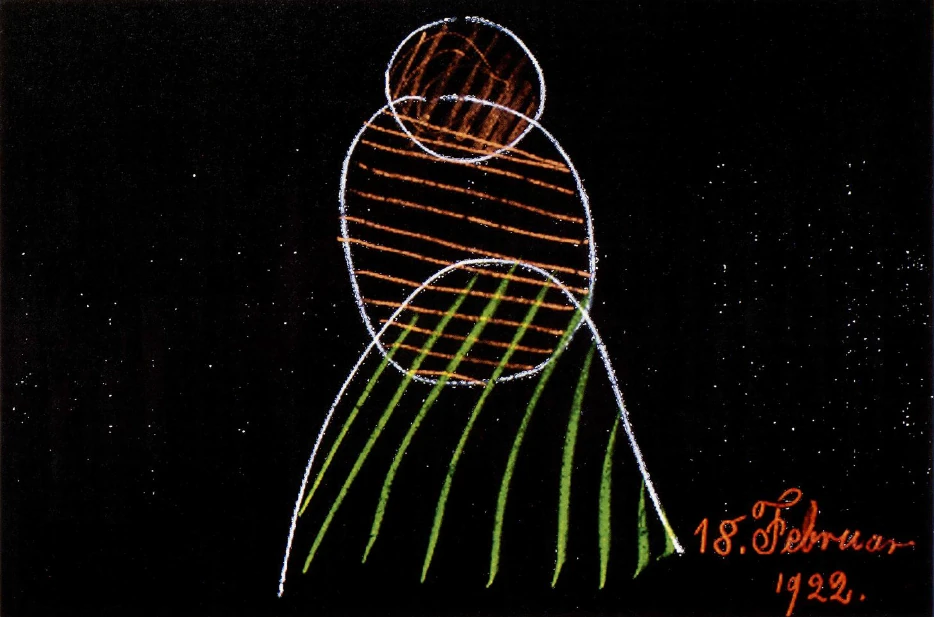
[ 8 ] Dasjenige, was nun schon belebter herüberkommt aus dem geistig-seelischen Leben, wenn die Seele heruntersteigt ins physische Erdenleben, das schlägt sogleich seinen Wohnsitz nicht im Kopfe, sondern im rhythmischen Organismus auf (rot). In diesem rhythmischen Organismus haben wir alles das in uns, was hereinspielt aus unserer Umgebung, die wir um uns gehabt haben zwischen dem Tode und einer neuen Geburt. Und während in seinem Kopfe der Mensch etwas hat, das nur ein Bild seines vorigen Erdenlebens ist mit dem toten Gedankenorganismus, hat er in seiner rhythmischen, in seiner oberen Brustorganisation etwas viel Lebendigeres. Da spielt der Nachklang alles dessen hinein, was die Seele erlebt hat, als sie sich frei im GeistigSeelischen zwischen dem Tode und der Geburt bewegte. Indem wir atmen, indem wir unsere Blutzirkulation haben, vibriert in dieses Atmen, in diese Blutzirkulation dasjenige hinein, was Kräfte waren zwischen dem Tode und der Geburt. Und was wir als unsere geistig-seelische Wesenheit für diese irdische Inkarnation haben, das haben wir weder im Kopfe noch haben wir es in der Brust, sondern das haben wir, so sonderbar das für den heutigen Menschen klingt, in der Gliedmaßen-Stoffwechselorganisation. Unser gegenwärtiges ErdenIch haben wir in der Gliedmaßen-Stoffwechselorganisation (grün).
[ 8 ] That which now comes across as more vivid from the spiritual-soul life, when the soul descends into physical earthly life, does not immediately take up residence in the head, but rather in the rhythmic organism (red). In this rhythmic organism, we have within us everything that flows in from our surroundings—the environment we were surrounded by between death and a new birth. And while in their head a person has something that is merely an image of their previous earthly life with its dead thought organism, they have something much more alive in their rhythmic, upper chest organization. This is where the echoes of everything the soul experienced as it moved freely in the spiritual-soul realm between death and birth come into play. As we breathe, as our blood circulates, what were forces between death and birth vibrate into this breathing and this blood circulation. And what we possess as our spiritual-soul being for this earthly incarnation is found neither in the head nor in the chest, but—as strange as this may sound to people today—in the metabolic organization of the limbs. Our present earthly “I” is located in the metabolic organization of the limbs (green).
[ 9 ] Die toten Gedanken, die müssen Sie sich ja doch lebend denken; diese toten Gedanken leben — wenn ich mich jetzt bildlich ausdrücke, ist es natürlich nur approximativ gemeint — in den Windungen des Gehirns drinnen, und das Gehirn wiederum ist eine Umbildung des Organismus der vorigen Inkarnation. Dieses Leben, dieses Hausen der toten Gedanken im Kopfe, das nimmt dann der Eingeweihte wahr als eine Wirklichkeitserinnerung an die vorige Inkarnation. Es ist wirklich gerade so mit dieser Erinnerung an die vorige Inkarnation, wie wenn Sie in einem finsteren Zimmer sind und haben auf Ihrem Kleiderrechen Ihre verschiedenen Kleider aufgehängt, und Sie können durch das Befühlen wählen, wo Sie, sagen wir zum Beispiel Ihren Samtrock haben, und dabei geht Ihnen nun auf, wann Sie diesen Samtrock gekauft haben. So ist es, wenn da die toten Gedanken überall anstoßen. Erfühlen dasjenige, was in der Hauptesorganisation ist, das ist alles Erinnerung an das vorige Erdenleben.
[ 9 ] You must, after all, think of these dead thoughts as living; these dead thoughts live—if I speak figuratively here, it is, of course, only meant as an approximation—within the convolutions of the brain, and the brain, in turn, is a transformation of the organism from the previous incarnation. This life, this dwelling of dead thoughts in the mind, is then perceived by the initiate as a real memory of the previous incarnation. It really is just like this with the memory of the previous incarnation: it’s as if you were in a dark room and had hung your various garments on a clothes rack, and by feeling them you can choose where, say, your velvet coat is, and in doing so you suddenly realize when you bought that velvet coat. That is how it is when the dead thoughts are bumping into things everywhere. What is sensed within the brain is all a memory of the previous earthly life.
[ 10 ] Was im Brustorganismus erlebt wird, das ist Erinnerung an das Leben zwischen dem Tode und neuer Geburt, und dasjenige, was im Gliedmaßen-Stoffwechsel erlebt wird, das ist jetziges Erdenleben. Nur dadurch, daß der Gliedmaßen-Stoffwechselorganismus heraufwirkt in die Gedanken hinein, hat der Mensch in seinen Gedanken das Erlebnis des Ich. Aber das ist ein trügerisches Erlebnis. In den Gedanken selbst ist das Ich gar nicht enthalten. Es ist ebensowenig in den Gedanken enthalten, wie Sie hinter dem Spiegel stehen, wenn Sie sich in ihm spiegeln. Das Ich ist gar nicht drinnen in dem Gedankenleben. Da ist dadurch, daß sich das Gedankenleben nach dem Kopfe formt, die Erinnerung an das vorige Erdenleben enthalten. Also im Kopfe haben Sie eigentlich Ihren Menschen aus dem vorigen Erdenleben. In Ihrer Brust haben Sie den Menschen, wie er lebte zwischen dem Tode und einer neuen Geburt, und in Ihrem Gliedmaßen-Stoffwechselorganismus und namentlich in Ihren Finger- und Zehenspitzen haben Sie im Grunde genommen den Menschen, wie er hier auf der Erde ist. Und nur weil Sie im Gehirn miterleben Ihre Finger- und Zehenspitzen haben Sie auch durch Gedanken ein Bewußtsein von diesem Ich in Ihrem Erdenleben. So grotesk sind die Dinge in der Wirklichkeit gegenüber manchem, was sich der Mensch gewöhnlich heute vorstellt.
[ 10 ] What is experienced in the chest organism is a memory of life between death and rebirth, and what is experienced in the limb-metabolic organism is the present earthly life. It is only because the metabolism of the limbs works its way up into the thoughts that a person has the experience of the “I” in their thoughts. But this is a deceptive experience. The “I” is not contained within the thoughts at all. It is no more contained within the thoughts than you are standing behind the mirror when you see your reflection in it. The “I” is not at all present within the life of thought. Because the life of thought is shaped by the head, it contains the memory of the previous earthly life. So, in your head, you actually have the person from your previous earthly life. In your chest you have the human being as he lived between death and a new birth, and in your limb-metabolic organism—and especially in the tips of your fingers and toes—you essentially have the human being as he is here on Earth. And it is only because you experience your fingertips and toes through your brain that you also have, through thought, an awareness of this “I” in your earthly life. That is how grotesque things really are compared to much of what people generally imagine today.
[ 11 ] So mit dem Kopfe vorzustellen, wie das heute geschieht, das trat eigentlich regulär erst ein mit dem Beginn des fünften nachatlantischen Zeitraumes, mit dem 15. Jahrhundert. Aber alle Dinge gehen in gewissem Sinne ahrimanisch voran, sie werden vorausgenommen. Das Luziferische ist das, was später eintritt, als es in der Entwickelung berechtigt ist; das Ahrimanische tritt früher ein. Und so haben wir die Möglichkeit, auf eine Erscheinung in der Geschichte hinzuweisen, wo in ganz entschiedener Weise etwas zu früh eintritt, was eigentlich regulär erst im 15. Jahrhundert hätte eintreten sollen. Da ist es dann auch eingetreten, aber es wurde eben schon vorausgenommen zur Zeit des Mysteriums von Golgatha. Und da können wir darauf hinweisen, wie die alttestamentlichen Vorstellungen, die ich Ihnen gestern etwas charakterisiert habe, durch den Zeitgenossen des Christus-Jesus, durch Philo von Alexandrien, ganz zu Allegorien gemacht worden sind.
[ 11 ] To conceive of this with the mind, as we do today, actually did not become the norm until the beginning of the fifth post-Atlantean epoch, in the 15th century. But in a certain sense, all things proceed in an Ahrimanic way; they are anticipated. The Luciferic is that which occurs later than is justified by the course of development; the Ahrimanic occurs earlier. And so we have the opportunity to point to an event in history where, in a very decisive way, something occurs too early—something that, strictly speaking, should not have occurred until the 15th century. It did occur then, but it had already been anticipated at the time of the Mystery of Golgotha. And here we can point out how the Old Testament concepts, which I characterized for you somewhat yesterday, were transformed entirely into allegories by a contemporary of Christ Jesus, Philo of Alexandria.
[ 12 ] Philo von Alexandrien faßt das ganze Alte Testament allegorisch auf, das heißt, er will das ganze Alte Testament, das in Form von Erlebnissen dargestellt wird, zu Gedankenbildern machen. Das ist sehr geistreich, und indem es zum erstenmal in der Menschheitsentwickelung auftritt, kann man auch von dieser Geistreichigkeit sprechen. Heute ist es weniger geistreich, wenn zum Beispiel Theosophen den «Hamlet» so erklären, daß die eine Figur Manas, die andere Buddhi ist und so weiter, wenn also die Sache ganz ins Allegorische gezerrt wird. Das ist natürlich ein Unsinn. Aber Philo von Alexandrien verwandelte gewissermaßen das ganze Testament in Gedankenbilder, in Allegorien. Diese Allegorien sind eben nichts anderes als die innere Offenbarung des ertöteten Seelenlebens, des gestorbenen und in der Gedankenkraft als Leichnam vorliegenden Seelenlebens. Die alttestamentliche Anschauung sah in ihrer Art noch zurück zu dem Leben vor der Geburt oder vor der Empfängnis, und aus dieser Anschauung stellte sie das Alte Testament her.
[ 12 ] Philo of Alexandria interprets the entire Old Testament allegorically; that is, he seeks to transform the entire Old Testament—which is presented in the form of experiences—into mental images. This is very ingenious, and since it occurs for the first time in human development, one can indeed speak of this ingenuity. Today, it is less ingenious when, for example, theosophists interpret Hamlet by claiming that one character is Manas, another is Buddhi, and so on—that is, when the matter is dragged entirely into the realm of allegory. That is, of course, nonsense. But Philo of Alexandria, in a sense, transformed the entire Old Testament into mental images, into allegories. These allegories are nothing other than the inner revelation of the slain soul life—the soul life that has died and lies before us in the power of thought as a corpse. The Old Testament worldview, in its own way, still looked back to life before birth or before conception, and it was from this perspective that it constructed the Old Testament.
[ 13 ] Als man nicht mehr zurückschauen konnte, und Philo von Alexandrien konnte nicht zurückschauen, da wurde das alles zu den toten Gedankenbildern. Und so haben wir in der geschichtlichen Entwickelung der Menschheit diese zwei bedeutsamen Erscheinungen nebeneinander: die alttestamentliche Entwickelung gipfelte in Philo von Alexandrien zur Zeit des Mysteriums von Golgatha. Das ganze Alte Testament macht Philo von Alexandrien zu einer Welt von strohernen Allegorien. Und gleichzeitig damit erscheint in dem Mysterium von Golgatha die Offenbarung, daß nicht das tote Erlebnis im Menschen zum Übersinnlichen hinführen kann, sondern der ganze Mensch, der durch das Mysterium von Golgatha geht, mit dem göttlichen Wesen in sich.
[ 13 ] When it was no longer possible to look back—and Philo of Alexandria could not look back—all of that became mere dead mental images. And so, in the historical development of humanity, we find these two significant phenomena side by side: the Old Testament development culminated in Philo of Alexandria at the time of the Mystery of Golgotha. The entire Old Testament, for Philo of Alexandria, becomes a world of straw-like allegories. And at the same time, the Mystery of Golgotha reveals that it is not a dead experience within the human being that can lead to the supersensible, but rather the whole human being who passes through the Mystery of Golgotha, with the divine being within them.
[ 14 ] Es sind das die zwei großen polarischen Gegensätze: Die abstrakte Welt, die in ahrimanischer Art vorausgenommen ist in Philo, und die Welt, die mit dem Christentum in die Menschheitsentwickelung einziehen soll. Man möchte sagen, von diesem Gesichtspunkte aus wird die ganze Welt zu einer Frage. Der Abstraktling — und Philo von Alexandrien ist vielleicht der genialste Abstraktling gewesen, weil er die spätere Abstraktheit ahrimaniisch vorausgenommen hat —, er will die Antwort für das Weltengeheimnis finden, indem er irgendwelche Gedanken faßt, die das Weltenrätsel lösen sollen. Dagegen ist das Mysterium von Golgatha der umfassende lebendige Protest. Niemals lösen Gedanken das Weltenrätsel, sondern diese Lösung bleibt lebendig. Der Mensch selber in seiner Totalität ist die Lösung des Weltenrätsels. Da erscheinen die Sonnen, die Sterne, die Wolken, die Flüsse, die Berge, die einzelnen Wesenheiten der verschiedenen Naturreiche, indem sie von außen sich offenbaren, als eine große Frage. Und der Mensch steht da, und in seiner ganzen Wesenheit ist er die Antwort.
[ 14 ] These are the two great polar opposites: the abstract world, which is foreshadowed in an Ahrimanic way in Philo, and the world that is to enter human development with Christianity. One might say that, from this point of view, the whole world becomes a question. The abstract thinker—and Philo of Alexandria was perhaps the most brilliant of such thinkers, because he foreshadowed the later Ahrimanic abstractness—seeks to find the answer to the mystery of the world by formulating thoughts intended to solve the world’s enigma. In contrast, the Mystery of Golgotha is the all-encompassing, living protest. Thoughts never solve the riddle of the world; rather, this solution remains alive. Human beings themselves, in their totality, are the solution to the riddle of the world. Thus the suns, the stars, the clouds, the rivers, the mountains, and the individual beings of the various kingdoms of nature—as they reveal themselves from without—appear as one great question. And human beings stand there, and in their entire being, they are the answer.
[ 15 ] Das ist auch ein Gesichtspunkt, von dem aus das Mysterium von Golgatha betrachtet werden kann. Man sucht nicht Gedanken in ihrer Totheit dem Weltenrätsel entgegenzustellen; man stellt dem ganzen Menschen entgegen das, was aus dem ganzen Menschen heraus erlebt werden kann.
[ 15 ] This is also a perspective from which the Mystery of Golgotha can be viewed. One does not seek to set thoughts, in their lifelessness, against the mystery of the world; rather, one sets the whole human being against that which can be experienced from within the whole human being.
[ 16 ] Nur ganz langsam und allmählich konnte die Menschheit den Weg finden, um das zu verstehen. Und heute ist er ja noch nicht gefunden. Anthroposophie will diesen Weg eröffnen. Aber seitdem die Abstraktheit Platz gegriffen hat, hat man gewissermaßen sogar das Bewußtsein verloren, daß dieser Weg gesucht werden müsse. Bis dahin war ein Ringen darnach vorhanden, und das Ringen zeigt sich gerade am deutlichsten noch an dieser Wende vom vierten in den fünften nachatlantischen Zeitraum hinein. Indem sich das Christentum als eine äußere Erscheinung ausbreitet, ringen gerade die besten Geister darnach, dieses Christentum innerlich zu verstehen. Es ist im Grunde ein fortwährendes Ringen um den Sinn des Christentums, das bei den besten Geistern sich abspielt. Man wollte gewissermaßen lebendig das Weltenrätsel vor den Menschen hinstellen, das heißt den Menschen als solchen wirklich verstehen. Man hatte eben die beiden Strömungen von alten Zeiten her übernommen: Auf der einen Seite die heidnische Strömung, die im Grunde genommen eine Naturweisheit war, die in allen Naturwesen geistig-elementarische Wesenheiten, dämonische Wesenheiten sah, eben jene dämonischen Wesenheiten, von denen das Evangelium erzählt, indem es darauf hinweist, daß die Dämonen sich aufbäumten, als der Christus unter die Menschen trat, weil sie jetzt wußten, ihre Herrschaft ist dahin. Die Menschen haben den Christus nicht erkannt. Die Dämonen haben ihn erkannt. Sie wußten, jetzt wird er Besitz ergreifen von den Herzen, von den Seelen der Menschen; sie müssen sich zurückziehen. Aber sie spielten noch lange eine Rolle in den Gemütern und im Erkenntnisstreben der Menschen. Das heidnische Bewußtsein, das die dämonisch-elementarisch-geistige Natur in allen Naturwesen auf alte Art suchte, das spielte noch lange eine Rolle. Es war eben ein Ringen um jene Erkenntnisart, die überall in dem Irdischen nun auch dasjenige suchen sollte, was durch das Mysterium von Golgatha sich mit dem Erdenleben als die Substanz des Christus selber vereinigt hatte.
[ 16 ] Humanity has been able to find the path to understanding this only very slowly and gradually. And even today, that path has not yet been found. Anthroposophy seeks to open up this path. But ever since abstraction has taken hold, people have, in a sense, even lost the awareness that this path must be sought. Up until then, there had been a struggle to do so, and this struggle is still most clearly evident at this turning point from the fourth into the fifth post-Atlantean epoch. As Christianity spreads as an external phenomenon, it is precisely the finest minds who are striving to understand this Christianity from within. At its core, it is a continuous struggle to grasp the meaning of Christianity that takes place among the finest minds. One sought, so to speak, to present the mystery of the world to humanity in a living way—that is, to truly understand humanity as such. They had simply taken up the two currents from ancient times: on the one hand, the pagan current, which was essentially a wisdom of nature that saw spiritual-elemental beings, demonic entities—precisely those demonic entities of which the Gospel speaks, pointing out that the demons rebelled when Christ came among humanity, because they now knew their dominion was over. People did not recognize Christ. The demons recognized him. They knew that he would now take possession of the hearts and souls of human beings; they would have to withdraw. But they continued to play a role in people’s minds and in their quest for knowledge for a long time afterward. The pagan consciousness, which sought the demonic-elemental-spiritual nature in all natural beings in the old way, continued to play a role for a long time. It was, in fact, a struggle over that kind of knowledge which was now to seek, everywhere in the earthly realm, that which—through the Mystery of Golgotha—had united with earthly life as the very substance of Christ Himself.
[ 17 ] Das war die eine Strömung, die heidnische Strömung, die eine Natur-Sophia war, die überall in der Natur das Geistige sah und daher auch auf den Menschen zurücksehen konnte, den sie zwar als ein Naturwesen ansah, aber dennoch als ein Geistiges, weil sie eben in allen Naturwesen auch ein Geistiges sah. Am reinsten, schönsten kommt das heraus in Griechenland und insbesondere wiederum in der griechischen Kunst, wo wir sehen, wie das Geistige als Schicksal das Menschenleben durchwebt, so wie die Naturgesetze die Naturerscheinungen durchweben. Und wenn wir auch manchmal schaudernd stehen vor dem, was sich in der griechischen Tragödie darbietet, so haben wir auf der andern Seite doch das Gefühl: Der Grieche empfand noch nicht bloß die abstrakten Naturgesetze, wie wir heute, sondern er empfand auch das Wirken von göttlich-geistiger Wesenheit in allen Pflanzen, in allen Steinen, in allen Tieren, und daher auch in dem Menschen selber, in dem sich die starre Notwendigkeit des Naturgesetzes zu dem Schicksal formte, wie es zum Beispiel im Ödipus-Drama zu finden ist. Wir haben da die innige Verwandtschaft des natürlich-geistigen Daseins mit dem menschlich-geistigen Dasein. Daher waltet in diesen Dramen noch nicht die Freiheit und auch noch nicht das menschliche Gewissen. Es waltet eine innere Notwendigkeit, ein Schicksalsmäßiges in dem Menschen, in ähnlicher Art, wie draußen die Naturgesetzmäßigkeit in der Natur waltet.
[ 17 ] That was one current—the pagan current—which was a “Nature-Sophia” that saw the spiritual everywhere in nature and could therefore also look back upon human beings, whom it regarded as natural beings, yet also as spiritual beings, precisely because it saw the spiritual in all natural beings. This is expressed most purely and beautifully in Greece, and in particular in Greek art, where we see how the spiritual, as destiny, interweaves human life, just as the laws of nature interweave natural phenomena. And even if we sometimes stand in awe before what is presented in Greek tragedy, we nevertheless have the feeling: The Greeks did not merely perceive the abstract laws of nature, as we do today, but they also perceived the workings of a divine-spiritual essence in all plants, in all stones, in all animals, and therefore also in human beings themselves, in whom the rigid necessity of the natural law took shape as fate, as can be found, for example, in the Oedipus drama. Here we see the intimate kinship between natural-spiritual existence and human-spiritual existence. Therefore, neither freedom nor human conscience yet reigns in these dramas. What reigns is an inner necessity, a fateful quality within the human being, in a manner similar to how the laws of nature reign in the natural world.
[ 18 ] Das ist die eine Strömung, die heraufkommt in die neuere Zeit. Die andere ist die alttestamentlich-jüdische Strömung. Sie hat keine Naturweisheit. Sie hat in bezug auf die Natur nur das Anschauen des sinnlich-physischen Daseins. Dafür ist aber diese alttestamentliche Anschauung hinaufgerichtet zu den Urquellen des Moralischen, die zwischen dem Tod und einer neuen Geburt liegen, zu jenen Urquellen, die aber jetzt nicht hinschauen auf das Naturhafte im Menschen. Für das Alte Testament gibt es keine Naturwissenschaft, sondern nur das Einhalten göttlicher Gebote. Die Dinge geschehen, im Sinne des Alten Testaments, nicht nach Naturgesetzen. Die Dinge geschehen, weil Jahve es will. Und so sehen wir, daß es aus dem Alten Testament heraus bildlos ertönt, in einem gewissen Sinne abstrakt, aber hinter diesen Abstraktionen steht bis auf Philo von Alexandrien, der nun alles zu Allegorien macht, der Herrscher Jahve, der diese Abstraktionen mit einer ins Übersinnliche hinauf idealisierten, allgemeinen Menschennatur durchdringt, der wie ein menschlicher Herrscher alles das durchdringt, was als Gebote von ihm herabklingt auf die Erde. Es ist in dieser alttestamentlichen Anschauung ein bloßes Hinschauen auf die moralische Welt, geradezu ein Sich-Scheuen davor, die Welt in ihrer äußeren Sinnlichkeit anzuschauen. Während die Heiden darauf bedacht waren, überall die göttlich-geistigen Wesenheiten zu sehen, ist der Judengott bloß der Eine. Der Jude ist Monotheist. Sein Gott, sein Jahve, ist der Eine, weil er sich nur auf das beziehen kann, was im Menschen als Einheitliches ist: Du sollst allein an einen Gott glauben; und diesen Gott sollst du nicht ausdrücken durch etwas Irdisches, nicht durch ein plastisches Bild, nicht einmal durch das Wort, das nur der Eingeweihte bei besonders festlichen Gelegenheiten aussprechen darf: Du sollst den Namen deines Gottes nicht unheilig aussprechen.
[ 18 ] This is one current that has emerged in more recent times. The other is the Old Testament-Jewish current. It has no wisdom about nature. With regard to nature, it has only a view of sensory-physical existence. However, this Old Testament perspective is directed upward toward the primordial sources of morality, which lie between death and a new birth—those primordial sources that do not, however, look toward the natural aspect of the human being. For the Old Testament, there is no natural science, but only the observance of divine commandments. In the sense of the Old Testament, things do not happen according to the laws of nature. Things happen because Yahweh wills it. And so we see that from the Old Testament it resounds without imagery, in a certain sense abstractly, but behind these abstractions—with the exception of Philo of Alexandria, who turns everything into allegories—stands the ruler Yahweh, who permeates these abstractions with a universal human nature idealized up into the supernatural, and who, like a human ruler, permeates everything that resounds down to earth from him as commandments. In this Old Testament worldview, there is a mere gazing upon the moral world—indeed, a shying away from viewing the world in its outward sensuality. While the pagans were intent on seeing divine-spiritual beings everywhere, the God of the Jews is simply the One. The Jew is a monotheist. His God, his Yahweh, is the One, because he can refer only to that which is unified within the human being: You shall believe in one God alone; and you shall not express this God through anything earthly, not through a sculpted image, not even through the word that only the initiate is permitted to utter on particularly festive occasions: You shall not take the name of your God in vain.
[ 19 ] Und so ist überall der Hinweis auf das Unanschauliche, auf das, was nicht durch die Natur zum Ausdrucke kommen kann, was nur gedacht werden kann. Aber im Alten Testament denkt man hinter diesen Gedanken noch die lebendige Jahve-Natur. Diese verschwindet in den Allegorien des Philo von Alexandrien.
[ 19 ] And so everywhere there are references to the intangible, to that which cannot be expressed through nature, to that which can only be conceived. But in the Old Testament, one still imagines the living nature of Yahweh behind these ideas. This disappears in the allegories of Philo of Alexandria.
[ 20 ] Nun handelt es sich darum, in dem christlichen Ringen der ersten Jahrhunderte und bis ins 15., 16., 17. Jahrhundert herein den Zusammenklang zu finden zwischen dem, was man sehen kann als das Geistige in der äußeren Natur und dem, was als das Göttliche erlebt wird, wenn wir auf die eigene Moralität, auf das Seelische im Menschen schauen. Wenn man diese Sache theoretisch nimmt, so sieht sie einfach aus. In Wirklichkeit war das Suchen nach dem Zusammenklang zwischen dem Anschauen des Geistigen in der äußeren Natur und dem Hinauflenken der Seele zu dem Geistigen, aus dem der Christus Jesus heruntergestiegen ist, ein ungeheures Ringen. Und indem das Christentum von Asien herüberzieht und die griechische, die römische Welt ergreift, sehen wir in den späteren Jahrhunderten des Mittelalters dieses Ringen noch am stärksten auf jenem Boden Europas, der sich noch viel Ursprünglichkeit erhalten hatte. In Griechenland selbst war noch das alte heidnische Element, die Anschauung des Geistigen in allen Naturdingen so groß, daß das Christentum zwar durch das Griechentum durchgegangen ist, sogar viele Sprachformen durch das Griechische erhalten hat, aber nicht innerhalb des Griechischen Wurzel fassen konnte. Nur die Gnosis, die geistige Anschauung vom Christentum, hat in Griechenland noch Wurzel fassen können.
[ 20 ] The task now is to find, in the Christian struggle of the first centuries and continuing into the 15th, 16th, and 17th centuries, a harmony between what can be seen as the spiritual in external nature and what is experienced as the divine when we look at our own morality, at the soul within human beings. If one approaches this matter theoretically, it seems simple. In reality, the search for harmony between contemplating the spiritual in external nature and directing the soul upward toward the spiritual from which Christ Jesus descended was an immense struggle. And as Christianity spread from Asia and took hold of the Greek and Roman worlds, we see this struggle most intensely in the later centuries of the Middle Ages in those parts of Europe that had retained much of their original character. In Greece itself, the old pagan element—the perception of the spiritual in all things of nature—was still so strong that although Christianity passed through Hellenism and even adopted many linguistic forms from Greek, it could not take root within Hellenism. Only Gnosticism, the spiritual perception of Christianity, was able to take root in Greece.
[ 21 ] Dann hatte das Christentum das prosaischste Element in der Weltentwickelung zu passieren: das Römertum, das ja in seiner Abstraktheit wiederum auch nur Abstraktes fassen konnte, gleichfalls das Spätere ahrimanisch vorausnehmend, das, was im Christentum lebendig ist. Aber ein wirklich lebendiges Ringen finden wir dann in Spanien, wo tatsächlich die Frage, aber nicht theoretisch, sondern als intensive Lebensfrage auftritt: Wie kann der Mensch, ohne daß er die Anschauung des Geistigen in den Naturdingen und Naturvorgängen verliert, den ganzen Menschen finden, der ihm durch den Christus Jesus vor die Augen der Seele gestellt ist? Wie kann der Mensch sich durchchristen? — Am lebendigsten tauchte sie gerade in Spanien auf, und wir sehen in Calderón einen Dichter, der dieses Ringen ganz besonders intensiv darzustellen wußte. In Calderón lebt, wenn ich so sagen darf, dramatisch dieses Ringen nach dem Durchchristerwerden des Menschen.
[ 21 ] Then Christianity had to pass through the most prosaic phase in the development of the world: Roman culture, which, in its abstract nature, could in turn grasp only the abstract, thereby also foreshadowing the later Ahrimanic aspect of what is alive in Christianity. But we find a truly vibrant struggle in Spain, where the question arises—not theoretically, but as an intense question of life: How can a person, without losing sight of the spiritual in natural things and processes, find the whole human being who is set before the eyes of the soul through Christ Jesus? How can a human being become fully Christian? — This question arose most vividly in Spain, and we see in Calderón a poet who knew how to portray this struggle with particular intensity. In Calderón, if I may say so, this struggle for humanity to become fully Christian lives on dramatically.
[ 22 ] Da sehen wir auf das charakteristischste Drama des Calderón hin, auf den «Cyprianus», der eine Art wundertätiger Magier ist, also ein Mensch zunächst, der in den Naturdingen und Naturvorgängen lebt, indem er jene Geistigkeit durchforschen will. Wenn Sie das Bild eines solchen Menschen nach seiner späteren Metamorphose, nach der Faust-Metamorphose nehmen, so haben Sie nicht die volle Lebendigkeit, mit der etwa bei Calderón Cyprianus auftritt. Denn dieses Drinnenstehen in dem Geiste der Natur bei Cyprianus hat noch volles Leben. Da ist noch eine volle Selbstverständlichkeit, während bei Faust alles schon in Zweifel gehüllt ist. Während Faust von Anfang an nicht mehr recht an das Finden des Geistigen in der Natur glaubt, ist der Cyprianus des Calderón durchaus noch eine mittelalterliche Figur. So, wie der heutige Physiker oder Chemiker in seinem Laboratorium von seinen Apparaten umgeben ist, der Physiker von den Geißlerschen Röhren und andern Apparaten, der Chemiker von seinen Retorten und von seinen Wärmeöfen und dergleichen, so ist Cyprianus für seine Seelenverfassung überall von dem umgeben, was als das Geistige aufleuchtet und aufquillt aus den Naturvorgängen und Naturwesenheiten.
[ 22 ] Here we turn to Calderón’s most characteristic drama, Cyprianus, who is a kind of miracle-working magician—that is, a person who, at first, lives among the things and processes of nature, seeking to explore their spiritual essence. If you take the image of such a person after his later metamorphosis—the Faustian metamorphosis—you do not have the full vitality with which, for example, Cyprianus appears in Calderón’s work. For this immersion in the spirit of nature in Cyprianus is still full of life. There is still a complete sense of naturalness there, whereas in Faust everything is already shrouded in doubt. While Faust, from the very beginning, no longer truly believes in finding the spiritual in nature, Calderón’s Cyprianus is still very much a medieval figure. Just as just as today’s physicist or chemist is surrounded in his laboratory by his instruments—the physicist by Geissler tubes and other apparatus, the chemist by his retorts, furnaces, and the like—so too is Cyprianus, in his state of mind, surrounded everywhere by that which, as the spiritual, shines forth and wells up from natural processes and natural entities.
[ 23 ] Da tritt- und das ist charakteristisch — in das Leben dieses Cyprianus Justina ein. Hier haben wir den Hinweis auf etwas, was im Drama ganz menschlich dargestellt wird als ein weibliches Wesen, was wir aber doch, wenn wir es bloß als ein weibliches Wesen auffassen, eben nicht voll erfassen. Denn diese mittelalterlichen Dichter werden nicht richtig verstanden, wenn man so, wie das ihre neueren Erklärer tun, immer sagt: Da muß nur das ganz derb materiell Konkrete aufgefaßt werden; wir dürfen zum Beispiel bei der Beatrice des Dante an nichts anderes denken als an ein weiches, weibliches Wesen. — Oder aber die Erklärer gehen an dem Richtigen auch vorbei, indem sie wiederum alles allegorisieren, in eine geistige Sphäre hinaufheben. So weit voneinander, wie für die Köpfe der modernen Erklärer, waren eben damals die geistigen Bilder und die wirklichen Erdenwesen noch nicht. Und so dürfen wir, indem da in dem Calderón-Drarma Justina auftritt, wiederum an die die Welt durchziehende Gerechtigkeit denken, die eben nicht so etwas Abstraktes war wie das, was heute auch die Juristen nicht mehr haben, sondern was in ihrer Bibliothek steht und was sie herausnehmen in Form von einzelnen Bänden. Es wurde eben die Jurisprudenz auch als etwas Lebendiges empfunden.
[ 23 ] At this point—and this is characteristic—Justina enters the life of this Cyprianus. Here we have a reference to something that is portrayed in the drama quite humanly as a female being, but which we nevertheless fail to fully grasp if we view it merely as a female being. For these medieval poets are not properly understood if, as their more recent interpreters do, one always says: “Only the very crude, material, concrete must be taken into account”; for example, when it comes to Dante’s Beatrice, we must think of nothing other than a gentle, feminine being. — Or else the interpreters miss the mark by, in turn, allegorizing everything and elevating it into a spiritual sphere. Back then, the spiritual images and the real earthly beings were not yet as far apart as they are in the minds of modern interpreters. And so, when Justina appears in Calderón’s drama, we may once again think of the justice that pervades the world—which was by no means something as abstract as what even lawyers no longer possess today, but rather what stands on their bookshelves and what they take down in the form of individual volumes. Jurisprudence was, after all, perceived as something living.
[ 24 ] So tritt Justina an Cyprianus heran. Und nun wird es natürlich wiederum schwierig für den modernen wissenschaftlichen Interpreten, der jetzt die Hymne verstehen soll, die Cyprianus auf Justina singt. Ja, die modernen Advokaten tun das nicht auf ihre Jurisprudenz, aber so jemand wie der Cyprianus empfand eben auch die Gerechtigkeit, die die Welt durchwebt und durchlebt als etwas, dem er Hymnen singen konnte. Es ist eben das geistige Leben anders geworden, das muß immer wieder betont werden. Aber Cyprianus ist zu gleicher Zeit auch Magier, der es mit den Geistwesen der Natur zu tun hat, jener Welt der Dämonen, unter der auch das mittelalterliche Wesen Satanas ist. Nun fühlt sich Cyprianus nicht fähig, wirklich an Justina heranzukommen. Da wendet er sich an den Satan, den Anführer dieser Naturdämonen. Der soll ihm Justina verschaffen.
[ 24 ] This is how Justina approaches Cyprianus. And now, of course, it becomes difficult once again for the modern scholarly interpreter, who is now supposed to understand the hymn that Cyprianus sings to Justina. Yes, modern lawyers do not do this in their jurisprudence, but someone like Cyprian perceived the justice that permeates and animates the world as something to which he could sing hymns. Spiritual life has simply changed; this must be emphasized again and again. But at the same time, Cyprian is also a magician who deals with the spirit beings of nature—that world of demons, which also includes the medieval figure of Satan. Now Cyprian feels unable to truly reach Justina. So he turns to Satan, the leader of these nature demons. He is to procure Justina for him.
[ 25 ] Da haben Sie die ganze tiefe Tragik des christlichen Konfliktes; nämlich das, was an Cyprianus herantritt in Justina, das ist die Gerechtigkeit, die der christlichen Entwickelung angemessen ist. Sie soll an Cyprianus, den noch halb heidnischen Naturgelehrten, herangebracht werden. Das ist die Tragik: Er kann aus der Naturnotwendigkeit, die etwas Starres hat, nicht die christliche Gerechtigkeit finden. Aber er kann sich auch nur an den Anführer der Dämonen, an den Satanas wenden, daß der ihm Justina verschaffe.
[ 25 ] Therein lies the full, profound tragedy of the Christian conflict; namely, what draws Justina to Cyprian is the justice that is appropriate to Christian development. It is to be brought to Cyprian, the natural philosopher who is still half-pagan. That is the tragedy: He cannot find Christian justice within the necessity of nature, which has something rigid about it. But he can only turn to the leader of the demons, to Satan, to have him procure Justina for him.
[ 26 ] Satanas macht sich heran an die Aufgabe. Die Menschen können schwer begreifen, weil natürlich Satanas ein sehr gescheites Wesen ist, daß er immer wieder an Aufgaben geht, an denen er schon so und so oft gescheitert ist. Aber das ist eben eine Tatsache. Wir mögen uns noch so gescheit dünken, wir können in dieser Weise nicht ein so gescheites Wesen wie Satanas kritisieren. Man müßte sich sagen, es muß doch etwas geben, was ein so gescheites Wesen immer wieder dazu bringt, das Glück aufs Neue zu versuchen, um die Menschen auf diese Weise zu verderben. Denn natürlich würde Verderbnis der Menschen eingetreten sein, wenn es Satan gelungen wäre, die christliche Gerechtigkeit — wenn ich mich so ausdrücken darf — herumzukriegen, um sie an Cyprianus heranzubringen. Also Satan macht sich daran, aber es gelingt ihm nicht. Die ganze Gesinnung Justinas widerstrebt dem Satanas; und sie entflieht dem Satan, und er behält ein Phantom von ihr zurück, ein Schattenbild.
[ 26 ] Satan sets about the task. It is difficult for people to understand—because, of course, Satan is a very clever being—that he repeatedly takes on tasks at which he has already failed so many times. But that is simply a fact. No matter how clever we may think we are, we cannot criticize a being as clever as Satan in this way. One would have to conclude that there must be something that repeatedly drives such an intelligent being to try his luck anew in order to corrupt people in this way. For, of course, the corruption of humanity would have occurred if Satan had succeeded in—if I may put it this way—outwitting Christian righteousness in order to bring it to Cyprian. So Satan sets out to do this, but he does not succeed. Justina’s entire disposition resists Satan; and she escapes from him, leaving him with only a phantom of her, a shadow image.
[ 27 ] Sie sehen, wie bei Calderón manches Motiv, das Sie dann im «Faust» wiederfinden, auftaucht, aber alles eben gewissermaßen in dieses urchristliche Ringen getaucht. Der Satan behält ein Schattenbild zurück, das bringt er dem Cyprianus. Cyprianus kann natürlich mit dem Phantom, mit dem Schattenbild nichts Rechtes anfangen. Es hat nicht Leben. Es hat nur ein Schattenbild der Gerechtigkeit in sich. Oh, es ist wunderbar ausgedrückt, wie das, was aus der alten Naturweisheit geworden ist und als neuere Naturwissenschaft auftritt, wenn es an so etwas herankommen will wie an das soziale Leben, an die Justina, wie es nicht das wirkliche Lebendige liefert, sondern nur Gedankenphantome. Wie es jetzt, weil die Menschheit mit dem fünften nachatlantischen Zeitraum zu der toten Gedankenwelt vorgedrungen ist, eben nur Phantome liefert, die Phantome der Gerechtigkeit, die Phantome der Liebe, die Phantome von allem — ich will nicht sagen im Leben, aber in der Theorie.
[ 27 ] You can see how, in Calderón’s work, certain motifs that you later find in Faust appear, but everything is, so to speak, steeped in this early Christian struggle. Satan leaves behind a shadow image, which he brings to Cyprianus. Cyprianus, of course, can’t really make sense of the phantom, of the shadow image. It has no life. It contains only a shadow image of justice. Oh, it is wonderfully expressed how what has become of the ancient wisdom of nature—and now appears as modern natural science—when it attempts to address something like social life or Justina, fails to provide the truly living, but only phantoms of thought. Just as now, because humanity has advanced into the dead world of thought with the fifth post-Atlantean epoch, it delivers only phantoms—the phantoms of justice, the phantoms of love, the phantoms of everything—I won’t say in life, but in theory.
[ 28 ] Und über alledem wird Cyprianus verrückt. Justina, die wirkliche Justina, kommt mit ihrem Vater in die Gefangenschaft. Sie wird zum Tode verurteilt. Cyprianus hört das in seinem Wahnsinne und fordert für sich auch den Tod. Und eben auf dem Schafott finden sie sich. Über ihrem Sterben erscheint die Schlange und auf ihr reitend der Dämon, der Justina dem Cyprianus zuführen wollte, und erklärt, sie seien erlöst. Sie können aufsteigen in die himmlischen Welten: «Gerettet ist das edle Glied der Geisterwelt vom Bösen!»
[ 28 ] And on top of all this, Cyprianus goes mad. Justina—the real Justina—is taken into captivity along with her father. She is sentenced to death. Cyprianus hears this in his madness and demands death for himself as well. And there they find themselves on the scaffold. As they are about to die, the serpent appears, and riding upon it is the demon who had intended to lead Justina to Cyprianus; the demon declares that they are redeemed. They may ascend to the heavenly realms: “The noble member of the spirit world is saved from evil!”
[ 29 ] Das ganze christliche Ringen des Mittelalters liegt darinnen. Der Mensch ist eingeschaltet zwischen dem, was er erleben kann vor der Geburt in der geistig-seelischen Welt und was er erleben soll, nachdem er durch die Pforte des Todes gegangen ist. Der Christus ist heruntergestiegen auf die Erde, weil nicht mehr gesehen werden konnte, was in früheren Zeiten noch im mittleren Menschen, im rhythmischen Menschen, gesehen worden ist, wovon ein Nachklang gesehen worden ist, als gerade dieser mittlere Mensch durch die Atmungsübungen des Jogasystems ausgebildet wurde, die also nicht eine Kopfausbildung waren, sondern eine Ausbildung des rhythmischen Menschen. Der Mensch kann den Christus in dieser Zeit nicht finden. Er strebt danach, ihn zu finden. Der Christus ist heruntergestiegen. Der Mensch soll, weil er ihn nicht mehr in der Erinnerung hat aus der Zeit, die er zwischen dem Tode und einer neuen Geburt durchlebt hat, er soll ihn hier finden.
[ 29 ] The entire Christian struggle of the Middle Ages lies in this. Human beings are caught between what they can experience before birth in the spiritual-soul world and what they are to experience after passing through the gate of death. Christ descended to Earth because it was no longer possible to perceive what had once been perceived in the “middle human,” the “rhythmic human”—a resonance of which was still discernible when this very “middle human” was developed through the breathing exercises of the yoga system, which were thus not a training of the head but a training of the rhythmic human. Humanity cannot find the Christ in this age. It strives to find him. The Christ has descended. Since humanity no longer remembers him from the time it lived between death and a new birth, it must find him here.
[ 30 ] Solche Dramen wie das Cyprianus-Drama des Calderón stellen das Ringen nach diesem Finden dar, und es stellt eben die Schwierigkeiten dar, die der Mensch hat, der nun wirklich in die geistige Welt wiederum zurückkommen soll, der den Zusammenklang mit der geistigen Welt erleben soll. Cyprianus ist noch befangen von dem, was an Dämonenhaftem aus der alten heidnischen Welt nachklingt. Er hat aber auch das Jüdisch-Althebräische noch nicht so weit überwunden, daß es ihm ein Gegenwärtig-Irdisches geworden ist. Jahve thront für ihn noch in überirdischen Welten, ist nicht durch den Kreuzestod herabgestiegen und hat sich noch nicht mit der Erde vereinigt. Cyprianus und Justina erleben ihr Zusammengehen mit der geistigen Welt, indem sie sterben und durch die Pforte des Todes gehen. So furchtbar ist dieses Ringen, um den Christus hereinzubekommen in die menschliche Natur in der Zeit zwischen Geburt und Tod. Und ein Bewußtsein davon ist vorhanden, daß das Mittelalter eben noch nicht reif ist, um ihn in dieser Weise hereinzubekommen.
[ 30 ] Plays such as Calderón’s Cyprianus depict the struggle to achieve this discovery, and they illustrate precisely the difficulties faced by the human being who is now truly meant to return to the spiritual world, who is meant to experience harmony with the spiritual world. Cyprianus is still influenced by the demonic echoes of the old pagan world. Nor has he yet overcome the Jewish-Old Hebrew tradition to the extent that it has become a present, earthly reality for him. For him, Yahweh still reigns in supermundane worlds; he has not descended through the death on the cross and has not yet united with the earth. Cyprianus and Justina experience their union with the spiritual world by dying and passing through the gate of death. So terrible is this struggle to bring Christ into human nature in the time between birth and death. And there is an awareness that the Middle Ages are simply not yet ripe to receive him in this way.
[ 31 ] In dem spanischen Cyprianus-Drama tritt uns das ganze Lebendige dieses Christus-Ringens viel deutlicher entgegen als in der Theologie dieses Mittelalters, die sich ja an abstrakte Begriffe halten wollte, und die in ihre abstrakten Begriffe das Mysterium von Golgatha einfangen wollte. In der dramatisch-tragischen Lebendigkeit des Calderón lebt dieses mittelalterliche Ringen nach dem Christus, das heißt, nach dem Durchchristetwerden der menschlichen Natur. Und wenn man dieses Calderón-Drama von dem Cyprianus mit dem späteren Faust-Drama vergleicht — es ist das charakteristisch genug —, dann sieht man, da tritt zuerst bei Lessing das Bewußtsein auf: Der Mensch muß im irdischen Leben den Christus finden können, denn der Christus ist durch das Mysterium von Golgatha gegangen und hat sich mit der irdischen Menschheit vereinigt. Nicht, daß das in klaren Ideen bei Lessing gelebt hat, aber ein deutliches Gefühl davon hat in Lessing gelebt. Und als er seinen «Faust» schreiben wollte — er hat ja nur ein kurzes Stückchen davon zu Papier bringen können —, endete er damit, daß den Dämonen, also denen, die noch den Cyprianus abhalten konnten, während des irdischen Lebens den Christus zu finden, zugerufen wird: «Ihr sollt nicht siegen!».
[ 31 ] In the Spanish drama Cyprianus, the full vitality of this struggle for Christ comes across to us much more clearly than in the theology of the Middle Ages, which sought to adhere to abstract concepts and to encapsulate the mystery of Golgotha within those abstract concepts. In the dramatic and tragic vitality of Calderón, this medieval struggle for Christ—that is, for the human nature to be permeated by Christ—comes to life. And if one compares this Calderón drama about Cyprian with the later Faust drama—which is characteristic enough—then one sees that it is in Lessing’s work that this awareness first emerges: Human beings must be able to find Christ in earthly life, for Christ has passed through the mystery of Golgotha and has united himself with earthly humanity. Not that this existed in clear ideas within Lessing, but a distinct sense of it did live within him. And when he set out to write his Faust—he was, after all, only able to put a short fragment of it on paper—he concluded by having the demons—that is, those who were still able to prevent Cyprian from finding Christ during his earthly life—be called out to: “You shall not prevail!”
[ 32 ] Damit war zu gleicher Zeit das Thema für den späteren Goetheschen «Faust» gegeben; und im Grunde genommen ist es auch noch beim Goetheschen Faust äußerlich, wie der Mensch sich zum Christentum findet. Nehmen Sie den ganzen Goetheschen «Faust», nehmen Sie den ersten Teil: Da ist das Ringen. Nehmen Sie den zweiten Teil: Da soll zunächst durch die klassische Walpurgisnacht, durch das Helena-Drama, das Aufnehmen des Christentums erfahren werden an der griechischen Welt. Dann aber weiß Goethe: Der Mensch muß hier im Erdenleben den Anschluß finden an Christus. Er muß daher seinen dramatischen Helden hinführen zu dem Christentum. Allein, wie führt er ihn hin? Es ist ja nur ein theoretisches Bewußtsein, möchte ich sagen. Goethe war ein zu großer Dichter, als daß man das nicht bemerkt, daß es nur ein theoretisches Bewußtsein war. Denn zuletzt ist schließlich doch nur im letzten Akt das Aufsteigen im christlichen Sinne an das ganze Faust-Drama angeleimt. Es ist gewiß alles großartig, aber es ist nicht aus der inneren Natur des Faust herausgeholt, sondern Goethe hat das katholische Dogma genommen. Goethe hat den katholischen Kultus genommen und hat den fünften Akt an die andern angeleimt. Er wußte, es muß der Mensch zu der Durchchristetheit geführt werden. Im Grunde genommen ist es nur die ganze Gesinnung, die im zweiten Teile des «Faust» lebt, die dieses Durchdringen mit dem Christus darstellt. Denn bildhaft konnte es auch Goethe noch nicht geben, und eigentlich ist es auch erst nach dem Tode des Faust, wo der ganze christliche Aufstieg entfaltet wird.
[ 32 ] This also provided the theme for Goethe’s later Faust; and, fundamentally speaking, even in Goethe’s Faust, the focus remains on the external aspect of how a person comes to Christianity. Take Goethe’s entire Faust, take the first part: there is the struggle. Take the second part: there, through the classical Walpurgis Night and the Helena drama, the acceptance of Christianity is to be experienced within the context of the Greek world. But then Goethe realizes: human beings must find their connection to Christ here in earthly life. He must therefore lead his dramatic hero toward Christianity. But how does he lead him there? It is, I would say, merely a theoretical awareness. Goethe was too great a poet for one not to notice that it was merely a theoretical awareness. For in the end, it is only in the final act that the ascent in the Christian sense is tacked onto the entire Faust drama. It is certainly all magnificent, but it is not drawn from Faust’s inner nature; rather, Goethe took Catholic dogma. Goethe took the Catholic liturgy and grafted the fifth act onto the others. He knew that man must be led to be permeated by Christ. Essentially, it is only the entire spirit that lives in the second part of Faust that represents this permeation with Christ. For even Goethe could not yet express it figuratively, and in fact, it is only after Faust’s death that the entire Christian ascent is unfolded.
[ 33 ] Ich wollte das alles nur anführen, um Ihnen zu zeigen, wie vermessen es eigentlich ist, wenn man leichten Herzens von der Erringung des Bewußtseins vom Mysterium von Golgatha, des christlichen Bewußtseins, spricht. Denn diese Erringung des christlichen Bewußtseins stellt eben durchaus eine Aufgabe dar, um die so schwer gekämpft worden ist, wie wir es an solchen Beispielen sehen können, wie ich sie angeführt habe. Es ist heute an der Menschheit, diese geistigen Kräfte innerhalb der geschichtlichen Entwickelung der mittleren und der neueren Zeit zu suchen. Und nach der großen Katastrophe, die wir durchgemacht haben, sollte schon die Menschheit ein Bewußtsein davon bekommen, daß es darauf ankommt, diese geistigen Impulse wirklich ins Seelenauge zu fassen.
[ 33 ] I wanted to mention all this simply to show you how presumptuous it actually is to speak so lightly of attaining an awareness of the Mystery of Golgotha—that is, Christian consciousness. For this attainment of Christian consciousness is indeed a task for which such a hard struggle has been waged, as we can see from examples such as those I have cited. It is now up to humanity to seek these spiritual forces within the historical development of the Middle Ages and modern times. And after the great catastrophe we have endured, humanity should indeed come to realize that what matters is truly grasping these spiritual impulses with the eye of the soul.
[ 34 ] Nun, davon wollen wir dann morgen weiterreden. Wir wollen uns wiederum um 8 Uhr hier zu der Fortsetzung dieser Betrachtung einfinden.
[ 34 ] Well, let's talk more about that tomorrow. Let's meet here again at 8 a.m. to continue this discussion.