Old and New Initiation Methods
Drama and Poetry in the Shift
of Consciousness in the Modern Era
GA 210
17 February 1922, Dornach
Translate the original German text into any language:
Versions Available:
Old and New Initiation Methods, tr. SOL
6. Über den Durchgang der menschlichen Geist-Seelenwesenheit durch die physisch-sinnliche Organisation
6. On the Passage of the Human Spirit-Soul Being Through the Physical-Sensory Organization
[ 1 ] Wir wollen heute einmal den Durchgang der menschlichen Geist-Seelenwesenheit durch die physisch-sinnliche Organisation betrachten, und zwar so, wie sich dieses Geistig-Seelische zunächst anschickt für die physische Inkarnation, indem es herunterkommt von den geistigen Welten, und dann, wie es wiederum hinausgeht durch die Pforte des Todes aus der physisch-sinnlichen Inkarnation in die geistige Welt. Und insbesondere wollen wir heute Rücksicht nehmen auf die seelischen Eigentümlichkeiten dieses Vorganges. Wir müssen uns klar darüber sein, daß beim Eintreten in die physische Organisation, und zwar schon bei der Konzeption, eine gewaltige Veränderung vor sich geht und daß wiederum eine gewaltige Veränderung eintritt, wenn der Mensch durch die Pforte des Todes die physische Inkarnation verläßt.
[ 1 ] Today we wish to consider the passage of the human spirit-soul being through the physical-sensory organization—specifically, how this spirit-soul being first prepares for physical incarnation by descending from the spiritual worlds, and then how it departs once more through the gate of death from the physical-sensory incarnation back into the spiritual world. And in particular, we want to consider today the soul-related characteristics of this process. We must be clear that upon entering the physical body—and indeed, already at the moment of conception—a tremendous transformation takes place, and that another tremendous transformation occurs when the human being leaves the physical incarnation through the gate of death.
[ 2 ] Nun haben wir das ja schon von den verschiedensten Gesichtspunkten aus charakterisiert; heute aber wollen wir gewissermaßen auf das innere Erlebnis der Seele als solche unseren Blick lenken. Wir wollen uns fragen: Welches sind die letzten Erlebnisse des Seelischen, bevor es heruntersteigt in das physische Erdenleben?
[ 2 ] We have already described this from a wide variety of perspectives; today, however, we want to turn our attention, so to speak, to the inner experience of the soul as such. Let us ask ourselves: What are the final experiences of the soul before it descends into physical life on Earth?
[ 3 ] Wenn wir das Seelische beobachten zwischen der Geburt und dem Tode, so finden wir es in der mannigfaltigsten Weise durchwebt von Gedanken, von Gefühlen, von Willensimpulsen. All das wirkt ineinander zu einem seelischen Gesamtbilde. Und wir haben ja auch für die einzelnen Gedankenformen, für die Formen des Gefühls, für die Formen der Willensimpulse besondere Sprachbezeichnungen und wissen aus dem, was im physischen Erdenleben seelisch erlebt wird, gewisse Arten von Gefühlen zu charakterisieren. Wir können, indem wir von mehr unterbewußten Gefühlserlebnissen und von Seelenerlebnissen überhaupt ausgehen, wenigstens einigermaßen ein Licht werfen auf das, was in der Seele lebt, bevor sie ins irdische Leben eintritt.
[ 3 ] When we observe the soul between birth and death, we find it interwoven in the most diverse ways with thoughts, feelings, and impulses of the will. All of this interacts to form a complete picture of the soul. And we do, after all, have specific linguistic terms for the individual forms of thought, for the forms of feeling, and for the forms of volitional impulses, and we know how to characterize certain types of feelings based on what is experienced in the soul during physical life on Earth. By starting from more subconscious emotional experiences and from soul experiences in general, we can at least to some extent shed light on what lives in the soul before it enters earthly life.
[ 4 ] Zunächst muß uns ja klar sein, daß das gedankliche Element als solches während des physischen Erdendaseins in der Seele wie ein Schattenhaftes lebt. Die Gedanken werden mit Recht blaß, abstrakt genannt. Das meiste, was der Mensch während des Erdenlebens an Gedanken, an Vorstellungen aufbringt, ist schließlich nichts weiter als Spiegelbild der Außenwelt. Der Mensch stellt sich vor, was er in der Außenwelt durch seine Sinne wahrgenommen hat, und Sie werden ja wissen, daß im Grunde genommen sehr wenig übrigbleibt, sobald Sie alles, was durch die Sinne wahrgenommen worden ist oder was im Laufe des physischen Erdenlebens sonst im Beisein der Sinne erlebt worden ist, von dem Gedankenleben abziehen, wenn nicht gerade ein Studium der Geisteswissenschaft dazu geführt hat, andern Gedankeninhalt zu bekommen als den, der aus der Sinneswelt herausgezogen ist. Aber diese schattenhafte Gedankenwelt ist eben aus dem Grunde schattenhaft, weil sie ihre innere Lebendigkeit verloren hat beim Herabsteigen in die physisch-sinnliche Welt. Gerade dasjenige, was in uns das gedankenhafte Erleben ist, das ist ein reges, in sich bewegtes, in sich volles Leben vor dem Hinuntersteigen in die physische Welt. Man kann sagen, wie sich irgendeine volle irdische Gestalt zu dem Schatten verhält, den sie an die Wand wirft, so verhält sich das, was in den Gedanken eigentlich lebt, zu dem, was als Gedanken während unseres Erdendaseins auftritt. Und wenn wir von den irdischen Gedanken, wie wir sie zwischen Geburt und Tod haben, zu der wahren Gestalt des Gedankenlebens gehen, so sind sie [diese Gedanken] doch eigentlich nur im rein geistigen Leben vor der Konzeption vorhanden. Es ist gerade so, wenn wir von einem Wandschattenbild zu demjenigen gehen, was es darstellt. Es ist ein reges inneres, voll lebendiges Dasein gerade in dem, was später abgeschattete Gedanken sind, vor der Geburt oder vor der Konzeption vorhanden. Wir können durchaus als das eigentliche geistige Dasein, als die eigentliche geistige Wesenhaftigkeit bezeichnen, was von der Gedankenwelt vor der Konzeption als inneres seelisches Weben und Leben vorhanden ist. Dieses innerlich-seelische Weben und Leben ist natürlich vor der Konzeption etwas, was das ganze uns bekannte Weltenall durchdringt. Wir leben eigentlich vor der Konzeption im Ganzen der Welt, die uns sonst umgibt, und was als Gedanke im Menschen dann während des Erdenlebens vorhanden ist, das ist das Schattenbild im kleinen Raum, im menschlichen physischen Organismus, von dem, was eigentlich kosmisches Leben hat vor der Konzeption.
[ 4 ] First of all, we must realize that the mental element as such exists in the soul like a shadow during our physical existence on Earth. Thoughts are rightly called pale and abstract. Most of what a person produces in the way of thoughts and ideas during their earthly life is, after all, nothing more than a reflection of the external world. A person imagines what they have perceived in the external world through their senses, and you will know that, strictly speaking, very little remains once you subtract from the life of thought everything that has been perceived through the senses or otherwise experienced in the presence of the senses during the course of physical earthly life—unless a study of spiritual science has led to to acquire thought content other than that drawn from the sensory world. But this shadowy world of thought is shadowy precisely because it has lost its inner vitality upon descending into the physical-sensory world. Precisely that which is the experience of thought within us is a lively, self-moving, self-contained life prior to the descent into the physical world. One might say that just as any full earthly form relates to the shadow it casts on the wall, so does that which actually lives in thought relate to what appears as thought during our earthly existence. And when we move from earthly thoughts—as we experience them between birth and death—to the true form of thought life, these thoughts actually exist only in the purely spiritual life prior to conception. It is exactly as when we move from a shadow cast on a wall to the thing it represents. There is a lively inner, fully vibrant existence present—precisely in what later become shadowed thoughts—before birth or before conception. We can certainly describe what exists in the world of thought before conception—as an inner, soulful weaving and life—as the actual spiritual existence, as the actual spiritual essence. This inner, soulful weaving and life is, of course, something that permeates the entire universe known to us before conception. We actually live before conception within the entirety of the world that otherwise surrounds us, and what then exists as thought within the human being during earthly life is the shadow image, within the small space of the human physical organism, of what actually constitutes cosmic life before conception.
[ 5 ] Damit bezeichnen wir das eine Element des Seelischen vor der Geburt oder vor der Konzeption. Was im Irdischen also Gedankenhaftes, im Außerirdischen bei der menschlichen Wesenheit eigentlich Geistiges ist, das finden wir, bevor der Mensch heruntersteigt in die physische Welt, als Inhalt der Seele. Das andere, was Inhalt der Seele ist, das ist nicht anders zu bezeichnen, wenn wir die Begriffe von dem irdischen Leben hernehmen wollen, als indem wir sagen: Es ist Furcht. In der Seele lebt in der Zeit, die dem physischen Erdenleben vorangeht, etwas, was sie ganz durchdringt als Furcht. Nur natürlich, wenn so etwas gesagt wird, müssen Sie sich klar darüber sein, daß Furcht als Erlebnis außerhalb des physischen Leibes etwas ganz anderes ist als im physischen Menschenleibe.
[ 5 ] By this we refer to that element of the soul that exists before birth or before conception. What is thought-like in the earthly realm—and what is, in the non-earthly realm, actually spiritual in the human being—we find, before the human being descends into the physical world, as the content of the soul. The other aspect that constitutes the content of the soul can be described—if we wish to use terms from earthly life—only by saying: it is fear. In the soul, during the time preceding physical life on Earth, there lives something that permeates it entirely as fear. Of course, when something like this is said, you must be clear that fear, as an experience outside the physical body, is something entirely different from fear within the physical human body.
[ 6 ] Der Mensch ist also, bevor er zur Erde heruntersteigt, ein GeistigSeelisches, durchzogen von einem Gefühlselemente, das man nur mit etwas, was der Mensch im Erdenleben als Furcht erfährt, vergleichen kann. Diese Furcht hat ihre gute Berechtigung für die Zeit des Menschenlebens, von der ich eben spreche. Der Mensch hat in dem Leben zwischen dem Tode und einer neuen Geburt alle möglichen Erfahrungen gemacht, die sich eben in diesem kosmischen Verbundensein mit dem All machen lassen. Der Mensch ist gewissermaßen müde geworden dieses kosmischen Lebens am Ende seines Daseins zwischen dem Tod und einer neuen Geburt, wie der Mensch durch das Vertrocknen, durch das Abgelähmtwerden seiner Leibesorganisation am Ende seines Erdenlebens für das irdische Leben müde ist. Der Mensch ist gewissermaßen müde geworden des außerirdischen Lebens. Und dieses Müdewerden drückt sich eben nicht als Müdewerden aus, sondern es drückt sich aus als Furcht vor dem All. Der Mensch flieht gewissermaßen das All. Er empfindet das, was die Grundeigenschaft des Alls ist, als etwas ihm nunmehr Fremdgewordenes, das ihm nichts mehr gibt; er empfindet eine Art von Scheu, die mit Furcht zu vergleichen ist, vor dem Elemente, in dem der Mensch darinnen ist. Er will sich herausziehen aus diesem Allgefühl, und er will sich zusammenziehen in das, was menschliche Leiblichkeit ist.
[ 6 ] Before descending to Earth, the human being is thus a spiritual-soul entity permeated by an emotional element that can only be compared to something the human being experiences as fear during earthly life. This fear is fully justified for the period of human life I am just speaking of. In the life between death and a new birth, the human being has had all manner of experiences that are possible precisely within this cosmic interconnectedness with the universe. The human being has, so to speak, grown weary of this cosmic life at the end of their existence between death and a new birth, just as the human being grows weary of earthly life at the end of their earthly existence due to the withering and paralysis of their physical organism. Human beings have, in a sense, grown weary of extraterrestrial life. And this weariness does not express itself as mere weariness, but rather as a fear of the cosmos. In a sense, human beings are fleeing the cosmos. They perceive what is the fundamental nature of the cosmos as something that has now become alien to them, something that no longer offers them anything; they feel a kind of aversion—comparable to fear—toward the element in which they are immersed. They want to withdraw from this sense of the cosmos and retreat into what constitutes human physicality.
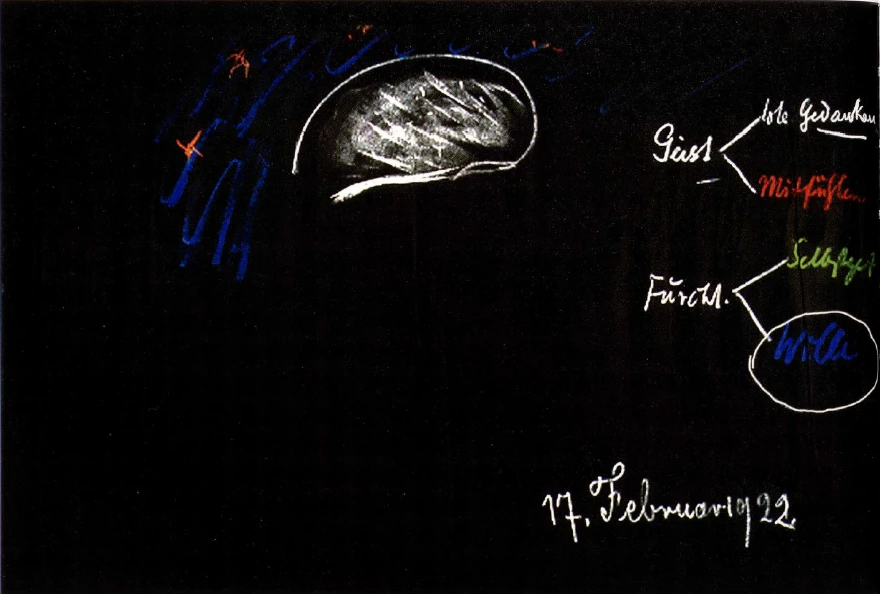
[ 7 ] Nun ist ja das, was sich von der Erde aus dem Menschen entgegenbietet, etwas, was in gewissem Sinne eine Art Anziehungskraft ausübt diesem Furchtzustande gegenüber, in dem der Mensch sich befindet, wenn er sich wiederum dem Erdendasein nähert. Wenn ich schematisch die Sache zeichnen soll, so müßte ich das in der folgenden Weise tun: Denken Sie sich die Schädeldecke mit dem Gehirn darinnen. Das ist der Boden der Schädeldecke. Nun, dasjenige, was da in den Formen des Gehirnes sich ausbildet, was so merkwürdige Windungen darstellt, das ist beim menschlichen Organismus, wie ich verschiedentlich schon angedeutet habe, eine Art Nachbildung des Sternenhimmels, des Weltenalls. Da drinnen in diesem zelligen Gebilde des Gehirns ist wirklich der Sternenhimmel nachgebildet (siehe Zeichnung). Und indem der Mensch vor dem Herunterkommen ins Irdische in dem All draußen, in der Sternenwelt gelebt hat, hat er ja in seiner Geistigkeit dieses Sternenall umfaßt. Aber jetzt fürchtet er sich vor demselben. Er zieht sich zusammen nach dem, was wie ein irdisches Abbild dieses Sternenraumes im menschlichen Gehirn ist.
[ 7 ] Now, what the Earth offers to the human being is, in a certain sense, a kind of gravitational pull toward that state of fear in which the human being finds themselves when they once again approach earthly existence. If I were to sketch this schematically, I would have to do so in the following way: Imagine the top of the skull with the brain inside it. That is the base of the skull. Now, what takes shape there in the forms of the brain—those remarkable convolutions—is, as I have indicated on various occasions, a kind of replica of the starry sky, of the universe, within the human organism. There, inside this cellular structure of the brain, the starry sky is truly replicated (see drawing). And because the human being lived out in the cosmos, in the world of the stars, before descending to the earthly realm, he had, in his spiritual nature, encompassed this starry cosmos. But now he fears it. He withdraws into what is, in the human brain, an earthly image of this starry space.
[ 8 ] Und da kommen wir zu dem, was man bezeichnen könnte als die Wahl, die das Geistig-Seelische trifft. Es geht die Seele eben zu demjenigen in Bildung begriffenen Gehirn hin, welches die meiste Ähnlichkeit hat mit der Sternkonstellation, in der die Seele vor dem Herabsteigen in das Irdische drinnengestanden hat. Es ist ja natürlich, daß das Gehirn des einen Embryos in anderer Weise als das eines andern Embryos ein Abbild des Sternenhimmels ist. Nach demjenigen Gehirn hin aber fühlt sich das Seelische angezogen, das am meisten Ähnlichkeit mit der Sternkonstellation hat, in der die Seele war, bevor sie auf die Erde heruntergestiegen ist.
[ 8 ] And this brings us to what one might call the choice made by the spiritual-soul aspect. The soul is drawn precisely to that brain still in the process of formation which bears the greatest resemblance to the constellation of stars in which the soul was situated before descending into the earthly realm. It is, of course, natural that the brain of one embryo reflects the starry sky in a different way than that of another embryo. However, the soul is drawn to the brain that most closely resembles the constellation in which the soul was situated before it descended to Earth.
[ 9 ] Es ist also im wesentlichen eine Art Furchtgefühl, was die Seele in den engen menschlichen Raum herunterführt, ein Furchtgefühl vor dem Unendlichen, könnte man sagen. Dieses Furchtgefühl ist das mehr Seelische. Die Gedankenwelt, die dann nach und nach von der Kindheit bis zur Erwachsenheit entfaltet wird, ist das Geistige. Dabei gehen dann sowohl dieses Furchtgefühl wie auch das Geistige, das dann zu den Gedankenschatten wird, eine wesentliche Metamorphose durch. Diese Metamorphose möchte ich Ihnen charakterisieren. Man kann sich da nur der Ausdrücke bedienen, welche für das gewöhnliche Vorstellen ungewohnt sind; allein das heutige gewöhnliche Vorstellen hat ja auch durchaus keine Anhaltspunkte, um diese Dinge zu bezeichnen. Es liegt ab von alledem, was in diese Region hineingehört, und daher müssen wir uns schon ungewohnter Ausdrücke bedienen, wenn wir diese den heutigen Vorstellungen abliegenden Dinge adäquat bezeichnen wollen.
[ 9 ] It is, in essence, a kind of fear that draws the soul down into the confined space of human existence—a fear of the infinite, one might say. This fear is the more soul-related aspect. The world of thought, which then gradually unfolds from childhood through adulthood, is the spiritual aspect. In the process, both this sense of fear and the spiritual aspect—which then becomes the shadows of thought—undergo a fundamental metamorphosis. I would like to describe this metamorphosis to you. One can only use expressions that are unfamiliar to ordinary conception; but then, today’s ordinary conception has absolutely no points of reference for describing these things. It lies beyond everything that belongs to this realm, and therefore we must resort to unfamiliar expressions if we are to adequately describe these things that lie beyond today’s conceptions.
[ 10 ] Wir haben also zunächst das geistige Element, das da lebt im All, das sich gewissermaßen hineinbegibt in die enge Wohnung des menschlichen Leibes, sich namentlich durch das Nervensystem, durch das Gehirn entfaltet und sich dabei metamorphosieren muß. Dabei gliedert es sich in zwei Regionen. Man kann wirklich davon sprechen, daß das, was der Mensch vor der Konzeption in der geistig-seelischen Welt ist, beim Übergehen in die physische Leiblichkeit stirbt. Die Geburt in der physischen Leiblichkeit ist ein Absterben für das geistig-seelische Leben des Menschen. Beim Absterben bleibt immer ein Leichnam übrig. Wie, wenn der Mensch für die Erde stirbt, der Leichnam übrigbleibt, so bleibt auch ein Leichnam übrig, wenn das Geistig-Seelische, indem es durch die Konzeption zur Erde hingeht — wenn ich mich des Ausdrucks bedienen darf —, für das Himmlische abstirbt. Von dem, was nun da als ein Leichnam übrigbleibt, von dem leben wir eigentlich gedanklich unser ganzes Erdenleben hindurch. Der Leichnam ist nämlich die Gedankenwelt; das Tote, das ist diese Schattenwelt. So daß wir sagen können: Indem das Geistige des Menschen durch die Konzeption ins Erdenleben heruntersteigt, stirbt es für die geistig-seelische Welt ab und läßt diesen Leichnam zurück.
[ 10 ] So we first have the spiritual element that lives in the universe, which, as it were, enters the confined space of the human body, unfolds itself specifically through the nervous system and the brain, and must undergo a metamorphosis in the process. In doing so, it divides itself into two regions. One can truly say that what a human being is in the spiritual-soul world before conception dies when making the transition into physical embodiment. Birth into physical embodiment is a dying-off for the human being’s spiritual-soul life. When something dies, a corpse always remains. Just as when a human being dies for the Earth, the corpse remains, so too does a corpse remain when the spiritual-soul aspect—as it moves toward the Earth through conception—if I may use that expression—dies for the heavenly realm. It is from what remains there as a corpse that we actually draw our mental sustenance throughout our entire earthly life. For the corpse is, in fact, the world of thought; what is dead is this shadow world. So that we can say: As the human spirit descends into earthly life through conception, it dies off from the spiritual-soul world and leaves this corpse behind.
[ 11 ] Geradeso wie der Leichnam des physischen Menschen in die irdischen Elemente sich auflöst, so löst sich für die geistige Welt das Geistig-Seelische auf und wird zu der Kraft, die in den physischen Gedanken entfaltet wird. Die Gedankenwelt ist der Leichnam unseres Geistig-Seelischen. So, wie die Erde den Leichnam verarbeitet, wenn wir ihn in die Erde legen, oder wie ihn das Feuer verarbeitet, wenn wir ihn verbrennen, so verarbeiten wir unser ganzes Leben hindurch den Leichnam unseres Geistig-Seelischen in unserer physischen Gedankenwelt. Also die physische Gedankenwelt ist im Grunde genommen das fortgehende Tote dessen, was als Wirkliches, als geistiges Leben vorhanden ist, bevor der Mensch in die physische Irdischheiit heruntersteigt.
[ 11 ] Just as the physical body of a human being dissolves into the earthly elements, so too does the spiritual-soul aspect dissolve into the spiritual world and become the force that unfolds within physical thoughts. The world of thought is the corpse of our spiritual-soul nature. Just as the earth processes the corpse when we lay it in the ground, or as fire processes it when we burn it, so throughout our entire life we process the corpse of our spiritual-soul nature in our physical world of thought. Thus, the physical world of thought is, in essence, the continuing death of that which exists as reality—as spiritual life—before a human being descends into physical earthly existence.
[ 12 ] Das andere, was in den Menschen als Lebendes einkehrt von seinem vorirdischen Dasein, das kommt im physischen Menschen nicht durch die Gedankenwelt zur Geltung, sondern im weitesten Umfange durch alles dasjenige, was wir Gefühl nennen können, sowohl Mitfühlen mit den Menschen wie auch Mitfühlen mit der Natur. Also alles das, wodurch Sie sich fühlend, empfindend in die Außenwelt verbreiten, das ist ein Element, das die lebendige Nachwirkung des vorirdischen Daseins darstellt (siehe Schema S. 97).
[ 12 ] The other aspect of human life that originates from our pre-earthly existence does not manifest itself in the physical human being through the world of thought, but rather, to the greatest extent, through everything we can call feeling—both empathy toward other people and empathy toward nature. In other words, everything through which you extend yourself into the outer world through feeling and sensation is an element that represents the living aftereffect of pre-earthly existence (see diagram, p. 97).
[ 13 ] Nicht in Ihren Gedanken erleben Sie auf lebendige Art Ihr vorirdisches Dasein, sondern in dem Gefühle mit den andern Wesen. Wenn wir eine Blume liebhaben, wenn wir einen Menschen liebhaben, so ist das im wesentlichen eine Kraft, die uns aus dem vorirdischen Dasein gegeben ist, aber in einer lebendigen Weise. So daß wir auch sagen können: Wenn wir zum Beispiel einen Menschen liebhaben, so haben wir ihn nicht bloß aus Erfahrungen im Erdenleben lieb, sondern auch aus dem Karma heraus, aus der Verbundenheit in früheren Erdenleben. Es wird etwas Lebendiges hinübergetragen aus dem vorirdischen Dasein, wenn die mitfühlende Sphäre des Menschen in Betracht kommt. Dagegen stirbt das, was lebendiges Geistelement zwischen dem Tod und einer neuen Geburt ist, in die Gedankenwelt hinein. Deshalb hat die Gedankenwelt während des irdischen Daseins dieses Blasse, Schattenhafte, dieses Tote an sich, weil es eigentlich den abgestorbenen Teil der vorirdischen Erlebnisse des Menschen darstellt.
[ 13 ] It is not in your thoughts that you experience your pre-earthly existence in a living way, but rather through your feelings toward other beings. When we love a flower, when we love a person, this is essentially a force given to us from our pre-earthly existence, but in a living way. So we can also say: When we love a person, for example, we love them not merely because of experiences in this earthly life, but also because of karma, because of the bond formed in previous earthly lives. Something living is carried over from pre-earthly existence when the human being’s sphere of compassion comes into play. In contrast, that which is the living spiritual element between death and a new birth fades into the world of thought. That is why the world of thought during earthly existence has this pale, shadowy, lifeless quality about it, because it actually represents the deceased part of a person’s pre-earthly experiences.
[ 14 ] Das zweite ist dann das, was man als Furcht bezeichnen muß, und auch das metamorphosiert sich so, daß es in zwei Elemente zerfällt. Das eine, also dasjenige, was wir vor dem Heruntersteigen in die irdische Welt als Furcht erleben, was die Seele ganz durchzieht und wobei sie die geistige Welt fliehen will, das wird etwas anderes, wenn es in den Leib einzieht, und das äußert sich zunächst im Inneren des Menschen als etwas, was ich bezeichnen möchte als das Selbstgefühl. Das Selbstgefühl ist wirklich die umgewandelte Furcht. Daß Sie sich als ein Selbst fühlen, daß Sie sich in sich selbst halten, das ist umgewandelte Furcht aus dem vorirdischen Leben.
[ 14 ] The second is what must be called fear, and this, too, undergoes a metamorphosis such that it breaks down into two elements. One of these—that is, what we experience as fear before descending into the earthly world, which permeates the soul entirely and causes it to want to flee the spiritual world—becomes something else when it enters the body, and this initially manifests within the human being as something I would like to call self-awareness. Self-awareness is truly fear in a transformed state. The fact that you feel yourself as a self, that you hold yourself within yourself—this is transformed fear from the pre-earthly life.
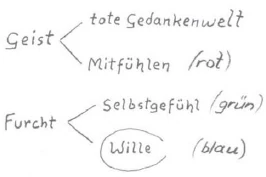
[ 15 ] Und der andere Teil, in den sich die Furcht verwandelt, das ist der Wille. Alles, was als Willensimpulse auftritt, was unserer Betätigung in der Welt zugrunde liegt, all das ist vor dem Heruntersteigen ins irdische Leben als Furcht vorhanden.
[ 15 ] And the other aspect into which fear is transformed is the will. Everything that manifests as impulses of the will—everything that underlies our activity in the world—all of this exists as fear before we descend into earthly life.
[ 16 ] Sie sehen, hier ist wiederum dem Menschen ein Gutes für das irdische Leben erwiesen dadurch, daß er im gewöhnlichen Bewußtsein nicht an dem Hüter der Schwelle vorüberschreitet. Ich sagte ja oftmals: Das, was der Wille eigentlich da unten darstellt im menschlichen Organismus, das verschläft der Mensch. Der Mensch hat die Intention seines Wollens, dann führt er das Wollen aus; dann hat er wiederum die Vorstellung von den Ergebnissen. Was aber zwischen diesen beiden Vorstellungswelten liegt, zwischen der Absicht, eine Handlung auszuführen und der vollendeten Handlung, also das, was eigentlich im Willen lebt, das wird von dem Menschen zunächst so verschlafen, wie er die Zustände zwischen dem Einschlafen und dem Aufwachen verschläft. Wenn der Mensch hinunterschauen würde in das, was seinem Willen zugrunde liegt, er würde heraufkraften fühlen aus seinem Organismus die aus dem vorirdischen Leben hereinkommende Furcht.
[ 16 ] You see, here again a benefit is bestowed upon the human being for earthly life in that, in ordinary consciousness, he does not pass by the Guardian of the Threshold. I have often said: What the will actually represents down there in the human organism, the human being sleeps through. A person has the intention of their will, then carries out that will; then they have the mental image of the results. But what lies between these two worlds of perception—between the intention to carry out an action and the completed action, that is, what actually lives in the will—is initially slept through by the person, just as they sleep through the states between falling asleep and waking up. If a person were to look down into what underlies their will, they would feel a force rising up from their organism—the fear that comes from pre-earthly life.
[ 17 ] Das ist es auch, was bei der Einweihung überwunden werden muß. Wenn man in sich selbst hineinschaut, sieht man zuerst allerdings das Selbstgefühl. Das ist ja schon etwas, was durch die Erziehung nicht zu sehr gesteigert werden darf, damit der Mensch, wenn er in die geistige Welt eintritt, nicht eben in Größenwahn verfällt. Aber auf dem Grunde seiner Willensimpulse findet er überall die Furcht, und er muß gestärkt sein gegen diese Furcht.
[ 17 ] This is also what must be overcome during initiation. When one looks within oneself, however, the first thing one sees is a sense of self. This is something that must not be overly emphasized in one’s upbringing, so that when a person enters the spiritual world, they do not fall into megalomania. But at the root of one’s impulses of will, one finds fear everywhere, and one must be strengthened against this fear.
[ 18 ] Im wesentlichen werden Sie daher sehen, daß überall in den Übungen, die angegeben sind in meinem Buche «Wie erlangt man Erkenntnisse höherer Welten?», darauf hingezielt ist, die Furcht, die man in der eben bezeichneten Weise gewahr wird, zu ertragen. Diese Furcht ist etwas, was unter den Entwickelungskräften da sein muß, sonst würde der Mensch gar nicht in das irdische Dasein herunterkommen aus der geistigen Welt. Er würde die geistige Welt nicht fliehen. Er würde nicht den Impuls entwickeln, in einen begrenzten physischen Menschenleib einzuziehen. Daß er es tut, hängt eben damit zusammen, daß er die Furcht vor der geistigen Welt als eine ganz natürliche Eigenschaft der Seele hat, wenn er eine Zeitlang zwischen dem Tode und einer neuen Geburt gelebt hat.
[ 18 ] Essentially, you will therefore see that throughout the exercises described in my book How Does One Attain Knowledge of Higher Worlds?, the aim is to endure the fear that one becomes aware of in the manner just described. This fear is something that must be present among the forces of development; otherwise, a person would not descend from the spiritual world into earthly existence at all. They would not flee the spiritual world. They would not develop the impulse to enter a limited physical human body. The fact that they do so is precisely because they have a fear of the spiritual world as a completely natural characteristic of the soul after having lived for a time between death and a new birth.
[ 19 ] Wir haben also die Gedanken als einen Leichnam an uns, das heißt, eigentlich ist es die Kraft der Gedanken, nicht die Gedanken selbst, die wir haben. Wir können das noch genauer beschreiben. Allerdings, wenn Sie auf diese genauere Beschreibung eingehen wollen, werden Sie sehr exakte Vorstellungen entwickeln müssen. Diese geistige Kraft, die da in den Gedanken erstirbt und zum Leichnam wird, wenn der Mensch ins physische Erdendasein heruntersteigt, diese Kraft ist dieselbe, die aus dem Kosmos heraus unsere Organe bildet. Was wir als Lunge, Herz, Magen, also als die geformten Organe in uns tragen, das wird aus dieser Gedankenkraft des Weltenalls heraus gebildet. Wenn wir nun ins irdische Leben eintreten, dann geht in unseren engbegrenzten Organismus diese Gedankenkraft ein. Was will nun die Erde mit ihrer Umgebung von uns? Ja, die Erde mit ihrer Umgebung will eigentlich von uns, daß wir sie in uns nachbilden.
[ 19 ] So we have thoughts as a corpse within us; that is to say, it is actually the power of thoughts—not the thoughts themselves—that we possess. We can describe this in even greater detail. However, if you wish to delve into this more detailed description, you will have to develop very precise concepts. This spiritual force, which dies within the thoughts and becomes a corpse when a human being descends into physical earthly existence, is the same force that forms our organs from the cosmos. What we carry within us as lungs, heart, and stomach—that is, as the formed organs—is shaped from this thought force of the universe. When we now enter earthly life, this thought force enters our narrowly limited organism. What, then, does the Earth and its surroundings want from us? Yes, the Earth and its surroundings actually want us to recreate them within ourselves.
[ 20 ] Wenn wir das Irdische nachbilden würden, dann würden allmählich im Verlaufe unseres Lebens unsere inneren Organe, wie Lunge und vor allen Dingen die verschiedensten Windungen des Gehirns und so weiter, in kristallartige Gestalten verwandelt werden. Wir würden alle Bildsäulen werden, die aber nicht dem Menschen ähnlich wären, sondern die so wie Kristalle, die gegeneinander gruppiert sind, aussehen würden. Wir würden aus unorganischen, aus leblosen Gestalten allmählich zusammengesetzt sein und eine Art von Bildsäule werden. Dagegen stemmt sich der menschliche Organismus. Er bleibt bei der Form seiner inneren Organe. Er läßt zum Beispiel seine Lunge nicht umbilden zu einer Art von, sagen wir, Gebirgszügen. Er läßt sein Herz nicht umbilden zu einer Art Kristallgruppe. Er stemmt sich dagegen. Und in diesem Sich-dagegen-Stemmen liegt der Anlaß dazu, daß wir, statt mit unseren Organen diese irdische Umgebung nachzuformen, sie bloß in Schattenbildern in unseren Gedanken nachbilden. Also die Gedankenkraft ist eigentlich immer auf dem Wege, von uns ein Abbild unserer physischen Erde, unserer physischen Erdenform zu machen. Wir möchten fortwährend zu einem System von Kristallen werden. Aber das läßt unsere Organisation nicht zu. So viel hat sie in dem Lebendigen, in dem Mitfühlen, in dem Selbstgefühle, in den Willensimpulsen zu entfalten, daß sie das nicht zuläßt. Sie läßt unsere Lunge nicht umbilden, so daß sie aussieht wie Kristalle, die aus der Erde herauswachsen. Sie stemmt sich gegen dieses irdische Gestaltetwerden, und da kommen nur die Tafel 9.
[ 20 ] If we were to replicate the earthly realm, then over the course of our lives our internal organs—such as the lungs and, above all, the various convolutions of the brain and so on—would gradually be transformed into crystal-like forms. We would all become statues, but ones that would not resemble human beings; rather, they would look like crystals grouped together. We would gradually be composed of inorganic, lifeless forms and become a kind of statue. The human organism resists this. It retains the form of its internal organs. For example, it does not allow its lungs to be transformed into, say, mountain ranges. It does not allow its heart to be transformed into a cluster of crystals. It resists this. And in this resistance lies the reason why, instead of using our organs to reshape this earthly environment, we merely recreate it as shadows in our thoughts. So the power of thought is actually always striving to make us a reflection of our physical Earth, of our physical Earth’s form. We would constantly like to become a system of crystals. But our organization does not allow this. It has so much to unfold in the realm of life, in empathy, in self-awareness, and in impulses of will that it does not permit this. It does not allow our lungs to be transformed so that they look like crystals growing out of the earth. It resists this earthly shaping, and thus only the Plate 9.
[ 21 ] Bilder der irdischen Gestalten dann zustande in der Geometrie, und was wir sonst uns an Gedanken bilden von unserer Erdenumgebung. Wie gesagt, es muß sehr exakt gedacht werden, wenn man zu dieser Vorstellung vorschreiten will.
[ 21 ] Images of earthly forms then arise in geometry, and whatever other ideas we form about our earthly surroundings. As I said, one must think very precisely if one wishes to proceed to this conception.
[ 22 ] Eigentlich ist aber immerfort die Tendenz vorhanden, daß wir unserem Gedankensystem ähnlich werden. Wir müssen fortwährend dagegen kämpfen, daß wir ihm nicht ähnlich werden. Wir streben eigentlich fortwährend dahin, so eine Art Kunstwerk zu werden, das allerdings bei der Art der Gedanken, wie sie die Menschen meistens haben, nicht gerade ein sehr schönes Kunstwerk zum Anschauen gäbe. Aber wir streben dahin, der äußeren Gestalt nach dasselbe zu wirken, was unsere Gedanken eben im bloßen Bilde, im bloßen Schatten sind. Wir werden es nicht, sondern wir lassen es gewissermaßen zurückspiegeln, und dadurch wird es unser Gedanke. Es ist ein Prozeß, der sich wirklich vergleichen läßt mit dem Entstehen von Spiegelbildern.
[ 22 ] In reality, however, there is always a tendency for us to become like our own system of thought. We must constantly fight against becoming like it. We are actually constantly striving to become a kind of work of art—though, given the nature of the thoughts that people usually have, this would not exactly be a very beautiful work of art to look at. But we strive to appear, in our outward form, to be exactly what our thoughts are in their mere image, in their mere shadow. We do not become it, but rather we allow it to be reflected back, as it were, and thereby it becomes our thought. It is a process that can truly be compared to the formation of mirror images.
[ 23 ] Wenn Sie hier einen Spiegel haben, davor einen Gegenstand, so wird dieser Gegenstand eben abgespiegelt. Er ist nicht da drinnen [Hier wird gezeichnet]. Alles, was vor unserem Auge steht, will eigentlich in uns fortwährend ein wirkliches Gebilde veranlassen. Aber wir stemmen uns dagegen, wir behalten unser Gehirn. Dadurch wird es zurückgespiegelt und wird das Gedankenbild. Ein Tisch will in Ihnen Ihr Gehirn selber zum Tisch machen; Sie lassen das nicht zu. Dadurch entsteht das Bild des Tisches in Ihnen. Das ist das Spiegeln, dieses Zurückwerfen der Tätigkeit. Dadurch aber stehen wir eben im Denken so da, daß unsere Gedanken nur die Schattenbilder der Außenwelt sind. Aber in unserem Gefühl, da haben wir schon etwas anderes gegeben. Versuchen Sie nur einmal sich richtig vorzustellen, was Sie mit Ihrem Fühlen haben. Sie fühlen anders einen runden Tisch als einen eckigen. Sie fühlen die Ecken. Der Gedanke des eckigen Dinges macht Ihnen nichts Besonderes aus, aber das Erfühlen der Ecken, das tut schon mehr weh, als wenn man nur in aller Ruhe die Rundung eines Tisches verfolgt. Also mit dem Fühlen leben wir in unserem Inneren schon mehr die äußere Form nach als mit den Gedanken.
[ 23 ] If you have a mirror here, with an object in front of it, that object is simply reflected. It is not in there [A drawing is shown here]. Everything that stands before our eyes actually seeks to continually bring about a real form within us. But we resist this; we hold on to our brain. As a result, it is reflected back and becomes a mental image. A table seeks to turn your brain itself into a table; you do not allow that to happen. This is how the image of the table arises within you. That is what mirroring is—this reflection of activity. As a result, however, we stand in our thinking in such a way that our thoughts are merely shadows of the external world. But in our feeling, there we have already given something else. Just try to really imagine what you experience through your feeling. You feel a round table differently than a square one. You feel the corners. The thought of a square object doesn’t mean much to you, but actually feeling the corners—that hurts more than simply calmly tracing the curve of a round table. So, through feeling, we already live out the external form more fully within ourselves than we do through thought.
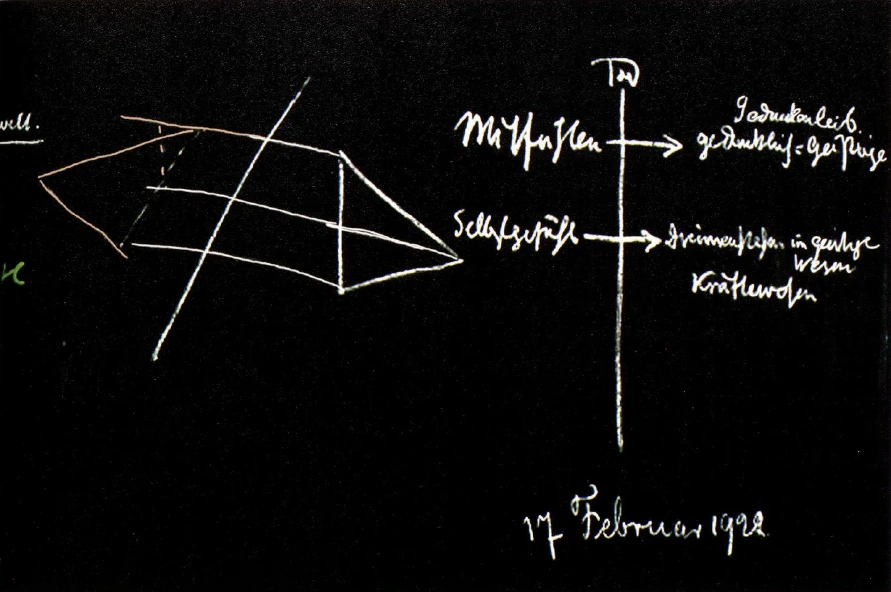
[ 24 ] Damit ist hingedeutet auf die Metamorphose, die das SeelischGeistige durchmacht, wenn es vom vorirdischen Dasein ins irdische Dasein kommt. Wie ist es nun, wenn wir durch die Pforte des Todes gehen? Die Gedankenwelt, die wir haben, ist ja ihrer Kraft nach bloß der Leichnam des vorirdischen Daseins. Die hat eigentlich keine Bedeutung. Geradeso wie, wenn wir uns in einem Spiegel sehen und dann den Spiegel wegnehmen, das Bild fort ist, so ist unser Gedankenleben fort, indem wir durch die Pforte des "Todes gehen. Also, "wenn der Mensch von Unsterblichkeit spricht, so soll er nur ja nicht auf diese irdische Gedankenkraft reflektieren. Die ist es nicht, die mit ihm durch die Pforte des Todes geht. Dagegen alles das, was er als Mitgefühl, als Nachgefühl, als Nachempfindung des Irdischen entwickelt hat, das geht durch die Pforte des Todes. Also Mitgefühl geht durch die Pforte des Todes hindurch (siehe Schema). Und dadurch, daß wir Mitgefühl haben mit der Umwelt, entwickeln wir die Kraft, jetzt in der geistigen Welt in den Wesenheiten darinnenzustehen, in dem Element, das Geistesgedankenelement ist. Das Mitfühlen, das durch unsere Körperlichkeit abgetrennt ist von der irdischen Umgebung, strömt jetzt nach dem Tode hinaus in die geistige Umgebung und verbindet sich mit dem Gedanklich-Geistigen der Welt, in die wir eintreten, wenn wir durch die Pforte des Todes gehen. Also mit dem Gedanklich-Geistigen verbindet sich dasjenige, was wir an Mitgefühl empfinden.
[ 24 ] This alludes to the metamorphosis that the soul-spirit undergoes when it passes from pre-earthly existence into earthly existence. What happens, then, when we pass through the gate of death? The world of thoughts we possess is, in terms of its power, merely the corpse of our pre-earthly existence. It has no real significance. Just as when we see ourselves in a mirror and then remove the mirror—the image is gone—so too is our life of thought gone when we pass through the gate of “death.” Therefore, “when a person speaks of immortality, they must by no means reflect on this earthly power of thought. It is not this that passes through the gate of death with them. On the other hand, everything they have developed as compassion, as empathy, as a sense of connection to the earthly—that passes through the gate of death. So compassion passes through the gate of death (see diagram). And by feeling compassion for our surroundings, we develop the power to now stand within the beings of the spiritual world, within the element that is the element of spiritual thought. The compassion that is separated from the earthly environment by our physicality now flows out after death into the spiritual environment and connects with the thought-spiritual aspect of the world we enter when we pass through the gate of death. Thus, what we feel as compassion connects with the thought-spiritual aspect.
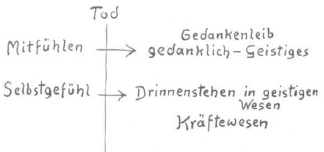
[ 25 ] Und dadurch, daß wir gewissermaßen hinüberfließen mit unserem Mitfühlen in das Gedanklich-Geistige, entwickeln wir selber wiederum eine Art Gedankenleib, einen lebendigen Gedankenleib, der uns dann eigen ist zwischen dem Tode und der nächsten Geburt. Denn das, was im Leben Selbstgefühl ist, das entwickelt sich zum Drinnenstehen in andern Wesenheiten. Während wir durch unser Selbstgefühl im irdischen Leben uns nur innerhalb unserer Leiblichkeit wissen, lernen wir uns wissen in andern Wesen, in den Wesen der höheren Hierarchien, wenn wir durch die Pforte des Todes gegangen sind. Und indem wir in geistigen Wesen drinnenstehen, empfangen wir von diesen auch die Kräfte, die uns dann wiederum weiterleiten auf unserer Lebensbahn zwischen dem Tode und einer neuen Geburt. So daß wir sagen können, das eigene Kräftewesen entwickelt sich auf diese Weise. Das ist die Metamorphose des Geistig-Seelischen, indem wir durch die Pforte des Todes hindurchgehen.
[ 25 ] And by flowing, as it were, with our empathy into the mental-spiritual realm, we in turn develop a kind of thought-body—a living thought-body—which then belongs to us between death and the next birth. For what is a sense of self in life develops into a sense of being present within other beings. Whereas in earthly life, through our sense of self, we are aware only of our physical body, we come to know ourselves within other beings—the beings of the higher hierarchies—once we have passed through the gate of death. And as we dwell within spiritual beings, we also receive from them the forces that in turn guide us further along our life path between death and a new birth. So that we can say that our own being of forces develops in this way. This is the metamorphosis of the spiritual-soul aspect as we pass through the gate of death.
[ 26 ] Der Wille als solcher ist nicht etwa so — wie die Gedankenwelt —, daß er mit dem Tode verschwände, sondern er ist ja der Quell für den Inhalt unserer Selbstgefühle. Denken Sie einmal, Sie wollen etwas, das Sie befriedigt, dann gibt dieses Wollen schon etwas, das Sie befriedigt, gibt Ihrem Selbstgefühl eine bestimmte Nuance. Wenn Sie etwas getan haben, was Sie nicht befriedigt, gibt das auch Ihrem Selbstgefühl eine bestimmte Nuance. Der Wille ist nicht nur etwas, das nach außen die Tätigkeit vollzieht, sondern er strebt auch kraftvoll in unser Inneres zurück. Wir wissen, was wir sind, aus dem heraus, was wir können. Und diese Nuance des Selbstgefühles, dieses in uns selbst wiederum Zurückstrahlen des Willenselementes, das nehmen wir mit dem Selbstgefühl eben mit in die geistige Welt. Also der Wille, das heißt eigentlich die Zurückstrahlung des Willens in unser Selbstgefühl ist es, was wir hineintragen, indem wir untertauchen in die Wesenheiten der höheren Hierarchien. Und dadurch, daß wir das mitnehmen, was unser Selbstgefühl erhöht oder geschwächt hat, bildet sich die Kraft unseres Karma, unseres Schicksals. Wenn man diese Dinge überblickt, kann man hineinschauen in das, was der Mensch eigentlich ist. Und man lernt auch auf diese Art insbesondere gewisse Begleiterscheinungen des irdischen Lebens kennen. Im irdischen Leben tritt die Furcht gewiß da oder dort auf; aber niemals darf sie die ganze Seele ausfüllen, und es wäre traurig, wenn es so wäre. Bevor wir dagegen ins irdische Leben heruntersteigen, ist die ganze Seele von Furcht ausgefüllt, und diese Furcht ist die Kraft, die wir in diesem Zustande haben müssen, damit wir ins physische irdische Leben wirklich heruntersteigen.
[ 26 ] The will, as such, is not—unlike the world of thought—something that vanishes with death; rather, it is the very source of the content of our sense of self. Just think: when you want something that satisfies you, that very act of wanting already provides something that satisfies you and gives your sense of self a certain nuance. When you have done something that does not satisfy you, that, too, gives your sense of self a certain nuance. The will is not merely something that carries out outward actions; it also strives powerfully back into our inner being. We know who we are based on what we are capable of. And this nuance of self-awareness—this reflection of the element of will back into ourselves—is precisely what we carry with our sense of self into the spiritual world. So it is the will—that is, the reflection of the will into our sense of self—that we carry with us as we immerse ourselves in the beings of the higher hierarchies. And by taking with us what has elevated or weakened our sense of self, the power of our karma—our destiny—is formed. When one surveys these things, one can gain insight into what a human being truly is. And in this way, one also comes to understand, in particular, certain accompanying phenomena of earthly life. In earthly life, fear certainly arises here and there; but it must never fill the entire soul, and it would be sad if it did. Before we descend into earthly life, however, the entire soul is filled with fear, and this fear is the force we must possess in this state in order to truly descend into physical earthly life.
[ 27 ] Das Selbstgefühl wiederum ist etwas, das im irdischen Leben nicht über eine gewisse Höhe hinaus gesteigert werden darf, was überhaupt eigentlich im irdischen Leben gar nicht selbständig empfunden werden sollte. Ein Mensch, der mit zu starker Selbständigkeit das Selbstgefühl entwickelt, der kennt eben nur sich. Das Selbstgefühl ist im irdischen Leben eigentlich nur dazu da, damit wir an unserer Leiblichkeit bis zum Tode festhalten, damit wir an jedem Morgen, wenn wir geschlafen haben, wiederum zurückkehren in unsere Leiblichkeit. Denn würden wir dieses Selbstgefühl nicht haben während unseres irdischen Lebens, so würden wir nicht wieder zurückkehren. Aber nach dem Tode brauchen wir es, wenn wir in die Welt der geistigen Wesenheiten untertauchen, denn wir würden uns sonst jederzeit verlieren. Wir müssen ja dort in reale geistige Wesenheiten untertauchen.
[ 27 ] Self-esteem, on the other hand, is something that must not be allowed to rise above a certain level in earthly life—and in fact, it should not be experienced independently at all in earthly life. A person who develops a sense of self with too much independence knows only himself. In earthly life, the sense of self is really only there so that we can hold on to our physicality until death, so that every morning, after we have slept, we can return once more to our physicality. For if we did not have this sense of self during our earthly life, we would not return. But after death, we need it when we immerse ourselves in the world of spiritual beings, for otherwise we would lose ourselves at any moment. After all, we must immerse ourselves there among real spiritual beings.
[ 28 ] Die Erde macht nicht diesen Anspruch an uns. Wenn Sie durch einen Wald gehen, dann bleiben Sie eben auf Ihrem Wege, und die Bäume sind links und rechts und vorne und hinten. Sie sehen die Bäume, aber die Bäume machen nicht den Anspruch, daß Sie in sie hineingehen, daß Sie fortwährend zur Baumnymphe werden und in die Bäume untertauchen. Aber die geistigen Wesenheiten der höheren Hierarchien, deren Welt Sie nach dem Tode betreten, die machen den Anspruch, daß wir in sie untertauchen. Wir müssen sie alle werden, diese Wesenheiten der geistigen Welt. Würden wir da nicht mit dem Selbstgefühl in diese geistige Welt hineingehen, wenn wir durch die Pforte des Todes treten, dann würden wir uns verlieren. Da brauchen wir das Selbstgefühl, einfach um uns zu erhalten. Und gerade auch die moralischen Dinge, die wir im Erdenleben verrichtet haben, die unser Selbstgefühl in berechtigter Weise erhöhen, die schützen uns davor, uns nach dem Tode als unser Selbst zu verlieren.
[ 28 ] The Earth does not make this demand of us. When you walk through a forest, you simply stay on your path, and the trees are to your left and right, in front of you, and behind you. You see the trees, but the trees do not demand that you enter them, that you continually become a tree nymph and submerge yourself in the trees. But the spiritual beings of the higher hierarchies—whose world you enter after death—do expect us to merge with them. We must become all of them, these beings of the spiritual world. If we were to enter this spiritual world without a sense of self when we pass through the gate of death, we would lose ourselves. We need that sense of self simply to preserve ourselves. And it is precisely the moral deeds we have performed in our earthly life—which justifiably enhance our sense of self—that protect us from losing ourselves as our true selves after death.
[ 29 ] Das sind Vorstellungen, die eigentlich wiederum eintreten müßten in das menschliche Bewußtsein von der Gegenwart ab nach der nächsten Zukunft der Erdenentwickelung hin. Diese Vorstellungen sind gewissermaßen der Menschheit in ältesten Zeiten während des instinktiven hellseherischen Erfassens schon zugeflossen. Die Menschen hatten einmal ein starkes Gefühl von dem, was sie waren, bevor sie zum irdischen Leben heruntergestiegen waren. Das war besonders stark entwickelt in den irdischen Urzeiten. Weniger entwickelt war in irdischen Urzeiten die Hoffnung auf ein Leben nach dem Tode. Das war etwas, das wie selbstverständlich hingenommen wurde. Geradeso aber, wie jetzt die Menschen sich hauptsächlich für ihr Erleben nach dem Tode interessieren, so interessierten sich die Menschen der irdischen Urzeit, die Menschen vor Jahrtausenden, für ihr Leben, bevor sie heruntergestiegen waren auf die Erde.
[ 29 ] These are concepts that should, in fact, re-enter human consciousness, starting from the present and extending into the near future of Earth’s evolution. In a sense, these concepts had already flowed into humanity in the most ancient times during the era of instinctive clairvoyant perception. People once had a strong sense of who they were before they descended into earthly life. This was particularly strongly developed in the earliest days of Earth’s history. Less developed in Earth’s primeval times was the hope for a life after death. That was something that was accepted as a matter of course. Just as people today are primarily interested in their experiences after death, so too were the people of Earth’s primeval times—the people of millennia past—interested in their lives before they had descended to Earth.
[ 30 ] Dann kam die Zeit, mit der sich dieses ursprünglich instinktive Hellsehen verlor, in der sich auch verlor das intensive Zusammenhängen der Seele mit ihrem vorirdischen Dasein. Und dann entsprangen die zwei Geistesströmungen, welche das vorbereitet haben, was eigentlich sich jetzt in der Menschheitszivilisation entwickeln mußte. Wir haben zwei deutlich voneinander verschiedene Strömungen, die wir von den verschiedensten Gesichtspunkten aus charakterisiert haben, und auf die wir heute von einem bestimmten Gesichtspunkte aus, der uns morgen und übermorgen bei unseren Betrachtungen wird dienen können, wiederum eingehen wollen.
[ 30 ] Then came the time when this originally instinctive clairvoyance was lost, a time in which the soul’s intense connection to its pre-earthly existence was also lost. And then arose the two spiritual currents that paved the way for what was now destined to develop within human civilization. We have two clearly distinct currents, which we have characterized from a wide variety of perspectives, and which we wish to address again today from a specific perspective that will serve us in our reflections tomorrow and the day after.
[ 31 ] Nehmen Sie die irdische Entwickelung, bevor das Mysterium von Golgatha über die Erde hinging, dann haben Sie gewissermaßen ausgebreitet über die Erde die heidnische Kultur, und in einer gewissen Absonderung diejenige Kultur, die man die alttestamentliche nennen könnte. Was war denn dieser heidnischen Kultur besonders eigentümlich? Sie hatte durchaus noch ein Bewußtsein davon, daß in allem, was physisch den Menschen umgibt, auch Geistiges enthalten ist. Die heidnische Kultur hatte ein starkes Bewußtsein von dem, was lebendige Gedanken sind, die dann in uns zu toten Gedanken werden. Sie sah überall in den Wesen der verschiedenen Naturreiche das lebendige Element für das, wofür die menschlichen Gedanken das tote Element sind. Die heidnische Welt nahm also die lebendigen Gedanken der Welt wahr, sie betrachtete den Menschen auch als angehörig diesen lebendigen Gedanken der Welt.
[ 31 ] If you consider earthly development before the Mystery of Golgotha came upon the earth, you will find, as it were, pagan culture spread across the earth, and, in a certain degree of separation, the culture that might be called Old Testament culture. What, then, was particularly distinctive about this pagan culture? It still possessed a clear awareness that everything physically surrounding human beings also contains a spiritual element. Pagan culture had a strong awareness of what living thoughts are—thoughts that later become dead thoughts within us. It saw everywhere in the beings of the various kingdoms of nature the living element corresponding to that for which human thoughts are the dead element. The pagan world thus perceived the living thoughts of the world; it also regarded human beings as belonging to these living thoughts of the world.
[ 32 ] Nun war ein besonders lebensvoll entwickelter Teil dieser heidnischen Welt die des alten Griechenvolkes. Sie wissen ja, daß die Welt des alten Griechenvolkes stark durchdrungen war von dem Schicksalsgedanken. Und — erinnern Sie sich an gewisse griechische Dramen — dieser Schicksalsgedanke durchstrahlt das menschliche Leben mit einer Gesetzmäßigkeit, ich möchte sagen wie die Naturgesetze die Natur. Der Grieche fühlte sich in der Natur durchaus so drinnenstehend, daß in ihn herein das Schicksal spielte, wie in die Naturtatsachen die Naturgesetze spielen. Das Schicksal trifft den Menschen innerhalb der griechischen Anschauung mit Naturgewalt. Das war aber die Eigentümlichkeit jeder heidnischen Vorstellung, sie kam nur bei den Griechen in ganz bedeutsamer Weise zum Ausdruck. Die heidnische Welt sah den Geist in allem Naturdasein. Sie hatte keine besondere Naturwissenschaft, die so gewesen wäre wie die unsrige, aber sie hatte eine ausgebreitete Naturwissenschaft. Sie redete überall, wo sie die Natur erblickte, von Geistigem. Das war die Naturwissenschaft, die zu gleicher Zeit eine Geisteswissenschaft war. Der Heide sah weniger auf das menschliche Innere. Er sah den Menschen auch wie ein Naturwesen von außen an, aber er konnte das, weil er auch die übrigen Naturwesen nicht seelenlos dachte. Er dachte den Baum, die Pflanzen, die Wolken nicht seelenlos. So brauchte er auch den Menschen nur von außen anzuschauen und ihn doch nicht seelenlos zu denken. Der alte Heide konnte also, indem er die Natur beseelte, auch den Menschen als Naturwesen betrachten, und so war das alte Heidentum ein Element, das von vorneherein ein Spirituelles in sich hatte, das zum Geiste hinneigte. Dem stand schroff entgegen als der andere Pol das Bekenntnis, das dann im Alten Testament sich ausgelebt hat.
[ 32 ] Now, a particularly vibrant and developed part of this pagan world was that of the ancient Greeks. As you know, the world of the ancient Greeks was deeply permeated by the concept of fate. And—if you recall certain Greek dramas—this concept of fate permeates human life with a regularity, I would say, much like the laws of nature permeate nature itself. The Greeks felt so deeply immersed in nature that fate operated within them just as the laws of nature operate within natural phenomena. In the Greek worldview, fate strikes human beings with the force of nature. But this was a characteristic of every pagan conception; it was simply expressed in a particularly significant way among the Greeks. The pagan world saw the spirit in all of nature’s existence. It had no specific natural science like ours, but it did have a widespread understanding of nature. Wherever it perceived nature, it spoke of the spiritual. This was the natural science that was, at the same time, a spiritual science. The pagan paid less attention to the inner life of human beings. He also viewed human beings from the outside as natural beings, but he was able to do so because he did not conceive of other natural beings as soulless either. He did not conceive of trees, plants, or clouds as soulless. Thus, he need only observe human beings from the outside without conceiving of them as soulless. The ancient pagan, therefore, by imbuing nature with a soul, could also regard human beings as natural beings, and thus ancient paganism was an element that from the very beginning contained a spiritual aspect within itself, one that was inclined toward the spirit. Standing in stark contrast to this, as the other pole, was the creed that later found its full expression in the Old Testament.
[ 33 ] Das Alte Testament kannte die Natur eigentlich weder in dem Sinne, wie wir die Natur kennen — ich meine, indem wir wiederum zur Geisteswissenschaft zurückkehren —, noch in dem Sinne, wie das Heidentum die Natur gekannt hat. Das Alte Testament kannte eigentlich nur eine moralische Weltordnung, und Jahve ist der Herrscher über diese moralische Weltordnung, und es geschieht das, was Jahve will. So daß innerhalb dieser Welt des Alten ’Testamentes eigentlich in ganz selbstverständlicher Weise die Anschauung entstand, man soll sich gar kein Bild machen von dem, was seelisch-geistig ist; eine Anschauung, die das Heidentum nie hätte haben können, denn das Heidentum hat in jedem Baume, in jeder Pflanze Bilder gesehen von dem Geistigen. Der Bekenner des Alten Testamentes hat nirgends Bilder gesehen, dagegen überall das Walten des unsichtbaren, bildlosen Geistigen.
[ 33 ] The Old Testament did not really understand nature either in the sense that we understand it—I mean, returning once more to spiritual science—or in the sense that paganism understood it. The Old Testament actually knew only a moral world order, and Yahweh is the ruler of this moral world order, and whatever Yahweh wills comes to pass. Thus, within this world of the Old Testament, the view arose quite naturally that one should not form any mental image of what is soul-spiritual; a view that paganism could never have held, for paganism saw images of the spiritual in every tree and every plant. The adherent of the Old Testament saw no images anywhere, but everywhere the working of the invisible, formless spiritual.
[ 34 ] Im Neuen Testamente sollte man eigentlich einen Zusammenschluß dieser beiden Geistesströmungen erkennen. Es ist immer so gewesen, daß in den Anschauungen der Menschen das eine oder das andere Element vorwiegend war. So ist zum Beispiel das heidnische Element immer vorwiegend gewesen da, wo mehr anschauliche religiöse Bekenntnisse gepflogen worden sind. Da machte man sich Bilder von geistigen Wesenheiten, die Naturbildungen nachgeahmt waren. Dagegen bildete sich das alttestamentliche Element überall da aus, wo die neuere Wissenschaftlichkeit heraufkam, wo man auf das Bildlose hinstrebte. Und in der neueren materialistischen Wissenschaft lebt in vieler Beziehung ein Nachklang gerade des Alten Testamentes, des unbildhaften Alten 'Testamentes. Man möchte sagen, der Materialismus der Wissenschaft, der will streng sondern das Materielle, dem er nun gar keinen Geist mehr läßt, und das Geistige, das nur im Moralischen leben soll, von dem man sich gar kein Bild machen darf, das also auch nicht gesehen werden darf in dem Irdischen.
[ 34 ] In the New Testament, one should actually be able to recognize a synthesis of these two spiritual currents. It has always been the case that one or the other element has predominated in people’s views. For example, the pagan element has always predominated where more vivid religious beliefs were practiced. There, people formed images of spiritual beings modeled after natural forms. In contrast, the Old Testament element developed wherever modern scientific thought emerged, where people strove toward the abstract. And in modern materialistic science, there is in many respects an echo of precisely the Old Testament—the non-iconic Old “Testament.” One might say that the materialism of science seeks to strictly separate the material—to which it now allows no spirit at all—from the spiritual, which is to live only in the moral realm, of which one must not form any image, and which therefore must not be seen in the earthly realm.
[ 35 ] Diese besondere Charakteristik des Wissenschaftlichen, der wir heute in der materialistischen Form der Wissenschaft begegnen, ist eigentlich noch ein in unsere Zeit hereinragender Impuls des Alten Testamentes. Die Wissenschaft ist noch gar nicht christlich geworden. Die Wissenschaft als Materialismus ist im Grunde genommen heute noch alttestamentlich. Und das wird eine der Hauptaufgaben der fortschreitenden Zivilisation sein, beides zu überwinden, aber auch beides synthetisch in eine höhere Einheit auflösen zu können. Wir müssen uns schon klar darüber sein, daß sowohl das Heidentum wie das Judentum Einseitigkeiten darstellen und daß sie, indem sie vielfach hereinragen in die neuere Zeit, ein zu Überwindendes darstellen.
[ 35 ] This particular characteristic of science—which we encounter today in the materialistic form of science—is actually still an impulse from the Old Testament that extends into our time. Science has not yet become Christian at all. Science as materialism is, in essence, still Old Testament in nature today. And one of the main tasks of an advancing civilization will be to overcome both of these, but also to be able to synthesize them into a higher unity. We must be clear that both paganism and Judaism represent one-sidednesses and that, insofar as they extend into modern times in many ways, they represent something that must be overcome.
[ 36 ] Die Wissenschaft wird zum Geiste kommen müssen. Die Kunst, die vielfach etwas Heidnisches hat, die verschiedene Ansätze gemacht hat zum Christlichwerden, Ansätze, die aber meistens ins Luziferisch-Heidnische ausgeschlagen sind, die Kunst wird einlaufen müssen in ein christliches Element. Wir haben heute eigentlich noch immer die Nachwirkungen des heidnischen und des alttestamentlichen Elementes und haben noch nicht ein voll ausgebildetes christliches Bewußtsein. Das ist es, was wir insbesondere fühlen müssen, wenn wir uns auf diese konkreten Durchgänge des Menschen durch Geburt und Tod besinnen, so wie sie uns von der Geisteswissenschaft gegeben werden.
[ 36 ] Science will have to come to its senses. Art, which often has a pagan quality and has made various attempts to become Christian—attempts that have, however, mostly veered into the Luciferic-pagan—will have to find its way into a Christian element. Today we are, in fact, still experiencing the aftereffects of the pagan and Old Testament elements and do not yet possess a fully developed Christian consciousness. This is what we must feel in particular when we reflect on these concrete passages of human life through birth and death, as they are presented to us by spiritual science.
[ 37 ] Auf der Grundlage dessen, was ich nun heute vor Ihnen entwickelt habe, werde ich morgen einiges Historisches im geisteswissenschaftlichen Sinne zur Darstellung zu bringen versuchen.
[ 37 ] Based on what I have outlined for you today, I will attempt tomorrow to present some historical perspectives from the perspective of the humanities.