Old and New Initiation Methods
Drama and Poetry in the Shift
of Consciousness in the Modern Era
GA 210
17 February 1922, Dornach
Translated by Steiner Online Library
6. On the Passage of the Human Spirit-Soul Being Through the Physical-Sensory Organization
[ 1 ] Today we wish to consider the passage of the human spirit-soul being through the physical-sensory organization—specifically, how this spirit-soul being first prepares for physical incarnation by descending from the spiritual worlds, and then how it departs once more through the gate of death from the physical-sensory incarnation back into the spiritual world. And in particular, we want to consider today the soul-related characteristics of this process. We must be clear that upon entering the physical body—and indeed, already at the moment of conception—a tremendous transformation takes place, and that another tremendous transformation occurs when the human being leaves the physical incarnation through the gate of death.
[ 2 ] We have already described this from a wide variety of perspectives; today, however, we want to turn our attention, so to speak, to the inner experience of the soul as such. Let us ask ourselves: What are the final experiences of the soul before it descends into physical life on Earth?
[ 3 ] When we observe the soul between birth and death, we find it interwoven in the most diverse ways with thoughts, feelings, and impulses of the will. All of this interacts to form a complete picture of the soul. And we do, after all, have specific linguistic terms for the individual forms of thought, for the forms of feeling, and for the forms of volitional impulses, and we know how to characterize certain types of feelings based on what is experienced in the soul during physical life on Earth. By starting from more subconscious emotional experiences and from soul experiences in general, we can at least to some extent shed light on what lives in the soul before it enters earthly life.
[ 4 ] First of all, we must realize that the mental element as such exists in the soul like a shadow during our physical existence on Earth. Thoughts are rightly called pale and abstract. Most of what a person produces in the way of thoughts and ideas during their earthly life is, after all, nothing more than a reflection of the external world. A person imagines what they have perceived in the external world through their senses, and you will know that, strictly speaking, very little remains once you subtract from the life of thought everything that has been perceived through the senses or otherwise experienced in the presence of the senses during the course of physical earthly life—unless a study of spiritual science has led to to acquire thought content other than that drawn from the sensory world. But this shadowy world of thought is shadowy precisely because it has lost its inner vitality upon descending into the physical-sensory world. Precisely that which is the experience of thought within us is a lively, self-moving, self-contained life prior to the descent into the physical world. One might say that just as any full earthly form relates to the shadow it casts on the wall, so does that which actually lives in thought relate to what appears as thought during our earthly existence. And when we move from earthly thoughts—as we experience them between birth and death—to the true form of thought life, these thoughts actually exist only in the purely spiritual life prior to conception. It is exactly as when we move from a shadow cast on a wall to the thing it represents. There is a lively inner, fully vibrant existence present—precisely in what later become shadowed thoughts—before birth or before conception. We can certainly describe what exists in the world of thought before conception—as an inner, soulful weaving and life—as the actual spiritual existence, as the actual spiritual essence. This inner, soulful weaving and life is, of course, something that permeates the entire universe known to us before conception. We actually live before conception within the entirety of the world that otherwise surrounds us, and what then exists as thought within the human being during earthly life is the shadow image, within the small space of the human physical organism, of what actually constitutes cosmic life before conception.
[ 5 ] By this we refer to that element of the soul that exists before birth or before conception. What is thought-like in the earthly realm—and what is, in the non-earthly realm, actually spiritual in the human being—we find, before the human being descends into the physical world, as the content of the soul. The other aspect that constitutes the content of the soul can be described—if we wish to use terms from earthly life—only by saying: it is fear. In the soul, during the time preceding physical life on Earth, there lives something that permeates it entirely as fear. Of course, when something like this is said, you must be clear that fear, as an experience outside the physical body, is something entirely different from fear within the physical human body.
[ 6 ] Before descending to Earth, the human being is thus a spiritual-soul entity permeated by an emotional element that can only be compared to something the human being experiences as fear during earthly life. This fear is fully justified for the period of human life I am just speaking of. In the life between death and a new birth, the human being has had all manner of experiences that are possible precisely within this cosmic interconnectedness with the universe. The human being has, so to speak, grown weary of this cosmic life at the end of their existence between death and a new birth, just as the human being grows weary of earthly life at the end of their earthly existence due to the withering and paralysis of their physical organism. Human beings have, in a sense, grown weary of extraterrestrial life. And this weariness does not express itself as mere weariness, but rather as a fear of the cosmos. In a sense, human beings are fleeing the cosmos. They perceive what is the fundamental nature of the cosmos as something that has now become alien to them, something that no longer offers them anything; they feel a kind of aversion—comparable to fear—toward the element in which they are immersed. They want to withdraw from this sense of the cosmos and retreat into what constitutes human physicality.
[ 7 ] Now, what the Earth offers to the human being is, in a certain sense, a kind of gravitational pull toward that state of fear in which the human being finds themselves when they once again approach earthly existence. If I were to sketch this schematically, I would have to do so in the following way: Imagine the top of the skull with the brain inside it. That is the base of the skull. Now, what takes shape there in the forms of the brain—those remarkable convolutions—is, as I have indicated on various occasions, a kind of replica of the starry sky, of the universe, within the human organism. There, inside this cellular structure of the brain, the starry sky is truly replicated (see drawing). And because the human being lived out in the cosmos, in the world of the stars, before descending to the earthly realm, he had, in his spiritual nature, encompassed this starry cosmos. But now he fears it. He withdraws into what is, in the human brain, an earthly image of this starry space.
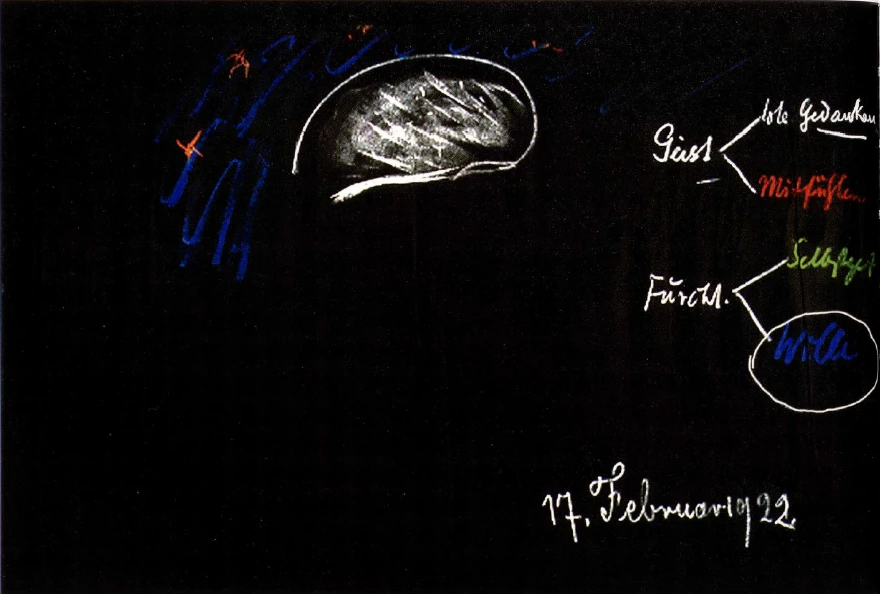
[ 8 ] And this brings us to what one might call the choice made by the spiritual-soul aspect. The soul is drawn precisely to that brain still in the process of formation which bears the greatest resemblance to the constellation of stars in which the soul was situated before descending into the earthly realm. It is, of course, natural that the brain of one embryo reflects the starry sky in a different way than that of another embryo. However, the soul is drawn to the brain that most closely resembles the constellation in which the soul was situated before it descended to Earth.
[ 9 ] It is, in essence, a kind of fear that draws the soul down into the confined space of human existence—a fear of the infinite, one might say. This fear is the more soul-related aspect. The world of thought, which then gradually unfolds from childhood through adulthood, is the spiritual aspect. In the process, both this sense of fear and the spiritual aspect—which then becomes the shadows of thought—undergo a fundamental metamorphosis. I would like to describe this metamorphosis to you. One can only use expressions that are unfamiliar to ordinary conception; but then, today’s ordinary conception has absolutely no points of reference for describing these things. It lies beyond everything that belongs to this realm, and therefore we must resort to unfamiliar expressions if we are to adequately describe these things that lie beyond today’s conceptions.
[ 10 ] So we first have the spiritual element that lives in the universe, which, as it were, enters the confined space of the human body, unfolds itself specifically through the nervous system and the brain, and must undergo a metamorphosis in the process. In doing so, it divides itself into two regions. One can truly say that what a human being is in the spiritual-soul world before conception dies when making the transition into physical embodiment. Birth into physical embodiment is a dying-off for the human being’s spiritual-soul life. When something dies, a corpse always remains. Just as when a human being dies for the Earth, the corpse remains, so too does a corpse remain when the spiritual-soul aspect—as it moves toward the Earth through conception—if I may use that expression—dies for the heavenly realm. It is from what remains there as a corpse that we actually draw our mental sustenance throughout our entire earthly life. For the corpse is, in fact, the world of thought; what is dead is this shadow world. So that we can say: As the human spirit descends into earthly life through conception, it dies off from the spiritual-soul world and leaves this corpse behind.
[ 11 ] Just as the physical body of a human being dissolves into the earthly elements, so too does the spiritual-soul aspect dissolve into the spiritual world and become the force that unfolds within physical thoughts. The world of thought is the corpse of our spiritual-soul nature. Just as the earth processes the corpse when we lay it in the ground, or as fire processes it when we burn it, so throughout our entire life we process the corpse of our spiritual-soul nature in our physical world of thought. Thus, the physical world of thought is, in essence, the continuing death of that which exists as reality—as spiritual life—before a human being descends into physical earthly existence.
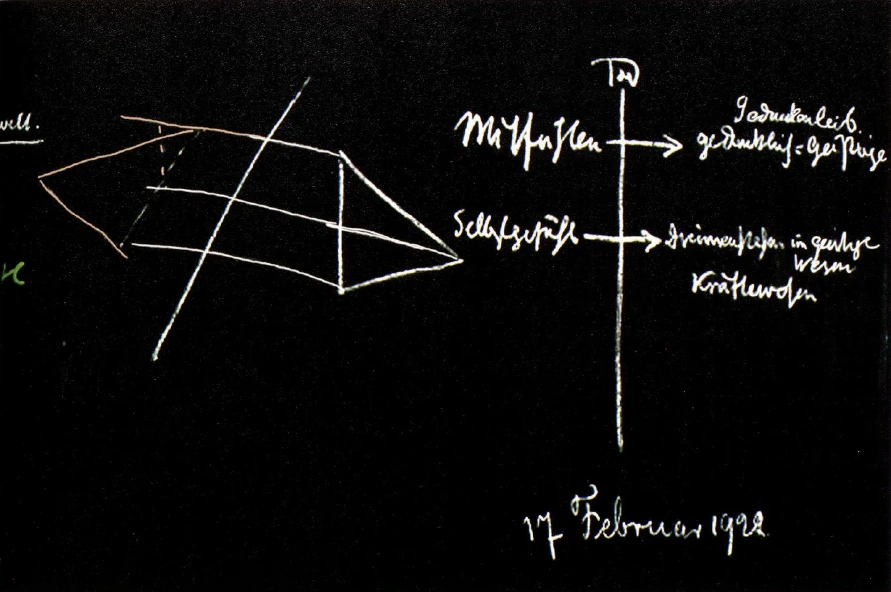
[ 12 ] The other aspect of human life that originates from our pre-earthly existence does not manifest itself in the physical human being through the world of thought, but rather, to the greatest extent, through everything we can call feeling—both empathy toward other people and empathy toward nature. In other words, everything through which you extend yourself into the outer world through feeling and sensation is an element that represents the living aftereffect of pre-earthly existence (see diagram, p. 97).
[ 13 ] It is not in your thoughts that you experience your pre-earthly existence in a living way, but rather through your feelings toward other beings. When we love a flower, when we love a person, this is essentially a force given to us from our pre-earthly existence, but in a living way. So we can also say: When we love a person, for example, we love them not merely because of experiences in this earthly life, but also because of karma, because of the bond formed in previous earthly lives. Something living is carried over from pre-earthly existence when the human being’s sphere of compassion comes into play. In contrast, that which is the living spiritual element between death and a new birth fades into the world of thought. That is why the world of thought during earthly existence has this pale, shadowy, lifeless quality about it, because it actually represents the deceased part of a person’s pre-earthly experiences.
[ 14 ] The second is what must be called fear, and this, too, undergoes a metamorphosis such that it breaks down into two elements. One of these—that is, what we experience as fear before descending into the earthly world, which permeates the soul entirely and causes it to want to flee the spiritual world—becomes something else when it enters the body, and this initially manifests within the human being as something I would like to call self-awareness. Self-awareness is truly fear in a transformed state. The fact that you feel yourself as a self, that you hold yourself within yourself—this is transformed fear from the pre-earthly life.
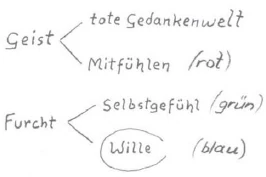
[ 15 ] And the other aspect into which fear is transformed is the will. Everything that manifests as impulses of the will—everything that underlies our activity in the world—all of this exists as fear before we descend into earthly life.
[ 16 ] You see, here again a benefit is bestowed upon the human being for earthly life in that, in ordinary consciousness, he does not pass by the Guardian of the Threshold. I have often said: What the will actually represents down there in the human organism, the human being sleeps through. A person has the intention of their will, then carries out that will; then they have the mental image of the results. But what lies between these two worlds of perception—between the intention to carry out an action and the completed action, that is, what actually lives in the will—is initially slept through by the person, just as they sleep through the states between falling asleep and waking up. If a person were to look down into what underlies their will, they would feel a force rising up from their organism—the fear that comes from pre-earthly life.
[ 17 ] This is also what must be overcome during initiation. When one looks within oneself, however, the first thing one sees is a sense of self. This is something that must not be overly emphasized in one’s upbringing, so that when a person enters the spiritual world, they do not fall into megalomania. But at the root of one’s impulses of will, one finds fear everywhere, and one must be strengthened against this fear.
[ 18 ] Essentially, you will therefore see that throughout the exercises described in my book How Does One Attain Knowledge of Higher Worlds?, the aim is to endure the fear that one becomes aware of in the manner just described. This fear is something that must be present among the forces of development; otherwise, a person would not descend from the spiritual world into earthly existence at all. They would not flee the spiritual world. They would not develop the impulse to enter a limited physical human body. The fact that they do so is precisely because they have a fear of the spiritual world as a completely natural characteristic of the soul after having lived for a time between death and a new birth.
[ 19 ] So we have thoughts as a corpse within us; that is to say, it is actually the power of thoughts—not the thoughts themselves—that we possess. We can describe this in even greater detail. However, if you wish to delve into this more detailed description, you will have to develop very precise concepts. This spiritual force, which dies within the thoughts and becomes a corpse when a human being descends into physical earthly existence, is the same force that forms our organs from the cosmos. What we carry within us as lungs, heart, and stomach—that is, as the formed organs—is shaped from this thought force of the universe. When we now enter earthly life, this thought force enters our narrowly limited organism. What, then, does the Earth and its surroundings want from us? Yes, the Earth and its surroundings actually want us to recreate them within ourselves.
[ 20 ] If we were to replicate the earthly realm, then over the course of our lives our internal organs—such as the lungs and, above all, the various convolutions of the brain and so on—would gradually be transformed into crystal-like forms. We would all become statues, but ones that would not resemble human beings; rather, they would look like crystals grouped together. We would gradually be composed of inorganic, lifeless forms and become a kind of statue. The human organism resists this. It retains the form of its internal organs. For example, it does not allow its lungs to be transformed into, say, mountain ranges. It does not allow its heart to be transformed into a cluster of crystals. It resists this. And in this resistance lies the reason why, instead of using our organs to reshape this earthly environment, we merely recreate it as shadows in our thoughts. So the power of thought is actually always striving to make us a reflection of our physical Earth, of our physical Earth’s form. We would constantly like to become a system of crystals. But our organization does not allow this. It has so much to unfold in the realm of life, in empathy, in self-awareness, and in impulses of will that it does not permit this. It does not allow our lungs to be transformed so that they look like crystals growing out of the earth. It resists this earthly shaping, and thus only the Plate 9.
[ 21 ] Images of earthly forms then arise in geometry, and whatever other ideas we form about our earthly surroundings. As I said, one must think very precisely if one wishes to proceed to this conception.
[ 22 ] In reality, however, there is always a tendency for us to become like our own system of thought. We must constantly fight against becoming like it. We are actually constantly striving to become a kind of work of art—though, given the nature of the thoughts that people usually have, this would not exactly be a very beautiful work of art to look at. But we strive to appear, in our outward form, to be exactly what our thoughts are in their mere image, in their mere shadow. We do not become it, but rather we allow it to be reflected back, as it were, and thereby it becomes our thought. It is a process that can truly be compared to the formation of mirror images.
[ 23 ] If you have a mirror here, with an object in front of it, that object is simply reflected. It is not in there [A drawing is shown here]. Everything that stands before our eyes actually seeks to continually bring about a real form within us. But we resist this; we hold on to our brain. As a result, it is reflected back and becomes a mental image. A table seeks to turn your brain itself into a table; you do not allow that to happen. This is how the image of the table arises within you. That is what mirroring is—this reflection of activity. As a result, however, we stand in our thinking in such a way that our thoughts are merely shadows of the external world. But in our feeling, there we have already given something else. Just try to really imagine what you experience through your feeling. You feel a round table differently than a square one. You feel the corners. The thought of a square object doesn’t mean much to you, but actually feeling the corners—that hurts more than simply calmly tracing the curve of a round table. So, through feeling, we already live out the external form more fully within ourselves than we do through thought.
[ 24 ] This alludes to the metamorphosis that the soul-spirit undergoes when it passes from pre-earthly existence into earthly existence. What happens, then, when we pass through the gate of death? The world of thoughts we possess is, in terms of its power, merely the corpse of our pre-earthly existence. It has no real significance. Just as when we see ourselves in a mirror and then remove the mirror—the image is gone—so too is our life of thought gone when we pass through the gate of “death.” Therefore, “when a person speaks of immortality, they must by no means reflect on this earthly power of thought. It is not this that passes through the gate of death with them. On the other hand, everything they have developed as compassion, as empathy, as a sense of connection to the earthly—that passes through the gate of death. So compassion passes through the gate of death (see diagram). And by feeling compassion for our surroundings, we develop the power to now stand within the beings of the spiritual world, within the element that is the element of spiritual thought. The compassion that is separated from the earthly environment by our physicality now flows out after death into the spiritual environment and connects with the thought-spiritual aspect of the world we enter when we pass through the gate of death. Thus, what we feel as compassion connects with the thought-spiritual aspect.
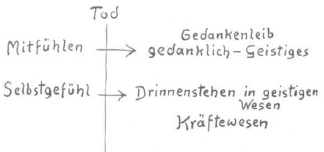
[ 25 ] And by flowing, as it were, with our empathy into the mental-spiritual realm, we in turn develop a kind of thought-body—a living thought-body—which then belongs to us between death and the next birth. For what is a sense of self in life develops into a sense of being present within other beings. Whereas in earthly life, through our sense of self, we are aware only of our physical body, we come to know ourselves within other beings—the beings of the higher hierarchies—once we have passed through the gate of death. And as we dwell within spiritual beings, we also receive from them the forces that in turn guide us further along our life path between death and a new birth. So that we can say that our own being of forces develops in this way. This is the metamorphosis of the spiritual-soul aspect as we pass through the gate of death.
[ 26 ] The will, as such, is not—unlike the world of thought—something that vanishes with death; rather, it is the very source of the content of our sense of self. Just think: when you want something that satisfies you, that very act of wanting already provides something that satisfies you and gives your sense of self a certain nuance. When you have done something that does not satisfy you, that, too, gives your sense of self a certain nuance. The will is not merely something that carries out outward actions; it also strives powerfully back into our inner being. We know who we are based on what we are capable of. And this nuance of self-awareness—this reflection of the element of will back into ourselves—is precisely what we carry with our sense of self into the spiritual world. So it is the will—that is, the reflection of the will into our sense of self—that we carry with us as we immerse ourselves in the beings of the higher hierarchies. And by taking with us what has elevated or weakened our sense of self, the power of our karma—our destiny—is formed. When one surveys these things, one can gain insight into what a human being truly is. And in this way, one also comes to understand, in particular, certain accompanying phenomena of earthly life. In earthly life, fear certainly arises here and there; but it must never fill the entire soul, and it would be sad if it did. Before we descend into earthly life, however, the entire soul is filled with fear, and this fear is the force we must possess in this state in order to truly descend into physical earthly life.
[ 27 ] Self-esteem, on the other hand, is something that must not be allowed to rise above a certain level in earthly life—and in fact, it should not be experienced independently at all in earthly life. A person who develops a sense of self with too much independence knows only himself. In earthly life, the sense of self is really only there so that we can hold on to our physicality until death, so that every morning, after we have slept, we can return once more to our physicality. For if we did not have this sense of self during our earthly life, we would not return. But after death, we need it when we immerse ourselves in the world of spiritual beings, for otherwise we would lose ourselves at any moment. After all, we must immerse ourselves there among real spiritual beings.
[ 28 ] The Earth does not make this demand of us. When you walk through a forest, you simply stay on your path, and the trees are to your left and right, in front of you, and behind you. You see the trees, but the trees do not demand that you enter them, that you continually become a tree nymph and submerge yourself in the trees. But the spiritual beings of the higher hierarchies—whose world you enter after death—do expect us to merge with them. We must become all of them, these beings of the spiritual world. If we were to enter this spiritual world without a sense of self when we pass through the gate of death, we would lose ourselves. We need that sense of self simply to preserve ourselves. And it is precisely the moral deeds we have performed in our earthly life—which justifiably enhance our sense of self—that protect us from losing ourselves as our true selves after death.
[ 29 ] These are concepts that should, in fact, re-enter human consciousness, starting from the present and extending into the near future of Earth’s evolution. In a sense, these concepts had already flowed into humanity in the most ancient times during the era of instinctive clairvoyant perception. People once had a strong sense of who they were before they descended into earthly life. This was particularly strongly developed in the earliest days of Earth’s history. Less developed in Earth’s primeval times was the hope for a life after death. That was something that was accepted as a matter of course. Just as people today are primarily interested in their experiences after death, so too were the people of Earth’s primeval times—the people of millennia past—interested in their lives before they had descended to Earth.
[ 30 ] Then came the time when this originally instinctive clairvoyance was lost, a time in which the soul’s intense connection to its pre-earthly existence was also lost. And then arose the two spiritual currents that paved the way for what was now destined to develop within human civilization. We have two clearly distinct currents, which we have characterized from a wide variety of perspectives, and which we wish to address again today from a specific perspective that will serve us in our reflections tomorrow and the day after.
[ 31 ] If you consider earthly development before the Mystery of Golgotha came upon the earth, you will find, as it were, pagan culture spread across the earth, and, in a certain degree of separation, the culture that might be called Old Testament culture. What, then, was particularly distinctive about this pagan culture? It still possessed a clear awareness that everything physically surrounding human beings also contains a spiritual element. Pagan culture had a strong awareness of what living thoughts are—thoughts that later become dead thoughts within us. It saw everywhere in the beings of the various kingdoms of nature the living element corresponding to that for which human thoughts are the dead element. The pagan world thus perceived the living thoughts of the world; it also regarded human beings as belonging to these living thoughts of the world.
[ 32 ] Now, a particularly vibrant and developed part of this pagan world was that of the ancient Greeks. As you know, the world of the ancient Greeks was deeply permeated by the concept of fate. And—if you recall certain Greek dramas—this concept of fate permeates human life with a regularity, I would say, much like the laws of nature permeate nature itself. The Greeks felt so deeply immersed in nature that fate operated within them just as the laws of nature operate within natural phenomena. In the Greek worldview, fate strikes human beings with the force of nature. But this was a characteristic of every pagan conception; it was simply expressed in a particularly significant way among the Greeks. The pagan world saw the spirit in all of nature’s existence. It had no specific natural science like ours, but it did have a widespread understanding of nature. Wherever it perceived nature, it spoke of the spiritual. This was the natural science that was, at the same time, a spiritual science. The pagan paid less attention to the inner life of human beings. He also viewed human beings from the outside as natural beings, but he was able to do so because he did not conceive of other natural beings as soulless either. He did not conceive of trees, plants, or clouds as soulless. Thus, he need only observe human beings from the outside without conceiving of them as soulless. The ancient pagan, therefore, by imbuing nature with a soul, could also regard human beings as natural beings, and thus ancient paganism was an element that from the very beginning contained a spiritual aspect within itself, one that was inclined toward the spirit. Standing in stark contrast to this, as the other pole, was the creed that later found its full expression in the Old Testament.
[ 33 ] The Old Testament did not really understand nature either in the sense that we understand it—I mean, returning once more to spiritual science—or in the sense that paganism understood it. The Old Testament actually knew only a moral world order, and Yahweh is the ruler of this moral world order, and whatever Yahweh wills comes to pass. Thus, within this world of the Old Testament, the view arose quite naturally that one should not form any mental image of what is soul-spiritual; a view that paganism could never have held, for paganism saw images of the spiritual in every tree and every plant. The adherent of the Old Testament saw no images anywhere, but everywhere the working of the invisible, formless spiritual.
[ 34 ] In the New Testament, one should actually be able to recognize a synthesis of these two spiritual currents. It has always been the case that one or the other element has predominated in people’s views. For example, the pagan element has always predominated where more vivid religious beliefs were practiced. There, people formed images of spiritual beings modeled after natural forms. In contrast, the Old Testament element developed wherever modern scientific thought emerged, where people strove toward the abstract. And in modern materialistic science, there is in many respects an echo of precisely the Old Testament—the non-iconic Old “Testament.” One might say that the materialism of science seeks to strictly separate the material—to which it now allows no spirit at all—from the spiritual, which is to live only in the moral realm, of which one must not form any image, and which therefore must not be seen in the earthly realm.
[ 35 ] This particular characteristic of science—which we encounter today in the materialistic form of science—is actually still an impulse from the Old Testament that extends into our time. Science has not yet become Christian at all. Science as materialism is, in essence, still Old Testament in nature today. And one of the main tasks of an advancing civilization will be to overcome both of these, but also to be able to synthesize them into a higher unity. We must be clear that both paganism and Judaism represent one-sidednesses and that, insofar as they extend into modern times in many ways, they represent something that must be overcome.
[ 36 ] Science will have to come to its senses. Art, which often has a pagan quality and has made various attempts to become Christian—attempts that have, however, mostly veered into the Luciferic-pagan—will have to find its way into a Christian element. Today we are, in fact, still experiencing the aftereffects of the pagan and Old Testament elements and do not yet possess a fully developed Christian consciousness. This is what we must feel in particular when we reflect on these concrete passages of human life through birth and death, as they are presented to us by spiritual science.
[ 37 ] Based on what I have outlined for you today, I will attempt tomorrow to present some historical perspectives from the perspective of the humanities.