

Old and New Initiation Methods
Drama and Poetry in the Shift
of Consciousness in the Modern Era
GA 210
12 February 1922, Dornach
Translated by Steiner Online Library
5. Old and New Initiation Methods II
[ 1 ] When one engages in discussions such as those that took place here yesterday, one does not, of course, always intend for them to serve as an invitation to practice in the direction indicated with regard to attaining higher supersensible knowledge. Of course, that is also part of it, but when such things are communicated, the aim is also to spread an understanding of what can be attained through such exercises leading to higher knowledge. And whoever explains that this or that is possible with regard to human development is thereby explaining something about the very nature of the human being. When one hears that a person seeking initiation can detach the soul-spiritual from the physical-bodily—either in the manner I described yesterday, as it occurred in the ancient mysteries, or in the way I shall shortly outline in a suggestive manner, adapted to the present day— if one hears that such a thing is possible, then one can know that the soul-spiritual is an independent entity whose existence extends beyond the physical. One thus learns from these teachings that there are higher insights—insights into the human being itself—and that is what is essential, first and foremost, for the dissemination of anthroposophical wisdom.
[ 2 ] Yesterday I described how the physical aspect was treated in the ancient mysteries so that it could release the soul in both of these different directions. I said that the two essential elements that mattered in the ancient mysteries were: the drink of forgetfulness on the one hand, and the evocation of states of fear, dread, and terror on the other. The potion of forgetfulness did indeed have the effect of erasing the memory of everything that had initially been stored there from ordinary earthly life. But this negative aspect was not the main point, I said; rather, the main point was that during the process of gaining insight into the mysteries, the brain was, so to speak, physically softened, and that as a result, the spiritual—which is otherwise held back—was not held back by the brain, but was allowed to pass through, and that the person thereby became aware: Yes, I have an eternal soul-spiritual essence that existed before my birth, or rather before my conception.
[ 3 ] The other point is that the rest of the organism, so to speak, froze under the influence of this terrifying event. But when the organism becomes rigid, it does not, as is otherwise the case, absorb the soul-spiritual aspect insofar as this is expressed through the will. On the one hand, the rigid physical aspect withdraws, so to speak, from the soul-spiritual aspect, and on the other hand, the soul-spiritual aspect becomes perceptible to the human being. Through the softening of the brain, the thought aspect of the soul became perceptible to the ancient mystery students. Through the stiffening of the rest of the organism, the volitional aspect became perceptible. And in this way, through initiation, the human being gained a conception of his soul-spiritual nature. But this conception had a thoroughly dreamlike character. For what was it, after all, that became free—on the one hand, on the side of thought, and on the other, on the side of will? It was that which descends from the spiritual-soul worlds and unites with the physical-bodily aspect of the human being. Only through the possession of the body does it become capable of making use of the senses and the intellect, for the body is necessary for this. Without making use of the body, it remains dreamlike; it remains entirely dull and dim. Thus, by having his soul-spiritual nature detached through the processes described, the human being thereby receives something dreamlike—albeit a dreamlike quality that, in a certain sense, does contain a thought-element.
[ 4 ] As I said yesterday: If people were to do this again today, or to do it in the same way as in the past, it would lead to a pathological condition. For, following the Mystery of Golgotha, human beings have essentially advanced in their constitution to such an extent that intellectual life has become stronger in comparison to the earlier, instinctive states of cognition. This particular intensification of intellectual life has come over humanity especially since the 15th century. It is extraordinarily significant that even throughout the entire Middle Ages, people knew that if they wished to attain higher insights—if they wished at all to lead, in a certain sense, a higher human life—it was necessary to detach the soul from the body.
[ 5 ] We would likely have a work of poetry within German literature dealing with this medieval knowledge of the supernatural—and this medieval relationship to the supernatural—had Schiller been able to carry out his planned grand drama, Die Malteser. It is an extraordinarily interesting phenomenon in German intellectual life that Schiller planned to write a drama about the Order of Malta precisely during the years when the Order was being destroyed by Napoleon—namely, the siege of the island of Malta by the Turks and the defense of the island by the Grand Master of the Order of Malta, Lavalette. Schiller was apparently unable to bring this drama to fruition. He then wrote “Wallenstein” and set aside “The Maltese.” Had Schiller’s The Maltese been staged, we would have a drama that clearly illustrates how, in such an order—and the Maltese Order traces its origins to the events of the Crusades—which outwardly is actually oriented toward humanitarian actions, public service, charitable work, and so on—the prevailing view was that one could only carry out such deeds if, at the same time, one ascended, in a certain sense, to a higher life.
[ 6 ] At the time when the Order of the Knights Templar and the Order of St. John—which later became the Order of Malta—were founded, and indeed throughout the entire Middle Ages, there was a strong sense that a person must undergo a transformation before he can undertake such a task in the proper way. It is this sense regarding the human being that has actually been completely lost in more recent times, and this is due to the fact that the human intellect has become significantly more intense and powerful, so that modern man is entirely intellectual, and the intellectual aspect is particularly prominent in him.
[ 7 ] In our time, there is once again a strong longing among people to overcome intellectualism. What stands out in literature today—particularly in journalism—still expresses the opposite, but among the broad masses there is definitely a longing to overcome the intellectualistic element. This is evident in particular from the fact that not only does talk of spiritual matters resonate exceptionally well in the widest circles today, but also that something like our eurythmy—which is drawn not from the intellectual but from what lies at the imaginative foundation of the human being—makes an impression on the widest circles today, even if it is not yet fully understood. For this has indeed become evident during the recent tours, but especially during the last eurythmy tour, that eurythmy makes an extraordinarily strong impression even on those circles who, of course, cannot fathom its deepest essence at first glance or upon the first movement, but who sense that there is something here that has been drawn from the deeper foundations of human nature—something that is more than mere intellectualism.
[ 8 ] Well, what is the basis of this intellectualism that is so characteristic of human beings today? I would like to illustrate this to you once again with a kind of schematic diagram [see p. 78, Plate 6]. I said yesterday: If we take the human brain (white), we can imagine that through what has been understood as the “drink of forgetfulness,” the spiritual-soul aspect—which otherwise stops short of the brain—penetrated the brain (red), and that, in a sense, the spiritual-soul aspect rose up from within the ancient initiate through the prepared brain. — Today’s intellectualism is based on the fact that, compared to people of earlier times—let us say, before the Mystery of Golgotha—the spiritual-soul aspect has become stronger and more intense within modern human beings. People of the past did not possess nearly as much intellectualism. Their spiritual-soul aspect did not take shape in such sharp lines of thought as is the case with people today. For when one is an intellectualist, one thinks of everything in straight lines. People of the past did not think that way. They thought in a more pictorial, dreamlike, and softer way, I would say. In modern people, thoughts are angular, endowed with sharp contours. But even though the soul-spiritual aspect of modern people has become stronger than it was in earlier times, they are still unable to grasp these thoughts from the soul-spiritual realm.
[ 9 ] Let us be clear, my dear friends. People today already possess a good deal more psychological and spiritual strength than people of the past. They no longer dream as people of the past did; they focus their thoughts more intently. Nevertheless, these thoughts would remain subdued if only the soul-spiritual aspect were to be at work in modern human beings. In fact, human beings still cannot think from their souls.
[ 10 ] It is the body that robs human beings of the power of thought. When we have a sensory perception, for example, we do indeed experience it through the soul-spiritual. But when we then want to think about this sensory perception, the body must help us. The body is actually the thinker. So today the situation is this: Sensory perception acts upon the human being; the soul-spiritual (red above) permeates the sensory perception, but the body acts like a mirror and constantly reflects the rays of thought back (green arrows). Through this, they become conscious. So the body is what relieves the human being of the effort of thinking, but not of the effort of sensory perception. And if, from this mental perspective, a person today wishes to strive for initiation, then through the exercises we know from How to Attain Knowledge of the Higher Worlds and from the second part of Outline of Esoteric Science, strengthen the soul-spiritual aspect even further; then they will gradually succeed in making this soul-spiritual aspect within themselves so independent that it no longer needs the body.
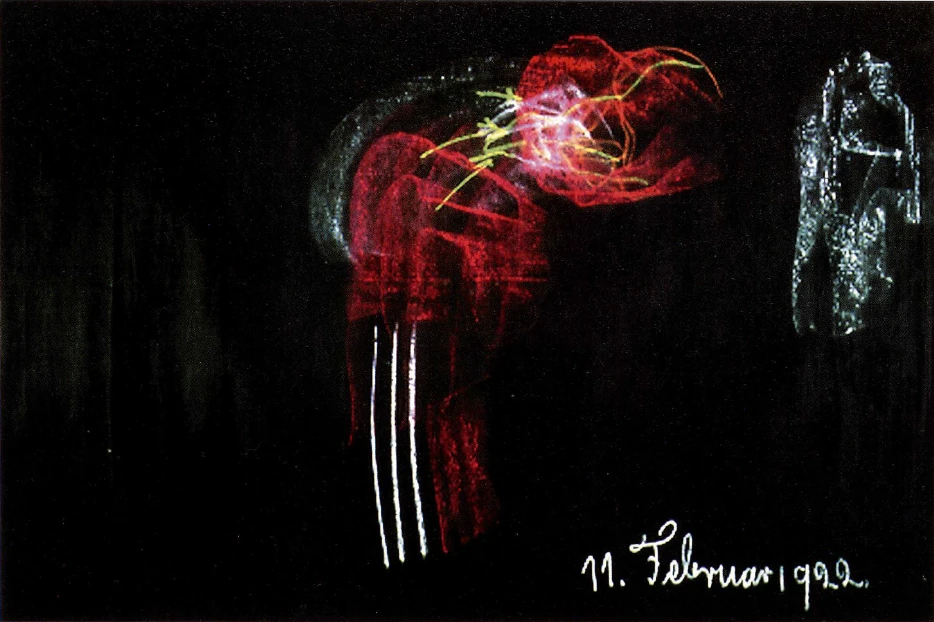
[ 11 ] So let’s be clear: When we think in everyday life today, it is indeed the soul-spiritual that is at work. Above all, it takes in sensory perceptions, but it could not develop the kinds of thoughts that are developed today. That is why the body steps in and relieves the human being of the effort of thinking. In everyday life, people certainly think with the body; the body is the thinking apparatus. When one performs the exercises described in the books mentioned, the soul becomes so strong through these exercises that it no longer needs the body to think—it thinks on its own. And this is essentially the first stage of development toward higher knowledge: that the soul-spiritual begins to set aside the body as the actual organ of thought for higher knowledge. It must be emphasized again and again that as a person ascends to higher knowledge—that is, to imagination—they always remain true to themselves with their sound common sense, as one who controls and critiques themselves. So one remains, alongside this, the same person one is in ordinary life. It is only the second human being that develops out of the first, who is then capable of thinking no longer with the help of the body, but without the help of the body.
[ 12 ] So what revealed itself to the ancient mystery student as spiritual-soul elements emerged from the body, passed through the brain, and, as it were, welled up—and the human being perceived it. But what a person perceives today as an initiate is intensified thinking, which does not involve the brain at all. So while the person of old drew what they perceived as the spiritual-soul aspect out of their own organism, the person today perceives the soul-spiritual aspect—on the level of thought—in such a way that it penetrates into them, just as sensory perceptions penetrate into them. As human beings ascend to this first stage of higher knowledge, they must accustom themselves to saying: I am beginning to perceive myself in terms of my eternal spiritual-soul aspect, for it penetrates through my eye; indeed, it penetrates into me from the outside.
[ 13 ] I said during a public lecture at the Bernoullianum in Basel: Spiritual science in the anthroposophical sense must regard sensory perception as its ideal. One must move beyond sensory perception. One must not go back to dreamlike cognition, but must advance to a clearer form of cognition than this perception itself. Therefore, our own being must approach us, just as colors and sounds approach the senses.
[ 14 ] You see, when a human being descends from the spiritual-soul world into physical embodiment, their spiritual-soul nature is such that it, so to speak, dies to the spiritual-soul world; as the human being is conceived and prepares for birth, he dies to the spiritual world. When the human being here dies to the physical world, he is, by passing through the gate of death, born into the spiritual world. These are only relative concepts. If one dies to the spiritual world, one is born physically; if one dies to the physical world, one is born spiritually. Death in the physical world means spiritual birth; birth in the physical world means spiritual death. As I said, these are, of course, only relative concepts. What occurs in the soul as it moves toward birth is, in fact, something that could not continue to exist in the spiritual world, something that would disintegrate in the spiritual world, and something that turns toward a physical body so that it may continue to exist.
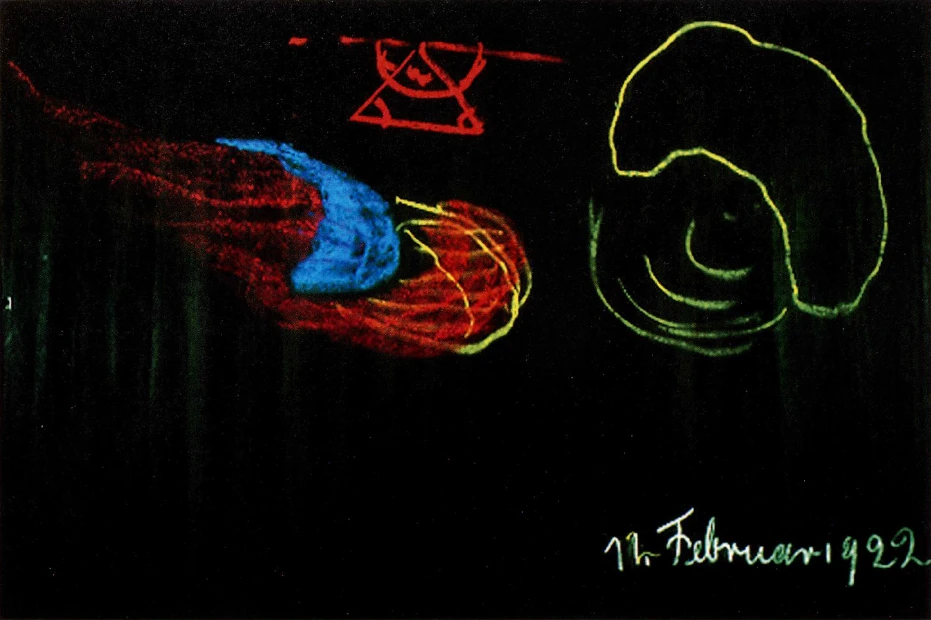
[ 15 ] So, if one were to draw this schematically, it would look something like this: The spiritual-soul aspect (red, from the left) descends from the spiritual-soul world. It has, one might say, reached a dead end; it cannot go any further now; it must equip itself with physical materiality (blue). But physical materiality actually operates only as I have just described—from the brain, not from the rest of the human being. From the rest of the human being, however, the spiritual-soul aspect flows out again; it recovers, so to speak, by not being allowed to pass through the brain, by having a counterbalance, a support, within the brain. This in turn enables the spiritual-soul aspect to oppose itself through the rest of the human organism—namely, through the limb-metabolic organization (red on the right). One could therefore say: What I have drawn here in blue is the head organization. Here, then, is the limb-metabolic organization (yellow); although it absorbs the soul-spiritual aspect in its normal state, it does so only to a certain degree. Even as we grow up from childhood, the soul-spiritual aspect actually comes to the fore again and again. At the moment a human being is conceived, and while he is an embryo, a seed within the mother’s womb, the entire spiritual-soul aspect—which descends from the spiritual-soul world—is, so to speak, submerged into the material realm. But because this spiritual-soul aspect has received a foundation, it recovers once again. The embryo has a form that already reveals this externally: first, the organization of the head, where the spiritual-psychic finds a foundation (see drawing). Then the rest of the organism develops; there, the spiritual-psychic already begins to well up again—I have drawn this schematically here.
[ 16 ] As we grow up as children, the spiritual-soul aspect becomes increasingly independent; it is not yet very strong in the child, but it becomes more and more independent. I have, in fact, described this in detail while outlining the child’s development; I have also explained how this spiritual-soul aspect becomes increasingly independent at the major transitional stages—such as the change of teeth and sexual maturity. Thus, as we grow up as human beings, we increasingly allow the physical-bodily aspect to recede and develop an independent spiritual-soul aspect. This independence is more intense in people today than in older generations. But it still cannot think on its own. As I said, it needs the body’s help if it is to think. Otherwise, precisely what is then developing within us would remain in a dreamlike state.
[ 17 ] So one might say: The older initiate sought to make the brain permeable, so that the earlier spiritual-soul elements that descended could still flow through it, enabling him, as it were, to still perceive his prenatal life through the softened brain. The modern initiate, however, does not reflect on this; rather, he reflects on what develops in the course of life. He awakens this to a higher intensity on the level of thought. The older initiate would not have been able to do this. He would not have been able to grasp so strongly what develops in the child in a dull manner as the new spiritual-soul aspect—which later passes through the “gate of death.” He therefore, in a sense, killed off the physical aspect; he paralyzed it so that the old spiritual-soul aspect—which existed before the child was conceived or received—could emerge.
[ 18 ] Today we grasp more firmly what we have been developing in a subtle way from childhood through adulthood, so that we can thus strengthen and reinforce what has been developing as the new spiritual-soul aspect since birth. In this way, we strive to establish an independent spiritual-soul aspect in relation to the body, oriented toward the realm of thought. So while the ancient initiate revealed the pre-birth spiritual-soul aspect by subduing the body, we seek to reveal what develops more and more as a spiritual-soul aspect after birth; but we do not reveal it to the degree of strength required to perceive the spiritual world independently. That is the difference.
[ 19 ] From the perspective of the will, the situation is as follows: As mentioned, the ancient initiate sought to make the will-organization rigid. As a result, the spiritual-soul aspect—which is otherwise absorbed by the will-organization—became perceptible to him once again; that is, what had existed from the pre-birth period. When the body is rigid, it does not absorb the spiritual-soul aspect; as a result, this aspect becomes manifest in its independence. We, as modern initiates, do not do this, however; instead, we proceed differently. Here, the will is strengthened by transforming the power of willing in the manner I have described in the aforementioned books. It would be entirely wrong to induce cataleptic states through shocks, states of anxiety, or states of fright, as was done with the ancient initiates. In modern human beings, with their highly developed intellectuality, this would fall entirely into the realm of pathology. So this must not happen. In contrast, for example, through “reverse exercises”—where one does not, so to speak, visualize forward, but rather, as in looking back, reviews the day’s experiences in reverse, from evening to morning—or through other exercises of the will, the will is transformed in a way that I can characterize roughly as follows: Consider the human eye. How must it be structured so that we can see? When we become seriously ill, the matter of the eye asserts itself independently. The eye cloaks itself in matter that then becomes opaque. The eye must be selfless, selflessly integrated into the organism, if we are to use it for proper vision; it must be transparent. Our organism is by no means transparent to the will. I have, after all, described this to you on several occasions. We can have a thought—let’s say we want to raise our arm or hand. We grasp the thought: “I want to raise my arm or hand.”—But what then happens in our organism as this thought shoots through it and carries out the action? This is just as shrouded in darkness as the events that take place between falling asleep and waking up. We only see, once again, the raised arm, the raised hand. So we have a mental image once more. The initial image and the final image are joined together; what lies in between is a state of sleep. The will unfolds in the unconscious for human beings in the same way that the events of sleep unfold in the unconscious. We can quite rightly say: With regard to perceiving the will, our organism is as opaque to ordinary consciousness as a severely diseased eye would be.
[ 20 ] Of course, I do not mean to say that the human organism is therefore sick. It must simply remain opaque to ordinary practical life. That is its normal state. But for higher knowledge, it cannot remain that way; it must become transparent—psychically and spiritually transparent. This happens precisely through exercises of the will. The organism becomes such that we can see through it—so that when the will unfolds, we no longer look down into an indeterminate void—but rather, it becomes as selfless as the eye is selflessly embedded in the organism in its substantiality, so that we may see external objects correctly. Just as the eye itself is transparent, the organism becomes spiritually and psychologically transparent; the entire organism becomes a sense organ. Through this, we objectively perceive spiritual beings on the side of the will, just as we perceive external physical objects through the physical eye. Thus, our exercises of the will are not aimed at stiffening the body so that the spiritual-soul aspect may be set free, but rather at developing the spiritual-soul aspect in such a way that it can see through the physical body. That is the essential point. One can only see into the spiritual world by looking through oneself. Just as one sees external objects through the eye only by looking through the eye, so one does not see directly into the spiritual world, but by looking through oneself.
[ 21 ] This is the other side—development from the perspective of the will. Thus, in modern times, the entire process of development is based, first, on strengthening thought so that it becomes independent of the brain, and second, on shaping the will in such a way that the whole human being becomes transparent. One cannot see into the spiritual world through the flash of blue, any more than one can see into the world of colors without the eye. One must see through oneself. But this is achieved through exercises of the will.
[ 22 ] Here, then, is what can be achieved through initiation for modern human beings. Not only can the soul-spiritual aspect be made independent of the physical body on the level of thought, but the body itself, in its materiality, can be transcended by becoming spiritually and soulfully transparent. In this way, you have given the spiritual-soul aspect, which has become independent through its own power. This is the great difference between the old and the new initiation. The old initiation transformed the body, altering it on the level of the brain and the rest of the organism; and because the body was transformed, the spiritual-soul aspect became perceptible in a dull way. Modern initiation transforms the spiritual-soul aspect, strengthening it from within toward the realm of thought and the realm of will, thereby making it, on the one hand, independent of the brain, and on the other hand, so powerful that it shines through the organism.
[ 23 ] This does, however, imply that the ancient initiate saw what he was able to perceive in a sort of ghostly manner. Once the relevant procedures had been completed, that which could reveal itself as the essential nature of the spiritual world appeared in a ghostly form. One saw the spiritual world, I would say, in ethereal forms. And the great concern of the teachers of the ancient mysteries was that the students, even though they perceived the spiritual world as ghostly, would learn to look beyond the ghostly appearance. Time and again, the admonitions of the teachers of the ancient mysteries were directed toward making it clear to the students: You see something that looks material, but you must regard it as images. In what you see—in this ghostly appearance—you have only the images of the spiritual world. You must not believe that what you see around you in this ghostly form is true reality—just as the chalk dust on the blackboard, when I write something down, is not reality itself, but rather what is being depicted. Of course, this wasn’t expressed in exactly those words, but in more modern terms, one could put it that way. That was the great concern of the ancient mysteries: that the students would not mistake what they saw there—dreamlike and ghostly—for reality, but would accept it as images.
[ 24 ] In modern initiation, the concern is different. One can only come to know the higher world by proceeding through imaginative perception. There, one lives in a world of images; the images are present from the outset in their pictorial nature. Thus, one is not subject to confusion; one begins with a pictorial nature. But in order to judge these images correctly—to know how to relate them to spiritual reality—one must apply the precise thinking one has acquired as a modern human being to the world of images, thinking within this world of images just as one has learned to think in the ordinary physical world. Any thoughtless observation is detrimental to modern initiation. Everything one has developed in terms of sound thinking as a modern human being must be carried over into higher knowledge. Just as one can find one’s bearings in the ordinary physical world if one is able to think properly, so too can one find one’s bearings in the world of the spirit—into which one enters through modern initiation—only if one is able to integrate everything one gains through imaginative, inspired, and intuitive knowledge in the proper way with the thinking one has acquired here in the physical world. I have, after all, always expressed this with complete clarity in my Theosophy, as well as in my Occult Science and also in How Does One Attain Knowledge of the Higher Worlds?, as a characteristic feature of modern initiation.
[ 25 ] That is why it is so essential that anyone who wishes to enter the higher worlds in the modern sense learn to think with true precision and practice precise thinking. For this is not as easy as people imagine. To make what I actually mean clear, let me say the following: Let’s consider a very concrete example. Suppose this esteemed audience were to be surprised tomorrow—this is, of course, merely a hypothetical scenario—by the appearance here at the Goetheanum of, say, Lloyd George. I simply want to cite an extreme case. Now, if Lloyd George were to appear here tomorrow, you would all have certain thoughts, certain feelings. But these thoughts, these feelings that you would have, would not arise merely from the fact that, from the moment Lloyd George appears until the moment he leaves, you follow everything you see. To follow that, you wouldn’t even need to know that he is Lloyd George. You would then be able to perceive in him only what one can see in a person who is completely unknown to you. Until you are able to set aside everything you already know and feel from elsewhere about anything you perceive in this way—until you can focus solely on what you see—you are not thinking precisely. You will think precisely only when you are able—if Lloyd George were to appear tomorrow—to think and feel nothing else about him here than what the pure impression evokes, from the very first moment your eye becomes aware of him until the moment he disappears from your sight again. You must set aside everything you knew about him before. You must set aside everything that annoyed you about him or delighted you in him, and you must grasp only what he presents to you in pure perception. Only in this way does one learn to think precisely in accordance with reality.
[ 26 ] Think how far humanity is from thinking in exact accordance with reality! Let anything stir within your soul, and you will see how much you allow to rise up from the hidden, unconscious, and subconscious feelings that dwell there. The greatest difficulty lies in limiting oneself to what one has merely seen. Try reading something in which someone describes something, and ask yourself: Is he merely describing what he has seen, or is he not evoking hundreds and hundreds of preconceived sensations and feelings that have a say in the matter? — And yet: Only when one is able to limit oneself purely to what one has seen is one capable of gradually arriving at precise thinking.
[ 27 ] So, above all, one must be able to shed everything that has been instilled in one—including through life itself—regarding certain phenomena, and truly pursue only what presents itself to one in life. If you reflect on this and meditate a little on what I have just said, you will gradually gain a sense of what is called “precise thinking.” In everyday life, under today’s circumstances, people actually have hardly any opportunity to practice precise thinking anywhere other than in geometry—or, at most, in arithmetic. There, people limit themselves to what they see. One doesn’t bring many preconceptions to a geometric figure, such as a triangle. One simply says to oneself: This is the triangle. I’ll draw a parallel line here. This angle is equal to that angle there, that one is equal to this one, and the one in the middle is equal to itself. That is then a straight angle. Thus, the three angles of the triangle are also equal to a straight angle. — I look at what is before me. I don’t bring such colossal preconceptions with me as I would if Lloyd George were to come tomorrow and I already knew it in advance. Of course, what I’ve just said is simply meant to illustrate that truly precise, exact thinking is good preparation for a correct perception of the higher spiritual worlds. A way of thinking in which one has the beginning of the thought firmly in hand and can truly survey every step of the thought with complete precision—that is necessary to enter the higher worlds; I mean, to enter the higher worlds with understanding. Above all, a pronounced conscientiousness in thinking is necessary—being accountable for what one thinks. And ordinary life, too, holds people back too much in this regard. In most cases, people have no interest in thinking precisely; rather, they are interested in thinking in such a way that the thought pleases them, that the thought is pleasant to them.
[ 28 ] Isn’t it true that when you’re a Catholic priest and you hear about anthroposophy, the thought that there might be something true in anthroposophy is terribly uncomfortable? So there can be no question of developing precise thinking in this regard. After all, one approaches the matter with all sorts of prior experiences, all sorts of preconceptions and prejudices, and then makes a judgment based on those prejudices. In life, most things are decided based on these prejudices. Just consider for a moment what a strange impression it sometimes makes when one simply tries to characterize something in an unbiased way. We live here at the Goetheanum. No one would suspect that I am any less of a Goethe admirer than anyone else, yet how much have I argued against Goethe! How often do I attempt to characterize Goethe within a limited range of phenomena that one can grasp, whereas usually, when people speak of Goethe, the very name “Goethe” already carries a whole host of evaluations. The mere utterance of the name “Goethe” stirs something in the soul. When approaching a new phenomenon, one cannot approach it without prejudice if one brings along this entire colossus of preconceptions.
[ 29 ] These things are usually not taken into account, and that is why people so often say: “Oh, we’re not getting anywhere in penetrating the spiritual worlds!” — Yes, if the most basic things are not taken into account, then of course one cannot enter them. And people consider it unreasonable when they are asked to take even the most basic things into account.
[ 30 ] Let me paint a picture for you. I was in Jena once in the 1890s; that was when Bismarck gave a major speech after his dismissal. He appeared under a canopy, accompanied by Haeckel, Bardeleben, and other professors from Jena. Now imagine: the entire colossal crowd that stood in Jena’s market square at the time was supposed to follow Bismarck’s words just as closely as they would follow someone they were only just getting to know! Isn’t that right? That’s unthinkable under ordinary circumstances. And yet, for anyone who truly wishes to enter into a kind of initiation, it is absolutely necessary to develop the open-mindedness to view everything they see—even if so much of it has already become fixed in their soul—as something entirely new, as something, so to speak, bestowed upon them from heaven. For that is, after all, the peculiarity of the spiritual world: that we must always win it anew at every moment if we wish to possess it. To do so, we must prepare ourselves in the appropriate manner.
[ 31 ] But one can certainly say: If one considers the general manifestations of civilization, humanity is moving in that direction. It’s just that, at first, this manifests in a negative light: in the rejection of all authority, in the rejection of all traditional judgments, and so on. All these things simply need to be refined. But humanity is moving in the direction of open-mindedness and impartiality. It simply manifests itself initially from its negative, ugly side. If one wants to correctly assess the development of civilization, if one wants to evaluate it for the future, one must also view it from the perspective I have just indicated.
[ 32 ] We will continue discussing these matters, my dear friends, next Friday at 8 o'clock.